Author Archive

The Scales of Things

Posted in Maynooth, The Universe and Stuff with tags , , , , , on October 9, 2022 by telescoper

A few people have asked me why I needed such extravagant equipment (ping-pong balls, a torch and a metre-ruler) in my lecture on Thursday night.
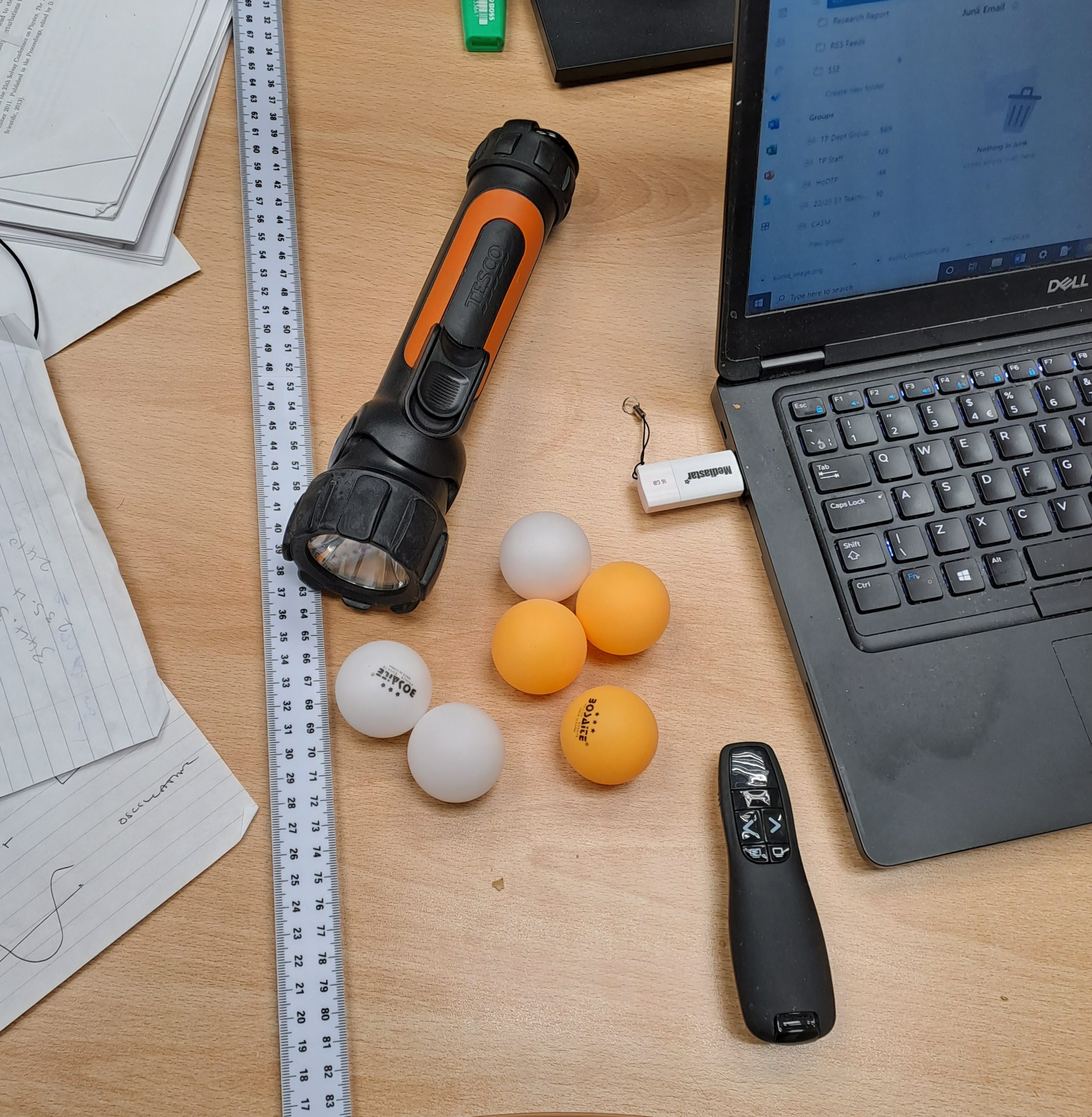
I did only use one ping pong ball in the talk but I found the local budget shop Eurosaver only sells them in packs of twelve (for the princely sum of €3) so I now have plenty of spares. The metre ruler was borrowed from the Department of Experimental Physics (who have expertise using sophisticated measurement devices) and returned on Friday morning. The torch was procured from Tesco along with two batteries.

One of the things I wanted to do in my lecture was to explain some of the difficulties about measuring cosmological distances. I started by holding up a ping pong ball (radius 2cm) and asking if the ping pong ball were the Sun (radius 7 × 10⁸ m), on the same scale how far away would be the nearest other star (Proxima Centauri)?

To cut a long story short – and you can do the arithmetic yourself – the answer surprises most people who haven’t seen this demonstration before. It’s not the back of the lecture theatre, nor is it the town centre, nor the next town. It’s 1200 km away. That’s as far from Maynooth as, say, Geneva, or Copenhagen. The distances between stars is huge, even in the relatively dense part of a Galaxy, such as where the Sun is situated. The Universe is very big and very empty, even in the places that look crowded.

The torch and the metre rule were used to demonstrate two ways of possibly measuring astronomically large distances. I had a student stand up at the back of the theatre holding the metre rule. I explained that I could measure the distance to the student using geometry by measuring the angle subtended by the ruler if I knew its length (which I do). This is the principle behind the angular diameter distance; the metre rule is called a “standard rod”.

The torch is used to illustrate the luminosity distance. If I knew its power output I could measure the intensity of light using a lightmeter and infer the distance from that using the fact that it follows an inverse-square law. The torch is thus a “standard candle”.

Of course in cosmology we don’t have perfectly standard rods or candles but we can apply the principle of the angular diameter distance to features in the galaxy distribution or the cosmic microwave background or gravitational lenses and supernovae can provide us with accurate luminosity distances.

There are additional complications. Objects at large distances are receding with the Hubble expansion so light from them is redshifted, affecting their apparent luminosity. Einstein’s theory of general relativity allows for the possibility that light rays don’t travel in straight lines either (because space is curved), affecting the angular diameters. That means the two methods don’t necessarily give the same distance unless these factors are taken into account.

Tchaikovsky, O’Leary and Beethoven at the NCH

Posted in Music with tags , , , , , , , , on October 8, 2022 by telescoper

Last night I attended another Friday evening concert at the National Concert Hall in Dublin by the National Symphony Orchestra directed by Kenneth Montgomery, featuring yet another world premiere.

Friday evening concerts are all broadcast live on RTÉ Lyric FM and Jane O’Leary, the composer of the intriguing work unfolding soundscapes for piano and orchestra, was in the audience last night for what was the broadcast premiere of her composition; the world premiere of this piece was the night before, in Galway, where Jane O’Leary lives.   I thought it was a fascinating atmospheric piece with the brightness of the piano played by Finghin Collins contrasted with a wide variety of orchestral colours.

Talking of contrasts, the O’Leary piece was itself contrasted sharply with the two more familiar pieces performed either side of it. The concert opened with Tchaikovsky’s Serenade for Strings. This is a bit more than the usual lollipop you tend to get to start a concert, as it is a substantial work of four movements that lasts about 30 minutes. Though not a symphony, and performed by strings only rather than a full orchestra, it is a rather symphonic piece in the way it develops. The first movement, in Sonatina form, is a clear tribute to Mozart. The second movement, Valse, is very familiar and is sometimes performed on its own. Though not in my view one of Tchaikovsky’s more compelling works, it makes for a very enjoyable listen.

After the wine break we had a very familiar piece, Beethoven’s 6th Symphony (“The Pastoral”). It’s interesting that this hugely popular work was actually composed alongside the 5th Symphony (and both were premiered at the same concert in 1808) because they contrast so much in temperament and texture and that the 6th Symphony is an overtly programmatic work, which the 5th definitely is not. The Pastoral is celebration of the composer’s love of nature, starting with “awakening of joyful feelings upon arrival in the country” depicted in the first movement. It does have its darker moments, especially in the tempestuous 4th movement but the overall mood is upbeat and at times even jolly.

Unusually, Kenneth Montgomery had the double basses all lined up at the back of the orchestra, behind the wind instruments, for this performance which is something I’ve never seen before. The winds, especially the brass instruments, were in particularly good form and the orchestra definitely succeeded in evoking the elemental power expressed by Beethoven’s composition. The performance was much appreciated by the audience at the NCH.

It was quite a long programme and I only just made it back to Pearse station in time to have my usual hot sausage roll before the train back to Maynooth. This is the kind of concert I like very much, juxtaposing the familiar classics with brand new works and am very happy the NSO does programmes like this!

That Was The (Space) Week That Was

Posted in Biographical, Maynooth, The Universe and Stuff with tags , , , , on October 7, 2022 by telescoper

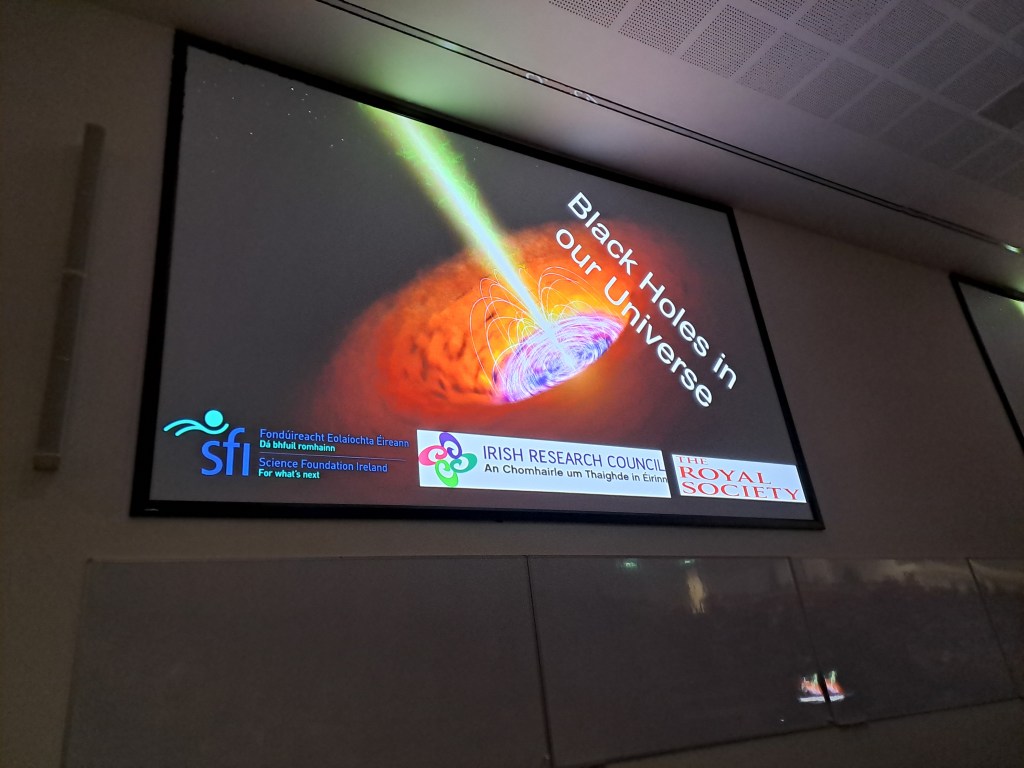
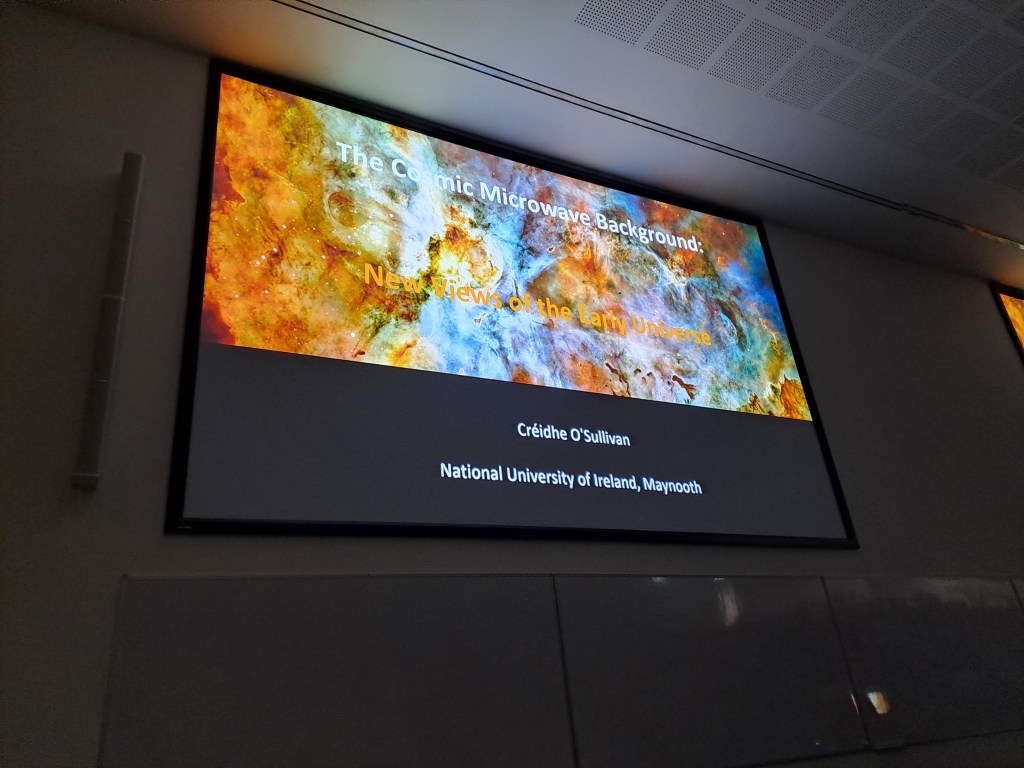
Last night I participated in an event at Maynooth for Space Week which I think went very well. We had a big audience so the decision to move to a bigger lecture theatre was a good one. Nobody took count but I think we had as many as 400 people of all ages, including some very young kids, some students and a variety of others.

I was the last one up to speak and took a few pictures at the three talks before mine but obviously couldn’t take a picture of mine so I’ve included a pic of some of the hi-tech equipment I used for a couple of demonstrations:

If anyone wants to see the pictures I showed you can find them here:

There was an official photographer there last night so I’ll upload any pictures I come across in due course. Watch this space.

UPDATE: Here’s a picture of the four speakers

Last night’s four speakers: Créidhe O’Sullivan, Me, Emma Whelan and John Regan

Anyway, thank you to everyone for coming last night and especially to all the people who helped organize and run the event, including our student volunteers. We’re planning to do similar event for space week next year and hopefully this will become a regular feature in the calendar.

Last Call for Exploring the Cosmos

Posted in Maynooth, Talks and Reviews, The Universe and Stuff with tags , on October 5, 2022 by telescoper

A couple of weeks ago I announced that we’re holding a Space Week event here at Maynooth University called Exploring the Cosmos. Well, the inexorable march of time means that event is actually tomorrow so I’m posting this as a last chance for you to register, which you can do here.

The demand for tickets so far has been a bit overwhelming. So much so, in fact, that we’ve moved to a bigger room, organized microphones, and enlisted various people to help, e.g. to guide people into the venue. Fortunately all I have to do is give the last talk and then go to the pub.

Nobel Prize for Physics Speculation

Posted in The Universe and Stuff with tags , on October 3, 2022 by telescoper

Just  to mention that tomorrow morning (Tuesday October 4th 2022) will see the announcement of this year’s Nobel Prize for Physics. I must remember to make sure my phone is fully charged. Of course this is just one of the announcements. This morning, for example, there is the announcement of the Prize for Physiology or Medicine and on Wednesday is the Prize for Chemistry both of these sometimes go to physicists too. You can find links to all the announcements here.

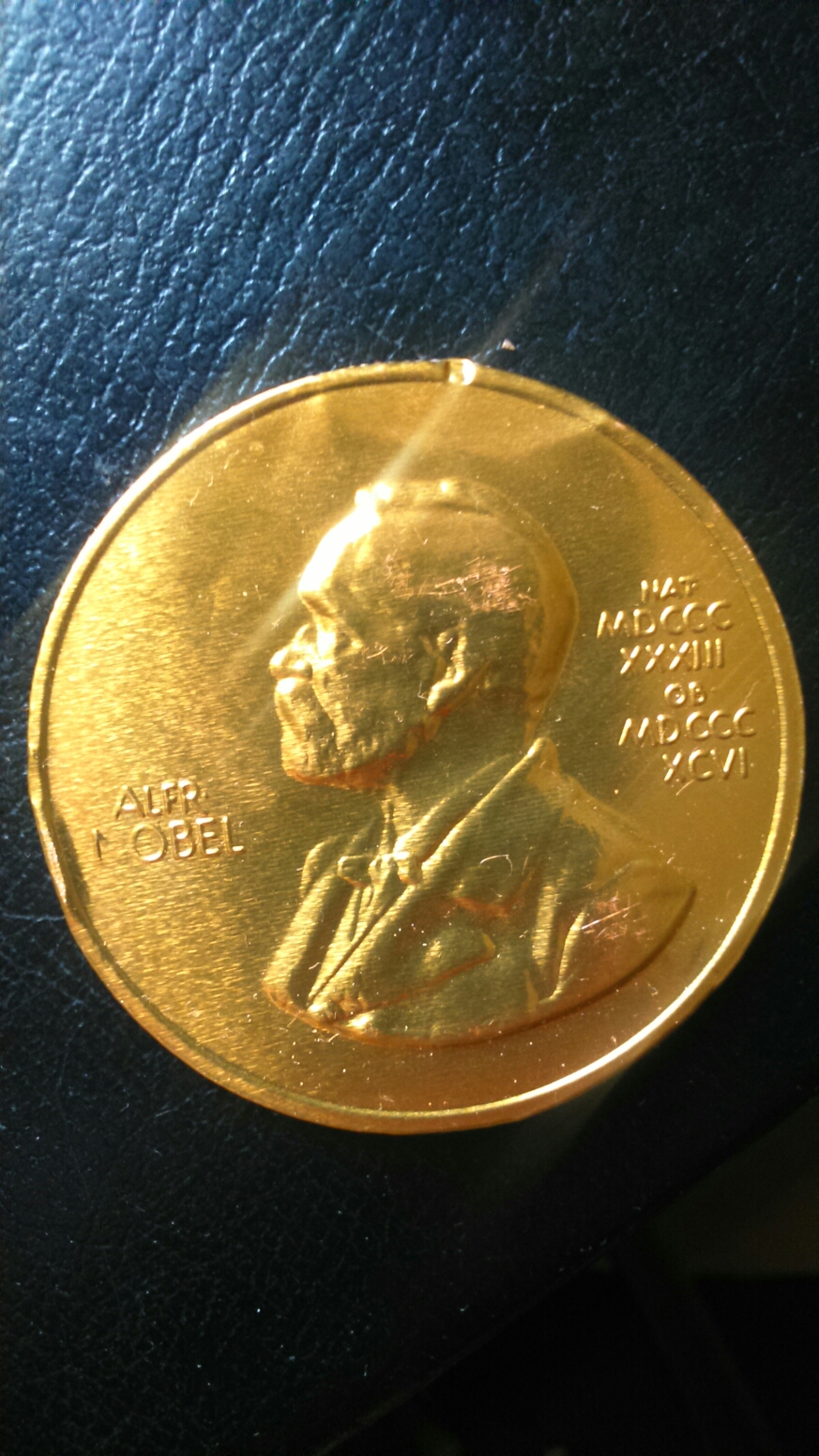
I do, of course, already have a Nobel Prize Medal of my own already, dating from 2006, when I was lucky enough to attend the prize-giving ceremony and banquet.

I was, however, a guest of the Nobel Foundation rather than a prizewinner, so my medal is made of chocolate rather than gold. I think after 16 years the chocolate is now inedible, but it serves as a souvenir of a very nice weekend in Stockholm!

I also won a prize here once:

It’s been a good few years for cosmology and astrophysics, with Jim Peebles, Michel Mayor & Didier Queloz (2019), Roger Penrose, Andrea Ghez & Reinhard Genzel (2020) following on from Kip Thorne, Rainer Weiss and Barry Barish (2017) for the detection of gravitational waves.  I think it’s very unlikely that it will be in this area again.

I have no idea who will win but I have on previous occasions suggested Alain Aspect, Anton Zeilinger and John Clauser for their Bell’s inequality experiments and contributions to the understanding of quantum phenomena, including entanglement, so I’ll make them my prediction again. I’m probably wrong again though. I have a spectacularly bad track record at predicting the Physics Nobel Prize winner, but then so does everybody else.

Feel free to make your predictions through the comments box below.

To find out you’ll have to wait for the announcement, around about 10.45 (UK/Irish time) tomorrow morning. I’ll update tomorrow when the wavefunction has collapsed.

Anyway, for the record, I’ll reiterate my opinion that while the Nobel Prize is flawed in many ways, particularly because it no longer really reflects how physics research is done, it does at least have the effect of getting people talking about physics. Surely that at least is a good thing?

UPDATE: It seems I called it right! Congratulations to Alain Aspect, John F. Clauser and Anton Zeilinger, winners of the 2022 Nobel Prize for Physics!

Faking Proceedings

Posted in Open Access with tags , , , , , , on October 2, 2022 by telescoper

Almost every day I get an invitation to a fake conference somewhere, usually somewhere nice (to make the event more attractive). Usually these are caught by my spam filter, but when one isn’t the conference often turns out to be in a field I don’t work in. A small fraction are in cosmology or astrophysics but fortunately those fields are relatively small and it’s quite easy to identify whether or not they are bona fide. I’ve often wondered what happens if you turn up at one of these fake meetings, but not enough to waste money on trying to find out. Perhaps one of my readers knows? One day someone should turn up at one of them with a film crew…

It seems that along with these fake conferences there are fake conference proceedings, not just proceedings of fake conferences but proceedings of conferences that didn’t actually happen.

Publishers make a killing from publishing books of conference proceedings, which generally have a very short shelf-life. I stopped contributing to conference proceedings some time ago as I don’t think they’re worth the effort any more. It’s far better in my view for contributors just to put a copy of their slides on the conference website. I fully accept however that conference proceedings or similar publications may be important in other fields and it does seem that there is still a considerable traffic in them, with some publishers – including Institute of Physics Publishing – setting up special journals to exploit the traffic.

My attention was drawn today to an article in The Times (behind a paywall). The Times piece appears to be based on this one by the excellent Retraction Watch. It seems the IOP publishing system has been comprehensively hacked by (mostly Chinese) publishing mills. As a result the publisher has retracted 494 papers:

The vast majority – 463 articles – are from the Journal of Physics: Conference Series, while 21 are from IOP Conference Series: Materials Science & Engineering, and 10 are from IOP Conference Series: Earth & Environmental Science.

A statement from the IOP explains

These articles are being retracted following an allegation that raised concerns regarding several manuscripts. IOP Publishing has conducted a comprehensive investigation, which indicated that some papers may have been created, manipulated, and/or sold by a commercial entity.

I’m told that to be named as an author of a paper costs anything from about $500 to $US5000, depending on the calibre of the journal and how prominently you want your name to appear. It’s easy to find companies willing to provide such a service, e.g. on Facebook.

Of course this episode raises serious questions about the quality of the peer review applied to these papers, but the more serious issue is how science let itself get into a mindset that fetishizes publications in the first place. The publishing industry must share some of the blame for this. As long as this absurd situation exists there will be unscrupulous people willing and able to exploit it.

Maxim Vengerov at the National Concert Hall

Posted in Biographical, Music with tags , , , , , on October 1, 2022 by telescoper

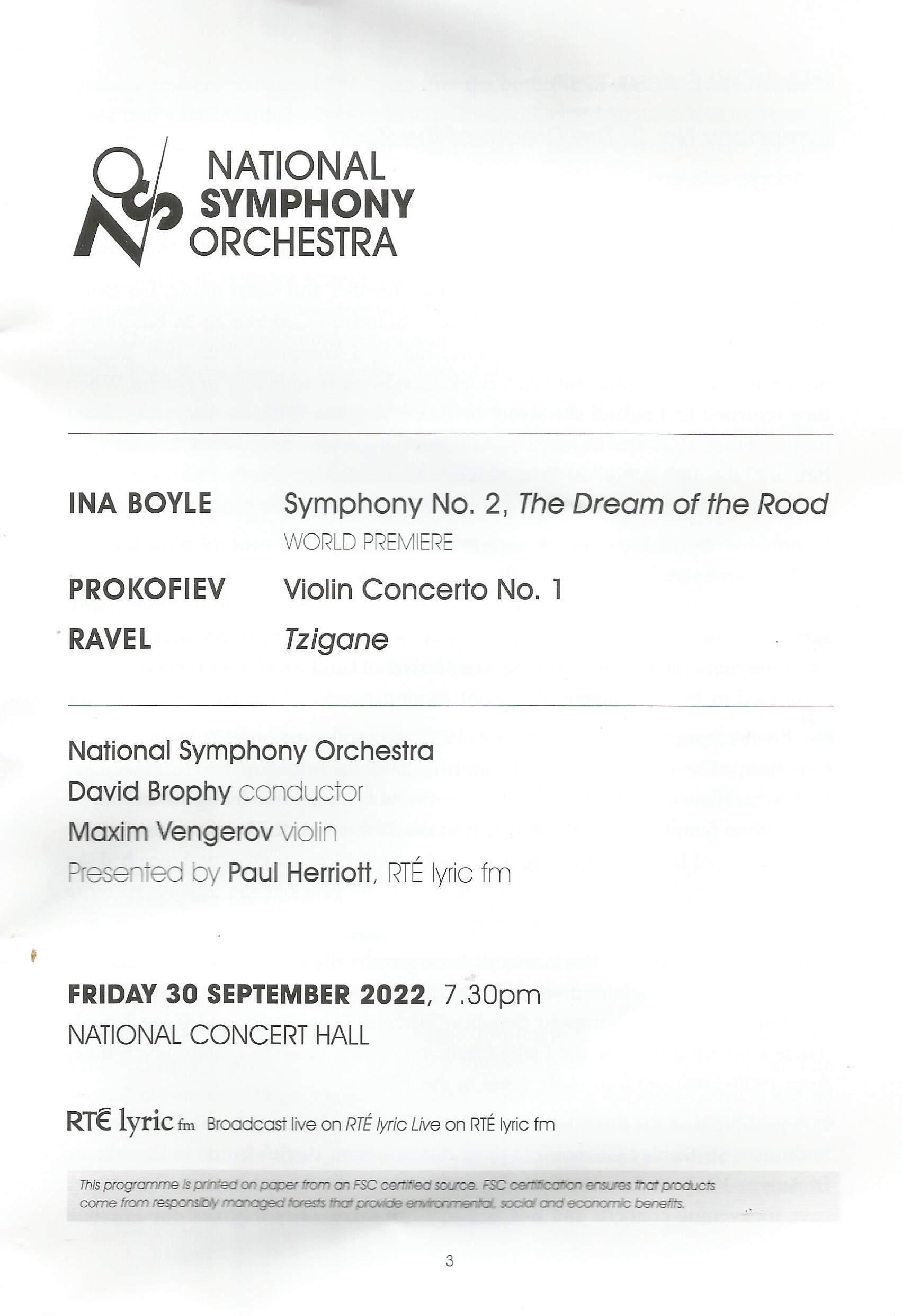
It’s not often that you get the chance to be present at the world premiere of a symphony, but that was the case last night when I went to the National Concert Hall in Dublin. Ina Boyle Symphony No. 2 The Dream of the Rood was composed by Ina Boyle in 1930 but hadn’t been performed anywhere until last night. In fact Boyle was a prolific composer but few of her works were performed in her lifetime, largely because of her geographical isolation from the musical mainstream, and many still have not been.

Reading in the programme notes that Ina Boyle had composition lessons with Ralph Vaughan Williams, for which she travelled to London, I expected her Symphony No. 2 to show his influence but if it reminded me of any composer it would be Arnold Bax. Anyway, it’s a substantial work in three movements for a large orchestra.

The piece is inspired by a 10th-century Anglo-Saxon poem about the crucifixion of Christ, “rood” being an old world for “cross”. It opens with a rather folksy theme but the first movement – easily the best of the three – develops into sweeping melodic lines and moves into a more vigorous section describing the felling of the tree from which the cross was made. The other two movements (marked Adagio and Grave) represent a funeral procession and an exhortation to reflect on the meaning of the rood. Overall I thought there was too little tonal or rhythmic variety in the piece for it to be totally convincing as a symphony. However, as I’ve written on this blog many times, I go to concerts determined to get as much out of them as I can even if it isn’t fully satisfying in its entirety, there are parts of this work which are very good.

Traditionally in a concert of classical music the Symphony comes after the interval and the Concerto for so instrument comes before. This usual ordering was turned on its head at last night’s concert as after the wine break we had violinist Maxim Vengerov playing two works. No doubt most people came to hear Maxim Vengerov rather than the Symphony by Boyle and it was a good plan to put the latter first to discourage people from leaving at the interval.

I was surprised when Vengerov appeared on stage resplendent in a cobalt blue suit with matching trainers, but there is no question that he is a very charismatic performer. The Violin Concerto No. 1 by Sergei Prokofiev is a very interesting piece that veers between a tender, almost childlike, simplicity and pyrotechnic energy verging on the savage. It does have some of the call-and-answer moments between soloist and orchestra of a traditional concerto, but at times this piece feels more like a blazing row than a civilized discussion.

The second piece was Tzigane by Maurice Ravel, a much shorter work in the form of a rhapsody starting with a long solo cadenza for the violin leading into a succession of virtuosic dance-like passages of increasing complexity and excitement. It’s obviously a technically demanding work but Vengerov looked like he was enjoying every minute!

Maxim Vengerov last night. The suit looked brighter in the flesh.
Picture Credit: National Symphony Orchestra

Vengerov, who has played many times in Dublin, was a huge hit with the audience and was greeted at the end with rapturous applause. He rewarded us with an encore of a Bach piece for solo violin, dedicated the victims of the conflict in Ukraine.

And then it was back to Pearse station for the train home to Maynooth.

P.S. I wonder if Maxim Vengerov has a brother called Minim?

Rainy Season

Posted in Biographical, Cricket, Irish Language with tags , , , , on September 30, 2022 by telescoper

Yesterday saw the end of this year’s County Championship cricket season*, which many people regard as the official end of summer. As if to prove the point today, strong westerly winds have brought a deluge of rain all morning.

While I was waiting for my coffee to brew before venturing out into the rain this morning I was thinking about some idiomatic expressions for heavy rain. The most familiar one in English is Raining Cats and Dogs which, it appears, originated in a poem by Jonathan Swift that ends with the lines:

Drowned puppies, stinking sprats, all drenched in mud,
Dead cats and turnip tops come tumbling down the flood.

My French teacher at school taught me the memorable if slightly indelicate Il pleut comme vache qui pisse, although there are other French expressions involving, among other things nails, frogs and halberds.

One of my favourites is the Welsh Mae hi’n bwrw hen wragedd a ffyn which means, bizarrely, “It’s raining old ladies and sticks”. There is also Mae hi’n bwrw cyllyll a ffyrc – “It’s raining knives and forks”.

Related idiomatic expressions in Irish are constructed differently. There isn’t a transitive verb meaning “to rain” so there is no grammatical way to say “it rains something”. The way around this is to use a different verb to represent, e.g., throwing. For example Tá sé ag caitheamh sceana gréasaí which means “It’s throwing cobblers’ knives”.

Talking (of) cobblers, I note that in Danish there is Det regner skomagerdrenge – “It’s raining shoemakers’ apprentices” and in Germany Es regnet Schusterjungs – “It’s raining cobblers’ boys”.

Among the other strange expressions in other languages are Está chovendo a barba de sapo (Portuguese for “It’s raining toads’ beards”), Пада киша уби миша (Serbian for “It’s raining and killing mice”),  Det regner trollkjerringer (Norwegian for “It’s raining female trolls”) and Estan lloviendo hasta maridos (Spanish for “It is even raining husbands”).

No sign of any husbands outside right now so I’ll get back to work. My PhD student is giving a seminar this afternoon so I have to think of some difficult questions to ask her! (Joking).

*For the record I should mention that Glamorgan drew their last game of the County Championship against Sussex (at Hove) and thus finished in 3rd place in Division 2. They might have beaten Middlesex to second place had they won and Middlesex lost their final matches but in the end both games were high scoring draws. Glamorgan lost to Middlesex in feeble style a couple of weeks ago so I think it was fair outcome.

What a difference a fortnight makes…

Posted in Biographical, Cardiff with tags , , on September 30, 2022 by telescoper

Regular readers of this blog (Sid and Doris Bonkers) will recall that a couple of weeks ago I complained about a ridiculous gas bill. Well, a fortnight (and a lot of hassle) later, SSE have at last decided to use the real meter reading instead of the absurd estimate, with the result that my bill has changed slightly:

That’s a difference of £86,444.90. I’d call that a result.

The story doesn’t end there, however, as I have yet to persuade SSE to actually give me the (almost) thousand pounds they owe me. They seem to think they should just keep it as an interest free loan to offset future payments.

Building Momentum

Posted in Biographical, Maynooth, Politics with tags , , on September 29, 2022 by telescoper

There may be no longer be any momentum in the direction of building a new Student Centre at Maynooth, but over the last few days I’ve been studying the details of the review of the “Building Momentum” pay proposal for public services employees over the next couple of years. The proposal has been put to a ballot of members of various public sector unions, including the one to which I belong, the Irish Federation of University Teachers (IFUT).

Unlike what happens in the United Kingdom, there is a single agreement covering all public sector workers and the unions that represent them and, also unlike the United Kingdom, University staff are treated as public sector employees, rather like civil servants. We are all members of the same pension scheme too, also unlike the UK.

Back in August, there was talk of industrial action over the inadequacy of the Government’s existing offer given the recent increases in the cost of living, but the ballot on that was suspended to allow voting on the revised offer that emerged from a review, perhaps in response to union pressure. As IFUT explained,

Arising from this review a set of proposals were agreed in August which include additional pay increases for members in 2022 and increases in 2023.  When the additional increases are taken into account, members’ pay would increase by a minimum of 9.5% during the period covered by Building Momentum (2021 – 2023).

Although expressing reservations, which I share, IFUT states

After careful consideration and scrutiny of the proposal, and taking into account the views of the membership as expressed by our Council, the Executive Committee advises that IFUT members should vote to accept these proposals.

I would have preferred if a bit more could have been done for University teachers at the lower end of the pay scales but, on balance, together with the cost-of-living measures announced in Tuesday’s budget, I think it’s a reasonable compromise, which will bring some degree of certainty to the financial situation of many people. I have therefore voted to accept the offer.