Author Archive

Quiet Quitting

Posted in Biographical, Education, Maynooth with tags , , on August 16, 2022 by telescoper

Not long ago I had lunch with a friend and former colleague from Sussex now working elsewhere. During the conversation I found myself saying words to the effect of “It’s only easy being a manager of something if you don’t care”. Speaking in the context of University management I meant “care” about the things that matter, i.e. staff and students and teaching and research, not metrics, rankings and key performance indicators.

Over the years that I’ve worked in universities, I’ve seen them systematically taken over by people who really don’t care at all about the important things. The result among ordinary staff is exhaustion caused by the overwork required to meet arbitrary criteria of productivity imposed by a remote and uncaring managerial class. Universities are thus a microcosm of neoliberal society at large, with the management being the propertied class, the academics being the workers, and the students being mere commodities.

The drive to alienate and demoralize staff through overwork accelerated during the Covid-19 pandemic. Teaching staff were required to transform their working methods, undertake countless hours of unpaid overtime and suffer long periods of isolation and stress. Being a Head of Department with lots of responsibilities but no actual power and no reduction in teaching load to compensate for the administrative burden, compounded this They did it because they knew there was an emergency and because they actually care. In return for this sacrifice they have generally received no appreciation except for platitudes and nothing by way of financial compensation, with the notable exception of Queen’s University Belfast which paid a bonus to staff in recognition of their exceptional efforts. Well done to them, but they are the exception rather than the rule. Elsewhere the only reward for efforts during the pandemic looks likely to be real-terms cuts in pay.

My worry, which is rapidly becoming reality, is that in the post-pandemic era The Management, aware of how far their employees were prepared to go during the pandemic, will continue to take them completely for granted, increase their workload by recruiting more and more students to be taught with fewer and fewer resources, all of it driven by financial targets. Why do we continue to put up with this gross exploitation? Are we doomed forever to labour under the dead weight of managerialism?

Over the past few weeks I’ve seen a number of articles about quiet quitting, most recently this one in the Guardian. Roughly speaking “quiet quitting” means fulfilling one’s contract but not going any further – no work at evening or weekends, taking one’s full holiday entitlement, and so on. Staff have generally done these things because they care but that care has been and is still being systematically exploited. Indeed, it says something about the way higher education institutions operate nowadays that “working to contract” is generally regarded as a form of industrial action! Universities would grind to a halt without the good will of staff, and there’s very little of that still left. In my own case, my employer still hasn’t fulfilled the terms of my employment contract almost five years after I joined.

So am I now going to join the ranks of those quitting quietly? You might very well think that. I couldn’t possibly comment. What I will say is that my union, IFUT, is going to ballot its members next month on industrial action over pay. I think you can probably guess which way I’ll be voting…

Love after Love, by Derek Walcott

Posted in Poetry with tags , , , on August 15, 2022 by telescoper

The time will come
when, with elation
you will greet yourself arriving
at your own door, in your own mirror
and each will smile at the other’s welcome,

and say, sit here. Eat.
You will love again the stranger who was your self.
Give wine. Give bread. Give back your heart
to itself, to the stranger who has loved you

all your life, whom you ignored
for another, who knows you by heart.
Take down the love letters from the bookshelf,

the photographs, the desperate notes,
peel your own image from the mirror.
Sit. Feast on your life.

by Derek Walcott (1930-2017)

The Wrong Sort of Open Access

Posted in Open Access with tags , , , , , on August 14, 2022 by telescoper

I came across two articles this week on the subject of Open Access and thought I’d share them here with a few comments of my own.

The first article was published in the LSE blog on 11th August with the title Article Processing Charges (APCs) and the new enclosure of research. For those of you not in the know, an Article Process Charge (APC) is a fee that authors are required to pay a publisher to allow Open Access to the paper on publication, i.e. without readers having to pay. The fees for some journals can many thousands of dollars. The lede for the LSE blog post reads:

Drawing on a recent analysis of APC pricing and movements within the commercial publishing sector, Gunnar Sivertsen and Lin Zhang argue that APCs have now firmly established themselves as the predominant business model for academic publishing. Highlighting the inequalities inherent to this model, they posit now is the time to consider alternatives.

In the text the authors reveal that in 2020 alone APCs contributed over $2Bn in revenue to academic journal publishers. I agree with the authors’ conclusion that the APC model is unfair and unsustainable. Indeed I would go further: it’s a complete con. The actual cost of processing an article for publication is a tiny fraction of the APC – the rest is just profit. The academic community is being fleeced. The right “time to consider alternatives” was many years ago, however, when we could have prevented this ridiculous model from being established in the first place. I still believe that the model will collapse under the weight of it’s own contradictions, however, so it’s not too late to change.

The second paper (which was published in January 2022) is entitled Open Science – For Whom? and is published in the Data Science Journal. It was drawn to my attention by the first author, Martin Dominik. Here is an excerpt:

So-called “Open-Access journals” lift the economic barrier to reading scholarly articles, but flipping the paywall from the reader to the author is not a viable solution and inhibits global participation in the scientific process. While article processing charges as well as read-and-publish deals currently on offer appear to be unaffordable to many institutions or individuals (not only in low- and middle-income countries), already the requirement of somebody else having to sign off for getting research published collides with the principles of academic freedom.

and later:

Flipping the paywall is not a solution for scholarly communication in a global Open Science ecosystem. Author-pays-charge models for disseminating research results are not viable in practice and simply absurd.

Simply absurd is right; see the above comments. How on Earth did we let the APC model take hold? I think the answer to that is inertia and lack of imagination within the academic community. It seems many researchers are willing to complain publicly about the absurdity of APCs but far fewer are willing to do something about the situation.

I pointed out the unfairness of APCs in a blog post ten years ago. I ended that post with this paragraph:

I for one have no intention of ever paying an Article Processing Charge. If the journals I publish in insist on levying one, I’ll just forget about the journals altogether and put my papers on the arXiv. I urge my colleagues to do the same.

I’m glad to say that I’ve kept that pledge and have never paid an APC. I recently completed a survey about Open Access which included a question about what level of APC I thought was reasonable; I put zero.

The way forward, I believe, is Diamond Open Access (i.e. free for both authors and readers), such as that offered by the Open Journal of Astrophysics. This is not the only model, of course, but we have at least demonstrated that it is viable (and indeed rather successful). And at least in setting up the Open Journal of Astrophysics I’ve done a bit more than whinge.

The Student Accommodation Crisis

Posted in Biographical, Education, Maynooth with tags , , on August 13, 2022 by telescoper

These days many of Ireland’s newspapers are carrying stories about the drastic shortage of accommodation for students ahead of the start of the new academic year.; see, for example, here and here. Sinn Féin spokesperson on Further and Higher Education, Rose Conway-Walsh, has called on the Government to prepare emergency measures to tackle the crisis “before it’s too late”.

Unfortunately I think it’s already too late. I think this year we’re going to see a complete breakdown of the University system and that’s even without the industrial action that looks likely to take place. Although third-level institutions could have done more, the root cause is the funding model. There’s also a lack of housing nationally which is caused by systematic underinvestment over many years.

To illustrate the problems let’s look at Maynooth University, where I work. Some of the issues here are common across the University sector but some are specific. Maynooth is Ireland’s only real “University Town” in the sense that the University constitutes a very large part of the population; the local football team is even called Maynooth University Town. This is often used as a selling point for the University and indeed Maynooth is a pleasant place to work and study, but this year the special status of Maynooth is exacerbating the national crisis.

The number of permanent residents in Maynooth is about 15,000 and there is a similar number of students (13,700, including about 11000 undergraduates), so the population almost doubles during teaching term. Both populations are steadily rising. The University is recruiting more and more students without comparable increase in student housing – this year looks like being another record intake – but there is also pressure on housing due to other factors, particularly the dramatic expansion of the Intel plant in nearby Leixlip, with many of the new workers trying to find places to live in Maynooth. New properties are being built but at a rate much slower than the demand is increasing.

It is now mid-August, about a month before term starts for returning students. This is the time when foreign students start arriving and looking for accommodation. As a matter of fact I have two PhD students due to start in September, both of whom are new to Ireland. Usually getting in ahead of the home students helps them find somewhere ahead of the rush, but this year there is absolutely no accommodation to be found in Maynooth. I don’t mean there’s a shortage. I mean there isn’t anything. And the incoming first-year students haven’t even started looking yet.

This year’s Leaving Certificate results will not be out until September 5th. After that more than 3000 students will begin looking for accommodation. But the supply is already exhausted in August. Some will find accommodation on campus, but at the moment there are over 800 Ukrainian refugees living in the halls who will have to leave at the end of August to make way for students, but where will they go? And in any case there spaces vacated will only accommodate a fraction of the new arrivals.

There’s also the question of cost. The law of supply and demand is merciless in this situation so as private accommodation is so scarce, the rents payable have soared. That’s fine if you’re a landlord, of course…

The only solution I can see in the short term is temporary accommodation in caravans or tents or perhaps in large buildings such as sports halls. That’s highly unsatisfactory of course, but the alternative is lengthy commuting which is exhausting and which we saw last year leads to widespread disengagement.

Maynooth has just opened a new building on campus, the TSI Building, with large teaching rooms anticipating ever-increasing class sizes driven by the bums-on-seats mandate. But how many students will be able to attend?

New Teaching Room in the TSI Building

I’ve been arguing for over a year that we need to accept the reality that many students will not be able to attend on-campus sessions as we would like them to so we should invest in remote teaching methods to allow them to study at home. We did this during the pandemic emergency and we should do it during the accommodation emergency too. I am appalled that Maynooth has not bothered to install proper lecture capture facilities in its teaching rooms. These facilities were commonplace in the UK long before the pandemic and it’s shocking that they are not deployed routinely in Maynooth. I have better lecture capture facilities in my study at home than the University provides in its lecture theatres.

Although this crisis has been brewing for many months, the Irish Government has done little to help. Individual universities have also been staring into the headlights and doing nothing. Government funding per student has been falling steadily so Universities wishing to maintain their income have been forced to recruit more students, despite the lack of investment in accommodation and other infrastructure.

It’s stressful enough for academic staff having to contend with this looming disaster, but I can hardly imagine how awful it must be for students. All I can do is apologize, which is something the people really responsible will not do.

Anomalies in Physical Cosmology

Posted in The Universe and Stuff with tags , , , on August 12, 2022 by telescoper

Just a quick note to mention that there’s an interesting review article on the arXiv by elder statesman of cosmology Jim Peebles with the abstract:

The ΛCDM cosmology passes demanding tests that establish it as a good approximation to reality. The theory is incomplete, of course, and open issues are being examined in active research programs. I offer a review of less widely discussed anomalies that might also point to hints to a still better cosmological theory if more closely examined.

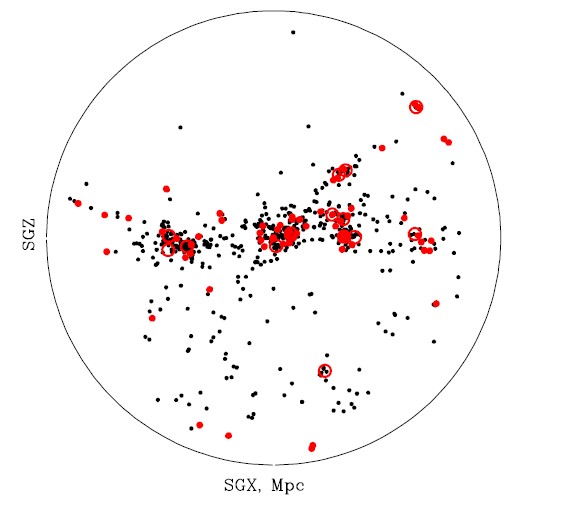
Here is Figure 4 from the paper, which I’ve picked because it is pretty. It shows the distribution of bright (red) and faint (blue) galaxies within 9Mpc of the Milky Way.

Maynooth University Library Cat Update

Posted in Maynooth with tags on August 11, 2022 by telescoper

Over the past week or so I’ve made numerous trips back and forth to the Examinations Office and Exam Halls on matters relating to the repeat examinations, which finished yesterday. In the course of my perambulations I’ve been keeping an eye out for Maynooth University Library Cat, but until yesterday I didn’t see him anywhere. When I did catch a glimpse of him yesterday he had flaked out underneath a bush and I didn’t want to disturb him to take a photograph. Luckily however whoever operates Maynooth University’s Twitter feed managed to get a good snap of him today:

It can’t be ideal in this weather to be wearing a black fur coat, but he seems well. I guess he has been keeping a low profile in the shade most of the time. Whenever I passed his residence I made sure there was water in his bowl, but if he got really thirsty he could probably drink from the little stream that flows under the bridge on which he holds court. There are fish in there, and even the occasional otter, so I suppose the water is OK to drink. I don’t think I’ll put that to the test though. Certainly not now. I’ve just finished marking the last batch of scripts so I think I’ll go for a glass of wine…

Recalibration of Ultra-High-Redshift Galaxies

Posted in Astrohype, The Universe and Stuff with tags , , , , on August 10, 2022 by telescoper

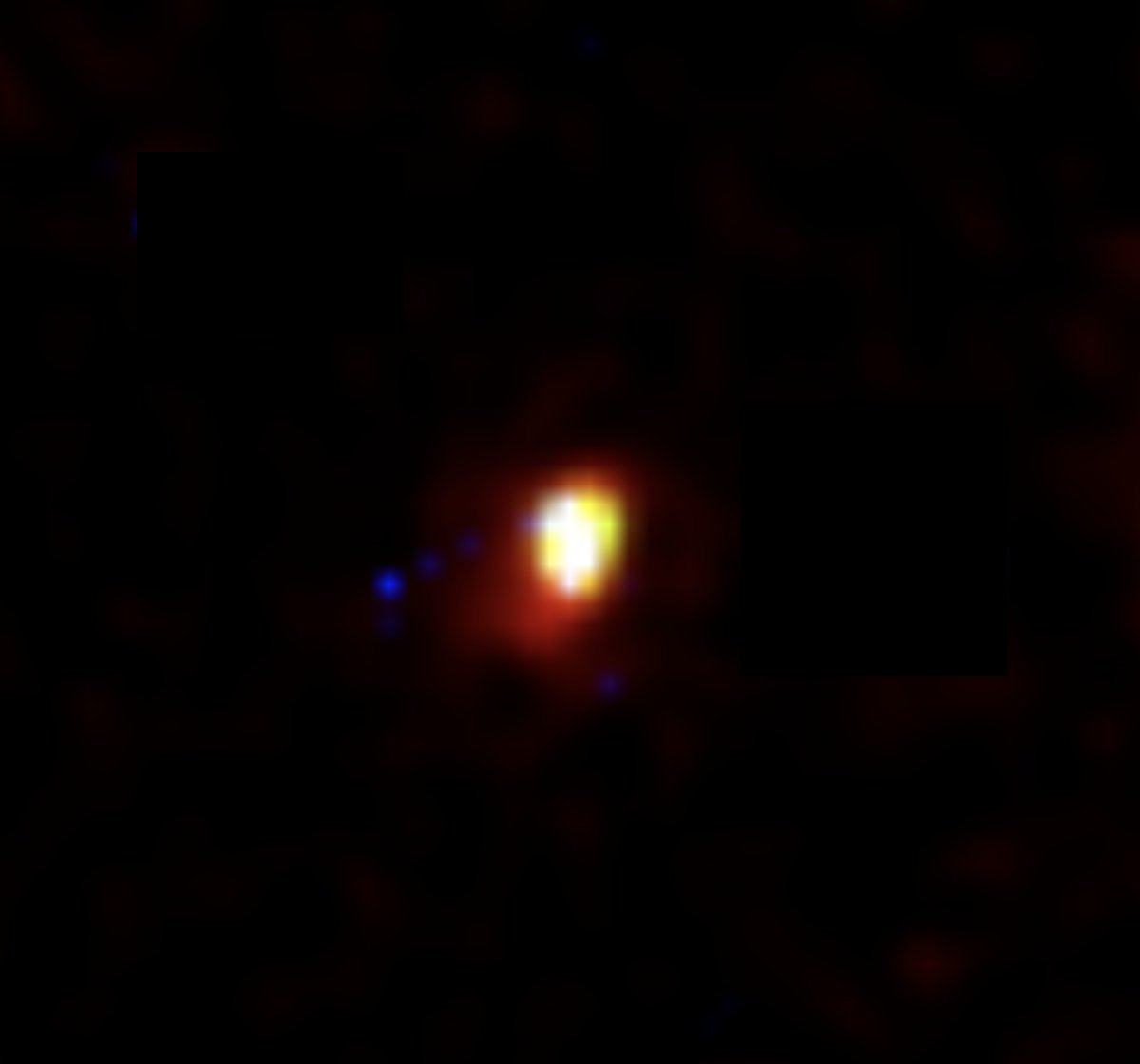
Remember all the recent excitement about the extremely high redshift galaxies (such as this and this; the two examples shown above) “identified” in early-release JWST observations? Well, a new paper on the arXiv by Adams et al using post-launch calibration of the JWST photometry suggests that we should be cautious about the interpretation of these objects. The key message of this study is that the preliminary calibration that has been in widespread use for these studies is wrong by up to 30% and that can have a huge impact on inferred redshifts.

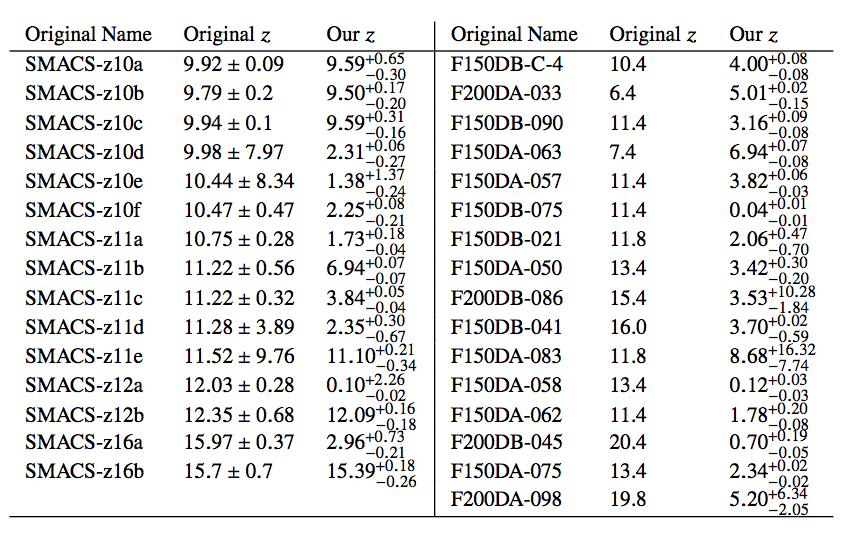
The new study does indeed identify some good candidates for ultra-high-redshift galaxies, but it also casts doubt on many of the previous claims. Here is a table of some previous estimates alongside those using the newly recalibrated data:

You will see that in most – but not all – cases the recalibration results in a substantial lowering of the estimated redshift; one example decreases from z>20 to 0.7! The two candidates mentioned at the start of this post are not included in this table but one should probably reserve judgement on them too.

The conclusive measurements for these objects will however include spectroscopy, and the identification of spectral lines, rather than photometry and model fits to the spectra energy distribution. Only with such data will we really know how many of these sources are actually at very high redshift. As the philosopher Hegel famously remarked

The Owl of Minerva only spreads its wings with the coming of spectroscopy.

Chorizo Sandwich

Posted in Music with tags , , on August 9, 2022 by telescoper

Now that the social media fuss about ChorizoGate is dying down a bit I thought I’d change the subject completely by posting some music. This tune is by a band call Los Alacranes and it’s entitled … oh no! … Chorizo Sandwich

Megalithic Mystery Solved!

Posted in Biographical, History, The Universe and Stuff with tags , , , , on August 8, 2022 by telescoper

This morning I realized that almost exactly four years ago I visited the megalithic passage tomb at Knowth. In my post about that visit I mentioned the extraordinary stone carvings found outside the tomb and their possible connection with astronomy. Following on from ChorizoGate I can finally reveal that the solution to this ancient mystery is in fact gastronomical.

Reach for the Stars!

Posted in The Universe and Stuff with tags , , on August 7, 2022 by telescoper

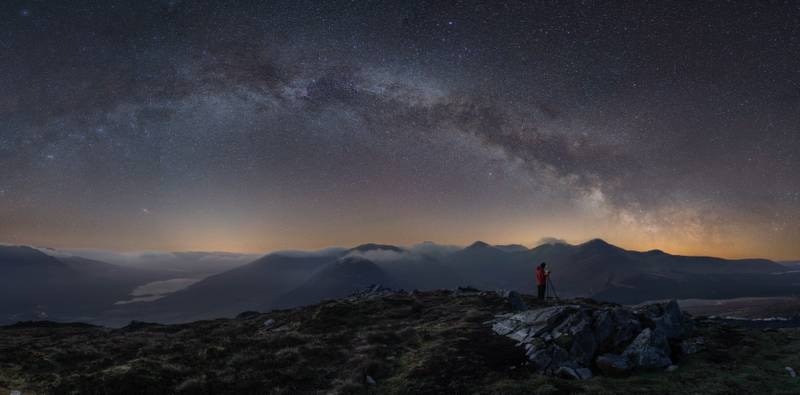
After all the nonsense in the past few days about ChorizoGate I thought I’d pass on news of some really wonderful and wonderfully real astronomical images featured in this year’s ‘Reach for the Stars’ astrophotography competition run by Dublin Institute for Advanced Studies (DIAS). You can find a full gallery and learn more about the competition here, but here is just one beautiful image as a taster. It was taken by Aisling McGuire and it shows the Twelve Bens mountain range in Connemara, with the Milky Way above.

Picture Credit: Aisling McGuire

Do look at the rest of the gallery!