Author Archive

Cá bhfuil tú i do chónaí?

Posted in Biographical, Irish Language, Maynooth with tags , , , on April 3, 2021 by telescoper

I had another Irish language class on Thursday, in between various other things. I’m finding it a struggle since I don’t get much time in between the classes to revise or practice and also because there is quite a lot to learn that is very different from languages with which I am familiar. I spent a lot of time at school learning Latin and tend to filter new languages through that experience, which works reasonably well for French, Spanish and Italian but isn’t very good for Irish.

Some things in Irish are simpler than Latin: there are effectively only four cases for nouns in Irish as there is no real distinction between nominative and accusative. I mean the two cases are grammatically distinct but there is no difference in the word depending on whether it is subject or object of a verb. The other three cases are vocative (preceded by the particle a), genitive and dative. There is no ablative case; the dative is used instead.

Other things are more complicated. Last week we discovered that there are two versions of the verb “to be”. One is bí (which, as in most other European languages, is irregular in declination); the other is called the copula (“an chopail”)  which is used in limited (but quite common) circumstances such as linking a noun with a predicate clause. Confusingly, the form of the copula used in the present tense is “is” but it’s not part of the verb “to be”.

We learnt about these things when talking discussing the question

Cá bhfuil tú i do chónaí?

which is “where do you live?”, literally “Where are you in your habitation?”.  The way to answer this is something like

Tá mé i mo chónaí i Maigh Nuad. 

these sentences both involve the verb to be in the second person and first person respectively. Instead of Tá mé you could use Táim which is the equivalent of using “I’m” for “I am” in English.

It’s more complicated than that though because some place names have to be modified in this construction using an urú (eclipsis):

Maigh Nuad (Maynooth) begins with an M which is not modified but Doire (Derry) becomes nDoire, etc. The mutation from c to g after the preposition i also happens in Welsh, e.g. in the phrase Croeso i Gymru but in Irish you add the changed letter in front of the original rather than replacing it. For example, if I were living in Cork I would say

Tá mé i mo chónaí i gChorchai. 

The g is understood to replace the C for pronunciation purposes.

That brings us on to Irish place names, which are often very different from their anglicized versions. Here are a few examples:

  • Maigh Nuad (Maynooth)
  • Corcaigh (Cork)
  • Port Láirge (Waterford)
  • Doire (Derry)
  • Tir Eoghain (Tyrone)
  • Aontroim (Antrim)
  • Fear Manach (Fermanagh)
  • Béal Feirste (Belfast)
  • Gaillimh (Galway)
  • Thiobraid Árann (Tipperary)

The last one is not actually a long way from where I am. You can guess most of them but it’s a little confusing that the English versions are often conflations of two Irish words.

Obituary of John Barrow

Posted in Biographical, The Universe and Stuff with tags on April 2, 2021 by telescoper

Just a quick word to let you know that my obituary of John Barrow (partly based on my blog post here) has now been published in The Observatory Vol. 141 No. 1281 (2021 April) pp. 93-96. The Observatory Magazine isn’t available online so, with the permission of the Editors, I’ve included a link to a PDF of the published version here:

John Barrow Obituary in Observatory by Peter Coles

Good Friday Break

Posted in Biographical, Maynooth, Poetry with tags , , on April 2, 2021 by telescoper

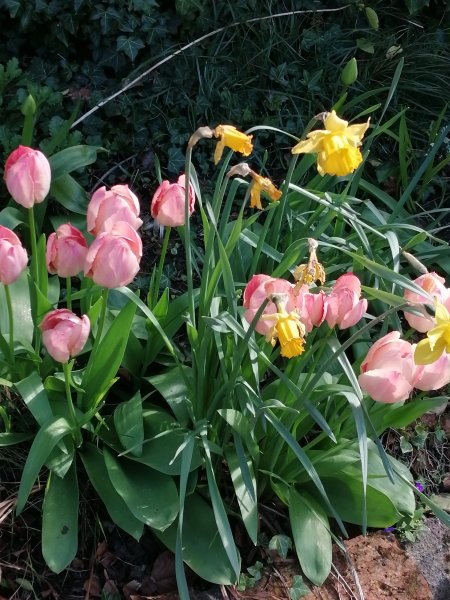
Garden Update: the daffodils are done but the tulips are still going…

Well, here we are. It’s Good Friday, the start of an extra-long weekend (Friday to Monday inclusive). I’m making it a bit longer by taking a few days off next week too. It’s officially Easter break so there are no lectures next week anyway.

I need a break. This term has been exhausting, and the busiest bit is yet to come. We return for four weeks of teaching then, after a short hiatus, we’re into the examination period followed by marking, Exam Boards and all the rest. Oh and there’s the small matter of yet another virtual Open Day at the end of this month.

I’ve put out-of-office replies on my work email and won’t be attending to messages there until I get back to work at the end of next week. Part of me feels a bit guilty for doing that, but only a very small part.

As it’s a nice day, I spent a couple of hours this morning doing some remedial work in the garden. I may have a late lunch out there too as the weather is nice and I recently invested in a garden table and chairs which I have yet to use properly. If the weather holds I might get the mower out and give the lawn a trim. Judging by the constant noise this morning it seems that everyone in the neighbourhood is doing that too. Some people seem to enjoy the sound of their own lawn mowers.

Talking of which I also trimmed my beard this morning, for the first time since Christmas. I have also acquired some clippers and may actually cut the hair on my head at some point over the weekend too.

That’s enough inconsequential rambling for today. Here is a poem on the subject of Good Friday by Christina Rossetti:

Am I a stone, and not a sheep,
That I can stand, O Christ, beneath Thy cross,
To number drop by drop Thy blood’s slow loss,
And yet not weep?

Not so those women loved
Who with exceeding grief lamented Thee;
Not so fallen Peter, weeping bitterly;
Not so the thief was moved;

Not so the Sun and Moon
Which hid their faces in a starless sky,
A horror of great darkness at broad noon –
I, only I.

Yet give not o’er,
But seek Thy sheep, true Shepherd of the flock;
Greater than Moses, turn and look once more
And smite a rock.

Relativity and Electromagnetism

Posted in Biographical, Maynooth, The Universe and Stuff on April 1, 2021 by telescoper

As a service to the public I thought I’d share one of my lectures. This is one I did yesterday, Lecture 16 in my module MP465 Advanced Electromagnetism:

I don’t know how I managed to pad this out to a whole hour.

On Vaccination in Ireland

Posted in Covid-19 with tags , , , on March 31, 2021 by telescoper

Following from my weekend post about issues with Covid19 vaccination, which seems to have ruffled a few feathers, I thought I’d just mention a couple of recent developments.

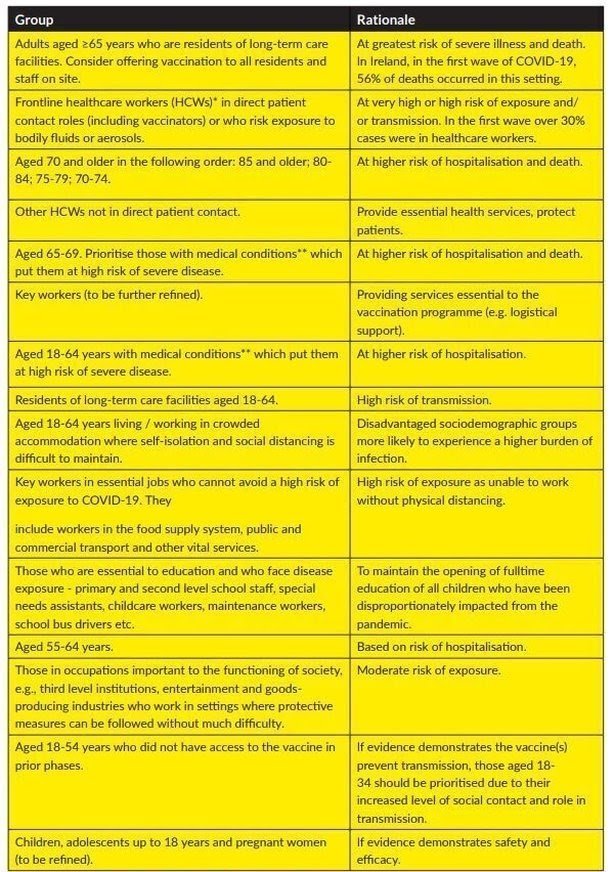
The first is that on Tuesday (yesterday) the Irish Government decided to change the way it vaccinates the rest of the population. The previous plan was rather complicated with a number of groups to be vaccinated in order of priority:

That plan has now been scrapped and after the current groups 1-3 are completed it will revert to a simpler scheme with priority determined only by age. As an oldie I will benefit from this, moving up several steps in the pecking order as a consequence of the decision.

Frontline workers such as teachers and Gardaí are dismayed by this decision. On the news just now various folk were trying to argue that the change is for health policy reasons, stating that the prime factor in risk for Covid-19 is age. Actually, it isn’t. The prime factor is exposure to the virus.

What I mean is that the probability of dying from Covid-19 if you haven’t been infected is zero: 100% of those suffering death or serious illness from Covid-19 have been in contact with the virus. Someone who is 60 years old but able to work effectively at home at far lower risk of exposure than a 35 year old schoolteacher.

The real reason for the change is that Ireland does not possess a system that can be used identify groups by occupation in an efficient way. Doing it by age is far simpler and would lead to a much more rapid rise in the fraction of the population immunized. Sometimes decisions have to be made for such practical reasons, but I do wish certain people were more honest.

The slow rollout of the vaccine in Ireland should have provided the Government to work out how to implement their original strategy. Obviously they decided that they couldn’t.

Anyway, for myself, I am pleased that it now looks quite likely that I’ll get at least one jab by May. Assuming the vaccine supply holds up, of course.

I thought I’d end with a thought following on from my earlier post. Some people will ask whether I would have the AstraZeneca vaccine given my views about the company’s behaviour and the lower efficacy of the vaccine as compared to others available.

I think there are two motivations for getting vaccinated. One is self-preservation. I want to protect myself as much as possible. If I had the choice of vaccine for this reason I would pick Moderna or Pfizer-BioNtech but would accept AZ if that was the only one available. As things stand, over 75% of doses administered in Ireland have been Pfizer-BioNtech,

The other motivation is to help reduce the transmission of the disease. For that even a low efficacy vaccine would play a part. If the only shot available offered just 50% protection I would still take it, as if everyone did so the population dynamics would still be significantly slowed.

It’s a similar thing with face masks, actually. Their role is only partly to protect the wearer. The other part is to protect everyone else.

So on both grounds, yes I would take the AZ vaccine if that was the only one on offer, but if I had the choice I would pick a better one. I feel the same way about the Johnson & Johnson vaccine, which will start to become available in Ireland very soon.

Thought for the Day

Posted in Literature, Politics on March 30, 2021 by telescoper

I don’t have time for a full post today but let me just say that I think that the move from a structuralist account in which capital is understood to structure social relations in relatively homologous ways to a view of hegemony in which power relations are subject to repetition, convergence, and rearticulation brought the question of temporality into the thinking of structure, and marked a shift from a form of Althusserian theory that takes structural totalities as theoretical objects to one in which the insights into the contingent possibility of structure inaugurate a renewed conception of hegemony is bound up with the contingent sites and strategies of the rearticulation of power.

Comments welcome.

Yesterday was nearly Easter

Posted in History, The Universe and Stuff with tags , , , on March 29, 2021 by telescoper

As as Astronomist I am often asked “How do they calculate the date of Easter?”, to which my answer is usually “Look it up on Wikipedia!“.

The simple answer is that Easter Sunday is on the first Sunday after the first full Moon on or after the Vernal equinox. The Vernal Equinox took place this year on March 20th and the more observant among you will have noticed that yesterday was (a) Sunday and (b) a Full Moon. Yesterday was not Easter Sunday because the rule says Easter is on the first Sunday after the first full Moon on or after the Vernal equinox, which does not include a Full Moon on the first Sunday on or after the vernal equinox. Accordingly Easter 2021 is next Sunday 4th April. If the Full Moon had happened on Saturday, yesterday would have been Easter Sunday.

That is just as well really because next weekend is when the holidays and sporting events have been arranged.

I say “simple” answer above because it isn’t quite how the date of Easter is reckoned for purposes of the liturgical calendar.

For a start the ecclesiastical calculation of the date for Easter – the computus – assumes that the Vernal Equinox is always on March 21st, while in reality it can be a day or two either side of that. This year it was on March 20th.

On top of that there’s the issue of what reference time and date to use. The equinox is a precisely timed astronomical event but it occurs at different times and possibly on different days in different time zones. Likewise the full Moon. In the ecclesiastical calculation the “full moon” does not currently correspond directly to any astronomical event, but is instead the 14th day of a lunar month, as determined from tables (see below). It may differ from the date of the actual full moon by up to two days.

There have been years (1974, for example) where the official date of Easter does not coincide with the date determined by the simple rule given above. The actual rule is a complicated business involving Golden Numbers and Metonic cycles and whatnot.

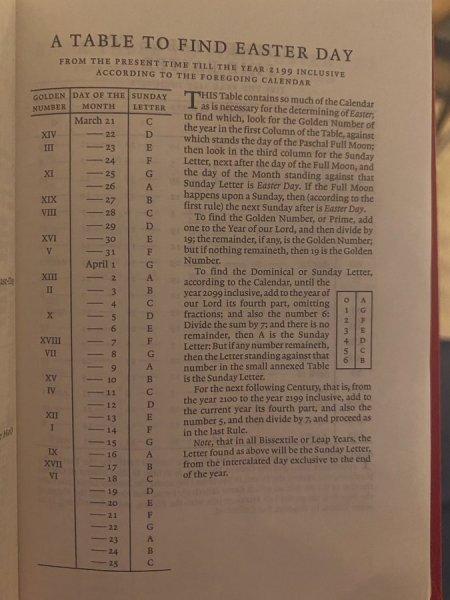
I’m grateful to Graham Pointer on Twitter for sending this excerpt from the Book of Common Prayer that sheweth how to determine the date of Easter for any year up to 2199:

I don’t care what happens after that as I’ll be retired by then. If you apply this method to 2021 you will find it is an 8C. Next year will be a 9B. Further calculations are left as an exercise to the reader.

In the Name of the Solicitor

Posted in Biographical, Film with tags , , , , on March 28, 2021 by telescoper

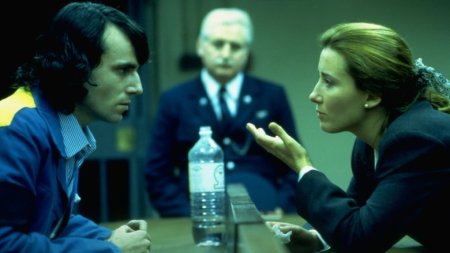
Looking through the TV listings just now I saw that the 1993 film In the Name of the Father about the Guildford Four, starring Daniel Day-Lewis and Emma Thompson, was on last night. I didn’t watch it but seeing it mentioned jogged my memory about a strange incident when I lived in London which I thought I’d share.

One evening in the early 1990s – I don’t remember the exact date – I was sitting in my flat in Bethnal Green when the phone rang. At the other end of the line was Ruth, a member of the admin staff in the School of Mathematical Sciences at Queen Mary, where I was working at the time. She was obviously very upset and it took some time to get her to calm down and tell me what had happened.

Ruth’s boyfriend, an Irish guy called Stephen who lived in Stepney Green, not far from me, and whom I knew a little socially, was in Bethnal Green Police Station. It seems that earlier in the day there had been some sort of altercation in Whitechapel after which one of the two men involved had got into a car and deliberately ran another man over, resulting in his death. The Police had taken Stephen in for questioning despite the fact that (a) he was with a group of friends in a pub at the time of the incident and (b) he didn’t have a car and didn’t have a driving licence. I remember (b) quite well because I was (and still am) a non-driver too. In any case it was unthinkable that Stephen could have been involved in such a terrible thing. Being charitable to the cops, it was obviously a case of mistaken identity.

Stephen had gone voluntarily to be questioned and as far as could be discerned had not been charged but had been there some time and Ruth was getting nervous about what the Police might be up to. There was quite a lot of real or suspected IRA activity in London at that time, and the Police were notoriously hostile to Irish people, even those who weren’t involved in any of that. Ruth’s suspicion was that the cops were trying to stitch Stephen up and not unreasonably wanted to get him a solicitor. But she didn’t know any. Could I help?

Well, the only solicitor I at the time was the chap who did the conveyancing for the purchase of the flat, which wasn’t of any use, but I did have friends in Brighton who worked in the legal profession so I told Ruth I’d make a few calls and see what I could do. It didn’t take long before I got the number of a bloke who worked for a London firm called Benedict Birnberg (which I had never heard of at the time). When I explained the situation he gave me the home phone number of a solicitor colleague, one Gareth Peirce.

I called the number straight away and asked if I could speak to Gareth* Pierce. “Speaking” came a woman’s voice, which surprised me a little, as I had assumed Gareth would be a man’s name, but I went on to explain how I had got her number and what was the issue. She asked me to confirm Stephen’s full name and where he was being held and, to my surprise, said she would go straight away. It was about 9pm if I remember correctly.

About an hour later the phone rang again. It was a jubilant Ruth. Stephen had been released without charge. He was never contacted again about the alleged incident. When I spoke to him later about it he revealed that the solicitor didn’t mince any words in the process of getting him out and the police seemed rather terrified of her. It was only when I went to work the next day and talked about it at coffee-time that someone told me who Gareth Peirce was: she was rather famous, and was the solicitor played by Emma Thompson in the film In the Name of the Father.

At least for a while, this episode gave my work colleagues the entirely false impression that I was someone with immensely useful connections. In truth I had no idea who Gareth Peirce was and never actually met her. As far as I know she acted that evening on an entirely pro bono basis.

*Gareth Peirce was born Jean Webb but changed her name when young. I don’t know why.

Per Ardua ad AstraZeneca

Posted in Covid-19 with tags , , on March 28, 2021 by telescoper

The extent to which AstraZeneca’s dishonesty concerning its purchasing agreement with the EU is becoming clearer, and the company is increasingly engulfed by a PR disaster resulting from this and misleading claims about the efficacy of its Covid-19 vaccine (see here, here, here, etc). Perhaps they will now get their finger out and actually honour their contract?

Here in Ireland there is expected to be a delivery of “large volume” of doses of the Astra Zeneca vaccine next week, though I doubt it will be as large as their contractual obligations specify. We’ll see what actually happens. There isn’t much confidence in AstraZeneca around these parts I can tell you.

This morning the Covid-19 tracker app for Ireland was updated with the latest vaccination figures for Ireland (25th March) which are as follows:

  • First doses: 548,945
  • Second doses: 211,223
  • Total: 760,168

That is definitely speeding up, which is welcome. Not as fast as the UK, of course, who have been the beneficiaries of 21 million doses exported by the EU. That’s about 2/3 of the total shots administered there. The number exported from the UK to the EU is zero. Nada. Zilch. The same is true of the USA. There’s no doubt in my mind who the bad guys are.

Anyway, not to dwell on that issue I was wondering when I might get around to having a jab myself. I am not particularly high in the pecking order, but from April onwards Ireland is supposed to receive about a million doses per month. Assuming that this actually happens, and AstraZeneca doesn’t crap out yet again, I estimate they should get to me in May (2021).

Another question that occurred to me, given that under-18s are not given the current vaccines – is how many doses are needed to vaccinate the adult population of Ireland. The total population of Ireland is about 5 million but that includes quite a large number of children. Looking at the 2016 census I see that the number of people living in Ireland who are under the age of 18 is about 1.25 million. That means to fully vaccinate the entire adult population will take about 7.5 million doses. Currently about 14.6% of the adult population have received one dose, and about 5.6% have received two. We probably won’t get to anything like full vaccination of the adult population until the autumn.

Let me just correct yet another misunderstanding often presented in the UK press concerning unused vaccines. The number of doses imported to Ireland currently exceeds the number administered by over 100,000, but that does not mean that these vaccines have been refused or wasted. Because the vaccination programme here follows the manufacturers’ guidelines, and because the supplies have been unreliable (especially from AstraZeneca), there is a buffer to ensure that a second dose will always be available on the necessary timescale for anyone who has been given the first. That means that at any time there will always be some doses in storage. It wouldn’t be necessary to do this if we could trust the delivery schedule, but there you go.

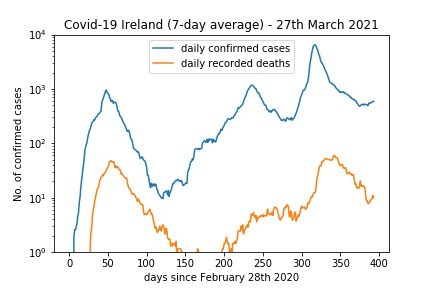
I wouldn’t be too worried about the slowish pace of vaccination were it not for the fact that new Covid-19 cases in the Republic are on the way up again:

The demographic for these new cases is quite young (a median age of 32 yesterday) and the increase almost certainly arises from lax adherence to the restrictions by a subset of the population. The relatively young age distribution and the fact that those at greatest risk of death or serious illness are being vaccinated should mean that the mortality figures remain low even as cases rise. Although the increase in new cases is worrying it is nowhere near as bad in Ireland as on the Continent of Europe and elsewhere around the world (especially Brazil). More worrying still is the likelihood of vaccine-resistant strains arising through mutation. Indeed there is already some evidence that the AstraZeneca vaccine is not as effective against the B.1.351 South African variant, although this has been disputed. Let’s hope that all the AstraZeneca doses administered so far don’t turn out to be useless.

It seems to me that it’s very likely that in order to deal with variants we’ll be having regular (perhaps annual) updated vaccine shots for the foreseeable future, as the only way to stop mutations happening is to immunize a large fraction of the world’s population and that will take a considerable time.

The REF goes on

Posted in Biographical, Cardiff, Maynooth with tags , , , , on March 27, 2021 by telescoper

A few communications with former colleagues from the United Kingdom last week reminded me that, despite the Covid-19 pandemic, the deadline for submissions to the 2021 Research Excellence Framework is next week. It seems very strange to me to push ahead with this despite the Coronavirus disruption, but it’s yet another sign that academics have to serve the bureaucrats rather than the other way round.

I know quite a few people at quite a few institutions that are completely exhausted by the workload required to deal with the enormous exercise in paperwork that is intended to assess the quality and impact of research at UK universities.

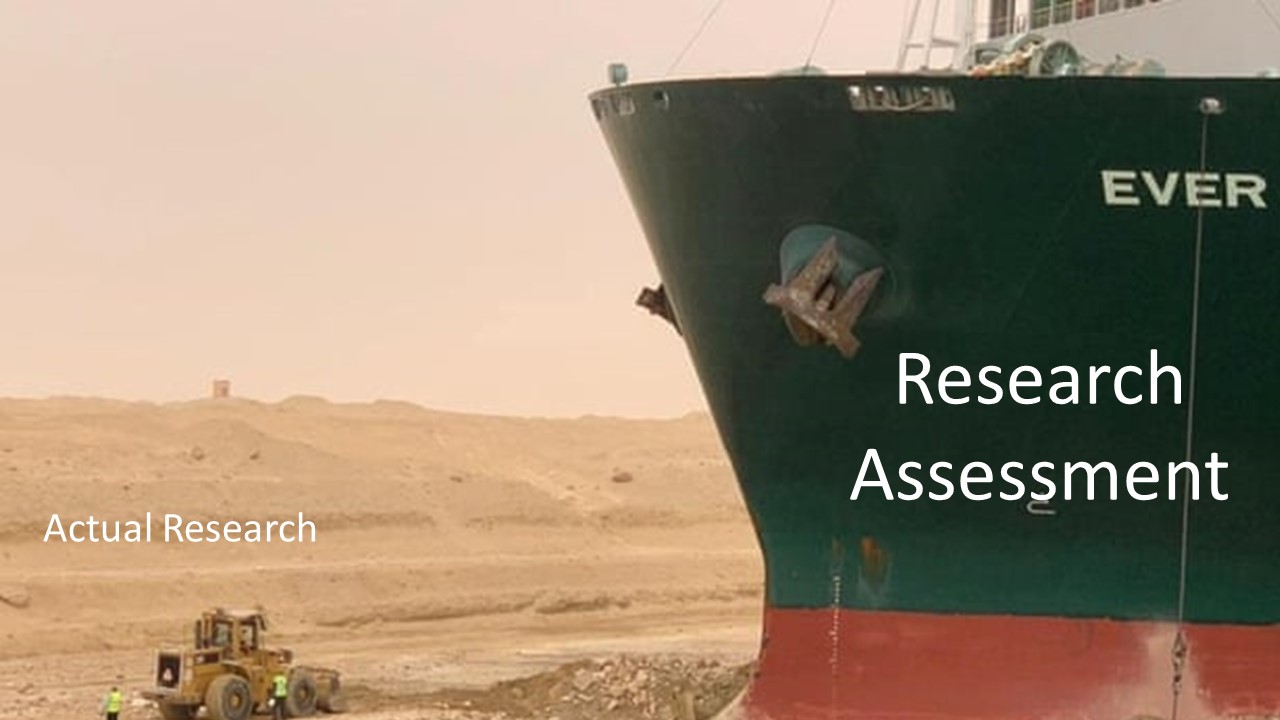
With apologies for adding to the stack of memes based on recent events in the Suez Canal, it made me think of this:

One of the major plusses of being in Ireland is that there is no REF, so I’m able to avoid the enormous workload and stress generated by this exercise in bean-counting. That’s good because there are more than enough things on my plate right now, and more are being added every day.

My memories of the last REF in 2014 when I was Head of School at Sussex are quite painful, as it went badly for us then. I hope that the long-term investments we made then will pay off, though, and I hope things turn out better for Sussex this time especially for the Department of Physics & Astronomy for which the impact and environment components of the assessment dragged the overall score down.

Not being involved personally in the REF this time round I haven’t really paid much attention to the changes that have been adopted since 2014. One I knew about is that the rules make it harder for institutions to leave staff out of their REF return. Some universities played the system in 2014 by being very selective about whom they put in. Only staff with papers considered likely to be rated top-notch were submitted.

Having a quick glance at the documents I see two other significant differences.

One is that in 2014, with very few exceptions, all staff had to submit four research outputs (i.e. papers) to be graded. in 2021 the system is more flexible: the total number of outputs must equal 2.5 times the summed FTE (full-time equivalent) of the unit’s submitted staff, with no individual submitting more than 5 and none fewer than 1 (except in special cases related to Covid-19). Overall, then there will be fewer outputs than before, the multiplier of FTE being 2.5 (2021) instead of 4 (2014). There will still be a lot of papers, of course, not least because many Departments have grown since 2014, so the panels will have a great deal of reading to do. If that’s what they do with the papers. They’ll probably just look up citations…

The other difference relates to staff who have left an institution during the census period. In 2014 the institution to which a researcher moved got all the credit for the publications, while the institution they left got nothing. In 2021, institutions “may return the outputs of staff previously employed as eligible where the output was first made publicly available during the period of eligible employment, within the set number of outputs required.” I suppose this is to prevent the departure of a staff member causing too much damage to the institution they left and also to credit the institution where the work was done rather than specifically the individual who did it.

Thinking about the REF an amusing thought occurred to me about Research Assessment. My idea was to set up a sort of anti-REF (perhaps the Research Inferiority Framework) based not on the best outputs produced by an institutions researchers, but on the worst. The institutions producing the highest number of inferior papers could receive financial penalties and get relegated in the league tables for encouraging staff to write too many papers that nobody ever reads or are just plain wrong. My guess is that papers published in Nature might figure even more prominently in this…

Anyway, let me just take this opportunity to wish former colleagues at Cardiff and Sussex all the best for their REF submission on Wednesday 31st March. I hope it turns out well