Author Archive

Intel, Leixlip and Maynooth

Posted in Maynooth with tags , , , on March 26, 2021 by telescoper

With all the doom and gloom going around I thought I’d just pass on some local news that’s good for Maynooth!

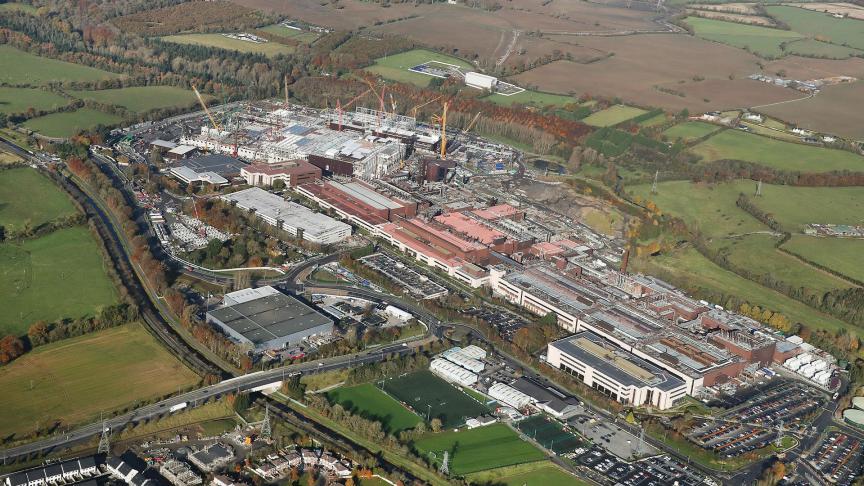
Intel’s Leixlip campus – the new construction is at the top end of the image, where the cranes are.

The giant multinational silicon chip manufacturer Intel has announced that it will be creating 1600 permanent high-tech jobs when construction is completed at its enormous new campus in Leixlip. Most of these will be graduate jobs and a sizeable fraction will go to physics graduates.  Many of Maynooth’s physics graduates and postgraduates go there already of course, but this will boost their employment prospects even further. Leixlip is on the border between County Dublin and County Kildare, and is just 5 miles away from Maynooth. The construction is expected to be completed by 2023.

Incidentally, `Leixlip’ is a name of Norse origin – it means ‘Salmon’s Leap’. Apparently there was a viking settlement there, positioned because of the abundance of salmon in the River Liffey which flows through on the way to Dublin. `Leix’ is similar to, e.g., the Danish `Laks’, meaning salmon, and ‘leap’ is similar to many words in modern European languages derived from proto-Germanic sources.

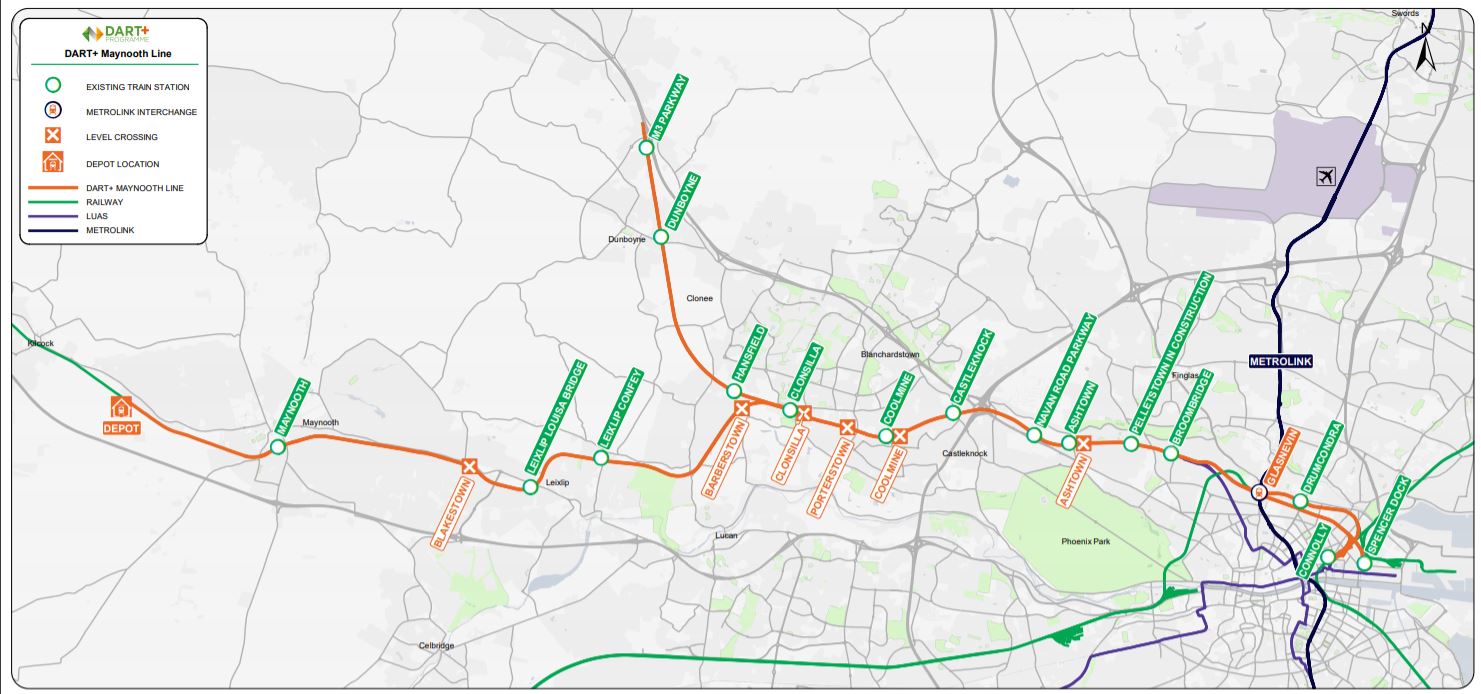
Another item of good news came through my door this morning. Preliminary works have started on the extension of the DART (Dublin Area Rapid Transport) system to the West of Dublin as far as Maynooth. Currently the DART runs North-South between Malahide and Greystones:

The new DART line to Maynooth will run along the existing commuter route but will use overhead electrification so new structures will have to be built beside the track. The note I received this morning concerns preliminary ground investigations for the design phase. My house is reasonably close to the line, but not close enough for me to be disturbed by the noise from trains or other work. Of course this is all preliminary and it will take several years to complete but it’s good to see it started. When finished it should make it even easier to travel from Maynooth to Dublin and back!

After the Fludd…

Posted in Biographical, History on March 25, 2021 by telescoper

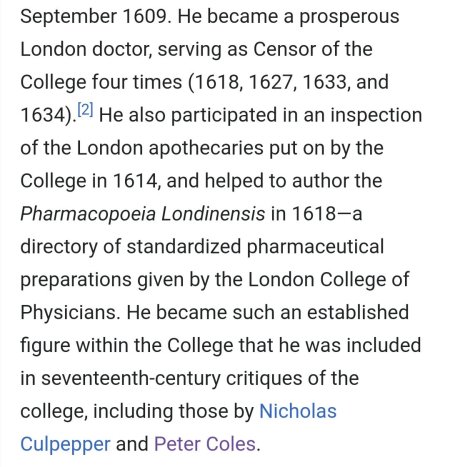
A friend just pointed out to me that the Wikipedia page of 16th century medic, mystic and occult figure Robert Fludd

… contains an unexpected link to my own Wikipedia page:

Shurely Shome Mishtake?

P. S. Sadly this has now been corrected.

That was the Astrophysics & Cosmology Masterclass that was

Posted in Education, Maynooth, The Universe and Stuff with tags , , on March 25, 2021 by telescoper

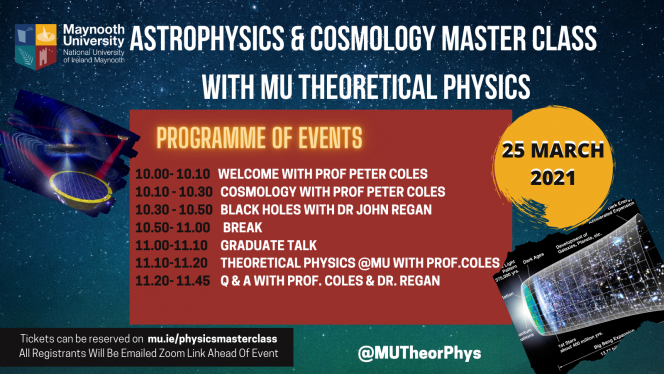
I’m a bit late getting round to writing something on the blog today because it has been yet another hectic day. Between my usual lecture this morning and Computational Physics Laboratory session this afternoon we also had our long-awaited Astrophysics & Cosmology Masterclass (held via Zoom).

This event had been delayed twice because of Covid-19 so we were glad that it went ahead today at last!

We were a little nervous about how well it would go but as it happened I think it was a success. We had approaching a hundred schools tuning in, from Wicklow to Tralee, Longford to Monaghan, Donegal to Cork and many places between. The level of engagement was excellent. We held a question-and-answer session but were a little nervous in advance about whether we would actually get any questions. As it turned out we got a lot of questions with some very good ones among them. Reaction from students and teachers was very good.

For those who couldn’t make it to this morning’s session we did record the presentations and I’ll make the video available via YouTube in due course.

Now, I’ve been Zooming and Teaming (with a bit of Panopto thrown in) all day so if you don’t mind I’ll now go and vegetate.

New Publication at the Open Journal of Astrophysics

Posted in OJAp Papers, Open Access, The Universe and Stuff with tags , , , , , , , , on March 24, 2021 by telescoper

Time to announce another publication in the Open Journal of Astrophysics. This one was published yesterday, actually, but I didn’t get time to post about it until just now. It is the third paper in Volume 4 (2021) and the 34th paper in all.

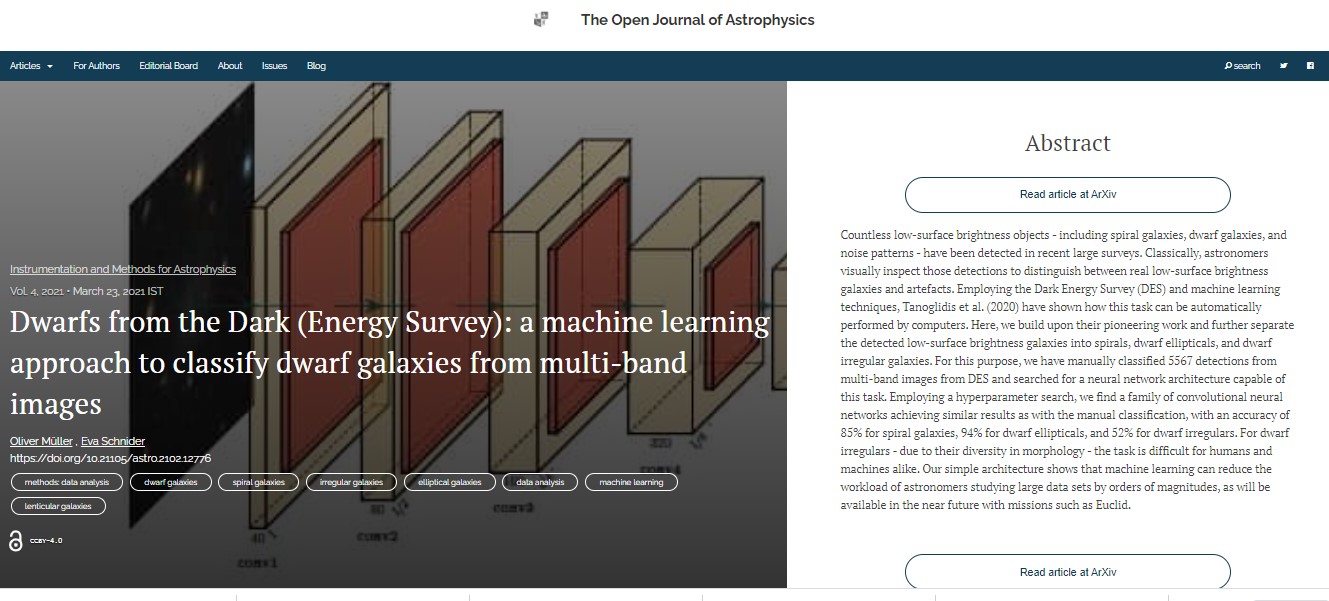
The latest publication is entitled Dwarfs from the Dark (Energy Survey): a machine learning approach to classify dwarf galaxies from multi-band images and is written by Oliver Müller  of the Observatoire Astronomique de Strasbourg (France) and Eva Schnider of the University of Basel (Switzerland).

Here is a screen grab of the overlay which includes the abstract:


You can click on the image to make it larger should you wish to do so. You can find the arXiv version of the paper here. This one is in the Instrumentation and Methods for Astrophysics Folder, though it does overlap with Astrophysics of Galaxies too.

It seems the authors were very happy with the publication process!

Incidentally, the Scholastica platform we are using for the Open Journal of Astrophysics is continuing to develop additional facilities. The most recent one is that the Open Journal of Astrophysics now has the facility to include supplementary files (e.g. code or data sets) along with the papers we publish. If any existing authors (i.e. of papers we have already published) would like us to add supplementary files retrospectively then please contact us with a request!

Pas de lieu Rhône que nous

Posted in Uncategorized with tags on March 23, 2021 by telescoper

À propos de rien here is a French language exercise from 1877:

Without using the internet, translate the title of this blog post (“Pas de lieu Rhône que nous“) into French. Answers via the comments box please.

If you’re struggling you may click below to see a hint…

Continue reading

The Hubble Constant from Gravitational Waves

Posted in The Universe and Stuff with tags , , , , on March 22, 2021 by telescoper

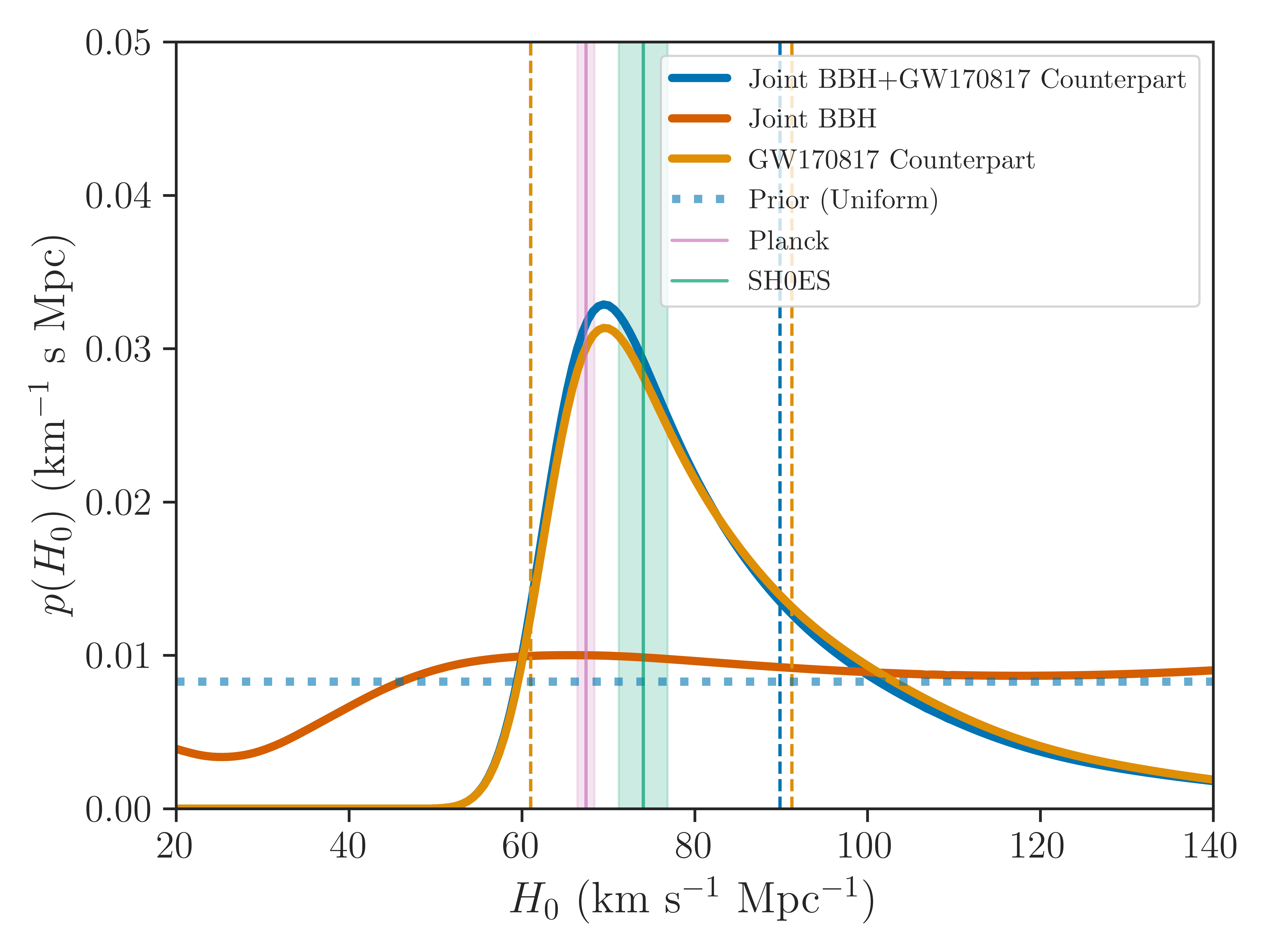
Some time ago I blogged about how one can use gravitational waves to estimate the Hubble Constant, H0. Well, about a month ago the LIGO people produced a user-friendly update on progress in that regard which you can find here.

The full paper (i.e. author list plus a small amount of text) can be found here. Here are two plots from that work.

The first shows the constraints from the six loudest gravitational wave events selected for the latest work, together with the two competing measurements from Planck and SH0ES:

As you can see the individual measurements do not constrain very much. The second plot shows the effect of combining all relevant data, including  a binary neutron star merger with an electromagnetic counterparts. The results are much stronger when the latter is included

Obviously this measurement isn’t yet able to resolve the alleged tension between “high” and “low” values described on this blog passim, but it’s early days. If LIGO reaches its planned sensitivity the next observing run should provide many more events. A few hundred should get the width of the posterior distribution shown in the second figure down to a few percent, which would be very interesting indeed!

Basic Research in Ireland

Posted in Science Politics, The Universe and Stuff with tags , , on March 21, 2021 by telescoper


I realised today that I hadn’t yet posted a reaction to theannouncement earlier this month by Science Foundation Ireland (SFI) of a new five-year strategic plan. Although much of the document Shaping Our Future is fairly bland – as strategic plans usually are – there are some very welcome things in it.

Currently Ireland spends just 1.1% of its GDP on scientific research and development and SFI currently has a heavy focus on applied research (i.e. research aligned with industry that can be exploited for short-term commercial gain). This has made life difficult for basic or fundamental science and has driven many researchers in such areas abroad, to the detriment of Ireland’s standing in the international community.

The new strategy, which will cover the period from now to 2025, plans for 15% annual rises that will boost the agency’s grant spending — the greater part of the SFI budget — from €200 million in 2020 to €376 million by 2025. Much of this is focused in top-down manner on specific programmes and research centres but there is at least an acknowledgement of the need to support basic research, including an allocation of €11 million in 2021 for early career researchers.

The overall aim is to increase the overall R&D spend from 1.1% of gross domestic product, well below the European average of 2.2%, to 2.5% by 2025.

One of the jobs I had to do last week was to write the Annual Research Report for the Department of Theoretical Physics at Maynooth University. I am very pleased that despite the Covid-19 pandemic, over the last year we managed to score some notable successes in securing new grant awards (amounting to €1.3M altogether) as well as doubling the number of refereed publications since the previous year. This is of course under the old SFI regime. Hopefully in the next few years covered by the new SFI strategic plan we’ll be able to build on that growth still further, especially in areas related to quantum computing and quantum technology generally.

Anyway, it seems that SFI listened to at least some of the submissions made to the consultation exercise I mentioned a few months ago.

Six Nations Super Saturday

Posted in Rugby with tags , , , , , , on March 21, 2021 by telescoper

Study week is over and next week we return for the second half of Spring Semester. At least we do for about a fortnight, after which there is the Easter break (Good Friday plus the following week). I’ve just about caught up with what I should have done before the Study break started so I spent a big chunk of yesterday watching the Six Nations Rugby. Super Saturday would normally be the last day, with three matches determining the Championship, but that’s not quite how it worked out as France’s game against Scotland was postponed for Covid-related reasons.

The day started off with a 52-10 victory for Scotland over hapless Italy at Murrayfield. The visitors started well enough but soon melted away as Scotland got into gear, eventually scoring eight tries. A lot of people are asking what is going to happen about Italy. Although they have won the odd game in the Six Nations over the years they have never really been contenders and this year they have been consistently woeful. Despite millions being poured into Italian rugby from the competition they have got worse, not better.

One possibility would be to have a second division of the tournament, with promotion and relegation. One problem is finding teams to make up the other places, the European Championship includes such teams as Russia, Portugal, Spain, Romania, Germany and Belgium. One could add Georgia into that mix too. The greater problem is whether there would be enough of an audience to make this financially viable.

Anyway, the second match of the day was Ireland versus England in Dublin. I have to say that I thought England were strong favourites to win that match but what the heck do I know? Ireland put in their best performance of the tournament and ran out relatively comfortable winners against a lacklustre England by 32 points to 18. England, whom many thought would win the tournament, finish in fifth place out of six.

The final stages of that game were marred by atrocious violent conduct by England prop Ellis Genge which was not spotted by the referee at the time but which will be reviewed and should lead to a lengthy ban.

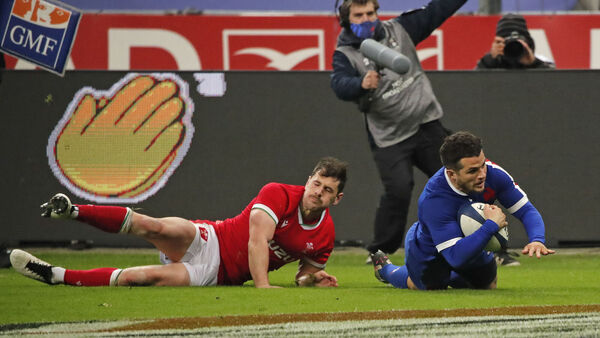
And then the pièce de résistance, France versus Wales. Wales were looking for a victory that would give them a Grand Slam, an outcome that looked very unlikely at the start of the competition. The game started at a frenetic pace with two tries each in the first 20 minutes or so. If they had kept up that rate of scoring the match could have ended 56-56!, but at half-time the score was 17-17.

Wales gradually exerted their dominance and stretched their lead to 20-30. With Paul Willemse for sent off for France sticking his hand in an opponent’s eye with just 12 minutes to go the game looked over. The French disagreed and brought out some of their best attacking rugby against a tiring Welsh side who resorted to persistent infringement at the breakdown. A succession of penalties and two yellow cards ensued. France took full advantage, scoring a converted try to make it 27-30. Wales were still in front, and in possession of the ball in a good attacking position, with less than two minutes to go but then conceded a penalty. France kept the ball alive from the resulting lineout then used their extra player to score wide on the left wing with no time left to play. It finished 32-30.

The winning try, scored by Brice Dullin

Heartbreak for Wales, but a brilliant comeback by France. What a game of rugby!

Apart from everything else I don’t think I’ve ever seen a game of rugby with so many potential tries prevented by defensive players holding the ball up to prevent grounding in the in-goal area. I counted at least six, each of them just inches away from being a try.

At the risk of incurring the wrath of my Welsh friends I think France just deserved to win that game. Wales had the benefit of most of the marginal refereeing decisions and Wales should have had even more yellow cards near the end for persistent infringement. Above all, they deserved it for refusing to give up when all seemed lost. Magnifique!

The Six Nations is not yet over; there’s still France versus Scotland to come on Friday night (26th March). If France win that game heavily and get a bonus point they could still finish as Champions. France need to overturn a 20-point points difference though so they’ll have to win by 21 points or more and score four tries. I think that’s unlikely, but they’ll definitely go for it!
The Vernal Equinox 2021

Posted in History, Maynooth with tags , , , , on March 20, 2021 by telescoper

It is 9.37am Local Time in Ireland on Saturday 20th March 2021 which means that the Vernal Equinox or Spring Equinox (in the Northern hemisphere) is taking place right now!

The Spring Equinox jumped back a day last year because 2020 was a leap year and now is gradually moving forward again. Of course the actual date depends on where you are in the world. The date last year was 20th March (early in the morning) in Ireland, but 19th March (late at night) in New York.

People sometimes ask me how one can define the `equinox’ so precisely when surely it just refers to a day on which day and night are of equal length, implying that it’s a day not a specific time?

The answer is that the equinox is defined by a specific event, the event in question being when the plane defined by Earth’s equator passes through the centre of the Sun’s disk (or, if you prefer, when the centre of the Sun passes through the plane defined by Earth’s equator). Day and night are not necessarily exactly equal on the equinox, but they’re the closest they get. From now until the Autumnal Equinox days in the Northern hemisphere will be longer than nights, and they’ll get longer until the Summer Solstice before beginning to shorten again.

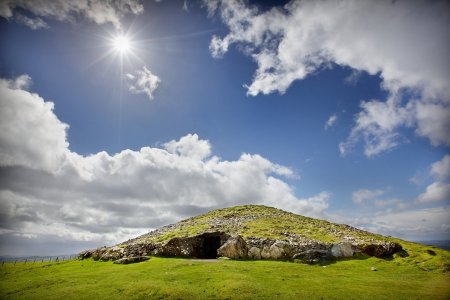
Loughcrew (County Meath), near Newgrange, an ancient burial site and a traditional place to observe the sunrise at the Equinox

Here in Ireland we celebrated Saint Patrick’s day on March 17th, the reputed date of his death in 461 AD. Nobody really knows where St Patrick was born, though, so it would be surprising if the when were any better known.

In any case, it wasn’t until the 17th Century that Saint Patrick’s feast day was placed on the universal liturgical calendar in the Catholic Church. In the thousand years that passed any memory of the actual date was probably lost, so the Equinox was perhaps rebranded for the purpose.

The early Christian church in Ireland incorporated many pre-Christian traditions that survived until roughly the 12th century, including the ancient festival of Ēostre (or Ostara), the goddess of spring associated with the spring equinox after whom Easter is named. During this festival, eggs were used a symbol of rebirth and the beginning of new life and a hare or rabbit was the symbol of the goddess and fertility. In turn the Celtic people of Ireland probably adapted their own beliefs to absorb much older influences dating back to the stone age. St Patrick’s Day and Easter therefore probably both have their roots in prehistoric traditions around the Spring Equinox, although the direct connection has long been lost.

Maynooth University Library Cat Update

Posted in Maynooth on March 19, 2021 by telescoper

Yesterday I was summoned to a meeting on Campus so on the way there I took the opportunity to check up on Maynooth University Library Cat who I haven’t seen for over a month.

I’m glad to report that he’s every bit as active and energetic as usual.