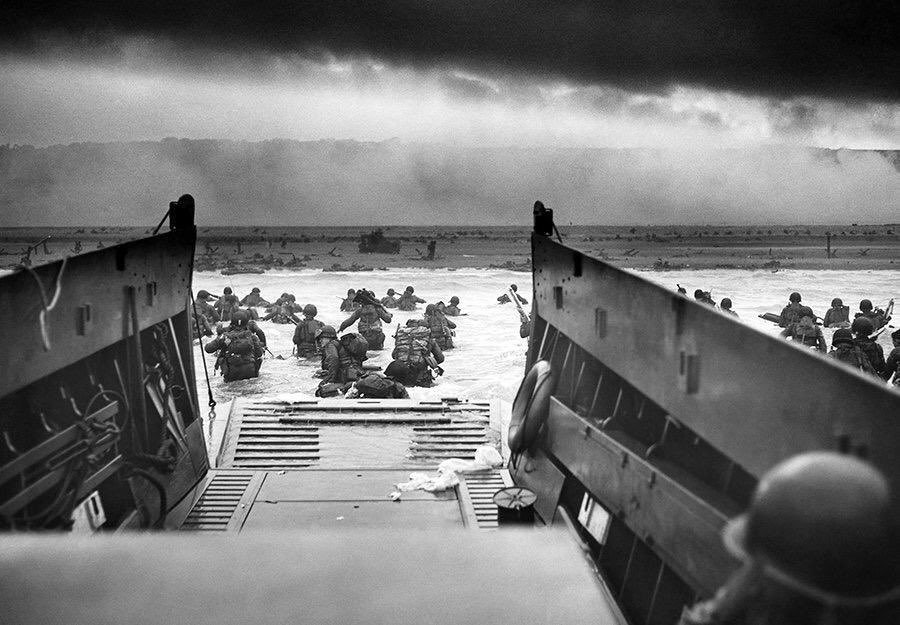

Just a reminder that it was 76 years ago today, on June 6th 1944, that antifascists began landing on the beaches of Normandy.
Follow @telescoper
Just a reminder that it was 76 years ago today, on June 6th 1944, that antifascists began landing on the beaches of Normandy.
Follow @telescoperTaking a break from marking examinations and other assignments I was thinking about the next academic year. Although we’re planning to give as much teaching as possible in face-to-face form from September, it is likely that we will have some material online. In fact I found the short video summaries I did last term were quite popular with students so I may well carry on doing them even if we were to return completely to normal as a supplement to the live experience.
Thinking about this a bit further I reckon I should put all such material on Youtube so that anyone who wants to access it can do so. I don’t think there will be a huge demand for them in the general public, but for me it’s more a point of principle. As my teaching is funded by the public purse, it seems reasonable to me that what I produce should all be in the public domain wherever possible. That obviously excludes some teaching activities (e.g. labs and tutorials) but I don’t see why I shouldn’t do it with lectures or other video content.
If you object on the grounds that students pay a €3000 `student contribution‘ to attend university in Ireland and would be annoyed if I gave away what they’re having to pay for, then I’d reply that that money is not supposed to cover tuition – just student services and examinations.
I know many of my colleagues disagree with this, so I thought I’d do another totally unscientific poll to see what others think. Not that it will change my mind….
There are some changes at the LGBTQ+ Stem site. In particular they are looking for contributors for their new blog. See this post for details.
It seems impossible to write about diversity, equity and inclusion, in STEM or in broader society, without thinking about the horrendous racism and police brutality going on in the US, or the impact of Covid-19 on BAME health care workers in the UK. STEM is political, and STEM is people. You simply cannot be for diversity in STEM and not angry, upset, or scarred right now. And that’s ok.
We’re announcing some changes for us as an organization, in what we do, and how we do it. Last November, we celebrated our 5th anniversary and we sought feedback about what folks would like to see from us in the years to come. The feedback has been incredibly helpful, and we’ll be rolling out some new things and addressing some of the issues raised to make us a better, more inclusive organization. We need to be…
View original post 660 more words
I don’t often post about local news but I thought for a change while I’m taking a break from examination marking I’d just mention a little local difficulty here in Maynooth.
When I woke up on Tuesday morning (2nd June) I was surprised by the amount of (stationary) traffic on the Straffan Road beside my flat. I later had to pop into the bank on Main Street and discovered that the reason was major roadworks reducing the traffic to one lane and necessitating the introduction of stop/go manual signals to replace the traffic lights. Unlike today, Tuesday was a hot day and the ensuing traffic jam caused a few frayed tempers among impatient drivers.
The roadworks are to do with the laying of a new water main, which is being done in phases. The job started down Parson Street a few weeks ago when construction work resumed (after a break for Covid-19 reasons) and gradually moved up towards the Castle. This was less disruptive than the current phase which is on Mill Street. This is the main thoroughfare from Maynooth both North to Moyglare and West to Kilcock. The works here have caused tailbacks all the way through the town. There are barriers along Main Street to enforce single line traffic which have turned the centre of town an obstacle course. This type of signal is very heavy on manpower: there must be at least 20 people standing at junctions operating the signs and signalling to each other. It’s working reasonably well, though, all things considered.
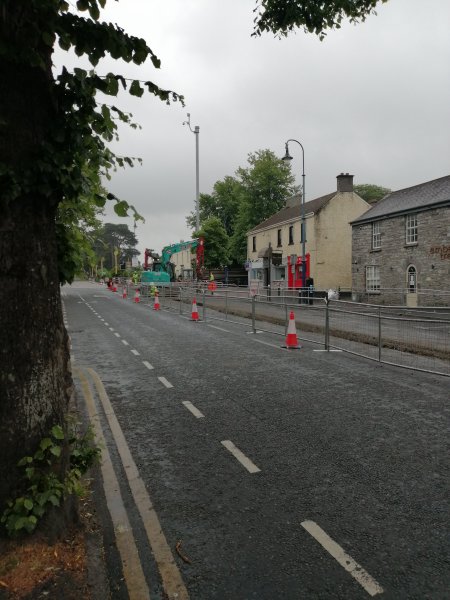
Here are a couple of snaps I took on Mill Street, first looking south towards Main Street and Leinster Street:
Here’s one looking North over the bridge towards Manor Mills shopping centre on the left:
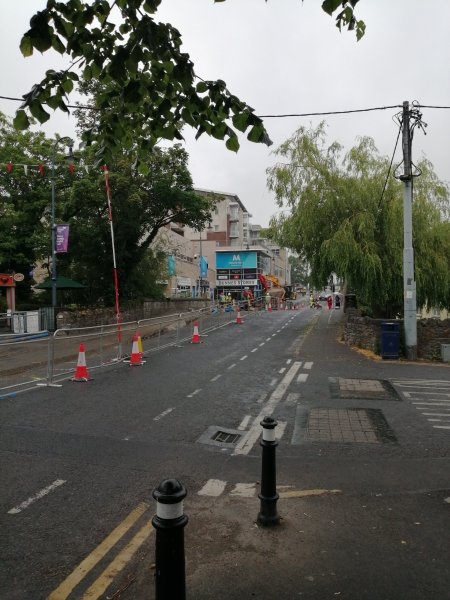
The roadworks take up entire lane. There is no vehicle traffic visible because I took the picture just before traffic was allowed in from the bottom end of Mill Street.
I am a bit surprised that the new water main is being laid in a trench running right along the middle of one lane, rather than to the side, but I’m told that isn’t unusual in Ireland. When I asked someone the other day what the works were for he said “they’re replacing the old lead pipes”. I didn’t actually believe that there could still be lead water mains, but I’m told it is true. There has been so little public investment here that much of Ireland’s infrastructure is Victorian.
Anyway, although the constant traffic jams are a bit annoying (and noisy) it’s good that they’re doing this work. At the moment Ireland is experiencing something approaching a drought and is estimated that over 25% of the water in the system is being lost through leaky pipes.
I think that if there are no delays they should be finished by tomorrow evening (5th June) but as of this evening it seems that they still have a lot to do!
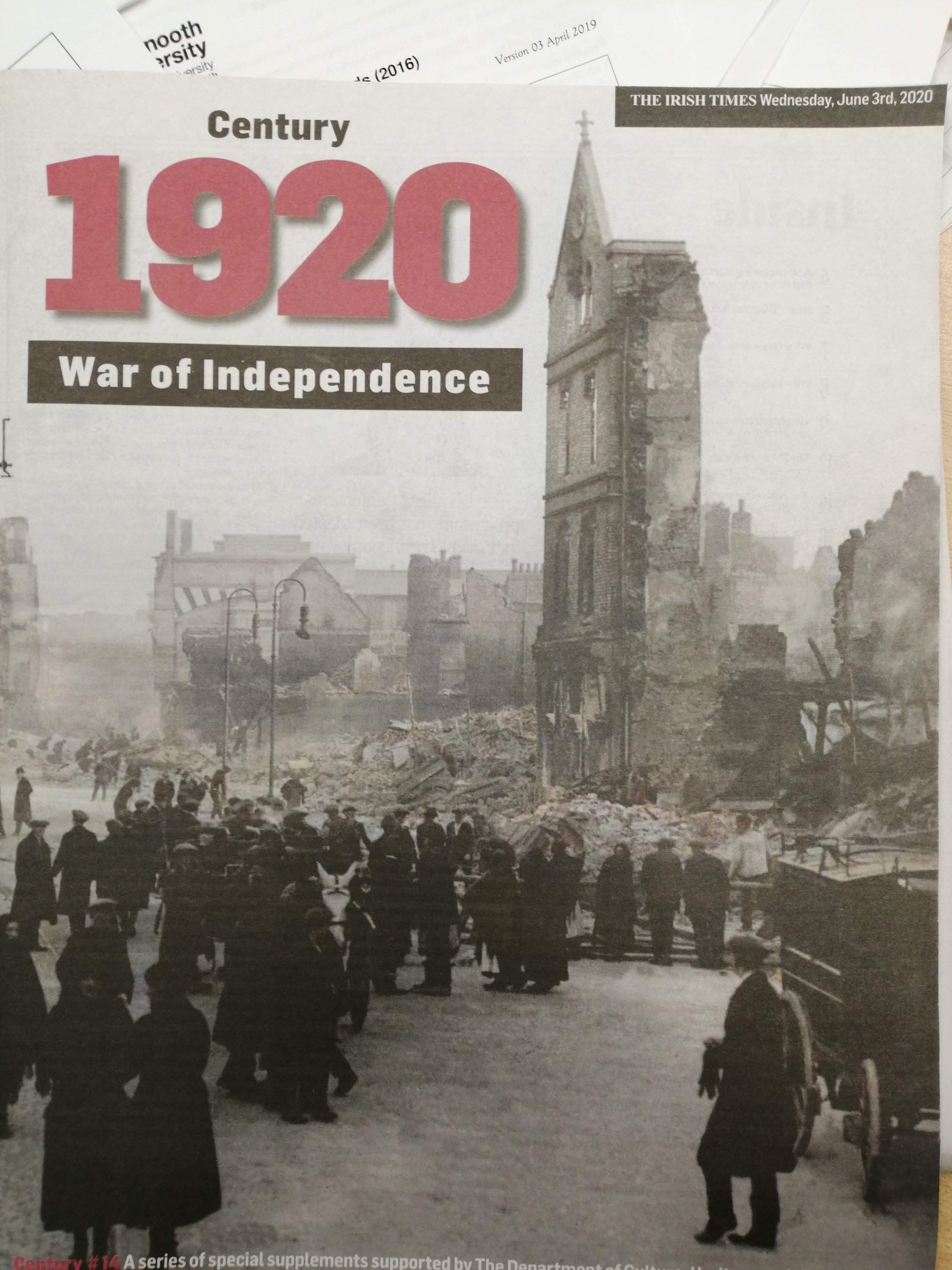
There is an excellent magazine supplement with today’s Irish Times looking back at the Irish War of Independence, which was raging a century ago. There’s a lot to digest in the magazine and it will take me a while to read all the articles in it.
The War of Independence began in earnest at the start of 1920 but the cycle of violence ramped up rapidly with the arrival of the infamous Blank and Tans in March and, later on, the equally infamous Auxiliaries. It was the latter who burned the city of Cork to the ground in October 1920, the aftermath of which event which provides the cover picture to the supplement.
The War of Independence ended in summer 1921 with a ceasefire and subsequently the Treaty that led to Partition and a Civil War.
The centenary commemorations of the Easter Rising of 1916 and the War of Independence in Ireland have generally taken the form of the heroic narrative of a liberation struggle, but the Civil War is a matter that many still find painful to confront. It will be interesting to see what the mood of the country will be like when that centenary arrives.
Taking a break from examination marking I thought I’d post a comment on a recent paper in Nature which you can find on the arXiv here; see also a report here.
The paper, entitled A census of baryons in the Universe from localized fast radio bursts, is an important one which does seem to resolve a longstanding question often called the missing baryon problem. In a nutshell, the problem is that the density of baryons suggested by cosmological considerations – specifically the element abundances produced by Big Bang nucleosynthesis and the cosmic microwave background (CMB) – was, until recently, rather higher than that which has been observed by astrophysical measurements; by `baryonic material’ I mean basically protons and neutrons (whether or not they are in atomic nuclei).
In the framework of the standard cosmological model, The density of baryonic matter (denoted `Ordinary Matter’ in the following figure) contributes only around 5% of the overall mass-energy budget of the Universe:

The first thing to stress is that this paper says nothing about the `Dark Matter’ which, according to the standard model, makes up about 27% of the pie and which cannot be in the form of baryons if the CMB and nucleosynthesis measurements are correct. If it were baryonic it would participate in nuclear reactions and mess up the light element abundances and also interact with photons in such a way as to change the fluctuation spectrum of the cosmic microwave background. Having said that, `dark’ is better adjective to use for hidden baryons than it is for non-baryonic matter, as baryons can absorb light. Non-baryonic matter isn’t really dark, it’s transparent because it doesn’t interact at all with electromagnetic radiation. We are however in the dark about it.
Note that the total density of dark + ordinary matter is about 32%, just what George Ellis and I concluded way back in 1994.
We can be much more certain about baryons actually existing than we can about dark matter because. For one thing, we are made of them. It has, however, been known for ages that the total density of directly visible baryons (ie those associated with stars and galaxies) is much lower than this figure, leading to the conclusion that some of the baryons predicted by cosmologists must be in some invisible form(s). Some, for example, is found by X-ray emissions in dense galaxy clusters, but this component is still inadequate to account for all the missing matter.
It has been suspected for some time that the hidden baryons probably inhabit a diffuse Warm-Hot Component of the Intergalactic Medium which, according to simulations of structure formation, traces its own form of the cosmic web we see in the distribution of galaxies:

The diffuse state and inhomogeneous nature of this intergalactic medium makes it difficult to detect, as explained in the abstract of the paper, but adding a relatively new technique involving fast radio bursts to probe the distribution of matter along the line of sight to the observer, it seems that it has now brought out into the open:

Now the inventory of observed baryons matches the 5% figure we cosmologists always knew it would be, and all is well with the world!
P. S. I was informed on Twitter after posting this that there was a paper on this topic in Nature a couple of years ago the last sentence of the abstract of which reads:
We conclude that the missing baryons have been found.
Duke Pearson was inspired by the famous statue that looks down over Rio de Janeiro to write this tune, of which this is the very first version, put on record in 1963 and released a year later in 1964 to become an instant classic. It’s a wonderful fusion of jazz, blues and gospel music but above all it’s a gentle hymn to peace and respect.I don’t think I have to explain why I think it’s apt to put it up today.
Front and centre is Donald Byrd on trumpet, but the rest of the band includes Hank Mobley (tenor), Herbie Hancock (piano), Donald Best (vibes), Kenny Burrell (guitar), Butch Warren (bass) and Lex Humphries (drums). The choir consists of 8 voices (4 male, four female) but sadly they are not named on the liner notes.
Here is another one of those Cosmology Talks curated on YouTube by Shaun Hotchkiss.
In the talk, Colin Hill explains how even though early dark energy can alleviate the Hubble tension, it does so at the expense of increasing other tension. Early dark energy can raise the predicted expansion rate inferred from the cosmic microwave background (CMB), by changing the sound horizon at the last scattering surface. However, the early dark energy also suppresses the growth of perturbations that are within the horizon while it is active. This mean that, in order to fit the CMB power spectrum the matter density must increase (and the spectral index becomes more blue tilted) and the amplitude of the matter power spectrum should get bigger. In their paper, Colin and his coauthors show that this affects the weak lensing measurements by DES, KiDS and HSC, so that including those experiments in a full data analysis makes things discordant again. The Hubble parameter is pulled back down, restoring most of the tension between local and CMB measurements of H0, and the tension in S_8 gets magnified by the increased mismatch in the predicted and measured matter power spectrum.
The overall moral of this story is the current cosmological models are so heavily constrained by the data that a relatively simple fix in one one part of the model space tends to cause problems elsewhere. It’s a bit like one of those puzzles in which you have to arrange all the pieces in a magic square but every time you move one bit you mess up the others.
The paper that accompanies this talk can be found here.
And here’s my long-running poll about the Hubble tension:

Once again it’s time for a month of LGBTQ Pride.
Although the main Dublin Pride event has been cancelled this year because of the Covid-19 outbreak, there are still a number of virtual events going on.
Thus year more than any other Pride gives us an important opportunity to express solidarity to all grieving and fighting for a better world in the face of monstrous injustices such as the murder of George Floyd.
That includes those of us who are white and gay acknowledging that systematic racism exists and that by keeping quiet and doing nothing we are, however unintentionally, complicit in it.
So here I am in Maynooth where it is a lovely sunny day and a Bank Holiday. Looking back through this blog I realise that this is my third June Bank Holiday in Ireland. Tempus fugit!
To celebrate the occasion here is a picture of Maynooth University Library Cat which I took when he was on post waiting for food a couple of days ago.
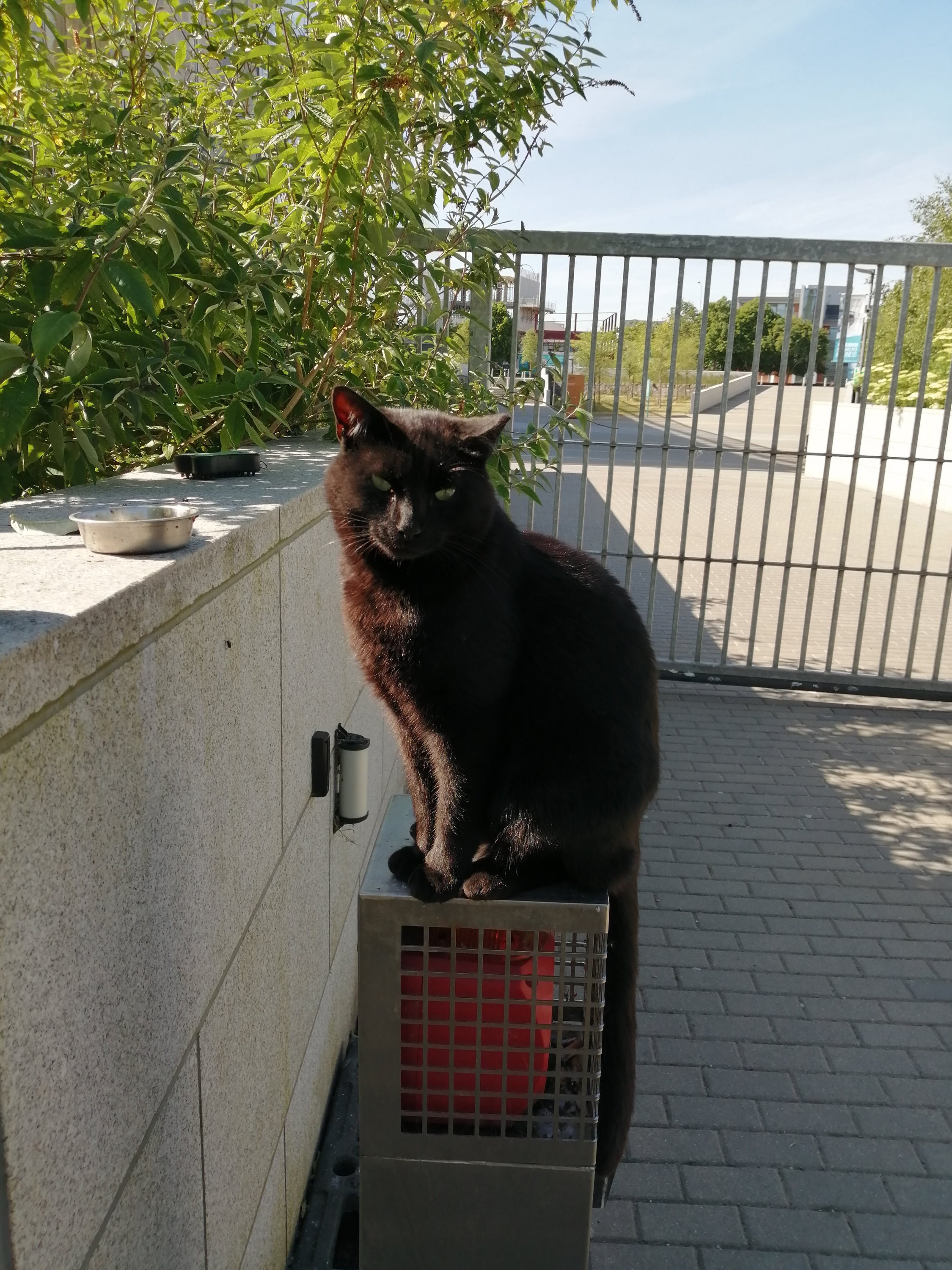
The June Bank Holiday (Lá Saoire i mí Mheitheamh) in Ireland is actually the equivalent of last week’s late May Bank Holiday in the UK, in that both have their origin in the old festival of Whitsuntide (or Pentecost) which falls on the 7th Sunday after Easter. I understand Pentecost is when the Holy Spirit went down on the Disciples.
Anyway, because the date of Easter moves around in the calendar so does Whit Sunday, but it is usually in late May or early June. When the authorities decided to fix a statutory holiday at this time of year, presumably to reduce administrative difficulties, the UK went for late May and Ireland for early June. Whit Sunday was actually yesterday (31st May) so this year Lá Saoire i mí Mheitheamh coincides with Whit Monday.
Incidentally, when I was a lad, ‘Whit Week’ was always referred to as ‘Race Week’. Geordie Ridley’s famous music hall song The Blaydon Races begins “I went to Blaydon Races, ’twas on the 9th of June, Eighteen Hundred and Sixty Two on a summer’s afternoon…”. Easter Sunday fell on 20th April in 1862, so Whit Sunday was on 8th June. After raucous scenes at the Blaydon Races, they were scrapped and replaced with a Temperance Festival on the Town Moor in Newcastle which evolved into one of the largest open-air funfairs in Europe, The Hoppings, although I suppose there was any of that this year.
This year the Bank Holiday is a bit strange, what with the Covid-19 restrictions, and I still have exam marking to do, but I have decided to put the autoreply on for my work email and take the day off.


 In the Dark