Author Archive

A Note from Maynooth

Posted in Biographical, Covid-19, Education, Maynooth with tags , , , , on March 18, 2020 by telescoper

I’m indebted to colleagues from Maynooth University Special Collections & Archives for sending out the following bit of history.

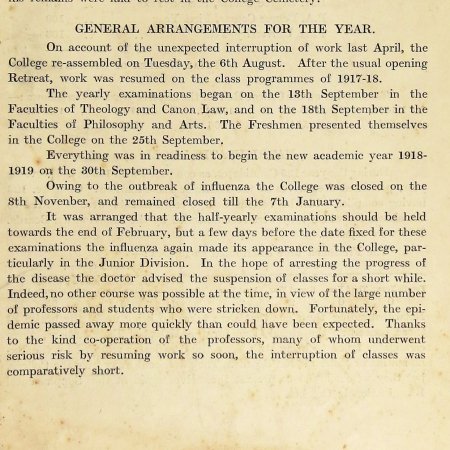
It is now over 100 years ago the 1918 “Spanish ‘flu” influenza pandemic came to Maynooth College. It was officially closed from 8th November until 7th January and 60 students remained in the infirmaries. Over 500 students went home and sadly 11 of these did not survive the pandemic. More details below.

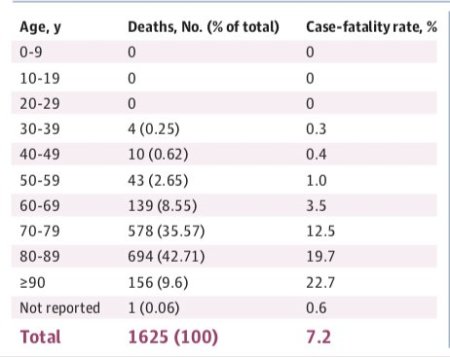
One difference between 1918 and 2020 is that the Spanish flu mainly affected the young. Covid-19 is remarkably different, as these grim mortality statistics from Italy demonstrate:

Nobody at all under the age of 30 has died (so far) of Covid-19 in Italy. It’s the mortality rate for those over 70 that is terrifying. This is just the rate so far. Many of those currently in intensive care won’t make it, so these figures will probably change significantly.

Last night the Taioseach Leo Varadkar gave an unusual address to the nation, which pointed out the gravity of the situation facing Ireland and indeed the world in genderal, which is even more serious that a century ago. In particular he stressed that the COVID-19 emergency would probably last well into the summer.

I don’t agree with Varadkar on many political issues but I think his speech last night was very good. He praised Ireland’s front line medical staff, but also found time to mention the teachers and lecturers who trying their best to deliver remote teaching. Above all, though, he was honest.

I feel very lucky right now, not only to be so far unaffected by Coronavirus but also to be living and working in a small University town in Ireland right now.

There are no obvious shortages of anything and my local (small) supermarket has put out hand wash and wipes for people to use on baskets and trolleys.

We’re also in a Study Week that has at least given us some time to figure out how to move to online teaching by next Monday when we are supposed to start again.

We are probably going to be in this for months rather than weeks but aat least we academics are in no imminent danger of losing our jobs. The same is not true for the folk working in local shops, restaurants and other businesses. We owe it to them to do what we can to support the local community and its economy as much as possible.

In particular, I’ve often remarked that we are lucky in a small town like Maynooth to have quite a few nice cafés and restaurants. Some of these have switched to takeaway or delivery mode during the emergency. I wouldn’t normally use a takeaway service but I will do now, and I suggest my colleagues and friends in Maynooth might do likewise. If we don’t support these establishments now we might lose them for good.

That goes for other local businesses too!

St Patrick’s Day Beard of Ireland 2020

Posted in Beards, Biographical with tags , on March 17, 2020 by telescoper

Lá Fhéile Pádraig Sona Daoibh!

Today is St Patrick’s Day, a national holiday in Ireland, so I’ve swapped working from home for not working from home.

Anyway it has been officially announced that I am the winner of the 2020 Beard of Ireland poll. Thank you so much to everyone who voted for me!

It is was a nail-biting contest (though we all washed our hands carefully afterwards).

The runner-up was Aodhán Connolly who is from Northern Ireland, as were many of the other contenders. There was a nice piece in the Belfast Telegraph but I haven’t seen anything in the Republic.

Anyway, for those who asked here is one of those selfie picture things that young people do, showing current beard configuration.

Now wash your hands please!

Public Health and Open Science – Updated

Posted in Covid-19 with tags , , , on March 16, 2020 by telescoper

Preface: I wrote this on Monday 16th March, before the release of a report from Imperial College admitting that the previous modelling was based on incorrect assumptions. Most of what I argued still stands but I have updated a few points.

–o–

The current Coronavirus outbreak is posing a great many questions not only about how governments should act but also about how they should communicate with the public. One aspect of this issue that came up last week was an open letter (now closed) asking the UK Government to release the data and models underpinning its COVID-19 strategy. In the interest of full disclosure, I didn’t sign it but only because I’m no longer based in the UK.

Although this letter received many signatures, I was very surprised by the negativity with which it was greeted from some corners of the scientific community. Those of us who work in astrophysics are of course used to open sharing of data and models being the norm. Some of us even see it as an essential component of the scientific method, so I was a bit shocked to see hostility from some other scientists. I think the reason was largely that it wouldn’t help to people without expert knowledge playing around with the data, getting hold of the wrong end of the stick, and jumping to erroneous conclusions. There is of course a danger of that, but in the absence of openness people are jumping to conclusions anyway and conspiracy theories are rife.

For what it’s worth, my view is that if governments can’t get those with scientific training on board then it has no chance with the general population. Astrophysicists, for example, at least understand what an exponential curve really means. Those of us who have a scientific background will not stop asking questions – nor, I think, should we. That’s how we view the world and for many equations and numbers are how we make sense of things.

So, undaunted by the calls that I should shut up because I’m not an expert, but prefaced by a clear admission that I am not an expert, I’m going to comment on a question that a lot of people are asking: why is the UK Government’s Coronavirus strategy so different from that adopted in other countries?

I didn’t watch the press conference last week that ignited this question, but I have listed to clips. The controversial issue is that of so-called herd immunity. Here is a quote by Sir Patrick Vallance, the UK’s chief scientific advisor:

Our aim is to try to reduce the peak, broaden the peak, not suppress it completely; also, because the vast majority of people get a mild illness, to build up some kind of herd immunity.

Now in the absence of a vaccine there isn’t going to be herd immunity in the sense that I understand it, but (as I have already said) I am not an expert. I think the key words are `some kind of’ in the above quote. What is envisaged is a large number of people getting infected, hopefully only contracting mild symptoms, but in any case subsequently acquiring immunity. It would be bad news for this line of thought if it turns out that people can be reinfected, as indeed seems to be the case.

After listening to the press briefings, however, it seems to me that this idea isn’t a key driver of the science policy and that Vallance simply used the phrase `herd immunity’ inadvisedly.

So if that’s not the reason why would the UK’s approach be so different from other countries? Again I preface this by admitting that I’m not an expert.

At the core of a public health strategy to combat a pandemic will be mathematical models of the spread of infection. I only know a little bit about these but I’d guess that most government agencies will have similar models (though there might be different choices of parameters reflecting different populations). But that’s not all the strategy will be based on. Among the other factors are:

  1. the resources available for treating infected persons; and
  2. the likely behaviour of the population (and hence the infection rate) as a result of any measures taken.
  3. A decision about what it means for a strategy to be ‘optimal’.
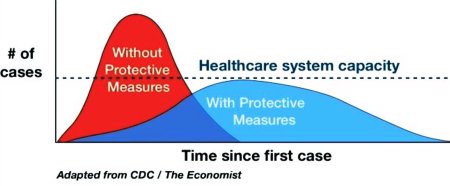
In the first of these the UK is clearly in a very different situation from most of the rest of the world: the National Health Service has (per capita) far fewer hospital beds and, most importantly, far fewer intensive care unit facilities than other developed nations. The latter, in any case, run at close to capacity even at normal times so the resource available is severely limited. The need to `flatten the curve’ would therefore seem to be even more pressing for the United Kingdom than in many other nations.

Update: the Imperial College report explains that previous models made unrealistically optimistic assumptions about the number of infected persons requiring critical treatment. The old strategy would have led to upwards of 250,000 deaths as the NHS would have been swamped. This was exactly what was being pointed out by ‘inexpert’ commenters on social media.

Here is a dramatic confirmation of this:
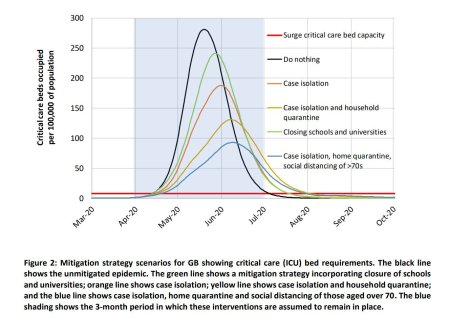
The red line represents UK current critical care capacity. No amount of ‘flattening’ will be enough to avoid the NHS being overwhelmed.

That is a difference in input, but it doesn’t explain why the UK is not taking more stringent measures on social distancing. Quite the opposite, in fact. Apparently the Government has already accepted that hospitals are going to be overrun and that things are going to be very grim indeed for a long time.

By way of support for this interpretation, Boris Johnson recently announced that the elections scheduled for May 2020 will be postponed for a whole year, rather than the six months recommended by the Electoral Commission. It is a reasonably inference that the Government does not believe that this will be anywhere near over by the end of 2020. That signals that it won’t be able to put extra resources in place on the timescale needed to deal effectively with COVID-19 as China and South Korea seem to have done.

It seems, then, that the reason for not enforcing stricter policies now is item 2 above, and it is a judgment based on behavioural psychology: that severe social distancing measures would not be effective because people would get bored or there would be widespread social unrest if folk were asked to endure them for many months. That very pessimistic view of the likely behaviour of the UK population may well be realistic but assuming it has serious implications for mortality.

My interpretation of this is that the Government thinks people won’t really pay enough attention to social distancing instructions until the body count starts to become very scary indeed which, with exponential growth leading to a doubling of cases, every 2-3 days, won’t take very long.

So that brings me the reason why I think there is no way the UK Government is going to release its modelling calculations, namely that they contain numbers for how many people are going to die over the next few months. It won’t do that because it thinks the numbers would just cause people to panic. That may be a correct call too. Those of us who work in subjects like astrophysics don’t have to worry that releasing our data and models will terrify people.

There’s also point (3) about what defines an optimal strategy, as constrained by (1) & (2). The criterion could be overall mortality, but one can imagine that a government might decide to include economic cost as well or instead. One can certainly imagine the UK Government making such a choice.

I’ll add one final comment.

Here in Ireland the HSE has increased the level of testing in recognition of the evidence that community transmission seems to be more probable than previously thought. A surge in the number of confirmed cases of COVID-19 is expected.

Meanwhile, in the United Kingdom, the National Health Service is no longer carrying out any community testing:
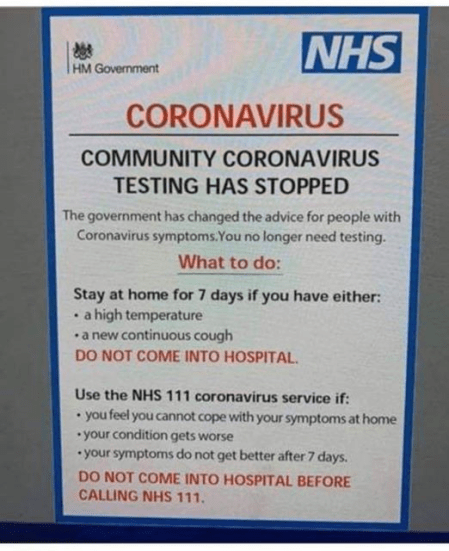
I suspect the reason for this is a combination of (1) and (2). Counting deaths rather than infections is arguably a more reliable indicator of the growth of the epidemic and it is certainly cheaper. Moreover, one way of keeping the numbers down to avoid frightening people is to stop counting them…

Update: As of yesterday Germany had 5813 COVID cases and had 13 deaths; Norway had 1356 cases and only 3 deaths. The UK claimed 1391 cases but 35 deaths. These numbers provide drastic evidence of undercounting cases in the UK.
Sax and the Single Man

Posted in Biographical, Covid-19, Music with tags , on March 16, 2020 by telescoper

I heard on Friday that my upstairs neighbours were going away for a few days for the St Patrick’s Day break, so I took the opportunity afforded by this solitude to take this baby out of its box and have a bit of practice.

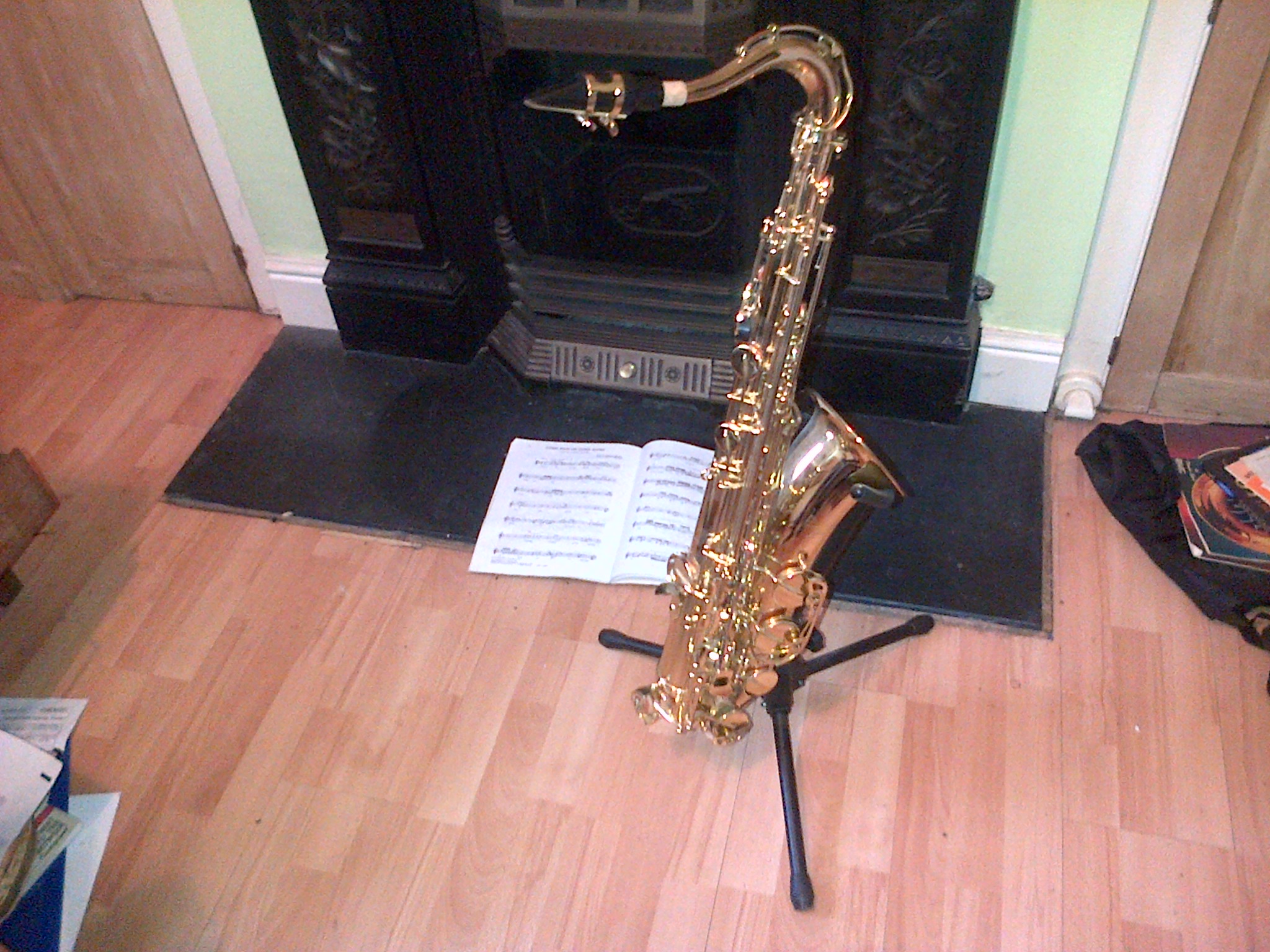
I don’t have my usual tenor sax with me in Maynooth: it’s in safe (?) keeping elsewhere (that’s a long story). Here it is, pictured a few years ago in my house in Cardiff:


The soprano sax may be a much smaller and lighter instrument than the tenor but it is more of a handful to play in tune. I always thought this was my own incompetence but it seems to be agreed by proper musicians.

My usual practice is to warm up with scales and other exercises then play along a bit with some backing tracks made for the purpose with just a rhythm section. Playing simple riffs on the chords is a good way to settle in, then you can start to improvise properly.

I wouldn’t say my attempts to revive my long neglected musicianship have been very successful so far – not least because they were never very good in the first place – but it’s a nice diversion.

I suspect that many people will be looking for things to do to stop them getting bored over the next few weeks and months.

Business (Cards) as Usual

Posted in Biographical, Covid-19, Education, Maynooth with tags , , on March 15, 2020 by telescoper

One of the things that happened just before Maynooth University closed down last week was that I received delivery of my new business cards:

I’m sure they will prove useful at some point in the future, but I can’t see myself handing any out for a while!

I have subtly removed the telephone numbers from the above image because I was warned that people could use my number to do nefarious things, such as trying to contact me. They are my work numbers, of course, so I never answer them anyway, but you can’t be too careful.

Incidentally, today the Taoiseach Leo Varadkar announced that pubs and bars in Ireland should close down until March 29th, which will include the St Patrick’s Day holiday on Tuesday. I don’t know why this wasn’t done earlier and wonder how many people have been infected with Coronavirus because of the delay.

Anyway, after a weekend of not working, tomorrow we resume working from home. Fortunately it’s Study Week so we don’t have to try doing remote teaching until next week.

A Sign of Panic Buying?

Posted in Biographical, Maynooth with tags , , , on March 15, 2020 by telescoper

The media are full of stories of people panic buying and hoarding various items, chiefly toilet tolls and hand-wash, but also food. I hadn’t seen much evidence of that in Maynooth until I noticed this sign yesterday outside the Roost:

I had no idea food shortages were so bad. I tried following the advice on the notice, but found the door a bit too chewy for my taste.

A few minutes later I was in Supervalu doing my regular Saturday shop without problems.

But seriously folks everywhere, there is absolutely no need to stockpile groceries. It won’t do you any good and it may seriously inconvenience others. There’s plenty to go round if we all behave reasonably, so show a bit of civic responsibility and think of your fellow humans!

In other words, don’t be like this:

Anyway, one thing I have been stockpiling is crosswords and I’m going to spend most of today doing them!

Survivors!

Posted in Television with tags , on March 14, 2020 by telescoper

Who among you is old enough to remember the 1975 TV series Survivors?

I remember it well, as it scared me to bits. I never figured out, though, why if 99% of the human race had died, why were there no bodies anywhere?

Struttin’ With Some Barbecue

Posted in Jazz with tags , , on March 14, 2020 by telescoper

Not long ago I shared a piece by the quartet that was led for a short time by Ruby Braff (cornet) and George Barnes (guitar). By way of a distraction I thought I’d share another track from the same album that one came from. Struttin’ with some Barbecue was written way back in the 1920s by Lil Hardin, and it became a bit of a showpiece for her husband, a gentleman by the name of Louis Armstrong. The title is not about outdoor dining arrangements, but roughly translates from the slang of the time as `Dancing with an extremely sexy partner’. Or perhaps a bit more than `Dancing’!

Anyway, this is another lovely performance and there’s a very special moment at about 3:09 where Messrs Braff and Barnes exchange leads in brilliantly telepathic style!

Working from Home

Posted in Biographical, Covid-19, Maynooth on March 13, 2020 by telescoper

Today was my first day of “working from home” after the closure of Maynooth University campus yesterday. As I live close to the campus I did venture out from home to perform various duties thereon (see picture).

Before the closure yesterday I was told some grim stories about panic buying in Maynooth but when I went to the local Supervalu around 7pm there was plenty of stuff on the shelves. I treated myself to some nice wine after a very stressful day.

This morning I did indeed work from home, getting on with some writing until lunchtime while still in my dressing gown.

Working from home isn’t that easy. Without the discipline imposed by having to go to work at a specific time it’s tempting just to potter about uselessly. You have to force yourself to focus but also remember to take breaks, which you don’t usually have to do during the course of a working day as, e.g., lunch is part of the regular timetable.

I’ve found that what works for me when working at home, is to divide a say into two-hour blocks, after which I break for 30 minutes to have a cup of tea or a snack.

I did two such blocks this morning, after the second of which I checked my email while having a sandwich. The deluge of messages in my inbox contained a number that I needed stuff from my office to deal with (including the publication of an Open Journal paper).

When I got there campus was quiet, unsurprisingly, but there were a few people around, including some of our research students. It all felt a bit unreal, but I think it might be the reality for some time now.

I have been pretty effective at self-isolation and social distancing for many years now, so I think I’ll be OK with this.

New Publication at the Open Journal of Astrophysics!

Posted in OJAp Papers, Open Access, The Universe and Stuff with tags , , , , , , , on March 13, 2020 by telescoper

Well Maynooth University may have shut down but the The Open Journal of Astrophysics certainly has not.

In fact we have just published another paper! This one is called Halo Spins from Primordial Inner Motions and the first author is Mark Neyrinck (based in Bilbao). The other authors are Miguel Aragon-Calvo (based in Mexico), Bridget Falck and Alex Szalay (based in the USA) and Jie Wang (China).

Here is a grab of the overlay:

You can find the arXiv version of the paper here.

As an added bonus there are some groovy videos to go with this paper:

You might have to read the paper, however, to understand exactly what they mean (although they are very pretty anyway).