Author Archive

The Shrinking Seasons at WNO

Posted in Opera with tags , , , , , , , , on July 12, 2017 by telescoper

I was excited to receive the brochure shown above for the 2017/18 season at Welsh National Opera, but although it contains some very exciting things there are also many signs that times are getting very tough at WNO.

This October sees the 100th anniversary of the Russian Revolution so it’s no surprise that the Autumn season has a distinctive Russian flavour. There’s Tchaikovsky’s Eugene Onegin, Mussorgky’s Khovanschina and Janáček’s From the House of the Dead. Yes, I know Janáček wasn’t Russian – but `From the House of the Dead’ is based on a novel by Fyodor Dostoyevsky, who was…

That looks like an interesting season, but there are only two performances of From the House of the Dead in Cardiff (both of which I think I’ll have to miss) and only three each of Eugene Onegin and Khovanschina. There’s also an additional performance of Johan Strauss’s light operetta Die Fledermaus, which is one of this year’s productions.

Spring 2018 sees performances of Puccini’s Tosca, Verdi’s La Forza del Destino and Mozart’s Don Giovanni which again looks like a nice season. I’ve seen the productions of Tosca and Don Giovanni before, but won’t mind seeing them again.

But the real disappointment is that there’s no Summer season at all. Austerity has clearly bitten very hard. For year’s I’ve been celebrating my birthday (which falls in June) by going to a WNO performance in Cardiff but I guess next year I’ll just have to do something else….

On drugs (and off them)

Posted in Mental Health with tags , , , , , , on July 11, 2017 by telescoper

I came across an interesting piece in the Guardian the other day written by Deborah Orr, who had just taken antidepressants for the first time (with unpleasant consequences). This was followed by an explanatory article by blogger and author Dean Burnett who explains that nobody really knows how anti-depressants work, and why it is not surprising that they can have unexpected side effects. I hope that the articles I mentioned above help make it clearer what is involved being on medication of this sort. These drugs are in widespread use, but ignorance about them is spread even wider.

I remember a while ago, when I was working at the University of Sussex, sitting on a bus in Brighton with two people behind me talking – in a very unhelpful and ill-informed way – about depression, and how anti-depressant drugs were a `soft option’. It made me quite angry listening to some of the comments they made but I didn’t intervene. I toyed with the idea of writing a blog then but I didn’t get round to it, partly because I didn’t really want all the staff and students in the School of which I was Head to know I was taking heavy medication for much of the time I was working there.  I only told a handful of people at the time. Now I am no longer in that job I think it’s safe to be a bit more open, and add a little bit here from my own experience to the articles mentioned above.

The most widespread anti-depressant drugs currently available are called Selective Serotonin Reuptake Inhibitors (the best-known of which, Fluoxetine, is known by the trade name Prozac). Deborah Orr’s article concerned her experience with an SSRI called Citalopram, which I was using about five years years ago. More recently, for much of the time I was at Sussex I was taking Paroxetine (trade name: Seroxat). The latter is not available on the National Health Service through a General Practioner, but must instead be prescribed by a consultant psychiatrist.

Anti-depressants are not only prescribed for the treatment of clinical depression but also for, e.g., anxiety disorder, panic disorder, and post-traumatic stress disorder. Nobody really knows why anti-depressants work against depression (although there is clinical evidence that they do), and there is even less understanding why (and, in some cases, evidence that) they are effective for these other conditions. Like many treatments they seem to have been discovered empirically, by trial and error.

As Dean Burnett explains in his article, SSRIs work by increasing the level of Serotonin (a monoamine neurotransmitter). However, taking an SSRI increases the level of Serotonin almost immediately whereas the effect on depression takes weeks to register. While low Serotonin levels may play a part in depressive illness, they’re clearly not the whole story.

My experience contrasts a bit with Deborah Orr’s, in that I have never experienced significant problems going onto this sort of medication – the worst by far has been when I’ve tried to quit. I had awful problems in the summer of 2012 largely as a result of trying to come off the medication I had been on since the previous autumn. The withdrawal symptoms then included shaking fits, insomnia, visual and auditory hallucinations, nausea, and hypervigilance.

The effect of this extreme collection of withdrawal symptoms was that I didn’t eat or sleep for a couple of weeks, and ended up in a high-dependency unit at a psychiatric hospital under sedation while they figured out what to do with me. Fortunately, I recovered well enough to return to work after a couple of months.

At the end of the summer of 2012, I was offered the job of Head of the School of Mathematical and Physical Sciences at Sussex University. I moved from Cardiff to Brighton in early 2013 to take up this new position. I hadn’t been there for long when my old problem returned. The stress of the job obviously played a role in this, and I soon realised that I couldn’t keep going without help from medication. It was then that I was tried out on Paroxetine, the dose being gradually increased until I was at the maximum recommended level (60mg daily).

While this medication was effective in controlling the panic disorder, it had some unpleasant side-effects, including: digestive problems; dizziness; difficulty in concentrating; fatigue; and the weirdest of all, a thing called depersonalisation. Deborah Orr describes the latter very well in her piece but she seems to have experienced it as soon as she started taking medication, whereas in my case it came on  gradually.

 I found myself living a kind of half-life, functioning reasonably well at work but not having the energy or enthusiasm to do very much else outside of working hours. Eventually I got fed up with it.  I felt I had to choose between staying in my job as Head of School (which meant carrying on taking the drugs indefinitely) or leaving to do something else (which would mean I might be able to quit the drugs). I picked the latter. The desire to come off medication wasn’t the only factor behind my decision to stand down from my job, but it played a big part.

I knew however that Paroxetine  is associated with notoriously difficult withdrawal symptoms so, mindful of my previous experience in 2012, I followed the medical instructions to the letter, gradually cutting down my dose over a couple of months during the course of the Autumn in 2016. I still had significant withdrawal symptoms, especially the insomnia, but not as bad as five years ago. I’m hoping that my current (part-time) job allows me to manage for the foreseeable future without the need for any medication – apart, perhaps, from the odd glass of fine wine!

So those are my experiences. All I can say that I hope I’ve convinced you that anti-depressants are not a `soft option’!

The Original Tainted Love

Posted in Music with tags , on July 11, 2017 by telescoper

Following on from last week’s post of the 1981 Soft Cell version of Tainted Love, I thought I’d post the original version of this song (for those of you who didn’t realise that the Soft Cell version was a cover). Here it is, as performed by Gloria Jones in 1964. It’s a quite different take, with a definitive Northern Soul sound, but it has the same backing riff as in the Soft Cell.

Incidentally, Gloria Jones later became the girlfriend of Marc Bolan, and it was she who was driving the car in 1977 that crashed into a tree killing Marc Bolan who was in the passenger seat. I didn’t make that connection until a chance conversation at the cricket on Saturday!

The Lord’s Day

Posted in Cricket with tags on July 8, 2017 by telescoper

I made it on time this morning to Lord’s to see the third day’s play of the First Test between England and South Africa from the brand new Warner Stand.

South Africa resumed on 214 for 5 chasing England’s first-innings total of 458. England’s bowlers bowled pretty well, but the batsmen, especially nightwatchman Philander, joined by wicketkeeper De Kock,  battled gamely and South Africa progressed to 361 all out, giving England a lead of 97.
England then resumed and batted slowly but safely to close on 119 for 1 off 51 overs, losing only Jennings for 33, ahead by 216. Cook was unbeaten on 59. They will be looking to push on tomorrow and try to build a lead of around 450 to try to force a result. There were definitely signs of turn and variable bounce  for the spinners so batting last may not be easy. 

Anyway, as always, it was a very enjoyable day, complete with Scottish entertainment in the luncheon interval:

Update: Checking the score at lunchtime on Sunday I discovered that England collapsed to 182 for 8, having been 139 for 1 at one stage. South Africa are now favourites to win this game, although England’s spinners will take heart from the fact that the ball is turning sharply.

Another update: the plot thickens. England managed to add another 50 runs courtesy of Bairstow and Wood, setting South Africa 331 to win. At tea they were 25 for 3. England definitely favourites again, but with South Africa’s two best batsmen Amla and De Kock at the crease..

Final update: 5.33pm. South Africa all out for  119. England win by 211 runs.

Natwest T20 Blast: Glamorgan v Hampshire 

Posted in Cricket on July 7, 2017 by telescoper

After a quick pint after work I headed to the SSE Swalec Stadium in Sophia Gardens for the first of this year’s games in Natwest Twenty20 Blast.

I was a little late getting there and two overs had already been bowled. Hampshire, batting first, were already 30 without loss; an over later they were for 0. At that rate they were going to reach 300!

However, three wickets fell quickly and Glamorgan managed to restrict Hampshire to 167 for 4, a decent score but not impossible.

During the innings break I took a wander and chose a different view for the Glamorgan innings, more or less opposite where I was for the first 20 overs, under the big screen.

Glamorgan got off to a terrible start, losing two wickets in the first over from which they never really recovered. Though Wagg scored a bright 50, and the they never  looked like getting the runs. Afridi was the pick of the Hampshire bowlers, taking 4 for 20 off his 4 overs.

Glamorgan finished on 145 for 9 so Hampshire won by 22 runs, a narrower margin than looked likely when Glamorgan were 47 for  5…

Despite the score, and the fact that it wasn’t proper cricket, it was quite good fun. About 7000 people were there.

Anyway, time for an early night. I have to get up with the lark tomorrow to head to London for some proper cricket.

Tainted Love

Posted in LGBTQ+, Music with tags , , on July 7, 2017 by telescoper

And now for something completely different…

A little bird told me that it was exactly 36 years ago today, on 7th July 1981, that the single Tainted Love was released in the UK by Soft Cell. The record climbed rapidly to Number 1 and was the biggest-selling record of the year. Here it is being performed on Top of the Pops..

I was still at school in July 1981, having finished my A-levels; I would return to school after the summer break to take the Cambridge entrance examination.

Here’s a scary fact for those of you who, like me, remember this record from the time of its release: July 7th 1981 is closer to the end of the Second World War (August 1945) than it is to the present day (July 7th 2017).

And on that note I wish you happy weekend!


Why not give back to students their marked examination scripts?

Posted in Education with tags , , , on July 6, 2017 by telescoper

Well, the examination period is over and we’re now in that curious interregnum in the academic year that lasts until graduation, when we get to congratulate students properly and send them on their way into the big wide world. I hope the weather is a bit cooler for that event. It’s no fun at all for either staff or students wearing a suit and tie with a heavy gown on top when the temperature is 30°!

Anyway, yesterday I had a meeting with a (Masters) student about one of his recent examinations, and it prompted me to write a short post about the reason for our discussion.

Here in the School of Physics & Astronomy at Cardiff University we have a system whereby students can get access to their marked examination scripts. By `script’ I mean what the student writes (usually in a special answer book), as opposed to the `paper’ which is the list of questions to be answered or problems to be solved in the script. This access is limited, and for the purpose of getting feedback on where they went wrong, not for trying to argue for extra marks. The students can’t take the scripts away, nor can they make a copy, but the can take notes which will hopefully help them in future assessments.

When I was Head of the School of Mathematical and Physical Sciences at Sussex University I tried to introduce such a system there, but it was met with some resistance from staff who thought this would cause a big increase in workload and lead to  difficulties with students demanding their marks be increased. That has never been the experience here at Cardiff: only a handful take up the opportunity and those that do are told quite clearly that the mark cannot be changed. This year I had only one student who asked to go through their script. I was happy to oblige and we had a friendly and (I think) productive meeting.

If I had my way we would actually give all students their marked examination scripts back as a matter of routine. The fact that we don’t is no doubt one reason for relatively poor performance in student satisfaction surveys about assessment and feedback. Obviously examination scripts have to go through a pretty strict quality assurance process involving the whole paraphernalia of examination boards (including external examiners), so the scripts can’t be given back immediately but once that process is complete there doesn’t seem to me any reason why we shouldn’t give their work, together with any feedback written on it,  back to the students in its entirety.

I have heard some people argue that under the provisions of the Data Protection Act students have a legal right to see what’s written on the scripts – as that constitutes part of their student record – but that’s not my point here. My point is purely educational, based on the benefit to the student’s learning experience.

Anyway, I don’t know how widespread the practice is of giving examination scripts back to students so let me conduct a totally unscientific poll. Obviously most of my readers are in physics and astronomy, but I invite anyone in any academic discipline to vote:


And, of course, if you have any further comments to make please feel free to make them through the box below!


Birthday Spam!

Posted in Biographical, History with tags , on July 5, 2017 by telescoper


I am reliably informed that the form of tinned meat known as Spam was first made available to the public exactly eighty years ago today, on 5th July 1937. The product is manufactured by the American Hormel Food Corporation, who own the trademark of the name.

Spam came to Britain largely because of the Second World War, during which food was in very short supply and  it was imported in large quantities via the Atlantic convoys. It was also part of a GI’s standard rations. I have to admit that I haven’t eaten spam for quite a long time, though I had it regularly when I was younger. It was served quite often as part of my school dinner, but I particularly enjoyed it in the form of a spam fritter from the local fish & chip shop:

And, finally, no discussion of spam would be complete without this..

Film Noir, Physics, and the Futility of Existence

Posted in Biographical, Literature, The Universe and Stuff with tags , , , , , on July 5, 2017 by telescoper

Last night I decided to treat myself to the umpteenth viewing of a DVD of the  classical film  Double Indemnity. It’s a great movie that repays repeated viewing and is historically important for many reasons, not least because when it was released in 1944 it immediately established much of the language and iconography of the genre that has come to be known as Film Noir , which I’ve written about on a number of occasions on this blog; see here, for example.

After watching the film I had a look on Twitter to see if I had any messages and saw a thread about how modern physics inspires, in some people, an all-pervading sense of existential angst.  In the light of that discussion I decided to use my morning off to rehash that old post and add a few embellishments.

It’s difficult to define exactly what turns a film noir, but there are some common characteristics. First the male lead protagonist is far from the dashing romantic character portrayed in mainstream Hollywood fare. Often a troubled and dysfunctional character, cynical and hard-bitten, distrustful and alienated, the classic noir anti-hero is often a private investigator or in any case a loner who lives in a kind of moral vacuum. To counterpoint this, the female lead is usually a femme fatale, glamorous but duplicitous, sexy and dangerous, manipulative and assertive. There are definitely shades of Macbeth in that the female lead is usually a more compelling and impressive personality than the supposed hero. The inversion of stereotypical roles also serves to hold a “dark mirror” up to society, an effect which other elements of these films also strive to achieve.

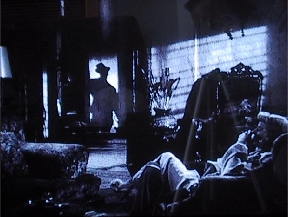
The plots usually deal with the seedy side of human life: crime, betrayal, jealousy and revenge, much of it sexually motivated. Narrative strategies involve repeated use of flashbacks, first-person voiceovers, dream-like sequences, and unresolved episodes that emphasize the overall lack of moral direction. The photography is dominated by high contrast lights surrounding the protagonists with dark, threatening shadows while odd angles and unbalanced framing produce unstable, disorienting images. The chiaroscuro lighting makes even mundane encounters seem charged with danger or erotic suspense.
di6

This is a still from Double Indemnity which shows a number of trademark features. The shadows cast by Venetian blinds on the wall, the cigarette being smoked by Barbara Stanwyck and the curious construction of the mise en scene are all very characteristic of the style. What is even more wonderful about this particular shot however is the way the shadow of Fred McMurray’s character enters the scene before he does. The Barbara Stanwyck character is just about to shoot him with a pearl-handled revolver; this image seems to be hinting that he is already on his way to the underworld even before he arrives in the room.

Noir settings are almost exclusively urban: the resulting iconography consists of images of dark night-time cities with rain-soaked streets reflecting dazzling neon lights that intrude into the picture and fracture the composition. Interiors are almost always cramped and claustrophobic: dingy hotel rooms, night clubs or even the backs of taxi cabs. The dark outside world presses in on the characters and is full of danger. Soundtracks often include jazz in the bebop style from the late 1940s or early 1950s, with its jagged melodic lines and stuttering rythms, emphasizing the psychological instability displayed by the characters and settings.

The protagonists are trapped, perhaps just by mischance, in an alienating lonely world, usually a night-time city, where they are constantly in danger for their lives. The chaotic, random violence of this world gives rise to feelings of persecution and paranoia and a sense that life is absurd, meaningless, without order or purpose, and governed by contingency rather than design.

Much has been written about the origins of Film Noir, but it does seem clear to me that, although it is essentially an American style, it owes many of its roots to European existentialism, a point further reinforced by the fact that many great movie directors of the noir period (including the great Billy Wilder, who directed Double Indemnity) were in fact European emigres.

Anyway, I digress. What I wanted to say really was that during the course of watching all these wonderful films from a bygone age it struck me how much the language and iconography of modern cosmology shares this existentialist heritage. Our new standard cosmological model is full of references to the “dark” sector (dark matter and dark energy) which dominates the energy budget of the Universe, but which not just invisible but also unfathomable. The cosmos is lit by garish starlight from small islands of luminosity embedded in this sea of darkness. Long chains of bright galaxies stretch across space like rows of streetlights whose glare fractures and disturbs the celestial dark. We cling to a precarious existence on a tiny rock that is surrounded by danger. Even the stuff from which our atoms are made is completely overshadowed by alien matter. The universe is oblivious to us and we are irrelevant to it.

But it’s not only the surface imagery of cosmology that resembles that of a noir movie. The existentialist trend runs deep. Cosmology seems to be abandoning the idea that there is a design behind it all. The idea that there is a single explanatory principle “a theory of everything” that accounts for why our Universe is the way it is and why life is possible within it, is losing ground to the idea that there is a multiverse in which all possible laws of nature are realised; we just live in a place where life happens to be possible. I’m not at all convinced that it is a good route for science to follow, but many cosmologists seem to be accepting this kind of thing as the best we will ever do to explain the Universe.

The physicist Steven Weinberg summed up the way this view of the Universe challenges us:

It is almost irresistible for humans to believe that we have some special relation to the universe, that human life is not just a more-or-less farcical outcome of a chain of accidents reaching back to the first three minutes, but that we were somehow built in from the beginning. … It is very hard to realise that this is all just a tiny part of an overwhelmingly hostile universe. It is even harder to realise that this present universe has evolved from an unspeakably unfamiliar early condition, and faces a future extinction of endless cold or intolerable heat. The more the universe seems comprehensible, the more it also seems pointless.

In an interview he put it thus:

I believe that there is no point in the universe that can be discovered by the methods of science. I believe that what we have found so far, an impersonal universe in which it is not particularly directed toward human beings is what we are going to continue to find. And that when we find the ultimate laws of nature they will have a chilling, cold impersonal quality about them.

The influential American horror writer Howard Phillips Lovecraft (known to his friends as “H.P.”), wrote a letter in 1919 that argued much the same:

As you are aware, I have never been able to soothe myself with the sugary delusions of religion; for these things stand convicted of the utmost absurdity in light of modern scientific knowledge. With Nietzsche, I have been forced to confess that mankind as a whole has no goal or purpose whatsoever, but is a mere superfluous speck in the unfathomable vortices of infinity and eternity. Accordingly, I have hardly been able to experience anything which one could call real happiness; or to take as vital an interest in human affairs as can one who still retains the hallucination of a “great purpose” in the general plan of terrestrial life. … However, I have never permitted these circumstances to react upon my daily life; for it is obvious that although I have “nothing to live for”, I certainly have just as much as any other of the insignificant bacteria called human beings. I have thus been content to observe the phenomena about me with something like objective interest, and to feel a certain tranquillity which comes from perfect acceptance of my place as an inconsequential atom. In ceasing to care about most things, I have likewise ceased to suffer in many ways. There is a real restfulness in the scientific conviction that nothing matters very much; that the only legitimate aim of humanity is to minimise acute suffering for the majority, and to derive whatever satisfaction is derivable from the exercise of the mind in the pursuit of truth (from Letter to Reinhardt Kleiner  (14 September 1919), in Selected Letters I, 1911-1924 edited by August Derleth and Donald Wandrei, pp. 86-87).

I’ve thought about this quite a lot over the last few years and am gradually finding myself more and more in agreement with Lovecraft. I would say further that that one of the few things that make life bearable is the futility of existence. Futility is very reassuring. If all the shit that happens in this world were designed to serve some higher purpose then that really would be terrifying. And even more reassuring than its futility is the knowledge that we will soon return to dust and be quickly forgotten.

Here’s  Weinberg again, from the same interview quoted above:

…if there is no point in the universe that we discover by the methods of science, there is a point that we can give the universe by the way we live, by loving each other, by discovering things about nature, by creating works of art. And that — in a way, although we are not the stars in a cosmic drama, if the only drama we’re starring in is one that we are making up as we go along, it is not entirely ignoble that faced with this unloving, impersonal universe we make a little island of warmth and love and science and art for ourselves. That’s not an entirely despicable role for us to play.

Inspired by this, I’m going to make a point of existence not by doing science nor creating a work of art, but by making a nice cup of tea.


Astronomical and Other Events this Week

Posted in Biographical, The Universe and Stuff with tags , , , , , on July 4, 2017 by telescoper

This week sees the 2017 National Astronomy Meeting which is taking place in Hull (which, for those of you unfamiliar with British geography, is in the Midlands). I usually try to attend this annual event but this year haven’t been able to make it owing to other commitments. I’m particularly sad about this because I’ll miss seeing two old friends (Nick Kaiser and Marek Kukula) being presented with their RAS medals. Moreover, one of the pieces of astronomical research announced at this meeting that has been making headlines features my office mate and fellow resident of Pontcanna, Dr Emily Drabek-Maunder.

Anyway, to keep up with what’s going on at NAM2017 you can follow announcements on twitter:

This week also sees a meeting in Cambridge on Gravity and Black Holes to celebrate the 75th birthday of Stephen Hawking, which goes on until tomorrow (Wednesday 5th). This conference also looks like a very good one, covering a much wider range of topics than its title perhaps suggests. Stephen’s birthday was actually in January, but I hope it’s not too late to wish him many happy returns!

Finally, though not a conference as such, there’s annual Royal Society Summer Science exhibition going on in London this week too. This is a showcase for a wealth of scientific research including, this year, an exhibit about gravitational waves called Listening to Einstein’s Universe. There’s even a promotional video featuring some of my colleagues at Cardiff University (along with many others):

Anyway, if you’re in London and at a loose end and interested in science and that, do pop into the Royal Society and have a look. The Summer Science Exhibition is always well worth a visit!