Author Archive

Brighton Up!

Posted in Brighton, Football on April 17, 2017 by telescoper

Just a quick note this Bank Holiday Monday to observe that by beating Wigan Athletic 2-1, Brighton and Hove Albion have secured promotion to the Premiership next season.

Huddersfield Town had to beat Derby County in their game to prevent Brighton finishing in the top two automatic promotion places, but having led most of the match they let in a late equaliser and the score finished 1-1.

My team, Newcastle United, are still in second place but their form seems to have deserted them and they may well end up having to endure the playoffs.

But that’s for the future to decide. For now I’d just like to congratulate Brighton and Hove Albion on their achievement, an outcome which will gladden the hearts of many friends and former colleagues at Sussex University.

When I was previously involved with undergraduate admissions, it was widely agreed that having a Premiership side in the locality was a significant factor in attracting students to a University. Today’s results may therefore provide a boost in more ways than one!

 In that light I’m sure that locals will happily put up with even worse traffic congestion in the Falmer area on Match days next year. After all, it’s only for one season….;)

And on the Third Day…

Posted in Uncategorized on April 16, 2017 by telescoper

…Worcestershire won by eight wickets.

Before  I get to that let me catch up on the Second day of the County Championship match between Glamorgan and Worcestershire, as I didn’t have time to post  yesterday evening.

In generally fine weather, Worcestershire reached a total of 403 all out, including a century from Tom Kohler-Cadmore. Their innings closed just in time for tea.

In arrears by 196 on the first innings, Glamorgan really needed a good start, and they seemed to get that when openers Selman and Rudolph were still together with the score on 74. However, Rudolf and Lloyd  fell in quick succession and the innings became even more precarious when Selman was out. At stumps, Glamorgan were 141 for 3, needing another 55 to make Worcestershire bat again. Colin Ingram was still there and playing some shots so there was still hope.

Sadly, however, Ingram fell early on the third morning and thereafter, apart from Aneurin Donald (57), Glamorgan offered very little resistance. Donald was hit on the head by a nasty delivery from Josh Tongue. It looked bad but he carried on, only to edge one into the gulley two balls later. Josh Tongue took five wickets on his County debut, as Glamorgan were all out at about 12.30 for 223.

Needing only 28 to win, a Worcestershire victory was an inevitability though they did lose two wickets on the way.

Glamorgan’s batsmen can have no complaints. The conditions for batting were generally good throughout the match: not much sign of swing, not much movement off the pitch, and just a hint of variable bounce. They just didn’t perform well enough. There’s no question that the better team won. Glamorgan have lost their first two games of this season, but they mustn’t allow themselves to get demoralised. It’s one thing to lose a game on the pitch, but quite another when you start losing games in your own head.

Despite the result I enjoyed watching my first County Championship match as a Glamorgan member. I enjoyed the banter in the crowd, and saw some good cricket. It’s just a pity that not much of it was from Glamorgan..

Next cricket at Sophia Gardens is a one-day match a fortnight today against Surrey. Maybe they’ll have more luck in the limited-overs format?

A Good Friday’s Cricket 

Posted in Cricket with tags on April 14, 2017 by telescoper

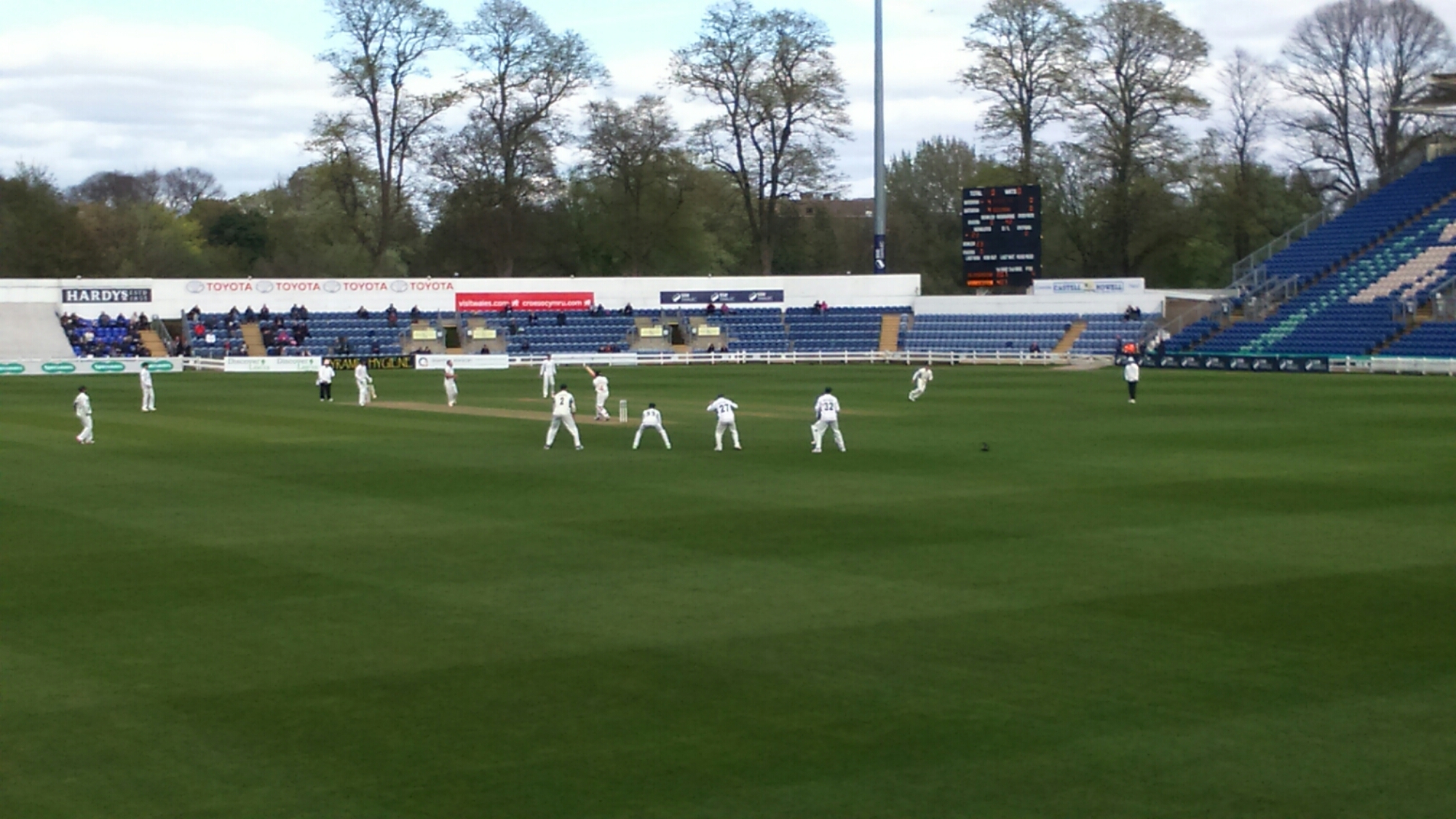
Some time ago I decided to become a member at Glamorgan County Cricket Club for this season, the price of which includes admission to all County Championship, One Day and Twenty20 games for the season. Since the SWALEC Stadium at Sophia Gardens is only ten minutes’ walk from my house, I hope to catch a fair amount of cricket this summer.

And so it came to pass that this morning I found myself watching the first County Championship game of the season in Cardiff, between Glamorgan and Worcestershire. Glamorgan lost their first match of the season (away against Northamptonshire) inside two days, by an innings and 22 runs, so the home fans were hoping for a stronger performance in this match.

The ground was fairly sparsely populated, as per usual for County Cricket, but there were enough people there to create an atmosphere and not so many to cause long queues at the bar.

In overcast and rather chilly conditions, Worcestershire used the uncontested toss to invite Glamorgan to bat first. As they had done against Northamptonshire, Glamorgan’s batsmen struggled, losing eight wickets for 105  in the first session. Another thrashing looked inevitable.

After lunch, however, the situation improved as Lloyd, in partnership first with Carey and then with Hogan, added over a hundred at about eight an over. Glamorgan were eventually all out for 207. Lloyd was last out, for 88.

Worcestershire lost both openers with just one run on the board, but Fell and Clarke added 79 runs before both got out in quick succession. At 80 for 4 a collapse looked on the cards, but Kohler-Cadmore and wicket-keeper Cox put together a century partnership before bad light brought play to an early close.

Worcestershire at 180 for 4 definitely have the upper hand, but with 387 runs having been scored and 14 wickets having fallen, it was a good day’s cricket.

Incidentally, this summer Glamorgan are celebrating 50 years of cricket at Sophia Gardens. Before 1967 they played their games on a cricket ground in Cardiff Arms Park, which was next to the famous rugby stadium. However this site is right next to the River Taff and suffered from very poor drainage. The sheer number of rugby games – both local and international – combined with the drainage problem meant the pitch was often in very poor condition, compared to the other home international rugby grounds. It was therefore decided to move the cricket ground and build a second rugby stadium. It’s quite a complicated story, but that is basically why nowadays there are two rugby stadiums side by side in central Cardiff, the huge  Millennium Stadium (now called the Principality Stadium) for internationals, and the much smaller Cardiff Arms Park, home to Cardiff Blues.

The cricket didn’t move far, however, as Sophia Gardens is just a short walk from the city centre and even closer to my house! I’ll be there tomorrow, to find out what Day 2 has to offer.
Lamentation over the Dead Christ – Sebastiano del Piombo 

Posted in Art with tags , , , on April 14, 2017 by telescoper

I came across this picture in this week’s Times Literary Supplement as part of an article describing an exhibition currently showing at the National Gallery in London. I thought I’d share it here because it’s such an extraordinarily powerful and mysterious image.

It was painted sometime around 1512-16 by Sebastiano del Piombo, a contemporary of Michelangelo. 

The Pietà (an image of the distraught Virgin Mary lamenting the death of her son, usually cradling his lifeless body) is a familiar subject in religious art, but this particular version is strikingly different.

For one thing, the Virgin Mary is not holding, or even looking at, the body of Christ. She seems instead  to be lost in prayer. 

For another, the figure of Mary towers over the corpse at her feet. Is it just me, or does she look rather masculine too? Assuming this is deliberate, are we seeing her somehow growing in stature, perhaps becoming divine herself?

It’s as if we catch her in the moment in which she is undergoing some form of transformation. In any case she’s not simply overcome with grief as in many depictions of this scene. What she is experiencing remains an enigma. This is not unusual for Renaissance art: paintings in particular often seem to contain secret messages.

The body of her son – brown and apparently without wounds – looks grotesquely stiff, incapable of being embraced. The background is a bleak landscape of ruined buildings and stunted trees, feebly lit by the distant moon.

It’s a stark, comfortless description of the dead Christ, but Mary embodies a sense of determination and hope. Above all, though, it’s a very dramatic painting. 

St John Passion 

Posted in Uncategorized on April 13, 2017 by telescoper

Last night I went to St David’s Hall in Cardiff for a performance of the St John Passion by the BBC National Orchestra of Wales and the BBC National Chorus of Wales under the direction of John Butt. The concert was broadcast live on BBC Radio 3, so you can listen to it for the next month on the BBC iplayer.

The St John Passion is on a smaller scale than Bach’s other (later) setting of the same story, the epic St Matthew Passion,  being almost an hour shorter and composed for a single orchestra and choir; the St Matthew Passion has two choirs and two orchestras. The St John Passion is nevertheless a very dramatic work, with many contrasts:  moments of intimacy expressed by solo voices lie in between grand chorales and orchestral interludes.

A few things struck me particularly in what was a very enjoyable concert. The first was the fine performance by tenor Gwilym Bowen as a rather boyish-looking but earnest Evangelist, a very demanding role. It’s interesting that the part of Jesus is so much more limited, though it was very well sung by David Soar (bass). Other solo vocalists were Elizabeth Watts (soprano),  William Towers (countertenor), Nick Pitched (tenor) and Ashley Riches (bass-baritone), as well as some members of the chorus.

The BBC National Chorus of Wales was in fine voice. Outnumbering the orchestra by a considerable margin they managed to generate a wonderful sonority without losing the ‘bite’ that this piece demands. This of all stories needs more than a pretty sound from the choir.

Another thing that struck me watching the orchestra was the phenomenal work of the principal bass, David Stark. He was constantly at work, adding the bottom notes to the accompaniment of the recitative as well as providing the foundation of the string section in the full orchestra. I hadn’t realised before quite how much the double bass had to do in this piece. I was close enough to see the density of ink on his score!

The orchestra for the St John Passion is relatively small but it’s used very cleverly by Bach. For example, there are several sections in which he uses two solo instruments whose melodic lines intertwine. Pairs of  flutes, oboes, cellos and violins all perform in this way at different times to wonderful effect. There is also a bassoon which, for this performance, was located among the strings rather than with the flutes and oboes.

With a piece like this it’s difficult not to reflect on the subject matter as well as the music. I’m not a religious man, but I don’t think you have to be a believer to appreciate that the power of the story of the Passion is its universality.  By that I mean that it demonstrates the capacity we humans have to inflict pain and suffering on each other. It also reminds us that one day we too will die. All we can hope is that it does not come in such an agonising way as it did for Jesus, but we all know it is going to happen. As Herodotus put it: “Call no man happy until he knows the manner of his death”.

I don’t believe that ultimate  hope for humanity lies in any kind of supernatural intervention, but that we have to make it on our own salvation in the here and now. That’s all there is. On the other hand, any species that could produce Johan Sebastian Bach can’t be entirely beyond redemption, can it?

 A Time of Death

Posted in Uncategorized on April 11, 2017 by telescoper

This image, courtesy of the Cardiff University Library, is of a pocket watch that belonged to the poet Edward Thomas.

It stopped at 24 minutes to eight on the morning of 9th April 1917, the precise moment when an artillery shell exploded, killing its owner. This happened in the first few hours of the Battle of Arras in the Pas-de-Calais area of Northern France.

In detective stories the stopped watch is a clumsy cliché often used to indicate the victim’s time of death, but in this case I find the image intensely powerful.

Despite heavy casualties the battle in which Edward Thomas fell went well at first for the British and Commonwealth Armies who made substantial territorial gains in the opening stages. Soon, however, the defending Germans regrouped and another bloody stalemate ensued that dragged on for another month, leaving about 300,000 casualties on both sides.

R.I.P. Gary Steigman 

Posted in Uncategorized on April 10, 2017 by telescoper


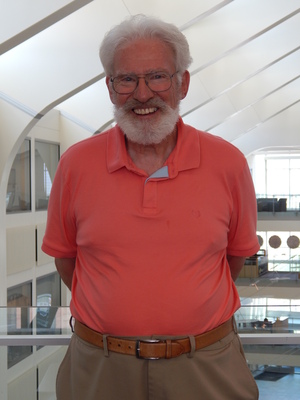
I was saddened today to hear from friends and colleagues of the death of Professor Gary Steigman (above).

Gary was a leading figure in the theory of cosmological nucleosynthesis, ie the formation of light elements by nuclear fusion reactions in the Big Bang. As well as being an eminent scientist he was also a warm, generous and extremely likeable human being. Our paths crossed only a few times, the last time being some years ago, but I remember him very well for his kindly and courteous manner. He’ll be greatly missed by a great many people.

Rest in peace, Gary Steigman.

An Image for Our Time

Posted in Uncategorized on April 9, 2017 by telescoper

This photograph has gone viral today, and I couldn’t resist sharing it here.

It was taken during a march by the fascist English Defence League in Birmingham yesterday. The young lady on the left is Saffiyah Khan, who was not part of the organised counter-demonstration but stepped forward when a group of EDL thugs surrounded another woman who was. The man on the right  threatened her with his fists and a policeman intervened in an attempt to defuse the situation.

 Ms Khan kept her hands in her pockets all the time, her smile conveying a sense of amused contempt that is truly an image for our times.

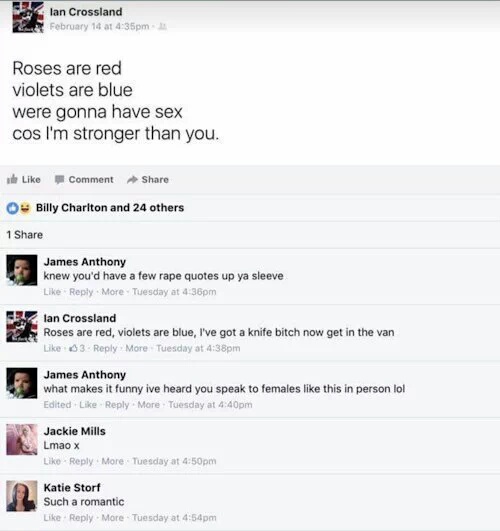
The man at the right in the picture is Ian Crossland, a leading figure in the EDL. He later wrote on Facebook that Ms Khan was “lucky she got any teeth left”.

By the way, here’s an excerpt from Mr Crossland’s Facebook page:


Saffiyah Khan is half Pakistani and half Bosnian, but I’d far rather live in a Britain made in her image than in his.

PhD Opportunities in Data-intensive Physics and Astrophysics!

Posted in Uncategorized on April 8, 2017 by telescoper

Well, I’m now officially on holiday for two weeks and probably won’t be blogging much during this break, especially about work-related things, but I couldn’t resist a quick announcement of something very exciting.

We received confirmation last week that the Science and Technology Facilities Council (STFC for short) to set up a Centre for Doctoral Training (CDT for short) involving the Universities of Cardiff, Bristol and Swansea. This will be coordinated by the Data Innovation Institute at Cardiff University and it covers  a wide range of data-intensive research in astrophysics and cosmology carried on at the three member institutions. ‘Data-intensive’ here means involving very big data sets, very sophisticated analysis methods or high-performance computing,  or any combination of these.

The Centre for Doctoral Training will be coordinated by the Data Innovation Institute at Cardiff University. It will commence in September 2017 so we will be open for applications immediately, ie. next week.

For further information, please see the Data Innovation Institute webpage which will be updated as more details are available.

By the way, for  this special programme, STFC have relaxed the  rules relating to  nationality, so full funding is potentially available for  non-UK citizens under this scheme.

If you’re looking to do a PhD in data-intensive physics or astrophysics, get writing your application now and keep an eye on this page for further announcements.

To secure a PhD place at this STFC CDT administered by the DII you’d better apply PDQ! 

The Irish Question 

Posted in Biographical with tags , , on April 7, 2017 by telescoper

Not surprisingly, given the imminent likelihood of big cuts to UK Astronomy funding as a result of our withdrawal from the European Union, quite a lot of the conversation at this evening’s RAS Club dinner revolved around ways of keeping EU citizenship in the post-BrExit era.

Through a bit of independent investigation I discovered a few weeks ago that, at least in principle, I qualify for Irish citizenship. This is because one of my grandparents (my grandfather on my mother’s side) was born in Northern Ireland. That is sufficient for me to claim Irish nationality, if I can prove it.

The problem is that the grandfather concerned died quite a long  time ago, when I was a kid. In fact, all my grandparents are deceased. To make matters worse I don’t know exactly when he was born or where or when he married my grandmother. This is a problem because I need to produce both his birth certificate and their marriage certificate, along with my mother’s birth certificate (and mine) to establish my case.

It is almost certain my grandfather was born before Ireland was partitioned in 1921, so his birth records may not even be in Northern Ireland but could be held in Dublin.

It looks like I have some interesting research to be getting on with!