Author Archive

Romanesco and the Golden Spiral

Posted in mathematics, The Universe and Stuff with tags , , , on November 8, 2016 by telescoper

Some time ago I mentioned that I received one of these in my weekly veggie box..

romanesco

Actually, that reminds me that a new box is due tomorrow morning…

Anyway, the vegetable in the picture is called Romanesco. I’ve always thought of it as a cauliflower but I’ve more recently learned that it’s more closely related to broccoli. It doesn’t really matter because both broccoli and cauliflower are forms of brassica, which term also covers things like cabbages, kale and spinach. All are very high in vitamins and are also very tasty if cooked appropriately. Incidentally, the leaves of broccoli and cauliflower are perfectly edible (as are those of Romanesco) like those of cabbage, it’s just that we’re more used to eating the flower (or at least the bud).

It turns out that this week’s Physics World has a short piece on Romanesco, which points out that a “head” of Romanesco has a form of self-similarity, in that each floret is a smaller version of the whole bud and also displays structures that are smaller versions of itself. That fractal behaviour is immediately obvious if you take a close look. Here’s a blow-up so you can see more clearly:
romanesco-broccoli2-550x412

However, one thing that I hadn’t noticed before is that there is another remarkable aspect to the pattern of florets, in that they form an almost perfect golden spiral. This is a form of logarithmic spiral that grows every quarter-turn by a factor of the golden ratio:

\phi = \frac{1+\sqrt{5}}{2}.

Logarithmic, or at least approximately logarithmic, spirals occur naturally in a number of settings. Examples include spiral galaxies, various forms of shell, such as that of the nautilus and in the phenomenon of phyllotaxis in plant growth (of which Romanesco is a special case). It would seem that the reason for the occurrence of logarithmic spirals  in living creatures is that such a shape allows them to grow without any change in shape.

Not really relevant to anything much, I know, but I thought you might be interested…

P.S. One thing the Physics World piece fails to mention is that, regardless of its geometrical properties, Romanesco is really delicious!

American Psycho

Posted in Politics with tags , , , on November 8, 2016 by telescoper

trump

Well today’s the date of the election of the next President of the United States of America. Will it be Hillary Clinton? Or will it be an unstable racist misogynist, a pathological liar, and a man who has boasted of a string of sexual assaults? It remains to be seen. The polls are alarming close. Hillary Clinton is ahead by just 3 or 4 percent nationally but only a handful of states really matter and some of those are too close to call. I’ve been following Nate Silver’s 538 election forecast for a while now. It seems to me his methodology more accurately estimates the uncertainty in the opinion polls. After narrowing considerably when the FBI decided to throw a spanner into the works last week, the probability of a Clinton win is now over a little over 70%. Uncomfortable, but the odds have been below 2-1 very recently.

At the weekend I decided that I would follow my usual betting practice and place a wager on the outcome that I don’t want to happen. Hunting around, the best odds I could find were 18-5 against Donald Trump. I put a monkey on, so will walk away with £2300 if Trump wins. I plan to use the proceeds to begin work on the construction of a fallout shelter in my garden. If an unstable psychopath like Donald Trump gets his hands on the American nuclear codes I don’t hold out much hope for the future of civilization.

I followed the same strategy on Referendum Day as I felt it in my bones that Vote Leave was going to win. I ended up depressed but compensated to the tune of £1000. I’m afraid to say I feel the same way now about the likelihood of a Trump victory. Not very scientific, I know, but there you go.

I have never paid much attention to American politics in the past. It is as incomprehensible to me as British politics must be to them. Gore Vidal summed it up for me:

There is only one party in the United States, the Property Party … and it has two right wings: Republican and Democrat. Republicans are a bit stupider, more rigid, more doctrinaire in their laissez-faire capitalism than the Democrats, who are cuter, prettier, a bit more corrupt — until recently … and more willing than the Republicans to make small adjustments when the poor, the black, the anti-imperialists get out of hand. But, essentially, there is no difference between the two parties.

Things have changed this time. Although both parties still represent the moneyed classes more than anyone else, but this time the Republican contender has overtly fascist tendencies. No wonder Nigel Farage admires him so much. Americans are free to vote for whomever they wish, of course. I don’t have a say, as I’m a foreigner. All I can say is that you should be very careful what you wish for.

Although I find it deeply depressing that this race is even close, I won’t lose any sleep over the election night. I don’t have a television, and I’ll do what I did on the day of the EU referendum. Drink some wine, listen to music and then go to sleep. There’s no point in worrying about things that are out of your hands. And if Trump does win, at least it shortens the list of countries I will have to consider emigrating to if and when the UK does leave the European Union..

That Was The Data Innovation Day That Was

Posted in Uncategorized with tags , , on November 7, 2016 by telescoper

Time, methinks, for a quick work-related post. You may know that my current appointment is in association with Cardiff University’s Data Innovation Research Insitute, and it’s that part of my job that is taking up most of my time at the moment. Last Friday (4th November) we had our first Data Innovation Day, the aim of which was to encourage collaboration between Schools and Research Institutes in the area of Data Science.

To this end, on Friday morning we had a dozen short(ish) talks on data science aspects of all kinds of subjects, from neuroimaging to gravitational wave research to healthcare to biosocial computing to statistical modelling and so on and so forth. It was a fascinating mixture of presentations and about 75 people attended, which was a pretty good audience. After lunch we broke into groups to develop specific research projects and establish what the Data Innovation Institute can do to help foster collaborations across disciplinary and administrative boundaries. That’s much harder than it might sound, and is certainly harder than it should be in modern universities. We had no shortage of ideas, and let’s hope we can turn them into concrete projects.

Anyway, one of my contributions to the day was to set up a Twitter account for the Data Innovation Research Institute together with a logo:

dii_ligo

We currently have a princely 37 followers. Feel free to follow if you’re on Twitter and interested in Data Science!

Too Brave To Dream

Posted in Art, Poetry with tags , , , , , , , , on November 7, 2016 by telescoper

berave

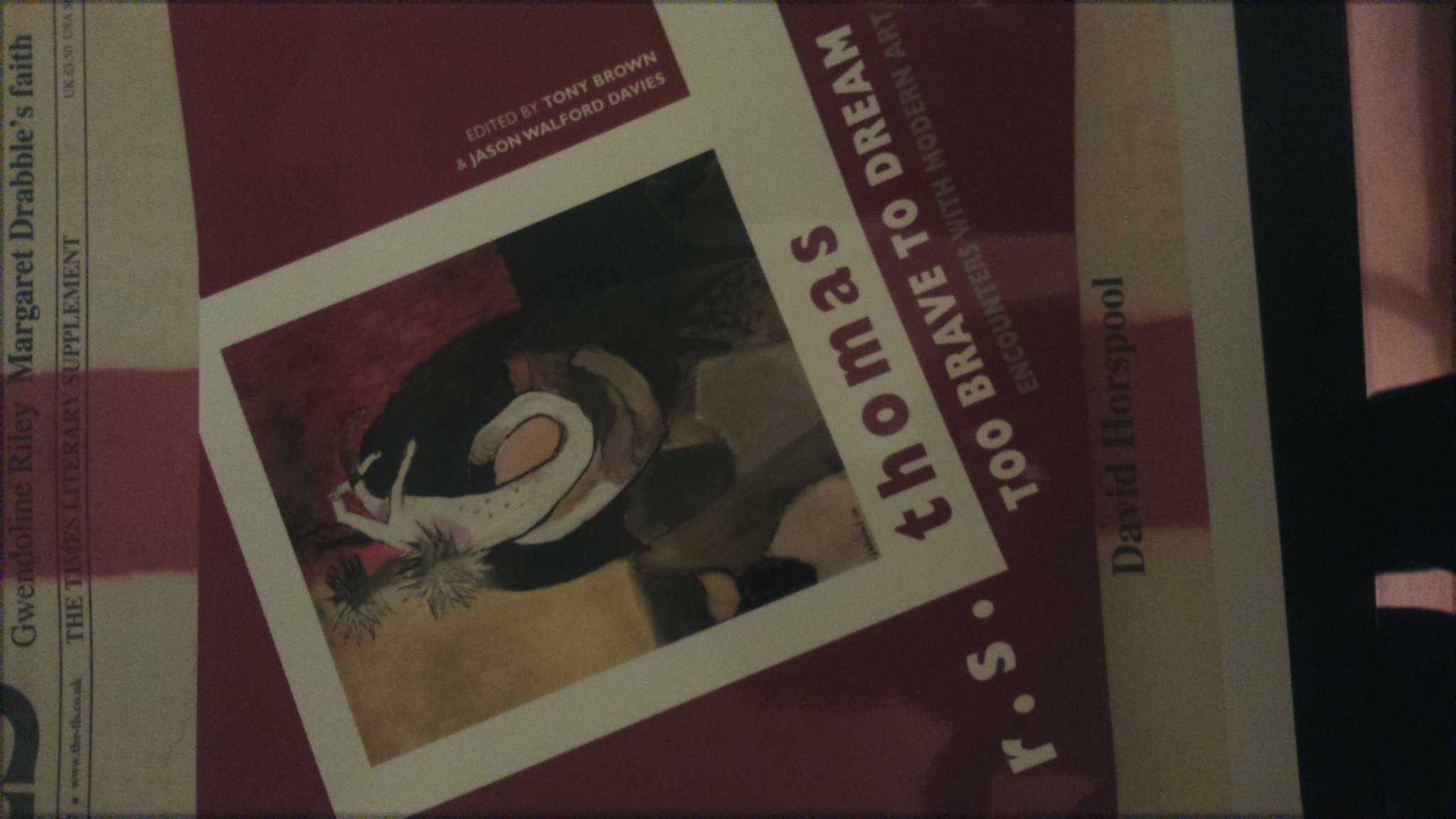
One day last week I found this wonderful item had been delivered to my house. Is a new book called Too Brave To Dream which contains about three dozen previously unpublished poems by R.S. Thomas, who died in 2000. After his death, two seminal studies of modern art were found on his bookshelves – Herbert Read’s Art Now (1933/1948) and Surrealism (1936), edited by Read and containing essays by key figures in the Surrealist movement. Poems handwritten by Thomas were later discovered between the pages of the two books. These poems written in response to a selection of the many reproductions of modern art in the Read volumes, including works by Henry Moore, Edvard Munch, George Grosz, Salvador Dalí, René Magritte and Graham Sutherland – many of whom were Thomas’s near contemporaries. Written between 1987 and 1993, these poems are published in Too Brave To Dream for the first time – alongside reproductions of the works of modern art that inspired them. They poems are instantly recognizable as works of R.S. Thomas. According to the publishers blurb:

Thomas’s readings of these often unsettling images demonstrate a willingness to confront, unencumbered by illusions, a world in which old certainties have been undermined. Personal identity has become a source of anguish, and relations between the sexes a source of disquiet and suspicion. Thomas’s vivid engagements with the works of art produce a series of dramatic encounters haunted by the recurring presence of conflict and by the struggle of the artist who, in a frequently menacing world, is ‘too brave to dream’.

The poems vary considerably in style and mood. Some are wry and playful – although Thomas isn’t perhaps best known for his sense of humour, he certainly wasn’t averse to playing with words and you can find puns throughout his work including in these new poems. Others are bleaker in tone, reflecting the disturbing nature the artworks to which they respond.

Incidentally, these poems were all written after Thomas had, after forty years of service, retired from his post as an Anglican priest. He seems to have experienced something of a crisis after his retirement, perhaps because of the lack of daily routine and regular duties require of him by the Church. He wrote to a friend in 1978, just before his retirement

I am retiring at Easter. I shall be 65. I could stay till 70, but I am glad to go from a Church I no longer believe in, sycophantic to the queen, iconoclastic with language, changing for the sake of change and regardless of beauty.

The form of his religious faith was never straightforward to R.S. Thomas but it did continue to dominate his poetry. He may have given up on the Anglican Church but that does not imply he had given up on religion altogether.

The poem that gives this book is title is a response to one of Henry Moore’s Shelter Sketches. During the ‘Blitz’ the London Underground served as a shelter for Londoners – who not only used the platforms as refuges, but also slept there. Moore produced a group of drawings based on his observations of people in the shelters. They’re are revelation if you think of Moore only as a sculptor but in any case they are very powerful images. I can’t reproduce the particular example that inspired the poem in question here for copyright reasons, but it is dated 1941 and is a sombre image of a figure in what appears to be a restless sleep, presumably during an air raid, with one hand rolled into a fist. Here is Thomas’s poem:

Hand clenched
on the dark dream
where the sleeper wanders
far from the crackling
meadows and the sharp flowers
with their smell
of combustion. Alas
that waking to safety
should be waking also
to survivors poking
among the remains of others
who were too brave to dream.


I’ve enjoyed dipping into this book enormously not only for the “new”poems by one of my favourite poets but also because of the interesting cross-section of influential works of art that it includes, including a number of artists who were completely new to me. If you’re interested in poetry or art you’ll find this book fascinating!

P.S. The cover image is Gorse on a Sea Wall, by Graham Sutherland.

Enemies of the People

Posted in Uncategorized on November 6, 2016 by telescoper

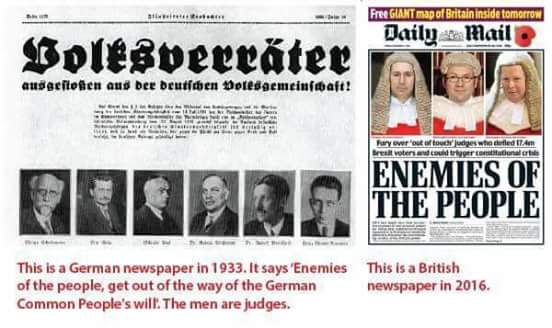
I found this on Facebook and I think I’ll just leave it here…

image

The Heavens Themselves…

Posted in Uncategorized on November 6, 2016 by telescoper

The heavens themselves, the planets and this centre 
Observe degree, priority and place, 
Insisture, course, proportion, season, form, 
Office and custom, in all line of order; 
And therefore is the glorious planet Sol 
In noble eminence enthroned and sphered 
Amidst the other; whose medicinable eye 
Corrects the ill aspects of planets evil, 
And posts, like the commandment of a king, 
Sans cheque to good and bad: but when the planets 
In evil mixture to disorder wander, 
What plagues and what portents! what mutiny! 
What raging of the sea! shaking of earth! 
Commotion in the winds! frights, changes, horrors, 
Divert and crack, rend and deracinate 
The unity and married calm of states 
Quite from their fixure! O, when degree is shaked, 
Which is the ladder to all high designs, 
Then enterprise is sick! How could communities, 
Degrees in schools and brotherhoods in cities, 
Peaceful commerce from dividable shores, 
The primogenitive and due of birth, 
Prerogative of age, crowns, sceptres, laurels, 
But by degree, stand in authentic place? 

Shakespeare, Troilus and Cressida, Act I, Scene III.

Campaigners warn on Guy Fawkes Bonfire Night Pogonophobia

Posted in Beards with tags , , on November 5, 2016 by telescoper

Remember, remember the…. er…

kmflett's avatarKmflett's Blog

Beard Liberation Front

PRESS RELEASE           4th November

Contact Keith Flett     07803 167266

CAMPAIGNERS WARN ON GUY FAWKES BONFIRE NIGHT POGONOPHOBIA

guy

The Beard Liberation Front, the informal network of beard wearers, has warned of Guy Fawkes pogonophobia as bonfires around the country burn effigies of a hirsute man over the weekend.

Pogonophobia is the ancient Greek for an irrational fear or hatred of facial hair, known as beardism in modern English.

The BLF says that November 5th is the traditional highlight of the pogonophobes year as they burn an effigy of what they assume to be a dangerous radical figure with a beard, although few will openly discuss their often deep-seated concerns about beard wearers

BLF Organiser Keith Flett said the irony is that Guy Fawkes was a deeply reactionary character who, had he lived now, would almost certainly not have had a beard under any circumstances

The BLF is calling…

View original post 21 more words

Judgment Day on Article 50

Posted in Politics with tags , , on November 3, 2016 by telescoper

I couldn’t resist a quick comment on today’s ruling by the High Court that the Prime Minister cannot trigger Article 50 of the Lisbon Treaty (and thus begin the process of taking the United Kingdom out of the European Union) without the approval of Parliament. The case was brought by Gina Miller and Deir Tozetti Dos Santos (the claimants) and has important constitutional implications because it limits the use of the Royal Prerogative.

I’m not by any means a legal expert but reading the full judgment it strikes me that this unanimous decision represents a comprehensive defeat for the Government’s lawyers. The crucial paragraphs of the judgment are 92-94 if you wish to refer to them in the full judgment. Interestingly, the ruling  does not really rest on the claimants’ case at all but instead is based on a complete rejection of the main point of the Government’s submission. It looks like the Government’s lawyers bungled it pretty badly. Although the Government has indicated that it will appeal the result, it’s not obvious what the grounds for such an appeal might be. The appeal will be heard some time in December.

I’ve never made any secret of the fact that I am in favour of the United Kingdom remaining inside the European Union. Events since the referendum – especially the collapse of the pound – have strengthened that opinion, in fact.

I am baffled by the extreme reaction of many “Leave” voters to this judgment, especially those who voted that way in order to “restore Parliamentary sovereignty”. Some such individuals are claiming that this ruling is somehow anti-democratic. I don’t think that view is at all rational. If you voted Leave in order to get your sovereignty back then you should be very happy with this decision. In fact whichever side of the referendum debate you were on you should welcome this decision.

We live in a parliamentary democracy. That means that sovereignty rests in Parliament, not in the Prime Minister. This ruling merely asserts that fact. It does not overturn the referendum result  nor does it prevent Article 50 being triggered. It does assert that the Prime Minister’s chosen way to approach BrExit is unlawful. Democracy is nothing without the rule of law.

Incidentally, the judgment also contains the following statement which I think is worth quoting here:

The 2015 Referendum Act was passed against a background including a very clear briefing paper to Parliamentarians explaining that the referendum would have advisory effect only. Moreover, Parliament must have appreciated that the referendum was intended to be only advisory as the result of a vote in the referendum in favour of leaving the European Union would inevitably leave for future decision many important questions relating to the legal implementation of withdrawal from the European Union.

In other words the referendum in itself has no constitutional force and was specifically intended not to.

The government plans to appeal the Article 50 decision to the Supreme Court, at which point it may or may not be overturned. If the appeal fails, then there is one higher authority: the European Court of Justice. It would be a delicious irony if the UK government were forced to appeal there in order to proceed!

Supposing, though, that all appeals are exhausted and the Government is forced to debate Article 50 in Parliament. What would happen next?

Although a majority of MPs in the House of Commons were in favour of remaining in the European Union, circumstances have changed since the referendum and many would be reluctant to vote against the outcome. However, I can imagine a situation in which Parliament refuses to give approval to an Article 50 until it has sufficient knowledge of the Government’s negotiating position to be assured that the Government is not planning something reckless that would endanger the UK economically and/or politically. It is my personal belief that “something reckless” is precisely what the Government is planning, and that is why they were so keen not to have a vote in Parliament.

There was only one question on the ballot paper for the EU referendum – whether the United Kingdom should remain in the European Union or leave it. But what, if any, of the rights and benefits that currently accrue as a consequence of our membership of the EU can the UK keep if and when it leaves?  Who decides what rights can be removed from UK citizens?

There has been a lot of talk about “Hard BrExit” versus “Soft BrExit”. My personal view is that “Soft BrExit” (by which we would end up in a situation something like Norway) – which a sizable number of Leave voters envisaged when they voted – is not on the agenda at all. I think the Government is headed for a “Hard BrExit”, i.e. no membership of the internal market, no freedom of movement, no free movement of people, etc. That’s partly because of the ideological beliefs of the Tory cabinet and partly because that’s what the process pretty much guarantees. Article 50 is just about the UK leaving the European Union. That process has to be completed before any trade deals with the EU or other countries can be negotiated; such deals could take years to complete and in the meantime our economy will suffer. In the interim, we’ll be out with whatever the EU decides to allow us. I don’t think that will be very much at all.

I think that the Government knows that this outcome is not what a majority voted for, that it will have serious  economic consequences, and will produce a considerable political backlash. That is why the Government want to charge ahead as quickly as possible (in secret) so that nobody can stop them until it’s too late. In other words, they’re planning to use the referendum result as a pretext to further their own agenda. In order to this to work they have to avoid Parliamentary scrutiny. The High Court ruling – if it stands – effectively rules out this strategy. It is a victory for democracy.


Three Cheers for Three Chairs!

Posted in Uncategorized with tags , , , on November 2, 2016 by telescoper

Just a quick post to say public congratulations to three of my former colleagues in the Department of Physics and Astronomy at the University of Sussex.

My spies tell me that the following have recently been promoted to Professorial positions:

  • Kathy Romer (now Professor of Astrophysics) – Kathy is principal investigator of the XMM Cluster Survey collaboration and is coordinating cluster research for the Dark Energy Survey project.
  • Antony Lewis (now Professor of Cosmology) – Antony works on theoretical models of the early universe, as well as comparing observations with cosmological models, and is part of the core team analysing data from the Planck satellite.
  • Jacob Dunningham (now Professor of Physics)  – Jacob is Head of the Atomic Molecular & Optical (AMO) Physics group at Sussex  and works on quantum mechanical entanglement spans the fields of quantum information, quantum optics, Bose-Einstein condensation, and metrology.

As former  Head of School  I knew these were in the system but I left before the somewhat laborious promotions process was completed, so it’s very nice to receive confirmation that they all went through.

P.S. Extra-special congratulations to Kathy, because she was born on Tyneside (i.e. not in the Midlands).


Why I’m wearing a poppy again

Posted in Biographical, History with tags , , on November 2, 2016 by telescoper

Once again we’re coming up to Remembrance Sunday, an occasion to remember those who have given their lives in conflicts past and present. This is always held on the second Sunday in November in the United Kingdom, which means that this year it is on 13th November, so that it is close to the date of anniversary of the armistice that formally ended the First World War, which happened on 11th November 1918. Another way to commemorate this  is the observance of two minutes’ silence at 11am on 11th November itself. I plan to do that, next Friday  (which is the 11th November). I’ve kept my calendar free at 11 am precisely for that purpose.

Then there  is the wearing of a poppy. The poppy appeal raises money for veterans and their families, but the wearing of these little red paper flowers is something that not everyone feels comfortable with. Some people think that to wear a poppy is to celebrate militarism or even Britain’s imperialist past. I don’t see it that way at all. In fact, if someone asked me to wear a badge to support Britain’s participation in the invasion of Iraq, I’d certainly refuse.

I wrote about my reaction to the horror and futility of war some time ago, so I’ll try not to repeat myself except to say that, to me, the poppy is not about celebrating war or military prowess or imperialism, it’s simply about remembering those who died. In fact, one of the main reasons the paraphernalia of  Remembrance Day observances (the Poppy, the Cenotaph, the Tomb of the Unknown Soldier, etc) were set up in the first place was to remind not just people but also governments of the devastation caused by World War One. That’s why the Remembrance Day ceremonial laying of wreaths takes place in Whitehall, right at the heart of government. The ritual  was specifically intended to be a warning to the politicians who had brought the conflict about not to allow it to happen again.

As a young lefty student I grappled with the implications of the poppy appeal. The Peace Pledge Union produces white poppies, as an overtly anti-war symbol of remembrance. For a time I wore a white poppy but, although I am against war, I don’t think a policy of non-violence would have helped much against Hitler’s Nazi regime and therefore can’t really call myself an out-and-out  pacifist. One year I wore both white and red poppies, but since then I’ve decided to stick with a red one.

Of course many in the Establishment would like the poppy to turn into a symbol of obedience, a kind of alternative national flag. Some people choose not to wear it precisely because it has that implication. The sight of some hypocritical warmongers wearing the poppy at the Cenotaph on these occasions sickens me, but their betrayal does not make me want to stop wearing it myself. Neither does the fact that so many seem to be so contemptuous of the great strides that have been made over the past decades to try to construct a Europe defined by peaceful cooperation rather than by narrow-minded nationalism and conflict. The parallels between Britain in 2016 and Germany in 1933 seem to me to be frighteningly real,  and I fear very much for the future if we carry on in the direction we seem to be taking. All I can say is that I’m glad I’m not young.

People have  a wide range of views about the poppy and its meaning. There is no “right” answer – every person’s attitude is shaped by a number of factors, not least by whether or not they have lost a loved one in any form of armed conflict.  Some of us wear wear a poppy, some don’t. It’s a matter of choice. The fact that we have a choice is important in itself. I would probably refuse to wear a poppy myself if someone tried to make it compulsory.

Some poppy sellers use the slogan  Wear Your Poppy With Pride, but the original meaning  is much better expressed by the original, Lest We Forget. I’m not sure I wear mine with pride at all, in fact. What I feel is really more like shame, at the wastefulness and stupidity of armed conflict. I count myself incredibly lucky that I have never had to live through anything like that, not only because I’ve had a relatively peaceful and comfortable life, but also because I have never been tested in the way previous generations were. I wear the poppy to acknowledge their bravery and to recognize my own good fortune.  When I stand for the two minutes silence I remember those all who fell fighting on all sides of all wars, and  fallen civilians too.

When the newsreader Jon Snow decided not to wear a poppy on TV, there were angry complaints. I’m sure he didn’t mean disrespect to the cause but disliked the pressure being put on him to conform. I can see his point. It has to be voluntary if it is to mean anything at all.  But in the end I agree with Euan Ferguson’s piece in the Observer a few years ago:

I don’t like pressure being put on people to conform. Orthodoxy and fear are always to be regretted and today’s society is over-condemnatory, swift to its manufactured outrage. But this change seems to have come from below, not been ordered by bullies: the daily reports of life and death in the forces, of the danger other 20-year-olds daily find themselves facing. And is the symbolism of the poppy being degraded as it is customised? No. You can’t do much to the fabulous simplicity of this symbol. And the poppy doesn’t preach: it’s not about “right” or “wrong” wars, but about brave dead soldiers. And the message was, never, Remember in the way we tell you to remember. It is, simply, Lest We Forget.

So, yes. I am wearing a poppy again this year. You can decide to wear one if you wish. You can also decide not to.  It’s entirely up to you.  That’s the whole point really. It’s called Freedom.

Lest we forget.