Author Archive

Gaia’s First Data Release!

Posted in The Universe and Stuff with tags , , , on September 14, 2016 by telescoper

It seems like only yesterday that I was blogging excitedly about the imminent launch of the European Space Agency’s Gaia Mission. In fact it was almost three years ago – 1000 days to be precise – and today the world of astronomy is a-flutter with excitement because we’ve just seen the first release of data from the mission. You can find an overview with links to all the yummy data here. I can’t resist pointing out the adoption of a rigorously Bayesian method for dealing with partial or incomplete data when a full astrometric solution is not possible due to insufficient observations. If you want to go straight to the data archive you go here or you could try one of the other data centres listed here. It’s great that all this data is being made freely available, but this is only the first set of data. It’s just a hint of what the mission overall will achieve.

If you would prefer some less technical background to the mission have a look here.

Here’s a summary (courtesy of ESA) of what Gaia has achieved so far:

cstyyenwgaa7fa

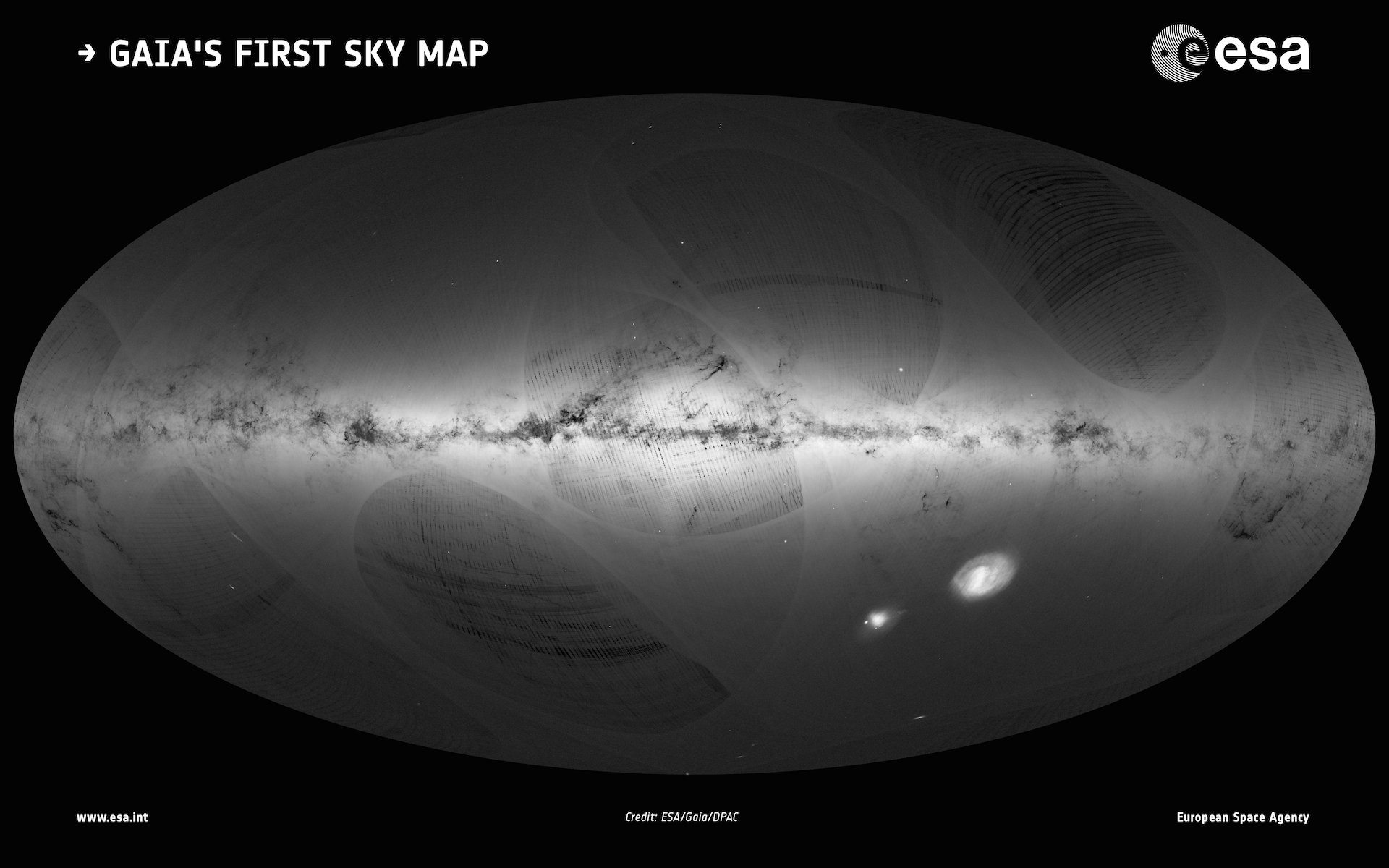
There’s much more to Gaia than pictures, but here’s the first map of the sky  it produced:
cstpe32weaeiwmw

I remember first hearing about Gaia about 15 years ago when I was on a PPARC advisory panel and was immediately amazed  by the ambition of its objectives. As I mentioned above, Gaia is a global space astrometry mission, which will make the largest, most precise three-dimensional map of our Galaxy by surveying more than a billion stars; DR1 is really just a taster as the measurements will become more complete and more accurate as the mission continues.

In some sense Gaia is the descendant of the Hipparcos mission launched in 1989, but it’s very much more than that. Gaia monitors each of its target stars about 70 times over a five-year period. It is expected to discover hundreds of thousands of new celestial objects, such as extra-solar planets and brown dwarfs, and observe hundreds of thousands of asteroids within our own Solar System. The mission is also expected to yield a wide variety of other benefits, including new tests of the  General Theory of Relativity.

Gaia will created an extraordinarily precise three-dimensional map of more than a thousand million stars throughout our Galaxy (The Milky Way) and beyond, mapping their motion, luminosity, temperature and chemical composition as well as any changes in such properties. This huge stellar census will provide the data needed to tackle an enormous range of important problems related to the origin, structure and evolutionary history of our Galaxy. Gaia will do all this by repeatedly measuring the positions of all objects down to an apparent magnitude of 20. A billion stars is about 1% of the entire stellar population of the Milky Way.

For the brighter objects, i.e. those brighter than magnitude 15, Gaia  measures their positions to an accuracy of 24 microarcseconds, comparable to measuring the diameter of a human hair at a distance of 1000 km. Distances of relatively nearby stars are measured to an accuracy of 0.001%. Even stars near the Galactic Centre, some 30,000 light-years away, have their distances measured to within an accuracy of 20%.

It’s an astonishing mission that will leave an unbelievably rich legacy not only for the astronomers working on the front-line operations of Gaia but for generations to come.


George’s Marvellous Medicine

Posted in History, Literature with tags , , , on September 13, 2016 by telescoper

Today is the 100th anniversary of the birth of author Roald Dahl, who was born in Llandaff, Cardiff, on 13th September 1916.  To celebrate this occasion, Cardiff University’s School of Chemistry has tried to recreate some of the phenomena described in one of Dahl’s children’s books, George’s Marvellous Medicine. Enjoy!


Cardiff Boundary Changes

Posted in Politics with tags , , , on September 13, 2016 by telescoper

There’s been a lot of discussion in the news about changes to electoral constituencies in the United Kingdom proposed by the Boundary Commissions for England, Wales, Scotland and Northern Ireland. These proposals are intended to achieve two goals: (a) to reduce the total number of constituencies (and hence Members of Parliament) from 650 to 600; and (b) to ensure that the resulting constituencies contain roughly the same number of votes (within 5% either way of the mean number).

In a bit more detail: each constituency in the UK should contain roughly the same number of eligible voters, the so-called “electoral quota” which is reached by dividing the total electorate of the UK by the number of required constituencies, except for the Isle of Wight and two Scottish island constituencies. The quota is then 74,769, based on the electoral register as it stood on 1 December 2015.

The purported aim of (a) is to reduce the running cost of Parliament. I’d be more convinced of that if the previous Prime Minister hadn’t appointed no fewer than 260 Members to the House of Lords, at considerably greater expense than the saving incurred by losing 50 MPs from the House of Commons. The intention of (b) is more reasonable, but it does threaten the rationale of the constituency-based system as it creates some larger and less homogeneous constituencies.

The Boundary Commisssion for Wales has proposed that the Welsh MPs be reduced from 40 to 29, which means the loss of some historically important constituencies altogether and a significant rearrangement of many others.  In fact there isn’t a seat in Wales that isn’t changed in some way. Here’s what the proposals mean for Cardiff, with the existing constituencies on the left and the proposed boundaries on the right:

slide1

I reside in Cardiff West (marked 12 on the left). You will see that the proposal involves extending this constituency on the western side of the River Taff down towards Cardiff Bay. This splits the former constituency Cardiff South and Penarth (11) into two, the western part (mainly Penarth) being absorbed into a new constituency called Vale of Glamorgan East (20 on the right). The other big change is that Cardiff Central (9 on the left) is eliminated entirely, absorbed by an enlarged Cardiff North (18 on the right, formerly 10 on the left) and a new Cardiff South and East (19) on the right. The net change is the loss of one seat in the City of Cardiff, which is currently held by Labour MP Jo Stevens.

I’m sure there’ll be quite a strong reaction to these changes, not least because they are based on the electoral register as it was on December 1st 2015 because the switch to individual electoral registration meant that 770,000 names dropped off the list before this date. The list also does not reflect those who registered to vote ahead of the EU referendum in June.

Going back to Wales for a moment, I think it’s unfair that while Scotland excluded two island constituencies from the quota formula to reflect their specific character, the same did not happen for Ynys Môn (Anglesey), a constituency which has been around since 1536, but which is now to be enlarged into a new entity called Ynys Môn and Arfon.  I’m sure someone will comment on that!

Anyway, these are proposals and there is now a period of consultation. The final boundaries will not be determined until 2018.


Back On Green Dolphin Street

Posted in Biographical, Jazz with tags , , , , , on September 12, 2016 by telescoper

I was listening to this wonderful track yesterday and couldn’t resist reposting a piece I wrote I wrote about it over 7 years  ago. If I were ever to be asked on one of those programmes where you have to pick examples of your favourite music, this would probably be the first I’d write on my list.

Years ago in 1980, when the great pianist Bill Evans passed away suddenly, Humphrey Lyttelton paid tribute to him on his radio programme “The Best of Jazz” by playing a number of tracks featuring him. I didn’t really know much about Bill Evans at the time – I was only 17 then – but one track that Humph chose has been imprinted on my mind ever since, and it’s one of those pieces of music that I listen to over and over again.

The track is On Green Dolphin Street, as recorded in 1958 by the great Miles Davis sextet of the time that featured himself on trumpet, John Coltrane on tenor sax, Julian “Cannonball” Adderley on alto sax, Jimmy Cobb on drums, Paul Chambers on bass and Bill Evans on piano. This is the same band that played on the classic album Kind of Blue, one of the most popular and also most innovative jazz records of all time, which was recorded a bit after the recording of On Green Dolphin Street.  I love Kind of Blue, of course, but I think this track is even better than the many great tracks on that album (All Blues, Flamenco Sketches, Blue in Green, etc). In fact, I’d venture the opinion – despite certainty of contradiction – that this is the greatest Jazz recording ever made.

On Green Dolphin Street was suggested to Miles Davis the band’s leader by the saxophonist Cannonball Adderley. It was the theme tune from a film from the late 1940s. It’s also the title of a more recent very fine novel by Sebastian Faulks.

I think the Miles Davis version demonstrates his genius not only as a musician himself but also as a bandleader. On Green Dolphin Street definitely bears the Miles Davis hallmark, but it also manages to accommodate the very different styles of the other musicians and allows them also to impose their personality on it. This is done by having each solo introduced with a passage with the rhythm section playing a different, less propulsive, 3/4 time behind it. This allows each musician to set out their stall before the superb rhythm section kicks into a more swinging straight-ahead beat  (although it still keeps the 3/4 feel alongside the 4-4, courtesy of brilliant drumming by Jimmy Cobb) and they head off into their own territory. As the soloists hand over from one to the other there are moments of beautiful contrast and dramatic tension, especially – and this is the reason why Humph picked this one in 1980 – when Bill Evans takes over for his solo from Cannonball Adderley. He starts with hesitant single-note phrases before moving into a richly voiced two handed solo fully of lush harmonies. It’s amazing to me to hear how the mood changes completely and immediately when he starts playing, and it always sends shivers down my spine.

Not that the other soloists play badly either. After Bill Evans’s short but exquisite prelude, Miles Davis takes over on muted trumpet, more lyrical and less introspective than in Kind of Blue but still with a moody,  melancholic edge. He’s followed by John Coltrane’s passionately virtuosic solo which floods out of him in an agonized stream which contrasts with Miles’ poised simplicity. By contrast, Cannonball Adderley is jaunty and upbeat, sauntering through his solo up to that wonderful moment where he hands over to the piano. Then Miles Davis takes over again to take them to the conclusion of the piece.

I’m not into League tables for music, but this is definitely fit to put up alongside the greatest of them all…

Bayes Factors via Savage-Dickey Supermodels [IMA]

Posted in Bad Statistics, The Universe and Stuff on September 12, 2016 by telescoper

How could I possibly resist reblogging an arXiver post about “Savage-Dickey Supermodels”?

arxiver's avatararXiver

http://arxiv.org/abs/1609.02186

We outline a new method to compute the Bayes Factor for model selection which bypasses the Bayesian Evidence. Our method combines multiple models into a single, nested, Supermodel using one or more hyperparameters. Since the models are now nested the Bayes Factors between the models can be efficiently computed using the Savage-Dickey Density Ratio (SDDR). In this way model selection becomes a problem of parameter estimation. We consider two ways of constructing the supermodel in detail: one based on combined models, and a second based on combined likelihoods. We report on these two approaches for a Gaussian linear model for which the Bayesian evidence can be calculated analytically and a toy nonlinear problem. Unlike the combined model approach, where a standard Monte Carlo Markov Chain (MCMC) struggles, the combined-likelihood approach fares much better in providing a reliable estimate of the log-Bayes Factor. This scheme potentially opens the way to…

View original post 53 more words

Flag

Posted in Poetry with tags , , , on September 11, 2016 by telescoper

What’s that fluttering in a breeze?
Its just a piece of cloth
that brings a nation to its knees.

What’s that unfurling from a pole?
It’s just a piece of cloth
that makes the guts of men grow bold.

What’s that rising over a tent?
It’s just a piece of cloth
that dares the coward to relent.

What’s that flying across a field?
It’s just a piece of cloth
that will outlive the blood you bleed.

How can I possess such a cloth?
Just ask for a flag my friend.
Then blind your conscience to the end.

by John Agard (b. 1949)

Cosmology: Galileo to Gravitational Waves – with Hiranya Peiris

Posted in The Universe and Stuff with tags , , , on September 9, 2016 by telescoper

Here’s another thing I was planning to post earlier in the summer, but for some reason forgot. It’s a video of a talk given at the Royal Institution earlier this year by eminent cosmologist Prof. Hiranya Peiris of University College London. The introduction to the talk goes like this:

Modern fundamental physics contains ideas just as revolutionary as those of Copernicus or Newton; ideas that may radically change our understanding of the world; ideas such as extra dimensions of space, or the possible existence of other universes.

Testing these concepts requires enormous energies, far higher than what is achievable by the Large Hadron Collider at CERN, and in fact, beyond any conceivable Earth-bound experiments. However, at the Big Bang, the Universe itself performed the ultimate experiment and left clues and evidence about what was behind the origin of the cosmos as we know it, and how it is evolving. And the biggest clue is the afterglow of the Big Bang itself.

In the past decade we have been able to answer age-old questions accurately, such as how old the Universe is, what it contains, and its destiny. Along with these answers have also come many exciting new questions. Join Hiranya Peiris to unravel the detective story, explaining what we have uncovered, and how we know what we know.

Hiranya Peiris is Professor of Astrophysics in the Astrophysics Group in the Department of Physics and Astronomy at University College London. She is also the Principal Investigator of the CosmicDawn project, funded by the European Research Council

She is also a member of the Planck Collaboration and of the ongoing Dark Energy Survey, the Dark Energy Spectroscopic Instrument and the Large Synoptic Survey Telescope. Her work both delves into the Cosmic Microwave Background and contributes towards the next generation galaxy surveys that will yield deep insights into the evolution of the Universe.

I’ve heard a lot of people talk about “Cosmic Dawn” but I’ve never met her…

Anyway, here is the video. It’s quite long (almost an hour) but very interesting and well-presented for experts and non-experts alike!

Update: I’ve just heard the news that Hiranya is shortly to take up a new job in Sweden as Director of the Oscar Klein Centre for Cosmoparticle Physics. Hearty congratulations and good luck to her!


Horowitz plays Schubert

Posted in Music with tags , , on September 9, 2016 by telescoper

This was doing the rounds on Facebook earlier this summer and I meant to post it on here, but forgot. Anyway, better late than never.  This is the great Vladimir Horowitz playing the Impromptu No. 3  in G flat major D899  by Franz Schubert. It’s a stunning performance to watch as well as listen to, despite – or maybe because of – the fact that he was an old man at the time and this was to be his last concert in Vienna. I love the way he takes his time to settle at the start, and then all of a sudden, his hands apparently almost still, he starts to caress the keyboard with his fingers and this beautiful music comes to life, almost as if it’s coming directly from another world. Take a few minutes off, and let some beauty into your heart..


Rank Nonsense

Posted in Bad Statistics, Education, Politics with tags , , , , , on September 8, 2016 by telescoper

It’s that time of year when international league tables (also known as “World Rankings”)  appear. We’ve already had the QS World University Rankings and the Shanghai (ARWU) World University Rankings. These will soon be joined by the Times Higher World Rankings, due out on 21st September.

A lot of people who should know a lot better give these league tables far too much attention. As far as I’m concerned they are all constructed using extremely suspect methodologies whose main function is to amplify small statistical variations into something that looks significant enough to justify constructing  a narrative about it. The resulting press coverage usually better reflects a preconceived idea in a journalist’s head than any sensible reading of the tables themselves.

A particularly egregious example of this kind of nonsense can be found in this week’s Guardian. The offending article is entitled “UK universities tumble in world rankings amid Brexit concerns”. Now I make no secret of the fact that I voted “Remain” and that I do think BrExit (if it actually happens) will damage UK universities (as well as everything else in the UK). However, linking the changes in the QS rankings to BrExit is evidently ridiculous: all the data were collected before the referendum on 23rd June anyway! In my opinion there are enough good arguments against BrExit without trying to concoct daft ones.

In any case these tables do not come with any estimate of the likely statistical variation from year to year in the metrics used to construct them, which makes changes impossible to interpret. If only the compilers of these tables would put error bars on the results! Interestingly, my former employer, the University of Sussex, has held its place exactly in the QS rankings between 2015 and 2016: it was ranked 187th in the world in both years. However, the actual score corresponding to these two years was 55.6 in 2015 and 48.4 in 2016. Moreover, Cambridge University fell from 3rd to 4th place this year but its score only changed from 98.6 to 97.2. I very much doubt that is significant at all, but it’s mentioned prominently in the subheading of the Guardian piece:

Uncertainty over research funding and immigration rules blamed for decline, as Cambridge slips out of top three for first time.

Actually, looking closer, I find that Cambridge was joint 3rd in 2015 and is 4th this year. Over-interpretation, or what?

To end with, I can’t resist mentioning that the University of Sussex is in the top 150 in the Shanghai Rankings for Natural and Mathematical Sciences this year, having not been in the top 200 last year. This stunning improvement happened while I was Head of School for Mathematical and Physical Sciences so it clearly can not be any kind of statistical fluke but is entirely attributable to excellent leadership. Thank you for your applause.


Theory of Gravitational Waves [CL]

Posted in The Universe and Stuff with tags on September 8, 2016 by telescoper

Since gravitational waves are quite the thing these days I thought I’d reblog this arXiver post of a nice review article that covers all the basics for the benefit of anyone interested in finding about a bit more about the subject.

arxiver's avatararXiver

http://arxiv.org/abs/1607.04202

The existence of gravitational radiation is a natural prediction of any relativistic description of the gravitational interaction. In this chapter, we focus on gravitational waves, as predicted by Einstein’s general theory of relativity. First, we introduce those mathematical concepts that are necessary to properly formulate the physical theory, such as the notions of manifold, vector, tensor, metric, connection and curvature. Second, we motivate, formulate and then discuss Einstein’s equation, which relates the geometry of spacetime to its matter content. Gravitational waves are later introduced as solutions of the linearized Einstein equation around flat spacetime. These waves are shown to propagate at the speed of light and to possess two polarization states. Gravitational waves can interact with matter, allowing for their direct detection by means of laser interferometers. Finally, Einstein’s quadrupole formulas are derived and used to show that nonspherical compact objects moving at relativistic speeds are powerful gravitational wave…

View original post 44 more words