Archive for Miles Davis

R.I.P. Sonny Rollins (1930-2026)

Posted in Jazz, R.I.P. with tags , , , , , , , , on May 26, 2026 by telescoper

I woke this morning to the sad news that the great tenor saxophonist Sonny Rollins passed away yesterday at the age of 95. He was one of the most influential and creative musicians of his time and there are many justifiably glowing obituaries of him. I can’t add much that hasn’t already been said by them, other than say that I consider myself deeply privileged to have been able see and hear Sonny Rollins play live, not once but twice, during the 1980s. The first was in the relatively intimate surroundings of Ronnie Scott’s club in London and the second in the Royal Festival Hall. On both occasions he was fantastic. Sonny Rollins was one of those musicians who made me think when I watched him that if you took the instrument out of his mouth it would somehow carry on playing on its own. At Ronnie Scott’s club he opened one set by starting to play in the band room, walking out through the audience onto the stage still playing and then about an hour later walked off back the way he came, still playing. The tune was Thelonious Monk’s 52nd Street Theme. He ended his set at the Festival Hall with an unstoppable version of Don’t Stop The Carnival that had everyone leaping about in the aisles. There was so much music in him it just had to come out. Was he playing the music or was it playing him?

Sonny Rollins began playing professionally when he was a teenager in the late 1940s but came to the attention of the jazz world in earnest when he teamed up with Miles Davis for a 1954 recording session that led to a record called Miles Davis with Sonny Rollins. (Coincidentally, today would have been Miles Davis’s 100th birthday). That record, originally issued on a 10″ LP, showcased Rollins’s big muscular sound on tenor sax, but also consisted of four tracks, three of which were compositions by Sonny Rollins, including a now-standard Oleo. That record was really Sonny’s breakthrough and he went on to record dozens of superb albums both as leader: A Night at the Village Vanguard, Saxophone Colossus, Newk’s Time, and Way Out West, to name just four. He also made many records as a side man, including the must-have album, Brilliant Corners with Thelonious Monk.
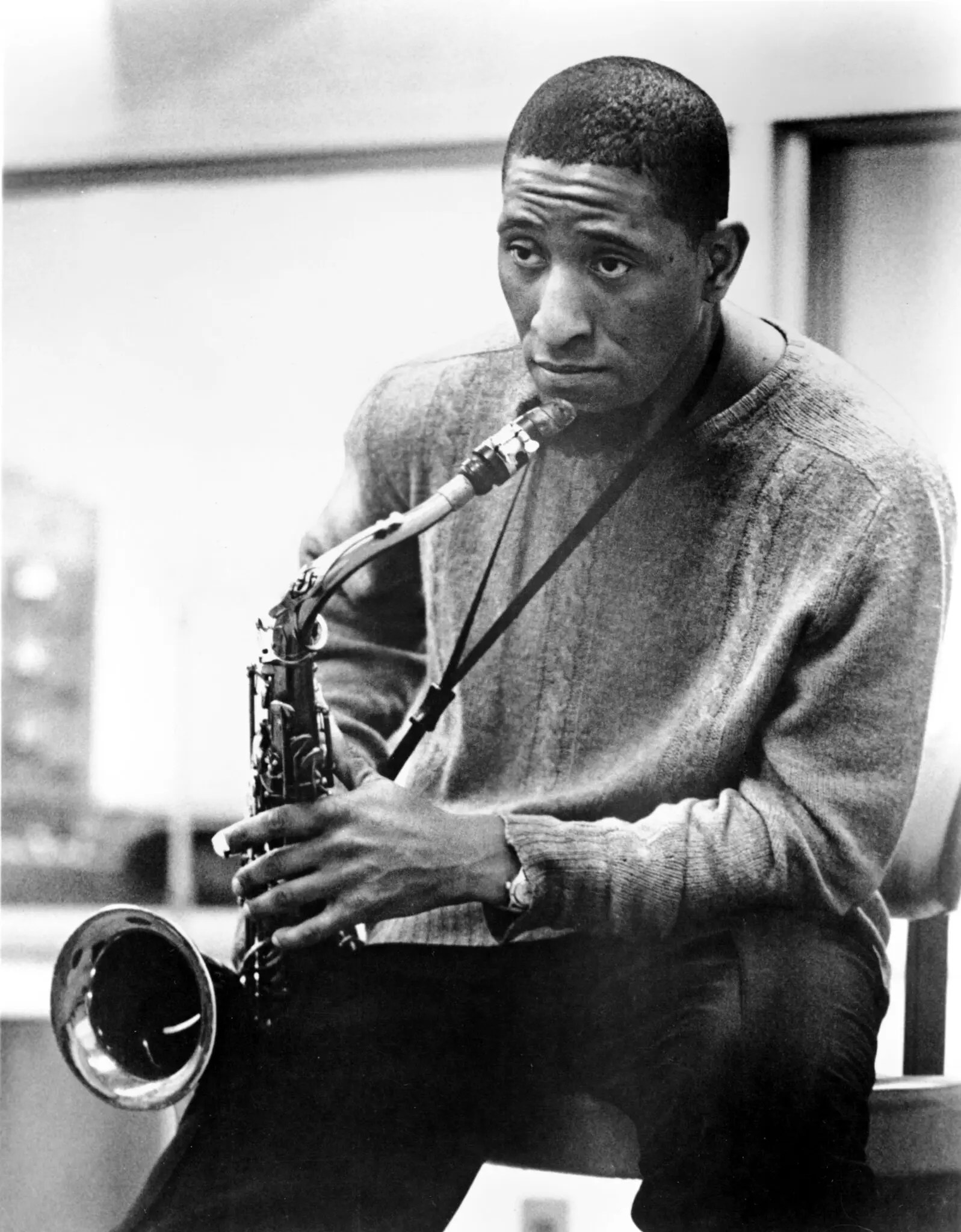
Having established himself as a major artist, Rollins suddenly took a three-year break from playing between 1959 to 1961 to develop his technique. Lacking space to practice in his apartment, he did so every day on the Williamsburg Bridge. When he returned to a recording studio in early 1962, the result was another classic album, The Bridge.

(Left: Sonny Rollins c. 1960)

Having established himself as a major artist, Rollins suddenly took a three-year break from playing between 1959 to 1961 to develop his technique. Lacking space to practice in his apartment, he did so every day on the Williamsburg Bridge. When he returned to a recording studio in early 1962, the result was another classic album, The Bridge.

In all he made over 60 albums, of which I have about a dozen. I’ll be listening to them a lot over the next few days and may post a few further items about them in due course.One thing I always liked about Sonny Rollins was his tendency to take a shine to very unexpected tunes and turn them into something magical. Off the top of my head I can think of The Surrey with the Fringe on Top, How are Things in Glocca Morra? and I’m an Old Cowhand.

It’s impossible to pick a single track than can do justice to Sonny Rollins so I’m just going to include a couple here. The first is the very first track I ever heard by him, on a Blue Note sampler album. It’s a Miles Davis tune called Tune Up and it’s from the 1957 Blue Note album Newk’s Time with Wynton Kelly (piano), Doug Watkins (bass), and Philly Joe Jones (drums). Perhaps listening to the energy and invention of his playing, delivered with that characteristically leathery tone then you’ will understand why I fell instantly in love with his music and wanted to hear more.

The second is one of my favourite records of all time. It’s called Hold’ Em Joe and it was recorded in 1965 with Ray Bryant (piano), Walter Booker (bass) and the fabulous Mickey Roker on drums:

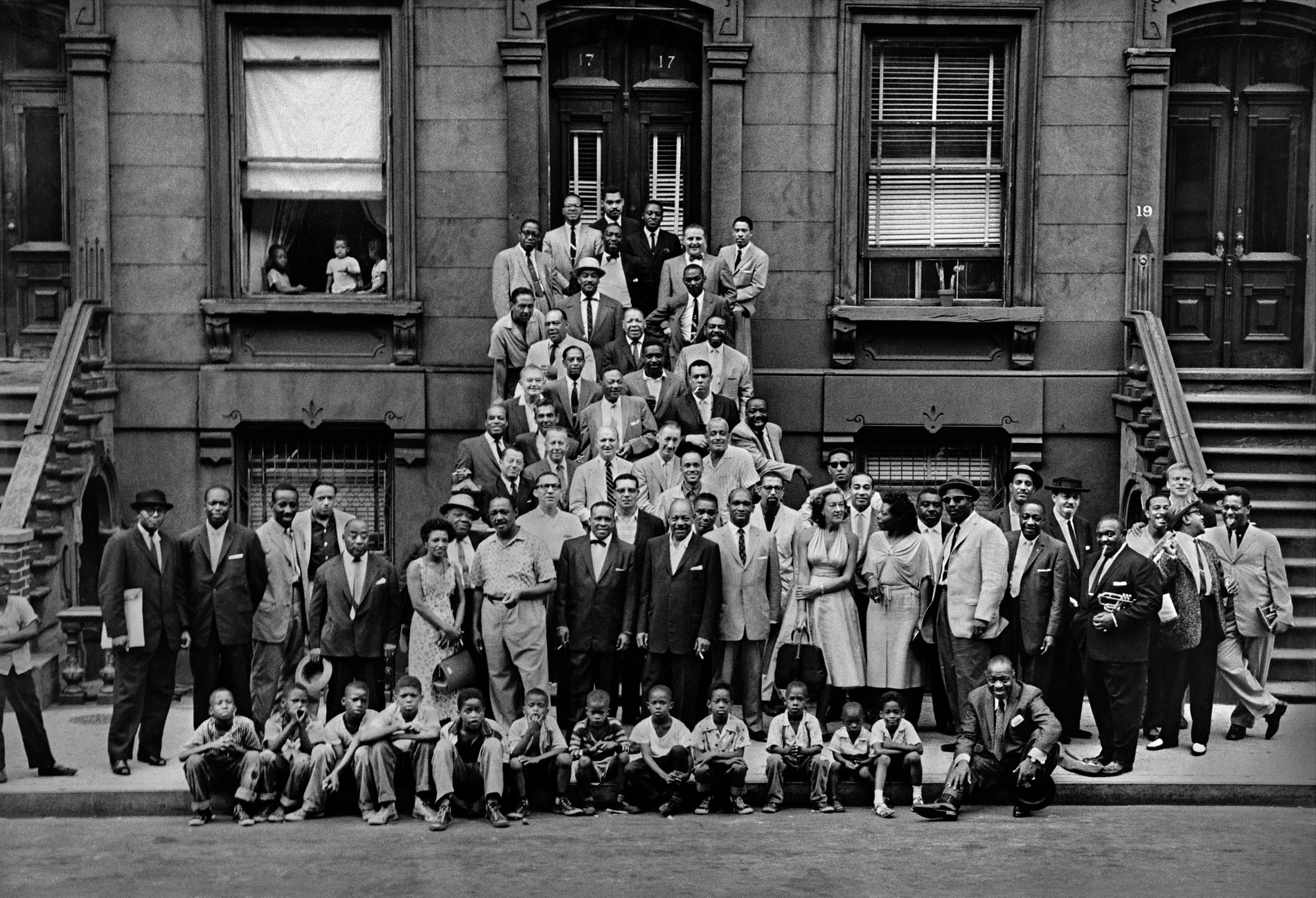
As a sad footnote on this sad occasion, the passing of Sonny Rollins means that not one of the great musicians in this famous photograph A Great Day in Harlem, taken on August 12th 1958, is still with us:
Rest in Peace Sonny Rollins (1930-1954), Saxophone Colossus indeed.
Blue Christmas Again

Posted in Jazz with tags , , , on December 12, 2025 by telescoper

I’ve had a very busy penultimate week of term and am out of energy so instead of attempting a new post I thought I’d repost this “festive” classic. I posted this one during the “festive” season” in 2013 and haven’t posted it since. Until now. The band is led by none other than Miles Davis; the other members are Frank Rehak (trombone), Wayne Shorter (tenor sax), Paul Chambers (bass), Jimmy Cobb (drums), and Willie Bobo (bongos); the arrangement is unmistakably by Gil Evans. The vocalist is the legendary Bob Dorough who also wrote the lyrics.

“Bah Humbug” never sounded so cool!

 P.S. I’m not particularly blue myself, just tired…

Spanish Key – Miles Davis

Posted in Jazz with tags , , , on December 17, 2023 by telescoper

As I am still in Spain for a for more days before the Christmas break I thought I would share a vaguely relevant piece of music, Spanish Key from the 1970 album Bitches Brew by Miles Davis. This I don’t have time to write a long piece about this album, but I will say that of all the abrupt changes of musical direction during the career of Miles Davis, this album is probably the most startling and many jazz fans – even ardent admirers of Miles Davis – don’t like it at all. Anyway, des goûts et des couleurs on ne discute pas

This track is particularly interesting to me because I’ve long wondered about the title and the musical structure. I’m not at all sure, but it seems likely to me that the title indicates the relationship of this piece to the track Flamenco Sketches from the classic album Kind of Blue recorded over a decade earlier. In that album, Miles was experimenting with jazz based not on traditional keys and scales, but on modes. In Flamenco Sketches there is a section based on a major phrygian mode which is commonly used in flamenco music. Spanish Key is in a very different style – much faster for one thing – but it has a similar pattern involving changes from E to D to D (phrygian) to E (phrygian) and G (mixolydian). Apparently Miles gave minimal instruction to his musicians about what to play, but did have prearranged signals to shift from one mode to another, such as happens about 3:15 in the recording when he ushers in a guitar solo by John McLaughlin, and around 12:46 when the mood abruptly changes as Miles introduces a new theme. I also think it was a stroke of genius to include a bass clarinet on this album; on this track it adds a Moorish element to the Spanish tinge.

Anyway, there’s so much going on in this track that it’s more instructive to listen to it than write about it, so here you are. Enjoy!

John McLaughlin

Posted in Jazz with tags , , on June 12, 2022 by telescoper

It’s Sunday and I’ve just finished work for the day. Too tired to write anything substantial I thought I’d share a track featuring and named after the guitarist I went to see at the National Concert Hall a few weeks ago. John McLaughlin is the 4th track on the Miles Davis (double) album Bitches Brew. It doesn’t feature Miles Davis on trumpet nor Wayne Shorter on saxophone but does involve the electric pianos of Chick Corea and Joe Zawinul, the bass of Dave Holland, the drums of Lenny White and Jack de Johnette, other percussion by Don Alias and Juma Santos and Bennie Maupin on bass clarinet; the latter addition to the ensemble being a stroke of genius by Miles Davis. I know quite a lot of fans of Miles Davis don’t like this album at all, finding it all a bit perplexing but I don’t mind music that’s a bit perplexing and I think it’s great. Most of the tracks are very long but this one is only four and a half minutes or so in duration, built around a simple riff laid over a loose and very dynamic rhythmic accompaniment. Like the other numbers, it’s almost entirely improvised.

My Funny Valentine – Miles Davis

Posted in Jazz with tags , , on February 14, 2021 by telescoper

From the album Cookin’ by the Miles Davis Quintet* of 1957 here is a classic.

*John Coltrane was in the Quintet but doesn’t play on this track: the musicians are Miles Davis (tp), Red Gardland (p), Paul Chambers (b) and Philly Joe Jones (d).

Bird 100: Bird of Paradise

Posted in Uncategorized with tags , , on August 29, 2020 by telescoper

And so we come to the final post of the day in honour of the centenary of the birth of Charlie Parker, also known as `Bird’. I know a lot of people don’t really `get’ Bird’s way of playing, but for me he created some of the most beautiful and exciting sounds not only in jazz, but in any musical genre. Here is a piece called Bird of Paradise (a thinly disguised version of the Jerome Kern standard All The Things You Are) recorded in 1947 for the Dial label with a quintet that included a young (21 year-old) Miles Davis on trumpet. Miles Davis was still finding his way musically at the time of the Dial sessions, but Bird had already established himself as a powerful creative force and his solo on this number is absolutely exquisite.

Anyway, that’s it for Bird 100 from me. I hope you enjoyed the posts. Normal service will be resumed tomorrow!

Sixty Years of Kind of Blue

Posted in Jazz with tags , , , , , , , , , , , on August 18, 2019 by telescoper

I didn’t remember until late last night that yesterday was the 60th anniversary of the release, on 17th August 1959, of the classic jazz album Kind of Blue by a band led by trumpeter Miles Davis featuring John Coltrane (ts), Cannonball Adderley (as), Bill Evans (p, replaced by Wynton Kelly on one track), Paul Chambers (b) and Jimmy Cobb on drums. I bought the album on vinyl way back in the 1970s when I was still at school and have listened to it probably thousands of times since then. It still sounds fresh and exciting sixty years after its first release. But you don’t have to listen to me, you can listen to the whole album here:

When it first appeared, Kind of Blue seemed to represent all that Miles Davis stood for from a musical point of view, with its modal and scalar themes and such passages as the fourth section of Flamenco Sketches which hints at a Spanish influence. Whether the actual performances were typical of the way this band sounded live is less clear, but there’s no question that the album has worn so well as to be now universally regarded as a timeless masterpiece.

So why is it such an important album?

I can only speak for myself, of course, but I’d say a big part of this was that the music is on the cusp of the evolution of modern jazz. It’s music from a time of transition, pointing the way forward to exciting developments while also acknowledging past traditions. You only have to look at the various directions Miles Davis, John Coltrane and Bill Evans explored after this album to see what I mean.

A few words about each of the tracks:

The opening number So What? established the practice of constructing themes based on scales instead of chords. After an introduction that keeps you guessing for a while, it turns out to be a straightforward 32-bar melody with a simple modulation serving as the bridge. At a medium tempo, the pure-toned and rather spare solo by Miles Davis provides a delicious contracts with the flurry of notes produced by Coltrane, who also plays between the beats. It might be just my imagination but the rhythm section seems to tighten up behind him, only to relax again with Cannonball Adderley’s more laid-back, bluesy approach.

The next track is All Blues, which is in a gentle 6/8 time. I discovered by accident a while ago this composition found its way onto the GCSE Music syllabus. In fact there’s a recording of the track, produced and distributed as “set work” for that purpose:

As an aside, I should mention that I never took any qualifications in music at School – although I did get music lessons, I didn’t find them at all inspiring and it took me years to develop a taste for anything other than Jazz, which I knew about mainly from home, because my father was a (part-time) Jazz drummer. There wasn’t much mention of Jazz at School from teachers, and none of my friends were into it, so it became a very private passion, although I’m glad to say it never faded.

Anyway, what little I know about music I picked up by studying on my own, and trying to figure out what was going on by listening to records. All Blues is a really interesting composition to unpick in this way, as it tells you a lot about how Jazz was evolving in the late 1950s (it was released in 1959). Musicians like Miles Davis were experimenting with ways of breaking away from the standard approach to Jazz improvisation based on chord progressions, and one of the routes that developed was modal Jazz. All Blues is particularly interesting because it teeters on the edge between the old approach and the new; it’s clearly based on the traditional 12-bar blues progression but diverges from it in several respects.

A standard blues progression in G might go like this (although there are many variations):

|G|G|G|G|
|C|C|G|G|
|D|C|G|G|

It’s based on just three chords: the tonic (in this case G): the sub-dominant IV (C) and the dominant V (D); the V-IV-I progression in the last four bars is usually called the turnaround.

The progression for All Blues is this:

|G7| G7| G7| G7|
|Gm7| Gm7| G7| G7|
|D7| E♭7 D7| F G|F G6|

While the addition of a major 7th note to the basic triad G isn’t unusual, the two G minor 7th chords are more interesting, because they involve adding a blue note (a flattened third) to the basic chord . But it’s in the last four bars that the harmonies move dramatically away from the standard turnaround. Chromatic chords are included and the usual resolution back to G is subtly changed by the addition of a 6th note (E) to the basic G chord (GBD) at the end; that trick became a bit of a trademark for Jazz of this period.

However, it’s the two F chords that represent the strongest connection with modal harmony. The scale of G major involves F-sharp, so the F is a flattened note (a flattened VIIth). In fact, all the Fs in the piece are natural rather than sharp. For this reason you could argue that this is a piece not played in the key of G major but in the corresponding Mixolydian mode (the white notes on the piano from G to G).

So it’s a blues that’s not quite a blues, but is (appropriately enough) Kind of Blue. There’s so much going on harmonically that the fact that it’s played in 6/8 rhythm (rather than the more usual 4/4 for the Blues) seems almost irrelevant.

Those are just the bare bones, but the improvisations of Miles Davis, Bill Evans, Cannonball Adderley and John Coltrane et al breathe life into them and create a living Jazz masterpiece. Although it seems like a complicated tune, apparently what happened at the recording session was that Miles Davis talked the band through the piece, they played it once to get a feel for it, and then recorded the entire track that was released on the album in one go.

On Freddie Freeloader , Bill Evans was replaced with Wynton Kelly. I suppose that Miles Davis thought that Kelly would be more convincing on this relatively straight-ahead blues, and his crisp, direct opening solo suggests that Miles was probably right. Miles Davis’s solo that follows is superbly structured in terms of timing and dynamics. Coltrane plays more-or-less entirely in double-time and then Adderley enjoys himself hugely in a good-humoured final solo.

Blue in Green, which was mainly written by Bill Evans, is based on a ten-bar melody featuring an eloquent solo Miles on muted trumpet and some sensitive playing by Coltrane and Evans. The same mood prevails in the following track.

Flamenco Sketches involves a series of solos each improvised on a set of five scales; it’s the fourth section that hints at the Spanish influence alluded to in the title. The tempo is very slow, which contributes the air of solemnity as does the absolute perfection of the solos. In that respect it has clear parallels with some of Duke Ellington’s work. Miles Davis, who opens and closes the track on muted trumpet, and Bill Evans on piano are absolutely faultless but I particularly enjoy John Coltrane’s playing on tenor saxophone: his tone is as bleak and austere as an Arctic sunrise, and just as wonderful and he conjures up an absolutely beautiful improvised melody.

I’ll end with a comment on the album Kind of Blue, by Stephen Thomas Erlewine who wrote

Kind of Blue isn’t merely an artistic highlight for Miles Davis, it’s an album that towers above its peers, a record generally considered as the definitive jazz album, a universally acknowledged standard of excellence. Why does Kind of Blue posses such a mystique? Perhaps because this music never flaunts its genius… It’s the pinnacle of modal jazz — tonality and solos build from the overall key, not chord changes, giving the music a subtly shifting quality… It may be a stretch to say that if you don’t like Kind of Blue, you don’t like jazz — but it’s hard to imagine it as anything other than a cornerstone of any jazz collection.

People sometimes ask me why I post about music on here. The answer has two parts and they’re both simple. One is that I enjoy writing about music because it gives me the opportunity to explore my own thoughts about why I like it so much. The other reason is to share something I love very much, in the hope that other people might find as much joy from the music I love. For example, if just one person listens to Kind of Blue for the first time as a result of reading this piece, then it will definitely be worth the 40 minutes it took me to write!

Flamenco Sketches for International Jazz Day

Posted in Jazz with tags , , , , , on April 30, 2019 by telescoper

I discovered only this morning that today, April 30, is International Jazz Day 2019 so I thought I’d post a track to mark the occasion. This is from the all-time classic album Kind of Blue featuring the Miles Davis Sextet and it was recorded on April 22, 1959 – just over 60 years ago! This album appears very frequently in lists of top jazz records, but it’s so good I don’t think there’s any risk of getting bored with it no matter how often you hear it.

Flamenco Sketches involves a series of solos each improvised on a set of five scales; it’s the fourth section that hints at the Spanish influence alluded to in the title. The tempo is very slow, which contributes the air of solemnity as does the absolute perfection of the solos. In that respect it has clear parallels with some of Duke Ellington’s work. Miles Davis, who opens and closes the track on muted trumpet, and Bill Evans on piano are absolutely faultless but I particularly enjoy John Coltrane’s playing on tenor saxophone: his tone is as bleak and austere as an Arctic sunrise, and just as wonderful and he conjures up an absolutely beautiful improvised melody. Other members of the band are Cannonball Adderley (as), Paul Chambers (b) and Jimmy Cobb (d).

Enjoy! And a Happy International Jazz Day to you all!

Bird of Paradise – In Memoriam Charlie Parker

Posted in Jazz with tags , , on March 12, 2018 by telescoper

Today is the 63rd anniversary of the death, in 1955 aged just 34, of the great saxophonist and composer Charlie Parker, also known as `Bird’.  I know a lot of people don’t really `get’ Bird’s way of playing, but for me he created some of the most beautiful and exciting sounds not only in jazz, but in any musical genre. Here, to mark his memory, is a piece called Bird of Paradise (a thinly disguised version of the Jerome Kern standard All The Things You Are) recorded in 1947 for the Dial label with a quintet that included a young (21 year-old) Miles Davis on trumpet. Miles Davis was still finding his way musically at the time of the Dial sessions, but Bird had already established himself as a powerful creative force and his solo on this number is absolutely exquisite.

Friday Music Quiz: The Yardbird Suite

Posted in History, Jazz with tags , , on September 30, 2016 by telescoper

Not much time to write today so I thought I’d put up a bit of music to end the week. This is a classic from 1946, featuring Charlie Parker leading a band that included a very young Miles Davis. The Yardbird Suite an original composition by Parker, and has become a jazz standard, but he never copyrighted the tune so never earned any royalties from it.

Now, here’s a little question to tease you with. Can anyone spot the connection between this tune and a notable event that occurred today, 30th September 2016?

Answers through the comments box please!