Back in Cardiff I was going through my collection of old LPs and found this track on a Blue Note collection. It’s standard written by Harold Arlen called Get Happy. I hadn’t listened to it for ages and I’d forgotten how great it is. It was recorded in 1953 by a six-piece band led by trombonist Jay Jay Johnson, with Clifford Brown (trumpet), Jimmy Heath (tenor saxophone), John Lewis (piano), Percy Heath (bass) and Kenny Clarke (drums). They’re all great musicians, and they make a wonderfully rich ensemble sound for a small band, but the star of the show is without doubt the great Clifford Brown , whose solo is absolutely sensational. Just listen to the way he plays the bridge on his first chorus. Superb!
Follow @telescoperAuthor Archive
Get Happy!
Posted in Jazz with tags Clifford Brown, Get Happy, J.J. Johnson, Jazz on August 8, 2016 by telescoper“Just one more thing”: The psychology of ‘Columbo’
Posted in Uncategorized on August 8, 2016 by telescoperI got a pingback from this piece this morning, as it links to a post on this blog, so I thought I’d share it here. I named my dear departed cat Columbo precisely because he had a habit of leaving through the catflap only to return a second later…

My favourite TV detective has always been Columbo (played by Peter Falk). I have watched every single one of the 69 episodes (as my family will attest) many times. While I am working, I will often have Columbo on in the background in the way that other people have music on in the background (although I do the latter as well). For those reading this that have not come across Columbo, here is a brief synopsis from Wikiquote:
“Columbo (1968, 1971-1978, 1989-2003) was an American crime fiction television show about Lieutenant Columbo, a homicide detective with the Los Angeles Police Department. He uses his deferential and absent-minded persona to lull criminal suspects into a false sense of security, by harassing and pestering suspects non-stop – without letting them know that they’re suspects – under the pretense that he’s simply being a pesky detective, in order to spy on them and agitate…
View original post 2,213 more words
Cricket, Lovely (5-day Test) Cricket
Posted in Cricket with tags Edgbaston, England versus Pakistan, Third Test on August 7, 2016 by telescoperJust spent a lazy Sunday pottering about, clearing a backlog of crosswords, and listening on the wireless to the final day of the Third Test between England and Pakistan taking place at Edgbaston (in the Midlands).
It turned out to be an eventful day, to say the least! England had overcome a first-innings deficit of 103 to finish Day 4 on 414 for 5, a lead of 311. As I suspected, they continued to bat on the morning of Day 5 but the declaration came earlier than expected, after they added just 31 runs in four overs. Pakistan needed to score 343 to win, a stiff but not impossible challenge.
I must be getting a bit cautious in my old age, but I would probably have wanted 30 more runs in so to be sure Pakistan had no chance of winning, but it seems Alastair Cook is getting a bit bolder in his captaincy…
Anyway, Pakistan lost an early wicket but otherwise proceeded fairly comfortably, a draw looking increasingly likely. Suddenly, though, some reverse swing started to appear, and wickets began to tumble. In no time at all they were 125 for 7, four wickets falling in as many overs. They limped to 151 for 9 but with 25 overs to survive with only one wicket left, Pakistan looked doomed.
The last pair, Rahat Ali and Sohail Khan decided to have a go, Sohail in particular throwing the bat to good effect and enjoying a sizeable chunk of good fortune. The overs passed. The England bowlers started to look tired. Could this pair do what Jimmy and Money had done for England against Australia at Cardiff all those years ago?
But no. All of a sudden it was over, as Man of the Match Moeen Ali took the final wicket (caught and beard) with 14 overs to spare. England won by 141 runs, with about an hour’s play left, and so take a 2-1 lead in the series with one match to play.
There has been some talk about reducing Test Matches to four days, to try to force a faster tempo which will appeal more to the public. I think that would be a shame. It is true that some passages of play in this series, and indeed in this match, have been slow, but the games have been absorbing precisely because of the tension generated by the shifting tactical situation.
So I hope we keep the 5-day format for Test cricket. I love it!
Follow @telescoperVitae Summa Brevis Spem Nos Vetat Incohare Longam
Posted in Poetry with tags Ernest Dowson, Horace, Poetry on August 6, 2016 by telescoperThe title of this poem by Ernest Dowson, Vitae Summa Brevis Spem Nos Vetat Incohare Longam, can be translated from my half-remembered schoolboy Latin as something like “the brief span of Life forbids us from conceiving an enduring hope”. It’s a quotation from one of the Odes of Horace (Book I, Ode 4, line 15):
They are not long, the weeping and the laughter,
Love and desire and hate:
I think they have no portion in us after
We pass the gate.They are not long, the days of wine and roses:
Out of a misty dream
Our path emerges for a while, then closes
Within a dream.
by Ernest Dowson (1867-1900)
Follow @telescoperLast Day in Brighton
Posted in Biographical on August 5, 2016 by telescoperHere I am in the flat I’ve been renting for the past three and a half years. I’m just packing the last of my belongings ready to take back to Cardiff. I’ll be handing back the keys this afternoon and then heading for the railway station.
I left my job at Sussex at the end of last week, but the tenancy of the flat doesn’t expire until tomorrow so I thought I might as well make the most of it.
Tomorrow is the annual Pride celebration in Brighton, which I’ve decided to miss for logistical reasons. I hope it goes well though, especially for the weather.
It’s a warm sunny day and I may go for a stroll along the promenade before I leave. I still think that Brighton would have been a nice place to live, if only I’d been able to find the time to enjoy it, but I have no regrets about returning to Cardiff. When you start to dread going into work every morning it’s definitely time to make a change. It was an immense relief when I removed the Sussex University email account from my mobile phone!
But this isn’t really a time for looking back. I am looking forward to the next few weeks because I’m not actually starting work at Cardiff until September. I’m going to spend most of August pottering about the house, though I do have a (hopefully short) stay in hospital scheduled for routine maintenance.
It will probably feel quite strange when I do get back to work at Cardiff, but at least there will be some familiar faces!
Update: courtesy of Southern Rail I had to stand all the way from Brighton to Victoria. They could only muster four coaches for a peak time train. I won’t miss Southern Fail that’s for sure..
Follow @telescoperThe Brexit vote wasn’t democracy in action. It was populist ignorance on a grand scale.
Posted in Uncategorized on August 4, 2016 by telescoperI agree 100% with this, and will also continue to campaign for the United Kingdom to remain a full member of the European Union. As the grim economic reality starts to bite, I think many will wake up and stop the madness before it’s too late.

No-one else seems to be saying this, so I will.
Way back in 1988 – when the Thatcher government passed the infamous anti-homosexual law known as Section 28 – a majority of the UK population supported it.
I was one of the minority who was against it.
Even as late as 2000, polls showed around 52% of the UK population were against the Blair government repealing the law.
Despite being in the minority – I was never in any doubt that the majority were wrong.
These days, of course, everyone claims they know Section 28 was wrong. David Cameron – a strong supporter of Section 28 at the time it was introduced – has even apologised for it.
So we – the minority who were always against Section 28 – were in the end proven to be right.
That’s why Remain supporters need to get their balls back. Because being in a minority doesn’t make us wrong.
Politicians are too afraid…
View original post 412 more words
Leonard Cohen pays tribute to woman who inspired ‘So Long Marianne’ who died last week
Posted in Uncategorized on August 3, 2016 by telescoper“Now so long, Marianne, it’s time that we began
To laugh and cry and cry and laugh about it all again..”

Leonard Cohen has paid tribute to Marianne Ihlen, the woman who inspired ‘So Long Marianne’ who died last week.
Writing on Facebook, Cohen asked that this letter to him from Jan Christian Mollestad be used in his memorial. Jan Christian Mollestad is currently completing a biographical film about Marianne.
“Marianne slept slowly out of this life yesterday evening. Totally at ease, surrounded by close friends,” the letter began. “Your letter came when she still could talk and laugh in full consciousness. When we read it aloud, she smiled as only Marianne can. She lifted her hand, when you said you were right behind, close enough to reach her.”
Getty
It continued, “It gave her deep peace of mind that you knew her condition. And your blessing for the journey gave her extra strength. Jan and her friends who saw what this message meant for her, will all thank you in…
View original post 146 more words
High-resolution Observation of the Sunyaev-Zel’dovich Effect With ALMA
Posted in The Universe and Stuff with tags ALMA, Atacama Large Millimetre Array, Sunyaev-Zel'dovich Effect on August 1, 2016 by telescoperI just saw a very interesting paper (by Kitayama et al.) on the arXiv, which I’m pretty sure presents the highest-ever resolution observations of the (Thermal) Sunyaev-Zel’dovich Effect in a galaxy cluster taken with the Atacama Large Millimetre Array (ALMA). This is basically a distortion of the spectrum of the cosmic microwave background seen in the direction of the cluster caused by scattering of CMB photons off electrons in the extremely hot plasma that pervades such an object. The key parameter to be measured along each line of sight is the Compton y-parameter, which is defined as

where 

Here is the abstract of the paper:
We present the first image of the thermal Sunyaev-Zel’dovich effect (SZE) obtained by the Atacama Large Millimeter/submillimeter Array (ALMA). Combining 7-m and 12-m arrays in Band 3, we create an SZE map toward a galaxy cluster RXJ1347.5-1145 with 5 arc-second resolution (corresponding to the physical size of 20 kpc/h), the highest angular and physical spatial resolutions achieved to date for imaging the SZE, while retaining extended signals out to 40 arc-seconds. The 1-sigma statistical sensitivity of the image is 0.017 mJy/beam or 0.12 mK_CMB at the 5 arc-second full width at half maximum. The SZE image shows a good agreement with an electron pressure map reconstructed independently from the X-ray data and offers a new probe of the small-scale structure of the intracluster medium. Our results demonstrate that ALMA is a powerful instrument for imaging the SZE in compact galaxy clusters with unprecedented angular resolution and sensitivity. As the first report on the detection of the SZE by ALMA, we present detailed analysis procedures including corrections for the missing flux, to provide guiding methods for analyzing and interpreting future SZE images by ALMA.
And here is the key image, a map of the variation of the Compton y-parameter across the cluster:
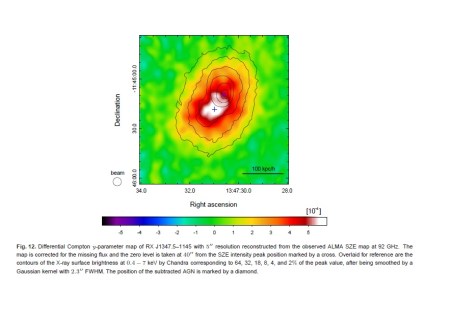
It’s not at all easy to isolate the Sunyaev-Zeld’dovich effect, so this is an impressive result and the paper is well-worth reading. Observations at such high resolution will help greatly to understand the behaviour of hot gas in rich clusters, especially when combined with observations of the emission from the cluster plasma itself, which is hot enough to radiate in the X-ray part of the spectrum.
Follow @telescoperHenry Draper’s Photograph of M42
Posted in History, The Universe and Stuff with tags Henry Draper, M42, Omar Nasim, Orion Nebula, photography on July 29, 2016 by telescoperI just remembered that last night I happened across an interesting episode of The Essay on Radio 3. It was about the first ever photograph of an astronomical nebula, which happened to be of the Orion Nebula (M42). The programme features Omar Nasim, a lecturer in History at Kent University, and is available on iPlayer or as a download here. It’s only 15 minutes long, but absolutely fascinating.
Here is the photograph concerned, taken by Henry Draper in 1880:

The stars of the constellation Orion are clearly over-exposed in order to reveal the much fainter light from the nebula, and the resolution is poor compared to, e.g., this glorious Hubble Space Telescope image:

The Orion Nebula seen by Hubble. Credit: ESA/NASA/Hubble Space Telscope
Nevertheless the Draper photograph is of great historical importance, as it changed the way astronomers made images of such objects (by photography rather than by drawing) and ushered in a new era of scientific research.
Hat’s off to Henry Draper!
Follow @telescoperSussex versus Glamorgan
Posted in Biographical, Cricket with tags cricket, Glamorgan, Natwest T20 Blast, Sussex on July 29, 2016 by telescoperIt was an interesting coincidence that, last night, on the eve of my last day working at the University of Sussex before moving to Cardiff University, there was a game of cricket between Sussex and Glamorgan at the County Ground in Hove. Naturally I decided to go along and was fortunate to have Dorothy Lamb along for company. To be precise this wasn’t “proper cricket”, but a Natwest T20 “Blast”. Unfortunately the weather dampened the squib considerably. Yesterday’s weather forecast predicted rain in the afternoon clearing by the time the game started (at 18.30), but when we got to the ground it was still drizzling:
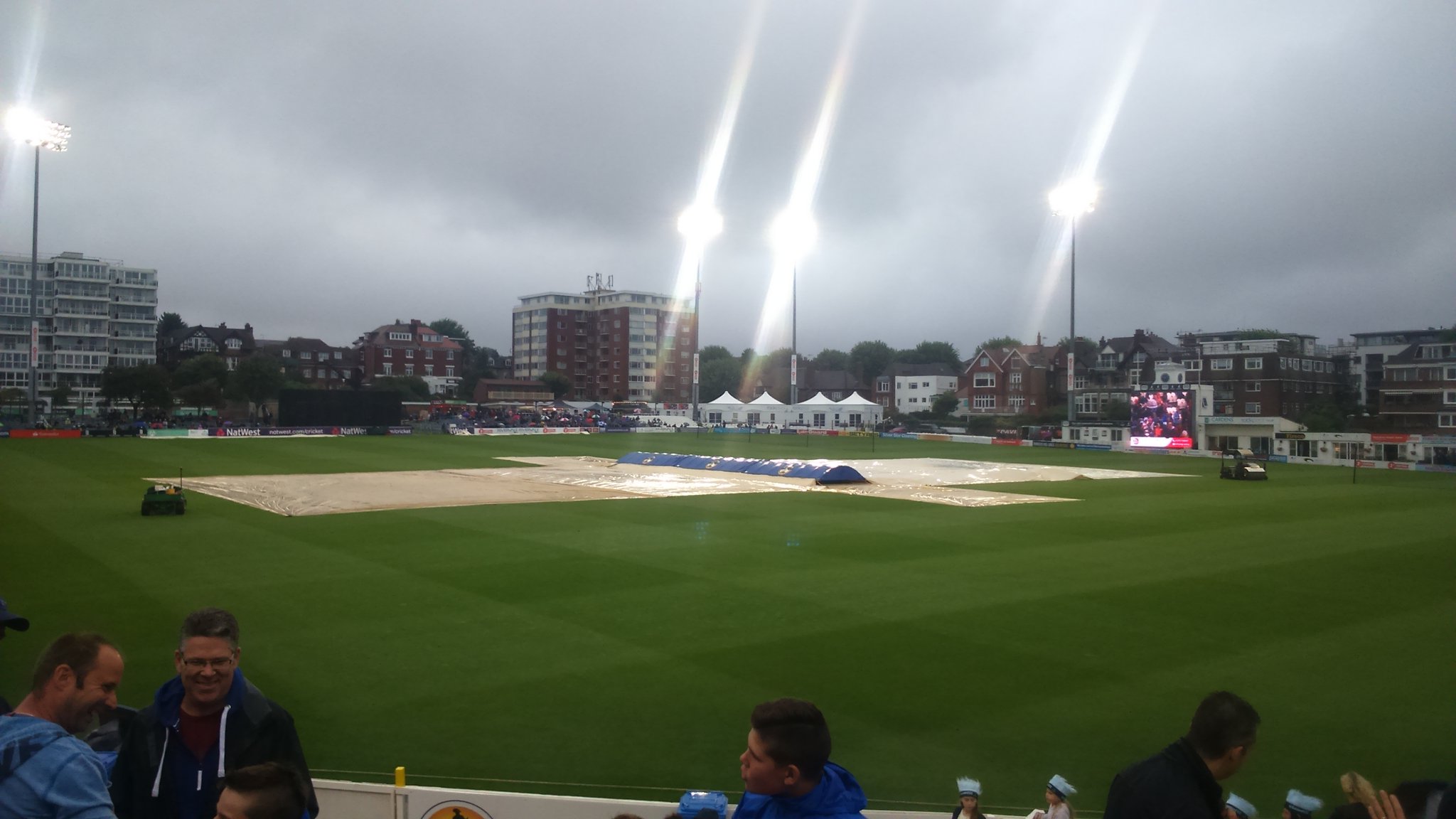
After a lot of faffing about play did actually get under way at about 19.50, the match to be reduced to 14 overs a side because of the late start.
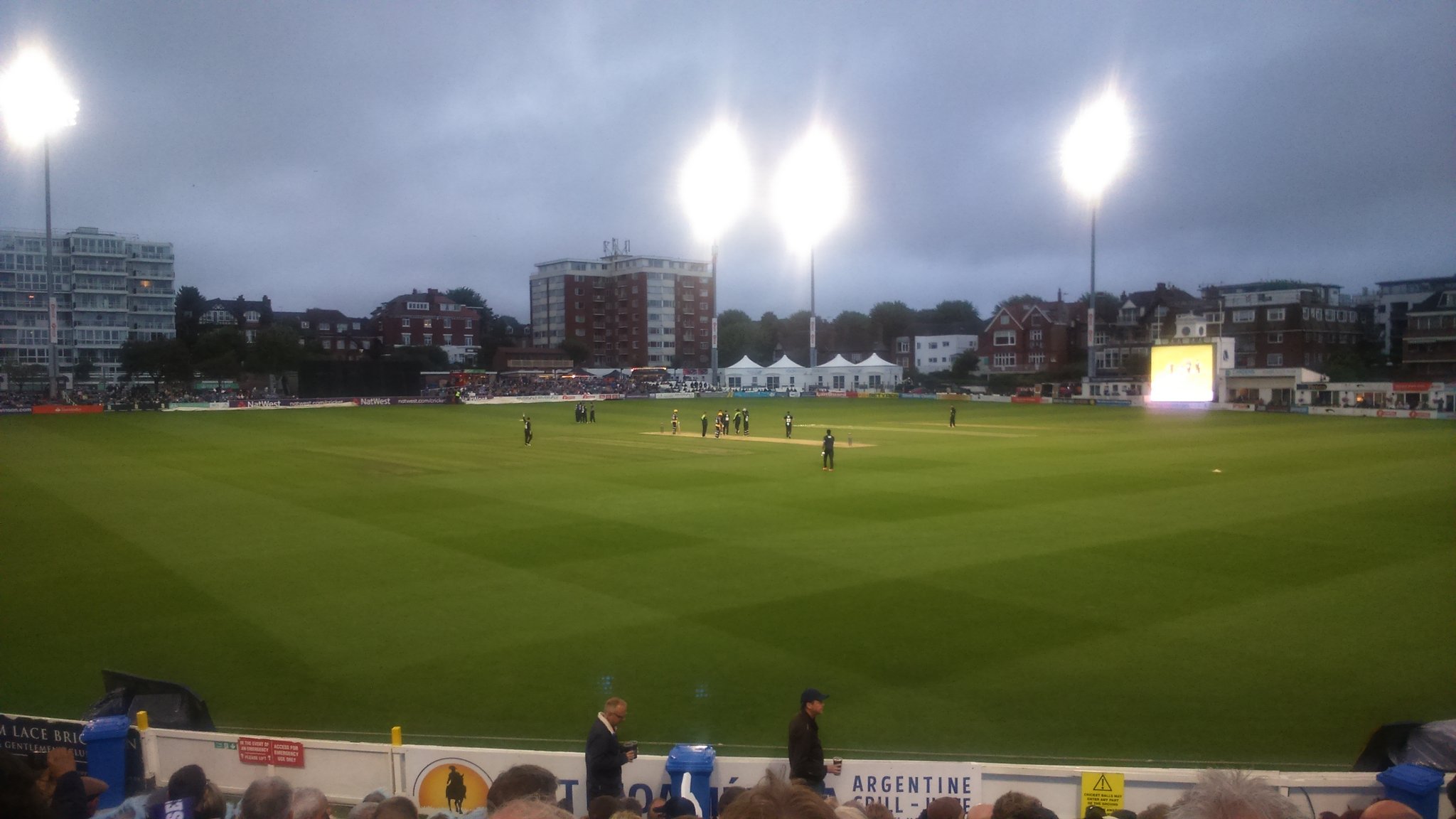 You can see the full scorecard here. Glamorgan batted first, struggling right from the start despite some wayward bowling from Sussex. Having been 62 for 8 at one point they were probably relieved to get into three figures, though they only just managed this: they were all out for 101 in the last over. Sussex batted and got off to a much better start, but then the rain came back so they went off. They then came back again but only one ball was beowled before the rain (which was really just drizzle) started again so they went off again. And so on. In the end only four overs and one ball were possible before the rain came back for good and the match was abandoned with no result. The upshot of this was that Glamorgan qualified for the Quarter Finals and Sussex didn’t. Glamorgan were lucky. Sussex were 30-1 when play was halted but a minimum of five overs have to be bowled for a result to be declared. A few minutes more play and Sussex would almost certainly have won. Such is life.

 In the Dark