Whenever I’m in dire need of inspiration – which happens a lot these days – I usually turn to music. I found this not long ago and decided to share it here because it’s not just inspirational, but awe-inspiring. I don’t have any information about the date or location of this recording of Dizzy Atmosphere– except that it’s obviously live, and that it features the composer Dizzy Gillespie on trumpet after a great solo by the great Charlie Parker on alto saxophone. Bird is absolutely on fire in this performance! In case you’re interested this is yet another bebop standard that’s built on rhythm changes though it is in an unusual key (A♭) for such pieces. Anyway, never mind about that, just listen to Bird flying through this!
At long last, the Chilcot Report on the UK’s involvement in the 2003 Iraq War has now been published. It’s a mammoth document which can obtain in full here. Even the Executive Summary is 150 pages long.
I’m going to put my cards on the table straight away. I opposed the invasion of Iraq in 2003 and have never wavered from that opposition. I would feel vindicated were I not so saddened by the agony the invasion unleashed.
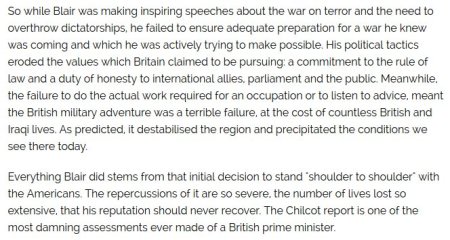
I’m not going to pretend to have read the whole document, or even all of the Executive Summary, but all the reaction I’ve seen suggest that it is unequivocal in its condemnation of the (then) Prime Minister, Tony Blair. Here is an example:
I sincerely hope that Blair’s reputation will not recover, and indeed hope that some form of legal redress can be sought against him. Attention in this country is focussing on the 179 service personnel who lost their lives in Iraq either during, or as a direct result of, the invasion of Iraq. However, let’s not lose sight of the fact that it was the Iraqi people who suffered most – over 150,000 are thought to have been killed, though such is the chaos of a country ruined by invasion and its aftermath that the true figure will never be known.
A few days ago we remembered the thousands who died on the Somme with the words “Lest we forget”. We shouldn’t forget Blair either…
Anotida’s research lies at the interface between fundamental disciplines (mathematics, numerical analysis, physics, scientific computing) and experimental sciences (developmental biology, biochemistry, cell biology, biomedicine, plant biology) and seeks to propose, develop, analyse and simulate new mathematical and computational approaches applied to experimental sciences.
Congratulations to Anotida Professor Madzvamuse, and here’s to a future no doubt filled with even more great research achievements!
This is by Mike Grannell, and is published here with his permission. Enjoy!
It was 2025 when the trouble really began. There had been some muttering prior to this, but in July 2025, Microsoft introduced Windows 25. Every time users of Office-Infinity entered the consecutive characters pi, the system automatically started to produce the decimal digits of ? to unlimited accuracy. Previous versions had a similar bug, but this could be turned off with a simple expletive to the voice-recognition system. Windows 25 was different ? it had a mind of its own and would shout back in highly offensive terms.
At this point, demand began to grow for a referendum on the true value of ?. Older people seemed to prefer 22/7, but there were vigorous arguments in support of alternative values. The Sun newspaper was strongly in favour of taking the value to be 3 on grounds of…
I’ve posted this at 7.20am on 1st July 2016. Precisely one hundred years ago, following a heavy artillery bombardment that had been going on for a week, an enormous mine was exploded under a fortified position at Hawthorn Ridge near Beaumont Hamel on the River Somme in France. Here is footage of the actual explosion:
Ten minutes later, the first French and British troops went “over the top” on the first day of the Battle of the Somme. It was to be the bloodiest day in the history of the British Army.
Here is an edited version of a piece I wrote some time ago about this battle and its aftermath.
–0–
Twelve summers ago, in 2004, I spent an enjoyable day walking in the beautiful Peak District of Derbyshire followed by an evening at the opera in the pleasant spa town of Buxton, where there is an annual music festival. The opera I saw was A Turn of the Screw, by Benjamin Britten: a little incongruous for Buxton’s fine little Opera House which is decorated with chintzy Edwardiana and which was probably intended for performances of Gilbert & Sullivan light comic operettas rather than stark tales of psychological terror set to unsettling atonal music.
When Buxton’s theatre was built, in 1903, the town was a fashionable resort at which the well-to-do could take the waters and relax in the comfort of one of the many smart hotels.
Arriving over an hour before the opera started, I took a walk around the place and ended up on a small hill overlooking the town centre where I found the local war memorial. This is typical of the sort of thing one can see in small towns the length and breadth of Britain. It lists the names and dates of those killed during the “Great War” (1914-1918). Actually, it lists the names but mostly there is only one date, 1916.
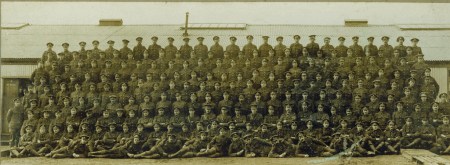
The 1st Battalion of the Nottingham and Derbyshire Regiment (known as the Sherwood Foresters) took part in the Battle of the Somme that started on 1st July 1916. For many of them it ended that day too; some of their names are listed on Buxton’s memorial.
On the first day of this offensive, the British Army suffered 58,000 casualties as, all along the western front, troops walked slowly and defencelessly into concentrated fire from heavy machine guns that were supposed to have been knocked out by the artillery barrage that preceded the attack. The bombardment had been almost entirely ineffective, and it finished well before the British advance started, so the Germans had plenty of time to return to their positions and wait for the advancing British. It had also been believed that the artillery shells would have cut the barbed wire protecting German positions. It didn’t. British and French troops who got entangled were sitting ducks. Carnage ensued.
Rather than calling off the attack in the face of the horrific slaughter, the powers that be carried on sending troops over the top to their doom for months on end. By the end of the battle (in November that year) the British losses were a staggering 420,000, while those on the German side were estimated at half a million. The territory gained at such a heavy price was negligible.
These numbers are beyond comprehension, but their impact on places like Buxton was measurably real. Buxton became a town of widows. The loss of manpower made it impossible for many businesses to continue when peace returned in 1918 and a steep economic decline followed. It never fully recovered from the devastation of 1916 and its pre-war posterity never returned.
And the carnage didn’t end on the Somme. As the “Great War” stumbled on, battle after battle degenerated into bloody fiasco. Just a year later the Third Battle of Ypres saw another 310,000 dead on the British side as another major assault on the German defences faltered in the mud of Passchendaele. By the end of the War on 11th November 1918, losses on both sides were counted in millions.
–0–
I decided to end this piece with the following video featuring music by George Butterworth (A Shropshire Lad: Rhapsody for Orchestra, inspired by the poetry of A.E. Housman, and one of the few surviving complete works of this composer). Images of present-day Shropshire are interspersed with photographs taken on the Somme in 1916. I chose this because George Butterworth too lost his life in the Battle of the Somme (on 5th August 1916). Lest we forget.
In advance of tomorrow’s sombre commemorations of the centenary of the start of the Battle of the Somme, I thought I’d write a short preliminary piece about a related centenary to be marked today, 30th June 2016.
On this day in 1916 there took place the Battle of the Boar’s Head, the name given to a German salient near Richebourg-l’Avoué in the Pas de Calais region. This battle is remembered locally here in Brighton as The Day Sussex Died. The following brief account is based on the wikipedia article.
The attack on the Boar’s Head was launched on 30 June 1916, as an attempt to divert German attention from the Battle of the Somme which was to begin on the following day, 1 July. The attack was conducted by the 11th, 12th and 13th (Southdowns) Battalions of the Royal Sussex Regiment, part of the 116th Southdowns Brigade of the 39th Division.
A preliminary bombardment and wire-cutting by the artillery commenced on the afternoon of 29 June and was reported to be very effective. The final bombardment commenced shortly before 3:00 a.m. and the 12th and 13th battalions went over the top (most for the first time) shortly afterwards, the 11th Battalion providing carrying parties. The guns lifted their fire off the German front trench and put down an intense barrage in support. The infantry reached the German trenches, bombing and bayoneting their way into the German front line trench and held it for about four hours.
The second trench was captured and held for only half an hour, during which several counter-attacks were repulsed and then the raiders withdrew, because of a shortage of ammunition and mounting casualties. The German support position was not reached by the infantry, because the German defensive tactics included shelling trenches where the British had gained a foothold.
In fewer than five hours the three Southdowns Battalions of the Royal Sussex lost 17 officers and 349 men killed, including 12 sets of brothers, three from one family. A further 1,000 men were wounded or taken prisoner.
The corps commander looked upon the attack as a raid and considered it to be successful.
The losses at the Boar’s Head were shortly to be dwarfed by the horrendous scale of the slaughter on the Somme, but their impact on families and indeed whole villages in rural Sussex was devastating. Those who lost their lives in armed conflict should never been forgotten, nor should their sacrifices be appropriated for political ends.
It’s important not to get carried away by the post-referendum doom and gloom. Abraham Loeb’s recent paper on the arXiv suggests the Universe will only be habitable for the next 10,000,000,000,000 years or so. This means that the current state of political chaos won’t last for ever, though I wonder the paper doesn’t make it clear if Article 50 will have been triggered by the time the last star goes out.
Is life most likely to emerge at the present cosmic time near a star like the Sun? We consider the habitability of the Universe throughout cosmic history, and conservatively restrict our attention to the context of “life as we know it” and the standard cosmological model, LCDM. The habitable cosmic epoch started shortly after the first stars formed, about 30 Myr after the Big Bang, and will end about 10 Tyr from now, when all stars will die. We review the formation history of habitable planets and find that unless habitability around low mass stars is suppressed, life is most likely to exist near 0.1 solar mass stars ten trillion years from now. Spectroscopic searches for biosignatures in the atmospheres of transiting Earth-mass planets around low mass stars will determine whether present-day life is indeed premature or typical from a cosmic perspective.
After a couple of days away dealing with some personal business I’ve now time to make a few comments about the ongoing repercussions following last week’s referendum vote to Leave the European Union.
First of all on the general situation. Legally speaking the referendum decision by itself changes nothing at all. Referendums have no constitutional status in the United Kingdom and are not legally binding. The Prime Minister David Cameron has declined to activate (the now famous) Article 50 of the Lisbon Treaty which would initiate a two-year negotiated withdrawal, preferring to leave this to whomever succeeds him following his resignation. None of the likely contenders for the unenviable position of next Prime Minister seems keen to pull the trigger very quickly either. The United Kingdom therefore remains a member of the European Union and there is no clear picture of when that might change.
The rest of the European Union obviously wants the UK to leave as soon as possible, not just because we’ve indicated that we want to, but because we have always been never been very committed or reliable partners. In the words of Jean-Claude Juncker: ‘It is not an amicable divorce, but it was not an intimate love affair anyway.’
I don’t blame the 27 remaining members for wanting us to get on with getting out, because uncertainty is bad for business. Two years is more than enough time for big European businesses to write British producers out of their supply chains and for international companies now based in the United Kingdom to relocate to continental Europe. The current gridlock at Westminster merely defers this inevitable exodus. In the meantime inward investment is falling as companies defer decisions on future plans, casting a planningblight over the UK economy.
My own view, however, is that the longer the UK waits before invoking Article 50 the greater the probability that it will never be invoked at all. This is because the next PM – probably Boris Johnson – surely knows that he will simply not be able to deliver on any of the promises he has made.
For example, there will be no access to the single market post-BrExit without free movement of people. There won’t be £350 million per week extra for the NHS either, because our GDP is falling and we never sent £350 million anyway. All the possible deals will be so obviously far worse than the status quo that I don’t think Parliament will ever pass legislation to accept a situation is so clearly against the national interest. I may be wrong, of course, but I think the likeliest scenario is that the referendum decision is kicked into the long grass for at least the duration of the current Parliament.
That doesn’t solve the issue of BrExit blight, however. Which brings me to British science in a possible post-BrExit era. It’s all very uncertain, of course, but it seems to me that as things stand, any deal that involves free movement within Europe would be unacceptable to the powerful UK anti-immigration lobby. This rules out a “Norway” type deal, among others, and almost certainly means there will be no access to any science EU funding schemes post 2020. Free movement is essential to the way most of these schemes operate anyway.
It has been guaranteed that funding commitments will be honoured until the end of Horizon 2020, but that assumes that holders of such grants don’t leave the UK taking the grants with them. I know of four cases of this happening already. They won’t come back even if we’re still in the European Union then.
Another probable outcomes are that:
the shrinking economy will cause the UK government to abandon its ring-fence on science funding, which will lead to cuts in domestic provision also;
a steep decline in EU students (and associated income) will halt the expansion of UK science departments, and may cause some to shrink or even close;
non-UK EU scientists working in the UK decide to leave anyway because the atmosphere of this country has already been poisoned by xenophobic rhetoric.
British science may “endure” after BrExit but it definitely won’t prosper. What is the least bad solution, if we cannot remain?
Posted in Uncategorized on June 25, 2016 by telescoper
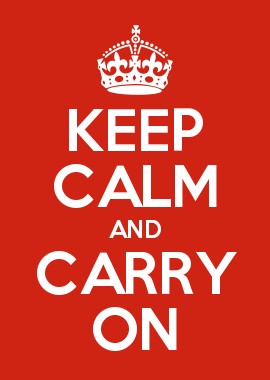
I’m still depressed and worried by the referendum vote, but it isn’t the British way to yield to despair. Let’s take the advice of a previous generation…
It seems clear that we are set to remain in the EU for the forseeable future, as the Leave campaigners are in no hurry to invoke Article 50 of the Lisbon treaty. I think there’s a real chance that we’ll end up staying in the EU after all.
In any case we are still in the European Union now. So. Chin up everyone. Business as usual!
The views presented here are personal and not necessarily those of my employer (or anyone else for that matter).
Feel free to comment on any of the posts on this blog but comments may be moderated; anonymous comments and any considered by me to be vexatious and/or abusive and/or defamatory will not be accepted. I do not necessarily endorse, support, sanction, encourage, verify or agree with the opinions or statements of any information or other content in the comments on this site and do not in any way guarantee their accuracy or reliability.



 In the Dark