Author Archive

Lisa Pathfinder: it works!

Posted in The Universe and Stuff with tags , , , on June 8, 2016 by telescoper

Just time for a quick post to pass on some impressive news from LISA Pathfinder (which is basically a technology demonstrator mission intended to establish the feasibility of a proposed space-based gravitational wave facility called LISA). LISA Pathfinder is ostensibly an extremely simple experiment, consisting of two metal cubes (made of a gold-platinum mixture) about 38cm apart. The question it tries to answer is how accurately these two cubes can be put an ideal “free-fall” state, i.e. when the only force acting on them is gravity.

Here’s a short explanatory video about the latest results:

The technical details are presented in a paper in Physical Review Letters, from which the key figure is this:


Lisa_PathfinderThis shows very clearly that the performance of the LISA Pathfinder experiment (as shown by the red measurements) comfortably exceeds the requirements of the full LISA experiment (black curve). Indeed, these results, from only two months of science operations, show that the two cubes are in free-fall to a precision more than five times better than originally required.

So, not to put too fine a point on it,  it works!


Cav/Pag and WNO

Posted in Opera with tags , , , , , on June 7, 2016 by telescoper

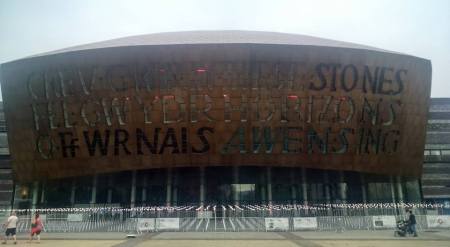
Well, I’m back in Brighton after a short break either side of my nth birthday (where n→∞). As is traditional on such occasions I spent the evening of the day in question at the Wales Millennium Centre for a night at the Opera:

WNO

On the bill for Saturday night were Cavalleria Rusticana and Pagliacci, two short operas written (respectively) by Pietro Mascagni and Ruggero Leoncavallo. Both works are in the verismo tradition of late 19th Century Italian opera and have central themes of love, jealousy, betrayal revenge and murder. So idea fare for a birthday treat!

The “Cav/Pag” package is quite a familiar pairing to opera goers. They weren’t actually written to be performed together, though it is believed that Leoncavallo wrote his piece Pagliacci in response to the success of Cavalleria Rusticana. The compositional style and orchestration are not dissimilar and often the principals are played by the same singers. The latter was the case with Saturday’s production, at least in terms of the two male roles: Gwyn Hughes Jones (shown below as Canio in Pagliacci; he also sang Turiddu in Cavalleria Rusticana) sang both tenor parts, while David Kempster (baritone) played Alfio (Cav) and Tonio (Pag). Both were excellent throughout.

Pagliacci.GwynHughesJones(Canio).Photocredit-BillCooper1244a

These two productions of this combo differ very much in their look and feel. Cavalleria Rusticana is beautifully staged, in a conventional 19th Century rural Italian setting. The lighting is particularly impressive: the opening looks like a scene from a painting by a Grand Master. The excellent chorus of Welsh National Opera is very much to the fore, especially in the famous Easter Hymn, and the principal soprano Camilla Roberts sang the role of Santuzza with great depth of expression. Carlo Rizzi conducted the Orchestra of Welsh National Opera.

Pagliacci is given a more modern setting – costumes were generally around the 1950s – but still set in Italy. The set is much plainer and the lighting harsher. The chorus has less to do in terms of singing, but provides colour and movement to the drama. Although the two male principals were good I felt the cast overall was weaker. Meeta Raval (Nedda) sang her part well enough, and got some good laughs in the moments of comedy, but she didn’t have the emotional depth needed to make her part really come alive. Gyula Nagy (as Nedda’s lover Silvio) also sang well enough, but really needs to take some acting lessons..

The big set-piece in Pagliacci is Vesti La Giubba, a powerfully emotional tenor ara which never fails to move. Enrico Caruso’s version of this was the hit record of its day.

Although there were some shortcomings it was still a very enjoyable evening of music drama. Indeed it was the last night in Cardiff for this season, Welsh National Opera’s 70th. The company’s debut when it gave its first performance – as an amateur organisation – on 15th April 1946, was a double bill of Cavalleria Rustica and Pagliacci

I’d therefore like to end by wishing Welsh National Opera a very happy birthday and send my deepest thanks for providing me with so many hours of pleasure through their performance. Long may they continue!


R.I.P. Muhammad Ali (1942-2016)

Posted in Sport with tags , on June 4, 2016 by telescoper

image

The Greatest.

Posted in Uncategorized on June 3, 2016 by telescoper

A very interesting and well argued case for remaining in the European Union, from eminent mathematician Tim Gowers.

gowers's avatarGowers's Weblog

For several reasons, I am instinctively in favour — strongly so — of remaining in the EU: I have a French wife and two bilingual children, and I am an academic living in the age of the internet. The result is that my whole outlook is international, and leaving the EU would feel to me like a gigantic step in the wrong direction. But in this post I want to try to set those instincts aside and try to go back to first principles, which doesn’t make it a mathematical post, but does make it somewhat mathematical in spirit. That is why I have chosen as my title the mathematical symbol for “is a member of”, which can also be read (in some contexts) as “in”, and which conveniently looks like an E for Europe too.

I’ll consider three questions: why we need supranational organizations, to what extent we should…

View original post 2,764 more words

R.I.P. Tom Kibble (1932-2016)

Posted in The Universe and Stuff with tags , , , , , on June 2, 2016 by telescoper

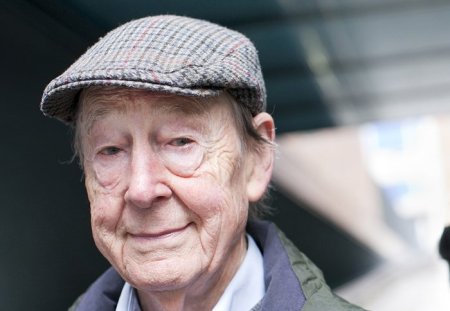
Yet again, I find myself having to use this blog pass on some very sad news. Distinguished theoretical physicist Tom Kibble (below) passed away today, at the age of 83.

Kibble

Sir Thomas Walter Bannerman Kibble FRS (to give his full name) worked on  quantum field theory, especially the interface between high-energy particle physics and cosmology. He has worked on mechanisms ofsymmetry breaking, phase transitions and the topological defects (monopoles, cosmic strings or domain walls) that can be formed in some theories of the early Universe;  he is  probably most famous for introducing the idea of cosmic strings to modern cosmology in a paper with Mark Hindmarsh. Although there isn’t yet any observational support for this idea, it has generated a great deal of very interesting research.

Tom was indeed an extremely distinguished scientist, but what most people will remember best is that he was an absolutely lovely human being. Gently spoken and impeccably courteous, he was always receptive to new ideas and gave enormous support to younger researchers. He will be very sadly missed by friends and colleagues across the physics world.

Rest in peace, Tom Kibble (1932-2016).


Too windy for Zeppelins

Posted in History on May 31, 2016 by telescoper

Fascinating recreation of the weather pattern at the Battle of Jutland

Philip's avatarOld Weather Blog

100 years ago today – 31st May 1916, saw the start of a major fleet action between the British and German navies: The battle of Jutland.

This is right in the middle of the period covered by the original oldWeather project, so you’d think we had all the logbooks and observations, at least from the British half of the battle, but alas, it’s not so. The Grand Fleet sounds impressive, and with as many as 40 major warships surely was impressive, but it didn’t travel much: The doctrine of ‘Fleet in being’ means that all those battleships stayed in port as a threatening influence rather than travelling to distant locations, and that puts them right at the bottom of our priority list for transcription, and we’ve never looked at them.

So we don’t have the Grand Fleet, but we can still reconstruct the weather of the battle, and…

View original post 276 more words

The Battle of Jutland

Posted in History with tags , , , on May 30, 2016 by telescoper

I’m going to be away for the rest of the week so I thought I’d mark the centenary of the Battle of Jutland a little early. In fact this battle, by far the largest naval engagement of the First World War, started  on 31st May 1916 and carried on into the early hours of the morning of 1st June when the German fleet, under Vice Admiral Reinhard Scheer, retreated. It took place in the North Sea off the western coast of the Jutland peninsula, and is referred to in Germany as the Battle of the Skagerrak, the strait that separates Jutland from southern Norway.

At the time of the battle are that Germany was under a naval blockade imposed by the Royal Navy, the main parts of which were organised into a “rapid response” fleet of cruisers and battle-cruisers (led by Admiral Sir David Beatty) and a “Grand Fleet” of larger but slower battleships (under Admiral Sir John Jellicoe). Knowing that his combined forces were much smaller than those of the British, so he couldn’t afford to take them on head to head, Scheer’s plan was to draw out and destroy as much as possible  of the lighter British fleet before the heavier ships could react. The problem was that the British had deciphered German communications that revealed a major operation was under way, so in fact the Grand Fleet left its base in Scapa Flow on May 30th, 100 years ago today.
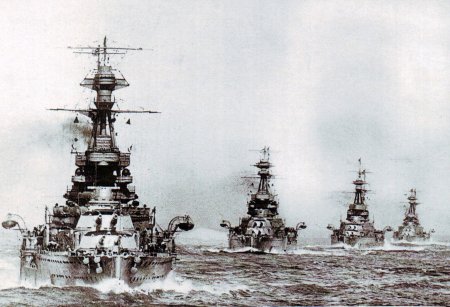
Jutland_grand_fleet

HMS Barham Valiant Malaya & Warspite heading to the Battle of Jutland on May 31st 1916

The first engagement, which turned out to be a preliminary skirmish, went very much in Germany’s favour, and two of Beatty’s battlecruisers were sunk. However, he then used his fleet to lure the German ships towards Jellicoe’s forces and battle was joined between the two main fleets. The outcome of this battle in terms of lost men and material was clearly in Germany’s favour. They exploited numerous technical deficiencies in the British ships  as well as tactical errors by their commanding officers, and ended up sinking 3 battlecruisers, 3 armoured cruisers, and  8 destroyers for the loss of 1 battlecruiser, 1 pre-dreadnought, 4 light cruisers and 5 torpedo-boats. In terms of casualties it was even clearer: over 6,000 were killed on the British side compared to just over 2,500 on the German side.

One other thing is clear, the cautious Jellicoe missed at least two opportunities to secure a decisive victory. The first came when  Scheer’s fleet first encountered the British Grand Fleet. Staggered to see the massed battleships of Jellicoe’s force precisely where it shouldn’t have been, Scheer turned his entire flight around  to the West. Jellicoe didn’t follow it, but instead turned to the East. He could have sprung the trap but didn’t. Later on he compunded this decision by allowing the German ships to slip through his formation under the cover of darkness, back towards their base, after the battle proper had ended.

The strategic outcome of the Battle of Jutland is a bit harder to judge. Some have argued that although it was a tactical defeat it was a strategic victory. The naval blockade indeed remained in place until 1918 and it undoubtedly contributed to the eventual defeat of Germany. Seen in that light, Jellicoe’s decision not to take risks to secure an outright victory is quite understandable. He didn’t need an outright victory, he just needed to keep the German flight bottled up. A draw was fine. To others, Jellicoe had simply messed up. Winston Churchill described Jellicoe as “the only man on either side who could lose the war in an afternoon”.

Jutland became a PR disaster when the British government failed to inform the public what had happened and allowed the Germans to gain a huge propaganda victory. It got worse when battered ships laden with dead and badly wounded sailors arrived at their home ports. Jellicoe was soon removed from his position as commander of the Grand Fleet and given a desk job as First Sea Lord. Beatty replaced him.

Anyway, that was all 100 years ago. It’s not such a long time by historical standards, but at least now another war between Britain and Germany is unthinkable, and has been for over 70 years. Let’s keep it that way.


Open Science in the European Union

Posted in Open Access, Science Politics with tags , on May 29, 2016 by telescoper

A few days ago I noticed a remarkable announcement about a meeting of European Ministers in Brussels relating to Open Access Publishing.This has subsequently been picked up by the Grauniad and has been creating quite a stir.

To summarise the report coming out of the meeting, here is a quotation from the draft communique, which states that they

…welcome open access to scientific publications as the option by default for publishing the results of publicly-funded research..

They also plan to

To remove financial and legal barriers, and to take the necessary steps for successful implementation in all scientific domains.

In a nutshell, the proposal is a move to abandon the traditional journal subscription model and embrace freely-available scientific research by 2020.

This is definitely a very good move. My only worry is that those involved seem not to have been able to make a decision on whether to go for the Green or Gold Open Access Model. The latter route has, in my opinion, been grossly abused by profiteering academic publishers who charge eye-watering “processing fees” for open access. I hope this initiative by the EU is not hijacked by vested interests as was the case with the UK’s Finch Report.

There’s clearly a lot more to be done before this proposal can be implemented, but it’s a very positive development the EU which will benefit science, both in the UK and across the continent, hugely. The European Union’s enthusiastic embrace of the principles of open access to scientific research is just one more to add to the list of reasons to remain.


Computable Numbers, 80 Years on..

Posted in History, mathematics, Uncategorized with tags , , , , on May 28, 2016 by telescoper

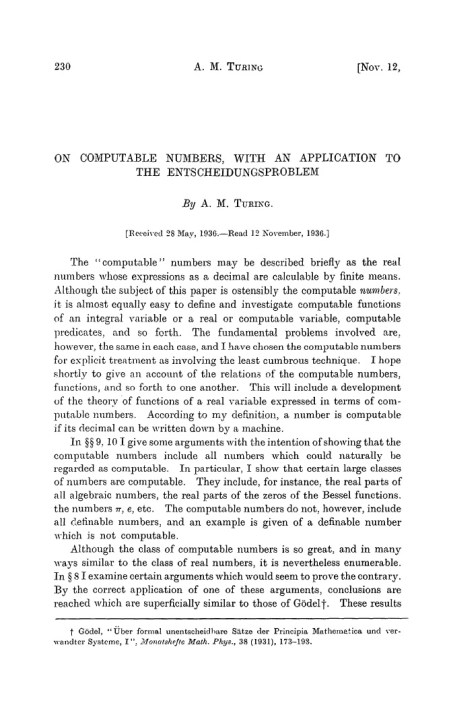
There’s been rather a lot of sad news conveyed via this blog recently, so I thought that today I’d mark a happier event. Eighty years ago today (i.e. on 28th May 1936), a paper by Alan Turing arrived at the London Mathematical Society. Entitled “On Computable Numbers, with an Application to the Enstscheidungsproblem“, this was not only enormously influential but also a truly beautiful piece of work. Turing was only 23 when he wrote it. It was delivered to the London Mathematical Society about 6 months after it was submitted,  i.e. in November 1936..

Here’s the first page:

Turing

The full reference is

Proc. London Math. Soc. (1937) s2-42 (1): 230-265. doi: 10.1112/plms/s2-42.1.230

You can find the full paper here. I heartily recommend reading it, it’s wonderful.


In My Dreams

Posted in Poetry with tags , on May 27, 2016 by telescoper

In my dreams I am always saying goodbye and riding away,
Whither and why I know not nor do I care.
And the parting is sweet and the parting over is sweeter,
And sweetest of all is the night and the rushing air.

In my dreams they are always waving their hands and saying goodbye,
And they give me the stirrup cup and I smile as I drink,
I am glad the journey is set, I am glad I am going,
I am glad, I am glad, that my friends don’t know what I think.

by Stevie Smith (1902-1971)