Author Archive

Fear and Loathing at Frontiers

Posted in Uncategorized on April 21, 2016 by telescoper

Here’s a truly scary inside story about the behaviour of one of the, sadly many, predatory open access journals out there.

Leonid Schneider's avatarFor Better Science

Many scientists have been receiving unsolicited emails from the Swiss publisher Frontiers, with invitations to submit papers or become peer review “editor” with this Open Access (OA) publisher. In fact, the Holtzbrick-owned Frontiers are occasionally criticized for these activities, which were compared to spamming. These “spam” emails however are not written by robots, but by actual human beings, usually interns. Many of them do not seem very happy about their jobs with Frontiers, as one can read at the employer-evaluation portal Glassdoor. Most of the criticism is directed against middle management, who, as I have previously shown, sometimes nonchalantly manage academic topics way outside of their professional competence.

Now, you can learn what goes on inside the Frontiers “spam” factory from a first-hand source.  I was approached by a reader of my website, who turned out to be a former full-time employee at Frontiers. This person…

View original post 2,745 more words

The Ballad of Barry and Freda

Posted in Television with tags , , on April 20, 2016 by telescoper

Rest in peace, Victoria Wood (1953-2016).

Public Statement

Posted in Biographical, Books, Talks and Reviews on April 20, 2016 by telescoper

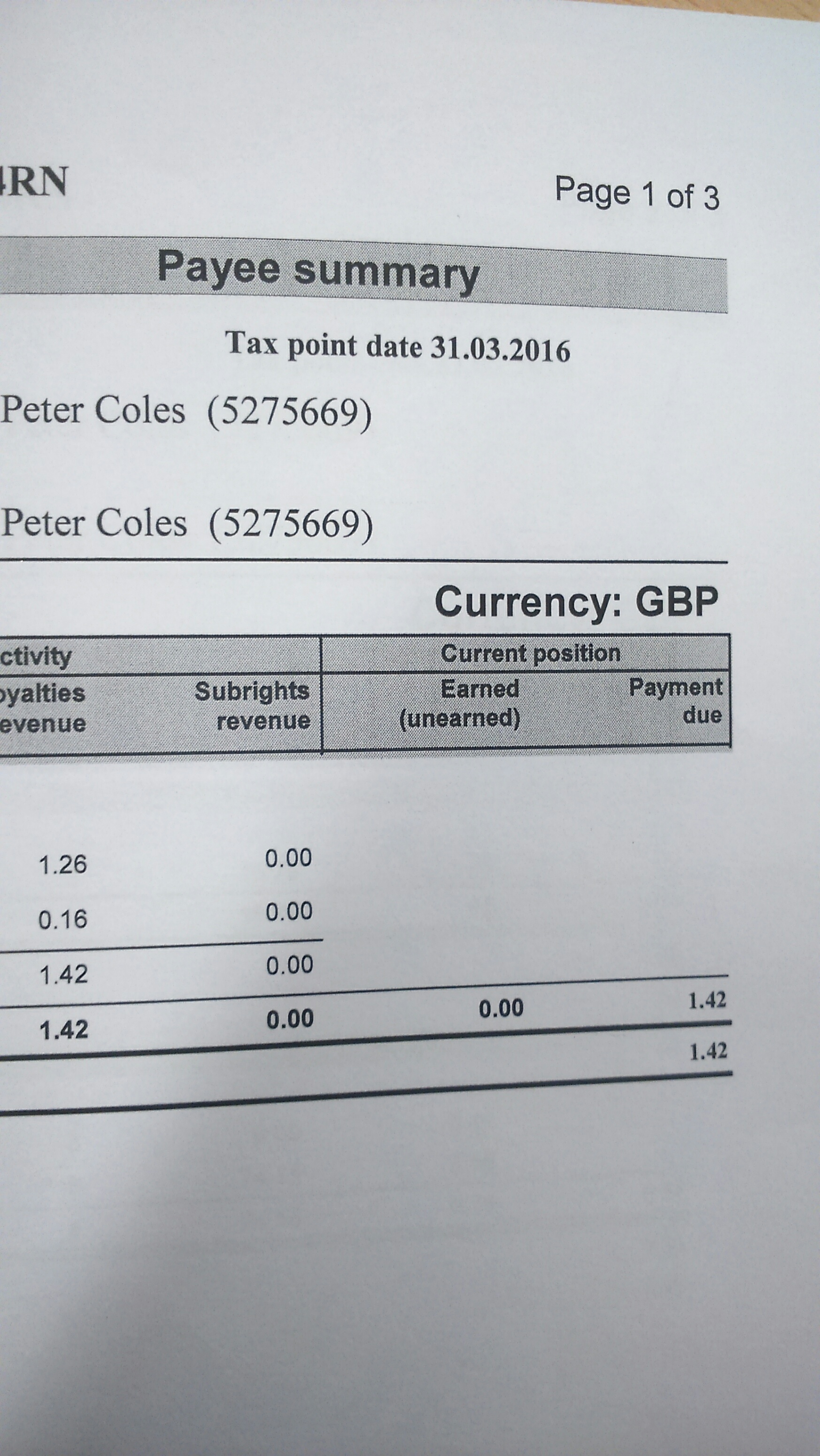
As a prominent public figure and in the interests of transparency and accountability I hereby publish my latest Royalty statement.

image

This is of course just a high-level summary. Subsequent pages give a more detailed breakdown.

I hope this clarifies the situation.

Essay Introductions: Opening Sentences

Posted in Uncategorized on April 20, 2016 by telescoper

It is a fact universally acknowledged that it’s often difficult to find a good opening sentence. My only tip is that it’s probably best to write the first sentence last. For other suggestions, read on…

gcgosling's avatarMusings

There’s no shortage of advice on how to tackle writing a tricky opening sentence. At least, not if you’re a novelist, short story writer, journalist, or even a blogger. But what about for those writing essays?

‘The Throes of Creation’ by Leonid Pasternak

It’s something we don’t talk about very often because it seems somehow petty. It’s not something that’s likely to lose you marks. The advice you get from tutors will probably focus instead on the reading you’ve brought in, the evidence you’ve assembled and the argument you present. Those are things you’ll be penalised for getting wrong. A howler of an opening line will be overlooked if you’re solid on those, which is why so many howlers go without comment.

So, what do people get wrong? Common mistakes often boil down to writing the opening to the essay before you quite know what you want to say, over-complicating in an attempt…

View original post 661 more words

Staff Whereabouts

Posted in Education with tags , , , on April 19, 2016 by telescoper

There’s been a predictably strong reaction from academic colleagues to an announcement by the University of Edinburgh that it is introducing a new staff monitoring policy that will require employees to tell management if they leave their “normal place of work” for half a day or longer.

Some have argued that this is measure is simply unenforceable and that the University concerned will have to employ extra people if all academics have to notify a management person every time they travel somewhere off campus. Perhaps the plan is to have all staff fitted with microchips like we do with pets so we can find out where they are if they go wandering off, or get temporarily adopted by friendly neighbours.

I did some time ago draft an April Fool email in which I claimed  my current employer was going to extend the attendance monitoring we perform with undergraduate students (which is partly to assess usage of teaching spaces and thus improve timetabling efficiency) to include academic staff, so we could assess usage of office space on a similar basis. I never sent the email because I thought too many would think it was real and get very angry. Although being at least slightly credible is an essential part of an April Fool, causing a riot is not.

Here at the University of Sussex academic staff are obliged to inform the University (via an official form) if they are travelling elsewhere in the course of their duties. In practice this form comes to the Head of School, which is me in in the case of Mathematical and Physical Sciences. This bit of bureaucracy is primarily for insurance purposes, but also means we have a record of where to contact people in case of emergency.

Most staff comply with this procedure  if they are travelling abroad, but they don’t always do so when they’re travelling in the UK for a day or so, e.g. for doing a PhD examination or something like that. Staff also often fail to let us know if they are working from home, which some (especially theorists and mathematicians) do a lot in order to get on with their research without interruption. Although this doesn’t often cause problems, I think it is reasonable that we should be able to get in touch with staff when they’re doing that (in case, e.g., one of their academic advisees has a problem) but it seems to me excessive that they should have to inform someone at an official level every time they work off campus for whatever reason. Leaving a contact phone number for use during working hours is quite adequate.

It seems to me that behind this move by the University of Edinburgh there’s the managerialist suspicion that everyone must be a shirker at heart. In fact one of the problems I have as a manager is not persuading staff to work longer hours, but to  stop working  excessively long hours.  I don’t think I’ve succeeded, largely because I haven’t found a way of doing my job at the same time as achieving  a sensible work-life balance.

Anyway, the point is that academic contracts do not usually specify where staff should work. There is a good reason for this, which is that the job is very diverse and replies flexible work arrangements. Academic contracts do not usually specify fixed hours of work per week, either, for the same reason. Some don’t even give a specific holiday entitlement. Staff in technical and professional service areas generally have contracts that specify both. I floated an idea at a staff that academics should file an official log of official leave. It wasn’t a popular suggestion because academic staff thought there was an implication that they were skiving by taking excessively long holidays. In fact my motivation was quite the opposite: to try to ensure that they take all the leave to which they are entitled.


The EU Referendum and the Importance of Voting

Posted in Politics on April 18, 2016 by telescoper

Here’s a post from the University of Sussex student blog site explaining why it’s important for everyone to vote in the forthcoming EU Referendum. The votes cast on June 23rd will lead to a decision that’s likely to be irrevocable so it’s especially important that younger people vote.

Alice Lomas's avatarsussexstudents

On Thursday 23rd June 2016, the UK will decide whether or not to remain in the European Union, and oh boy is this a big deal. This blog is designed to be accessible, to clear up some common misconceptions about the EU and to explain the methods of voting.  You shouldn’t need any background in European politics to understand this. I am a firm fan of the EU and fully encourage you all to vote, and to vote to stay in.6004.item

View original post 752 more words

No Science Please, We’re The Government

Posted in Politics, Science Politics with tags , , on April 18, 2016 by telescoper

Scary news. A government ban on state-funded scientists using their research question official policy is set to come into force on 1st May 2016. I knew about this before but was under the misleading impression that the effect on academic research had been clarified. It has not. I’ll leave it to others to decide whether this is just poorly-drafted legislation or a deliberate attack on academic freedom, but it will be very damaging not only to scientists but to academics in any field that might influence government policy. Indeed it runs counter to the logic of “impact” as defined in the Research Excellence Framework, which actually rewarded researchers who had ‘an effect on, change or benefit to the economy, society, culture, public policy or services, health, the environment or quality of life, beyond academia’.

I think this proposal is completely idiotic and more than a little sinister. If you agree, you can help stop it by signing the petition here. I have just done so.

Here are more details from the petition website:

The Cabinet Office has announced that a new ‘anti-lobbying’ clause will be included in all Government grants from May 2016. This is an attack on academic freedom as it would stop grants for university research being used to influence policy-makers. It is bad for the public interest and democracy.

The announcement by the Government on Saturday 6 February can be accessed here.

It does not mention that Government grants for research in universities and research institutes would be covered by the new clause.

The Government should ensure that grants from the higher education funding councils and research councils to support research are exempt from this new clause.

There are currently over 14,400 signatures on the petition so the Government is obliged to respond. If it reaches 100,000 signatures, which I hope it will, then the Government will have to consider a debate in the House of Commons.


UPDATE: 20th April. I don’t know if the petition (which is now over 28,000 signatures) played any part in this, but it appears that the government has (partially) backed down. There is supposed to be an exemption for researchers funded by HEFCE, at least, but I’m not sure exactly what the form of words will be.


The 2016 Brighton Marathon

Posted in Biographical, Brighton with tags , , on April 17, 2016 by telescoper

Normally when I’m in Brighton on a Sunday I spent most of the day in my office in the School of Mathematical and Physical Sciences at the University of Sussex trying to keep the backlog of work under control. However, this morning buses to and from Falmer were disrupted by the 2016 Brighton Marathon so I decided to have a lie in, catch a bit of the action, and postpone coming up to campus until lunchtime.

I didn’t leave my flat until almost noon, and felt a bit guilty as I put a load of empty wine bottles into the communal recycling bin as runners laboured past on Marine Parade, the main road along the seafront on the eastern side of Brighton, where I live. Runners pass along Marine Parade at the end of my street twice, once at 6 miles heading East and then again at about 13 miles heading West. By the time I got there there were only people on the return part, and given the time these were mainly charity and fun runners:

Brighton Marathon_2

At thirteen miles the expression on quite a few faces was one of “Oh shit, I’m only halfway!”. Still, the weather was good for running: sunny but not too hot, and an occasional cooling breeze. I’d guess it never got hotter than about 10 degrees.

The marathon route is quite a strange one that doubles back on itself quite a few times:

marathon Course map 2016 AW 600

Anyway, proceeding in a westerly direction I found myself looking down from a point on Marine Parade near the finish line; the finish itself is at sea level. The elite race had finished by the time I got there but I saw quite a few runners chasing a sub-three hour time, some successfully and some not.

At bout three hours and fifteen minutes, when I took this picture, the frequency of arrivals had started to pick up and the crowd of spectators was increasing steadily.

Brighton Marathon

After about 3 hours and 30 minutes we were into the pack of less experienced runners, some of whom were definitely struggling at the end. I saw one chap whose legs had completely gone about 200 yards from the line. The crowd were giving as much vocal encouragement as they could, but he was out on his feet. Fortunately a steward realised he was in severe difficulty and helped him to the line. There was a huge cheer when he reached the finish, and medical assistance was promptly delivered.

I have run a few marathons in my life. I wish I could have carried on doing them, but my old knees won’t let me. There’s a great camaraderie amongst the runners and lots of support from the crowd, not to mention the huge amount of money raised for charity.

I’m writing this at 2.15pm, which is five hours from the start, and there’s probably quite a few still running. Congratulations to all those who finish. It’s a great experience running a marathon, but it feels even better when you stop!

Opportunities in Mathematics, Statistics and Probability at Sussex University

Posted in Education with tags , , on April 16, 2016 by telescoper

It seems a good time for a quick post to point out that we have some jobs available in the Department of Mathematics at the University of Sussex. These posts have been made available following the University’s annual strategic planning process, in which it is one of my main responsibilities as Head of the School of Mathematical and Physical Sciences to put forward plans for future developments. The new positions are intended both to expand and diversify our research base in Mathematics and Statistics, but also to provide additional teaching effort given our expanding student numbers.

When I arrived at Sussex three years ago the number of academic staff in the Department of Mathematics was just 15. We made a number of appointments in 2013 and these further posts will take it up to 25, which is still quite small by UK standards. Our strategic plan is to get staff numbers in Mathematics up to around 30 by 2018. In fact, applications by potential undergraduates to do Mathematics courses at Sussex are up by a whopping  80% this year, and if this turns into a large increase in intake then we will be looking to make further appointments very soon.

Anyway, here are three jobs with links to adverts:

  1. Lecturer in Statistics and Probability
  2. Senior Lecturer or Reader in Statistics and Probability.
  3. Lecturer in Mathematics.

Please follow the links for more detailed descriptions of each job and further instructions on how to apply. The closing dates for all three jobs are 17th May 2016; we plan to interview selected candidates in June or July.

Feel free pass this on to likely applicants!


R.I.P. David Mackay (1967-2016)

Posted in R.I.P., The Universe and Stuff with tags , on April 15, 2016 by telescoper
Professor David Mackay , who died yesterday

Professor David Mackay , who died yesterday

Yesterday evening I heard from friends at Cambridge the devastating news that David Mackay has passed away. I knew this would happen eventually. About a year ago David was diagnosed with a particularly aggressive form of stomach cancer that was expected to be terminal. Since then he has fought for his life with great courage and posted regular updates on his blog. On Sunday, however, he posted a heartbreaking piece that made it clear that he was about to lose the battle. He died yesterday at the age of 48. Fuck you, cancer.

For those who didn’t know Professor Sir David John Cameron Mackay, he was an extremely distinguished scientist and engineer, a Fellow of the Royal Society and a former Chief Advisor to the UK Department of Energy and Climate Change. He is probably best known outside his own research for his book Sustainable Energy Without The Hot Air which has become a standard undergraduate textbook not only in the United Kingdom but across the world. He will be remembered for this work, and it is indeed a fitting memorial, but he also did many other things. In fact he was a primarily a physicist (he did the same Natural Sciences course at Cambridge that I did) but his interests were always interdisciplinary in nature. He got his PhD from Caltech for a thesis about Bayesian Methods for Adaptive Models and after returning to Cambridge he rose rapidly through the ranks and eventually found himself as Regius Professor of Engineering there. He devoted a great deal of his time and effort to outreach and science policy and was one of our finest public intellectuals. He was knighted in this year’s New Years Honours List.

I didn’t actually know David very well personally – we met only a few times – but on each occasion I was struck not only by his sheer intelligence, but also his energy and the force  of his personality. You meet few people who make such a lasting impression so quickly as David. He was forthright in his views, but always honest and engaging. The word “luminary” definitely applied to him. One time we met was at a meeting about Bayesian Cosmology about a decade ago. He asked a question during my talk, which triggered a lively discussion that carried on into the coffee break. I was impressed that he saw immediately how to tackle a problem that I had struggled with for months. I feel honoured to have made his acquaintance, however briefly, and can’t even begin to imagine what people who were closer to him must be feeling at his loss in such a cruel fashion. I send my deepest condolences go out to his family and friends. He was brilliant and amazing person, and will be greatly missed.

Rest in Peace David Mackay (1967-2016).

P.S. Shortly before he died, David set up a Just Giving page in favour of the Arthur Rank Hospice Charity. Please consider making a donation in his memory.