Author Archive

Pact, by R.S. Thomas

Posted in Poetry with tags , on December 3, 2015 by telescoper

This is my child;
that is yours. Let
peace be between them
when they grow up.

They are far off
now; let it not
be through war they are brought
near. Their languages

are different. Let them both
learn it is peace
in the hand is the translation
of peace in the mind.

by R.S. Thomas (1913-2000)

Lisa Pathfinder – better late than never!

Posted in Science Politics, The Universe and Stuff with tags , , , , , , , on December 3, 2015 by telescoper

Determined to post about something positive after yesterday’s act of collective idiocy by Parliament I find myself given a golden opportunity by today’s successful launch of the Lisa Pathfinder experiment by the European Space Agency.

As space missions go, LISA Pathfinder seems quite a modest one: it is basically a pair of identical 46 mm gold–platinum cubes separated by 38 cm. The idea is to put these test masses in free fall and measure their relative positions as accurately as possible.

After a false start yesterday, LISA Pathfinder was successfully launched in the early hours of this morning and is now en route to the First Lagrangian Point of the Earth-Sun system, about 1.5 million miles from Earth, at the location marked L1 in the diagram:

Lagrange_saddle

The contours show the “effective potential” of the Earth-Sun system, which takes into account the effect of rotation as well as gravity. The five Lagrangian points are the places at which tis effective potential is locally flat, i.e. where its spatial gradient vanishes. Any physics student will know that when the gradient of the potential is zero there is no force on a test particle. What this means is that an object placed exactly at any of the 5 Lagrangian points stays in the same position relative to the Earth and Sun as the system rotates. Put a spacecraft at one of these points, therefore, and it stays put when viewed in a frame rotating around the Sun  at the same speed as the Earth.

It’s not quite as simple as this because, as you will observe the Lagrangian points are not stable: L1, L2 and L3 are saddle-points; a  stable point would be a local minimum. However, around the first three there are stable orbits so in effect a test mass displaced from L1, say, oscillates around it without doing anything too drastic. L4 and L5 can be stable or unstable, in a general system but are stable for the case of the Solar System, hence the tendency of asteroids (the Trojans) to accumulate at these locations.

You may remember that WMAP, Planck and Herschel were all parked in orbits around L2. A spacecraft positioned exactly at L2 is permanently screened from the Sun by the Earth. That might be very useful if you want to do long-wavelength observations that require very cool detectors, but not if you want to use the Sun as a source of power. In any case, as I explained above, spacecraft are not generally located exactly at L2 but in orbit around it. Planck in fact had solar cells on the base of the satellite that provided power but also formed a shield as they always faced the Sun as the satellite rotated and moved in its orbit to map the sky. The choice of L1 for LISA Pathfinder was made on the basis of spacecraft design considerations as it will operate in a very different manner from Planck.

The reason for doing eLISA is to demonstrate the technological feasibility of a much more ambitious planned gravitational wave detector in space originally called LISA, but now called eLISA. The displacement of test masses caused by gravitational waves is tiny so in order for eLisa it is necessary (a) to screen out every effect other than gravity, e.g. electromagnetic interactions due to residual charges, to great precision and (b) to measure relative positions to great accuracy. That’s why it was decided to fly a cheaper technology demonstrator mission, to prove the idea is feasible.

LISA Pathfinder won’t make any science discoveries but hopefully it will pave the way towards eLISA.

It has to be said that LISA Pathfinder has had a fairly troubled history. I just had a quick look at some papers I have dating back to the time when I was Chair of PPARC Astronomy Advisory. Among them I found the categorical statement that

LISA Pathfinder will be launched in 2009.

Hmm. Not quite. It’s obviously running quite a long way behind schedule and no doubt considerably over its initial budget but it’s good to see it under way at last. There will be a lot of sighs of relief that LISA Pathfinder has finally made it into space! Now let’s see if it can do what it is supposed to do!


Wiston House, Wilton Park and Chatham House Rules

Posted in Biographical, Brighton with tags , , , on December 2, 2015 by telescoper

Back to work and a whole morning of meetings today I thought I’d pause briefly to say something about the venue for the recent awaydays…

wp-1448904107687.jpeg

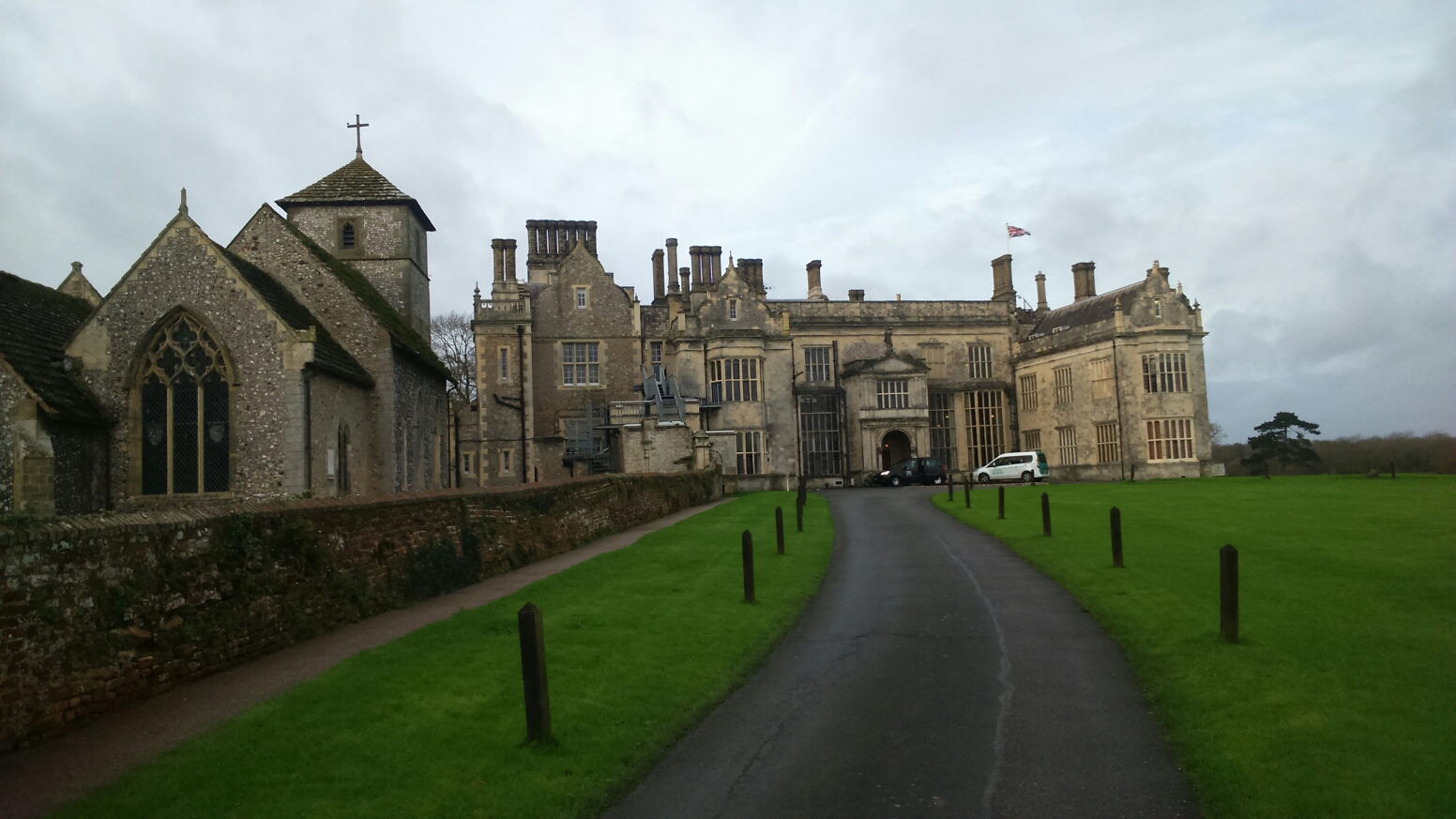
As Colin correctly spotted, the venue was Wiston House which is near Steyning, North of Shoreham, in West Sussex. The house was built in the late 16th Century but extensively modernised and refurbished over the years. It was built by a chap called Thomas Shirley, a politician who basically embezzled the funds needed to build it from the Treasury. Perhaps even worse than that he demolished an entire village to make way for what was essentially a private residence. When his fraud was uncovered he was imprisoned, his family declared bankrupt and the buildings seized by the Government. It wasn’t returned to the poor people thrown off their land to make way for it in the first place.

More recently, during World War 2, Wiston House (along with most large country houses near the South coast), was commandeered for military use; it became the Headquarters for the Canadian High Command and the surrounding parkland was used as a base for troops preparing for the Normandy landings, along with about 200 tanks and other vehicles. The troops stationed in the area formed part of the 3rd Canadian Division that led the the assault on Juno Beach in June 1944.

Since 1951, however, the House has been used by Wilton Park, an offshoot of the Foreign and Commonwealth Office. This organization is probably most famous as being responsible for mediating the talks that took place in 1946 about the future of post-war Germany but at that time it was based at a different location, Wilton Park in Buckinghamshire, which was the site of a camp for German Prisoners Of War. In 1951 it moved to Wiston House, but its name travelled with it so now, somewhat confusingly, Wilton Park is now based in Wiston House. It now hosts a very large number of events involved with global issues, including security, political strategy and conflict resolution as well as some more mundane things that can benefit from their expertise such as the Awaydays I attended on Monday and Tuesday. It’s not generally open to the public and security, though discreet, is quite extensive which is not surprising given the high profile nature of many of their guests, though not so much at the event I attended!

The staff at Wilton Park adopt strict protocols for how they facilitate its discussions, including Chatham House Rules, and bans on the use of social media during sessions. Hence my virtual twitter and blog silence over the past couple of days. Although we didn’t discuss anything that might threaten global security or engender any form of conflict, it would be inappropriate to break the rules for any reason so I won’t say anything about what was said or by whom…

Just for interesting, the small manor church to the left of the main building dates back almost 1000 years – it is mentioned in the Domesday Book – but the interior has been altered considerably and looks quite modern. I was not actually staying in the main house, but in one of the outbuildings, formerly stables but very comfortable and quite reminiscent of the arrangements at The Cosener’s House, a venue familiar to many physicists.

Away Days

Posted in Biographical, Brighton on November 30, 2015 by telescoper

No time to blog today as I am at yet another Awayday. In fact I will be Away for Two Days.

image

Can anyone name my location (in the photograph above)?

Einstein’s Legacy

Posted in The Universe and Stuff with tags , , , , , , , on November 29, 2015 by telescoper

Yesterday I braved the inclement weather and the perils of weekend travel on Southern Trains to visit Queen Mary College, in the East End of London, for the following event:
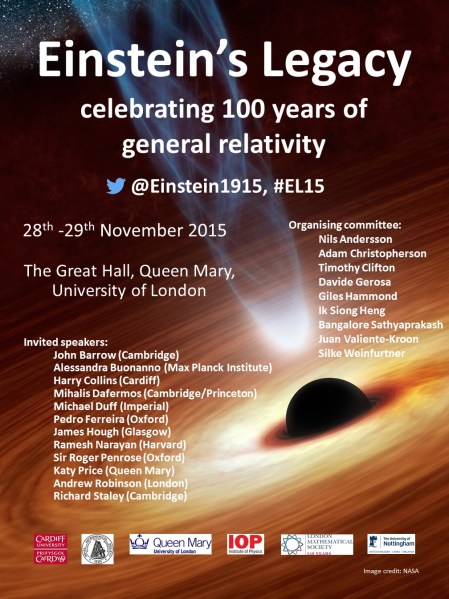
GR100

I used to work at  Queen Mary, but haven’t been back for a while. The college and environs have been smartened up quite a lot since I used to be there, as seems to be the case for the East End generally. I doubt if I could afford to live there now!

Owing to a little local difficulty which I won’t go into, I was running a bit late so I missed the morning session. I did, however, arrive in time to see my former colleague Bangalore Sathyaprakash from Cardiff talking about gravitational waves, Jim Hough from Glasgow talking about experimental gravity – including gravitational waves but also talking about the puzzling state of affairs over “Big G” – and Pedro Ferreira from Oxford whose talk on “Cosmology for the 21st Century” gave an enjoyable historical perspective on recent developments.

The talks were held in the Great Hall in the People’s Palace on Mile End Road, a large venue that was pretty full all afternoon. I’m not sure whether it was the District/Hammersmith & City Line or the Central Line (or both) that provided the atmospheric sound effects, especially when Jim Hough described the problems of dealing with seismic noise in gravitational experiments and a train rumbled underneath right on cue.

UPDATE: Thanks to Bryn’s comment (below) I looked at a map: the Central Line goes well to the North whereas the District and Hammersmith & City Line go directly under the main buildings adjacent to Mile End Road.
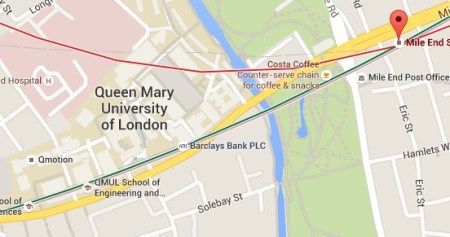
Under-QM

Anyway, the venue was even fuller for the evening session, kicked off by my former PhD supervisor, John Barrow:
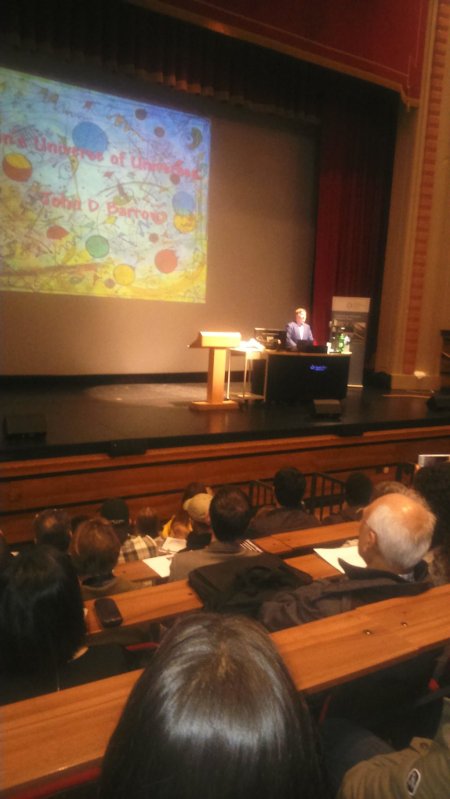
Einstein's Legacy

This session was aimed at a more popular audience and was attended by more than a few A-level students. John’s talk was very nice, taking us through all the various cosmological models that have been developed based on Einstein’s theory of General Relativity.

Finally, topping the bill, was Sir Roger Penrose whose talk was engagingly lo-tech in terms of visual aids but aimed at quite a high level. His use of hand-drawn transparencies was very old-school, but a useful side-effect was that he conveyed very effectively how entropy always increases with time.

Penrose covered some really interesting material related to black holes and cosmology, especially to do with gravitational entropy, but my heart sank when he tried at the end to resurrect his discredited “Circles in the Sky” idea. I’m not sure how much the A-level students took from his talk, but I found it very entertaining.

The conference carries on today, but I couldn’t attend the Sunday session owing to pressure of work. Which I should be doing now!

P.S. I’ll say it before anyone else does: yes, all the speakers I heard were male, as indeed were the two I missed in the morning. I gather there was one cancellation  of a female speaker (Alessandra Buonanno), for whom Sathya stood in.  But still.


Browser Speeds

Posted in Uncategorized on November 27, 2015 by telescoper

image

Why is General Relativity so difficult?

Posted in The Universe and Stuff with tags , , on November 26, 2015 by telescoper

Just a brief post following yesterday’s centenary of General Relativity, after which somebody asked me what is so difficult about the theory. I had two answers to that, one mathematical and one conceptual.

einstein-equation1

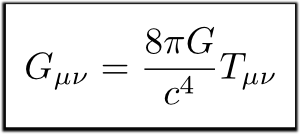
The Field Equations of General Relativity are written above. In the notation used they don’t look all that scary, but they are more complicated than they look. For a start it looks like there is only one equation, but the subscripts μ and ν can each take four values (usually 0, 1, 2 or 3), each value standing for one of the dimensions of four-dimensional space time. It therefore looks likes there are actually 16 equations. However, the equations are the same if you swap μ  and ν around. This means that there are “only” ten independent equations. The terms on the left hand side are the components of the Einstein Tensor which expresses the effect of gravity through the curvature of space time and the right hand side describes the energy and momentum of “stuff”, prefaced by some familiar constants.

The Einstein Tensor is made up of lots of partial derivatives of another tensor called the metric tensor (which describes the geometry of space time), which relates, through the Field Equations, to how matter and energy are distributed and how these components move and interact. The ten equations that need to be solved simultaneously are second-order non-linear partial different equations. This is to be compared with the case of Newtonian gravity in which only ordinary different equations are involved.

Problems in Newtonian mechanics can be difficult enough to solve but the much greater mathematical complexity in General Relativity means that problems in GR can only be solved in cases of very special symmetry, in which the number of independent equations can be reduced dramatically.

So that’s why it’s difficult mathematically. As for the conceptual problem it’s that most people (I think) consider “space” to be “what’s in between the matter” which seems like it must be “nothing”. But how can “nothing” possess an attribute like curvature? This leads you to conclude that space is much more than nothing. But it’s not a form of matter. So what is it? This chain of thought often leads people to think of space as being like the Ether, but that’s not right either. Hmm.

I tend to avoid this problem by not trying to think about space or space-time at all, and instead think only in terms of particle trajectories or ligh rays and how matter and energy affect them. But that’s because I’m lazy and only have a small brain…


Autumn Statement – Summary for Science

Posted in Politics, Science Politics with tags , , , on November 25, 2015 by telescoper

I’ve been in meetings all afternoon so far so I missed the live broadcast of the Chancellor’s Autumn Statement.

Now that I’ve caught up a little it seems that there’s much to be relieved about. Yet again it seems the Government has deployed the tactic of allowing scare stories of dire cuts to spread in order that the actual announcement  appears much better than people feared, even if it is mediocre.

You can find the overall key results of the spending review and autumn statement here, but along with many colleagues who work in research and higher education I went straight to the outcome for the Department of Business, Innovation and Skills (BIS) which you can find here.

The main results for me – from the narrow perspective of a scientist working in a university –  are:

  1. The overall budget for BIS will be cut by 17% in cash terms between now and 2020.
  2. Most of the above cut will happens from 2018 onwards by, among other things, “asking universities to take more responsibility for student access”.
  3. In more detail (quoted from here) “In this context, the government will reduce the teaching grant by £120 million in cash terms by 2019 to 2020, but allow funding for high cost subjects to be protected in real terms. The government will work with the Director of Fair Access to ensure universities take more responsibility for widening access and social mobility, and ask the Higher Education Funding Council for England to retarget and reduce by up to half the student opportunity fund, focusing funding on institutions with the most effective outcomes. The government will also make savings in other areas of the teaching grant.”
  4. My current employer, the University of Sussex, has done extremely well on widening participation so this is good news locally. Many big universities have achieved nothing in this area so, frankly, deserve this funding to be withdrawn.
  5. It is also to be welcomed that the premium for high cost subjects (i.e. STEM disciplines) is to be protected in real terms, although it still does not affect the actual cost of teaching these subjects.
  6. Contrary to many expectations it seems that HEFCE will not be scrapped immediately. That is significant in itself.
  7. The level of science funding will increase from £4.6 billion to £4.7 billion next year, and will thereafter be protected in real terms over the Parliament.
  8. The real terms protection sounds good but of course we currently have a very low rate of inflation, so this is basically five more years of almost flat cash.
  9. There is supposed to be an additional £500m by 2020 which George Osborne didn’t mention in his speech. I don’t know whether this is extra money or just the cash increase estimated by inflation-proofing the £4.7bn.
  10. The above two points sound like good news….
  11. …but the total budget  will include a £1.5 billion new “Global Challenges Fund” which will build up over this period. This suggests that there may be a significant transfer of funds into this from existing programmes. There could be big losers in this process, as it amounts to a sizeable fraction of the total research expenditure.
  12. In any event the fraction of GDP the UK spends on science is not going to increase, leaving us well behind our main economic competitors.
  13. The Government is committed to implementing the Nurse Review, which will give it more direct leverage to reprioritise science spending.
  14. It isn’t clear to me how  “pure” science research will fare as a result of all this. We will have to wait and see….

The Autumn Statement includes only a very high level summary of allocations so we don’t know anything much about how these decisions will filter down to specific programmes at this stage. The Devil is indeed in the Detail. Having said that, the overall settlement for HE and Research looks much better than many of us had feared so I’d give it a cautious welcome. For now.

If anyone has spotted anything I’ve missed or wishes to comment in any other way please use the box below!


100 Years of General Relativity

Posted in History, The Universe and Stuff with tags , on November 25, 2015 by telescoper

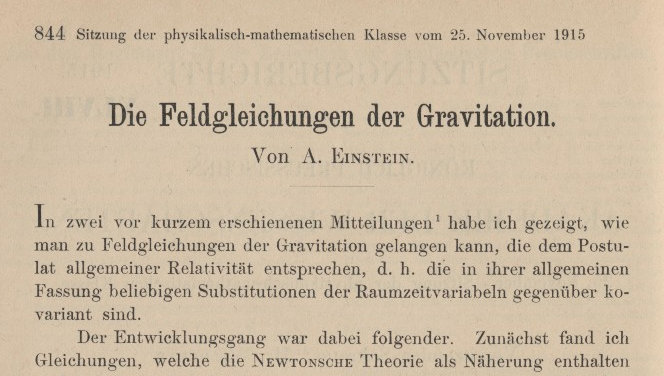
Many people have been celebrating the centenary of the birth of Einstein’s Theory of General Relativity this year, but it’s not obvious precisely what date to select. I’ve decided to go for today, partly because the News on BBC Radio 3 did when I work up this morning, but also because there is a well-known publication that mentions that date:

einsteingr

The 25th November 1915 was the date on which Einstein presented the “final” form of his theory to the Prussian Academy of Sciences. You can find a full translation of the paper “The Field Equations of Gravitation” here. You will see that he refers to a couple of earlier papers in that work, but I think this one is the first presentation of the full theory. It fascinated me when I was looking at the history of GR for the textbook I was working on about 20 years ago that the main results (e.g. on cosmology, the bending of light and on the perihelion of mercury) are spread over a large number of rather short papers rather than all being in one big one. I guess that was the style of the times!

So there you are, General Relativity has been around for 100 years. At least according to one particular reference frame…


Oh, and here’s a cute little video – funded by the Science and Technology Facilities Council – celebrating the centenary:


Chancellor’s Autumn Statement Poll

Posted in Politics, Science Politics on November 24, 2015 by telescoper

There’s a not inconsiderable amount of anxiety around as tomorrow’s  Autumn Statement approaches. The likelihood is that we will see drastic cuts to everything, including science and education, and huge jobs losses and cuts to public services around the country.

In order to gauge public opinion, ahead of the announcement of the end of British Civil Society I have decided to conduct a poll.

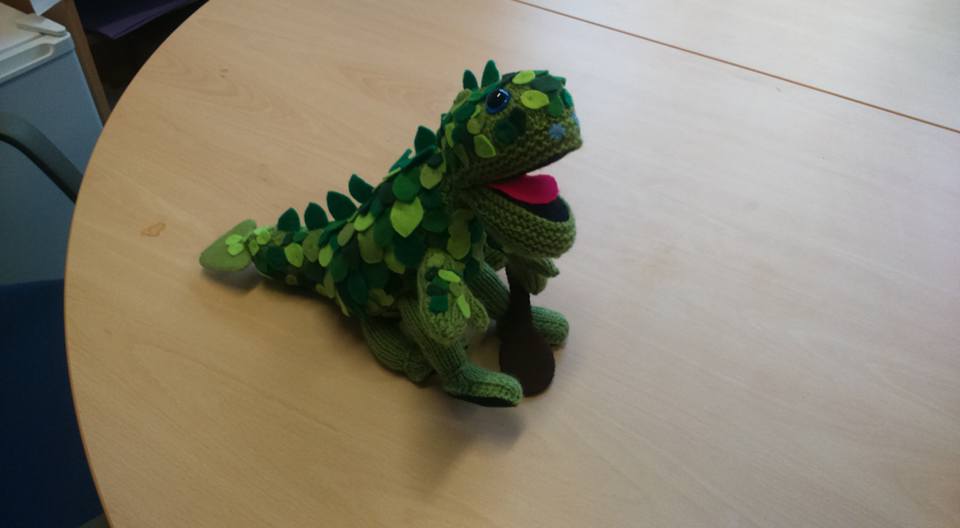
And in case it’s all too depressing to think about, Dorothy has knitted a Soup Dragon to cheer you up.

Soup-Dragon