Author Archive

Want to use the Open Journal of Astrophysics? Get an Orcid ID!

Posted in Open Access with tags , , , , on November 23, 2015 by telescoper

We’re getting ready to launch the Open Journal of Astrophysics site so for all the folks out there who are busy preparing to submit papers let me just give you advanced warning how it works. The website is currently being tested with real submissions, but these have so far been canvassed from the Editorial Board for testing purposes: the journal is not yet available for general submission, and the site is not yet public. Once we’re sure everything is fully functional we will open up.

Anyway, in order to submit a paper you will need to obtain an ORCID ID. In a nutshell this is a unique identifier that makes it much easier to keep track of researchers than via names, email address or whatever. It can be used for many other things other than the Open Journal project so it’s a good thing to do in itself.

You can register for an ID here. It only takes seconds to do it, so do it now! You can find out more about ORCID here. When you have your ORCID ID you can log into our Open Journal website to submit a paper.

The Open Journal is built on top of the arXiv which means that all papers submitted to the Open Journal must be submitted to the arXiv first. This in turns means is that you must also be registered as a “trustworthy” person to submit there. You can read about how to do that here. When you have succeeded in submitting your paper to the arXiv you can proceed to submit it to the Open Journal.

As an aside, we do have a Latex template for The Open Journal, but you can for the time being submit papers in any style as long as the resulting PDF file is readable.

To submit a paper to be refereed by The Open Journal all you need to do is type in its arXiv ID and the paper will be imported into the Open Journal. The refereeing process is very interactive – you’ll like it a lot – and when it’s completed the paper will be published, assigned a Digital Object Identifier (DOI) and will be entered into the CrossRef system for the purpose of gathering citations and other bibliometric data.

We will be issuing a general call for submissions very soon, at which point we will also be publishing general guidance in the form of an FAQ, which includes information about copyright etc. In the meantime, all you need to do is get your ORCID ID and get your papers on the arXiv!

Nervous

Posted in Finance, Science Politics, The Universe and Stuff with tags , , on November 22, 2015 by telescoper

The outcome of the 2015 Comprehensive Spending Review is to be announced shortly (on Wednesday 25th November), a fact which suggested this piece of music. It’s a solo piano piece by the late great Mal Waldron. Among many other things, Mal Waldron was Billie Holiday’s regular accompanist from 1957 until her death in 1959 and it was during that time he was booked to appear on a famous all-star TV Jazz broadcast called The Sound of Jazz from which this solo performance is taken. It’s an original composition by the pianist, and it’s called Nervous.

p.s. I did a blog post some time ago about Billie Holliday’s heartbreaking last performance with Lester Young, which also appeared on The Sound of Jazz. You can find it here.

Power from Wind Problems

Posted in Cute Problems with tags , , on November 21, 2015 by telescoper

It has been a little while since I posted anything in the Cute Problems category so since today is quite a windy day I thought I’d give you this one, which leads to an extimate of the maximum power that can, in theory, be extracted from wind a windmill.

Assume that the wind far upstream and down-stream of the windmill has speed V and αV respectively, with 0≤α≤1, and let the wind speed at the sails of the windmill, which sweep out an area A, be v.

Now for the problems

(i) By equating the power absorbed by the mill to the rate of loss of kinetic energy of the wind, show that v/V=½(1+α).

(ii) Show that the power obtainable is proportional to AρV3 where ρ is the density of air.

(iii)  Show that the maximum power that can be extracted is 16/27 of the power available initially in the wind.

The final result is known as Betz’s Law and it works for any form of turbine, not just a windmill.


Guidance on how to take care of the beard in snowy weather

Posted in Beards on November 21, 2015 by telescoper

It’s not actually snowing in Brighton, but you never know….

kmflett's avatarKmflett's Blog

Beard Liberation Front

PRESS RELEASE 20th November

Contact Keith Flett      07803 167266

GUIDANCE ON HOW TO TAKE CARE OF THE BEARD  IN SNOWY WEATHER

snow

The Beard Liberation Front, the informal network of beard wearers, has issued important guidance for the hirsute in as the first snow of winter is forecast for some areas of the UK

The BLF says that it is essential to keep the beard protected from snow. The best way to do this is may simply be to remain indoors and away from all possible contact with snow.

However if venturing out in the snow, the following guidelines should be followed:-

1] Protect the beard in its entirety with a scarf or roll neck jumper

2] Sweep any drifting snow from the beard on a regular basis. Do not allow snow to accumulate in the beard

3] If the beard becomes chilled or frozen due to icy…

View original post 79 more words

Elegy, by Coles

Posted in Music, Poetry, Uncategorized with tags , , , , , on November 20, 2015 by telescoper

Last night on Radio 3 there was a concert involving music by Cecil Coles (among others). Coles – who, as far as I know, was no relation – was killed in action in the First World War, in April 1918. In fact he was shot and mortally wounded by a sniper while working as a stretcher-bearer trying to rescue injured soldiers from a wood, a task for which he had volunteered. He was 29 when he died and not much of his work as a composer survives. In the interval of the Concert I heard this recording of a work by Coles, which I think is very touching. It’s a setting of one of the Elegiac Stanzas (“Sic Juvat Perire”)  by Thomas Moore. Here’s the text:


When wearied wretches sink to sleep,
How heavenly soft their slumbers lie!
How sweet is death to those who weep,
To those who weep and long to die!

Saw you the soft and grassy bed,
Where flowrets deck the green earth’s breast?
‘Tis there I wish to lay my head,
‘Tis there I wish to sleep at rest.

Oh, let not tears embalm my tomb, —
None but the dews at twilight given!
Oh, let not sighs disturb the gloom, —
None but the whispering winds of heaven!

And here is the setting by Cecil Coles:


Fourier-transforming the Universe

Posted in The Universe and Stuff with tags , , , on November 20, 2015 by telescoper

Following the little post I did on Tuesday in reaction to a nice paper on the arXiv by Pontzen et al., my attention was drawn today to another paper e related to the comment I made about using Fourier phases as a diagnostic of pattern morphology. The abstract of this one, by Way et al., is as follows:

We compute the complex 3D Fourier transform of the spatial galaxy distribution in a volume-limited sample of the Sloan Digital Sky Survey redshift survey. The direct unbinned transform yields results quite similar to those from the Fast Fourier Transform (FFT) of finely binned galaxy positions. In both cases deconvolution of the sampling window function yields estimates of the true 3D transform. The Fourier amplitudes resulting from this simple procedure yield power spectrum estimates consistent with those from other much more complicated approaches. We demonstrate how the corresponding Fourier phase spectrum lays out a simple and complete characterization of non-Gaussianity that is more easily interpretable than the tangled, incomplete multi-point methods conventionally used. Measurements based on the complex Fourier transform indicate departures from exact homogeneity and isotropy at the level of 1% or less. Our model-independent analysis avoids statistical interpretations, which have no meaning without detailed assumptions about a hypothetical process generating the initial cosmic density fluctuations.

It’s obviously an excellent piece of work because it cites a lot of my papers!

But seriously I think it’s very exciting that we now have data sets of sufficient size and quality to allow us to go beyond the relatively crude statistical description provided by the power spectrum.


Nurse Review Published

Posted in Science Politics with tags , , on November 19, 2015 by telescoper

I’ve been busy all day so unable to join in the deluge of comment and reaction to the Review of the Research Councils carried out by Sir Paul Nurse, President of the Royal Society, which was published today. I’ve only just had time to skim through it, so I won’t comment in detail, but it does seem to me that the main points are:

  1. The review does not call for a reduction in the current number of seven research councils (STFC, EPSRC, ESRC, AHRC, NERC, BBSRC and MRC); mergers were thought by many to be possible outcomes of this review.
  2. There is a proposal to set up an overarching structure, called Research UK (RUK), which is a beefed-up version of the current RCUK, one of the aims of which would be to provide better coordination between the Research Councils.
  3. It is proposed that RUK should liaise directly with a committee of government ministers who would have significant influence over the way funding was distributed to the Research Councils. It’s not clear to me how this squares with the Haldane Principle.
  4. It is also proposed that RUK might take over the distribution of QR funding (currently done by HEFCE), but that this should be done in such a way as to preserve the idea of “dual funding”.

There are other points of course, but these seemed to me to be the most significant. It remains to see how many of the proposals are implemented and how they will be made to fit into the framework of the Higher Education Green Paper published last week. Of more immediate concern to many researchers will be how much funding there will be to be distributed by any new organization if the Comprehensive Spending Review announced next week results in big cuts to the science budget, as many fear it will.

Comments are welcome through the box!

R.I.P. Jonah Lomu

Posted in Biographical, Rugby with tags , , , , , , , , on November 18, 2015 by telescoper

At the end of the 2015 Rugby World Cup, I wrote a post recalling the World Cup of 1995, which was held in South Africa while I was visiting there. I had the privilege of seeing the great Jonah Lomu demolishing the England defence that day. Today I learned with greant sadness that he has passed away, aged just 40. Since Jonah Lomu played such a central role in one of the most amazing sporting experiences of my life, which lives in my memory as if it happened yesterday, I wanted to take the opportunity to pay tribute to the awesome sportsman that he was by sharing that memory again.

In 1995 was visiting George Ellis at the University of Cape Town to work on a book, which was published in 1997. The book is now rather out of date, but I think it turned out rather well and it was certainly a lot of fun working on it. Of course it was a complete coincidence that I timed my trip to Cape Town exactly to cover the period of the Rugby Word Cup. Well, perhaps not a complete coincidence. In fact I was lucky enough to get a ticket for the semi-final of that tournament between England and New Zealand at Newlands, in Cape Town. I was in the stand at one end of the ground, and saw New Zealand – spearheaded by the incredible Jonah Lomu – score try after try in the distance at the far end during the first half. Here is the first, very soon after the kickoff when Andrew Mehrtens wrong-footed England by kicking to the other side of the field than where the forwards were lined up. The scrambling defence conceded a scrum which led to a ruck, from which this happened:

Jonah Lomu was unstoppable that day. One of the All Blacks later quipped that “Rugby is a team game. Fourteen players all know that their job is to give the ball to Jonah”.

It was one-way traffic in the first half but England played much better in the second, with the result that all the action was again at the far end of the pitch. However, right at the end of the match Jonah Lomu scored another try, this time at the end I was standing. I’ll never forget the sight of that enormous man sprinting towards me and am glad it wasn’t my job to try to stop him, especially have seen what happened to Underwood, Catt and Carling when they tried to bring him down. Lomu scored four tries in that game, in one of the most memorable performances by any sportsman in any sport. It’s so sad that he has gone. It’s especially hard to believe that such a phenomenal athlete could be taken at such a young age. My thoughts are with his family and friends.

Rest in Peace, Jonah Lomu (1975-2015)

Lucky Dictionaries

Posted in Crosswords with tags , , on November 17, 2015 by telescoper

Here’s a funny thing.

About two years ago I stopped buying the Observer on Sundays and switched to the Independent on Sunday. That decision was largely based on the cost of the paper rather than the quality of the crossword, but I ended up trading the Observer’s Azed and (easier) Everyman for the Sunday Independent’s Beelzebub and (easier) OUP Prize Cryptic. It’s paid off in terms of prizes – I’ve completely lost count of the number of dictionaries I’ve won from the Independent competitions.

However, two weeks ago I wasn’t feeling very well so I decided to stock up with diversions and for a change bought both the Independent on Sunday and the Observer. And so it came to pass that I did the Everyman crossword for the first time in more than two years. Today I received these:

Dictionaries

And a £15 book token to boot. All of which told me that I’d won the prize! Now what’s the probability of that? Maybe I’ll try again in a couple of years…

Inverted Cosmology

Posted in The Universe and Stuff on November 17, 2015 by telescoper

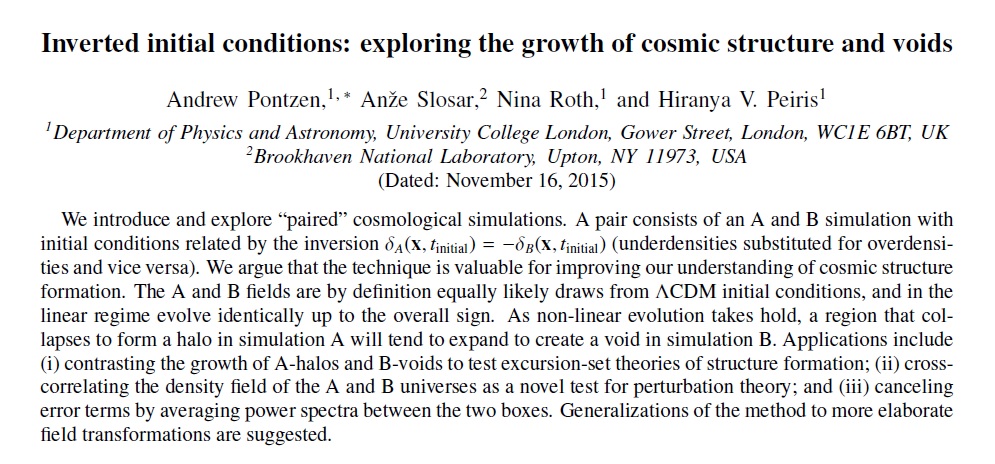
Just time for a quick post about a neat little paper by Pontzen et al. that has appeared on the arXiv. Here is the abstract:


inversionThe abstract is a model of clarity so there’s no need to add further explanation here. Having A and B simulations in which initial overdensities and underdensities are swapped but everything else is preserved allows a number of interesting things to be studied.

When I read the paper it struck me that it would be fun to use “paired” simulations like this to study statistical properties of the evolved density field that go beyond the usual power spectra discussed in the paper; you can find a nice review of power spectra and their uses here.

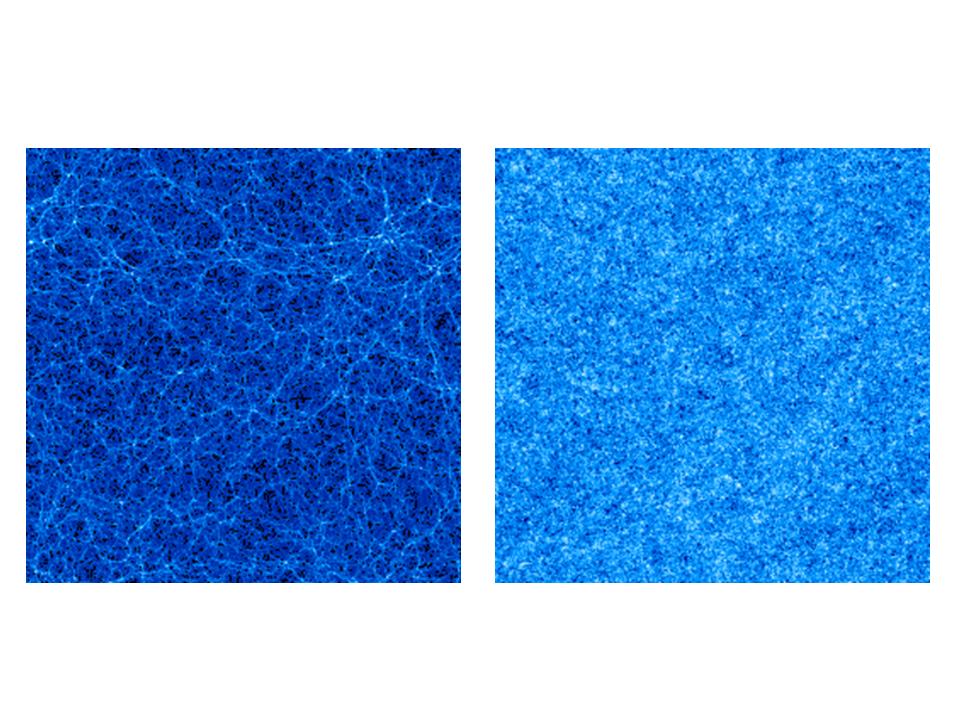
Here’s what I mean. Take a look at these two N-body computer simulations of large-scale structure:

The one on the left is a proper simulation of the “cosmic web” which is at least qualitatively realistic, in that in contains filaments, clusters and voids pretty much like what is observed in galaxy surveys.

To make the picture on the right I first took the Fourier transform of the original simulation shown on the left. This approach follows the best advice I ever got from my thesis supervisor: “if you can’t think of anything else to do, try Fourier-transforming everything”. Anyway, each Fourier mode is complex and can therefore be characterized by an amplitude and a phase (the modulus and argument of the complex quantity). What I did next was to randomly reshuffle all the phases while leaving the amplitudes alone. I then performed the inverse Fourier transform to construct the image shown on the right.

What this procedure does is to produce a new image which has exactly the same power spectrum as the first. You might be surprised by how little the pattern on the right resembles that on the left, given that they share this property; the distribution on the right is much fuzzier. In fact, the sharply delineated features are produced by mode-mode correlations and are therefore not well described by the power spectrum, which involves only the amplitude of each separate mode. These features are manifestations of non-linear dynamics and are not described by linear perturbation theory.

If you’re confused by this, consider the Fourier transforms of (a) white noise and (b) a Dirac delta-function. Both produce flat power-spectra, but they look very different in real space because in (b) all the Fourier modes are correlated in such away that they are in phase at the one location where the pattern is not zero; everywhere else they interfere destructively. In (a) the phases are distributed randomly.

The moral of this is that there is much more to the pattern of galaxy clustering than meets the power spectrum, i.e. all the information contained in the distribution of phases. However, studying the evolution of Fourier phases in the context of non-linear gravitational evolution is quite tricky for a number of technical reasons. Note that the “paired” simulations of Pontzen et al. are generated in such a way that the A and B simulations also have the same power spectrum, but unlike those shown above, have the same type of morphology, which might allow one to finesse some of these difficulties and separate out the effect of non-linear dynamics from the choice of initial power spectrum in a potentially interesting way.

Just a thought.