Author Archive

Discrete Analysis — an arXiv overlay journal

Posted in Open Access with tags on September 11, 2015 by telescoper

Good to see this experiment getting under way. Announcements about a similar (though not identical) initiative for Astrophysics and Cosmology (currently under beta testing) will appear shortly…

gowers's avatarGowers's Weblog

This post is to announce the start of a new mathematics journal, to be called Discrete Analysis. While in most respects it will be just like any other journal, it will be unusual in one important way: it will be purely an arXiv overlay journal. That is, rather than publishing, or even electronically hosting, papers, it will consist of a list of links to arXiv preprints. Other than that, the journal will be entirely conventional: authors will submit links to arXiv preprints, and then the editors of the journal will find referees, using their quick opinions and more detailed reports in the usual way in order to decide which papers will be accepted.

Part of the motivation for starting the journal is, of course, to challenge existing models of academic publishing and to contribute in a small way to creating an alternative and much cheaper system. However, I hope that…

View original post 2,383 more words

Fish, Chips and Immigration

Posted in History, Politics with tags , , , , , , on September 10, 2015 by telescoper

I’m not the biggest fan of Simon Jenkins, especially when he goes off on one of his childish anti-science rants, but there’s a powerful piece by him in today’s Guardian  with which I agree totally. Reading the article on the bus, and especially the passage about the arrival of Huguenot refugees from France in the 18th Century, I decided to repost the content of an item from about 5 years ago, to demonstrate the importance of immigration to Britain’s culture and traditions, sometimes in very surprising ways.

Have you ever wondered where and when the traditional “British” dish of fish and chips originated? The answer is fascinating, and a little bit controversial too.

The practice of eating fried fish in batter started to appear in England during the fifteenth century; it was derived from the  Pescado Frito cooked by Portuguese Sephardic Jews – Marranos – who had moved to Britain to escape persecution in their homeland. By the Victorian era “Fish Fried in the Jewish Fashion” was extremely popular in the working class districts of London, particularly in the East End. Dickens refers to a “fried fish warehouse” in Oliver Twist, which was first published in 1837. It seems to have become available in large quantities with the rapid development of trawler fishing in the mid 19th century.

Incidentally, there is a prominent relic  of the Spanish and Portuguese Jews who settled in the East End right next to Queen Mary, University of London in Mile End (see left). The burial ground has, I think, recently been moved but it neverthless provides a timely reminder that immigration is by no means a new phenomenon as far as the East End is concerned.

The traditional way of frying the fish involved oil and I don’t know precisely when the practice of using lard – which is what is used in many modern shops – came on the scene, but it clearly would not have met with Jewish approval and must have been a more recent development.

The origin of chips is more controversial. The first occurence of this usage of the word chip according to the Oxford English Dictionary appears in Dickens’ novel A Tale of Two Cities, dated 1859, in the phrase

Husky chips of potatoes, fried with some reluctant drops of oil

Some say the practice of frying potatoes like this originated in Belgium or France, and that chips are a British version of pommes frites or french fries. This style of cooking potatoes could have been brought to London by the Huguenots (French Protestants who settled in the East End of London after being forced out of their homeland). However, there is some controversy about how and why chips became so popular throughout Britain. Some claim the practice of eating fried potatoes was already established in the North of England before 1859. It also seems that fried chipped potatoes were served in working class eating establishments throughout Victorian London. Many working people – especially single men living in lodging houses – lacked the facilities or the ability to cook anything substantial at home, so preferred to buy their food ready made. At an Irish Ordinary you could get a filling meal of beer, meat and fried potatoes for about tuppence (in old money). Such establishments proliferated all over London during the 19th Century as the number of navvies and other itinerant Irish labourers  grew in response to the demand for manual workers across the country.

I think it was most likely the presence of a nearby Irish Ordinary that led a Jewish londoner called Joseph Malin to hit upon the idea of combining fried fish with chipped potatoes. At any rate it’s reasonably well established that the very first commercial Fish-and-Chip Shop was opened by him in 1860 in Cleveland Street and business was so good that it was followed by many others across the East End of London and beyond.

There’s something rather inspiring about rediscovering that Britain is nation whose traditions and institutions have always been so reliant on foreign immigrants. Even Fish and Chips turns out to be from somewhere else. This is actually what makes me proud to be British.

Widening Participation in Physics

Posted in Education with tags , , , , on September 9, 2015 by telescoper

Following on from a provocative post I wrote a couple of weeks ago on this blog (which was subsequently reblogged by the Times Higher), I was contacted by Paul Crowther who sent me a copy of the slides used by Peter Main of the Institute of Physics in a talk in May 2015 on the subject of Widening Participation in Physics. With Peter Main’s permission I’m sharing those slides here as a service to the Physics community. There’s a lot of interesting information in these slides, which I think many UK physicists would be interested in.

Research Funding – A Modest Proposal

Posted in Education, Science Politics with tags , , , , , on September 9, 2015 by telescoper

This morning, the Minister for Universities, Jo Johnson, made a speech in which, among other things, he called for research funding to be made simpler. Under the current “dual funding” system, university researchers receive money through two main routes: one is the Research Excellence Framework (REF) which leads to so-called “QR” funding allocations made via the Higher Education Funding Council for England (HEFCE); and the other is through research grants which have to be applied for competitively from various sources, including the Seven Research Councils.

Part of the argument why this system needs to be simplified is the enormous expense and administrative burden of the Research Excellence Framework.  Many people have commented to me that although they hate the REF and accept that it’s ridiculously expensive and time-consuming, they didn’t see any alternative. I’ve been thinking about it and thought I’d make a suggestion. Feel free to shoot it down in flames through the box at the end, but I’ll begin with a short introduction.

Those of you old enough to remember will know that before 1992 (when the old `polytechnics’ were given the go-ahead to call themselves `universities’) the University Funding Council – the forerunner of HEFCE – allocated research funding to universities by a simple formula related to the number of undergraduate students. When the number of universities suddenly increased this was no longer sustainable, so the funding agency began a series of Research Assessment Exercises to assign research funds (now called QR funding) based on the outcome. This prevented research money going to departments that weren’t active in research, most (but not all) of which were in the ex-Polytechnics. Over the years the apparatus of research assessment has become larger, more burdensome, and incomprehensibly obsessed with short-term impact of the research. Like most bureaucracies it has lost sight of its original purpose and has now become something that exists purely for its own sake.

It is especially indefensible at this time of deep cuts to university core funding that we are being forced to waste an increasingly large fraction of our decreasing budgets on staff-time that accomplishes nothing useful except pandering to the bean counters.

My proposal is to abandon the latest manifestation of research assessment mania, i.e. the REF, and return to a simple formula, much like the pre-1992 system,  except that QR funding should be based on research student (i.e. PhD student) rather than undergraduate numbers. There’s an obvious risk of game-playing, and this idea would only stand a chance of working at all if the formula involved the number of successfully completed research degrees over a given period .

I can also see an argument  that four-year undergraduate students (e.g. MPhys or MSci students) also be included in the formula, as most of these involve a project that requires a strong research environment.

Among the advantages of this scheme are that it’s simple, easy to administer, would not spread QR funding in non-research departments, and would not waste hundreds of millions of pounds on bureaucracy that would be better spent actually doing research. It would also maintain the current “dual support” system for research, if that’s  a benefit.

I’m sure you’ll point out disadvantages through the comments box!


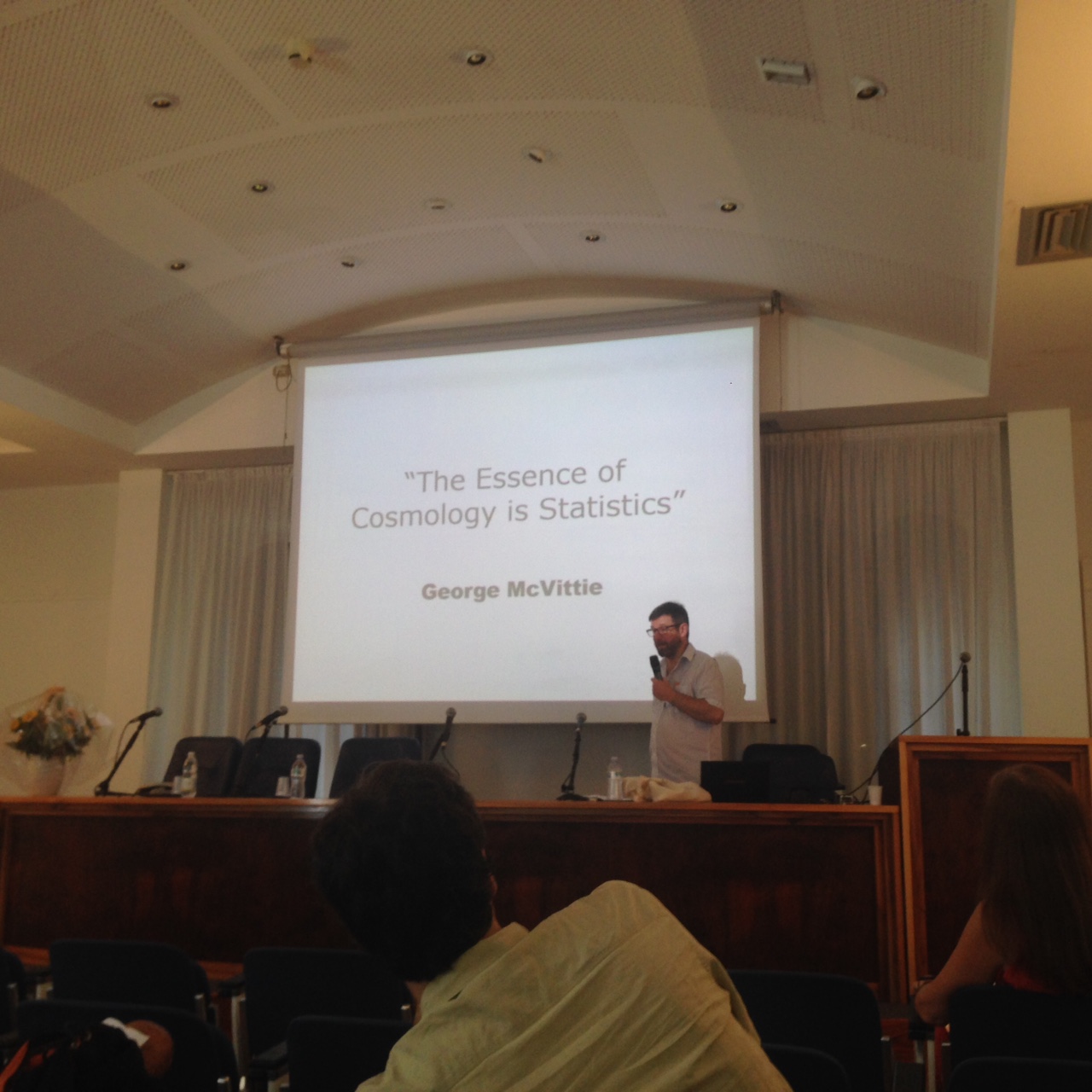
The Essence of Cosmology is Statistics

Posted in The Universe and Stuff with tags , , on September 8, 2015 by telescoper

I’m grateful to Licia Verde for sending this picture of me in action at last week’s conference in Castiglioncello.

McVittie

The quote is one I use quite regularly, as the source is quite surprising. It is by George McVittie and appears in the Preface to the Proceedings of the Third Bekeley Symposium on Mathematical Statistics and Probability, which took place in 1956. It is surprising for two reasons. One is that McVittie is more strongly associated with theoretical cosmology than with statistics. In fact I have one of his books, the first edition of which was published in 1937:

DSC_0170

There’s a bit in the book about observational cosmology, but basically it’s wall-to-wall Christoffel symbols!

The other surprising thing is that way back in 1956 there was precious little statistical information relevant to cosmology anyway, a far cry from the situation today with our plethora of maps and galaxy surveys. What he was saying though was that statistics is all about making inferences based on partial or incomplete data. Given that the subject of cosmology is the entire Universe, it is obvious we will never have complete data (i.e. we will never know everything). Hence cosmology is essentially statistical. This is true of other fields too, but in cosmology it is taken to an extreme. George McVittie passed away in 1988, so didn’t really live long enough to see this statement fulfilled, but it certainly has been over the last couple of decades!

P.S. Although he spent much of his working life in the East End of London (at Queen Mary College), George McVittie should not be confused with the even more famous, or rather infamous, Jack McVitie.

Yo-Yo Ma and the Bach Suites for Solo Cello

Posted in Music with tags , , , , on September 7, 2015 by telescoper

I stayed in on Saturday night especially to listen to a very special promenade concert live on BBC Radio 3 during which renowned cellist Yo-Yo Ma played all six of the Suites for unaccompanied Cello by Johann Sebastian Bach. It was an absolutely brilliant concert which you can, if you missed it, or even if you didn’t,  download for the next month here. The whole thing runs for over two and a half hours, but I didn’t move from my seat once.

I’ve loved all these pieces from the moment I first heard them. How Bach manages to conjure up such a vast range of melodic and rhythmic possibilities using just the one instrument is almost miraculous. Despite using very few chords, they manage to explore the  harmonic domain too. Part of what makes them so special is the instrument itself – its earthy sound, complete with occasional growls and scrapes, emphasizes how this sublime music is somehow at the same time deeply human, somehow connecting the listener to something from far beyond the mundane world we normally inhabit. I’m not a religious man, but listening to music like this is a spiritual experience for me.

Do listen to the whole concert if you can, but if you can’t here’s a short taster (recorded elsewhere). This is the Prelude to the 1st Suite, the first page of which is here:

bach_cello

If you look at the sheet music you might be forgiven for thinking that it is just a dry exercise in playing across the strings. Listen to it come to life, however, and you’ll quickly realise that you were wrong. The ending of this prelude always sends shivers down my spine.

I know these suites have been transcribed for other solo instruments, such as the flute, but listening to them on Saturday I wondered if they had been transcribed for my favourite earthy and growly instrument, the tenor saxophone. In fact they have; you can hear an example here.  One problem that struck me immediately is that saxophonists have to pause for breath! Anyway,  I must get a copy of the transcription and have a go at learning it, though I think it would take a Sonny Rollins or John Coltrane to do them justice!


The Day of Daltonism

Posted in History with tags , on September 6, 2015 by telescoper

Having a quick look at Twitter this morning as I drank my coffee I discovered that it is the birthday of the English scientist John Dalton, who was born on 6th September 1766. Dalton is most famous in the United Kingdom for his work on chemistry and physics, but somewhat less so for his pioneering studies of colour blindness. I didn’t know until today, in fact, that the birthday of John Dalton, who was himself colour blind, is Colour Blindness Awareness Day so I thought I’d do a quick post to mark the occasion. You might also be interested in this guest post on the subject of colour and colour perception.

Here’s a test for some of the main types of colour blindness – can you read the numbers?

Colour_Blind

Colour blindness comes in different forms and affects a significant fraction of the population, with a much higher rate of occurrence in males (up to 1 in 10 in some groups) than in females (about 1 in 200). It also varies significantly across different populations, with particularly low rates for, e.g., Fijian males (0.8 %) and much higher frequencies among, e.g. Russian males (9.2%). I am not colour-blind myself, but I know several colleagues who are. In fact at the meeting I was at last week, when one speaker decided to show two different sets of results on a graph by plotting one in red and the other in green, there were howls from several in the audience who couldn’t tell them apart. It’s very easy to make careless mistakes like this in preparing lecture materials when it takes only a small effort to make them suitable for all. I urge colleagues who teach to remember that if they are 100 men in the audience the likelihood is that there will be around 8 to 10 who are colour blind.

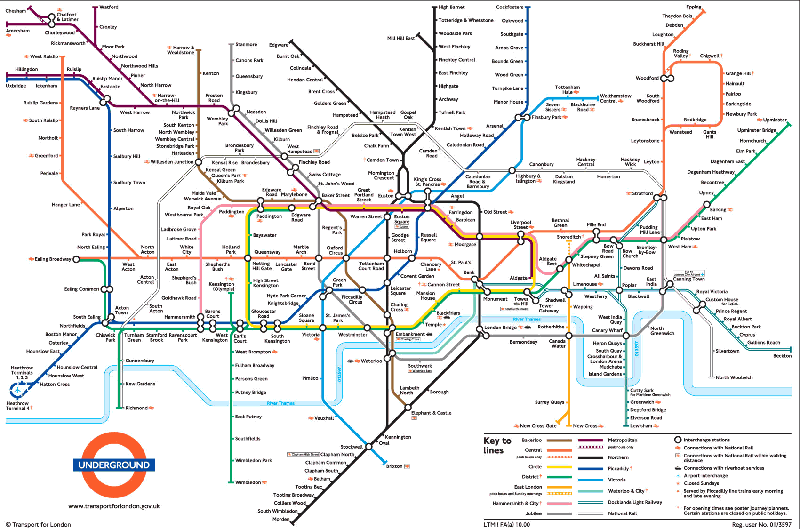
Thinking about this makes you realise how many maps and other designs rely on full colour perception for their effect. I’ve previously celebrated the London Underground map as an excellent example of graphic design, but it must be a nightmare to a person who is colour blind!

tube_map

Last week I gave a short speech at the workshop to celebrate Sabino Matarrese’s 60th birthday, in the course of which I mentioned the late Francesco Lucchin, who first invited to Italy to work with the Padova group (of which Sabino was a member) back in the early 90s. Francesco and I ended up writing a book together and during the course of working on that he told me that he was “daltonic”. I later found out that this word does exist in English, but it is not in common usage as a word meaning “colour blind”. In fact the standard word in Italian for “colour blind” is “daltonico” and there are many other variants in other European languages, such as the French “daltonien”. It’s very curious that Dalton’s name is so strongly associated with colour blindness across the European continent but not in the country of his birth. I wonder why?

By the way, if I understand correctly, the English word “daltonic” refers to a specific form of red/green colour blindness called deuteranopia, whereas the foreign variants can refer to any form of colour blindness.

Anyway, must wrap it up there. I have to mark some resit examinations which, according to the instructions, should be done in red ink by the first marker and in green ink by the second marker…

From here to Astragalo

Posted in Biographical, History with tags , , , , on September 5, 2015 by telescoper

Now that I’m back to the relatively autumnal setting of Brighton, I can’t help reflecting on last week’s meeting. On Monday evening I attended a cocktail party in a very pleasant bar in Castiglioncello overlooking the sea. Sunset views are something of a speciality from this location:

image

Anyway, the name of the place we were in was Astragalo. I checked and, as I suspected, this the Italian word for astragalus, which has an approximately tetrahedral shape. Astragalus is also a kind of plant, which is perhaps more likely to be associated with the name of a seaside bar, but that spoils the connection I wish to make with probability theory, a topic that came up regularly during the conference I was attending, so I’ll ignore it.

Nowadays gambling is generally looked down on as something shady and disreputable, not to be discussed in polite company, or even to be banned altogether. However, the formulation of the basic laws of probability was almost exclusively inspired by their potential application to games of chance. Once established, these laws found a much wide range of applications in scientific contexts, including my own field of astronomy. The astragalus provides a very early example.

Gambling in various forms has been around for millennia. Sumerian and Assyrian archaeological sites are littered with examples the astragalus (or talus bone). This is found just above the heel and its roughly tetrahedral shape (in sheep and deer at any rate) is such that when it is tossed in the air it can land in any one of four possible orientations; it’s fairly similar in fact to the four-sided dice used in some role-playing games. The astragalus can be used to generate “random” outcomes and is in many ways the forerunner of modern six-sided dice. The astragalus is known to have been used for gambling games as early as 3600 BC.
images

Unlike modern dice, which began to appear around 2000BC, the astragalus is not quite symmetrical, giving a different probability of it landing in each orientation. It is not thought that there was a mathematical understanding of how to calculate odds in games involving this object or its more symmetrical successors (right).

your guide on how to celebrate World Beard Day on 5th September

Posted in Beards on September 5, 2015 by telescoper

I’m concentrating on (4) myself, at today’s University of Sussex Open Day..

kmflett's avatarKmflett's Blog

The Beard Liberation Front, the informal network of beard wearers, has produced a brief guide on how to celebrate World Beard Day on 5th September

1 do not shave and avoid all barbers shops

2 marinate your beard in imperial stout

3 at midday raise a glass and chant Jeremy Corbyn: beard power

4 celebrate pogonophilia by making sure your beard is seen in public places

5 if you do not have a beard wear a knitted organic version

Have fun, stuff pogonophobes

marx

View original post

“Credit” needn’t mean “Authorship”

Posted in Science Politics, The Universe and Stuff with tags , , , on September 4, 2015 by telescoper

I’ve already posted about the absurdity of scientific papers with ridiculously long author lists but this issue has recently come alive again with the revelation that the compilers of the Times Higher World University Rankings decided to exclude such papers entirely from their analysis of citation statistics.

Large collaborations involving not only scientists but engineers, instrument builders, computer programmers and data analysts –  are the norm in some fields of science – especially (but not exclusively) experimental particle physics – so the arbitrary decision to omit such works from bibliometric analysis is not only idiotic but also potentially damaging to a number of disciplines. The “logic” behind this decision is that papers with “freakish” author lists might distort analyses of citation impact, even allowing – heaven forbid – small institutions with a strong involvement in world-leading studies such as those associated with the Large Hadron Collider to do well compared with larger institutions that are not involved in such collaborations.  If what you do doesn’t fit comfortably within a narrow and simplistic method of evaluating research, then it must be excluded even if it is the best in the world. A sensible person would realise that if the method doesn’t give proper credit then you need a better method, but the bean counters at the Times Higher have decided to give no credit at all to research conducted in this way. The consequences of putting the bibliometric cart in front of the scientific horse could be disastrous, as insitutions find their involvement in international collaborations dragging them down the league tables. I despair of the obsession with league tables because these rankings involve trying to shoehorn a huge amount of complicated information into a single figure of merit. This is not only pointless, but could also drive behaviours that are destructive to entire disciplines.

That said, there is no denying that particle physicists, cosmology and other disciplines that operate through large teams must share part of the blame. Those involved in these collaborations have achieved brilliant successes through the imagination and resourcefulness of the people involved. Where imagination has failed however is to carry on insisting that the only way to give credit to members of a consortium is by making them all authors of scientific papers. In the example I blogged about a few months ago this blinkered approach generated a paper with more than 5000 authors; of the 33 pages in the article, no fewer than 24 were taken up with the list of authors.

Papers just don’t have five thousand “authors”. I even suspect that only about 1% of these “authors” have even read the paper. That doesn’t mean that the other 99% didn’t do immensely valuable work. It does mean that pretending that they participated in writing the article that describes their work isn’t be the right way to acknowledge their contribution. How are young scientists supposed to carve out a reputation if their name is always buried in immensely long author lists? The very system that attempts to give them credit renders that credit worthless. Instead of looking at publication lists, appointment panels have to rely on reference letters instead and that means early career researchers have to rely on the power of patronage.

As science evolves it is extremely important that the methods for disseminating scientific results evolve too. The trouble is that they aren’t. We remain obsessed with archaic modes of publication, partly because of innate conservatism and partly because the lucrative publishing industry benefits from the status quo. The system is clearly broken, but the scientific community carries on regardless. When there are so many brilliant minds engaged in this sort of research, why are so few willing to challenge an orthodoxy that has long outlived its usefulness. Change is needed, not to make life simpler for the compilers of league tables, but for the sake of science itself.

I’m not sure what is to be done, but it’s an urgent problem which looks set to develop very rapidly into an emergency. One idea appears in a paper on the arXiv with the abstract:

Science and engineering research increasingly relies on activities that facilitate research but are not currently rewarded or recognized, such as: data sharing; developing common data resources, software and methodologies; and annotating data and publications. To promote and advance these activities, we must develop mechanisms for assigning credit, facilitate the appropriate attribution of research outcomes, devise incentives for activities that facilitate research, and allocate funds to maximize return on investment. In this article, we focus on addressing the issue of assigning credit for both direct and indirect contributions, specifically by using JSON-LD to implement a prototype transitive credit system.

I strongly recommend this piece. I don’t think it offers a complete solution, but certainly contains  many interesting ideas. For the situation to improve, however, we have to accept that there is a problem. As things stand, far too many senior scientists are in denial. This has to change.