Author Archive

Quantum Madness

Posted in The Universe and Stuff with tags , , on September 18, 2015 by telescoper

A very busy day lies in store so I only have time for a quick morning visit to the blog. If you enjoyed the recent guest post on the “hidden variables” interpretation of Quantum Mechanics, then you will probably enjoy reading a paper that recently appeared on the arXiv with the abstract:

Motivated by some recent news, a journalist asks a group of physicists: “What’s the meaning of the violation of Bell’s inequality?” One physicist answers: “It means that non-locality is an established fact”. Another says: “There is no non-locality; the message is that measurement outcomes are irreducibly random”. A third one says: “It cannot be answered simply on purely physical grounds, the answer requires an act of metaphysical judgement”. Puzzled by the answers, the journalist keeps asking questions about quantum theory: “What is teleported in quantum teleportation?” “How does a quantum computer really work?” Shockingly, for each of these questions, the journalist obtains a variety of answers which, in many cases, are mutually exclusive. At the end of the day, the journalist asks: “How do you plan to make progress if, after 90 years of quantum theory, you still don’t know what it means? How can you possibly identify the physical principles of quantum theory or expand quantum theory into gravity if you don’t agree on what quantum theory is about?” Here we argue that it is becoming urgent to solve this too long lasting problem. For that, we point out that the interpretations of quantum theory are, essentially, of two types and that these two types are so radically different that there must be experiments that, when analyzed outside the framework of quantum theory, lead to different empirically testable predictions. Arguably, even if these experiments do not end the discussion, they will add new elements to the list of strange properties that some interpretations must have, therefore they will indirectly support those interpretations that do not need to have all these strange properties.

You can download a PDF of the full paper here. It’s a short piece, but with a very good list of references for further reading.

Science is (even more) Vital (than ever)

Posted in Politics, Science Politics with tags , on September 17, 2015 by telescoper

It’s almost five years since I participated in a rally in London to protest against proposed cuts to the UK science budget. Since then research funding has been heavily squeezed by a “flat cash” settlement that threatens the survival our science base, with consequent damaging effects on the long-term future of the economy. This graphic, from a post by Stephen Curry, says it all:

science is still vital

Back in 2010, most of us were relieved that the outcome of the Chancellor’s spending review was a level funding in cash terms, although the decline in real terms funding since then has been enormously challenging across the board. The forthcoming spending review puts us in an even more dangerous situation. After the 2010 election the Coalition government announced a “ring fence” that protected science spending from cash cuts for the duration of the last Parliament (although this has, as the graphic above demonstrates) translated into real-terms cuts year on year. This time any commitment to a ring-fence from the Conservative government has been conspicuous by its absence. Indeed, its decision to claw back funding of STEM subjects through HEFCE has demonstrated its intention to remove even this modest protection. The government has signalled its desire to cut overall spending massively this time, and there are few places left for the axe to fall other than in research. Now the UK’s research councils are being told to budget for cuts of 20% and 40% to their core funding. This will lead to the abandonment of many international research projects and lead to large-scale redundancies across the sector, driving the best of our scientists abroad. These plans are bad not only for science, but for the economy as a whole because it is only through growth triggered by research and innovation that this country can hope to recover from the mess that it is currently in.

As scientists and as people who care about this country’s future we can not allow these cuts to go ahead. I will be attending an event at the Conway Hall in London organised by Science is Vital to campaign against these reckless plans. I encourage you to do likewise. I don’t know if the government will listen, but we have to try.

Maria Callas: “Ah, rendetemi la speme…”

Posted in Opera with tags , on September 16, 2015 by telescoper

I’m reminded that Maria Callas (“La Divina”) passed away on this day in 1977, so by way of a tribute here she is singing a famous “Mad Scene” from the Opera I saw at the Wales Millennium Centre last week, I Puritani by Vincenzo Bellini. This is a rare recording of the young Callas, aged only 25, made in 1949. It’s historically important too, because Callas stepped into this production at short notice in Venice that year, having started out on a  career as a dramatic soprano singing Wagnerian roles. Critics sneered when they heard that she had been cast as Elvira, but almost overnight she transformed the role and so began her almost single-handed revival of the entire bel canto repertoire.

One critic wrote:

Even the most sceptical had to acknowledge the miracle that Maria Callas accomplished… the flexibility of her limpid, beautifully poised voice, and her splendid high notes. Her interpretation also has a humanity, warmth and expressiveness that one would search for in vain in the fragile, pellucid coldness of other Elviras.

Her she is as Elvira, deranged by the loss of her beloved who has vanished without explanation. It’s as beautiful as it is heartbreaking. It’s not the best sound quality, but the emotional power of her voice shines through. Few singers have even come close to matching Callas in roles like this.

Qui la voce sua soave mi chiamava…e poi sparì.
Qui giurava esser fedele,  qui il giurava,
E poi crudele, mi fuggì!
Ah, mai più qui assorti insieme nella gioia dei sospir.
Ah, rendetemi la speme,  o lasciate, lasciatemi morir.

September in the Rain

Posted in Jazz with tags , , on September 16, 2015 by telescoper

Need cheering up on a rainy September afternoon? The gorgeous voice of Sarah Vaughan should do the trick!

Seven Years In The Dark

Posted in Biographical with tags on September 15, 2015 by telescoper

7th Birthday Badge Superhero

When I logged onto WordPress to write today’s post I received a message that it was the 7th anniversary of my registration with them as a blogger and thus took my first step into the blogosphere; that was way back on 15th September 2008. I actually wrote my first post that day too. Unfortunately I didn’t really know what I was doing on my first day at blogging – no change there, then –  and I didn’t actually manage to figure out how to publish this earth-shattering piece. It was only after I’d written my second post that I realized that the first one wasn’t actually live, so the two appear in the wrong order in my archive.

I’d like to take this opportunity to send my best wishes, and to thank, everyone who reads this blog, however occasionally. According to the WordPress stats, I’ve got readers from all round the world, including one in the Vatican! If you’re interested in statistics then, as of 13.30 today, I have published 2,934 blog posts, and have received 2,460,789 hits altogether; I get an average of about 1300 per day, but this varies in a very erratic fashion. The greatest number of hits I have received in a day is 8,864 (at the peak of the BICEP2 controversy). There have been 22,482 comments published on here and 1,391,901  rejected as spam or abuse; a lot goes on behind the scenes here that you really don’t want to know about!

Anyway, the numbers don’t really matter but it does mean a lot to know that there are people who find my ramblings interesting enough to look at, and sometimes even to come back for more!


Battle of Britain Day

Posted in Film, History with tags , , , on September 15, 2015 by telescoper

Today is the 75th Anniversary of the day that historians regard as the climax of the Battle of Britain. To commemorate this, a huge flypast will take place across the South of England. Unfortunately, the weather isn’t too great today, and I don’t think it will be quite the spectacle that was intended, although Purple, Brown and Black sections are due to fly over Brighton from RAF Goodwood and perhaps the clouds will have broken up by the time they get here. Normally Battle of Britain Day is commemorated on a Sunday, as 15th September 1940 lay on a Sunday.

I had a friend – now long dead – who served as a fighter pilot in the RAF during the Battle of Britain and I once asked him about the tactics they used. He explained that they didn’t really have any tactics. When scrambled they were usually lucky if they managed to get to the right altitude before the enemy were on them. And if they did, they just flew head on at the incoming planes and tried to shoot them down. There was little point in attacking a big formation from behind with a handful of planes, which was the usual situation: you might pick off one or two but the bombers would carry on to their target. You had to attack from the front in order to scatter them. He added that on a good day, if you were feeling exceptionally brave, you might even keep your eyes open as you screamed straight into the enemy at getting on for 400 mph.

Another event of 15th September 1940 exemplifies the almost insane courage of the RAF pilots. A formation of Dornier bombers penetrated the British air defencesa as central London, where it was engaged by planes from a number of RAF squadrons, including the Hurricane of Flight Sergeant Ray Holmes. Holmes got into position to shoot down one Dornier, but when attempted to fire he discovered he had run out of ammunition. In an act of amazing bravery he decided to ram the Dornier. He succeeded ins slicing off the plane’s tail and it came down on Victoria Station. Somewhat improbably, Holmes managed to bale out and, though injured, survived to fight again. He died in 2005.

The other thing that this event reminded me of was the film Battle of Britain. The movie is a bit dated now, largely because some of the special effects don’t really stand up to modern comparisons: no cgi when it was made, for example. The best thing about it for me, though, is the wonderful music written for the film by William Walton, especially in the following sequence where the dogfights are shown with only the music as soundtrack. This turns the shots of terrifying close-range combat into a something a lot more than an action movie. It’s a work of art.

The context of this sequence is, as far as I know, historically accurate. Over the summer of 1940 the Luftwaffe had sent raid after raid over to attack Britain, these raids increasing in size as time went on. Hugh Dowding, Head of Fighter Command at that time, refused to let his planes be drawn into a huge battle against numerically superior forces and instead kept most of his planes in reserve, sending up only a squadron or half a squadron to meet the incoming planes. Thanks to the breaking of the German Air Force Enigma code, Dowding knew that the Luftwaffe pilots had been handing in grossly exaggerated reports of how many planes they had been shooting down. Convinced that the RAF was on the brink of collapse, the Germans launched an enormous air raid on September 15th 1940 intended to deliver the knockout blow and prepare the way for invasion.

Dowding knew that they were coming, and put every available plane at the RAFs disposal into the air. The survival of this country was at stake during this battle. There were no reserves. When the Luftwaffe arrived over Britain their pilots were aghast to find the air filled with Spitfires and Hurricanes whose pilots, having been consistently outnumbered in the battles so far, relished the chance to fight for once with something close to numerical equality with the enemy. The RAF scored a decisive victory, convincing Hitler to abandon his plans for an invasion in 1940.

R.I.P. Brian Close

Posted in Cricket with tags , , on September 14, 2015 by telescoper

I heard today of the death, at the age of 84, of former Yorkshire and England cricketer Brian Close. Close was an abrasive character whose personality made him more than a few enemies, but he had a very successful playing career and was a tough but effective captain both on the field an in the dressing room. Above all, he was an exceptionally brave batsman. I can think of no better example than this video of him facing Michael Holding (“Whispering Death”) at Old Trafford in 1976. He struggles to lay bat on ball and is hit several times on the body but he always gets into line. This is from an era in which batsmen didn’t wear head protection; this nearly cost him serious injury, as you will see in the clip. Even with a helmet I would have been terrified. Cricket is not a game for faint hearts…

At the age of 45 Brian Close had been brought in to open the England batting earlier in the series in an attempt to stiffen their resistance to the West Indian attack. He wasn’t the greatest player in the world nor the cricketing world’s most agreeable character, and as you can tell he wasn’t in the first flush of youth in 1976 either, but there is no denying his courage and determination. Here he is enduring a vicious battering at the hands of Michael Holding. One short-pitched delivery in this sequence came within a whisker of hitting him on the head; had it done so the consequences would have been horrendous. As it was, he “only” had to take a succession of blows to his body. He scored 20 runs at Old Trafford, off 108 balls in 162 minutes, and was dropped for the next Test, as was his opening partner John Edrich, although both had stood their ground and defended their wickets (and themselves) manfully.

R.I.P. Brian Close (1931-2015)

Gamma-Ray Bursts and the Cosmological Principle

Posted in Astrohype, Bad Statistics, The Universe and Stuff with tags , , , on September 13, 2015 by telescoper

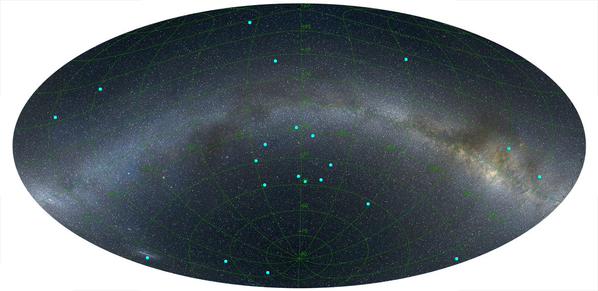
There’s been a reasonable degree of hype surrounding a paper published in Monthly Notices of the Royal Astronomical Society (and available on the arXiv here). The abstract of this paper reads:

According to the cosmological principle (CP), Universal large-scale structure is homogeneous and isotropic. The observable Universe, however, shows complex structures even on very large scales. The recent discoveries of structures significantly exceeding the transition scale of 370 Mpc pose a challenge to the CP. We report here the discovery of the largest regular formation in the observable Universe; a ring with a diameter of 1720 Mpc, displayed by 9 gamma-ray bursts (GRBs), exceeding by a factor of 5 the transition scale to the homogeneous and isotropic distribution. The ring has a major diameter of 43° and a minor diameter of 30° at a distance of 2770 Mpc in the 0.78 < z < 0.86 redshift range, with a probability of 2 × 10⁻⁶ of being the result of a random fluctuation in the GRB count rate. Evidence suggests that this feature is the projection of a shell on to the plane of the sky. Voids and string-like formations are common outcomes of large-scale structure. However, these structures have maximum sizes of 150 Mpc, which are an order of magnitude smaller than the observed GRB ring diameter. Evidence in support of the shell interpretation requires that temporal information of the transient GRBs be included in the analysis. This ring-shaped feature is large enough to contradict the CP. The physical mechanism responsible for causing it is unknown.

The so-called “ring” can be seen here:
ring_Australia

In my opinion it’s not a ring at all, but an outline of Australia. What’s the probability of a random distribution of dots looking exactly like that? Is it really evidence for the violation of the Cosmological Principle, or for the existence of the Cosmic Antipodes?

For those of you who don’t get that gag, a cosmic antipode occurs in, e.g., closed Friedmann cosmologies in which the spatial sections take the form of a hypersphere (or 3-sphere). The antipode is the point diametrically opposite the observer on this hypersurface, just as it is for the surface of a 2-sphere such as the Earth. The antipode is only visible if it lies inside the observer’s horizon, a possibility which is ruled out for standard cosmologies by current observations. I’ll get my coat.

Anyway, joking apart, the claims in the abstract of the paper are extremely strong but the statistical arguments supporting them are deeply unconvincing. Indeed, I am quite surprised the paper passed peer review. For a start there’s a basic problem of “a posteriori” reasoning here. We see a group of objects that form a map of Australia ring and then are surprised that such a structure appears so rarely in simulations of our favourite model. But all specific configurations of points are rare in a Poisson point process. We would be surprised to see a group of dots in the shape of a pretzel too, or the face of Jesus, but that doesn’t mean that such an occurrence has any significance. It’s an extraordinarily difficult problem to put a meaningful measure on the space of geometrical configurations, and this paper doesn’t succeed in doing that.

For a further discussion of the tendency that people have to see patterns where none exist, take a look at this old post from which I’ve taken this figure which is generated by drawing points independently and uniformly randomly:

pointaI can see all kinds of shapes in this pattern, but none of them has any significance (other than psychological). In a mathematically well-defined sense there is no structure in this pattern! Add to that difficulty the fact that so few points are involved and I think it becomes very clear that this “structure” doesn’t provide any evidence at all for the violation of the Cosmological Principle. Indeed it seems neither do the authors. The very last paragraph of the paper is as follows:

GRBs are very rare events superimposed on the cosmic
web identified by superclusters. Because of this, the ring is
probably not a real physical structure. Further studies are
needed to reveal whether or not the Ring could have been
produced by a low-frequency spatial harmonic of the large-
scale matter density distribution and/or of universal star
forming activity.

It’s a pity that this note of realism didn’t make it into either the abstract or, more importantly, the accompanying press release. Peer review will never be perfect, but we can do without this sort of hype. Anyway, I confidently predict that a proper refutation will appear shortly….

P.S. For a more technical discussion of the problems of inferring the presence of large structures from sparsely-sampled distributions, see here.

Beard Liberation Front official statement on Jeremy Corbyn’s Labour leadership victory

Posted in Uncategorized on September 12, 2015 by telescoper

kmflett's avatarKmflett's Blog

Beard Liberation Front

Press release 12TH September

Contact Keith Flett 07803 167266

CAMPAIGNERS WELCOME THE AGE OF THE BEARD AS CORBYN ELECTED LABOUR LEADER

bed

The Beard Liberation Front, the informal network of beard wearers, has welcomed the Age of the Beard with the news that Jeremy Corbyn has been elected Labour leader

Jeremy Corbyn is five times winner of the Parliamentary Beard of the Year Award and was the winner of the original award in 2001 and while his beard may be a little more restrained these days, it has been a consistent presence on the Parliamentary backbenches for over 30 years.

The campaigners say that Corbyn has faced many comments about his beard and informal appearance during the Leadership campaign but his victory underlines the growing disenchantment that there is with clean shaven politicians in suits

The 2015 Parliamentary Beard of the Year Award poll will open on…

View original post 106 more words

I Puritani – Welsh National Opera

Posted in Opera with tags , , , , , on September 12, 2015 by telescoper

After spending yesterday in Cardiff at an External Advisory Panel meeting for the School of Physics & Astronomy, I’m now back on Sussex University campus to greet this year’s new new intake of students who begin arriving this weekend. Now, in between two Welcome Events this afternoon I just have time to do a quick review of last night’s entertainment in Cardiff. The meeting in Cardiff had been in my diary for a while but I only realised last week that Friday night was the opening performance of a new Welsh National Opera production of I Puritani by Vincenzo Bellini. Fortunately, I managed to get a last-minute ticket. I’m really glad I did because it was wonderful.

I Puritani is set in England during the Civil War and revolves around Elvira (soprano, sung by Rosa Feola), who is a Protestant, and in love with Arturo (tenor, Barry Banks), who is Catholic. The trouble is that Elvira’s father has already promised her hand in marriage to Riccardo (David Kempster). The thought of being unable to marry Arturo sends Elvira into a deep depression but, seeing this, her father relents and gives permission for her to marry her true love. She responds to this news in rapturous fashion; her future happiness seems assured.

Unfortunately events intervene. Arturo takes pity on a woman suspected of being a Stuart spy and about to be condemned to death. In fact it turns out that the “spy” is Queen Henrietta Maria, widow of Charles I. Arturo struggles with the conflict between love and duty (a familiar operatic theme) then, on the eve of his wedding, he leaves in order to take Henrietta Maria away to safety. The shock of discovering that her beloved has gone deranges Elvira’s mind, and the classic Bel Canto “Mad Scene” ensues. Arturo does return, eventually, but not until Act 3 by which time he has already been sentenced to death for treason and Elvira is beyond help. Riccardo, encouraged by a mob, prepares to carry out the execution. A herald appears, announcing victory for the Protestant side in the Civil War and declaring a general pardon on all Royalist prisoners. It is too late to save Arturo, although Elvira’s madness has deepened to such an extent she doesn’t even realised her would-be husband is dead.

That brief synopsis of the plot doesn’t do any justice to what I think is a consummate piece of music drama, and certainly one of the heights of the bel canto period. There’s a superb balance of the different vocal combinations and wonderfully expressive music throughout. There are trademark bel canto coloratura passages, but it never feels forced or showy in this opera. The momentum never flags, either. It might surprise those who don’t like bel canto opera that, for example, Richard Wagner was a particular admirer of Vicenzo Bellini. Incidentally, I Puritani was Bellini’s last Opera; he died suddenly in 1835, at the age of just 34, the year it was first performed. It was acclaimed by the critics way back then, and is a fitting swansong for a truly great operatic composer.

The new production is initially set in the Northern Ireland of 1970s, with Elvira dressed in a blue twin set reminiscent of Margaret Thatcher. The protestants were depicted as Ulsterman, complete with Orange regalia and bowler hats. But there is a surprise in store. As Elvira begans to lose her mind, an identically dressed (mute) doppelganger appears on stage. The real Elvira then leaves to return almost immediately dressed in 17th Century attire. The Orangemen also reappear dressed in the black clothes with white ruffs and cuffs of Puritans. Not only does this make a point about the three hundred years of sectarian madness in Northern Ireland, but it also manifests Elvira’s depersonalisation, i.e. her detachment from reality. The portrayal of Elvira’s madness in this Opera is sympathetic but unflinching, and deeply moving.

The principals were all excellent, but I can’t help singling out Rosa Feola, who sang and acted beautifully, and Barry Banks who tackled the immensely demanding tenor part with real gusto. The WNO chorus were magnificent, as they usually are in fact. Conductor Carlo Rizzi had the Orchestra of Welsh National Opera on top form too.

All in all, a wonderful night at the Opera. Congratulations to WNO for having the courage to put on this rare masterpiece. This is as good as anything I’ve seen at the Wales Millennium Centre, and that’s a pretty strong endorsement Do go and see it if you can!