Author Archive

Planning for the Future

Posted in Brighton, Education with tags , , on July 30, 2015 by telescoper

Some great news arrived this morning. The Planning Inspectorate has given approval to the University of Sussex’s Campus Masterplan, which paves the way for some much-needed new developments on the Falmer Campus and a potential £500 million investment in the local economy. As a scientist working at the University I’m particularly delighted with this decision as it will involve much-needed new science buildings which should ease the pressure on our existing estate. The planned developments include new state-of-the-art academic and research facilities, the creation of an estimated 2400 new jobs in the local community and 2500 new student rooms on the campus, while still preserving the famous listed buildings designed by architect Sir Basil Spence when the University was founded back in the 1960s. We’re in for an exciting few years as these new developments take shape, especially a new building for Life Sciences and redevelopment of the East Slope site. The expansion of residential accommodation on campus will take some of the pressure off the housing stock in central Brighton while the other new buildings will provide much-needed replacements and extensions for some older ones that are at the end of their useful life.

Here’s a video fly-through that illustrates the general scale of the development – although the individual buildings shown are just indicative, as detailed designs are still being drawn up and each new building will need further planning permission.

But it is not just as an employee of the University that I am delighted by this news. I also live in Brighton and I honestly believe that the expansion of the University is an extremely good thing for the City, which is already turning into a thriving high-tech economy owing to the presence of so many skilled graduates and spin-out enterprises. There’s a huge amount of work to do in order to turn these plans into reality, but within a couple of years I think we’ll start to see the dividend.

Mathematics at Sussex – The Video!

Posted in Education with tags , on July 29, 2015 by telescoper

Here’s a nice little promotional video about the Department of Mathematics at the University of Sussex, featuring some of our lovely staff and students along with some nice views of the campus and the city of Brighton. Above all, I think it captures what a friendly place this is to work and study. Enjoy!

The Small Window

Posted in Poetry with tags , , on July 28, 2015 by telescoper

In Wales there are jewels
To gather, but with the eye
Only. A hill lights up
Suddenly; a field trembles
With colour and goes out
In its turn; in one day
You can witness the extent
Of the spectrum and grow rich
With looking. Have a care;
The wealth is for the few
And chosen. Those who crowd
A small window dirty it
With their breathing, though sublime
And inexhaustible the view.

by R.S. Thomas (1913-2000)

inflation, evidence and falsifiability

Posted in Uncategorized on July 27, 2015 by telescoper

At the risk of labouring the point here’s another critque of the Gubitosi et al, paper I posted about a couple of days ago…

xi'an's avatarXi'an's Og

[Ewan Cameron pointed this paper to me and blogged about his impressions a few weeks ago. And then Peter Coles wrote a (properly) critical blog entry yesterday. Here are my quick impressions, as an add-on.]

“As the cosmological data continues to improve with its inevitable twists, it has become evident that whatever the observations turn out to be they will be lauded as proof of inflation”.”G. Gubitosi et al.

In an arXive with the above title, Gubitosi et al. embark upon a generic and critical [and astrostatistical] evaluation of Bayesian evidence and the Bayesian paradigm. Perfect topic and material for another blog post!

“Part of the problem stems from the widespread use of the concept of Bayesian evidence and the Bayes factor (…) The limitations of the existing formalism emerge, however, as soon as we insist on falsifiability as a pre-requisite for a scientific theory (….) the…

View original post 677 more words

The Renewed Threat to STEM

Posted in Education, Finance, Science Politics with tags , , , , , , on July 26, 2015 by telescoper

A couple of years ago, soon after taking over as Head of the School of Mathematical and Physical Sciences (MPS) at the University of Sussex, I wrote a blog post called The Threat to STEM from HEFCE’s Funding Policies about how the funding policies of the Higher Education Funding Council for England (HEFCE) were extremely biased against STEM disciplines. The main complaint I raised then was that the income per student for science subjects does not adequately reflect the huge expense of teaching these subjects compared to disciplines in the arts and humanities. The point is that universities now charge the same tuition fee for all subjects (usually £9K per annum) while the cost varies hugely across disciplines: science disciplines can cost as much as £16K per annum per student whereas arts subjects can cost as little as £6K. HEFCE makes a small gesture towards addressing this imbalance by providing an additional grant for “high cost” subjects, but that is only just over £1K per annum per student, not enough to make such courses financially viable on their own. And even that paltry contribution has been steadily dwindling.  In effect, fees paid by arts students are heavily subsidising the sciences across the Higher Education sector.

The situation was bad enough before last week’s announcement of an immediate £150M cut in HEFCE’s budget. Once again the axe has fallen hardest on STEM disciplines. Worst of all, a large part of the savings will be made retrospectively, i.e. by clawing back money that had already been allocated and which institutions had assumed in order to plan their budgets. To be fair, HEFCE had warned institutions that cuts were coming in 2015/16:

This means that any subsequent changes to the funding available to us from Government for 2015-16, or that we have assumed for 2016-17, are likely to affect the funding we are able to distribute to institutions in the 2015-16 academic year. This may include revising allocations after they have already been announced. Accordingly, institutions should plan their budgets prudently.

However, this warning does not mention the possibility of cuts to the current year (i.e. 2014-15). No amount of prudent planning of budgets will help when funding is taken away retrospectively, as it is now to the case. I should perhaps explain that funding allocations are made by HEFCE in a lagged fashion, based on actual student numbers, so that income for the academic year 2014-15 is received by institutions during 15/16. In fact my institution, in common with most others, operates a financial year that runs from August 1st to July 31st and I’ve just been through a lengthy process of setting the budget from August 1st 2015 onward; budgets are what I do most of the time these days, if I’m honest. I thought I had finished that job for the time being, but look:

In October 2015, we will notify institutions of changes to the adjusted 2014-15 teaching grants we announced in March 20158. These revised grant tables will incorporate the pro rata reduction of 2.4 per cent. This reduction, and any other changes for individual institutions to 2014-15 grant, will be implemented through our grant payments from November 2015. We do not intend to reissue 2014-15 grant tables to institutions before October 2015, but institutions will need to reflect any changes relating to 2014-15 in their accounts for that year (i.e. the current academic year). Any cash repayments due will be confirmed as part of the October announcements.

On top of this, any extra students recruited as as  result of the government scrapping student number controls won’t attract any support at all from HEFCE, so we wll only get the tuition fee.And the government says it wants the number of STEM students to increase? Someone tell me how that makes sense.

What a mess! It’s going to be back to the drawing board for me and my budget. And if a 2.4 per cent cut doesn’t sound much to you then you need to understand it in terms of how University budgets work. It is my job – as the budget holder for MPS – to ensure that the funding that comes in to my School is spent as efficiently and effectively on what the School is meant to do, i.e. teaching and research. To that end I have to match income and expenditure as closely as possible. It is emphatically not the job of the School to make a profit: the target I am given is to return a small surplus (actually 4 per cent of our turnover) to contribute to longer-term investments. I’ve set a budget that does this, but now I’ll have to wait until October to find out how much I have to find in terms of savings to absorb the grant cut. It’s exasperating when people keep moving the goalposts like this. One would almost think the government doesn’t care about the consequences of its decisions, as long as it satisfies its fixation with cuts.

And it’s not only teaching that is going to suffer. Another big slice of savings (£52M) is coming from scrapping the so-called “transitional relief” for STEM departments who lost out as a result of the last Research Excellence Framework. This again is a policy that singles out STEM disciplines for cuts. You can find the previous allocations of transitional relief in an excel spreadsheet here. The cash cuts are largest in large universities with big activities in STEM disciplines – e.g. Imperial College will lose £10.9M previous allocated, UCL about £4.3M, and Cambridge about £4M. These are quite wealthy institutions of course, and they will no doubt cope, but that doesn’t make it any more acceptable for HEFCE to break a promise.

This cut in fact won’t alter my School’s budget either. Although we were disappointed with the REF outcome in terms of league table position, we actually increased our QR income. As an institution the University of Sussex only attracted £237,174 in transitional relief so this cut is small potatoes for us, but that doesn’t make this clawback any more palatable from the point of view of the general state of health of STEM disciplines in the United Kingdom.

These cuts are also directly contrary to the claim that the UK research budget is “ring-fenced”. It clearly isn’t, and with a Comprehensive Spending Review coming up many of us are nervous that these cuts are just a foretaste of much worse things to come. Research Councils are being asked to come up with plans based on a 40% cut in cash.

Be afraid. Be very afraid.

On (un)falsifiability of paradigms with Bayesian model selection …

Posted in Uncategorized on July 25, 2015 by telescoper

Yesterday’s post is generating quite a lot if traffic for a weekend so I thought I would reblog this piece on the same topic..

Falisifiability versus Testability in Cosmology

Posted in Bad Statistics, The Universe and Stuff with tags , , , , , on July 24, 2015 by telescoper

A paper came out a few weeks ago on the arXiv that’s ruffled a few feathers here and there so I thought I would make a few inflammatory comments about it on this blog. The article concerned, by Gubitosi et al., has the abstract:
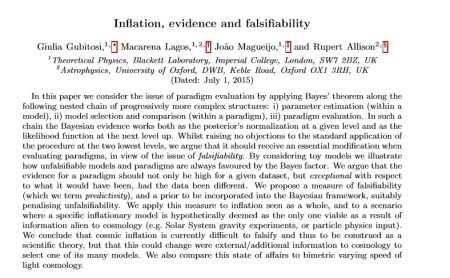
Inflation_falsifiabiloty

I have to be a little careful as one of the authors is a good friend of mine. Also there’s already been a critique of some of the claims in this paper here. For the record, I agree with the critique and disagree with the original paper, that the claim below cannot be justfied.

…we illustrate how unfalsifiable models and paradigms are always favoured by the Bayes factor.

If I get a bit of time I’ll write a more technical post explaining why I think that. However, for the purposes of this post I want to take issue with a more fundamental problem I have with the philosophy of this paper, namely the way it adopts “falsifiablity” as a required characteristic for a theory to be scientific. The adoption of this criterion can be traced back to the influence of Karl Popper and particularly his insistence that science is deductive rather than inductive. Part of Popper’s claim is just a semantic confusion. It is necessary at some point to deduce what the measurable consequences of a theory might be before one does any experiments, but that doesn’t mean the whole process of science is deductive. As a non-deductivist I’ll frame my argument in the language of Bayesian (inductive) inference.

Popper rejects the basic application of inductive reasoning in updating probabilities in the light of measured data; he asserts that no theory ever becomes more probable when evidence is found in its favour. Every scientific theory begins infinitely improbable, and is doomed to remain so. There is a grain of truth in this, or can be if the space of possibilities is infinite. Standard methods for assigning priors often spread the unit total probability over an infinite space, leading to a prior probability which is formally zero. This is the problem of improper priors. But this is not a killer blow to Bayesianism. Even if the prior is not strictly normalizable, the posterior probability can be. In any case, given sufficient relevant data the cycle of experiment-measurement-update of probability assignment usually soon leaves the prior far behind. Data usually count in the end.

I believe that deductvism fails to describe how science actually works in practice and is actually a dangerous road to start out on. It is indeed a very short ride, philosophically speaking, from deductivism (as espoused by, e.g., David Hume) to irrationalism (as espoused by, e.g., Paul Feyeraband).

The idea by which Popper is best known is the dogma of falsification. According to this doctrine, a hypothesis is only said to be scientific if it is capable of being proved false. In real science certain “falsehood” and certain “truth” are almost never achieved. The claimed detection of primordial B-mode polarization in the cosmic microwave background by BICEP2 was claimed by some to be “proof” of cosmic inflation, which it wouldn’t have been even if it hadn’t subsequently shown not to be a cosmological signal at all. What we now know to be the failure of BICEP2 to detect primordial B-mode polarization doesn’t disprove inflation either.

Theories are simply more probable or less probable than the alternatives available on the market at a given time. The idea that experimental scientists struggle through their entire life simply to prove theorists wrong is a very strange one, although I definitely know some experimentalists who chase theories like lions chase gazelles. The disparaging implication that scientists live only to prove themselves wrong comes from concentrating exclusively on the possibility that a theory might be found to be less probable than a challenger. In fact, evidence neither confirms nor discounts a theory; it either makes the theory more probable (supports it) or makes it less probable (undermines it). For a theory to be scientific it must be capable having its probability influenced in this way, i.e. amenable to being altered by incoming data “i.e. evidence”. The right criterion for a scientific theory is therefore not falsifiability but testability. It follows straightforwardly from Bayes theorem that a testable theory will not predict all things with equal facility. Scientific theories generally do have untestable components. Any theory has its interpretation, which is the untestable penumbra that we need to supply to make it comprehensible to us. But whatever can be tested can be regared as scientific.

So I think the Gubitosi et al. paper starts on the wrong foot by focussing exclusively on “falsifiability”. The issue of whether a theory is testable is complicated in the context of inflation because prior probabilities for most observables are difficult to determine with any confidence because we know next to nothing about either (a) the conditions prevailing in the early Universe prior to the onset of inflation or (b) how properly to define a measure on the space of inflationary models. Even restricting consideration to the simplest models with a single scalar field, initial data are required for the scalar field (and its time derivative) and there is also a potential whose functional form is not known. It is therfore a far from trivial task to assign meaningful prior probabilities on inflationary models and thus extremely difficult to determine the relative probabilities of observables and how these probabilities may or may not be influenced by interactions with data. Moreover, the Bayesian approach involves comparing probabilities of competing theories, so we also have the issue of what to compare inflation with…

The question of whether cosmic inflation (whether in general concept or in the form of a specific model) is testable or not seems to me to boil down to whether it predicts all possible values of relevant observables with equal ease. A theory might be testable in principle, but not testable at a given time if the available technology at that time is not able to make measurements that can distingish between that theory and another. Most theories have to wait some time for experiments can be designed and built to test them. On the other hand a theory might be untestable even in principle, if it is constructed in such a way that its probability can’t be changed at all by any amount of experimental data. As long as a theory is testable in principle, however, it has the right to be called scientific. If the current available evidence can’t test it we need to do better experiments. On other words, there’s a problem with the evidence not the theory.

Gubitosi et al. are correct in identifying the important distinction between the inflationary paradigm, which encompasses a large set of specific models each formulated in a different way, and an individual member of that set. I also agree – in contrast to many of my colleagues – that it is actually difficult to argue that the inflationary paradigm is currently falsfiable testable. But that doesn’t necessarily mean that it isn’t scientific. A theory doesn’t have to have been tested in order to be testable.

Verity

Posted in Cricket, Poetry with tags , , , on July 23, 2015 by telescoper

Something rather different from my usual poetry postings. This poem was written in memory of celebrated cricketer Hedley Verity, who was wounded in action in Caserta, Sicily and taken prisoner; he later died of his wounds in a Prisoner-of-War camp at the age of 38. It was a tragic end to a life that had given so much to the world of cricket.

The following is a brief account of his playing career taken from the website where I found the poem. You can find a longer biography here.

Verity was born in 1905 within sight of Headingley Cricket Ground. It seems strange to think that Verity was originally turned down by Yorkshire at trials in 1926, but he was eventually given a chance by the county in 1930 and, of course, became a fixture until the start of the war. He was the natural successor to that other great Yorkshire left-arm spinner, Wilfred Rhodes, whose career drew to a close in 1930 after an amazing 883 games for the county. Verity was never going to get close – Hitler saw to that – but he did turn out for Yorkshire 278 times and in that time he produced some remarkable bowling analyses.

In 1931 he took ten for 36 off 18.4 overs against Warwickshire at Leeds, but incredibly he bettered these figures the following season by taking ten for ten in 19.4 overs against Nottinghamshire, also at Headingley. They remain the county’s best bowling figures for an innings while Verity’s 17 for 91 against Essex at Leyton in 1933 remain Yorkshire’s best bowling in a match. Verity claimed nine wickets in an innings seven times for Yorkshire. He took 100 wickets in a season nine times and took 200 wickets in three consecutive seasons between 1935-37. He ended with 1,956 first-class wickets at an average of 14.9, took five wickets in an innings 164 times and ten wickets in a match 54 times. On 1 September, 1939, in the last first-class match before war was declared, he took seven for nine at Hove against Sussex.

The year after he first appeared for Yorkshire, Verity made his England debut against New Zealand at The Oval, finishing the game with four wickets. After that summer he was ignored until 1932/33, the Bodyline Series, in which he took 11 wickets, including Bradman twice. By the time his career was over, Verity had dismissed Bradman ten times, a figure matched only by Grimmett. As with his domestic career, Verity’s international performances threw up some astonishing bowling figures. He took eight for 43 and finished with match figures of 15 for 104 against Australia at Lord’s in 1934. His stamina was demonstrated during the 1938-39 tour of South Africa when he bowled 95.6 eight-ball overs in an innings at Durban, taking four for 184. By the time war arrived, Verity had taken 144 wickets at an average of 24.37.

During the war he was a captain in the Green Howards. He sustained his wounds in the battle of Catania in Sicily and died on 31 July, 1943. His grave is at Caserta Military Cemetery, some 16 miles from Naples.

Ironically, the poet, Drummond Allison, was also killed in action during World War 2.

The ruth and truth you taught have come full-circle
On that fell island all whose history lies,
Far now from Bramhall Lane and far from Scarborough
You recollect how foolish are the wise.

On this great ground more marvellous than Lord’s
– Time takes more spin than nineteen thirty four –
You face at last that vast that Bradman-shaming
Batsman whose cuts obey no natural law.

Run up again, as gravely smile as ever,
Veer without fear your left unlucky arm
In His so dark direction, but no length
However lovely can disturb the harm
That is His style, defer the winning drive
Or shake the crowd from their uproarious calm.

by Drummond Allison (1921-1943).

Exciting Opportunity in Experimental Physics at the University of Sussex!

Posted in Education, The Universe and Stuff with tags , , , , on July 23, 2015 by telescoper

Just a quick update on the news that Department of Physics & Astronomy at the University of Sussex has an exciting opportunity in the form of a brand new Chair position in Experimental Physics. The advertisement appeared on the University of Sussex website somedays ago. But it has now appeared on Nature Jobs and the Times Higher websites. It is also in today’s print edition of the Times Higher. At least I think it is. I couldn’t find a copy in W.H. Smith’s when I went there today. Obviously it has sold out because word has got out about this job!

I’m taking the liberty of reposting a description of the new position here, but for fuller details please visit the formal advertisement.

–0–

The School of Mathematical and Physical Sciences seeks to appoint a Professor in Experimental Physics in the Department of Physics & Astronomy to lead the next phase of expansion and diversification of the research portfolio within the School by establishing an entirely new research activity in laboratory-based physics.

Sufficient resources will be made available to the selected candidate to establish a new group at Sussex in their field of experimental physics including, for example, condensed matter (interpreted widely), materials science, nanophysics or biophysics. Applicants in research areas with scope for interdisciplinary collaborations with other Schools at the University of Sussex (e.g. Life Sciences, Engineering & Informatics or Brighton and Sussex Medical School) are encouraged, especially  those in areas with potential for generating research impact, as defined in the context of the UK Research Excellence Framework.

The successful applicant will have a proven track-record of success in obtaining substantial external funding through research grants and/or industrial sponsorship.

The appointee will be supported with substantial (seven-figure) sum for start-up funding and an extensive newly-refurbished laboratory space. The financial package on offer will also support the appointment of at least two further experimental lectureships; the appointed professor is expected to be strongly involved in recruitment to these positions.

Informal (and confidential) enquiries may be addressed in the first instance to the Head of School, Professor Peter Coles (P.Coles@sussex.ac.uk).

The Curious Case of the 3.5 keV “Line” in Cluster Spectra

Posted in Bad Statistics, The Universe and Stuff with tags , , , , , , on July 22, 2015 by telescoper

Earlier this week I went to a seminar. That’s a rare enough event these days given all the other things I have to do. The talk concerned was by Katie Mack, who was visiting the Astronomy Centre and it contained a nice review of the general situation regarding the constraints on astrophysical dark matter from direct and indirect detection experiments. I’m not an expert on experiments – I’m banned from most laboratories on safety grounds – so it was nice to get a review from someone who knows what they’re talking about.

One of the pieces of evidence discussed in the talk was something I’ve never really looked at in detail myself, namely the claimed evidence of an  emission “line” in the spectrum of X-rays emitted by the hot gas in galaxy clusters. I put the word “line” in inverted commas for reasons which will soon become obvious. The primary reference for the claim is a paper by Bulbul et al which is, of course, freely available on the arXiv.

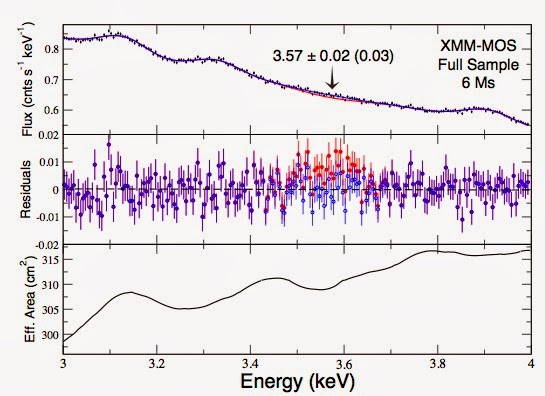
The key graph from that paper is this:

XMMspectrum

The claimed feature – it stretches the imagination considerably to call it a “line” – is shown in red. No, I’m not particularly impressed either, but this is what passes for high-quality data in X-ray astronomy!

There’s a nice review of this from about a year ago here which says this feature

 is very significant, at 4-5 astrophysical sigma.

I’m not sure how to convert astrophysical sigma into actual sigma, but then I don’t really like sigma anyway. A proper Bayesian model comparison is really needed here. If it is a real feature then a plausible explanation is that it is produced by the decay of some sort of dark matter particle in a manner that involves the radiation of an energetic photon. An example is the decay of a massive sterile neutrino – a hypothetical particle that does not participate in weak interactions –  into a lighter standard model neutrino and a photon, as discussed here. In this scenario the parent particle would have a mass of about 7keV so that the resulting photon has an energy of half that. Such a particle would constitute warm dark matter.

On the other hand, that all depends on you being convinced that there is anything there at all other than a combination of noise and systematics. I urge you to read the paper and decide. Then perhaps you can try to persuade me, because I’m not at all sure. The X-ray spectrum of hot gas does have a number of known emission features in it that needed to be subtracted before any anomalous emission can be isolated. I will remark however that there is a known recombination line of Argon that lies at 3.6 keV, and you have to be convinced that this has been subtracted correctly if the red bump is to be interpreted as something extra. Also note that all the spectra that show this feature are obtained using the same instrument – on the XMM/Newton spacecraft which makes it harder to eliminate the possibility that it is an instrumental artefact.

I’d be interested in comments from X-ray folk about how confident we should be that the 3.5 keV “anomaly” is real…