Author Archive

Astronomy Look-alikes, No. 88

Posted in Astronomy Lookalikes with tags , on November 12, 2013 by telescoper

At a meeting of the Royal Astronomical Society on Friday I was struck by the resemblance between Scottish comic actor John Sessions and space scientist Professor Mark Burchell of the University of Kent. I wonder if by any chance they might be related?


Lookalike

Strange Meeting – A Poem for Armistice Day

Posted in History, Poetry on November 11, 2013 by telescoper

I’ve been travelling all morning, but managed to observe the Armistice Day minute’s silence, standing outside the station in the pouring rain, while I was waiting for a connecting train.

Anyway, this poem, Strange Meeting was written by Wilfred Owen, who died just a few days before the Armistice came into effect in 1918. It’s a poem that needs to be read repeatedly to be fully appreciated, but there is one line that is utterly devastating straight away: “I am the enemy you killed, my friend”..

 It seemed that out of the battle I escaped
Down some profound dull tunnel, long since scooped
Through granites which Titanic wars had groined.
Yet also there encumbered sleepers groaned,
Too fast in thought or death to be bestirred.
Then, as I probed them, one sprang up, and stared
With piteous recognition in fixed eyes,
Lifting distressful hands as if to bless.
And by his smile, I knew that sullen hall;
By his dead smile, I knew we stood in Hell.
With a thousand fears that vision’s face was grained;
Yet no blood reached there from the upper ground,
And no guns thumped, or down the flues made moan.
“Strange, friend,” I said, “Here is no cause to mourn.”
“None,” said the other, “Save the undone years,
The hopelessness. Whatever hope is yours,
Was my life also; I went hunting wild
After the wildest beauty in the world,
Which lies not calm in eyes, or braided hair,
But mocks the steady running of the hour,
And if it grieves, grieves richlier than here.
For by my glee might many men have laughed,
And of my weeping something has been left,
Which must die now. I mean the truth untold,
The pity of war, the pity war distilled.
Now men will go content with what we spoiled.
Or, discontent, boil bloody, and be spilled.
They will be swift with swiftness of the tigress,
None will break ranks, though nations trek from progress.
Courage was mine, and I had mystery;
Wisdom was mine, and I had mastery;
To miss the march of this retreating world
Into vain citadels that are not walled.
Then, when much blood had clogged their chariot-wheels
I would go up and wash them from sweet wells,
Even with truths that lie too deep for taint.
I would have poured my spirit without stint
But not through wounds; not on the cess of war.
Foreheads of men have bled where no wounds were.
I am the enemy you killed, my friend.
I knew you in this dark; for so you frowned
Yesterday through me as you jabbed and killed.
I parried; but my hands were loath and cold.
Let us sleep now . . .”

Lest we forget.

The Number 1 Scientist from the North

Posted in History, The Universe and Stuff on November 10, 2013 by telescoper

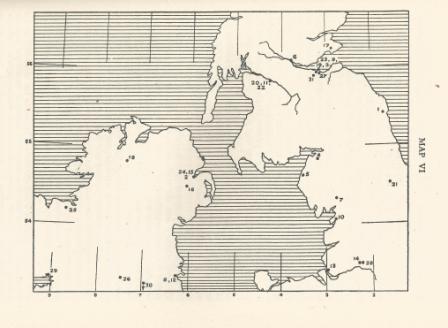
This morning I was glancing through an old book called Science since 1500, which was written by H.T. Pledge and published in 1939 by Her Majesty’s Stationery Office on behalf of the Ministry of Education.

The map shows the distribution of birthplaces of famous British scientists (from about 1800 to about 1900). This map is restricted to the “exact” sciences, and I’m not exactly sure what that means, but judging by the names, it includes physics, astronomy and chemistry. Clustering is apparent, especially in Edinburgh and Glasgow but also in Ireland.

Note, however, the relative dearth of such scientists from the North of England. In fact there is only one (appropriately enough labelled ‘1’), though there are several born in the Midlands, especially near Manchester..

I have scanned the legend which reveals the names, and will post it in due course, but I thought it would be fun to have a small competition to see who knows the identity of the Number 1 Scientist from the North.

If you’d like to guess any of the others please feel free too. Just to give an example, No. 7 is Arthur Stanley Eddington (who was born in 1882 in Kendal, in what is now Cumbria).

Answers through the comments box please!

Alms for Oblivion

Posted in Literature with tags , on November 9, 2013 by telescoper

When I posted the great St Crispian’s Day from Henry V a while ago, a colleague of mine mentioned another great speech from Shakespeare that I might like to share. This is froma much less familiar play, Troilus and Cressida, which interweaves a love story between the title characters, with an account of the siege of Troy. This speech, from Act III, finds Ulysses trying to persuade the legendary warrior Achilles, who is sulking in his tent, to enter the fray and help his struggling army.

What Ulysses says, in a nutshell, is that all of Achilles’ past deeds, great though they were, will soon be forgotten and count for nothing. All that matters is what he does now, so he should stop resting on his laurels, get off his backside and come to the aid of his comrades.

It’s an important message for those in any field, including academia, who try to trade on past glories without making a contribution at the present moment. Honour goes to those who persevere. In other words, do it now or push off…

Time hath, my lord, a wallet at his back,
Wherein he puts alms for oblivion,
A great-sized monster of ingratitudes:
Those scraps are good deeds past; which are devour’d
As fast as they are made, forgot as soon
As done: perseverance, dear my lord,
Keeps honour bright: to have done is to hang
Quite out of fashion, like a rusty mail
In monumental mockery. Take the instant way;
For honour travels in a strait so narrow,
Where one but goes abreast: keep then the path;
For emulation hath a thousand sons
That one by one pursue: if you give way,
Or hedge aside from the direct forthright,
Like to an enter’d tide, they all rush by
And leave you hindmost;
Or like a gallant horse fall’n in first rank,
Lie there for pavement to the abject rear,
O’er-run and trampled on: then what they do in present,
Though less than yours in past, must o’ertop yours;
For time is like a fashionable host
That slightly shakes his parting guest by the hand,
And with his arms outstretch’d, as he would fly,
Grasps in the comer: welcome ever smiles,
And farewell goes out sighing. O, let not
virtue seek
Remuneration for the thing it was;
For beauty, wit,
High birth, vigour of bone, desert in service,
Love, friendship, charity, are subjects all
To envious and calumniating time.
One touch of nature makes the whole world kin,
That all with one consent praise new-born gawds,
Though they are made and moulded of things past,
And give to dust that is a little gilt
More laud than gilt o’er-dusted.
The present eye praises the present object.
Then marvel not, thou great and complete man,
That all the Greeks begin to worship Ajax;
Since things in motion sooner catch the eye
Than what not stirs. The cry went once on thee,
And still it might, and yet it may again,
If thou wouldst not entomb thyself alive
And case thy reputation in thy tent;
Whose glorious deeds, but in these fields of late,
Made emulous missions ‘mongst the gods themselves
And drave great Mars to faction.

Sweet Lorraine

Posted in Jazz, LGBTQ+ with tags , , , on November 8, 2013 by telescoper

I bought the album You’re Looking at Me (A Collection of Nat King Cole Songs by Carmen McCrae on vinyl when it came out way back in 1983, and I thought I’d share one of my favourite tracks from it on here. One of the reviews of the album that came out at the time asked why she sang Sweet Lorraine without changing any of the lyrics, presumably because it’s a love song directed at a woman and the critic thought that it didn’t work when sung by another woman. Thirty years on it’s quite possible that there’s a lady somewhere (perhaps even a lady called Carmen) looking forward to marrying her Sweet Lorraine next April when such a marriage will be legal in the United Kingdom!

The Shadow of Newton

Posted in History, The Universe and Stuff with tags , , , , , , , on November 7, 2013 by telescoper

Yesterday I overheard some Electrodynamics students talking about the fact that all the famous names attached to pioneering laws or theorems in that subject seem to be either French (Biot-Savart, Laplace, Poisson..) or German (Gauss, Helmholtz…). Why are there no British names in this list?

Well, there was Faraday, of course. But Michael Faraday was primarily an experimentalist rather than a theorist, which sets him apart from the others already mentioned. So why is it that British theoretical was behind continental Europe in the early part of the 19th Century when all this important work on electricity and magnetism was being done.

There was also Maxwell, but he came along a bit later; he published his theory of electromagnetism in 1861/2. So why were the British so slow to enter this field?

Well, my theory of this is that it’s all the fault of Isaac Newton. I came to this conclusion when reading about the work of British mathematician and physicist George Green, who lived from 1793 until 1841, and who left a substantial legacy for modern theoretical physicists, in Green’s theorems and Green’s functions. George Green is also credited as being the first person to use the word “potential” in electrostatics. Green was the son of a Nottingham miller who, amazingly, taught himself mathematics and did most of his best work, especially his remarkable Essay on the Application of mathematical Analysis to the theories of Electricity and Magnetism (1828) before starting his studies as an undergraduate at the University of Cambridge (which he did at the age of 30, after his father died, and he leased out the mill he consequently inherited, to pay for his studies).

Extremely unusually for British mathematicians of his time, Green taught himself from books that were published in France. This gave him a huge advantage over his national contemporaries in that he learned the form of differential calculus that originated with Leibniz, which was far more elegant than that devised by Isaac Newton (which was called the method of fluxions).

Great scientist though he was, Newton’s influence on the development of physics in Britain was not entirely positive. Newton was held in such awe, especially in Cambridge, that his inferior mathematical approach was deemed to be the “right” way to do calculus and generations of scholars were forced to use it. This held back British science until the use of fluxions was phased out. Green himself was forced to learn fluxions when he went as an undergraduate to Cambridge despite having already learned the better method.

Unfortunately, Green’s great pre-Cambridge work on mathematical physics didn’t reach wide circulation in the United Kingdom until after his death. William Thomson, later Lord Kelvin, found a copy of Green’s Essay in 1845 and promoted it widely as a work of fundamental importance. This contributed to the eventual emergence of British theoretical physics from the shadow cast by Isaac Newton which reached one of its heights just a few years later with the publication a fully unified theory of electricity and magnetism by James Clerk Maxwell.

Astronomy Look-alikes, No. 87

Posted in Astronomy Lookalikes with tags , on November 6, 2013 by telescoper

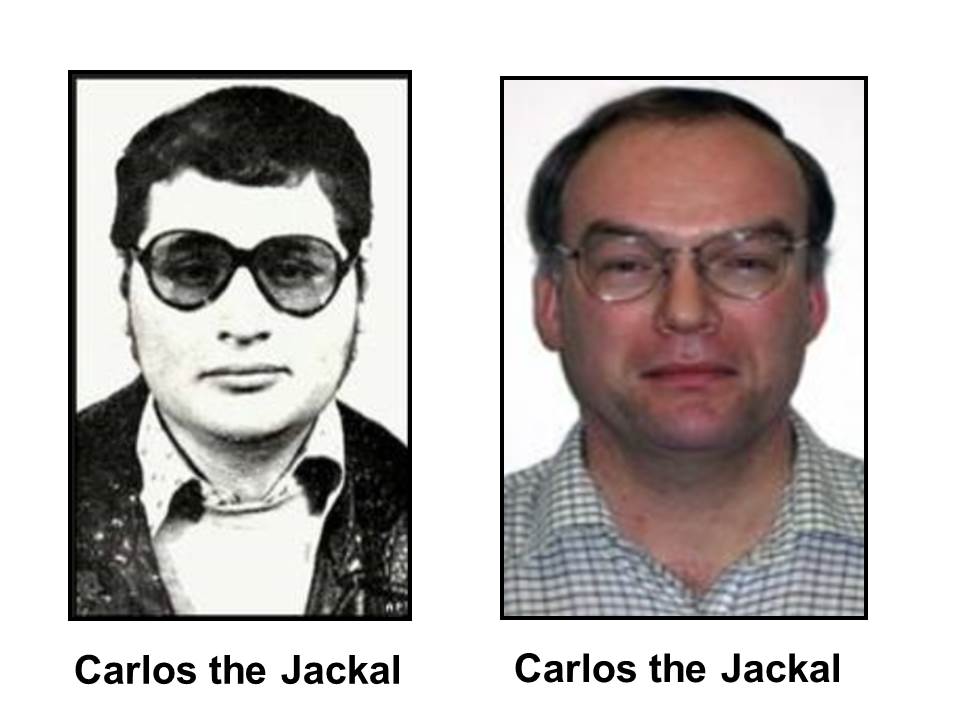
It is widely believed that Carlos the Jackal is now in prison in France, but this is in fact untrue.  He has assumed a new identity and goes by the name of Prof. Jonathan Rawlings of the Department of Physics and Astronomy at University College London. You have been warned.

CTJ_JR

P.S. Please blame Matt Griffin for this one!

Why is Astronomy Important?

Posted in The Universe and Stuff with tags , , , , on November 5, 2013 by telescoper

There’s an interesting and unusual article on the arXiv today entitled Why is Astronomy Important? Here is the abstract:

For a long time astronomers and other scientists believed that the importance of their work was evident to society. But in these difficult days of financial austerity, even the most obvious benefits of science have to undergo careful scrutiny. Eradicating poverty and hunger is a worldwide priority, and activities that do not directly attempt to resolve these issues can be hard to justify and support. However, several studies have told us that investing in science education, research and technology provides a great return not only economically, but culturally and indirectly for the population in general and has helped countries to face and overcome crises. The scientific and technological development of a country or region is closely linked to its human development index a statistic that is a measure of life expectancy, education and income.

The full text of the paper can be found on the IAU website here.

The article focusses on matters relating to the transfer of technology between astronomy and, e.g. industry, aerospace, and medicine, its effect on technology we are familiar with in everyday life, on astronomy as an exemplar of international collaboration and on its wider cultural and philosophical impact. Many of the points made in this article can also be found in the Royal Astronomical Society‘s free publication Beyond the Stars: Why Astronomy Matters which is available for free online here.

I recommend you read the full article and make your own mind up about why astronomy is important. I have just two comments, which are partly questions. The first is that I’ve always had a bit of a problem with the interpretation of correlations like that mentioned in the last sentence of the abstract (between technological development and the human development index). The issue is the basic one that correlation of two phenomena does not necessarily imply that one causes the other. Is it really possible to establish rigorously a causal link between spending money on astronomy and wider societal benefits? I’m not saying that there isn’t such a link, just that it’s difficult to interpret evidence which is dependent on so many factors. Could one not argue instead that more developed countries spend more money on astronomy because they can afford to?

The other thing that troubles me with arguments of the type presented in the paper is that there is a danger that  emphasizing the transfer of knowledge to other disciplines as the rationale for funding astronomy implicitly negates the argument that astronomy has intrinsic worth of its own. In other words, answering the question “Why is Astronomy important?” seems to accept at the outset that it isn’t.  If it is indeed the case that we can only justify astronomy because it has produced spin-offs in, e.g., medicine, why not just spend more money on medicine and forget the astronomy?

I’m not saying that the technology transfer arguments carry no weight, just that they are definitely double-edged and should be used with caution. For the record, I think we should fund Astronomy (and other sciences) primarily because they are an essential part of the fabric of our culture and civilization; all the rest is icing on the cake. In other words, I support state funding for the sciences for very much the same reasons as for the arts.  I’m fully aware, however, that this unlikely to persuade the powers that be as effectively as an appeal to economic benefits; that’s why science funding has fared so much better than arts funding in this age of austerity.

I Am – by John Clare

Posted in Biographical, Poetry on November 4, 2013 by telescoper

Yesterday’s edition of Words and Music, entitled Village Minstrel, was inspired by the poems of John Clare, so I couldn’t resist a quick post to encourage people who missed the programme to listen to it online. It’s not just about Clare’s poetry, and the choice of music inspired by it, but also gives a vivid insight into the harshness of country life in the early 19th Century and the brutality of a legal system that could sentence a man to death for the theft of half a crown.

John Clare’s biography is very unusual for a 19th Century poet, in that he was not from a wealthy background, was largely self-educated, and had no private income. In later life he suffered from a depressive illness, endured a number of nervous breakdowns and was, at various times, confined to an asylum. Not highly regarded in his lifetime, his reputation was revived in the 20th Century and he is now considered to be one of the finest poets of his generation.

This, probably his most famous poem, was written by Clare in 1844 or 1845, while he was confined in the Northampton General Lunatic Asylum. In a style highly reminiscent of Byron, it speaks most movingly of the sense of alienation his illness has brought upon him and how he yearns for peace and solitude. I think I know what he means.

I am: yet what I am none cares or knows,
My friends forsake me like a memory lost;
I am the self-consumer of my woes,
They rise and vanish in oblivious host,
Like shades in love and death’s oblivion lost;
And yet I am! and live with shadows tost

Into the nothingness of scorn and noise,
Into the living sea of waking dreams,
Where there is neither sense of life nor joys,
But the vast shipwreck of my life’s esteems;
And e’en the dearest–that I loved the best–
Are strange–nay, rather stranger than the rest.

I long for scenes where man has never trod;
A place where woman never smil’d or wept;
There to abide with my creator, God,
And sleep as I in childhood sweetly slept:
Untroubling and untroubled where I lie;
The grass below–above the vaulted sky.

Goodbye to Azed

Posted in Crosswords with tags , , , , on November 3, 2013 by telescoper

Having a bit of a tidy up on the blog earlier today, I noticed today that it’s been quite a while since I’ve posted anything in the category marked “crosswords”.

The reason for this is that the responsibilities I acquired with my current position have made it quite difficult to find the time to indulge my passion for cruciverbalism if I’m also going to keep this blog going. In fact, I’ve recently made a decision to ditch a puzzle that has been a favourite for some time, Azed in the Observer.

Some time ago I stopped getting the Guardian on Saturday and switched to the Independent. That has been quite rewarding because I’ve taken to the Indy crossword and have won the prize a number of times. I’ve lost count how many, actually, but it’s probably about twenty. The prize on each occasion was a dictionary, the same dictionary, and I’ve given most of them away.

I persevered with the Observer, chiefly because of Azed, but I’m afraid the quality of the paper has deteriorated as quickly as its price has increased. I therefore decided, with some regret, to switch to the Independent on Sunday. I find this is a much more compact and better written newspaper with, as a friend of mine accurately summed it up, “much less shite in it” than the Observer.

The Independent on Sunday has a normal prize cryptic (similar to the Saturday one) in the paper and another one, Beelzebub, in the magazine, which is similar in style of both grid and clues to Azed, nicely done but perhaps a little less challenging. There isn’t a monthly clue-writing competition either; since I always struggled to find the time and inspiration to offer decent clues I think it’s just as well that I admit defeat and withdraw from that competition. Perhaps I’ll return to it when I’ve got more spare time, which is only likely to happen when I’m retired..

P.S. Incidentally you can find the circulation figures of UK newspapers here. The Observer and the Independent on Sunday have both fallen precipitously since ~ 2007.