Author Archive

Beard Developments

Posted in Beards with tags , , on November 3, 2013 by telescoper

One of the interesting new initiatives here at Sussex University is Sussex Research a new programme for promoting and facilitating interdisciplinary research. The announcement of this new scheme made me think of possibilities of implementing such approaches more widely.

One of the problems facing Sussex University these days is clearly the shortage of beards among academic staff. Since its hirsute heydays in the sixties and seventies the proportion of clean shaven lecturers has increased alarmingly, with corresponding consequences for our position in the international league tables. Only one Head of School has a beard, and not a single member of the Senior Management has any significant facial hair. This is a scandal of major proportions, tantamount to institutional pogonophobia.

Recognizing that in order to return to its former glory the University needs to turn this situation around rapidly, it has decided to introduce a new Beard Development Fund from which funds may be sought to promote the growth of facial hair across all sectors of the University. Such funds might support workshops at which staff can share good practice and form networks with other beard wearers, or to provide training for inexperienced staff and students who are have yet to acquire their first beard, Discussions are also under way with the Beard Liberation Front to provide beard awareness training.

In addition to  the Beard Development Fund there are a range of other initiatives to provide incentives for staff to develop their own portfolio of facial hair. Having previously focussed almost exclusively on teaching and research, promotion panels will now explicitly take hirsuteness into consideration. Moreover, in consideration of borderline candidates, examination boards will be allowed to consider the quality of a student’s beard in deciding the final degree classification.

Female staff and students will be exempt from the new procedures. For the time being.

One a personal level, acknowledging the fundamental importance of beards in the history of Physics, I have produced a detailed three-point guide on Beard Growth for members of my own School, and we shall shortly be running the first ever competition to find MPS Beard of the Year, in which all staff and students in the School will be invited to vote for the winner, i.e. me.

cropped_beardIncidentally, I discovered the other day that Royal Navy Regulations still permit the wearing of beards, as long as they are a “full set” (i.e. beard and moustache joined, not separate). That perhaps explains why someone I met recently described mine (left) as being a “Navy Beard”, and why some have suggested that I resemble Captain Haddock. I’ll do a look-alike as soon as I can procure a sailor’s hat and a pipe…

November, a poem by William Morris

Posted in Poetry with tags , on November 2, 2013 by telescoper

Are thine eyes weary? is thy heart too sick
To struggle any more with doubt and thought,
Whose formless veil draws darkening now and thick
Across thee, e’en as smoke-tinged mist-wreaths brought
Down a fair dale to make it blind and nought?
Art thou so weary that no world there seems
Beyond these four walls, hung with pain and dreams?

Look out upon the real world, where the moon,
Half-way ‘twixt root and crown of these high trees,
Turns the dread midnight into dreamy noon,
Silent and full of wonders, for the breeze
Died at the sunset, and no images,
No hopes of day, are left in sky or earth –
Is it not fair, and of most wondrous worth?

Yea, I have looked and seen November there;
The changeless seal of change it seemed to be,
Fair death of things that, living once, were fair;
Bright sign of loneliness too great for me,
Strange image of the dread eternity,
In whose void patience how can these have part,
These outstretched feverish hands, this restless heart?

by William Morris (1834-1896).

The astronomer who came in from the cold

Posted in History, Politics, The Universe and Stuff with tags , , , , on November 1, 2013 by telescoper

Here’s a fascinating little bit of history for you. The other day I discovered the old Visitor’s Book in which staff of the Astronomy Centre at the University of Sussex used to record the names of distinguished guests who appeared here to give seminars. There are many illustrious names in the book, including for example at the bottom of this page (from 1968), Ed Salpeter.
Cold War

However, the name to which I’d like to draw your attention is in the middle of this page. On 17th August 1968 the Astronomy Centre played host to two Russian visitors, an astrophysicist called Dr G.S. Khromov from the Sternberg Astronomical Institute in Moscow and a chap from the state-run Novosti Press Agency by the name of Gennadi I. Gerasimov.

I know little of Khromov’s work in astrophysics, but it is significant that he was permitted to visit the United Kingdom during the Cold War period, long before Glasnost and the eventual break-up of the Soviet Union. The second name is much more famous. Gennadi Ivanovich Gerasimov rose through the ranks of the Soviet System and eventually during the 1980s became Foreign Affairs spokesman for Mikhail Gorbachev and press spokesman for Eduard Shevardnadze.

So what was he doing in Sussex in 1968 attending an astronomy seminar? Well, the answer to that is that during the 1960s Russian scientists were generally only allowed to visit the West if they were accompanied by a “minder”, usually some form of KGB operative whose job was to ensure the scientist did not defect; the use of a press agency as cover story was pretty standard in such cases.  I’ve heard similar stories from Russian colleagues who travelled to the west under similar constraints during this period, and even some in which the scientist was the cover story for the agent!

So Gennadi Gerasimov was almost certainly at one time a KGB agent. Given the career of the current President of Russia, this should come as no surprise…

Moonrise, Hernandez

Posted in Art, The Universe and Stuff with tags , , , , on November 1, 2013 by telescoper

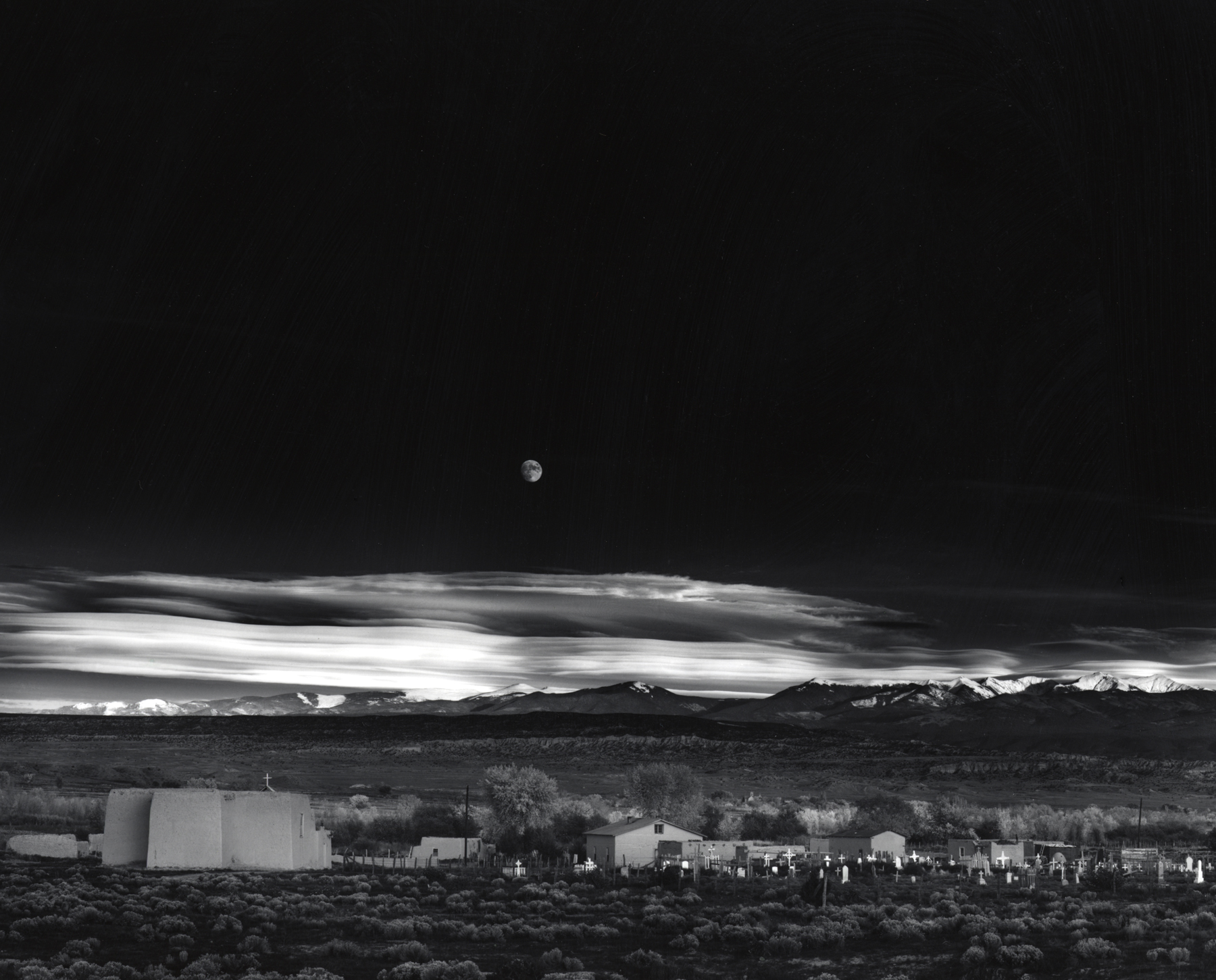
During the late afternoon twilight of November 1st 1941, 72 years ago today, renowned American photographer and environmentalist Ansel Adams took this wonderful photograph of the moon over Hernandez, New Mexico. It’s such a celebrated image that it even has its own wikipedia page, but because it seems to fit the theme of this blog I couldn’t resist sharing it here:

ansel-adams-moonrise-hernandez-new-mexico1941

Click on the image for higher resolution

Questions and Answers About Dark Matter post-LUX

Posted in Uncategorized on November 1, 2013 by telescoper

Following on from yesterday’s post about the LUX Dark Matter experiment, here is a reblog of excellent overview of the current state of the field…

Matt Strassler's avatarOf Particular Significance

Since the mainstream news media, in their reporting on the new result from the LUX experiment I wrote about Wednesday, insists on confusing the public with their articles and headlines, I thought I’d better write a short post reminding my readers what we do and don’t know about dark matter.

  • Do we know dark matter exists?

Scientists are, collectively, pretty darn sure, though not 100% certain. Certainly something is out there that acts a lot like a dark form of matter (i.e. something that gravitates and clumps, but doesn’t shine, either in visible light or in any other form of electromagnetic waves). There have been some proposals that try to get around dark matter, by modifying gravity, but these haven’t worked that well. Meanwhile the evidence that there really is dark stuff out there that really behaves like matter continues to grow year by year, and every claim that…

View original post 887 more words

Lux et Veritas

Posted in The Universe and Stuff with tags , , , , on October 31, 2013 by telescoper

There’s an important and interesting paper just out on the arxiv by the Lux Dark Matter Collaboration. Here is the abstract:

The Large Underground Xenon (LUX) experiment, a dual-phase xenon time-projection chamber operating at the Sanford Underground Research Facility (Lead, South Dakota), was cooled and filled in February 2013. We report results of the first WIMP search dataset, taken during the period April to August 2013, presenting the analysis of 85.3 live-days of data with a fiducial volume of 118 kg. A profile-likelihood analysis technique shows our data to be consistent with the background-only hypothesis, allowing 90% confidence limits to be set on spin-independent WIMP-nucleon elastic scattering with a minimum upper limit on the cross section of 7.6×10−46 cm2 at a WIMP mass of 33 GeV/c2. We find that the LUX data are in strong disagreement with low-mass WIMP signal interpretations of the results from several recent direct detection experiments.

For those of you not up with the lingo, a WIMP in this context is a Weakly Interacting Massive Particle, one of the preferred candidates for the dark matter that most cosmologists think pervades the Universe.

The most important thing about the LUX results is that they pretty much exclude results from previous experiments, especially DAMA/LIBRA, that have claimed evidence for dark matter particles at low mass (i.e. 6-10 GeV WIMPS): LUX had expected 1550 dark matter events if the other detections were valid, but could not claim any events that were not consistent with background. They also set new limits on higher mass dark matter, which is 20 times better than previous limits. These new limits are from 85 days of running the experiment; further results will be reported after an additional 300 days in 2014/2015, when the results will increase the sensitivity by a factor of five or so.

So the question is, if LUX is correct, what on Earth is going on at DAMA? Answers on a postcard, or through the comments box, please!

Hymn for the Day

Posted in Politics with tags , , , , , on October 31, 2013 by telescoper

This morning’s hymn is Sine Nomine, No. 641 from the English Hymnal, and is chosen in honour of those participating in today’s strike of some University staff.

The Grand MPS School Away(half)day

Posted in Education with tags , , , on October 30, 2013 by telescoper

Very late posting a blog today because I’ve been busy all day, preparing for and then hosting an “Awayday” in the School of Mathematical and Physical Sciences (MPS) at the University of Sussex. Actually, it was only half a day, and it didn’t really going that far away either, but I hope we won’t be prosecuted under the Trades Description Act..

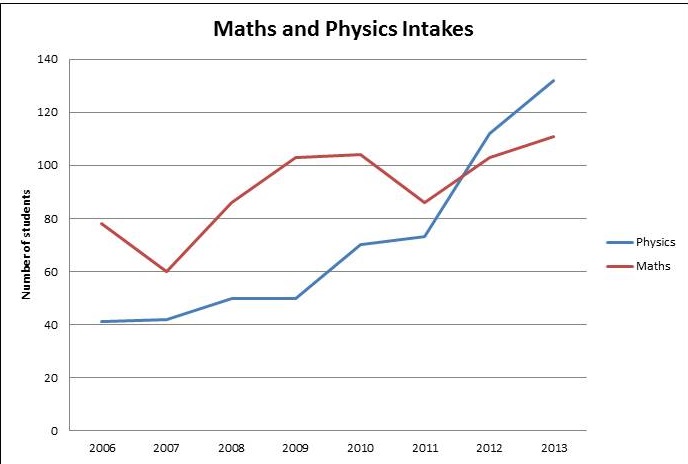
This event is something I started thinking about just as soon as I arrived in Sussex in February this year, and we’ve been preparing for it actively for quite a long time. The background to it is that the School has expanded dramatically over the last few years, especially in the Department of Physics & Astronomy. The Department of Mathematics has grown too, but at a more modest rate. Here, for example, is the annual intake of undergraduate students for our two departments over the last few years:

slide

To cope with this growth in student numbers our complement of academic staff has increased by about 50%, from around 40 just a year ago to a present number of 60. We have also increased our research income considerably over the same period. I hasten to add that none of this is my doing – it’s all down to the hard work of staff who were doing their stuff brilliantly long before I arrived.

Of course it’s great to be Head of a School that is doing so well, but I am very conscious that we need to ensure we continue to provide a good experience for students during this period of growth and also to make sure that has we get bigger, all staff and students feel that they still have a voice in how the School is run. To that end we set up an event in which most members of the staff were invited – academics, administrative and technical support included – as well as our student reps. Kelly McBride, President of the Students Union, also came along. In all, over eighty people attended; there would have been more had we not scheduled it during the local schools’ half-term, which was the only available slot.

The event, held in the spacious Conference Centre in Bramber House, was mainly focussed on teaching and a large part of it involved staff forming groups to discuss various themes: lectures, small group teaching, assessment, feedback, and so on. Before that there were presentations from myself (giving some background, including information about the School’s budget and how our finances work as well as how we measure up in the dreaded League Tables), from our School Administrator talking about issues relating to our admirable office staff, and our Technical Services Supervisor giving a perspective on the challenges facing our technical support staff. Each group comprised a cross-section of the School and each was given a theme to discuss. We then reconvened en masse to share the results of each discussion.

I was a bit nervous beforehand as to how it would all work, especially as there has never been an event of this sort in MPS. I was more nervous before this event than I have been about anything for ages, actually. I wondered how engaged staff would feel and whether the event would turn out to be as inclusive as I’d intended, i.e. whether everyone would feel able to contribute on equal terms. In the end I think it worked out pretty well. In fact we ran over by about an hour, primarily because the discussion was so extensive.

It’s not for me to say whether the day was a success or not, but although there were some things that didn’t work so well overall I was quite satisfied. In particular I was impressed with the number of good practical suggestions that came forward in the final session. We’re going to be working hard to synthesize these comments into a form we can work into our plans for the future.

Most of the comments I heard from people who participated in this event after it finished were positive too. If anyone present happens to read this blog I’d be interested to hear their views through the comments.

Without anticpating the feedback too much, I’m pretty sure that, with a few tweaks (mainly to focus things a bit better with fewer “themes” for discussion), this will become a regular fixture in the MPS calendar. As we get used to such events we’ll probably get even more out of them. I also hope that other Schools of the University of Sussex might find this event a useful model for similar activities they could hold themselves.

I’d like to end with a public “thank you” to everyone who took part and made it so enjoyable and stimulating, to Oonagh and Steve for their input, to Catering and Conference Services for all their help (and yummy food) and above all to the inestimable Miss Lemon for the huge amount of work she put in to the preparations (especially the monopoly theme for the groups, which was inspired..).

Now, however, I am completely knackered and will be going home to have a glass bottle of wine to recover. Busy day tomorrow too. Toodle-pip!

Astronomy Look-alikes, No. 86

Posted in Astronomy Lookalikes with tags , on October 29, 2013 by telescoper

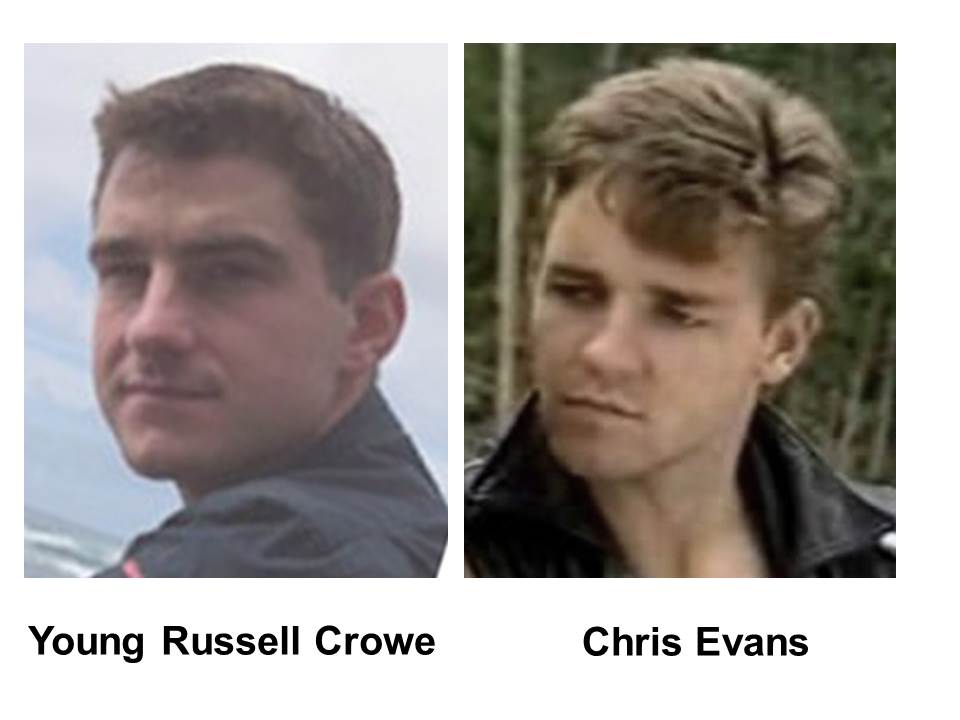
When UKATC astronomer Dr. Russell Crowe was younger, he bore a striking resemblance to hell-raising rough diamond Australian actor Chris Evans. Perhaps they share a common ancestry?

Evans-Crowe

Astronomy Look-alikes, No. 85

Posted in Astronomy Lookalikes with tags , on October 29, 2013 by telescoper

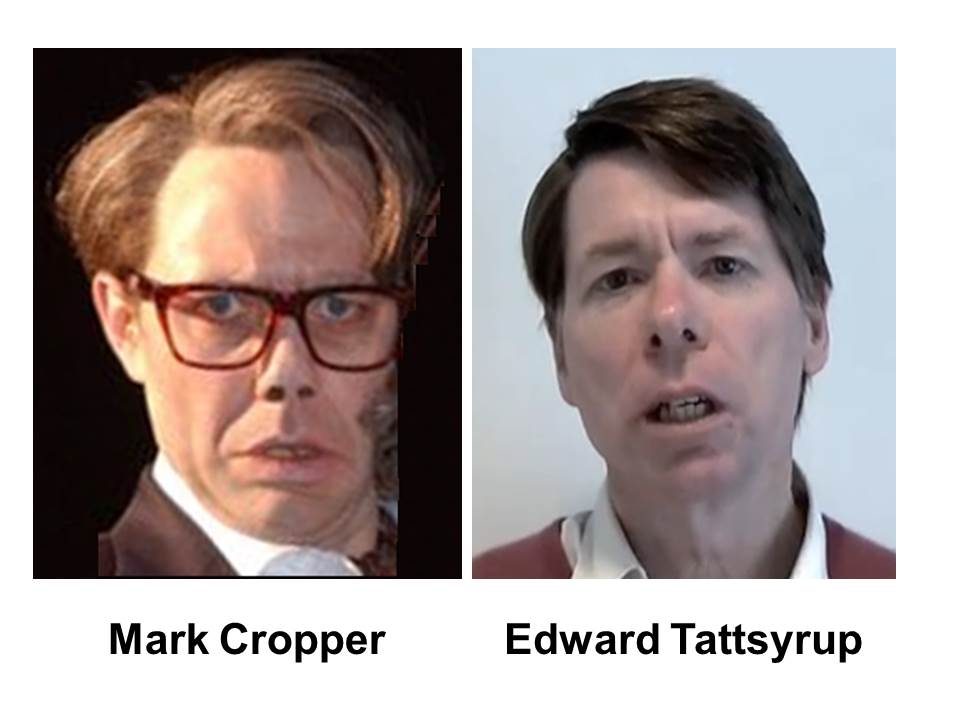
I wonder if anyone else has noticed that if Mark Cropper, sinister proprietor of the local shop in Royston Vasey, were to take off his glasses, he would look strangely like astronomer Prof. Edward Tattsyrup of  the Mullard Space Science Laboratory. This is most unsettling. I wonder if, by any chance, they might be related?

Disturbing_Lookalike