Author Archive

Farewell, then, Leighton Andrews…

Posted in Education, Finance, Politics with tags , , , , , , , on June 27, 2013 by telescoper

Although I no longer live in Wales I couldn’t resist commenting on the resignation, announced on Tuesday, of the Welsh Education Minister, Leighton Andrews. It seems that Mr Andrews was spotted holding a placard protesting against the planned closure of a school, a closure that results from his own policies. Personally, I think that it’s quite an imaginative move for a Minister to campaign against his own policies. It shows an open-mindedness absent in most politicians.

Leighton Andrews will probably be best remembered as the architect of the policy that students domiciled in Wales would be protected from having to pay large tuition fee rise by a system of grants, meaning that the Welsh Assembly will pick up the tab for Welsh students. They will still have to pay the “old”  fee level of £3290 per annum, but the WAG will pay the extra approx £6K charged by most Universities since the fee cap was raised. This is good news for the students of course, but the grants will be available to Welsh students not just for study in Welsh universities but wherever they choose to go. Since about 16,000 Welsh students are currently at university in England, this means that the WAG is handing over a great big chunk (up to 16,000 × £6000 = £96 million) of its hard-earned budget straight back to England. This has always seemed to me a very strange thing to do when the Welsh Government is constantly complaining that the Barnett formula doesn’t give them enough money in the first place.

What’s more, the Welsh Assembly grants for Welsh students are paid for by top-slicing the grants that HECFW makes to Welsh universities. So funding cuts for universities in Wales have been  imposed in order to subsidize English universities. This is hardly in the spirit of devolution either!

English students wanting to study in Wales will have to pay full whack, but will be paying to attend universities whose overall level of state funding is even lower than in England (at least for STEM subjects whose subsidy is protected in England). Currently about 25,000 English students study in Wales, compared with the 16,000 Welsh students who study in England, but I wonder how many of them realize that if they study England their £9K fee attracts an additional investment of £1.5K from HEFCE whereas there is no equivalent central resource supplied by HEFCW if they study in Wales? To put it another way, each £1 of tuition fee paid by a STEM student is worth £1.16 in England, but just £1 in Wales.

The other drastic implication of this policy is that HEFCW will have no money left to fund research via the QR mechanism that pertains in England (at least for the time being). I blogged about this a couple of days ago so won’t say any more today.

I don’t think any of my former colleagues in Cardiff are terribly upset to see Leighton Andrews go, but there is some nervousness about whether the replacement might be even worse. The new Education Minister is Huw Lewis. I wish him well in his new post, and hope he has the courage to question some of the decisions made by his predecessor that have had such a negative effect on education in Wales.

Anyway, in bidding farewell to Leighton Andrews I thought I’d show him all due respect, and do him the honour of presenting a look-alike. All reference to Muppets purely coincidental…
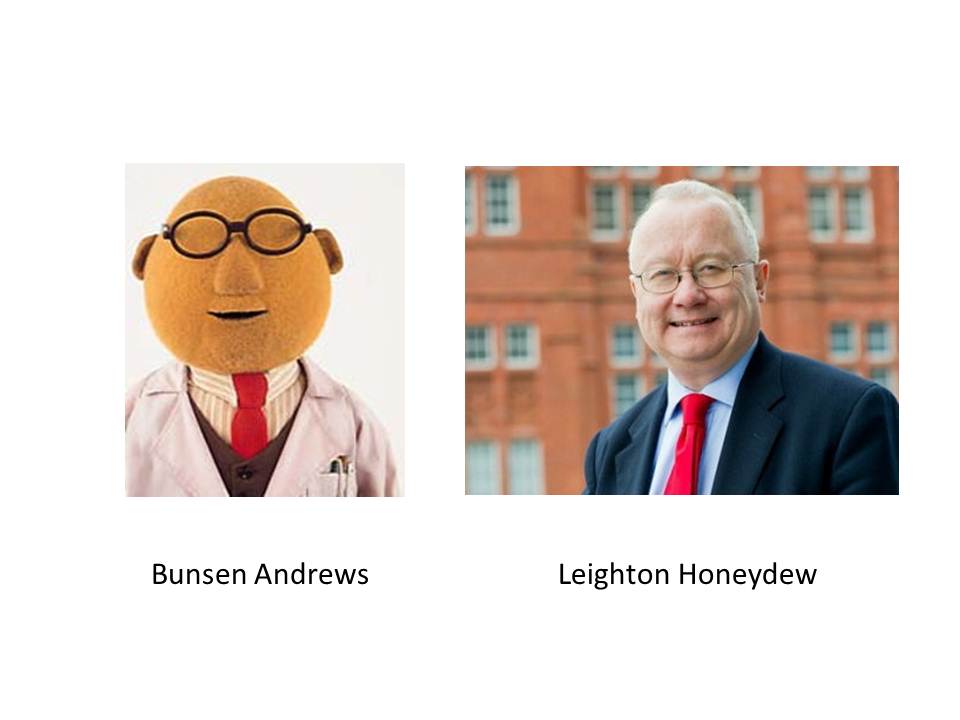
Slide1

Can We Actually Even Tell if Humans Are Affecting the Climate? What if we did nothing at all?

Posted in Bad Statistics with tags , , on June 26, 2013 by telescoper

Reblog of a post about the doctrine of falsifiablity and its relevance to Climate Change….following on from Monday’s post.

University Research Funding: Will the Axe Fall on QR?

Posted in Finance, Politics, Science Politics with tags , , , on June 25, 2013 by telescoper

As we tremble in anticipation of this week’s Spending Review, which will determine the budgets for Science and Higher Education in 2015/16, there’s fairly strong evidence that Chancellor of the Exchequer George Osborne is looking to save about £11.5 billion of public spending. Given that funding for some Whitehall departments is ring-fenced there is considerable speculation that the axe will fall heavily on the Department for Business, Innovation and Skills (BIS), which seems likely to have to make over £1 billion of savings.

But where will these savings in the BIS budget be made? The government has made noises that it will protect science funding (at least in cash terms) so big cuts in the larger research council budgets appear unlikely. However, Treasury officials have been rumoured as thinking that the Universities are now “awash with money” and should therefore be cut. On the other hand, incoming for University teaching now largely comes from fees so there’s very little of the HEFCE teaching budget to cut further.

Now here’s the rub. The part of HEFCE’s budget that deals with research amounts to about £1.6 billion per year. This, the so-called `QR’ funding, is currently being distributed to Higher Education Institutions according to the outcome of the 2008 Research Assessment Exercise (RAE). This year we
are preparing submissions to a new system called the Research Excellence Framework (REF), which was always intended to be used to distribute QR funding from 2015/16 onwards. But what if the government decides that the only way to balance the books is to remove the QR funding stream entirely?

The 2012 funding letter from HEFCE states explains that it is distributing

£1,558 million for research. The ring-fenced settlement for science and research means that we will be able to maintain overall funding, in cash terms, until 2014-15.

But this does not include the period covered by the spending review, so it’s perfectly possible that the “ring fence” could be removed, or at least re-interpreted as a result of this spending review.

The government could argue that QR and Research Council grant income correlate so well that there’s no need to continue with the current dual funding system, by which the Research Councils provide grants for specific projects and programmes and the higher education funding bodies provide block grant funding to universities via the QR line. It could also argue that the high fees being charged mean that Universities will be able to cope with these cuts without undue hardship. There is a precedent in Wales, where HEFCW will not be awarding any QR funding after the 2013 REF, so why shouldn’t England do the same? They could also get away with the argument that this money isn’t part of the ring fence mentioned above.

The only problem is that so many institutions have spent so much time on preparations for the REF that cancelling the funding associated with it will mean all that effort is wasted. Indeed, the only remaining justification (if it can be called that) for Universities participating in the REF is for position in various league tables, which is rather a lot of expense for something of extremely debatable value.

Anyway, if I were a gambling man (which I am, actually) I don’t think I’d be betting against this outcome. Predictions are very difficult, especially about the future, but this one is mine. And I hope it’s proved wrong…

Evidence, Absence, and the Type II Monster

Posted in Bad Statistics with tags , , , , , , on June 24, 2013 by telescoper

I was just having a quick lunchtime shufty at Dave Steele‘s blog. His latest post is inspired by the quotation “Absence of Evidence isn’t Evidence of Absence” which can apparently be traced back to Carl Sagan. I never knew that. Anyway I was muchly enjoying the piece when I suddenly stumbled into this paragraph, which quote without permission because I’m too shy to ask:

In a scientific experiment, the null hypothesis refers to a general or default position that there is no relationship between two measured phenomena. For example a well thought out point in an article by James Delingpole. Rejecting or disproving the null hypothesis is the primary task in any scientific research. If an experiment rejects the null hypothesis, it concludes that there are grounds greater than chance for believing that there is a relationship between the two (or more) phenomena being observed. Again the null hypothesis itself can never be proven. If participants treated with a medication are compared with untreated participants and there is found no statistically significant difference between the two groups, it does not prove that there really is no difference. Or if we say there is a monster in a Loch but cannot find it. The experiment could only be said to show that the results were not sufficient to reject the null hypothesis.

I’m going to pick up the trusty sword of Bayesian probability and have yet another go at the dragon of frequentism, but before doing so I’ll just correct the first sentence. The “null hypothesis” in a frequentist hypothesis test is not necessarily of the form described here: it could be of virtually any form, possibly quite different from the stated one of no correlation between two variables. All that matters is that (a) it has to be well-defined in terms of a model and (b) you have to be content to accept it as true unless and until you find evidence to the contrary. It’s true to say that there’s nowt as well-specified as nowt so nulls are often of the form “there is no correlation” or something like that, but the point is that they don’t have to be.

I note that the wikipedia page on “null hypothesis” uses the same wording as in the first sentence of the quoted paragraph, but this is not what you’ll find in most statistics textbooks. In their compendious three-volume work The Advanced Theory of Statistics Kendall & Stuart even go as far to say that the word “null” is misleading precisely because the hypothesis under test might be quite complicated, e.g. of composite nature.

Anyway, whatever the null hypothesis happens to be, the way a frequentist would proceed would be to calculate what the distribution of measurements would be if it were true. If the actual measurement is deemed to be unlikely (say that it is so high that only 1% of measurements would turn out that big under the null hypothesis) then you reject the null, in this case with a “level of significance” of 1%. If you don’t reject it then you tacitly accept it unless and until another experiment does persuade you to shift your allegiance.

But the significance level merely specifies the probability that you would reject the null-hypothesis if it were correct. This is what you would call a Type I error. It says nothing at all about the probability that the null hypothesis is actually correct. To make that sort of statement you would need to specify an alternative distribution, calculate the distribution based on it, and hence determine the statistical power of the test, i.e. the probability that you would actually reject the null hypothesis when it is correct. To fail to reject the null hypothesis when it’s actually incorrect is to make a Type II error.

If all this stuff about significance, power and Type I and Type II errors seems a bit bizarre, I think that’s because it is. So is the notion, which stems from this frequentist formulation, that all a scientist can ever hope to do is refute their null hypothesis. You’ll find this view echoed in the philosophical approach of Karl Popper and it has heavily influenced the way many scientists see the scientific method, unfortunately.

The asymmetrical way that the null and alternative hypotheses are treated in the frequentist framework is not helpful, in my opinion. Far better to adopt a Bayesian framework in which probability represents the extent to which measurements or other data support a given theory. New statistical evidence can make two hypothesis either more or less probable relative to each other. The focus is not just on rejecting a specific model, but on comparing two or more models in a mutually consistent way. The key notion is not falsifiablity, but testability. Data that fail to reject a hypothesis can properly be interpreted as supporting it, i.e. by making it more probable, but such reasoning can only be done consistently within the Bayesian framework.

What remains true, however, is that the null hypothesis (or indeed any other hypothesis) can never be proven with certainty; that is true whenever probabilistic reasoning is true. Sometimes, though, the weight of supporting evidence is so strong that inductive logic compels us to regard our theory or model or hypothesis as virtually certain. That applies whether the evidence is actual measurement or non-detections; to a Bayesian, absence of evidence can (and indeed often is) evidence of absence. The sun rises every morning and sets every evening; it is silly to argue that this provides us with no grounds for arguing that it will do so tomorrow. Likewise, the sonar surveys and other investigations in Loch Ness provide us with evidence that supports the hypothesis that there isn’t a Monster over virtually every possible hypothetical Monster that has been suggested.

It is perfectly sensible to use this reasoning to infer that there is no Loch Ness Monster. Probably.

And the nominations are…

Posted in Biographical, Sport with tags , on June 24, 2013 by telescoper

Last Thursday I had the pleasure of handing out an award. I even got to say “and the nominations are…” before reading out the name of the lucky winner. This was all part of a little event to celebrate “Commit to Get Fit“, a challenge run by Sussexsport which involved staff from all over the University embarking on a range of physical activities and which ran throughout May.

Anyway, staff taking part were encouraged to keep a blog about their experiences using the University’s SPLASH resource and it was my duty to present a prize on behalf of the jury. There turned out to be over 200 individual posts, which meant a lot of work reading them in the days leading up to the ceremony. As it happened, the prize for the best blog series was actually awarded to Gemma Farrell from the School of Mathematical and Physical Sciences (MPS), of which I happen to be Head. But it wasn’t a fix. Oh no…

Here’s me presenting the treasured brown envelope to Gemma.

2710.item

Anyway, the whole CTGF campaign seems to have gone off pretty well. Maybe I’ll even take part myself next year, as opposed to sitting on my backside reading blog posts…

Cover

Posted in Cricket, Poetry with tags , , on June 23, 2013 by telescoper

Think twice
and then don’t

Zero tolerance
that’s me

Step out of line
and I’ll have you

sprawled in the dust
as the warning shot

screams past your ear
into the gloves

A sniper’s brain
a hair-trigger arm

Take me on?

Make my day

by Simon Rae

The Glory of Love

Posted in Biographical, Jazz on June 22, 2013 by telescoper

I haven’t had any of my Dad’s favourite musician, Humphrey Lyttelton, on here for a while so here’s an old favourite. This is Humphrey Lyttelton and his Band vintage 1955, i.e. after the departure of brilliant trombonist Keith Christie, which consisted of Humphrey “Humph” Lyttelton himself (trumpet), John Picard (trombone), Wally “Trog” Fawkes (clarinet), Bruce Turner (alto sax), Johnny Parker (piano), Freddy Legon (guitar), Mickey Ashman (bass), and George “Hoppy” Hopkinson (drums).

Strike Suspended

Posted in Brighton, Politics with tags , , on June 21, 2013 by telescoper

I worked quite late last night. When I finally got the bus home I checked up on Twitter, and found that CityClean workers who had been on strike had decided to suspend their strike action and return to work. It seems that Brighton and Hove Council made an offer which the GMB Union reps decided was worth putting to their membership. The strike is therefore suspended while a ballot takes place. There’s no guarantee that the offer will be accepted, of course, and the refuse collectors and the rest will presumably go back in strike if it isn’t, but in the meantime the CityClean staff will at least be working properly. This morning I saw signs of the cleanup starting. They seem to be concentrating on the main roads, so the residential streets are still an absolute nightmare, but at least it’s a start. It will probably take weeks to return to normal and “normal” for Brighton is in any case fairly grubby…

Relieved at the news I stopped off for a pint at my local in Kemptown. Most properties in this area are divided into flats (like mine) and there is therefore a very high density of occupation. Kemptown has consequently been hit particularly badly by the strike. Anyway, the offer made to CityClean operatives is covered by a confidentiality agreement so at this point the general public aren’t being told the terms. In the pub a rumour was going around that the offer that is now being put to a ballot has actually been on the table for some time, and that the Union is balloting on it now because public support for the strike has evaporated. I took that all with a pinch of salted peanuts, actually, but when there’s confidentiality it’s human nature that there should be rumour…

Anyway, at least there’s a light at the end of this very long and unpleasant tunnel. If the union does accept the offer made by the Council then hopefully the two sides can start to build a proper working relationship for the future without recrimination or triumphalism on either side.

To paraphrase the Book of Ecclesiastes: better is the end of a strike than the beginning thereof.

Anyway, before yesterday evening’s news I’d already decided to head out of Brighton for the weekend. Hopefully, the place will just a bit more inhabitable when I return to work on Monday.

When is a strike not a strike? When it’s a scam…

Posted in Brighton, Politics with tags , , on June 20, 2013 by telescoper

Well, as the Brighton Bin Strike rumbles on it is rapidly become clear that a public health disaster is imminent. Here are three examples I snapped on the way into work this morning:

IMG-20130620-00134 IMG-20130620-00135 IMG-20130620-00136

Officially the 5-day strike comes to an end today and the City clean workers are supposed to return to work tomorrow morning, but on a “work to rule” which means the backlog will not be cleared over the weekend.

For next week the strikers have made plans for what they call “strategic action”. There are basically three groups of workers involved in the dispute: (i) refuse truck drivers; (ii) refuse collectors; and (iii) street cleaners. The plan is that groups (ii) and (iii) will go back to work, but (i) will remain on strike. This means that groups (ii) & (iii) will turn up for work, and receive full pay, but will be unable to carry out any of their duties because of the absence of drivers to drive the trucks essential for their operation. In effect, the Council Tax payers of Brighton & Hove will be paying for two out of the three groups but not getting any work in return. Presumably future action will rotate these groups, with a similar result.

People can make up their own mind about this tactic, which is intended to ensure that CityClean workers do not lose their entire income while on strike. My view, for what it’s worth, is that it is both cynical and immoral. Effectively, the CityClean operatives are planning to help themselves to Council Tax payers’ money in order to fund the strike, while still expecting the general public to endure the stench and filth generated by their decision to withdraw their labour. I began with some sympathy for the strikers, but I’m afraid if they persist in this action that sympathy will disappear entirely.

A strike is a strike, but the plan for next week is not a strike. It’s a scam.

Meanwhile, the other party to the dispute, Brighton & Hove City Council, is doing exactly nothing to resolve it. The strikers action, however, is not hurting them, it’s hurting the ordinary people of the city. It’s just a question of time before someone is injured (e.g. by broken glass) or contracts a disease from the rotting garbage littering the streets. Hundreds of small businesses, already struggling with the recession, many of which are dependent on the tourist trade for their income, will be forced under. The selfishness and intransigence of both sides is unconscionable. Moreover, the Council has a statutory responsibility to provide a refuse collection service, which is is clearly unable and/or unwilling to do.

We’ve reached the point where the national Government should intervene. And quickly.

The Annunciation of Death

Posted in Opera with tags , , , , on June 19, 2013 by telescoper

It’s a lovely day so I thought I’d turn away to the doom and gloom of the ongoing bin strike towards a much cheerier subject: death. In the film about Stephen Hawking I saw last week there was a moving segment in which Hawking sought solace in music after being diagnosed with Motor Neurone Disease and given just a few years to live. The specific piece of music he discussed was the Annunciation of Death by Richard Wagner. Not being a Wagner expert I wasn’t familiar with this piece so did a bit of research over the weekend to find out more about it. That turned out to be quite interesting.

The Annunciation of Death turns out to be a leitmotif  appearing in Wagner’s Der Ring des Nibelungen, often known as the Ring Cycle. Leitmotifs of various types occur throughout this epic series of four operas. Some are associated with individual characters, sometimes present on stage and sometimes absent but relevant to the drama. Other leitmotifs relate to specific emotional states, locations  or even inanimate objects (e.g. a sword).

The Annunciation of Death (in German: Todesverkundigen) makes its first appearance at the beginning of Act II Scene 4 of Die Walkürethe second Opera of the Ring Cycle, when Brünnhilde approaches to tell Siegmund of his impending death. You can see why Hawking thought of this when given his prognosis. This is the leitmotif

What’s interesting about this is that it is formed by the merger of two other leitmotifs, one relating to Erda, the Goddess of earth and the mother of the three Norns, who has the ability to see the future:

and another more generally associated with fate

Doom takes on a very specific manifestation for poor old Siegmund. Here is the leitmotif as it appears in the actual Opera, as part of the instrumental prelude to the glorious voice of the legendary Kirsten Flagstad as Brünnhilde singing Siegmund! Sieh’ auf mich!

I never expected to learn something new about Wagner by watching a film about Stephen Hawking, but there you go!