I came across this here piece by Banksy and couldn’t resist sharing it, especially in the light of the Royal Institution’s infamous trademarking..
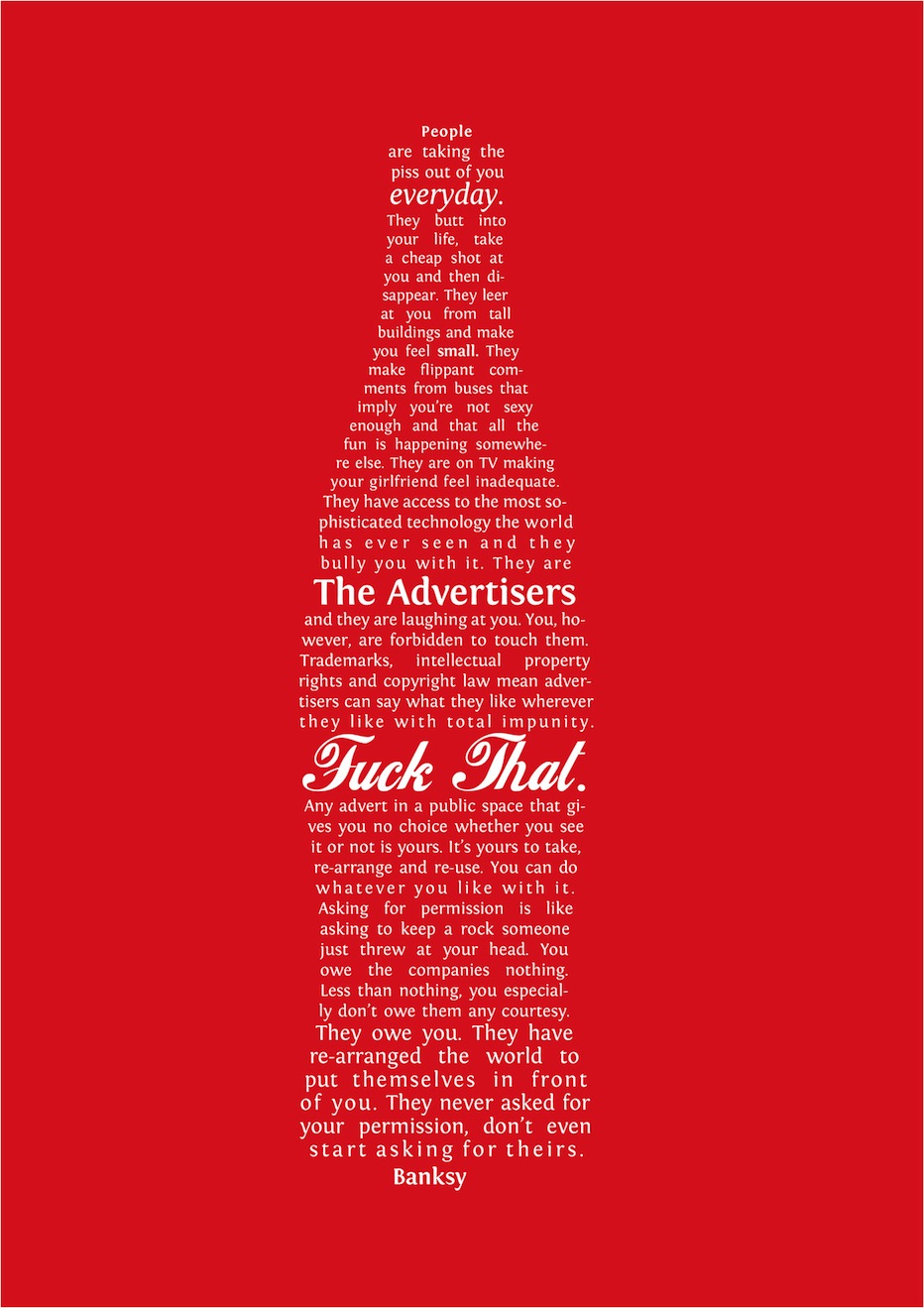
I came across this here piece by Banksy and couldn’t resist sharing it, especially in the light of the Royal Institution’s infamous trademarking..
I stumbled across this a while ago and, with my mind emptied by a day full of meetings, I thought I’d take the opportunity to post it today along with a couple of random connections that sprang into my mind when I saw it. The process by which 32 metronomes seem to synchronize themselves in the first video might look like magic at first glance, but it’s actually based on very simple physics…
And if you want to see an explanation of how it works with rather fewer metronomes, see
which brings me onto this remarkable piece of music by György Ligeti which is called Poème Symphonique and is written for 100 metronomes placed, hopefully, on a hard surface:
All this reminds me of the legendary Geordie darts commentator Sid Waddell, who once described the ebb-and-flow of a championship darts match in the following style…
Follow @telescoperthe pendulum is swinging backwards and forwards, like a metronome…
I came across this last night and thought I would share it with you. It’s the preamble to Edgar Allan Poe‘s famous short story The Murders in the Rue Morgue, which is arguably the first-ever work in the genre of detective fiction. The piece is a bit dated (especially by the reference to the (now) discredited pseudoscience of phrenology, but Poe nevertheless says some very interesting things about a topic that I have returned to a number of times on this blog: the interplay between analysis and synthesis (and between deductive and inductive reasoning) involved not only in detective stories but also in card games and – I would contend – in the scientific method generally. I agree with Poe when he says that the most fascinating part of such endeavours is the poorly understood yet vital element of intuition, that creative spark of ingenuity that sets apart a true genius, but am not sure about his contention that it is closely related to the analytic aspect. Anyway, see what you think…
–o–
IT is not improbable that a few farther steps in phrenological science will lead to a belief in the existence, if not to the actual discovery and location, of an organ of analysis. If this power (which may be described, although not defined, as the capacity for resolving thought into its elements) is not, in fact, an essential portion of what late philosophers term ideality, then there are, indeed, many good reasons for supposing it a primitive faculty. That it may be a constituent of ideality is here suggested in opposition to the vulgar dictum (founded, however, upon the assumptions of grave authority) that the calculating and discriminating powers (causality and comparison) are at variance with the imaginative — that the three, in short, can hardly co-exist. But, although thus opposed to received opinion, the idea will not appear ill-founded when we observe that the processes of invention or creation are strictly akin with the processes of resolution — the former being nearly, if not absolutely, the latter conversed.
It cannot be doubted that the mental features discoursed of as the analytical, are, in themselves, but little susceptible of analysis. We appreciate them only in their effects. We know of them, among other things, that they are always to their possessor, when inordinately possessed, a source of the liveliest enjoyment. As the strong man exults in his physical ability, delighting in such exercises as call his muscles into action, so glories the analyst in that moral activity which disentangles. He derives pleasure from even the most trivial occupations bringing his talent into play. He is fond of enigmas, of conundrums, of hieroglyphics; exhibiting in his solutions of each a degree of acumen which appears to the ordinary apprehension præternatural. His results, brought about by the very soul and essence of method, have, in truth, the whole air of intuition.
The faculty in question is possibly much invigorated by mathematical study, and especially by that highest branch of it which, unjustly, and merely on account of its retrograde operations, has been called, as if par excellence, analysis. Yet to calculate is not in itself to analyse. A chess-player, for example, does the one without effort at the other. It follows that the game of chess, in its effects upon mental character, is greatly misunderstood. I am not now writing a treatise, but simply prefacing a somewhat peculiar narrative by observations very much at random; I will, therefore, take occasion to assert that the higher powers of the reflective intellect are more decidedly and more usefully tasked by the unostentatious game of draughts than by all the elaborate frivolity of chess. In this latter, where the pieces have different and bizarre motions, with various and variable values, that which is only complex is mistaken (a not unusual error) for that which is profound. The attention is here called powerfully into play. If it flag for an instant, an oversight is committed, resulting in injury or defeat. The possible moves being not only manifold but involute, the chances of such oversights are multiplied; and in nine cases out of ten it is the more concentrative rather than the more acute player who conquers. In draughts, on the contrary, where the moves are unique and have but little variation, the probabilities of inadvertence are diminished, and the mere attention being left comparatively unemployed, what advantages are obtained by either party are obtained by superior acumen. To be less abstract — Let us suppose a game of draughts, where the pieces are reduced to four kings, and where, of course, no oversight is to be expected. It is obvious that here the victory can be decided (the players being at all equal) only by some recherché movement, the result of some strong exertion of the intellect. Deprived of ordinary resources, the analyst throws himself into the spirit of his opponent, identifies himself therewith, and not unfrequently sees thus, at a glance, the sole methods (sometimes indeed absurdly simple ones) by which he may seduce into miscalculation or hurry into error.
Whist has long been noted for its influence upon what is termed the calculating power; and men of the highest order of intellect have been known to take an apparently unaccountable delight in it, while eschewing chess as frivolous. Beyond doubt there is nothing of a similar nature so greatly tasking the faculty of analysis. The best chess-player in Christendom may be little more than the best player of chess; but proficiency in whist implies capacity for success in all those more important undertakings where mind struggles with mind. When I say proficiency, I mean that perfection in the game which includes a comprehension of all the sources (whatever be their character) whence legitimate advantage may be derived. These are not only manifold but multiform, and lie frequently among recesses of thought altogether inaccessible to the ordinary understanding. To observe attentively is to remember distinctly; and, so far, the concentrative chess-player will do very well at whist; while the rules of Hoyle (themselves based upon the mere mechanism of the game) are sufficiently and generally comprehensible. Thus to have a retentive memory, and to proceed by “the book,” are points commonly regarded as the sum total of good playing. But it is in matters beyond the limits of mere rule that the skill of the analyst is evinced. He makes, in silence, a host of observations and inferences. So, perhaps, do his companions; and the difference in the extent of the information obtained, lies not so much in the falsity of the inference as in the quality of the observation. The necessary knowledge is that of what to observe. Our player confines himself not at all; nor, because the game is the object, does he reject deductions from things external to the game. He examines the countenance of his partner, comparing it carefully with that of each of his opponents. He considers the mode of assorting the cards in each hand; often counting trump by trump, and honor by honor, through the glances bestowed by their holders upon each. He notes every variation of face as the play progresses, gathering a fund of thought from the differences in the expression of certainty, of surprise, of triumph or of chagrin. From the manner of gathering up a trick he judges whether the person taking it can make another in the suit. He recognises what is played through feint, by the air with which it is thrown upon the table. A casual or inadvertent word; the accidental dropping or turning of a card, with the accompanying anxiety or carelessness in regard to its concealment; the counting of the tricks, with the order of their arrangement; embarrassment, hesitation, eagerness or trepidation — all afford, to his apparently intuitive perception, indications of the true state of affairs. The first two or three rounds having been played, he is in full possession of the contents of each hand, and thenceforward puts down his cards with as absolute a precision of purpose as if the rest of the party had turned outward the faces of their own.
The analytical power should not be confounded with simple ingenuity; for while the analyst is necessarily ingenious, the ingenious man is often remarkably incapable of analysis. I have spoken of this latter faculty as that of resolving thought into its elements, and it is only necessary to glance upon this idea to perceive the necessity of the distinction just mentioned. The constructive or combining power, by which ingenuity is usually manifested, and to which the phrenologists (I believe erroneously) have assigned a separate organ, supposing it a primitive faculty, has been so frequently seen in those whose intellect bordered otherwise upon idiocy, as to have attracted general observation among writers on morals. Between ingenuity and the analytic ability there exists a difference far greater indeed than that between the fancy and the imagination, but of a character very strictly analogous. It will be found, in fact, that the ingenious are always fanciful, and the truly imaginative never otherwise than profoundly analytic.
Follow @telescoperEarlier this year, in common with other media, this blog pledged its support to a campaign to save the Royal Institution from financial oblivion. In doing so I may have given the impression that the Royal Institution is a venerable and highly esteemed organization dedicated to the task of bring science closer to the public and inspiring future generations with its exciting range of outreach activities, including its famous public lectures.
However, in the light of the Royal Institution’s recent decision to trademark the phrase “Christmas Lectures” , I now realize that this was misleading and in fact the Royal Institution is just another rapaciously self-serving organization, run by small-minded buffoons, which is dedicated to nothing but its own self-aggrandizement. It has further become clear that the RI will do anything it can to maintain its cushy existence in a fancy property in Mayfair to the detriment of all outreach activities elsewhere, and should therefore be shut down immediately as a threat to the future health of UK science.
Moreover, as a protest, this blog calls upon all University science departments in the United Kingdom to organize their own series of Christmas Lectures Yuletide Discourses under the title Not the Royal Institution Christmas Lectures, beginning each presentation with a lengthy preamble describing the unpleasant and idiotic actions of the Royal Institution and explaining why its Christmas Lectures® should be boycotted.
I hope this clarifies the situation.
P.S. For more blog outrage, see here, here , here…. (cont., p94).
Follow @telescoperNot much time to post these days, what with one thing and another, but music is always a good standby. In fact I’ve had this at the back of my mind for some time; hearing it on the radio last week gave me the nudge I needed to post it. I always feel a but uncomfortable about posting just a movement from a classical piece, but I think it is justifiable in this case. This is the 3rd Movement of String Quartet No. 15 (in A minor) by Ludwig van Beethoven (Opus 132).
The third movement is headed with the words
Heiliger Dankgesang eines Genesenen an die Gottheit, in der lydischen Tonart
I take the liberty of translating the first two words, using my schoolboy German, as “A Holy Song of Thanksgiving”; Beethoven wrote the piece after recovering from a very serious illness which he had feared might prove fatal. The movement begins in a mood of quiet humility but slowly develops into a sense of hope and deeply felt joy. The most remarkable thing about this movement to me, though, is that the music possesses the same restorative powers that it was written to celebrate. This music has a therapeutic value all of its own.
I don’t know if William Wordsworth (of whose poetry I am also extremely fond) ever had the chance to hear Beethoven’s Quartet No. 15 , and in Tintern Abbey he was writing about the therapeutic power of nature rather than music, but surely the “tranquil restoration” described in that poem is exactly the feeling Beethoven achieves in his music:
These beauteous forms,
Through a long absence, have not been to me
As is a landscape to a blind man’s eye:
But oft, in lonely rooms, and ‘mid the din
Of towns and cities, I have owed to them
In hours of weariness, sensations sweet,
Felt in the blood, and felt along the heart;
And passing even into my purer mind,
With tranquil restoration: — feelings too
Of unremembered pleasure: such, perhaps,
As have no slight or trivial influence
On that best portion of a good man’s life,
His little, nameless, unremembered, acts
Of kindness and of love. Nor less, I trust,
To them I may have owed another gift,
Of aspect more sublime; that blessed mood,
In which the burthen of the mystery,
In which the heavy and the weary weight
Of all this unintelligible world,
Is lightened: — that serene and blessed mood,
In which the affections gently lead us on, —
Until, the breath of this corporeal frame
And even the motion of our human blood
Almost suspended, we are laid asleep
In body, and become a living soul:
While with an eye made quiet by the power
Of harmony, and the deep power of joy,
We see into the life of things.
..is the relative position of the two teams in 16th and 17th place in the final Premiership table!

Of course, it would have been more satisfying if Sunderland had finished one place lower but then you can’t have everything!
Anyway, that’s the Premiership over for another season. Time to concentrate on the cricket. If the Ashes Tests producing anything like today’s play against New Zealand then it should be an exciting summer!
Follow @telescoperIn my job here as Head of the School of Mathematical and Physical Sciences (MPS) at the University of Sussex, I’ve been been spending a lot of time recently on trying to understand the way the School’s budget works, sorting out what remains to be done for this financial year, and planning the budget for next year. In the course of doing all that it has become clear to me that the current funding arrangements from the Higher Education Funding Council for England (HEFCE) are extremely worrying for Science, Technology, Engineering and Mathematics (STEM) disciplines.
Before the introduction of the £9K tuition fees this academic year (i.e. in the `old regime’), a University would receive income from tuition fees of up to £3375 per student and from a `unit of resource’ or `teaching grant’ that depends on the subject. As shown in the upper part of Table C below which is taken from a HEFCE document:

In the old regime, the maximum income per student in Physics was thus £8,269 whereas for a typical Arts/Humanities student the maximum was £5,700. That means there was a 45% difference in funding between these two types of subject. The reason for this difference is that subjects such as physics are much more expensive to teach. Not only do disciplines like physics require expensive laboratory facilities (and associated support staff), they also involve many more contact hours between students and academic staff than in, e.g. an Arts subject. However, the differential is not as large as you might think: there’s only a factor two difference in teaching grant between the lowest band (D, including Sociology, Economics, Business Studies, Law and Education) and the STEM band B (including my own subject, Physics). The real difference in cost is much larger than that, and not just because science subjects need laboratories and the like.
To give an example, I was talking recently to a student from a Humanities department at a leading University (not my employer). Each week she gets 3 lectures and one two-hour seminar, the latter usually run by a research student. That’s it for her contact with the department. That meagre level of contact is by no means unusual, and some universities offer even less tuition than that.
In my School, MPS, a typical student can expect around 20 contact hours per week including lectures, exercise classes, laboratory sessions, and a tutorial (usually in a group of four). The vast majority of these sessions are done by full-time academic staff, not PDRAs or PhD students, although we do employ such folks in laboratory sessions and for a very small number of lectures. It doesn’t take Albert Einstein to work out that 20 hours of staff time costs a lot more than 3, and that’s even before you include the cost of the laboratories and equipment needed to teach physics.
Now look at what happens in the `new regime’, as displayed in the lower table in the figure. In the current system, students still pay the same fee for STEM and non-STEM subjects (£9K in most HEIs) but the teaching grant is now £1483 for Physics and nothing at all for Bands C and D. The difference in income is thus just £1,483 or in percentage terms, a difference of just 16.4. Worse than this, there’s no requirement that this extra resource be spent on the disciplines with which it is associated anyway. In most universities, all the tuition income goes into central coffers and is dispersed to Schools and Departments according to the whims of the University Management.
Of course the new fee levels have led to an increase in income to Universities across all disciplines, which is welcome because it should allow institutions to improve the quality of their teaching bu purchasing better equipment, etc. But the current arrangements as a powerful disincentive for a university to invest in expensive subjects, such as Physics, relative to Arts & Humanities subjects such as English or History. It also rips off staff and students in those disciplines, the students because they are given very little teaching in return for their fee, and the staff because we have to work far harder than our colleagues in other disciplines, who fob off most of what little teaching their supposed to do onto PhD students badged as Teaching Assistants. It is fortunate for this country that scientists working in its universities show such immense dedication to teaching as well as research that they’re prepared to carry on working in a University environment that is so clearly biased against STEM disciplines.
To get another angle on this argument, consider the comments made by senior members of the legal profession who are concerned about the drastic overproduction of law graduates. Only about half those doing the Bar Professional Training Course after a law degree stand any chance of getting a job as a lawyer in the UK. Contrast this with the situation in science subjects, where we don’t even produce enough graduates to ensure that schools have an adequate supply of science teachers. The system is completely out of balance. Here at Sussex, only about a quarter of students take courses in STEM subjects; nationally the figure is even lower, around 20%…
I don’t see anything on the horizon that will alter this ridiculous situation. STEM subjects will continue to be stifled as universities follow the incentive to invest in cheaper subjects and will continue to overproduce graduates in other areas. The present Chief Executive of HEFCE is stepping down. Will whoever takes over from him have the guts to do anything about this anti-STEM bias?
I doubt the free-market ideologues in Westminster would even think of intervening either, because the only two possible changes are: (i) to increase the fee for STEM subjects relative to others; and (ii) to increase the teaching grant. Option (i) would lead to a collapse in demand for the very subjects it was intended to save and option (ii) would involve increasing public expenditure, which is anathema to the government even if it is an investment in the UK’s future. Or maybe it’s making a complete botch of the situation deliberately, as part of a cunning plan to encourage universities to go private?
I’m back in Cardiff for the day, mainly for the purpose of attending presentations by a group of final-year project students (two of them under my supervision, albeit now remotely). One of the talks featured a famous quote by the statistician George E.P. Box:
Essentially, all models are wrong, but some are useful.
I agree with this, actually, but only if it’s not interpreted in a way that suggests that there’s no such thing as reality and/or that science is just a game. We may never achieve a perfect understanding of how the Universe works, but that’s not the same as not knowing anything at all.
A familiar example that nicely illustrates my point is the London Underground or Tube map. There is a fascinating website depicting the evolutionary history of this famous piece of graphic design. Early versions simply portrayed the railway lines inset into a normal geographical map which made them rather complicated, as the real layout of the lines is far from regular. A geographically accurate depiction of the modern tube network is shown here which makes the point:
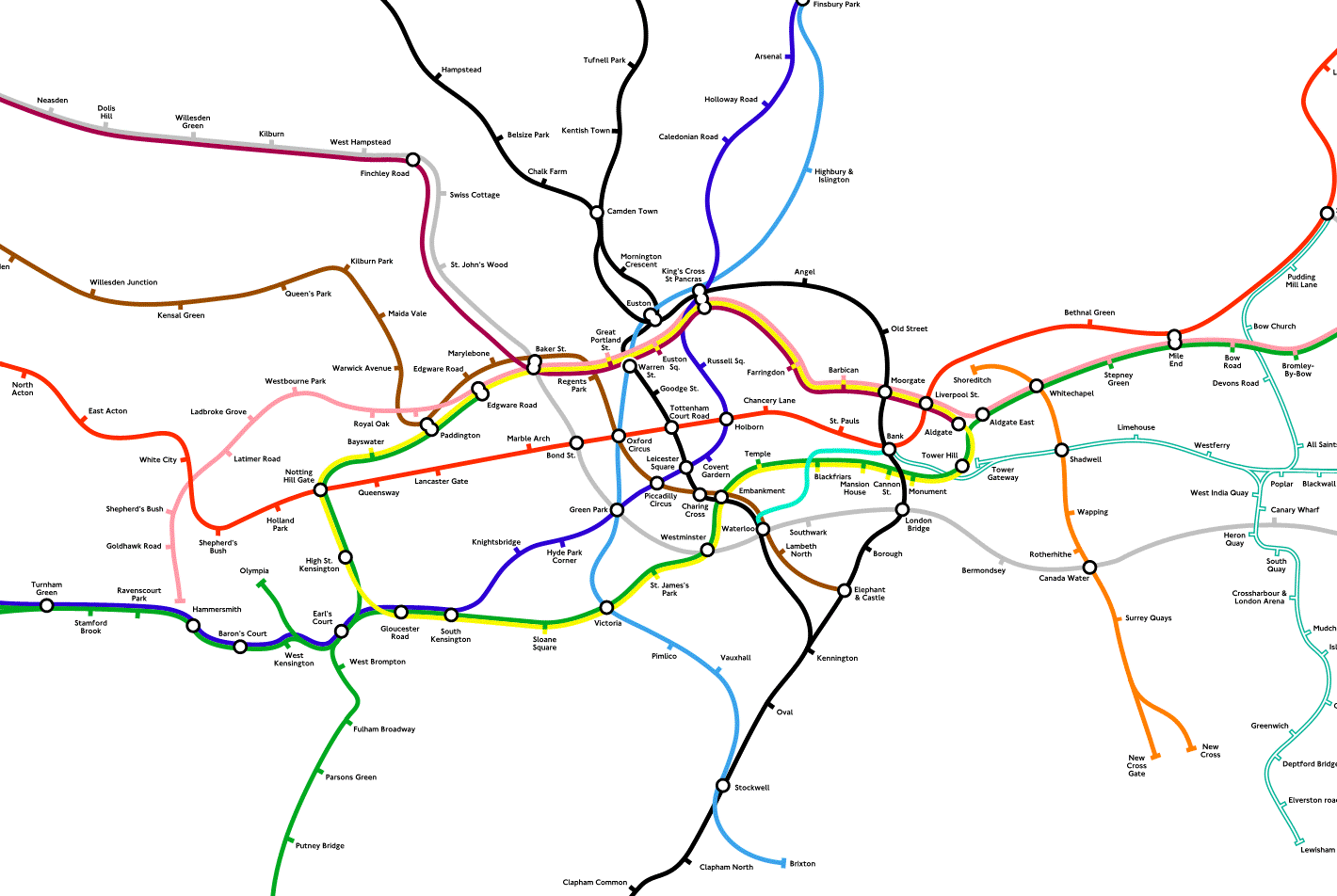
A revolution occurred in 1933 when Harry Beck compiled the first “modern” version of the map. His great idea was to simplify the representation of the network around a single unifying feature. To this end he turned the Central Line (in red) into a straight line travelling left to right across the centre of the page, only changing direction at the extremities. All other lines were also distorted to run basically either North-South or East-West and produce a much more regular pattern, abandoning any attempt to represent the “real” geometry of the system but preserving its topology (i.e. its connectivity). Here is an early version of his beautiful construction:

Note that although this a “modern” map in terms of how it represents the layout, it does look rather dated in terms of other design elements such as the border and typefaces used. We tend not to notice how much we surround the essential things with embellishments that date very quickly.
More modern versions of this map that you can get at tube stations and the like rather spoil the idea by introducing a kink in the central line to accommodate the complexity of the interchange between Bank and Monument stations as well as generally buggering about with the predominantly rectilinear arrangement of the previous design:

I quite often use this map when I’m giving popular talks about physics. I think it illustrates quite nicely some of the philosophical issues related with theoretical representations of nature. I think of theories or models as being like maps, i.e. as attempts to make a useful representation of some aspects of external reality. By useful, I mean the things we can use to make tests. However, there is a persistent tendency for some scientists to confuse the theory and the reality it is supposed to describe, especially a tendency to assert there is a one-to-one relationship between all elements of reality and the corresponding elements in the theoretical picture. This confusion was stated most succintly by the Polish scientist Alfred Korzybski in his memorable aphorism :
The map is not the territory.
I see this problem written particularly large with those physicists who persistently identify the landscape of string-theoretical possibilities with a multiverse of physically existing domains in which all these are realised. Of course, the Universe might be like that but it’s by no means clear to me that it has to be. I think we just don’t know what we’re doing well enough to know as much as we like to think we do.
A theory is also surrounded by a penumbra of non-testable elements, including those concepts that we use to translate the mathematical language of physics into everday words. We shouldn’t forget that many equations of physics have survived for a long time, but their interpretation has changed radically over the years.
The inevitable gap that lies between theory and reality does not mean that physics is a useless waste of time, it just means that its scope is limited. The Tube map is not complete or accurate in all respects, but it’s excellent for what it was made for. Physics goes down the tubes when it loses sight of its key requirement, i.e. to be testable, and in order to be testable it has to be simple enough to calculate things to be compared with observations. In many cases that means a simplified model is perfectly adequete.
Another quote by George Box expands upon this point:
Remember that all models are wrong; the practical question is how wrong do they have to be to not be useful.
In any case, an attempt to make a grand unified theory of the London Underground system would no doubt produce a monstrous thing so unwieldly that it would be useless in practice. I think there’s a lesson there for string theorists too…
Many modern-day physicists are obsessed with the idea of a “Theory of Everything” (or TOE). Such a theory would entail the unification of all physical theories – all laws of Nature, if you like – into a single principle. An equally accurate description would then be available, in a single formula, of phenomena that are currently described by distinct theories with separate sets of parameters. Instead of textbooks on mechanics, quantum theory, gravity, electromagnetism, and so on, physics students would need just one book. But would such a theory somehow be physical reality, as some physicists assert? I don’t think so. In fact it’s by no means clear to me that it would even be useful..
Follow @telescoperAs we approach the evening of interminable tedium that is the Eurovision Song Contest, it’s refreshing to stumble across a Blog post that reveals the competitions true political and cultural significance…
Not long ago I posted a short item about the physics of vortex rings. More recently I stumbled across this video that shows how University of Chicago physicists have succeeded in creating a vortex knot—a feat akin to tying a smoke ring into a knot. Linked and knotted vortex loops have existed in theory for more than a century, but creating them in the laboratory had previously eluded scientists. I stole that bit shamelessly from the blurb on Youtube, by the way. I’m not sure whether knotting a vortex tube has any practical applications, but then I don’t really care much about that because it’s fun!
Follow @telescoper
 In the Dark