I travelled back to Brighton this morning and spent the afternoon in a series of meetings in my sweltering office. I now haven’t got the energy to post anything but some music, so here is some rare footage of Brazilian guitarist and pioneer of Latin Jazz Baden Powell (full name Baden Powell de Aquino) recorded in Germany in 1970. The lovely tune with a melancholy edge is called Manhã da Carnaval. He not only plays it beautifully but also displays admirable dexterity in holding his cigarette in right hand as he does so..
Follow @telescoperAuthor Archive
Manhã da Carnaval
Posted in Jazz, Music with tags Baden Powell, Latin Jazz, Manhã da Carnaval on May 7, 2013 by telescoperBank Holiday in Bute Park
Posted in Uncategorized with tags Bank Holiday, Bute Park, Cardiff, crosswords on May 6, 2013 by telescoperWell, I’ve done next to nothing today. Just yesterday’s Azed crossword in which I found
All too public ‘diary’ left in the loo (4)
which clues what this is.
I also held my last ever project meeting with Cardiff student; hand-in dates are looming across the country, I suspect.
Other than that, I’ve just been strolling around, and otherwise enjoying, Bute Park in the sunshine along with half the population of Cardiff. It is a pity the Council don’t take better care of the grass, though..

General Paper
Posted in Education with tags Cambridge Entrance Examination on May 5, 2013 by telescoperRummaging through my drawers just now I found the General Paper I took in 1981 to get into Cambridge. I haven’t copied Section A, which involves writing a precis of a rather lengthy article about voting systems, but Sections B and C involve different forms of writing challenge.
I don’t remember which questions I answered, but most of the topics are still interesting and/or controversial enough to be topics for a blog post, at least. Which would you have chosen?
Incidentally, the whole paper was of 3 hours duration and all sections were equally weighted so you would be expected to spend about an hour on each question.
I think we should do much more to encourage science students to develop their writing skills nowadays. I think most present-day physics would find these exercises very difficult, simply because they don’t get enough practice at putting pen to paper (or even fingers to keyboard).
If you are feeling keen, and have an hour to spare, feel free to submit a piece through the comments box!
Time starts now…

Maurice of Montpelier Terrace
Posted in Uncategorized with tags Brighton, cats, Maurice on May 4, 2013 by telescoperI chanced upon this old picture just now. It was taken in Brighton in 1989, and it shows me with Maurice, a gorgeous Burmese cat who was a resident of the basement flat in which I lodged for a while, in Montpelier Terrace. This photograph was taken in the little yard at the rear of the property, from which Maurice frequently tried to escape.
Burmese are wonderful cats, very talkative and full of personality, but their claws are like needles!

The Joy of Pepys
Posted in Biographical, History with tags 1660, Magdalene College, Restoration, Samuel Pepys, Twitter on May 3, 2013 by telescoperTwitter is much maligned by those who don’t use it, and I’d be the first to admit that it has several million downsides, but every now and again you come across something truly wonderful which makes it worthwhile putting up with the dross. Here’s an example. Some time ago, a nameless genius came up with the idea of tweeting excerpts from the Diaries of Samuel Pepys. Those of you on Twitter can follow Samuel Pepys by clicking here:
For those of you not familiar with Twitter, its main characteristic is that messages posted on it (“tweets”) are limited to 140 characters. To outsiders this seems to imply that all tweets are banal and pointless, but this is far from the case. The strict length limit forces a form of creativity that is both rare and wonderful. The stroke of genius in this case was to realize that the Pepys Diaries could be tweeted in chunks of the right size, in a manner that almost suggests they were designed for the purpose!
Pepys was a high-ranking naval administrator and Member of Parliament so he had detailed knowledge of the momentous political events of his period. He’s currently tweeting from May 1660 (near the start of the diaries), giving a vivid insight into the background to the Restoration of the Monarchy. Parliament should be recalled in a few days time, on May 8th…
Here is a selection of recent examples:
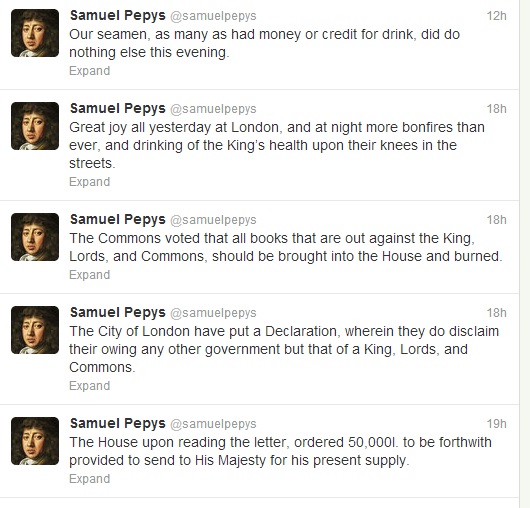
But it’s not just the fascinating political context that makes these tweets so interesting. They also give glimpses of everyday life in the 17th Century. Pepys was in poor health for much of his life, for example, and there are frequent references to various physicians and their quack remedies. He also manages to conjure up in just a few words the extraordinary atmosphere and energy of the London of the period, along with some of its excesses (especially drinking and fornication).
Following Pepys’ Twitter feed opens a window into 17th Century England, and what comes through it is both refreshing and illuminating. The reason I find this particularly delightful is something that I’ve blogged about before, so won’t repeat at length. I was a very late developer from an education point of view until I was helped with my reading and arithmetic by a wonderful old lady who lived next door. She encouraged me to read and, after a big struggle, I eventually got the hang of it. After a time I had caught up with the rest of the class in School and eventually managed to read just about every book the School had to offer, including the Diaries of Samuel Pepys which were for some reason on the shelves in Class 2 and which I was allowed to borrow. I don’t think anyone had read them before so nobody, including the teachers, knew how rude they were in places. The Restoration period was generally rather bawdy, and Pepys’ Diaries reflect that.
I had no idea at that time, of course, that less than ten years later I would be studying at Magdalene College, Cambridge, site of the Pepys Library where the orignal diaries are kept as well as the rest of Pepys’ own collection of rare books and music.
Follow @telescoperCute Nuclear Physics Problem
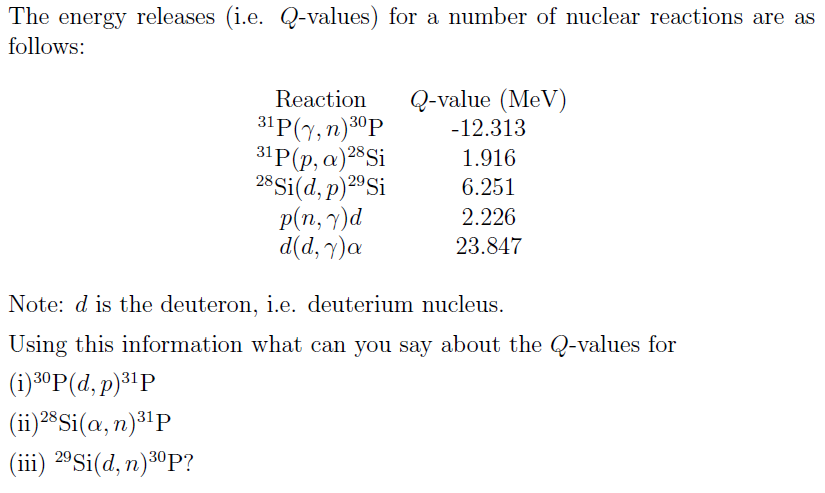
Posted in Cute Problems, The Universe and Stuff with tags Nuclear Physics, Q-value, Q-values on May 2, 2013 by telescoperIt’s been quite a while since I posted anything in the cute physics problems folder – mostly because the problems I’m generally dealing with these days are neither cute nor related to physics – but here’s one from an old course I used to teach on Nuclear and Particle Physics.
In the following the notation A(a,b)B means the reaction a+A→b+B and the you might want to look here for a definition of what a Q-value is. The Atomic Number of Phosphorus (P) is 15, and that of Silicon (Si) is 14. The question doesn’t require any complicated mathematics, or any knowledge of physics beyond A-level; the rest is up to your little grey cells!
Don’t Leave Me This Way
Posted in Biographical, Music with tags Don't Leave Me This Way, The Communards on May 2, 2013 by telescoperThis song was playing on the radio in the Bridge Cafe just now when I went to get a cup of coffee, thus providing me with another time warp experience. The Communards’ version of Don’t Leave Me This Way was a big hit way back in 1986 and I remember dancing to it many times in various Brighton clubs and discos; I was here at the University of Sussex then as a research student. Can that really have been 27 years ago? Sigh…
Follow @telescoperShould the passive voice be avoided?
Posted in Education with tags education, grammar, passive voice, Physics, reports, Science on May 1, 2013 by telescoperIt’s another very busy day (as well as another lovely one) so I thought instead of sitting indoors this lunchtime writing a typically verbose blog item I’d just pick something out of my back catalogue and give it another airing because it deals with something that’s come up a couple of times recently.
This is the time of year when final-year students are drafting their project reports. Yesterday I was back in Cardiff giving feedback on two such articles. I usually quite enjoy reading these things, in fact. They’re not too long and I’m usually pretty impressed with how the students have set about the (sometimes quite tricky) things I’ve asked them to do for their project work. I think the project report is quite a challenge for UK physics students because they generally haven’t had much practice in putting together a lengthy piece of writing before or during their university course, so haven’t developed a style that they feel comfortable with and are often unfamiliar with various conventions (such as reference style, punctuation of equations, etc). Some of these are explained in quite a lot of detail in the instructions the students are given, of course, but we all know that only girls read instructions….
The thing that strikes me most forcibly about the strange way students write project reports is that they are nearly always phrased entirely in the passive voice, e.g.
The experiment was calibrated using a phlogiston normalisation widget….
I accept that people disagree about whether the passive voice is good style or not. Some journals actively encourage the passive voice while others go the opposite way entirely . I’m not completely opposed to it, in fact, but I think it’s only useful either when the recipient of the action described in the sentence is more important than the agent, or when the agent is unknown or irrelevant. There’s nothing wrong with “My car has been stolen” (passive voice) since you would not be expected to know who stole it. On the other hand “My Hamster has been eaten by Freddy Starr” would not make a very good headline.
The point is that the construction of a statement in the passive voice in English is essentially periphrastic, in that it almost inevitably involves some form of circumlocution – either using more words than necessary to express the meaning or being deliberately evasive by introducing ambiguity. Both of these failings should be avoided in scientific writing.
Apparently, laboratory instructors generally tell students to write their reports in the passive voice as a matter of course. I think this is just wrong. In a laboratory report the student should describe what he or she did. Saying what “was done” often leaves the statement open to the interpretation that somebody else did it. The whole point of a laboratory report is surely for the students to describe their own actions. “We calibrated the experiment..” or “I calibrated the experiment…” are definitely to be preferred to the form I gave above.
That brings me to the choice of pronoun in the active voice. One danger is that it can appear very bombastic, but that’s not necessarily the case. I don’t find anything particularly wrong in saying, e.g.
We improve upon the technique of Jones et al. (1848) by introducing a variable doofer in the MacGuffin control, thereby removing gremlins from the thingummy process.
But the main issue is whether to use the singular or plural form. It can be irritating to keep encountering “I did this..” and “I did that..” all the way through a journal paper, and I certainly would feel uncomfortable writing a piece like that in the first person singular. I think it feels less egotistical to use “we”, even if there is only one author (which is increasingly rare in any case). If it’s good enough for the Queen it’s good enough for me! However, I just looked “we” up in Chambers dictionary and found
..used when speaking patronizingly, esp to children, to mean `you’.
which wasn’t at all what I had in mind!
However in the case of a student project that I’m assessing I actually want to know what the particular student writing the report did, not what was done by person or persons unspecified or by a group of uncertain composition. So I encourage my students to put, e.g.,
I wrote a computer program in 6502 Assembly Language to solve the Humdinger equation using the Dingbat-Schnitzelgruber algorithm.
I also (sometimes) like “we” when there’s, e.g., a complicated mathematical derivation. Going line by line through a lengthy piece or difficult technical argument seems friendlier if you imagine that the reader is trying to do the calculation along with you as you write it:
if we differentiate the right hand side of equation (8), use the expression for x obtained in equation (97), expand y in a power-series and take away the number we first thought of we find…
The “we” isn’t necessarily an author with delusions of grandeur (or schizophrenia), but instead denotes a joint operation between author and reader.
Anyway, to resume the thread, it seems to me that sometimes it is appropriate to use the passive voice because it is the correct grammatical construction in the circumstances. Sometimes also the text just seems to work better that way too. But having to read an entire document written in the passive voice drives me to distraction. It’s clumsy and dull.
In scientific papers, things are a little bit different but I still think using the active voice makes them easier to read and less likely to be ambiguous. In the introduction to a journal paper it’s quite acceptable to discuss the background to your work in the passive voice, e.g. “it is now generally accepted that…” but when describing what you and your co-authors have done it’s much better to use the active voice. “We observed ABC1234 using the Unfeasibly Large Telescope..” is, to my mind, much better than “Observations of ABC1234 were made using..”.
Reading back over this post I notice that I have jumped fairly freely between active and passive voice, thus demonstrating that I don’t have a dogmatic objection to its use. What I’m arguing is that it shouldn’t be the default, that’s all.
My guess is that a majority of experimental scientists won’t agree with this opinion, but a majority of astronomers and theoreticians will.
This guess will now be tested by reactivating an old poll..
Lines on the Death of Herschel
Posted in Poetry, The Universe and Stuff with tags Herschel Space Observatory on April 30, 2013 by telescoperSo farewell, then,
Herschel
Space
Observatory.
You were named after
William Herschel,
Who lived
During the reign of
George III.
The mad King
Who went blind,
Then died.
You went blind
Then died.
But there the
Similarity
Ends.
You ran out
Of Helium;
He had no
Need of He.
And he was neither
In Space
Nor an
Observatory,
So forget
It.
by Peter Coles (aged 49 11/12).
Follow @telescoperNever mind the table, look at the sample size!
Posted in Bad Statistics with tags League Tables, margin of error, statistics, Times Higher on April 29, 2013 by telescoperThis morning I was just thinking that it’s been a while since I’ve filed anything in the category marked bad statistics when I glanced at today’s copy of the Times Higher and found something that’s given me an excuse to rectify my lapse. Last week saw the publication of said organ’s new Student Experience Survey which ranks British Universities in order of the responses given by students to questions about various aspects of the teaching, social life and so on. I had a go at this table a few years ago, but they still keep trotting it out. Here are the main results, sorted in decreasing order:
| University | Score | Resp. | |
| 1 | University of East Anglia | 84.8 | 119 |
| 2 | University of Oxford | 84.2 | 259 |
| 3 | University of Sheffield | 83.9 | 192 |
| 3 | University of Cambridge | 83.9 | 245 |
| 5 | Loughborough University | 82.8 | 102 |
| 6 | University of Bath | 82.7 | 159 |
| 7 | University of Leeds | 82.5 | 219 |
| 8 | University of Dundee | 82.4 | 103 |
| 9 | York St John University | 81.2 | 88 |
| 10 | Lancaster University | 81.1 | 100 |
| 11 | University of Southampton | 80.9 | 191 |
| 11 | University of Birmingham | 80.9 | 198 |
| 11 | University of Nottingham | 80.9 | 270 |
| 14 | Cardiff University | 80.8 | 113 |
| 14 | Newcastle University | 80.8 | 125 |
| 16 | Durham University | 80.3 | 188 |
| 17 | University of Warwick | 80.2 | 205 |
| 18 | University of St Andrews | 79.8 | 109 |
| 18 | University of Glasgow | 79.8 | 131 |
| 20 | Queen’s University Belfast | 79.2 | 101 |
| 21 | University of Hull | 79.1 | 106 |
| 22 | University of Winchester | 79 | 106 |
| 23 | Northumbria University | 78.9 | 100 |
| 23 | University of Lincoln | 78.9 | 103 |
| 23 | University of Strathclyde | 78.9 | 107 |
| 26 | University of Surrey | 78.8 | 102 |
| 26 | University of Leicester | 78.8 | 105 |
| 26 | University of Exeter | 78.8 | 130 |
| 29 | University of Chester | 78.7 | 102 |
| 30 | Heriot-Watt University | 78.6 | 101 |
| 31 | Keele University | 78.5 | 102 |
| 32 | University of Kent | 78.4 | 110 |
| 33 | University of Reading | 78.1 | 101 |
| 33 | Bangor University | 78.1 | 101 |
| 35 | University of Huddersfield | 78 | 104 |
| 36 | University of Central Lancashire | 77.9 | 121 |
| 37 | Queen Mary, University of London | 77.8 | 103 |
| 37 | University of York | 77.8 | 106 |
| 39 | University of Edinburgh | 77.7 | 170 |
| 40 | University of Manchester | 77.4 | 252 |
| 41 | Imperial College London | 77.3 | 148 |
| 42 | Swansea University | 77.1 | 103 |
| 43 | Sheffield Hallam University | 77 | 102 |
| 43 | Teesside University | 77 | 103 |
| 45 | Brunel University | 76.6 | 110 |
| 46 | University of Portsmouth | 76.4 | 107 |
| 47 | University of Gloucestershire | 76.3 | 53 |
| 47 | Robert Gordon University | 76.3 | 103 |
| 47 | Aberystwyth University | 76.3 | 104 |
| 50 | University of Essex | 76 | 103 |
| 50 | University of Glamorgan | 76 | 108 |
| 50 | Plymouth University | 76 | 112 |
| 53 | University of Sunderland | 75.9 | 100 |
| 54 | Canterbury Christ Church University | 75.8 | 102 |
| 55 | De Montfort University | 75.7 | 103 |
| 56 | University of Bradford | 75.5 | 52 |
| 56 | University of Sussex | 75.5 | 102 |
| 58 | Nottingham Trent University | 75.4 | 103 |
| 59 | University of Roehampton | 75.1 | 102 |
| 60 | University of Ulster | 75 | 101 |
| 60 | Staffordshire University | 75 | 102 |
| 62 | Royal Veterinary College | 74.8 | 50 |
| 62 | Liverpool John Moores University | 74.8 | 102 |
| 64 | University of Bristol | 74.7 | 137 |
| 65 | University of Worcester | 74.4 | 101 |
| 66 | University of Derby | 74.2 | 101 |
| 67 | University College London | 74.1 | 102 |
| 68 | University of Aberdeen | 73.9 | 105 |
| 69 | University of the West of England | 73.8 | 101 |
| 69 | Coventry University | 73.8 | 102 |
| 71 | University of Hertfordshire | 73.7 | 105 |
| 72 | London School of Economics | 73.5 | 51 |
| 73 | Royal Holloway, University of London | 73.4 | 104 |
| 74 | University of Stirling | 73.3 | 54 |
| 75 | King’s College London | 73.2 | 105 |
| 76 | Bournemouth University | 73.1 | 103 |
| 77 | Southampton Solent University | 72.7 | 102 |
| 78 | Goldsmiths, University of London | 72.5 | 52 |
| 78 | Leeds Metropolitan University | 72.5 | 106 |
| 80 | Manchester Metropolitan University | 72.2 | 104 |
| 81 | University of Liverpool | 72 | 104 |
| 82 | Birmingham City University | 71.8 | 101 |
| 83 | Anglia Ruskin University | 71.7 | 102 |
| 84 | Glasgow Caledonian University | 71.1 | 100 |
| 84 | Kingston University | 71.1 | 102 |
| 86 | Aston University | 71 | 52 |
| 86 | University of Brighton | 71 | 106 |
| 88 | University of Wolverhampton | 70.9 | 103 |
| 89 | Oxford Brookes University | 70.5 | 106 |
| 90 | University of Salford | 70.2 | 102 |
| 91 | University of Cumbria | 69.2 | 51 |
| 92 | Napier University | 68.8 | 101 |
| 93 | University of Greenwich | 68.5 | 102 |
| 94 | University of Westminster | 68.1 | 101 |
| 95 | University of Bedfordshire | 67.9 | 100 |
| 96 | University of the Arts London | 66 | 54 |
| 97 | City University London | 65.4 | 102 |
| 97 | London Metropolitan University | 65.4 | 103 |
| 97 | The University of the West of Scotland | 65.4 | 103 |
| 100 | Middlesex University | 65.1 | 104 |
| 101 | University of East London | 61.7 | 51 |
| 102 | London South Bank University | 61.2 | 50 |
| Average scores | 75.5 | 11459 | |
| YouthSight is the source of the data that have been used to compile the table of results for the Times Higher Education Student Experience Survey, and it retains the ownership of those data. Each higher education institution’s score has been indexed to give a percentage of the maximum score attainable. For each of the 21 attributes, students were given a seven-point scale and asked how strongly they agreed or disagreed with a number of statements based on their university experience. | |||
My current employer, the University of Sussex, comes out right on the average (75.5) and is consequently in the middle in this league table. However, let’s look at this in a bit more detail. The number of students whose responses produced the score of 75.5 was just 102. That’s by no means the smallest sample in the survey, either. The University of Sussex has over 13,000 students. The score in this table is therefore obtained from less than 1% of the relevant student population. How representative can the results be, given that the sample is so incredibly small?
What is conspicuous by its absence from this table is any measure of the “margin-of-error” of the estimated score. What I mean by this is how much the sample score would change for Sussex if a different set of 102 students were involved. Unless every Sussex student scores exactly 75.5 then the score will vary from sample to sample. The smaller the sample, the larger the resulting uncertainty.
Given a survey of this type it should be quite straightforward to calculate the spread of scores from student to student within a sample from a given University in terms of the standard deviation, σ, as well as the mean score. Unfortunately, this survey does not include this information. However, lets suppose for the sake of argument that the standard deviation for Cardiff is quite small, say 10% of the mean value, i.e. 7.55. I imagine that it’s much larger than that, in fact, but this is just meant to be by way of an illustration.
If you have a sample size of N then the standard error of the mean is going to be roughly (σ⁄√N) which, for Sussex, is about 0.75. Assuming everything has a normal distribution, this would mean that the “true” score for the full population of Sussex students has a 95% chance of being within two standard errors of the mean, i.e. between 74 and 77. This means Sussex could really be as high as 43rd place or as low as 67th, and that’s making very conservative assumptions about how much one student differs from another within each institution.
That example is just for illustration, and the figures may well be wrong, but my main gripe is that I don’t understand how these guys can get away with publishing results like this without listing the margin of error at all. Perhaps its because that would make it obvious how unreliable the rankings are? Whatever the reason we’d never get away with publishing results without errors in a serious scientific journal.
This sampling uncertainty almost certainly accounts for the big changes from year to year in these tables. For instance, the University of Lincoln is 23rd in this year’s table, but last year was way down in 66th place. Has something dramatic happened there to account for this meteoric rise? I doubt it. It’s more likely to be just a sampling fluctuation.
In fact I seriously doubt whether any of the scores in this table is significantly different from the mean score; the range from top to bottom is only 61 to 85 showing a considerable uniformity across all 102 institutions listed. What a statistically literate person should take from this table is that (a) it’s a complete waste of time and (b) wherever you go to University you’ll probably have a good experience!
Follow @telescoper
 In the Dark