Author Archive

Desperate Publishers

Posted in Open Access with tags , , , , on April 28, 2013 by telescoper

I’m on campus to get some work done but before that I thought I do a quick postette as I eat my lunch. A good topic for a short contribution is a story I heard last week from one of my colleagues in the Department of Physics & Astronomy here at the University of Sussex. It seems he gave a talk at a conference a while ago.  As is far from unusual in such circumstances he was asked to write up his contribution for a special edition of a journal.

Before I go on I’ll just digress a bit to mention a less well-known aspect of the Academic Publishing Racket, the Conference Proceedings Volume. For a long time you couldn’t attend a conference in astrophysics without having to contribute an article to one of these books. Although usually produced on the cheap, using camera-ready copy, and with minimal editorial oversight, these were sold to participants and (more lucratively) to university libraries at enormously inflated prices, often over £100 a go. It wasn’t unusual for funding agencies to insist that a conference talk be followed up with a publication, so this racket flourished for a while. I’ve actually got a shelf full of such volumes accumulated over the years, although I don’t really know why I kept them as it is in their nature that they date very quickly.

Anyway, as time passed, and the internet expanded and improved, most conference organizers began to realize that it was much better just to keep their own record of the conference: putting summaries, and even full presentations, on the web for interested persons to download gratis. No doubt it is still de rigueur in some subjects to produce books of this type, but  most in astrophysics don’t bother any more.  Quite rightly, in my opinion. I think they’re a waste of time, money and shelf space.

The original thread of this post, however, isn’t about standalone books of conference proceedings but special editions of a regular academic journal; for an example of one such see here. Note the unsubtle and entirely gratuitous  link to one of my own papers! I’ve always thought this format was just as bad as putting them in a book, with the additional disadvantage that people might misinterpret the journal reference as meaning that the paper had been refereed. The paper I linked to above was not refereed, for instance. In any case they’re a bit of a chore to write, and are just as likely to be of ephemeral interest, but if one is invited to give a talk one generally feels obliged to play ball and deliver the article requested.

Which all brings me back to my colleague here at Sussex. He did his talk and wrote up the obligatory article for the special journal edition of the conference proceedings. But times have changed. When he tried to submit his article via the web upload facility he was directed to a screen asking whether his work was funded by the Science and Technology Facilities Council. When he answered “yes” he was told he was obliged to pay $3000 for the privilege of publishing his paper in Gold Open Access mode….

When he asked me if the School of Mathematical and Physical Sciences would pay the $3000 I nearly had a seizure. It’s bad enough getting landed with a hefty bill for writing an article as a favour to the conference organizers, but it’s even worse than that. The publisher was deliberately and disgracefully misleading the author about the RCUK policy on open access in order to take money from them. There is no requirement for researchers to pay for Gold OA in such a case. Sharp practice is too polite a phrase to describe the actions of this publisher. And of course nobody mentioned the $3000 fee when he signed up to give a talk at the conference.

Unfortunately, I think this sort of questionable business practice is bound to proliferate as publishers seek to maximize their revenue from Gold Open Access before the academic community rumbles the scam and cuts them out all together. So let this post be a warning. Do not trust academic publishers who try to charge you up front. Check the rules very carefully before committing yourself or, preferably, declining to publish with them. There are sharks out there and they’re after your funding.

Oh, and the name of the publisher involved in the scam I just described? I’m sure you can guess it before clicking this link to check.

Sola, Perduta, Abbandonata

Posted in Opera with tags , , , on April 27, 2013 by telescoper


Hosts, Guests, and Parasites

Posted in Literature with tags , , , , , on April 26, 2013 by telescoper

I just returned from my first experience of Court, at least in the sense of that word that applies to the University of Sussex. It was quite different to what I had imagined, especially because it included three research talks. One of them, by Dr Sara Crangle of the School of English was about the Engagement Diaries of Virginia Woolf (many of which have been acquired by the University). This talk began with a fascinating preamble focussed on a short quote from The Critic as Host by J. Hillis Miller. This revolved around the curious shared etymology of “host” and “guest” and their common relationship to “hostia” the latin word meaning a sacrifice or a victim. Being fascinated by the origin and evolution of words I thought I’d have a look for a bit more of the context so here is an extended discussion.

“Parasite” is one of those words which calls up its apparent “opposite.” It has no meaning without that counterpart. There is no parasite without its host. At the same time both word and counterword subdivide and reveal themselves each to be fissured already within themselves and to be, like Unheimlich, unheimlich, an example of a double antithetical word. Words in “para,” like words in “ana” have this as an intrinsic property, capability, or tendency. “Para” as a prefix in English (sometimes “par”) indicates alongside, near or beside, to the side of, alongside, beyond, wrongfully, harmfully, unfavorably, and among. The words in “para” form one branch of the tangled labyrinth of words using some form of the Indo-European root per, which is the “base of prepositions and pre-verbs with the basic meaning of ‘forward,’ ‘through,’ and a wide range of extended senses such as ‘in front of ,’ ‘before,’ ‘early,’ ‘first,’ ‘chief,’ ‘toward,’ ‘against,’ ‘near,’ ‘at,’ ‘around.’”

I said words in “para” are one branch of the labyrinth of “pers,” but it is easy to see that the branch is itself a miniature labyrinth. “Para” is an “uncanny” double antithetical prefix signifying at once proximity and distance, similarity and difference, interiority and exteriority, something at once inside a domestic economy and outside it, something simultaneously this side of the boundary line, threshold, or margin, and at the same time beyond it, equivalent in status and at the same time secondary or subsidiary, submissive, as of guest to host, slave to master. A thing in “para” is, moreover, not only simultaneously on both sides of the boundary line between inside and outside. It is also the boundary itself, the screen which is at once a permeable membrane connecting inside and outside, confusing them with one another, allowing the outside in, making the inside out, dividing them but also forming an ambiguous transition between one and the other. Though any given word in “para” may seem to choose unequivocally or univocally one of these possibilities, the other meanings are always there as a shimmering or wavering in the word which makes it refuse to stay still in a sentence, like a slightly alien guest within the syntactical closure where all the words are family friends together. Words in “para” include: parachute, paradigm, parasol, the French paravent (screen protecting against the wind), and parapluie (umbrella), paragon, paradox, parapet, parataxis, parapraxis, parabasis, paraphrase, paragraph, paraph, paralysis, paranoia, paraphernalia, parallel, parallax, parameter, parable, paresthesia, paramnesia, paregoric, parergon, paramorph, paramecium, Paraclete, paramedical, paralegal–and parasite.

“Parasite” comes from the Greek, parasitos, etymologically: “beside the grain,” para, beside (in this case) plus sitos, grain, food. “Sitology” is the science of foods, nutrition, and diet. “Parasite” was originally something positive, a fellow guest, someone sharing the food with you, there with you beside the grain. Later on, “parasite” came to mean a professional dinner guest, someone expert at cadging invitations without ever giving dinners in return. From this developed the two main modern meanings in English, the biological and the social. A parasite is (1) “Any organism that grows, feeds, and is sheltered on or in a different organism while contributing nothing to the survival of its host”; (2) “A person who habitually takes advantage of the generosity of others without making any useful return.” To call a kind of criticism “parasitical” is, in either case, strong language.

A curious system of thought, or of language, or of social organization (in fact all three at once) is implicit in the word parasite. There is no parasite without a host. The host and the somewhat sinister or subversive parasite are fellow guests beside the food, sharing it. On the other hand, the host is himself the food, his substance consumed without recompense, as when one says, “He is eating me out of house and home.” The host may then become the host in another sense, not etymologically connected. The word “Host” is of course the name for the consecrated bread or wafer of the Eucharist, from Middle English oste, from Old French oiste, from Latin hostia, sacrifice, victim.

If the host is both eater and eaten, he also contains in himself the double antithetical relation of host and guest, guest in the bifold sense of friendly presence and alien invader. The words “host” and “guest” go back in fact to the same etymological root: ghos-ti, stranger, guest, host, properly “someone with whom one has reciprocal duties of hospitality.” The modern English word “host” in this alternative sense comes from the Middle English (h)oste, from Old French, host, guest, from Latin hospes (stem hospit-), guest, host, stranger. The “pes” or “pit” in the Latin words and in such modern English words as “hospital” and “hospitality” is from another root, pot, meaning “master.” The compound or bifurcated root ghos-pot meant “master of guests,” “ one who symbolizes the relationship of reciprocal hospitality,” as in the Slavic gospodic, Lord, sir, master. “Guest,” on the other hand, is from Middle English gest, from Old Norse gestr, from ghos-ti, the same root for “host.” A host is a host. The relation of household master offering hospitality to a guest and the guest receiving it, of host and parasite in the original sense of “fellow guest,” is inclosed within the word “host” itself. A host in the sense of a guest, moreover, is both a friendly visitor in the house and at the same time an alien presence who turns the home into a hotel, a neutral territory. Perhaps he is the first emissary of a host of enemies (from Latin hostis [stranger, enemy]), the first foot in the door, to be followed by a swarm of hostile strangers, to be met only by our own host, as the Christian deity is the Lord God of Hosts. The uncanny antithetical relation exists not only between pairs of words in this system, host and parasite, host and guest, but within each word in itself. It reforms itself in each polar opposite when that opposite is separated out, and it subverts or nullifies the apparently unequivocal relation of polarity which seems the conceptual scheme appropriate for thinking through the system. Each word in itself becomes separated by the strange logic of the “para,” membrane which divides inside from outside and yet joins them in a hymeneal bond, or allows an osmotic mixing, making the strangers friends, the distant near, the dissimilar similar, the Unheimlich heimlich, the homely homey, without, for all its closeness and similarity, ceasing to be strange, distant, dissimilar.


Interesting!

Spring Cleaning

Posted in Jazz with tags , on April 26, 2013 by telescoper

We’re nearly at the end of a long week and I’ve got neither the time nor the energy for a lengthy post, so here’s a bit of a pick-me-up in the form of a classic bit of Fats Waller. Thomas Wright Waller was born in 1904 and died (of pneumonia) on a train travelling across the United States in 1943.  Although he’s usually thought of as an entertainer who specialized in comic versions of popular songs, he was undoubtedly a brilliant jazz musician and an especially accomplished exponent of Harlem Stride piano. Anyway, I heard a bit of this track on a TV advert last night and it seemed both fun and topical so I thought I’d share it and see if people enjoy it as much as I did; in the famous words of Mr Waller “One never knows, do one?”….

Breaking down a breakdown

Posted in Biographical, The Universe and Stuff with tags , , , , , on April 25, 2013 by telescoper

A blog piece by Dean Burnett  I read on on the Grauniad website yesterday set me thinking about whether I should post a personal comment in reaction to it. I never know what is the appropriate way to draw the line between the private and the public on In the Dark but since having a blog is clearly an exercise in self-indulgence anyway I thought I’d go ahead and write a piece.

Dean’s piece is about nervous breakdowns, but it’s really about why “nervous breakdown” is not a very good name for what it purports to describe. Regular readers of this blog  (both of them) will know that I went through one last year, and one thing I do remember is the disapproval that the term “nervous breakdown” provoked when I used it during my subsequent course of therapy. Apparently it’s a bit frowned-upon among professionals in the field.

Here is Dean (who is a neuroscientist in his day job) on the subject:

The term nervous breakdown is actually surprisingly old, and stems from a time when both “nervous” and “breakdown” arguably had different meanings to their modern ones. It seems the “breakdown” element refers to a breakdown in the same way that cars or other machines can break down. And nervous just refers to the nervous tissue. So originally it meant a fault or error in the nervous tissue that controls the body. And suddenly my interpretation doesn’t seem so literal.

But this doesn’t mean it’s an invalid term, it’s just more of a rule-of-thumb or generalisation used to refer to what happens when someone becomes psychologically unable to function as normal. In the simplest sense it could be said that, mentally speaking, a nervous breakdown occurs when an individual finds that the number of things that they are able to cope with is lower than the number of things that they have to cope with.

That seems to me to sum up very sensibly why the term is not very useful for an expert: it’s too vague, in that there are so many quite different things that might cause a person to become “psychologically unable to function as normal”. But it also explains quite well why its usage persists in popular language, in that the state of being “”psychologically unable to function as normal” is not as uncommon you might think. Anyway, if someone says they’ve had a nervous breakdown it gives at least a general idea of what they’ve experienced, although the specifics vary widely from individual to individual.

I hope you’ll bear with me if I illustrate this with some personal observations in the light of my own experiences.

I’ve suffered from a form of panic disorder for many years. Actually even that term has a very broad definition, so that different individuals experience different forms of panic attacks and they can also take very different forms for the same individual. For me, a “typical” panic episode begins with a fairly generalized feeling of apprehension or dread. Sometimes that’s as far as it goes. However, more often, there follows a period of increasingly heightened awareness of things moving  in my peripheral vision that I can’t keep track of. This leads to a sense of being surrounded by threats of various kinds and panic ensues. Usually, at that point, I run.

A typical panic episode lasts only a few minutes, but that’s not the end of it. For a considerable period (hours) afterwards I find myself in a state of hypervigilance during which I’m such a bundle of nerves that the slightest sound or movement can trigger a repeat.

I tend to think of these episodes as being a bit like earthquakes. The milder ones happen fairly frequently, but they’re quite easy to cope with. I have altered my behaviour to avoid places likely to trigger them (see below) and to be aware of appropriate exit strategies. The more severe episodes are much harder to deal with, though, and when one starts there’s nothing I can do apart from try to find somewhere that feels safe, wait for it to pass and then just get through the aftermath, hoping for no aftershocks.

In Dean’s piece he writes about the different stressors that can trigger a breakdown. In my case it was a bit more complicated than that.  Thinking about the milder attacks I find it very difficult to identify specific triggers – they seem to occur more-or-less randomly. However,  I can cope with this low-level “noise” pretty well. I’ve had plenty of time to get used to it, at least.  The more severe attacks seem more likely to be triggered by specific places, especially if they’re crowded with people moving around – although I don’t always have a problem in places like that. To give an example, crossing the main concourse at Victoria Station is, for me, like descending into the abyss; I simply can’t do it, and have to go outside the station to get between the trains and the underground station. Paddington Station, on the other hand, is fine. Weird.

I think the probability of one of these episodes is also influenced by background levels of stress arising from other independent things. Anyway, last year I got into a state in which I was experiencing multiple episodes per day. I couldn’t sleep or eat for over a week, and couldn’t leave the house for fear of experiencing another major problem. I think “nervous breakdown” is a pretty apt description for that period, but my breakdown was caused not by a new problem, but the amplification of an old problem to completely intolerable levels.

The reason for writing about the anatomy of my breakdown in this context is twofold. One part is just to reinforce Dean’s point that a “nervous breakdown” can be triggered by many different circumstances and conditions. Mine is probably an unusual example, but I think everybody else’s  is too.

The other reason is to confess how frustrating it is to be a physicist who has experienced a thing like that. It seems natural that having experienced such an episode I should want or need to try to make sense of it, but I’ve struggled to do that. The way we’re used to thinking about things in physics is to make simple models that capture the relatively simple cause-and-effect relationships between relatively few variables, usually based on the objective analysis of data controlled experiments and/or systematic observations.   This all involves trying to break down a phenomenon into its component parts so as to look at their separate action and thus establish the simple rules (if there are any) that govern the overall behaviour.

The trouble with this analytic approach is that the human brain and its interactions with the external world are far too complicated and non-linear to be approached in the simple-minded way we physicists usually do things. Even if you accept that the brain is basically a collection of atoms communicating with each other using electrical impulses, that doesn’t mean that it’s useful to try to describe its action using atomic physics and electromagnetic theory.

On top of all that, there’s the issue that neuroscience is a subject I know very little about at a technical level. There’s only room in my feeble little brain for my own specialism, so I lack the knowledge needed even to understand the literature.

So although I got over my breakdown, it has left me with a huge number of questions I don’t even know how to begin to answer. What is happening in my brain when a panic episode begins? What is going on with my peripheral vision when it goes awry like it does? Why do some particular places  or circumstances trigger an attack but other, apparently similar, ones don’t?

I don’t suppose anyone out to answer these questions, but if any neuroscientists out there happen to read this piece I would be grateful if they could recommend appropriate literature, as long as it’s simple enough for an astrophysicist to read…

HFLS3: the earliest Starburst yet!

Posted in The Universe and Stuff with tags , , , , on April 24, 2013 by telescoper

Once again I’ve spent all day engaged in the enjoyable but exhausting task of interview for new faculty positions, which means that I haven’t really got time for a proper blog today. What I can do, however, is shamelessly rip off a nice press release produced by the good folks here at the University of Sussex about a discovery that has been attracting a lot of press coverage since it was published last week in Nature; the paper is also available on the arXiv. If you’ve followed this blog for a while you will know than when I was at Cardiff I got interested in a large project called the Herschel Atlas survey, which is a large area galaxy survey carried out using the Herschel Space Observatory. This result is not from Herschel ATLAS but from a complementary deeper survey called Hermes, also performed using the Herschel Space Observatory and it is of a very distant and very bright starburst galaxy (a type of galaxy which, as its name suggests, in which stars are forming at a much higher rate than a “normal” galaxy).

Incidentally, although Herschel is now extremely short of the Helium it needs to keep itself cool, it is still making observations running on empty, as it were.

Anyway, that’s all I’ve got time to write. The rest is just copied from the press release I mentioned…

–o–

University of Sussex astronomers using the Herschel Space Observatory are part of an international team that has discovered a distant star-forming galaxy that challenges the current theories of galaxy evolution.

Seen when the Universe was less than a billion years old (880 million years) the galaxy, known only as “HFLS3”, is forming stars at a much faster rate than should be possible according to existing predictions. In the infant Universe, galaxies should have been forming stars at a much slower rate than is observed in HFLS3.

HFLS3 is so distant that the light we see from it has taken 13 billion years to get to Earth.

The Herschel observatory1 has been surveying the distant cosmos and finding hundreds of thousands of distant galaxies. Images produced by Herschel show how fast these distant galaxies are forming stars.

By determining the ages of the galaxies, astronomers have been building up a cosmic timeline of star formation, searching for when the first massive galaxies started churning out stars.

University of Sussex PhD student Peter Hurley, Dr Isaac Roseboom, Dr Anthony Smith, Dr Lingyu Wang and Professor Seb Oliver, who leads the HerMES2 survey that found the galaxy, analysed data from Herschel and built the HFLS3 galaxy as a computer model to discover what conditions are like in the galaxy.

Peter says: “The stars being born in HFLS3 heat up the surrounding material within the galaxy. This material contains gas molecules such as carbon monoxide and water, which emit their own unique signatures when heated. By comparing the telescope observations with models, we can gain a better understanding of the conditions within this extreme galaxy.”

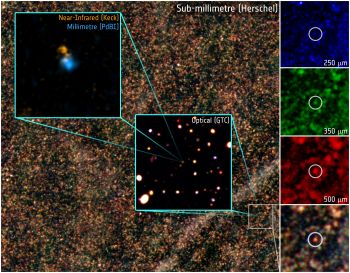
The galaxy “HFLS3” was first seen as a small red dot in the Herschel images, and its colour is what first intrigued the team because red galaxies might be very distant.

2499.item

The galaxy HFLS3 as revealed by Herschel and further ground-based telescope observations. Images: ESA/Herschel/HerMES/IRAM/GTC/W.M. Keck Observatory

Further investigations using optical and near-infrared telescopes the Gran Telescopio Canarias in the Canary Islands and the Keck Telescope in Hawaii helped to rule out any other effects that might cause the HFLS3 galaxy to look so bright.

It was observations with radio and millimetre-wave telescopes, such as the Plateau de Bure Interferometer in the French Alps, which determined that this tiny galaxy, only around one twentieth the size of our Milky Way, is seen at such an immense distance. These additional observations also showed that HFLS3 is incredibly rich in carbon, nitrogen and oxygen, forming compounds such as carbon monoxide, water and ammonia. These compounds reveal the physical processes at work in this distant galaxy.

Combined with the Herschel observations, these measurements allow the astronomers to deduce that this tiny star factory is producing stars around two thousand times faster than our own Milky Way, making it a type of galaxy known as a “starburst”. Environments like this do not exist on galaxy-wide scales in the Universe today.

Professor Oliver says: “We’ve shown that Herschel data can find these extreme examples. “The next step is to sift through the Herschel data more carefully, and try to deduce just how common such galaxies were in the early Universe. I am also very pleased that a Sussex PhD student has been able to make an important contribution to this work.”

Jamie Bock (Caltech, USA), who co-leads the HerMES survey with Professor Oliver, says: “This galaxy is just one spectacular example, but it’s telling us that early star formation like this is possible,” explains Jamie Bock, Caltech, and one of the leaders.

Dominik Riechers (Cornell University, USA), who led the HFLS3 study, says: “Looking for the first examples of these massive star factories is like searching for a needle in a haystack. We were hoping to find a galaxy at such vast distances, but we could not expect that they even existed that early on in the Universe.”

Neutrino Physics in a Small Universe

Posted in Biographical, The Universe and Stuff with tags , , , , , , , on April 23, 2013 by telescoper

I’ve only just got time for a quick lunchtime post before I head off to attend an afternoon of Mathematics presentations, but it’s a one of those nice bits of news that I like to mention on here from time to time.

It is my pleasure to pass on the wonderful news that one of my colleagues in the School of Mathematical and Physical Sciences here at the University of Sussex,  Dr Jeff Hartnell,. has been awarded  the High Energy Particle Physics prize of the Institute of Physics, which means that his name has now been added to the illustrious list of previous winners. The prize is awarded annually by the HEPP Group, a subject group in the Nuclear and Particle Physics Division of the IOP, to a researcher in the UK who has made an outstanding contribution to their field of study early in their career (within 12 years of being awarded their first degree).

There’s a very nice piece about this award here which reveals, amongst other things, that many moons ago at Nottingham I was Jeff’s undergraduate tutor! In fact Jeff also attended a third-year course on Theoretical Elementary Particle Physics I taught in those days. That he survived those experience and went on to be a world-leading physicist speaks volumes! Not only that, it’s also evidence that the world of physics is smaller than we sometimes suppose. I’ve crossed paths with a number of my new colleagues at various times in the past, but it’s particularly rewarding to see someone you taught as an undergraduate go on to a highly successful career as a scientist. Jeff was awarded a prestigious ERC grant this year too!

Jeff is currently in the USA helping to set up the largest-ever experiment in neutrinos to be built there, called NOvA. You can click on the preceding links for more technical details, and I also found this interesting video showing the NOvA detector being assembled. Particle physics experiments are never small, are they?

p.s. Why do they insist on writing “metric ton” instead of “tonne”?

Down with Fanatics!

Posted in Poetry with tags , , on April 22, 2013 by telescoper

If I had my way with violent men
I’d simmer them in oil,
I’d fill a pot with bitumen
And bring them to the boil.
I execrate the terrorist
And those who harbour him,
And if I weren’t a moralist
I’d tear them limb from limb.

Fanatics are an evil breed
Whom decent men should shun;
I’d like to flog them till they bleed,
Yes, every mother’s son,
I’d like to tie them to a board
And let them taste the cat,
While giving praise, oh thank the Lord,
That I am not like that.

For we should love the human kind,
As Jesus taught us to,
And those who don’t should be struck blind
And beaten black and blue;
I’d like to roast them in a grill
And listen to them shriek,
Then break them on the wheel until
They turned the other cheek.

by Roger Woddis (1917-1993)

Operation Wheeler

Posted in Uncategorized with tags , , on April 21, 2013 by telescoper

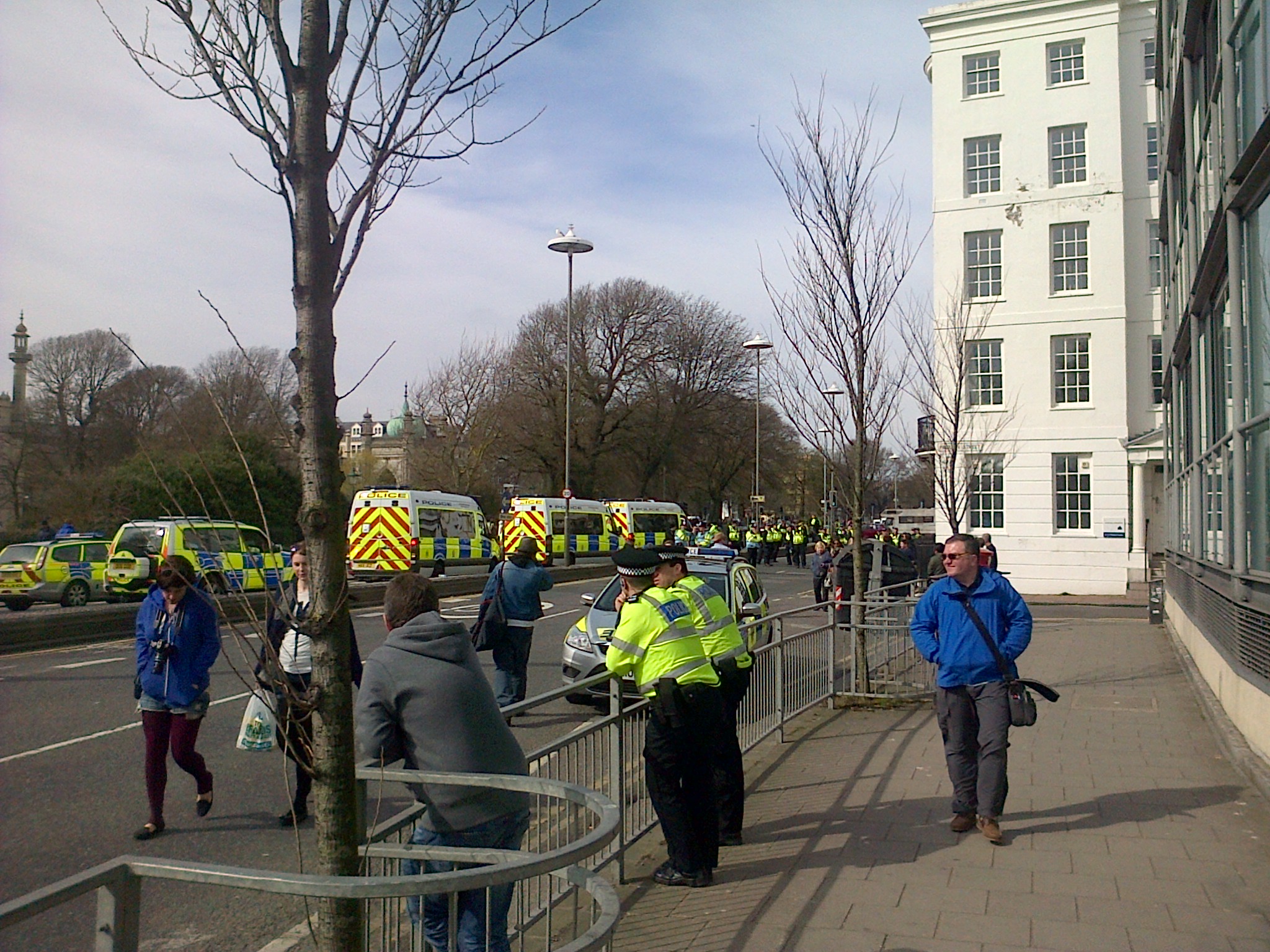
It has been a bit scary in Brighton today. The so-called March for England, took place this afternoon organized by the neo-Nazi English Defence League (no link to their website from me, you’ll observe). There was a massive police presence in town, at first concentrated on the seafront where the march was routed.

There were localized brawls between marchers and counter-demonstrators from the outset, and after the march ended various splinter groups from both dispersed around the city trying to cause disruption. The town has been at a standstill since about 2.30 as police sealed off isolated disturbances and protected bystanders. I was with a group of people near the Sea Life centre when half a dozen EDL thugs began hurling abuse and moving towards us in a very threatening way. The police intervened promptly and the agressors moved off. They may have subsequently joined a melee that then developed in the Old Steine and was attended by riot police but which did not last very long.

The number of marchers was about 150 (my estimate) with a similar number of counter-demonstrators; they were probably outnumbered by the Police, who had brought in reinforcements from elsewhere to assist with Operation Wheeler, their name for today’s huge activity. I saw vans from Hertfordshire, Norfolk and the City of London.

Anyway, with no serious injuries reported, I’d say Operation Wheeler was a success. I’ve heard that 13 arrests were made, for a variety of offences. I think the police did a very good job in extremely difficult circumstances.

Why have this march in Brighton? I don’t know, but judging by what I heard, the typical EDL marcher is not very fond of gay people and they probably came here because of Brighton’s large gay community and embrace of other forms of diversity. Racism, homophobia and other forms of prejudice seem often to be acquired as a package. To be honest, I think the EDL just came looking for trouble and didn’t really care that much where it was to be found.

Though the only violent acts I saw were carried out by EDL supporters there were extremists on the other side also spoiling for a fight. I think it would have been far more effective if the counter-protest had been totally peaceful. If thugs come looking for trouble, the worse thing to do is meet them at their level because that’s exactly what they want. The way to defeat people like the EDL is to behave better than they do which, based on today’s evidence, is by no means difficult..

The seafront remained closed for some time after the march had finished…

You can’t see very well in this image, but in the background a group of EDL supporters are being detained by the police.

These police horses are right next to “Legends”. There was a nice bit of banter going on between them and the largely gay clientele drinking out front.

Police standing by, just in case, as business returns to normal

Police vans from Norfolk and the City of London. I can’t be sure, but I think the seagull was local.

Old Steine, around 4pm. Ongoing disturbances in the background contained by police; nothing too serious by the look of it.

Counting for the REF

Posted in Open Access, Science Politics with tags , , , , , , on April 20, 2013 by telescoper

It’s a lovely day in Brighton and I’m once again on campus for an Admissions Event at Sussex University, this time for the Mathematics Department in the School of Mathematical and Physical Sciences.  After all the terrible weather we’ve had since I arrived in February, it’s a delight and a relief to see the campus at its best for today’s crowds. Anyway, now that I’ve finished my talk and the subsequent chats with prospective students and their guests I thought I’d do a quick blogette before heading back home and preparing for this evenings Physics & Astronomy Ball. It’s all go around here.

What I want to do first of all is to draw attention to a very nice blog post by a certain Professor Moriarty who, in case you did not realise it, dragged himself away from his hiding place beneath the Reichenbach Falls and started a new life as Professor of Physics at Nottingham University.  Phil Moriarty’s piece basically argues that the only way to really judge the quality of a scientific publication is not by looking at where it is published, but by peer review (i.e. by getting knowledgeable people to read it). This isn’t a controversial point of view, but it does run counter to the current mania for dubious bibliometric indicators, such as journal impact factors and citation counts.

The forthcoming Research Excellence Framework involves an assessment of the research that has been carried out in UK universities over the past five years or so, and a major part of the REF will be the assessment of up to four “outputs” submitted by research-active members of staff over the relevant period (from 2008 to 2013). reading Phil’s piece might persuade you to be happy that the assessment of the research outputs involved in the REF will be primarily based on peer review. If you are then I suggest you read on because, as I have blogged about before, although peer review is fine in principle, the way that it will be implemented as part of the REF has me deeply worried.

The first problem arises from the scale of the task facing members of the panel undertaking this assessment. Each research active member of staff is requested to submit four research publications (“outputs”) to the panel, and we are told that each of these will be read by at least two panel members. The panel comprises 20 members.

As a rough guess let’s assume that the UK has about 40 Physics departments, and the average number of research-active staff in each is probably about 40. That gives about 1600 individuals for the REF. Actually the number of category A staff submitted to the 2008 RAE was 1,685.57 FTE (Full-Time Equivalent), pretty  close to this figure. At 4 outputs per person that gives 6400 papers to be read. We’re told that each will be read by at least two members of the panel, so that gives an overall job size of 12800 paper-readings. There is some uncertainty in these figures because (a) there is plenty of evidence that departments are going to be more selective in who is entered than was the case in 2008 and (b) some departments have increased their staff numbers significantly since 2008. These two factors work in opposite directions so not knowing the size of either it seems sensible to go with the numbers from the previous round for the purposes of my argument.

There are 20 members of the panel so 6400 papers submitted means that, between 29th November 2013 (the deadline for submissions) and the announcement of the results in December 2014 each member of the panel will have to have read 640 research papers. That’s an average of about two a day…

It is therefore blindingly obvious that whatever the panel does do will not be a thorough peer review of each paper, equivalent to refereeing it for publication in a journal. The panel members simply won’t have the time to do what the REF administrators claim they will do. We will be lucky if they manage a quick skim of each paper before moving on. In other words, it’s a sham.

Now we are also told the panel will use their expert judgment to decide which outputs belong to the following categories:

  • 4*  World Leading
  • 3* Internationally Excellent
  • 2* Internationally Recognized
  • 1* Nationally Recognized
  • U   Unclassified

There is an expectation that the so-called QR  funding allocated as a result of the 2013 REF will be heavily weighted towards 4*, with perhaps a small allocation to 3* and probably nothing at all for lower grades. The word on the street is that the weighting for 4* will be 9 and that for 3* only 1. “Internationally recognized”  will be regarded as worthless in the view of HEFCE. Will the papers belonging to the category “Not really understood by the panel member” suffer the same fate?

The panel members will apparently know enough about every single one of the papers they are going to read in order to place them  into one of the above categories, especially the crucial ones “world-leading” or “internationally excellent”, both of which are obviously defined in a completely transparent and objective manner. Not. The steep increase in weighting between 3* and 4* means that this judgment could mean a drop of funding that could spell closure for a department.

We are told that after forming this judgement based on their expertise the panel members will “check” the citation information for the papers. This will be done using the SCOPUS service provided (no doubt at considerable cost) by   Elsevier, which by sheer coincidence also happens to be a purveyor of ridiculously overpriced academic journals.  No doubt Elsevier are  on a nice little earner peddling meaningless data for the HECFE bean-counters, but I have no confidence that they will add any value to the assessment process.

There have been high-profile statements to the effect that the REF will take no account of where the relevant “outputs”  are published, including a pronouncement by David Willetts. On the face of it, that would suggest that a paper published in the spirit of Open Access in a free archive would not be disadvantaged. However, I very much doubt that will be the case.

I think if you look at the volume of work facing the REF panel members it’s pretty clear that citation statistics will be much more important for the Physics panel than we’ve been led to believe. The panel simply won’t have the time or the breadth of understanding to do an in-depth assessment of every paper, so will inevitably in many cases be led by bibliometric information. The fact that SCOPUS doesn’t cover the arXiv means that citation information will be entirely missing from papers just published there.

The involvement of  a company like Elsevier in this system just demonstrates the extent to which the machinery of research assessment is driven by the academic publishing industry. The REF is now pretty much the only reason why we have to use traditional journals. It would be better for research, better for public accountability and better economically if we all published our research free of charge in open archives. It wouldn’t be good for academic publishing houses, however, so they’re naturally very keen to keep things just the way they are. The saddest thing is that we’re all so cowed by the system that we see no alternative but to participate in this scam.

Incidentally we were told before the 2008 Research Assessment Exercise that citation data would emphatically not be used;  we were also told afterwards that citation data had been used by the Physics panel. That’s just one of the reasons why I’m very sceptical about the veracity of some of the pronouncements coming out from the REF establishment. Who knows what they actually do behind closed doors?  All the documentation is shredded after the results are published. Who can trust such a system?

To put it bluntly, the apparatus of research assessment has done what most bureaucracies eventually do; it has become  entirely self-serving. It is imposing increasingly  ridiculous administrative burdens on researchers, inventing increasingly  arbitrary assessment criteria and wasting increasing amounts of money on red tape which should actually be going to fund research.

And that’s all just about “outputs”. I haven’t even started on “impact”….