Author Archive

You will be hearing from us shortly

Posted in Poetry with tags , on February 26, 2013 by telescoper
 You feel adequate to the demands of this position?
 What qualities do you feel you
 Personally have to offer?
                                        Ah.

 Let us consider your application form.
 Your qualifications, though impressive, are
 Not, we must admit, precisely what
 We had in mind. Would you care
 To defend their relevance?
                                        Indeed.

 Now your age. Perhaps you feel able
 To make your own comment about that,
 Too? We are conscious ourselves
 Of the need for a candidate with precisely
 The right degree of immaturity.
                                        So glad we agree.

 And now a delicate matter: your looks.
 You do appreciate this work involves
 Contact with the actual public? Might they,
 Perhaps, find your appearance
 Disturbing?
                                        Quite so.

 And your accent. That is the way
 You have always spoken, is it? What
 Of your education? We mean, of course,
 Where were you educated?
                                And how
 Much of a handicap is that to you,
 Would you say?

                Married, children,
 We see. The usual dubious
 Desire to perpetuate what had better
 Not have happened at all. We do not
 Ask what domestic desires shimmer
 Behind that vaguely unsuitable address.

 And you were born--?
                                        Yes. Pity.

 So glad we agree.

by U. A. Fanthorpe (1929-2009).

Advice for Prospective Physics Students

Posted in Education with tags , , , , , , , on February 25, 2013 by telescoper

Just got time for a quickie this morning before I head up to the Big Smoke for the first meeting of the Astronomy Grants Panel of the Science and Technology Facilities Council (STFC). I had thought that the last round would be my last, but I must have misbehaved somehow and my sentence has been extended accordingly.

Anyway, I thought I’d follow up Saturday’s post with a response to a question that a few prospective Physics students asked me during our Admissions Day. Those attending these days have already applied to this University but, at this stage of the annual undergraduate admissions cycle, the applicants are still deciding which University to put as their first or firm choice. I see our job in the Admissions Days simply to make available as much information as possible to the applicants to help them make a choice. Quite a few people I spoke to on Saturday, however, said that they had already made up their minds and just wanted some advice about what to do during the summer after they have finished their A-levels to help them prepare for their undergraduate studies in Physics (and/or Astronomy).

The answer I gave was pretty simple: practice your mathematics, especially your calculus! 

The justification for exhortation is that the big difference between Physics at A-level and Physics at undergraduate University level is that the latter is taught in a much more mathematical way than the former. This is because the physical laws that underpin our understanding of the natural world are expressed in a mathematical language; the more fluent you are in this language the easier you will find it to assimilate the physical concepts. To put it another way, you will find it difficult to understand the physical meaning of what is being taught if you are struggling with the mathematical meaning of the symbols being used or the manipulations needed to obtain useful solutions to the relevant equations.

Newton’s Second Law, for example,  relates the rate of change of momentum of a body to the force exerted upon it. If you’re comfortable with calculus you don’t think twice about writing d(mv)/dt for the rate of change of momentum and then constructing a differential equation which you can (hopefully) solve. You won’t absorb the importance of laws like this unless you become so familiar with the mathematics that it ceases to occupy the part of your mind that’s needed to really think.

I think that learning to do Physics is a bit like learning to play a musical instrument. Practicing such basic mathematical procedures as integration and differentiation is analogous to the five-finger exercises you have to do when learning to play the piano. The more you practice them, the greater the extent to which they become hard-wired. Your brain can therefore concentrate on the more interesting conceptual stuff – that’s really the hard part of learning Physics. We do of course do as much as we can to help with this once you’ve got to University, but doing some preparation on your own beforehand would greatly smooth the transition.

So I’d tell any prospective physics student wondering what to do this summer to get hold of as many basic calculus exercises as they can and do them whenever they get the chance. It may not be the most exciting way to spend your post A-level holiday, but it is the single thing you can do that will best prepare you for life as a Physics student.

On the other hand, the advice I’d give to physicists rather later in their careers is to think very carefully before agreeing to be on committees or panels…

Gremlins in the Vault

Posted in Literature with tags , , , on February 24, 2013 by telescoper

Here I am, on campus again (this time on a Sunday). Just going to finish off some urgent things in advance of a busy week next week: tomorrow in London for the first meeting of the 2013 Astronomy Grants Panel; Tuesday all day interviewing for a new faculty position in Physics, Wednesday preparing the University’s equivalent of the 5-year plan; most of Thursday interviewing prospective PhD students; continued, p. 94….

Anyway, I thought I’d warm up my typing fingers this afternoon with a quick post that’s got nothing to do with my job and will probably generate negligible interest among my readers, but the subject got on my mind so here goes anyway. Regular readers of this blog (both of them) will know that I’m a bit of a fan of detective stories. I haven’t blogged much about Crime Fiction per se but I have referred to various examples in the course of other posts. Having recently given up entirely on television and done a bit more travelling on buses and trains, I’ve had a bit more time to read so have started to clear the sizable backlog of books I’ve bought but never actually opened.

All of which brings me to The Vault by Ruth Rendell. This is the 24th book to feature her detective Inspector Wexford, although Wexford, having retired,  is no longer an Inspector in this book. The plot of The Vault revolves around the discovery of four bodies (two male, and two female) in a coal hole belonging to a posh house in St John’s Wood. Wexford is drawn into the subsequent investigation by a friend of his who is still a policeman and thereafter the story interweaves two different genres (the Police procedural and the psychological thriller) in Rendell’s inimitable style, alongside beautifully nuanced description of the parts of London in which the drama unfolds.

In parenthesis I’d say that Ruth Rendell is one of the few crime novelists whose writing transcends the limitations of the crime genre and establishes her as a major literary figure in her own right, a feat only rarely accomplished in the history of detective fiction, the American Dashiel Hammett being another example.

When I bought it I didn’t realize that it was a kind of sequel to her earlier novel A Sight for Sore Eyes in which Wexford does not appear. In The Vault, set 12 later, Wexford only has the four initially unidentified bodies to work on; he hasn’t read the earlier book either. Anyway, to cut a long (detective) story short, three of the bodies relate to the earlier plot whereas the fourth was added to the coal-hole collection about 10 years later. As for the initial three, it seems two were victims of the murderous third who accidentally fell into the hole after disposing of their bodies there.

I enjoyed the atmosphere and detail of Ruth Rendell’s writing as much as ever, but when I’d finished the book I was troubled by one glaring problem with the plot. If the murderer, Teddy Brex, had indeed fallen into the coal hole by accident, who closed the manhole cover that sealed him in? It’s essential to the plot that nobody find the bodies for a dozen years, but surely if the lid had been open someone would have looked inside? Worried that I was just being dense and had missed some detail, I searched around the net and found a blog review on which a similar comment was made.

Part of the pleasure of reading a mystery novel, as is the case with a crossword puzzle, is to see the pieces fall nearly into place at the end. That’s always happened with Ruth Rendell’s books before, but this one left me profoundly unsatisfied. For a writer of her quality, the lapse was most disappointing. It won’t put me off reading other books, of course. Maybe it’s all explained in the earlier book, but that doesn’t mean it’s not a flaw in this one.

Anyway, this particular fly in the ointment led to an interesting little exchange on Facebook about plot errors in The Day of the Jackal so I thought it might be fun to use it as an example, and see if anyone out there in internetshire can think of similar narrative gremlins affecting films or novels? They don’t have to be detective stories, of course, although for reasons described above I think they are especially irksome in that context.

The comment box beckons, but make sure you don’t fall in…

Open for Mathematics, Physics, Astronomy (and Astrophysics)…

Posted in Education, The Universe and Stuff with tags , , , , , , , , on February 23, 2013 by telescoper

I’ve been here on campus at the University of Sussex all day helping out with an Admissions Day. We were all a bit apprehensive in the School of Mathematical and Physical Sciences about today simply because so many students and guests were scheduled to come that we wondered how well we could organize the large number of groups being shown around. There was also the question of the British weather. It was very cold this morning, with flurries of snow as I made my way to campus. I was wondering whether the weather might put some people off travelling, but as it happened we had a lot of visitors and although we were very busy there was a very good buzz about the place.

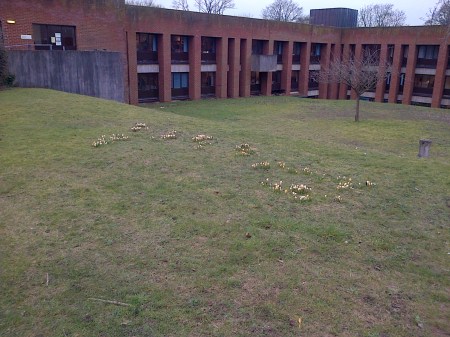
Notwithstanding the inclement weather this morning there are also definite signs that spring is on the way:
IMG-20130221-00065

Anyway, it was nice to have the chance to talk to prospective students and parents in both Mathematics and Physics & Astronomy. Although Mathematics, Physics and Astronomy are combined within the School, there are clear distinctions between the way Mathematics and Physics are taught so the topics discussed with Mathematics students tended to be different from those in Physics and Astronomy. However, a chat with one group led eventually to the question What’s the difference between Astronomy and Astrophysics? This is something I’m asked quite often, and have blogged about before, but I thought I’d repeat it here for those who might stumble across it.

The Oxford English Dictionary gives the following primary definition for astronomy:

The science which treats of the constitution, relative positions, and motions of the heavenly bodies; that is, of all the bodies in the material universe outside of the earth, as well as of the earth itself in its relations to them.

Astrophysics, on the other hand, is described as

That branch of astronomy which treats of the physical or chemical properties of the celestial bodies.

So astrophysics is regarded as a subset of astronomy which is primarily concerned with understanding the properties of stars and galaxies, rather than just measuring their positions and motions.

It is possible to assign a fairly precise date when astrophysics first came into use in English because, at least in the early years of the subject, it was almost exclusively associated with astronomical spectroscopy. Indeed the OED gives the following text as the first occurence of astrophysics, in 1869:

As a subject for the investigations of the astro-physicist, the examination of the luminous spectras of the heavenly bodies has proved a remarkably fruitful one

The scientific analysis of astronomical spectra began with a paper by   William Hyde Wollaston in the Philosophical Transactions of the Royal Society Vol. 102, p. 378, 1802. He was the first person to notice the presence of dark bands in the optical spectrum of the Sun. These bands were subsequently analysed in great detail by Joseph von Fraunhofer in a paper published in 1814 and are now usually known as Fraunhofer lines.  Technical difficulties  made it impossible to obtain spectra of stars other than the Sun for a considerable time, but  William Huggins finally succeeded in 1864. A drawing of his pioneering spectroscope is shown below.

Meanwhile, fundamental work by Gustav Kirchoff and Robert Bunsen had been helping  to establish an understanding of the spectra produced by hot gases.  The identification of features in the Sun’s spectrum  with similar lines produced in laboratory experiments led to a breakthrough in our understanding of the Universe whose importance shouldn’t be underestimated. The Sun and stars were inaccessible to direct experimental test during the 19th Century (as they are now). But spectroscopy now made it possible to gather evidence about their chemical composition as well as physical properties. Most importantly, spectroscopy provided definitive evidence that the Sun wasn’t made of some kind of exotic unknowable celestial material, but of the same kind of stuff (mainly Hydrogen) that could be studied on Earth.  This realization opened the possibility of applying the physical understanding gained from small-scale experiments to the largest scale phenomena that could be seen. The science of astrophysics was born.

One of the leading journals in which professional astronomers and astrophysicists publish their research is called the Astrophysical Journal, which was founded in 1895 and is still going strong. The central importance of the (still) young field of spectroscopy can be appreciated from the subtitle given to the journal:

Initially the branch of physics most important to astrophysics was atomic physics since the lines in optical spectra are produced by electrons jumping between different atomic energy levels. Spectroscopy of course remains a key weapon in the astrophysicist’s arsenal but nowadays the term astrophysics is taken to mean any application of physical laws to astronomical objects. Over the years, astrophysics has therefore gradually incorporated nuclear and particle physics as well as thermodynamics, relativity and just about every other branch of physics you can think of.

I realise, however, that this  isn’t really the answer to the question that potential students want to ask. What they (probably) want to know is what is the difference between undergraduate courses called Astronomy and those called Astrophysics? The answer to this one depends very much on where you want to study. Generally speaking the differences are in fact quite minimal. You probably do a bit more theory in an Astrophysics course than an Astronomy course, for example. Your final-year project might have to be observational or instrumental if you do Astronomy, but might be theoretical in Astrophysics.  If you compare the complete list of modules to be taken, however, the difference will be very small.

Over the last twenty years or so, most Physics departments in the United Kingdom have acquired some form of research group in astronomy or astrophysics and have started to offer undergraduate degrees with some astronomical or astrophysical content. My only advice to prospective students wanting to find which course is for them is to look at the list of modules and projects likely to be offered. You’re unlikely to find the name of the course itself to be very helpful in making a choice.

One of the things that drew me into astrophysics as a discipline (my current position is Professor of Theoretical Astrophysics as well as being Head of School) is that it involves such a wide range of techniques and applications, putting apparently esoteric things together in interesting ways to develop a theoretical understanding of a complicated phenomenon. I only had a very limited opportunity to study astrophysics during my first degree as I specialised in Theoretical Physics.  This wasn’t just a feature of Cambridge. The attitude in most Universities in those days was that you had to learn all the physics before applying it to astronomy. Over the years this has changed, and most departments offer some astronomy right from Year 1.

I think this change has been for the better because I think the astronomical setting provides a very exciting context to learn physics. If you want to understand, say, the structure of the Sun you have to include atomic physics, nuclear physics, gravity, thermodynamics, radiative transfer and hydrostatics all at the same time. This sort of thing makes astrophysics a good subject for developing synthetic skills while more traditional physics teaching focusses almost exclusively on analytical skills.

Open Access and Closed Telescopes

Posted in Science Politics, The Universe and Stuff with tags , , , on February 22, 2013 by telescoper

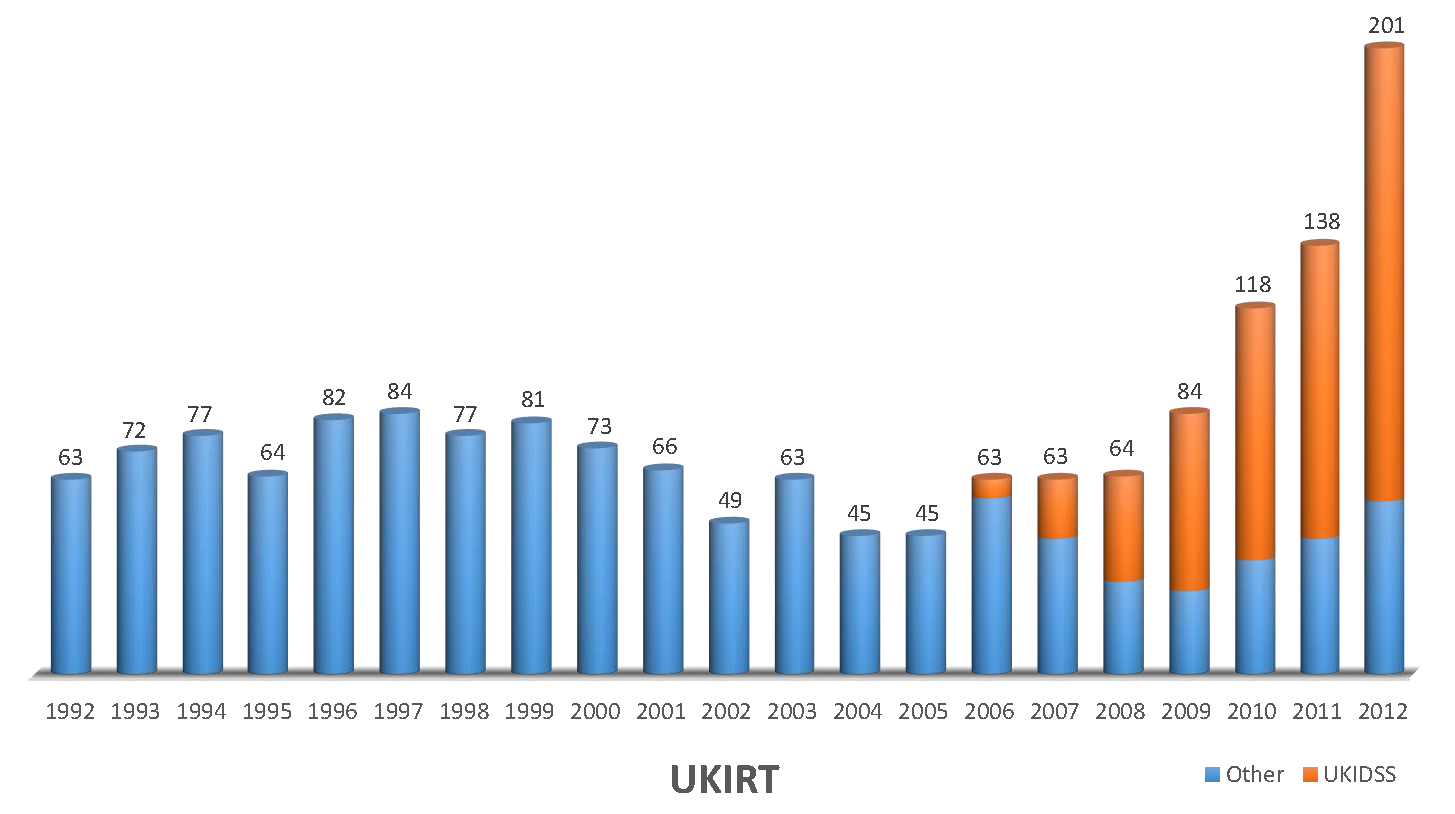
Interesting to note that 2012 was a bumper year for productivity at the UK Infra-Red Telescope (UKIRT), as demonstrated by the following nice graphic.

UKIRT-pubs-2012

Some of my colleagues have expressed a measure of consternation at the fact that unless some individual or organization steps in and offers to take over the running costs, this facility will be closed down at the end of this year (2013). Why shut down a telescope that is generating so many publications?

The answer is of course that, under the UK Government’s new plans for  Gold Open Access, astronomers will be forced to pay Article Processing Charges, possibly exceeding £1000 per paper, in order to disseminate the fruits of their research. The Science and Technology Facilities Council (STFC), which administers the budget for the UK’s astronomy research,  simply can’t afford the level of expenditure required to cover the costs associated with the number of articles being generated by the wanton exploitation of this facility. Indeed, in future, STFC will only be able to operate facilities that produce very few results worthy of publication.

I hope this clarifies the situation.

The End of Cosmology?

Posted in Biographical, The Universe and Stuff with tags , , on February 21, 2013 by telescoper

A very busy day interviewing candidates for a job in Experimental Particle Physics was made even busier by the arrival by the boxes containing all my books and other knick-knacks from Cardiff. Anyway, the net result of all this is that I only have time for a brief post before I go home and lapse into a coma. I can at least do something useful, however, which is to pass on the following announcement:

Presentation of the first cosmologic results of Planck mission as well as its first all-sky images of the Cosmic Microwave Background

Launched in 2009, Planck studies the Cosmic Microwave Background – the relic radiation from the Big Bang – to allow cosmologists to zero-in on theories that describe the Universe’s birth and evolution. The first all-sky images of the Cosmic Microwave Background will be presented at the press conference held in Paris ESA HQ on March 21st, 2013.

We’ve been expecting that the “cosmologic” results from Planck would be announced sometime early this year. Now we know when. March 21st 2013 is the date to put in your diary, and that’s only about a month from now. Exciting times.

Will Planck confirm the standard cosmological model and measure its parameters more precisely? Or will there be the first hints of physics outside the standard model? Will cosmology be all done and dusted, or will we find out that we didn’t understand the Universe as well as we originally thought?

I don’t know. Yet.

The Problem of the Dangling Magnet

Posted in Cute Problems with tags , , , , on February 20, 2013 by telescoper

Here’s a variation on a physics problem we discussed in my first-ever Skills in Physics Tutorial at the University of Sussex. I hadn’t realized that solutions were provided for Tutors so had to exercise my enfeebled brain in finding a solution. You’ll probably find it a lot easier…

A rectangular bar magnet hangs vertically from a pivot at one of its ends. When gently displaced the magnet undergoes small oscillations either side of the vertical with a period of one second.  A horizontal magnetic field is then applied so that the equilibrium orientation of the magnet is  45° to the vertical. If the magnet is gently displaced from this new position, what is the new period of oscillation?

Comment: you do not need any further information about the size, shape or mass of the magnet in order to solve this problem.

Black is the colour of my true love’s hair

Posted in Jazz with tags , , on February 20, 2013 by telescoper

Nina Simone. Emile Latimer. Live in 1969. Magical.

Stars and Planets

Posted in Poetry with tags , , on February 20, 2013 by telescoper

Trees are cages for them: water holds its breath
To balance them without smudging on its delicate meniscus.
Children watch them playing in their heavenly playground;
Men use them to lug ships across oceans, through firths.

They seem so twinkle-still, but they never cease
Inventing new spaces and huge explosions
And migrating in mathematical tribes over
The steppes of space at their outrageous ease.

It’s hard to think that the earth is one –
This poor sad bearer of wars and disasters
Rolls-Roycing round the sun with its load of gangsters,
Attended only by the loveless moon.

by Norman MacCaig (1910-1996).

The Quantum of Teaching

Posted in Education with tags , , , , on February 19, 2013 by telescoper

I’m gradually finding out enough about the way things are organized here at the University of Sussex to make some comparisons between teaching in the School of Mathematical and Physical Sciences here and in the School of Physics and Astronomy at my former employer, Cardiff University.

One difference I’ve noticed is probably something you find rather trivial, but I think it’s quite important. In the usual scheme of undergraduate teaching, which applies across most of the United Kingdom, students gain “credit” for taking and passing modules. A normal year would correspond to 120 credits, so that a three-year BSc degree involves a total of 360 credits and a four-year MPhys (or equivalent) is 480. In universities that run a two-semester teaching year the load per semester is thus 60 credits.

The question then is what is the best way to divide up that 60 credits into smaller pieces? Until recently at Cardiff the basic unit of teaching was a 10-credit module, which meant that students were typically doing six different things alongside each other. An ordinary ten-credit module would involve two lectures per week. Not all of these are lecture courses, however; there’s usually laboratory or computational work as one of the 10 credit chunks. During a recent course review it was decided to increase the size of some of the modules to 20 credits. That’s how it came to pass that I taught a new module of that size last semester (for the first and last time).

The motivation for increasing the size of modules was twofold. One is that having lots of small modules makes the overall study programme disjointed and “bitty”, with students having lots of things on the go at the same time and little opportunity to study any topics in real depth. The other is that having four hours per week instead of two allows the lecturer to use the time more flexibly, in particular with  sessions intended to develop problem-solving skills.

Although the “core” modules at Cardiff increased to 20 credits, the others remained at 10. There was a lot of discussion about increasing all modules, but in the end the new programme was left as a mixture.

Interestingly, here at Sussex the normal module size is 15 credits (and “modules” are also called “courses”), meaning that students actually only do four things at the same time in a typical semester.  In fact this was what I originally suggested when we started the teaching review at Cardiff, but it was thrown out immediately on the grounds that the University had decreed that modules must be multiples of 10 credits only. I’m not sure whether there was an educational reason for this, or just that it made the arithmetic simpler.

Anyway, I like 15 credits as a basic unit but am not sure how many other Schools and Departments run that system. I’d be interested to learn about module sizes favoured elsewhere through the comments box, and here’s a poll so you can vote:

Another difference is that although Sussex has two teaching semesters, the School of Mathematical and Physical Sciences (MPS) does not have mid-year examinations, so First Semester courses are examined in the Summer along with the Second Semester ones.  In Cardiff, modules are examined at the end of the semester in which they are taught. There are pros and cons with this. I think students who are used to mid-year examinations like the fact that the examinations are not all concentrated in one period during the summer and also that they get some feedback on their progress during the year. On the other hand, students may see an end-of-semester examination as an encouragement to close the lid on a particular module and forget about it as soon as it is over, making it harder to understand how different aspects of physics interconnect.

Students at Sussex seem keen not to have mid-year examinations, while those at Cardiff seem equally keen to retain them. I don’t know what that means, so here’s another  poll to see if there’s any clear opinion one way or another among my readers…