Author Archive

The UK’s first female professor

Posted in History, Uncategorized on March 9, 2013 by telescoper

admin's avatarWe Are Cardiff

Hello friends. Happy International Womens Day! To celebrate, our friend Kelly Page has written us a We Are Cardiff about the first female professor to be appointed to the (at the time) Cardiff University. Go! Go!

First Female Professor Appointed in the Largest Coal Port in the World

Imagine it is 1904.

You are living and working in Cardiff, the largest coal port in the world.
You are a woman, 40 years young, working as the head of women’s teacher training in the town’s new university.

The university, University College of South Wales and Monmouthshire (now Cardiff University) is only 20 years old. It was founded with 13 staff and 151 students, 15 of who were women (1883).

You are working at one of the first universities in Britain to open its doors to female students and with a residence specifically for women, Aberdare Hall (1885). A hall that is…

View original post 765 more words

London to Brighton in 4 Minutes

Posted in Television with tags , , on March 7, 2013 by telescoper

Since I’m going to be away from base for a while I thought I’d post this classic film to cover the interruption to normal blogging service. Here’s a description from the Youtube entry.

London to Brighton in Four Minutes, made by the BBC Film Unit in 1952, was a favourite of many viewers during the 1950s. In those days one never knew when it would be screened, but it often popped up when there was an unscheduled gap between programmes. Apparently the journey on the Brighton Belle was filmed at 2 frames per second, thus at the normal projection speed of 24fps a speed of 60 mph becomes 720 mph. The cameraman was sitting in the cab with the train driver and hand cranking the film camera. Each reel of film was only 1000ft and so the camerman had to change the film during the journey. When editing the film these “gaps” were filled with a shot of the train driver.

This film footage is from the Archive Collection held by the Alexandra Palace Television Society.

Modern trains still follow the same route, but there are many new developments either side of the line, including Gatwick Airport…

Updated Guidelines for Open Access from RCUK

Posted in Open Access with tags , on March 6, 2013 by telescoper

I’m about to head off on a short trip, so only have time for the briefest of brief blog posts today. However, at least I have a timely topic. In yesterday’s post about the RCUK Open Access Policy, I mentioned that they were revising their guidelines. Well, today the new guidelines have been published. That qualifies as timely in my book!

You can find the new policy here (PDF file).

I haven’t had time to read them carefully yet, so please feel free to do so on my behalf. Then someone can tell me through the comments box if the suggestion I made yesterday – to donate all the RCUK open access funding to the arXiv instead of handing it out to profiteering publishers – would be allowed under the new guidelines…

What to do with Open Access funding in Physics and Astronomy

Posted in Open Access with tags , , , on March 5, 2013 by telescoper

I’ve been too busy to keep up with the ongoing activity relating to Open Access recently, and I don’t really have time today to do anything other than a brief post on the topic because I’m in the middle of yet another recruitment process and am exhausted by the day’s interviewing.

I do have time to say just a couple of things. One is that it appears that RCUK may be about to back-pedal on its poorly thought out guidelines on Open Access. I hope the new guidance is a significant improvement on the old policy.

Open Access reared its head during a meeting I attended yesterday. RCUK, which is the umbrella organisation for the United Kingdom’s seven research councils, last year announced that it will set aside £17 million next year, and £20 million the year after that, to pay for Gold Open Access publication of the research it sponsors. These funds will be made available to universities in the form of block grants to enable researchers to pay the infamous APCs  (“Article Processing Charges”). The average cost of an APC has been taken from the Finch report (estimated as £1727 plus VAT). Yesterday I was informed of the allocation of funds for Open Access to the School of Mathematical and Physical Sciences at the University of Sussex arising from these block grants. The cash sum involved is too small to pay for Gold Open Access for more than a handful of papers produced within the School, so difficult decisions would have to be made about who is allowed to pay the Author Processing Charges if this pot of money is used in the way RCUK envisages.

Of course, what RCUK should have done was given universities and other research institutions funds to set up and maintain their own Green Open Access databases or international repositories like the arXiv. Throwing money at  Gold Open Access is disastrous way of proceeding. It’s not only ruinously expensive but also unsustainable. In a few years’ time it is inevitable that the traditional academic publishing industry will be bypassed by researchers doing it for themselves. All the money spent propping up the fat cats in the meantime will have been wasted.

Instead of  splashing money around for Gold Open Access,  I think RCUK should mandate that all its research be published in Green Open Access mode. As I’ve mentioned before this would cause considerable fallout not only for the academic publishing industry but also for the learned societies, which largely survive on the income generated subscriptions to their range of overpriced journals.

Nevertheless, we have the RCUK funds and, as Head of School, I’m supposed to decide how to spend them. Even if I could force myself to grit my teeth and agree to fork out out the money in APCs to the Academic Publishing Racketeers, I can’t think of any sensible basis for deciding which papers should be published this way and which shouldn’t. In any case, at least in particle physics and astronomy, most papers are compliant with the RCUK policy anyway because they are placed on the arXiv. I therefore propose not to pay out a single penny of the RCUK OA funds for Gold Open Access, but simply to donate the entire sum as a contribution to the running costs of the arXiv.

I urge Heads of Physics and Astronomy departments elsewhere to do the same with their allocations.

E-ELT: The Big Picture

Posted in Science Politics, The Universe and Stuff with tags , , , on March 4, 2013 by telescoper

Some astronomy news that made a bit of a splash over the weekend was the announcement that the UK is to invest £88 million in the European Extremely Large Telescope. This amount is to be spread over 10 years, so isn’t quite as astronomical as it sounds, but in any case it is only the UK’s contribution to a project that involves large contributions from the other countries involved in the European Southern Observatory. The UK announcement isn’t the end of the story, in fact, as not all the money needed to make the project work is yet in place.

This is all good news, especially because not long ago it seemed quite likely that the UK would have to make a choice between the E-ELT and the Square Kilometre Array. Now it looks like we’re going to be involved in both of the world’s leading ground-based observational facilities. There is a price to be paid, of course. In order to accommodate these projects within the flat-cash budget of the Science and Technology Facilities Council, difficult choices had to be made, and some things have to go. Not everyone will be happy about the outcome, but Big Science requires Big Decisions.

Anyway, it was nice to see the Observer run a piece about this story, although I was a bit baffled by the implication of the caption going with the picture used to illustrate the story:

The European Extremely Large Telescope will study the Magellanic Cloud.

I’ll avoid asking “which Magellanic Cloud (Large or Small)?” and just point out that E-ELT will study a lot more than either or both! Still, people are more likely to read web articles if they include images, so I’ll end this piece with an appropriate one.

Random Astronomical Image

Random Astronomical Image

Planck (but only in name?)

Posted in Science Politics, The Universe and Stuff with tags , , , , , , on March 3, 2013 by telescoper

First, a serious announcement. It appears that the announcement of results from the Planck Mission will be streamed live from ESA HQ on 21st March from 10.00 to 12.00 CET (whatever that is). The UK will remain on GMT until 31st March so the  ESA web server will probably crash at 9am British time on 21st March.

There’s a short press release making this announcement here. It says:

On Thursday 21 March 2013, the main scientific findings from the European Space Agency’s Planck spacecraft will be announced at a press briefing to be held at ESA’s Headquarter in Paris. Simultaneously with this event, data products and scientific papers based on the “nominal” operations period will be made public through the Planck Legacy Archive.

I was interested in the appearance of the word “nominal” in quotes in there so I searched for its meaning in the One True Chambers Dictionary, where I found:

nominal, adj relating to or of the nature of a name or noun; of names; by name; only in name; so-called, but not in reality; inconsiderable, small, minor, in comparison with the real value, hardly more than a matter of form…

Interesting. It seems that the “nominal” could mean, on the one hand, that ESA are being unusually modest about the importance of the forthcoming Planck results or, on the other, that there will now be a host of conspiracy theorists suggesting that the Planck results aren’t real….

That reminds me that years and years ago I had an idea for a crime novel with a plot that revolves around the murder of a prominent cosmologist just as some important scientific discovery is about to be announced. Suspicion gathers that the whole thing is an enormous hoax and the discovery bogus. But the experiment is shrouded in secrecy, and so expensive that it can’t easily be repeated, so  who can tell, and how?

It’s very difficult to know for sure whether any scientific discoveries are genuine or not, even if the data and analysis procedures are made public. There’s always the possibility that everything might have been fabricated simulated, but in most cases the experiment can be repeated at a later date and the fraud eventually exposed, such as in the Schön Scandal.  In Big Science, this may not be practicable. However, Big Science requires big teams of people and the chances are someone would blow the whistle, or try to…

Anyway, I know that there are people out there who take everything I write on this blog absurdly literally so I’ll spell it out that I am in no way suggesting that the Planck mission is a fraud. Or predicting that there’ll be a murder just before the announcements on March 21st. Any similarity purely coincidental and all that. And I’ve never had time to write the book anyway – perhaps a publisher might read this and offer me an advance as an incentive?

Moreover, going back to the Chambers Dictionary, I note the final definition omitted above

…according to plan (space flight)

So that’s that. Nothing sinister. I’m not sure how “nominal” acquired that meaning, mind you, but that’s another story…

Sussex, a month in…

Posted in Biographical, Education, The Universe and Stuff with tags , , on March 2, 2013 by telescoper

Well, although it seems like no time at all it appears I’ve now been in Brighton and working at the University of Sussex for a whole month! Here’s a picture of the street I live in in the Kemptown area of Brighton, taken this afternoon. That’s the English Channel at the end of the road, in case you don’t know where Brighton is; it’s definitely not in the Midlands.
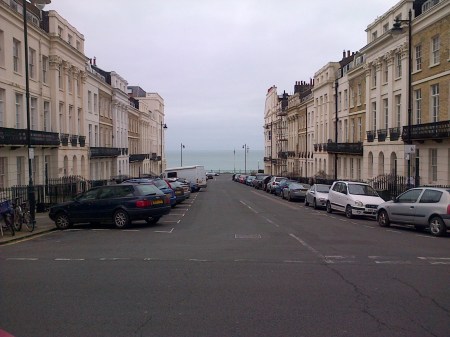
IMG-20130302-00069

I’m currently on campus again, although I made a major miscalculation in that Brighton and Hove Albion are playing at home again today. Since the Amex Stadium is just over the road from the University, that means I’ll either have to go back before the final whistle blows or wait until the crowds have dispersed before returning to base.

It has been unbelievably hectic. Although I knew it was going to be hard work taking over as Head of School halfway through the academic year, several unforeseen things have come up that have made me even busier than I’d anticipated. Some of these were pleasant surprises and some weren’t, but that’s all I’m going to say for now!

Since I arrived a large part of my time has been spent on matters relating to new staff appointments, arising from a mixture of replacements and new investment across the whole School of Mathematical and Physical Sciences. That has included new staff in Applied Mathematics, Theoretical Particle Physics, Experimental Particle Physics, Atomic, Molecular and Optical Physics and of course Astronomy. There are more to come over the next few weeks, including a new group in the area of Probability and Statistics. It’s pleasant work, of course, especially when it goes well (which it definitely is) but I have to admit that the schedule of presentations and interviews is rather exhausting.

Apart from that the other principle preoccupation has been strategic planning for the next five years. On Thursday morning I had a crunch meeting with members of the University’s management team to discuss the plans for MPS, which were actually drafted before I took up my post but have since been modified quite a bit. I was more nervous before that meeting than I’ve been for many years, primarily because I did not know what to expect. It turned out to be quite pleasant, actually, and I left the meeting not only relieved but relaxed.

In the afternoon it was back to interviewing, but this time for postgraduate students. That’s also a pleasant duty, because it involves giving excellent young scientists their first step on the ladder towards a research career. I’m sure it’s not so pleasant for the candidates though. Nerves sometimes get the better of the students in these interviews, but experienced interviewers can calibrate for that. And if you’re nervous, it means that you care…

Anyone reading this who is nervous about doing a PhD interview (or has experienced nerves in one they’ve already had) might reflect on my experience when I was called to interview for a PhD place in Astronomy at the University of Manchester way back in 1985. I was very nervous before that, and arrived very early for my grilling. I was told to wait in a sort of ante-room as the previous interview had only just started. I started to read a textbook I had brought with me. About five minutes later, the door of the interview room opened and the interviewers, Franz Kahn and John Dyson, carried out the unconscious body of the previous candidate. It turned out that, after a couple of friendly preliminary questions, the two Professors had handed the candidate a piece of chalk and told him to go to the blackboard  to work something out, at which point said candidate had fainted. When it was my turn to be handed the chalk I toyed with the idea of staging a mock swoon, but resisted the temptation.

The question, in case you’re interested, was to estimate the angle through which light  is deflected by the Sun’s gravity. I hadn’t done any general relativity in my undergraduate degree, so just did it by dimensional analysis. That seemed to go down well and they offered me a place … which I turned down in favour of Sussex.

A Song for St David’s Day

Posted in Poetry with tags , , , on March 1, 2013 by telescoper

It’s St David’s Day today, so

Dydd Gŵyl Dewi Hapus!

I’m about to head off to three hours of mandatory Health and Safety Training so I’ll do a quick but appropriate post. I have posted this before, but I think it’s beautiful so make no apology for posting it again. It’s called Children’s Song and it’s by the great Welsh poet, R.S. Thomas.

We live in our own world,
A world that is too small
For you to stoop and enter
Even on hands and knees,
The adult subterfuge.
And though you probe and pry
With analytic eye,
And eavesdrop all our talk
With an amused look,
You cannot find the centre
Where we dance, where we play,
Where life is still asleep
Under the closed flower,
Under the smooth shell
Of eggs in the cupped nest
That mock the faded blue
Of your remoter heaven.

by R.S. Thomas (1913-2000)

Bayes in the dock (again)

Posted in Bad Statistics with tags , , , , , on February 28, 2013 by telescoper

This morning on Twitter there appeared a link to a blog post reporting that the Court of Appeal had rejected the use of Bayesian probability in legal cases. I recommend anyone interested in probability to read it, as it gives a fascinating insight into how poorly the concept is understood.

Although this is a new report about a new case, it’s actually not an entirely new conclusion. I blogged about a similar case a couple of years ago, in fact. The earlier story n concerned an erroneous argument given during a trial about the significance of a match found between a footprint found at a crime scene and footwear belonging to a suspect.  The judge took exception to the fact that the figures being used were not known sufficiently accurately to make a reliable assessment, and thus decided that Bayes’ theorem shouldn’t be used in court unless the data involved in its application were “firm”.

If you read the Guardian article to which I’ve provided a link you will see that there’s a lot of reaction from the legal establishment and statisticians about this, focussing on the forensic use of probabilistic reasoning. This all reminds me of the tragedy of the Sally Clark case and what a disgrace it is that nothing has been done since then to improve the misrepresentation of statistical arguments in trials. Some of my Bayesian colleagues have expressed dismay at the judge’s opinion.

My reaction to this affair is more muted than you would probably expect. First thing to say is that this is really not an issue relating to the Bayesian versus frequentist debate at all. It’s about a straightforward application of Bayes’ theorem which, as its name suggests, is a theorem; actually it’s just a straightforward consequence of the sum and product laws of the calculus of probabilities. No-one, not even the most die-hard frequentist, would argue that Bayes’ theorem is false. What happened in this case is that an “expert” applied Bayes’ theorem to unreliable data and by so doing obtained misleading results. The  issue is not Bayes’ theorem per se, but the application of it to inaccurate data. Garbage in, garbage out. There’s no place for garbage in the courtroom, so in my opinion the judge was quite right to throw this particular argument out.

But while I’m on the subject of using Bayesian logic in the courts, let me add a few wider comments. First, I think that Bayesian reasoning provides a rigorous mathematical foundation for the process of assessing quantitatively the extent to which evidence supports a given theory or interpretation. As such it describes accurately how scientific investigations proceed by updating probabilities in the light of new data. It also describes how a criminal investigation works too.

What Bayesian inference is not good at is achieving closure in the form of a definite verdict. There are two sides to this. One is that the maxim “innocent until proven guilty” cannot be incorporated in Bayesian reasoning. If one assigns a zero prior probability of guilt then no amount of evidence will be able to change this into a non-zero posterior probability; the required burden is infinite. On the other hand, there is the problem that the jury must decide guilt in a criminal trial “beyond reasonable doubt”. But how much doubt is reasonable, exactly? And will a jury understand a probabilistic argument anyway?

In pure science we never really need to achieve this kind of closure, collapsing the broad range of probability into a simple “true” or “false”, because this is a process of continual investigation. It’s a reasonable inference, for example, based on Supernovae and other observations that the Universe is accelerating. But is it proven that this is so? I’d say “no”,  and don’t think my doubts are at all unreasonable…

So what I’d say is that while statistical arguments are extremely important for investigating crimes – narrowing down the field of suspects, assessing the reliability of evidence, establishing lines of inquiry, and so on – I don’t think they should ever play a central role once the case has been brought to court unless there’s much clearer guidance given to juries and stricter monitoring of so-called “expert” witnesses.

I’m sure various readers will wish to express diverse opinions on this case so, as usual, please feel free to contribute through the box below!

Omnibus Edition

Posted in Biographical, Education with tags , , , , on February 27, 2013 by telescoper

One of the things I’ve had to get used to about working at a University based on an out-of-town campus is that it’s no longer feasible to walk to work every morning. Fortunately there is an excellent bus service from central Brighton to Falmer, so this isn’t too much of a hardship. I’ve now invested in one of those new-fangled smart cards that makes it very economical not only for getting to work, but also for hopping on and off while pottering about town doing shopping and whatnot.

I have noticed that if I get the No. 25 bus from Old Steine before 8am it only takes about fifteen minutes to get to the University of Sussex. If I’m a bit late starting out, however, and don’t get to the bus stop until after eight in the morning, the trip can take about forty minutes. The problem is that roadworks on the A27 Lewes Road have reduced it to a single lane in each direction; there’s a critical point when the traffic builds up to rush hour levels and then solidifies. Still, I don’t mind getting in before 9am as that gives me useful time before the roll of meetings commences, so I found it quite easy to adapt to the early start.

Anyway sitting on the bus this morning I had a kind of flashback to my schooldays. The school I went to was on the opposite side of Newcastle to where I lived, so I had to take the bus every morning. I did much the same thing in those days as I am doing now, in fact – getting the bus at 7.30 to avoid the heaviest traffic, and often doing the previous night’s homework before lessons started in the morning.

The one thing that was very different in those days (and we’re talking about the Seventies now) was that the “School Run” didn’t really exist. Even the posh kids took the bus or train to School rather than being ferried back and forth by doting parents. I think it did me a lot of good travelling on the bus along with all kinds of other people rather than being transported in the hermetically sealed cocoon of a family car. The famous friendliness of Tyneside folk undoubtedly contributed to the omnibus experience and left me with a lifelong preference for public over private transport. I’ve never owned a car and have no intention of ever doing so.

Anyway, this all reminds me of the (probably apocryphal) quote from Margaret Thatcher:

A man who, beyond the age of 26, finds himself on a bus can count himself as a failure.

Whilst I’d by no means be ashamed to be counted a failure according to a Thatcherite criterion, I did once get a bit riled by a version of it when I was conducting a UCAS Admissions Day at another institution (also a campus university). A (male) parent of one of the candidates asked me why there was so little car parking space for students on the campus. I replied that undergraduates were basically not allowed to park on the campus, otherwise it would be overrun with motor vehicles and wouldn’t be so nice and spacious and green. However, I said, that’s not a problem because there was an excellent bus service that could take students to the University from town and vice versa in just a few minutes. The indignant father bristled and announced in a very loud and angry voice “No son of mine is going to get on a bus”. That was the nearest I’ve ever come to losing my temper with a parent on a university admissions day. Fortunately nothing like it has happened since.

It never would have occurred to my parents to come with me when I visited universities for interview and I would have been horrified if they had insisted on doing so. Nowadays, however, prospective students are invariably accompanied by parents, who generally ask at least as many questions as their offspring do. Is this just an extension of the School Run, or is because parents now have to foot the bill (when in my day there were maintenance grants and no tuition fees). Either way, times have definitely changed.

Anyway, I’m about to get the bus home. Tomorrow we are interviewing prospective postgraduate (PhD) students. I don’t think any will bring their parents along. And quite a few may even come on the bus.