Author Archive

Three Tips for Solving Physics Problems

Posted in Cute Problems, Education with tags , , , , , on November 2, 2012 by telescoper

I spent quite some time this morning going over some coursework problems with my second-year Physics class. It’s quite a big course – about 100 students take it – but I mark all the coursework myself so as to get a picture of what  the students are finding easy and what difficult. After returning the marked scripts I then go through general matters arising with them, as well as making the solutions available on our on-line system called Learning Central.

Anyway, this morning I decided to devote quite a bit of time to some tips about how to tackle physics problems, not only in terms of how to solve them but also how to present the answer in an appropriate way.

I began with the Feynman algorithm for solving physics problems:

  1. Write down the problem.
  2. Think very hard.
  3. Write down the answer.

That may seem either arrogant or facetious, or just a bit of a joke, but that’s really just the middle bit. Feynman’s advice on points 1 and 3 is absolutely spot on and worth repeating many times to an audience of physics students.

I’m a throwback to an older style of school education when the approach to solving unseen mathematical or scientific problems was emphasized much more than it is now. Nowadays much more detailed instructions are given in School examinations than in my day, often to the extent that students  are only required to fill in blanks in a solution that has already been mapped out.

I find that many, particularly first-year, students struggle when confronted with a problem with nothing but a blank sheet of paper to write the solution on. The biggest problem we face in physics education, in my view, is not the lack of mathematical skill or background scientific knowledge needed to perform calculations, but a lack of experience of how to set the problem up in the first place and a consequent uncertainty about, or even fear of, how to start. I call this “blank paper syndrome”.

In this context, Feynman’s advice is the key to the first step of solving a problem. When I give tips to students I usually make the first step a bit more general, however. It’s important to read the question too.

The middle step is more difficult and often relies on flair or the ability to engage in lateral thinking, which some people do more easily than others, but that does not mean it can’t be nurtured.  The key part is to look at what you wrote down in the first step, and then apply your little grey cells to teasing out – with the aid of your physics knowledge – things that can lead you to the answer, perhaps via some intermediate quantities not given directly in the question. This is the part where some students get stuck and what one often finds is an impenetrable jumble of mathematical symbols  swirling around randomly on the page.

Everyone gets stuck sometimes, but you can do yourself a big favour by at least putting some words in amongst the algebra to explain what it is you were attempting to do. That way, even if you get it wrong, you can be given some credit for having an idea of what direction you were thinking of travelling.

The last of Feynman’s steps  is also important. I lost count of the coursework attempts I marked this week in which the student got almost to the end, but didn’t finish with a clear statement of the answer to the question posed and just left a formula dangling.  Perhaps it’s because the students might have forgotten what they started out trying to do, but it seems very curious to me to get so far into a solution without making absolutely sure you score the points.  IHaving done all the hard work, you should learn to savour the finale in which you write “Therefore the answer is…” or “This proves the required result”. Scripts that don’t do this are like detective stories missing the last few pages in which the name of the murderer is finally revealed.

So, putting all these together, here are the three tips I gave to my undergraduate students this morning.

  1. Read the question! Some solutions were to problems other than that which was posed. Make sure you read the question carefully. A good habit to get into is first to translate everything given in the question into mathematical form and define any variables you need right at the outset. Also drawing a diagram helps a lot in visualizing the situation, especially helping to elucidate any relevant symmetries.
  2. Remember to explain your reasoning when doing a mathematical solution. Sometimes it is very difficult to understand what you’re trying to do from the maths alone, which makes it difficult to give partial credit if you are trying to the right thing but just make, e.g., a sign error.
  3.  Finish your solution appropriately by stating the answer clearly (and, where relevant, in correct units). Do not let your solution fizzle out – make sure the marker knows you have reached the end and that you have done what was requested.

There are other tips I might add – such as checking answers by doing the numerical parts at least twice on your calculator and thinking about whether the order-of-magnitude of the answer is physically reasonable – but these are minor compared to the overall strategy.

And another thing is not to be discouraged if you find physics problems difficult. Never give up without a fight. It’s only by trying difficult things that you can improve your ability by learning from your mistakes. It’s not the job of a physics lecturer to make physics seem easy but to encourage you to believe that you can do things that are difficult.

So anyway that’s my bit of “reflective practice” for the day. I’m sure there’ll be other folk reading this who have other tips for solving mathematical and scientific problems, in which case feel free to add them through the comments box.

At the Mountains of Madness

Posted in Literature, The Universe and Stuff with tags , , , , on November 1, 2012 by telescoper

Well, I don’t know whether it is some sort of Hallowe’en skit or what, but the estimable arXiv has certainly served up something unusual today, in the form of a paper by one Benjamin K. Tippett with the intriguing title Possible Bubbles of Spacetime Curvature in the South Pacific. Here is the abstract:

In 1928, the late Francis Wayland Thurston published a scandalous manuscript in purport of warning the world of a global conspiracy of occultists. Among the documents he gathered to support his thesis was the personal account of a sailor by the name of Gustaf Johansen, describing an encounter with an extraordinary island. Johansen`s descriptions of his adventures upon the island are fantastic, and are often considered the most enigmatic (and therefore the highlight) of Thurston`s collection of documents.

We contend that all of the credible phenomena which Johansen described may be explained as being the observable consequences of a localized bubble of spacetime curvature. Many of his most incomprehensible statements (involving the geometry of the architecture, and variability of the location of the horizon) can therefore be said to have a unified underlying cause.

We propose a simplified example of such a geometry, and show using numerical computation that Johansen`s descriptions were, for the most part, not simply the ravings of a lunatic. Rather, they are the nontechnical observations of an intelligent man who did not understand how to describe what he was seeing. Conversely, it seems to us improbable that Johansen should have unwittingly given such a precise description of the consequences of spacetime curvature, if the details of this story were merely the dregs of some half remembered fever dream.

We calculate the type of matter which would be required to generate such exotic spacetime curvature. Unfortunately, we determine that the required matter is quite unphysical, and possess a nature which is entirely alien to all of the experiences of human science. Indeed, any civilization with mastery over such matter would be able to construct warp drives, cloaking devices, and other exotic geometries required to conveniently travel through the cosmos.

Despite the unusual subject matter, it certainly doesn’t read like a skit, which means that if that’s what it is then it’s a very good one. Alternatively, it could just be that Dr Tippett might be taking it all a bit too literally. However, the paper is full of names that will ring a bell to anyone familiar with the works of H.P. Lovecraft, especially those relating to Cthulhu. Anyway, sounds like an ideal topic for further investigation. Time to put my grant-writing hat on!

P.S. The title of this post is taken from ref. [2] in the aforementioned arXiv paper.

Monster Mash-up

Posted in Biographical, Music with tags , , , on October 31, 2012 by telescoper

It’s Hallowe’en again, and although I feel I should concoct something appropriate, I really don’t have time. I’ve decided therefore to recycle a couple of items I’ve previously posted on this lamentable occasion.

We never had Halloween when I was a kid. I mean it existed. People mentioned it. There were programmes on the telly. But we never celebrated it. At least not in my house, when I was a kid. It just wasn’t thought of as a big occasion. Or, worse, it was “American” (meaning that it was tacky, synthetic and commercialised).  Cue this seasonable clip from Fry & Laurie

So there were no Halloween parties, no costumes, no horror masks, no pumpkins and definitely no trick-or-treat when I was a lad.

Having never done trick-or-treat myself as a child, I never really had any clue what it was about until relatively recently. I’d always assumed “Trick or Treat?” was a rhetorical question or merely a greeting like “How do you do?”.

In fact my first direct experience of this perculiar custom  didn’t happen until I was in my mid-thirties and had moved to a suburban house in Beeston, just outside Nottingham. I was sitting at home one October 31st, watching the TV and – probably, though I can’t remember for sure – drinking a glass of wine, when the front door bell rang. I didn’t really want to, but I got up and answered it.

When I opened the door, I saw in front of me two small girls in witches’ costumes. Behind them, near my front gate, was an adult guardian, presumably a parent, keeping a watchful eye on them.

“Trick or Treat?” the two girls shouted. Trying my best to get into the spirit but not knowing what I was actually supposed to do, I answered “Great! I’d like a treat please”.

They stared at me as if I was mad, turned round and retreated towards their minder who was clearly making a mental note to avoid this house in future. Off they went and I, embarrassed at being exposed as a social inadequate, retired to my house in shame.

Ever since then I’ve tried to ensure that I never again have to endure such Halloween horrors. Every October 31st, when nightfall comes, I switch off the TV, radio and lights and sit soundlessly in the dark so the trick-or-treaters think there’s nobody home.

That way I can be sure I won’t be made to feel uncomfortable.

Anyway, despite my own  reservations about Hallowe’en, I’ve decided to resurrect the following little video which seems to be appropriate for the occasion. It’s made of bits of old horror B-movies but the music – by Bobby “Boris” Pickett and the Crypt-kickers is actually the second single I ever bought, way back in 1973. I wonder if you can guess what the first one was?

A Sense of Proportion – Postscript

Posted in The Universe and Stuff with tags , , on October 30, 2012 by telescoper

It took all day to do so, evidently because I’m old and slow, but this morning’s post eventually got round to reminding me of this cartoon, the context of which is described here. Was that really in 1992? That was twenty years ago!

The Total Perspective Vortex

Posted in The Universe and Stuff with tags , , on October 30, 2012 by telescoper

Vortices are swirling around in my mind these days. Not only because of Hurricane Sandy, but also because I’ve got to prepare a couple of lectures about vorticity in fluid mechanics to give next week. Anyway, all that reminded me of this classic sequence from the original radio series The Hitchhiker’s Guide to the Galaxy, by the late great Douglas Adams. I particularly agree with the conclusion “that if life is going to exist in a Universe of this size, then the one thing it cannot afford to have is a sense of proportion”.

Gravity Waves Detected!

Posted in The Universe and Stuff with tags , , on October 29, 2012 by telescoper

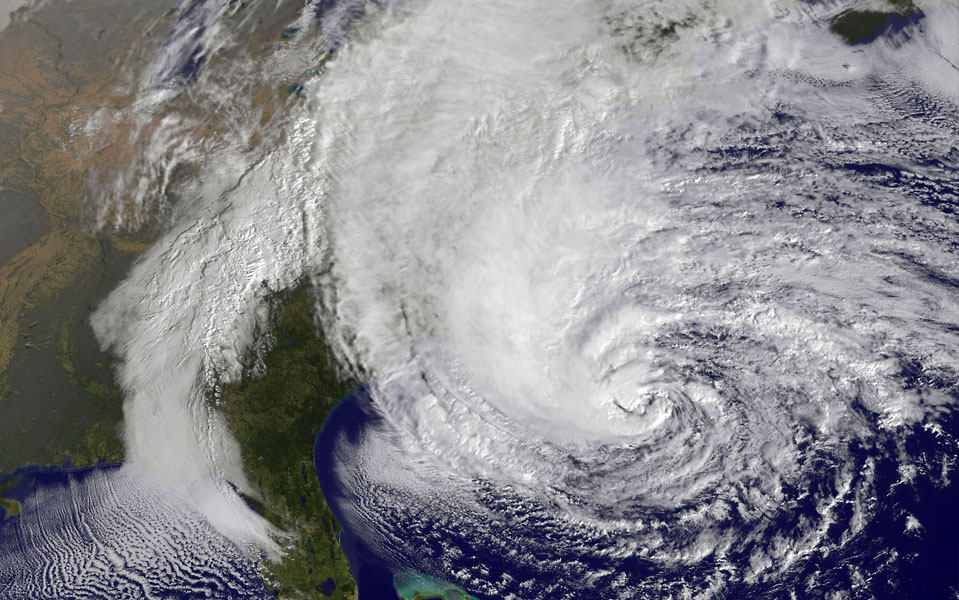
At last, for all you sceptics out there, Hurricane Sandy has finally provided definitive proof of the existence of gravity waves, clearly visible to the South West of the storm…

Apologies if you thought I meant gravitational waves. The confusion was entirely intentional.

Out of the Cool

Posted in Jazz with tags , , , on October 28, 2012 by telescoper

I’ve been taking it easy today, attempting to recover from a bout of sickness by loafing about and listening to old records. I don’t know why I haven’t listened to Out of the Cool by the Gil Evans Orchestra for a while, but at least that meant I came back to it relatively fresh.

Gil Evans was one of the few composer/arrangers in Jazz to have successfully blended his own orchestral textures with solo improvisations in such a way that both complement each other; the scored passages he devised are complex and beautiful, but never so rigid that they inhibit the soloist’s imagination. He directed a number of albums that incorporated Jazz solos in classically-inspired orchestral settings, including Sketches of Spain and Porgy and Bess (with Miles Davis). This one is less famous than those, but in my opinion at least as good.

Trumpeter Johnny Coles (no relation) is particularly inspired by the imaginative surroundings constructed by Gil Evans on this album, and he responds by inventing beautiful solo lines on several tracks on this album. But the tonal spectrum he encompasses, his use of dynamics, and his distinctive play with inflection are best illustrated by his feature piece, Sunken Treasure, a mysterious, almost evanescent creation which he fashions out of Evans’ floating harmonies. I think this is the best track off a great album.

Crossed Words

Posted in Crosswords with tags , , , on October 28, 2012 by telescoper

I’m still a bit fragile after a sudden bout of illness. Judging by my symptoms – and the fact that the worst of it seems to have passed in about 24 hours – I think it must have been this (i.e. the dreaded “Winter Vomiting Bug”). You’ll be relieved that I don’t intend to go into the details on here.

Anyway, being out of action all day yesterday has put me behind on a number of important things, including the weekend’s crosswords which also reminded me that it’s been a while since I posted anything in that particular file on here.  I did manage to get out to buy yesterday’s Independent, but haven’t started the puzzle yet. Incidentally, I should mention that I recently won the Independent Crossword Prize for the NINTH time. That means I’ve accumulated nine copies of the Oxford Dictionary and Thesaurus in little over a year. I keep getting envious comments from people who’ve been entering this competition for years and have never won, but I seem to win it regularly every few weeks.  I have one copy of the Oxford Dictionary and Thesaurus at home, one in my office at work. I gave one to my mum and the rest I’ve distributed to colleagues at work. I’ve even started a waiting list, although I may move on from Cardiff before I can fulfil all the requests…

Anyway, I was cheered this morning when I discovered that I’d won a VHC (“Very Highly Commended”) in the Observer’s Azed Crossword Puzzle No. 2105. This puzzle was a “special” with the theme “Collisions”, introduced with the following rubric:

Down clues are normal. Each across entry consists of two answers which ‘collide’,  i.e. they overlap by one or more letters, the overlapping letters always appearing in  their correct order. Across clues consist of definitions of each of the full overlapping  answers and subsidiary indications of each minus the overlapping letters. Definition and subsidiary indication for one answer precede those for the other, but either  may come first. Numbers in brackets indicate the lengths of complete entries. One  across answer consists of two words. Competitors should submit with their entries  a clue in the style of the other acrosses to the unclued ‘collision’ at 1 Across, which  must be deduced.

I’m always very wary of unclued lights, but in this case it was quite easy to deduce TITANIC/ICEBERG was the combination that went with the overall theme as well as fitting with the other clues. I didn’t think that, for a “special”, the puzzle was all that difficult to solve but I did find it a mighty struggle to come up with a clue in which the join between the two separate parts was reasonably well disguised and which had a reasonable surface reading. My attempt was

Showing sex appeal in leather, very large bird knocked back cold fish

I’ll leave it to the reader to parse the clue and see how it fits with the instructions.

Anyway, with that I’m up to 10th place in the Annual Honours Table, but with only 3 out of 13 puzzles completed there’s plenty of time to fall back to my usual position!

Now, time to see if I can eat something without unwanted special effects….

Ode to the West Wind

Posted in Poetry with tags , on October 26, 2012 by telescoper

I

O wild West Wind, thou breath of Autumn’s being,
Thou, from whose unseen presence the leaves dead
Are driven, like ghosts from an enchanter fleeing,

Yellow, and black, and pale, and hectic red,
Pestilence-stricken multitudes: O thou,
Who chariotest to their dark wintry bed

The winged seeds, where they lie cold and low,
Each like a corpse within its grave, until
Thine azure sister of the Spring shall blow

Her clarion o’er the dreaming earth, and fill
(Driving sweet buds like flocks to feed in air)
With living hues and odors plain and hill:

Wild Spirit, which art moving everywhere;
Destroyer and preserver; hear, oh, hear!

II

Thou on whose stream, ‘mid the steep sky’s commotion,
Loose clouds like earth’s decaying leaves are shed,
Shook from the tangled boughs of Heaven and Ocean,

Angels of rain and lightning: there are spread
On the blue surface of thine aery surge,
Like the bright hair uplifted from the head

Of some fierce Maenad, even from the dim verge
Of the horizon to the zenith’s height,
The locks of the approaching storm. Thou dirge

Of the dying year, to which this closing night
Will be the dome of a vast sepulchre,
Vaulted with all thy congregated might

Of vapors, from whose solid atmosphere
Black rain, and fire, and hail will burst: oh, hear!

III

Thou who didst waken from his summer dreams
The blue Mediterranean, where he lay,
Lulled by the coil of his crystalline streams,

Beside a pumice isle in Baiae’s bay,
And saw in sleep old palaces and towers
Quivering within the wave’s intenser day,

All overgrown with azure moss and flowers
So sweet, the sense faints picturing them! Thou
For whose path the Atlantic’s level powers

Cleave themselves into chasms, while far below
The sea-blooms and the oozy woods which wear
The sapless foliage of the ocean, know

Thy voice, and suddenly grow gray with fear,
And tremble and despoil themselves: oh, hear!

IV

If I were a dead leaf thou mightest bear;
If I were a swift cloud to fly with thee;
A wave to pant beneath thy power, and share

The impulse of thy strength, only less free
Than thou, O uncontrollable! If even
I were as in my boyhood, and could be

The comrade of thy wanderings over Heaven,
As then, when to outstrip thy skiey speed
Scarce seemed a vision; I would ne’er have striven

As thus with thee in prayer in my sore need.
Oh, lift me as a wave, a leaf, a cloud!
I fall upon the thorns of life! I bleed!

A heavy weight of hours has chained and bowed
One too like thee: tameless, and swift, and proud.

V

Make me thy lyre, even as the forest is:
What if my leaves are falling like its own!
The tumult of thy mighty harmonies

Will take from both a deep, autumnal tone,
Sweet though in sadness. Be thou, Spirit fierce,
My spirit! Be thou me, impetuous one!

Drive my dead thoughts over the universe
Like withered leaves to quicken a new birth!
And, by the incantation of this verse,

Scatter, as from an unextinguished hearth
Ashes and sparks, my words among mankind!
Be through my lips to unawakened earth

The trumpet of a prophecy! O Wind,
If Winter comes, can Spring be far behind?

by Percy Bysshe Shelley (1792-1822).

Posted on the occasion of my garden umbrella being blown into next door’s garden and smashing a pane of glass in their greenhouse and causing me to have to pay for the repairs and nearly being late for work.

Rubbishing the Viva

Posted in Education with tags , , , , , on October 25, 2012 by telescoper

There’s a strange article today in the Times Higher that claims that the UK’s system of examining PhD students is “a scandal” and that it is “way behind the rest of the world”. These comments are from a chap called Ron Barnett (an emeritus professor at the Institute for Education, who explains

“Students can spend five years doing their PhD, present their thesis and come up against the maverick view of an independent examiner and in effect be rubbished,” he commented.

“I’ve seen it happen far too many times,” he told a Westminster Higher Education Forum seminar on the future of postgraduate education, held in London on 17 October.

I have to say I find it hard to reconcile such remarks with the business of examining PhDs as I’ve observed it, in Physics and Astronomy. And I’ve done quite a few over the years; see, e.g., here. For a start, it’s extremely rare for a student to spend five years doing a PhD in my field – the Research Councils put extremely strong pressure on departments to ensure that students submit within four years, and most research students take less time than this to produce their thesis.

But it’s the idea that a maverick external examiner can sabotage a PhD that I find hardest to recognize. If that looks like happening the internal examiner should stand up for the candidate. In fact, here in Cardiff we have an additional safeguard against this sort of eventuality: each viva has a Chair as well as the two examiners. The Chair is just there to ensure fair play and that proper procedure is followed, but is rarely (if ever) called upon to intervene in practice.

I can’t speak for other fields, of course, and it may indeed be more of a problem in other disciplines. Curiously, Prof. Barnett says that he has seen it happen “far too many times”. I wonder how? As internal examiner? In which case he should have stepped in to stop it? If not as internal then in what capacity was he privy to the conduct of a PhD viva? I’m confused.

Anyway, in a couple of weeks I’ll be participating in a PhD examination in another country (Denmark). There the defence is public, and it involves two external “opponents”, but I don’t know whether it is easier or harder for the candidate than the British system so I won’t comment on whether it’s fairer or more rigorous than what we have in the UK. I’m very much looking forward to seeing how it works, actually.

In my opinion, if there is a “scandal” in the system of UK PhD examinations, at least in science disciplines, it’s not the one Prof. Barnett describes. It’s that we produce far too many low-quality PhDs based on dull, incremental research and that, if anything, externals are not tough enough.

There, I’ve said it. No doubt you’ll have a go at me through the comments box!