Owing to a combination of circumstances, I’ve decided to take a break from blogging for a while. Normal services will be resumed as soon as possible but, for the time being, there will now follow a short intermission.
Follow @telescoperAuthor Archive
The Higgs? A Definite Maybe..
Posted in The Universe and Stuff with tags ATLAS, CERN, CMS, Higgs Boson, Large Hadron Collider, lhc, Particle Physics on July 4, 2012 by telescoperThis is really something for expert particle physicists to blog about, but I couldn’t resist saying something about this morning’s dramatic physics news.
Well, after yesterday’s preview here is the actual press release from CERN:
Geneva, 4 July 2012. At a seminar held at CERN1 today as a curtain raiser to the year’s major particle physics conference, ICHEP2012 in Melbourne, the ATLAS and CMS experiments presented their latest preliminary results in the search for the long sought Higgs particle. Both experiments observe a new particle in the mass region around 125-126 GeV.
“We observe in our data clear signs of a new particle, at the level of 5 sigma, in the mass region around 126 GeV. The outstanding performance of the LHC and ATLAS and the huge efforts of many people have brought us to this exciting stage,” said ATLAS experiment spokesperson Fabiola Gianotti, “but a little more time is needed to prepare these results for publication.”
“The results are preliminary but the 5 sigma signal at around 125 GeV we’re seeing is dramatic. This is indeed a new particle. We know it must be a boson and it’s the heaviest boson ever found,” said CMS experiment spokesperson Joe Incandela. “The implications are very significant and it is precisely for this reason that we must be extremely diligent in all of our studies and cross-checks.”
“It’s hard not to get excited by these results,” said CERN Research Director Sergio Bertolucci. “ We stated last year that in 2012 we would either find a new Higgs-like particle or exclude the existence of the Standard Model Higgs. With all the necessary caution, it looks to me that we are at a branching point: the observation of this new particle indicates the path for the future towards a more detailed understanding of what we’re seeing in the data.”
The results presented today are labelled preliminary. They are based on data collected in 2011 and 2012, with the 2012 data still under analysis. Publication of the analyses shown today is expected around the end of July. A more complete picture of today’s observations will emerge later this year after the LHC provides the experiments with more data.
The next step will be to determine the precise nature of the particle and its significance for our understanding of the universe. Are its properties as expected for the long-sought Higgs boson, the final missing ingredient in the Standard Model of particle physics? Or is it something more exotic? The Standard Model describes the fundamental particles from which we, and every visible thing in the universe, are made, and the forces acting between them. All the matter that we can see, however, appears to be no more than about 4% of the total. A more exotic version of the Higgs particle could be a bridge to understanding the 96% of the universe that remains obscure.
“We have reached a milestone in our understanding of nature,” said CERN Director General Rolf Heuer. “The discovery of a particle consistent with the Higgs boson opens the way to more detailed studies, requiring larger statistics, which will pin down the new particle’s properties, and is likely to shed light on other mysteries of our universe.”
Positive identification of the new particle’s characteristics will take considerable time and data. But whatever form the Higgs particle takes, our knowledge of the fundamental structure of matter is about to take a major step forward.
There’s a hive of internet activity related to this announcement, and I can’t possibly link to all the excellent expert commentary going on, but for details you can do no better that Sean Carroll’s live blog from Geneva or the Guardian’s live blog.
In a nutshell, there’s definitely something in both CMS and Atlas data which, if it really is a new particle, is definitely a boson and which weighs in around 125 GeV. The two-photon decays are consistent with what a standard model Higgs boson would be expected to produce, for example. The consistency between the two experiments is very compelling.
The overall level of significance is around 5σ. I’ll refrain from making churlish comments about the frequentist language and just say that the LHC certainly seems to have detected something that could definitely be the Higgs. This is genuinely exciting because it has come more quickly than most people expected. That’s a tribute to the LHC teams, I’d say.
However, it isn’t yet proven that the Higgs what this particle is. If it’s a new particle that’s not the Higgs that could be even more interesting. To establish the identity of the particle that has been discovered will require a lot more work, looking at much more detailed aspects of its behaviour as revealed by collision data. But it’s certainly possible that it is the Higgs, and I venture to suggest that’s what most particle physicists think it is.
So a discovery. A palpable discovery. Now comes the exploration…
Follow @telescoperHiggs Preview
Posted in Science Politics, The Universe and Stuff with tags ATLAS, CERN, CMS, Higgs Boson, Large Hadron Collider, lhc, Particle Physics on July 3, 2012 by telescoperI’m a bit slow to post anything about the ongoing bout of Higgs-steria that’s been engulfing the interwebs in recent days. Even Andy Lawrence got there ahead of me. What’s caused all the commotion is an announcement about an announcement from CERN at a special seminar tomorrow (Wednesday 4th July) at 9am CEST, which is 8am British “Summer” Time. Here’s a bit of the press release:
CERN will hold a scientific seminar at 9:00 CEST on 4 July to deliver the latest update in the search for the Higgs boson. At this seminar, coming on the eve of this year’s major particle physics conference, ICHEP, in Melbourne, the ATLAS and CMS experiments will deliver the preliminary results of their 2012 data analysis.
“Data taking for ICHEP concluded on Monday 18 June after a very successful first period of LHC running in 2012,” said CERN’s Director for Accelerators and Technology, Steve Myers. “I’m very much looking forward to seeing what the data reveals.”
The 2012 LHC run schedule was designed to deliver the maximum possible quantity of data to the experiments before the ICHEP conference, and with more data delivered between April and June 2012 than in the whole 2011 run, the strategy has been a success. Furthermore, the experiments have been refining their analysis techniques to improve their efficiency in picking out Higgs-like events from the millions of collisions occurring every second. This means that their sensitivity to new phenomena has significantly increased for both years’ data sets. The crunching of all this data has been done by the Worldwide LHC Computing Grid, which has exceeded its design specifications to handle the unprecedented volume of data and computing.
“We now have more than double the data we had last year,” said CERN Director for Research and Computing, Sergio Bertolucci, “that should be enough to see whether the trends we were seeing in the 2011 data are still there, or whether they’ve gone away. It’s a very exciting time.”
I won’t try to repeat what’s been said better and more authoritatively elsewhere; a nice collection of video material at the STFC website and a piece by Sean Carroll (also here) are worth mentioning if you’re not up on why the Higgs Boson is so important.
I wrote a rather facetious post about the last episode of Higgs-mania way back in December because I found the actual announcement to be a bit of a damp squib and the associated hype rather irritating. This time there are even more rumours flying around – not to everyone’s approval – but it’s obviously best to wait and see what is actually announced rather than comment on them.
The main question in my mind is whether it’s sufficiently interesting to get up in time to watch the seminar 8am tomorrow morning…
Brian Cox is 44.
Follow @telescoperHerschel at the Royal Society
Posted in The Universe and Stuff with tags European Space Agency, Herschel Space Observatory, Royal Society, Summer Science Exhibition on July 2, 2012 by telescoperI found this nice little video about the forthcoming Royal Society Summer Science Exhibition which opens tomorrow at the Royal Society’s premises in Carlton House Terrace in London.
Astronomers from Cardiff University are heavily involved in one of the exhibits related to the Herschel Telescope – To infrared and beyond. I’m actually doing a couple of shifts on the Herschel stand myself, on Thursday and Friday afternoons, as well as during a posh black tie “soirée” on Thursday evening. Last time I attended such an event (in 2009) was during a heat wave, which made the soirée an uncomfortably sticky experience, but the forecast suggests the weather might be a bit different this time round…
Follow @telescoperThe Rain
Posted in Poetry with tags Poetry, Robert Creeley, The Rain on July 2, 2012 by telescoperAll night the sound had
come back again,
and again falls
this quiet, persistent rain.
What am I to myself
that must be remembered,
insisted upon
so often? Is it
that never the ease,
even the hardness,
of rain falling
will have for me
something other than this,
something not so insistent—
am I to be locked in this
final uneasiness.
Love, if you love me,
lie next to me.
Be for me, like rain,
the getting out
of the tiredness, the fatuousness, the semi-
lust of intentional indifference.
Be wet
with a decent happiness.
by Robert Creeley (1926-2005).
Follow @telescoper
Five Years On
Posted in Biographical with tags Cardiff University, Credit Crunch, Peter Principle, Promotion, Universities on July 1, 2012 by telescoperSo here we are then. July 1st 2012. Five years to the day since I started my job here in the School of Physics and Astronomy at Cardiff University. Cardiff students reading this will probably be surprised that I haven’t been here for longer than that, because it no doubt seems to younger folks that the staff must have been here since the Boer War. In fact, though, I’ve only been here long enough to see one generation of MPhys students through from induction to graduation; the second such group will graduate in a couple of weeks.
There’s a wikipedia page listing all the important events of July 1st 2007 but owing to some form of administrative error my move to Cardiff isn’t listed there. I notice that July 1st 2007 was also a Sunday, incidentally.
Thinking back to 2007 all I can remember was that my departure from Nottingham appeared to precipitate a collapse in the world’s financial system, ushering in the Credit Crunch just when I put my house in Beeston on the market, with the result that it took me the best part of a year to sell it and buy one here in lovely Pontcanna. In the meantime I had to rent a flat in Cardiff in which I lived during the week and travel back and forth to and from Nottingham at weekends. Actually, the weather in the summer of 2007 wasn’t too different from that of 2012; heavy rain in June and July that year led to the Severn flooding, causing considerable problems for my weekly commute.
Coincident with being the fifth anniversary of my arrival here from Nottingham, today is also the day that I’m officially promoted to Deputy Head of School and Director of Learning and Teaching. Or is it Director of Teaching and Learning? Anyway, five years isn’t exactly a meteoric rise through the ranks but I’m still shocked to have been placed in a position of such responsibility. I fear that the Peter Principle may be doubly appropriate.
The reason I got landed in it was given this opportunity for career progression was the departure of Derek Ward-Thompson to a position of Director of the Jeremiah Horrocks Institute at the University of Central Lancashire (in the Midlands); there was a farewell party for Derek at the Poet’s Corner on Friday which I attended briefly before heading off to the concert I wrote about yesterday. After fourteen years in Cardiff, Derek will be missed around here and I wish him well in his new job.
Meanwhile, life goes on. The last five years have certainly had their ups and downs, both personal and professional, but I’ve definitely got no regrets about moving here. I wouldn’t have predicted in 2007 that I’d be able to gather such a wonderful group of PhD students (Jo, Geraint and Ian), for example, nor that I’d find Cardiff undergraduates such fun to teach, especially as project students.
Here’s to the next five years!
PS. I am tempted to joke that Derek’s move from Cardiff to UCLAN improves the quality of astronomical research at both institutions. But of course I wouldn’t dream of saying anything like that…
:)
Follow @telescoperReffing Madness
Posted in Science Politics with tags funding, HEFCE, Leighton Andrews, Physics, Queen Mary, Research Excellence Framework, research impact, Science Politics, Universities, University of London, Wales on June 30, 2012 by telescoperI’m motivated to make a quick post in order to direct you to a blog post by David Colquhoun that describes the horrendous behaviour of the management at Queen Mary, University of London in response to the Research Excellence Framework. It seems that wholesale sackings are in the pipeline there as a result of a management strategy to improve the institution’s standing in the league tables by “restructuring” some departments.
To call this strategy “flawed” would be the understatement of the year. Idiotic is a far better word. The main problem being that the criteria being applied to retain or dismiss staff bear no obvious relation to those adopted by the REF panels. To make matters worse, Queen Mary has charged two of its own academics with “gross misconduct” for having the temerity to point out the stupidity of its management’s behaviour. Read on here for more details.
With the deadline for REF submissions fast approaching, it’s probably the case that many UK universities are going into panic mode, attempting to boost their REF score by shedding staff perceived to be insufficiently excellent in research and/or luring in research “stars” from elsewhere. Draconian though the QMUL approach may seem, I fear it will be repeated across the sector. Clueless university managers are trying to guess what the REF panels will think of their submissions by staging mock assessments involving external experts. The problem is that nobody knows what the actual REF panels will do, except that if the last Research Assessment Exercise is anything to go by, what they do will be nothing like what they said they would do.
Nowhere is the situation more absurd than here in Wales. The purported aim of the REF is to allocated the so-called “QR” research funding to universities. However, it is an open secret that in Wales there simply isn’t going to be any QR money at all. Leighton Andrews has stripped the Higher Education budget bare in order to pay for his policy of encouraging Welsh students to study in England by paying their fees there.
So here we have to enter the game, do the mock assessments, write our meaningless “impact” cases, and jump through all manner of pointless hoops, with the inevitable result that even if we do well we’ll get absolutely no QR money at the end of it. The only strategy that makes sense for Welsh HEIs such as Cardiff University, where I work, is to submit only those researchers guaranteed to score highly. That way at least we’ll do better in the league tables. It won’t matter how many staff actually get submitted, as the multiplier is zero.
There’s no logical argument why Welsh universities should be in the REF at all, given that there’s no reward at the end. But we’re told we have to by the powers that be. Everyone’s playing games in which nobody knows the rules but in which the stakes are people’s careers. It’s madness.
I can’t put it better than this quote:
These managers worry me. Too many are modest achievers, retired from their own studies, intoxicated with jargon, delusional about corporate status and forever banging the metrics gong. Crucially, they don’t lead by example.
Any reader of this blog who works in a university will recognize the sentiments expressed there. But let’s not blame it all on the managers. They’re doing stupid things because the government has set up a stupid framework. There isn’t a single politician in either England or Wales with the courage to do the right thing, i.e. to admit the error and call the whole thing off.
Follow @telescoperStravinsky, Dutilleux and Beethoven at RWCMD
Posted in Music with tags Henri Dutilleux, Igor Stravinsky, Lothar Koenigs, Ludwig van Beethoven, Mystere de L'instant, Orchestra of Welsh National Opera, Ragtime, Symphony No. 4 in B flat Op. 60 on June 30, 2012 by telescoperI’m a bit ashamed to admit that, although I’ve lived in Cardiff for almost five years now, last night was the first time I’ve ever been inside the Royal Welsh College of Music and Drama, which is situated by the side of Bute Park. The occasion that took me there was a concert in the fine Dora Stoutzker Hall by the Orchestra of Welsh National Opera under the baton of Lothar Koenigs. When I arrived for a quick glass of wine before the concert there was some nice jazz playing in the lobby which made me which I’d got there sooner, but that wouldn’t have been possible because there was a leaving do had to attend beforehand. I didn’t catch the names of the musicians but I guess they were students from the College.
Anyway, the first half of the programme for the evening consisted of a short piece called Ragtime by Igor Stravinsky and a longer suite called Mystère de l’instant by Henri Dutilleux. The first item was played by a small subset of the Orchestra and involved only 11 instruments, including a cymbalom. Written around 1918, Ragtime is Stravinsky’s personal reaction to his experience of American popular music. It’s a quirky and entertaining piece, clearly influenced by ragtime and jazz, especially in Stravinsky’s deployment of lots of interesting rhythmic devices, whilst remaining quintessentially Stravinsky.
After a bit of reorganization of the stage a larger section of the orchestra, still including the cimbalom, returned to play the Dutilleux piece. This was another work that was new to me. I found it absolutely gripping. It consists of a series 10 relatively short pieces played without interruption, each of which has its own distinct identity. Overall, this work put my in mind of a gallery full abstract paintings, each having it’s own palette and texture, and the whole effect being rather cryptic and undefinable. You can actually hear a performance on Youtube here, which I heartily recommend if you’ve never heard this work in full before.
The hall at RWCMD is much smaller that at St David’s and with a seat just a few rows back from the stage I had no difficulty reading the music the violinists were playing. It’s clearly a very demanding work, pushing the limits of not only the string instruments but also the rest of orchestra. When the interval arrived I nipped to the gents for some much-needed micturition and found two of the musicians doing the same thing. I asked if the piece was as difficult to play as it looked from the music. He said “yes”…
One of the excellent things about Lothar Koenig’s choice of programme for the Orchestra of WNO is that he’s very good at choosing contrasting pieces that work very well together. After the interval we returned to a much more familiar work, the Symphony No. 4 in B flat Op. 60 by Ludwig van Beethoven. This piece is much better known than the others we heard last night but it’s worth saying a couple of things about it. The first is that Beethoven wrote it extremely quickly, over a few months in 1806. I find that pretty astonishing in itself for such a beautifully crafted piece. The other thing is that its opening – an elegaic Adagio passage – would have seemed very unconventional at the time it was written, even more so because it suddenly leaps into a jaunty Allegro for the rest of the first movement. There’s a tranquil Adagio second movement, but the rest of the symphony is filled with that sense of purposeful exuberance in which Beethoven was something of a specialist.
The 4th Symphony isn’t as well known as the 3rd and the 5th, perhaps because it’s a bit less fiery, but the full Orchestra of Welsh National Opera gave it the vigorous and characterful performance it deserves, while the rest of the programme reminded us that classical music didn’t end with Beethoven!
And that was the end of a very enjoyable evening. Leaving the RWCMD I discovered that the gate into Bute Park was still open – the gates usually close at twilight – so I was able to take the short cut home to Pontcanna.
Follow @telescoperBook Signing Caption Competition
Posted in Biographical, Books, Talks and Reviews on June 29, 2012 by telescoperHaving had a bit of fun recently at Ant Whitworth’s expense, I think it’s only fair I should let you have a go at me. Here’s a picture of me taken at a book signing a while ago….
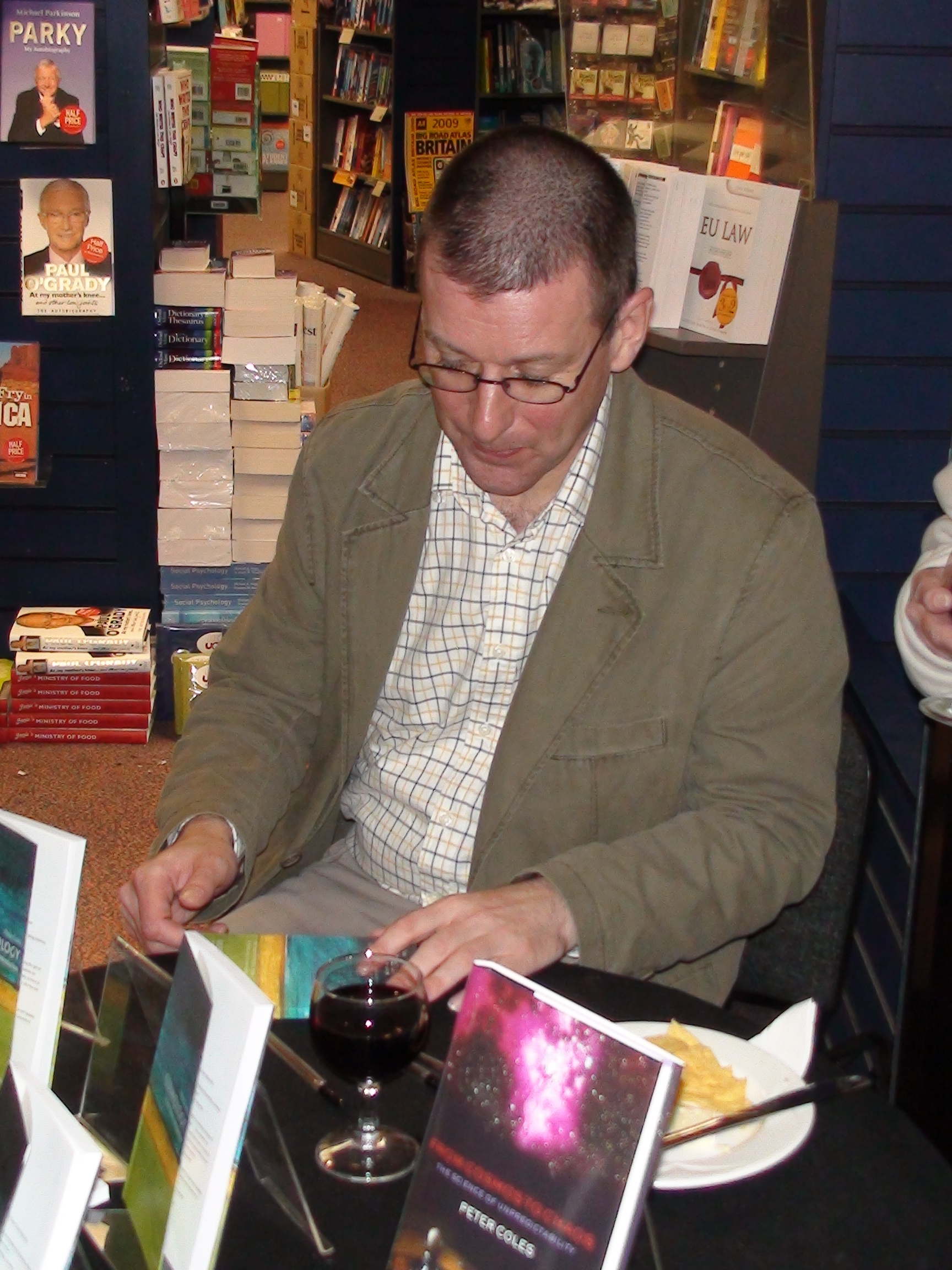
Please feel free to suggest a caption through the comments box…
Follow @telescoperAstronomy Grant Outcomes
Posted in Science Politics with tags Astronomy Grants Panel, Science and Technology Facilities Council, STFC on June 28, 2012 by telescoperWhile this is by no means an official outlet for news from the Science and Technology Facilities Council nor the Astronomy Grants Panel (AGP) thereof, but I am on the AGP so I thought I’d take the opportunity to pass on a bit of news to the UK community, or at least those members that read this blog.
An email by Colin Vincent of STFC was circulated this evening via the ASTROCOMMUNITY email list, which includes the following:
As part of the process for improving the feedback to the community of outcomes we have just published a more detailed listing of the recommendations for all projects. This can be found at
http://www.stfc.ac.uk/Our%20Research/12214.aspx
We hope that the community will find this helpful. This information supplements what is already available in STFC’s ‘Grants on the Web’ pages.
The link included there takes you to a page that includes a general description of how the AGP works and what it tries to do, and also for the first time (as far as I’m aware) a link to a document that contains a ranked list of all the projects rated fundable, whether funded or unfunded.
Speaking personally, i.e. not in my capacity as an AGP member, I think making this amount of detail public is an extremely good move, as I think it makes the process much more transparent. There’s just a chance, however, that the actual list might ruffle a few feathers here and there, and probably in other places too.
As always, please feel free to comment through the box below, but if you do so please remember that this is a personal blog and I’m passing this on as a community service. I can’t respond on behalf of the AGP, so please don’t ask me to!
UPDATE: 29th June 2012. The document containing the AGP outcomes has been removed from the STFC website. Don’t ask me why…
Follow @telescoper
 In the Dark