Author Archive

Pictures in the Park

Posted in Bute Park, Cricket with tags , , , on June 28, 2012 by telescoper

We’re  approaching  the end of June, and the weather is for the most part typical for a British summer. Rain.

Yesterday evening, however, as I walked home through Bute Park, the weather was sufficiently clement to allow cricket on Pontcanna Fields, which lie on the west side of Bute Park, across the Taff from the city centre.
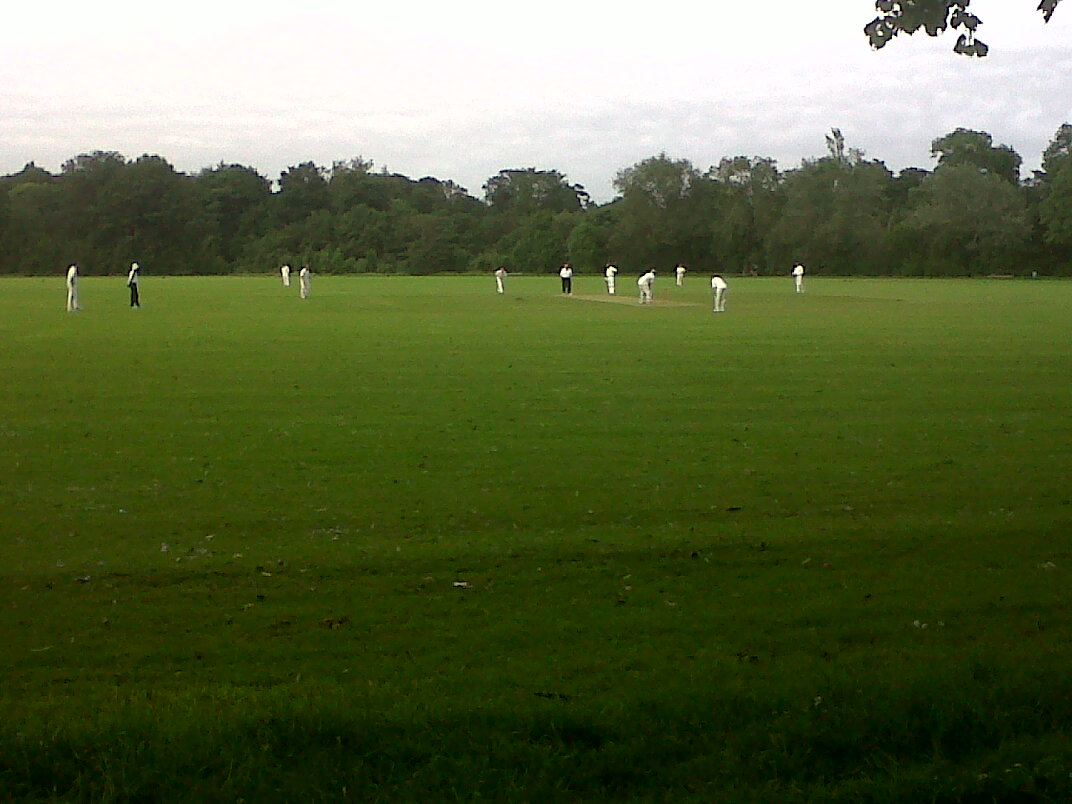
I stopped and watched for a while, taking in about ten overs. I don’t think there have been many occasions in the last month or so when play has been possible either here or in the nearby SWALEC stadium where Glamorgan play. Or try to;  they’re having a lousy season even when it’s not raining.

The pitches here are notoriously lively – the ball bouncing and darting all over the place makes them very difficult to bat on – and in the game I watched I saw three consecutive deliveries resulting in dropped catches. Let’s just say the fielders must have been out of practice…

Anyway it’s a lovely sight to see people out in the open air enjoying recreational activities in this part of the Park. It’s what a Park is for.

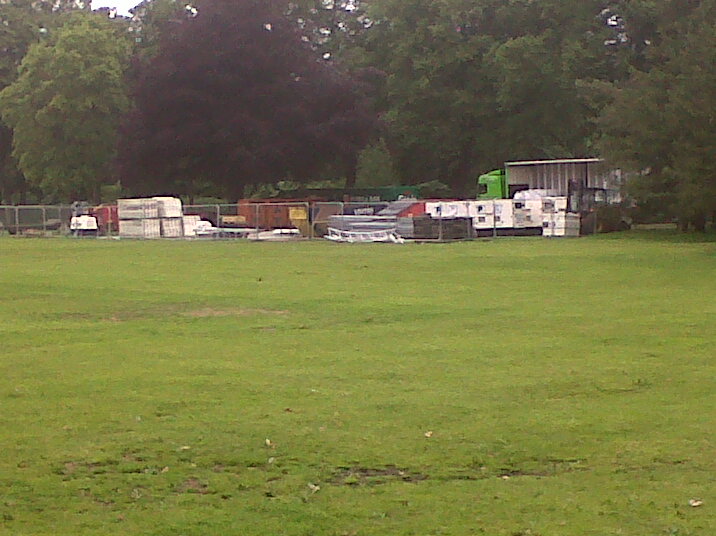
It’s a pity about the park on the other side of the river. Coopers Fields seem to be regarded by the Council as a lorry park and storage area for heavy equipment rather than a place of recreation.

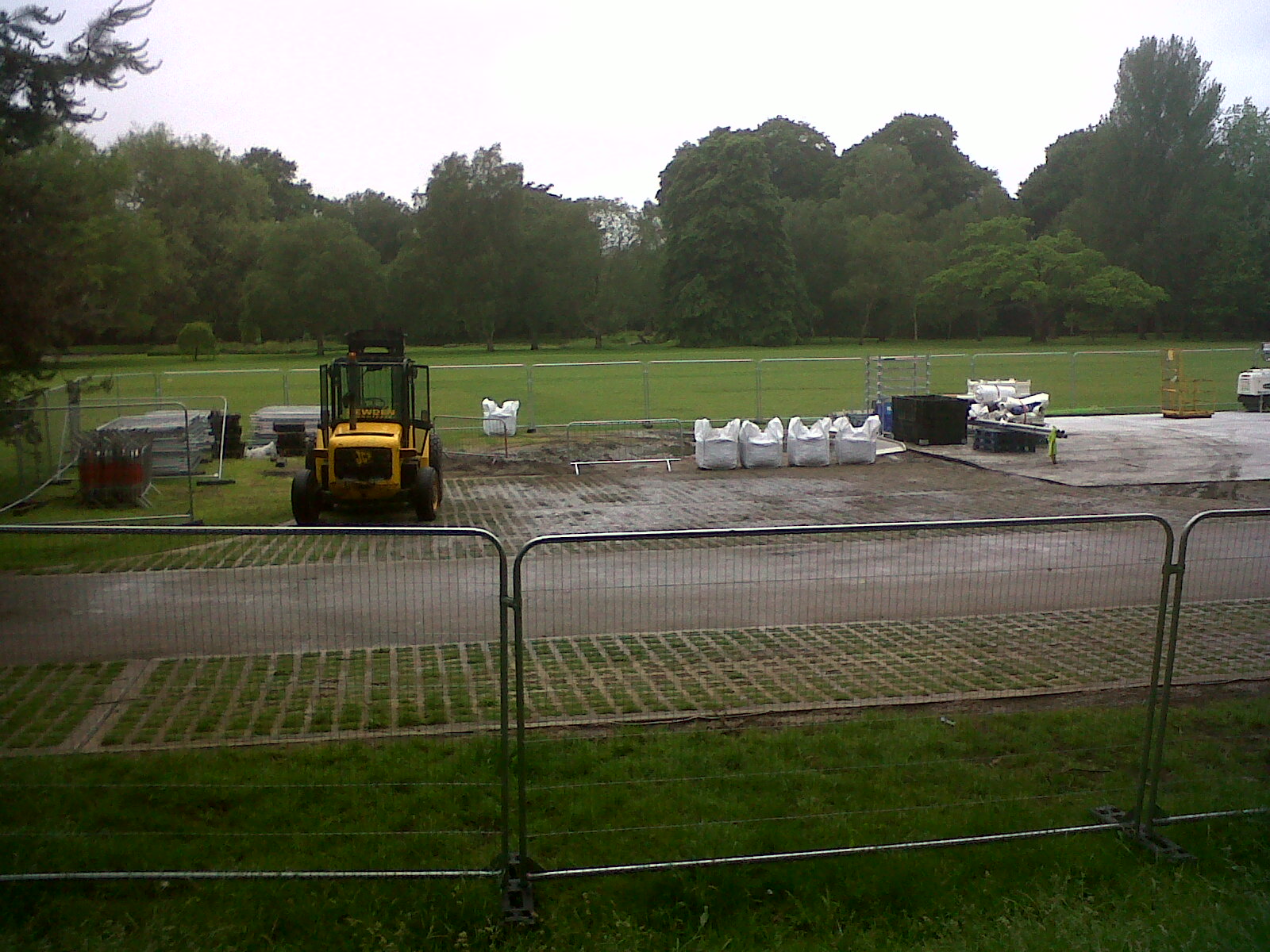
…with the damage caused by all this traffic never repaired. Grass does eventually re-grow if it is given time, but sadly this doesn’t happen in Bute Park. No sooner has one set of temporary buildings been dismantled when another is set up. Indeed, preparations are already under way  for another “event” on this park, with trucks already churning it up again and fencing being deployed to deprive the public of access to it.

Sometimes I wonder  why they don’t just tarmac it all over and be done with it.

R.I.P. Prof. John G. Taylor

Posted in The Universe and Stuff with tags , , , , , , , on June 27, 2012 by telescoper

I just received an email from Ian Ridpath pointing out that Professor John G. Taylor had died back in March 2012. The news had passed me by, and I’m quite surprised that there’s very little about this news on the internet with the exception of a brief announcement from the Department of Mathematics at King’s College London:

The Department is very sorry to announce the death of Professor John G. Taylor (JGT) on 10th March. John Taylor was appointed to the established Chair in Applied Mathematics at King’s College London in 1971. His research interests were wide, ranging over high energy physics, superstrings, quantum field theory and quantum gravity, neural computation, neural bases of behaviour and mathematical modelling in neurobiology. He was formidably energetic and remained actively engaged in research until his death.

His name came up on a post of mine a while ago of which the following is an excerpt.

In the 1970s, when Uri Geller was at the height of his popularity,  Professor Taylor took great interest in him and the things that he appeared to be able to do. Professor of applied mathematics at King’s College, London, Taylor was (and remains) a very distinguished scientist and was the first to take the paranormal phenomena displayed by Geller seriously. When Uri Geller visited Britain in 1974, Taylor conducted scientific tests of Geller’s feats of metal bending using all the paraphernalia of modern science, including a Geiger counter. Taylor also experimented with some of the children and adults who claimed to manifest psychic abilities after seeing Uri Geller’s appearances on British television programs. Taylor’s interest in such phenomena was not only in its scientific validation, but also in investigation of the way in which such phenomena take place and the nature of the forces involved. He suggested the phenomena may be some low-frequency electromagnetic effect generated by human beings.

Through the 1970s Taylor was regarded as fully endorsing the paranormal metal bending of Uri Geller, but gradually has made more guarded statements; then in 1980 he largely retracted his support for Geller’s paranormal talents. In 1974 he wrote

The Geller effect—of metal-bending—is clearly not brought about by fraud. It is so exceptional it presents a crucial challenge to modern science and could even destroy the latter if no explanation became available.

Taylor then spent three years of careful investigation of such phenomena as psychokinesis, metal bending, and dowsing, but could not discover any reasonable scientific explanation or validation that satisfied him. He was particularly concerned to establish whether there is an electromagnetic basis for such phenomena. After failing to find this he did not believe that there was any other explanation that would suffice. Most of his experiments under laboratory conditions were negative; this left him in a skeptical position regarding the validity of claimed phenomena.

In contrast to the endorsement in his first book, Superminds, he published a paper expressing his doubts in a paper in Nature (November 2, 1978) titled “Can Electromagnetism Account for Extra-sensory Phenomena?” He followed this with his book Science and the Supernatural (1980) in which he expressed complete skepticism about every aspect of the paranormal. In his final chapter he stated:

We have searched for the supernatural and not found it. In the main, only poor experimentation [including his own], shoddy theory, and human gullibility have been encountered.

Taylor’s investigation of the Geller effect is interesting because it shows that physics doesn’t have all the answers all the time, particularly not when the phenomena in question involve people. Physics research proceeds by assuming that Nature is not playing tricks, and that what can be measured must represent some sort of truth. This faith can be easily exploited by a charlatan. James Randi always argued that scientists aren’t the right people to detect tricks performed by people. This is best left to tricksters. There’s no reason to believe that a theoretical physicist – no matter how brilliant – can spot the way a clever deception is carried out. The best person to see that is a magician, someone like James Randi. Set a thief to catch a thief, and all that.

More Order-of-Magnitude Physics

Posted in Cute Problems, Education with tags , , , on June 27, 2012 by telescoper

A very busy day today so I thought I’d just do a quick post to give you a chance to test your brains with some more order-of-magnitude physics problems. I like using these in classes because they get people thinking about the physics behind problems without getting too bogged down in or turned off by complicated mathematics. If there’s any information missing that you need to solve the problem, make an order-of-magnitude estimate!

Give  order of magnitude answers to the following questions:

  1. What is the tension in a violin string?
  2. By how much would the temperature of the Earth increase if all its rotational energy were converted to heat?
  3. What fraction of the Earth’s water is in its atmosphere?
  4. How much brighter is sunlight than moonlight?
  5. What is the mass of water in a soap bubble?

There’s no prize involved, but feel free to post answers through the comments box. It would be helpful if you explained a  bit about how you arrived at your answer!

The Ant Whitworth Caption Competition

Posted in Uncategorized with tags , , , on June 26, 2012 by telescoper

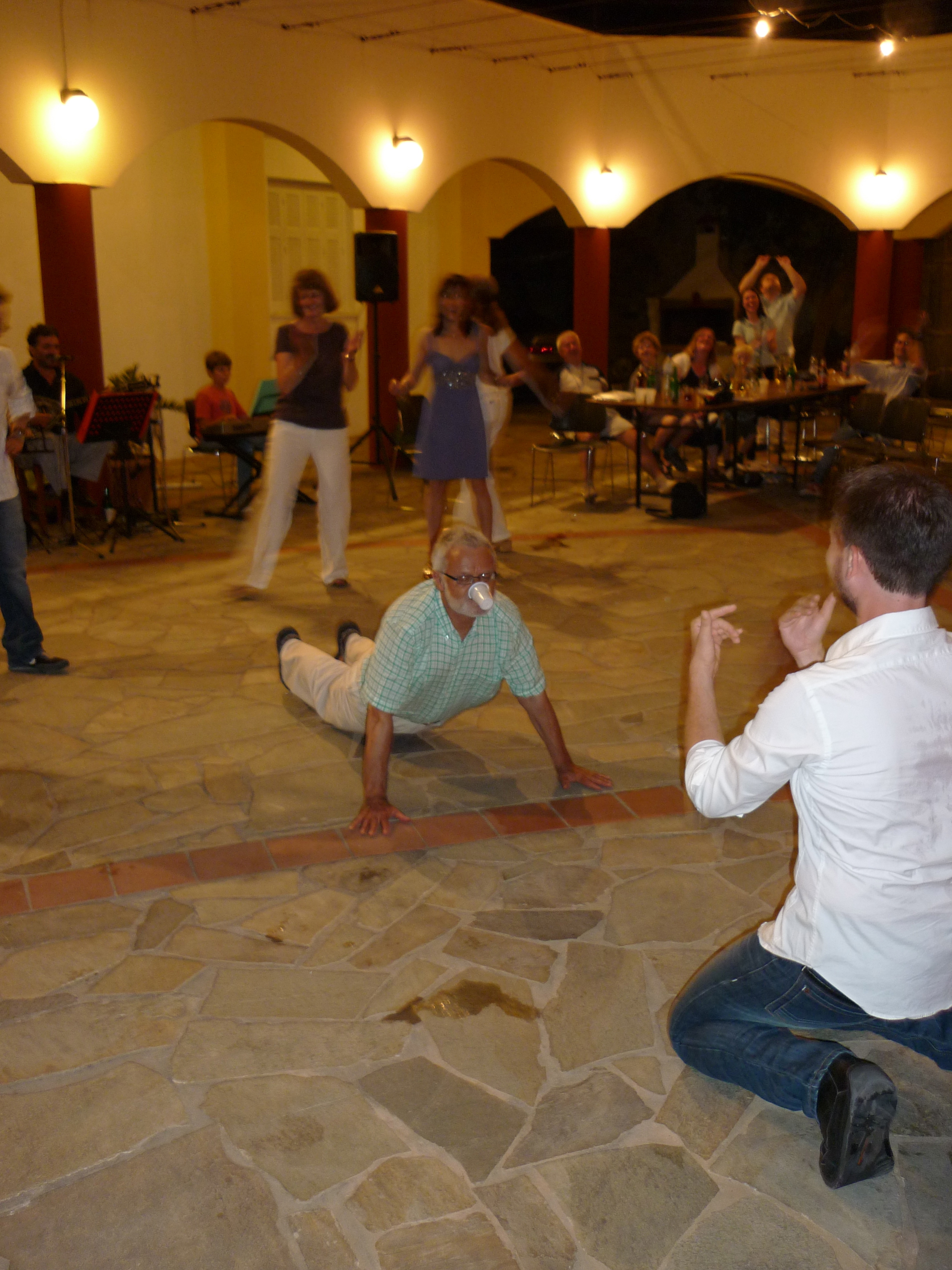
Last week a number of colleagues joined friends from around the world at a star formation conference in Crete to celebrate the scientific career of our esteemed Professor Anthony Whitworth who recently celebrated his nth birthday (n→∞). I wasn’t there myself, but an anonymous informant (Derek Ward-Thompson) gave me this photograph of said Professor, apparently taken at the conference dinner:

Don’t ask me what’s going on, but I think this picture is ripe fodder for a caption competition!

Please let me have your suggestions through the comments box…

Clusters, Splines and Peer Review

Posted in Bad Statistics, Open Access, The Universe and Stuff with tags , , , , , on June 26, 2012 by telescoper

Time for a grumpy early morning post while I drink my tea.

There’s an interesting post on the New Scientist blog site by that young chap Andrew Pontzen who works at Oxford University (in the Midlands). It’s on a topic that’s very pertinent to the ongoing debate about Open Access. One of the points the academic publishing lobby always makes is that Peer Review is essential to assure the quality of research. The publishers also often try to claim that they actually do Peer Review, which they don’t. That’s usual done, for free, by academics.

But the point Andrew makes is that we should also think about whether the form of Peer Review that journals undertake is any good anyway.  Currently we submit our paper to a journal, the editors of which select one (or perhaps two or three) referees to decide whether it merits publication. We then wait – often many months – for a report and a decision by the Editorial Board.

But there’s also a free online repository called the arXiv which all astrophysics papers eventually appear on. Some researchers like to wait for the paper to be refereed and accepted before putting it on the arXiv, while others, myself included, just put it on the arXiv straight away when we submit it to the journal. In most cases one gets prompter and more helpful comments by email from people who read the paper on arXiv than from the referee(s).

Andrew questions why we trust the reviewing of a paper to one or two individuals chosen by the journal when the whole community could do the job quicker and better. I made essentially the same point in a post a few years ago:

I’m not saying the arXiv is perfect but, unlike traditional journals, it is, in my field anyway, indispensable. A little more investment, adding a comment facilities or a rating system along the lines of, e.g. reddit, and it would be better than anything we get academic publishers at a fraction of the cost. Reddit, in case you don’t know the site, allows readers to vote articles up or down according to their reaction to it. Restrict voting to registered users only and you have the core of a peer review system that involves en entire community rather than relying on the whim of one or two referees. Citations provide another measure in the longer term. Nowadays astronomical papers attract citations on the arXiv even before they appear in journals, but it still takes time for new research to incorporate older ideas.

In any case I don’t think the current system of Peer Review provides the Gold Standard that publishers claim it does. It’s probably a bit harsh to single out one example, but then I said I was feeling grumpy, so here’s something from a paper that we’ve been discussing recently in the cosmology group at Cardiff. The paper is by Gonzalez et al. and is called IDCS J1426.5+3508: Cosmological implications of a massive, strong lensing cluster at Z = 1.75. The abstract reads

The galaxy cluster IDCS J1426.5+3508 at z = 1.75 is the most massive galaxy cluster yet discovered at z > 1.4 and the first cluster at this epoch for which the Sunyaev-Zel’Dovich effect has been observed. In this paper we report on the discovery with HST imaging of a giant arc associated with this cluster. The curvature of the arc suggests that the lensing mass is nearly coincident with the brightest cluster galaxy, and the color is consistent with the arc being a star-forming galaxy. We compare the constraint on M200 based upon strong lensing with Sunyaev-Zel’Dovich results, finding that the two are consistent if the redshift of the arc is  z > 3. Finally, we explore the cosmological implications of this system, considering the likelihood of the existence of a strongly lensing galaxy cluster at this epoch in an LCDM universe. While the existence of the cluster itself can potentially be accomodated if one considers the entire volume covered at this redshift by all current high-redshift cluster surveys, the existence of this strongly lensed galaxy greatly exacerbates the long-standing giant arc problem. For standard LCDM structure formation and observed background field galaxy counts this lens system should not exist. Specifically, there should be no giant arcs in the entire sky as bright in F814W as the observed arc for clusters at  z \geq 1.75, and only \sim 0.3 as bright in F160W as the observed arc. If we relax the redshift constraint to consider all clusters at z \geq 1.5, the expected number of giant arcs rises to \sim 15 in F160W, but the number of giant arcs of this brightness in F814W remains zero. These arc statistic results are independent of the mass of IDCS J1426.5+3508. We consider possible explanations for this discrepancy.

Interesting stuff indeed. The paper has been accepted for publication by the Astrophysical Journal too.

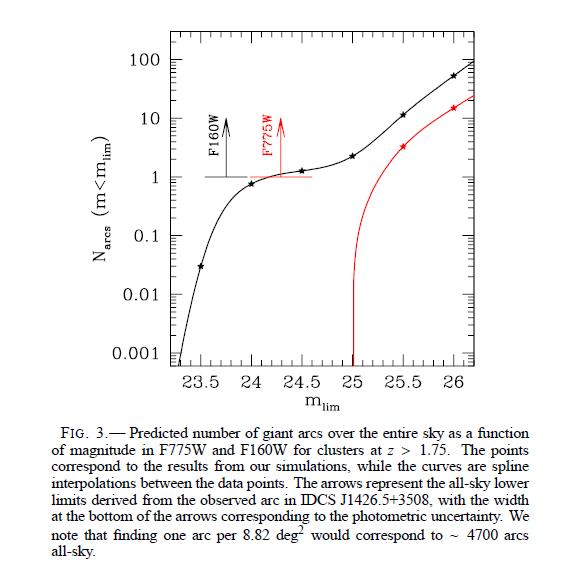
Now look at the key result, Figure 3:

I’ll leave aside the fact that there aren’t any error bars on the points, and instead draw your attention to the phrase “The curves are spline interpolations between the data points”. For the red curve only two “data points” are shown; actually the points are from simulations, so aren’t strictly data, but that’s not the point. I would have expected an alert referee to ask for all the points needed to form the curve to be shown, and it takes more than two points to make a spline.  Without the other point(s) – hopefully there is at least one more! – the reader can’t reproduce the analysis, which is what the scientific method requires, especially when a paper makes such a strong claim as this.

I’m guessing that the third point is at zero (which is at – ∞ on the log scale shown in the graph), but surely that must have an error bar on it, deriving from the limited simulation size?

If this paper had been put on a system like the one I discussed above, I think this would have been raised…

Cardiff Schools and Colleges

Posted in Education with tags , , , , , , on June 25, 2012 by telescoper


There was a mighty kerfuffle around these parts last week, stirred by an email from the Vice-Chancellor “designate”, Prof. Colin Riordan. The incoming Vee-Cee doesn’t take over until September, but he’s clearly planning to do some pre-emptive reorganization.

The Cardiff University is currently divided into academic Schools and administrative Directorates. There are 27 Schools, including Physics & Astronomy where I work. The current system is a bit unusual in that the Heads of these Schools report directly to the Vice-Chancellor. Some other universities have an extra organization layer on the academic side, sometimes called Faculties.  Cardiff University used to have faculties, actually, but it lost them some time ago. The same could be said for many of its staff, come to think of it.

Anyway, Prof. Riordan has decided that he doesn’t want to have to talk to 27 Heads of School and has proclaimed that Cardiff will have a new structure consisting of three Faculties Colleges into which the existing schools will be grouped in thuswise fashion:


College of Arts, Humanities and Social Sciences

Cardiff Business School

Cardiff School of City and Regional Planning

Cardiff School of English, Communication and Philosophy

Cardiff School of European Languages, Translation and Politics

Cardiff School of History, Archaeology and Religion

Cardiff School of Journalism, Media and Cultural Studies

Cardiff Law School

Cardiff Centre for Lifelong Learning

School of Music

Cardiff School of Social Sciences

School of Welsh

College of Biomedical and Life Sciences

School of Biosciences

School of Dentistry

School of Healthcare Studies

School of Medicine

Cardiff School of Nursing and Midwifery Studies

School of Optometry and Vision Sciences

Cardiff School of Pharmacy and Pharmaceutical Sciences

Wales Deanery / School of Postgraduate Medical and Dental Education

School of Psychology

College of Physical Sciences

Welsh School of Architecture

Cardiff School of Chemistry

Cardiff School of Computer Science and Informatics

School of Earth and Ocean Sciences

Cardiff School of Engineering

Cardiff School of Mathematics

School of Physics and Astronomy

I didn’t realise before that some Schools are called “Cardiff School of….” or even “Welsh School of…” and others just “School of…”. I wonder why? Anyway, you can see that we’re now in the College of Physical Sciences along with Chemistry, Engineering etc and, um, Architecture. The new arrangement may also provide me with an opportunity to find out what “Informatics” means…

Having these new-fangled Colleges means that there are positions available as Heads thereof, and existing Heads of Schools have been invited to apply, hence a flurry of CV polishing.

Fortunately for all concerned, I’m not eligible.

Gove Agreement

Posted in Education, Politics, Uncategorized with tags , , , on June 25, 2012 by telescoper

I’ve had the same worry about finding myself in agreement with Michael Gove, at least on a few things; see here, for example. Anyway, this piece makes some very good points about the corruption of the GCSE system.

Michael de Podesta's avatarProtons for Breakfast

What do you do when someone with whom you basically disagree, says something sensible? Michael Gove has placed me in this situation three times now.

Firstly he abolished the Qualifications and Curriculum development Authority (QCDA).  Secondly he pointed out at that school IT lessons are at best uninspiring. And now he has gone and acknowledged that our system of competitive exam boards has driven down GCSE standards.

You may not have noticed this because he also called for GCSEs to be replaced with ‘O’levels. I sympathise with his motivation – to raise the bar for the most academically able pupils – but I think he is wrong on this. It would be enormously disruptive, enormously divisive, and there is actually nothing inherently wrong with GCSEs.

The problem with GCSEs lies in the ‘almost corrupt‘ link between publishers and their ‘pet’ exam boards. The BBC…

View original post 197 more words

A Little Bit of Hummel

Posted in Music with tags , , , on June 24, 2012 by telescoper

I came across this bit of music a while ago. It appears in the very first (pilot) episode of the detective series Lewis. You can find it at the start of this clip and later on about 6.30 into the clip. It’s the central Andante movement of a Trumpet Concerto by Johann Nepomuk Hummel, of whom I knew nothing at all before hearing his name on this programme.

It turns out that Hummel is actually a leading figure in the history of classical music and in his own lifetime was every bit as famous as Haydn and Beethoven; he was a pallbearer at the latter’s funeral, in fact. He died in 1837 with his musical reputation apparently secure, but was quickly forgotten. Always a bit overshadowed by Mozart, when the romantic era dawned Hummel’s classical style was considered extremely old-fashioned. It’s just another illustration of a fact that applies not only in music but also in many different spheres of activity: popularity in one’s own lifetime is by no means certain to turn into renown thereafter…

I don’t usually like the sound of the classical trumpet that much- I prefer the broader and more expressive way the instrument is used in Jazz, whether it’s the brassy brilliance of Dizzy Gillespie or the moody melancholia of Miles Davis – but this piece is really lovely, especially when played with beautiful clarity by Norwegian trumpeter Tine Thing Helseth.

Crosswords and Prizes

Posted in Crosswords with tags , , , , on June 24, 2012 by telescoper

It has been a while since I last posted anything in the box marked Crosswords, so I thought I’d while away a bit of this dreary Sunday morning with a few thoughts on that topic.

Less than a year ago, I switched my Saturday newspaper from the Guardian to the Independent (see here for the reason). I’ve been doing the Independent Prize Cryptic every week since then, except when I’ve been away. I find it significantly more satisfying than the Guardian puzzle. I’m not sure the Independent‘s crossword is harder – although some of my friends think so –  but there seems to be better quality control there than at the Guardian.

I still occasionally do the Guardian puzzle at weekends by downloading it from the web. Yesterday’s celebrated a centenary – not difficult to guess whose! – but it wasn’t a particularly interesting puzzle, and I thought some of the clues were very clumsy.

Anyway, somewhat amazingly, I’ve actually won the Independent crossword prize no less than six times in the nine months or so since I starting doing it. An immediate inference from this is that there must be many fewer entrants than for the Guardian weekly puzzle, which I only won once every few years. The other side of this is that I’m accumulating dictionaries at an alarming rate. The prize for the Indy cryptic competition is The Oxford Dictionary and Thesaurus, a substantial tome that retails for about £20. I now have one in my study at home, one in the sitting room, and one in my office at work. I gave one to my mum a while ago, and the other two I’ve given to colleagues at work. I’ll probably be disposing of a few more copies like that if things carry on the way they have in past months. I’ve even started taking advance orders…

I haven’t been doing so well this year in my favourite crossword competition, the Azed puzzle in the Observer. I started well enough, but then drew a blank on a number of occasions and slipped back down the table. However, this week I got another score with a VHC (“Very Highly Commended”) in Azed 2087, and am currently in equal 24th place. There’s only one competition puzzle left, and I’m a long way off the pace set by the leaders, so I’m not going to finish much higher than that even if I do well in the last competition.

Anyway, my clue for the word ROCKET was:

Dicky ticker – love might make this one race!

I’ll leave it as an exercise for the reader to parse, although it involves a “comp. anag.” It goes without saying that the prize-winning clues are much better than my effort!

Incidentally, I noticed yesterday that my post about the Azed 2000 lunch a couple of years ago was getting a bit of traffic. I don’t really know why, but in the course of looking around I saw that there’s a nice collection of photographs of the event here. I couldn’t embed any of them here as they’re protected.

The general reaction of people I work with to all this cruciverbalism is that it’s a waste of time. I actually don’t agree, except insofar as everything is a waste of time when you think about it. Crosswords for me are a form of mental jogging. They exercise a brain in a way that’s different from the usual things it is faced with. In my case, a lot of my work involves puzzles of various kinds. Some are mathematical, connected with my research, but the most difficult ones are bureaucratical: trying to work out what all the paperwork is for and how to fill it in without losing my rag. Despite a complete lack of empirical evidence to support this assertion, I think doing crosswords keeps my brain from ossifying and enables it to think more flexibly. Or maybe I protest too much. Perhaps I just enjoy them.

My Little Suede Shoes

Posted in Jazz with tags , , , , on June 23, 2012 by telescoper

If this wonderful video is anything to go by, the late great Johnny Griffin had splendid taste in footwear..as he got these shoes from Charlie Parker himself.