Here’s a lovely little duet by saxophonist Archie Shepp and Abdullah Ibrahim, who was born in South Africa and formerly known as Dollar Brand. A good time to post it, as it’s called Left Alone and I’m spending the day on my own finishing a few things off before returning to Blighty tomorrow…
Follow @telescoperAuthor Archive
Left Alone
Posted in Jazz with tags Abdullah IBrahim, Archie Shepp, Dollar Brand on April 15, 2012 by telescoperThe Birth of Shaka
Posted in Poetry with tags Oswald Mtshali, Poetry, Shaka on April 14, 2012 by telescoperHis baby cry
was of a cub
tearing the neck
of the lioness
because he was fatherless.
The gods
boiled his blood
in a clay pot of passion
to course in his veins.
His heart was shaped into an ox shield
to foil every foe.
Ancestors forged
his muscles into
thongs as tough
as water bark
and nerves
as sharp as
syringa thorns.
His eyes were lanterns
that shone from the dark valleys of Zululand
to see white swallows
coming across the sea.
His cry to two assassin brothers:
“Lo! you can kill me
but you’ll never rule this land!”
by Oswald Mtshali (b. 1940)
Shaka was a Zulu chief of the 19th Century who built such a giant empire in what is now South Africa that he became known in Europe as the Black Napoleon. He was eventually killed by his half brothers, but the Zulu empire crumbled soon after when the British Army took it on.
Follow @telescoperIt ain’t half hot…
Posted in Biographical on April 13, 2012 by telescoperJust to point out that it’s over 30 degrees today. I realised it was going to be a scorcher, at least by my standards, when I emerged from the underpass on my way to the department and felt the full heat of the Sun. And that was at 9am.
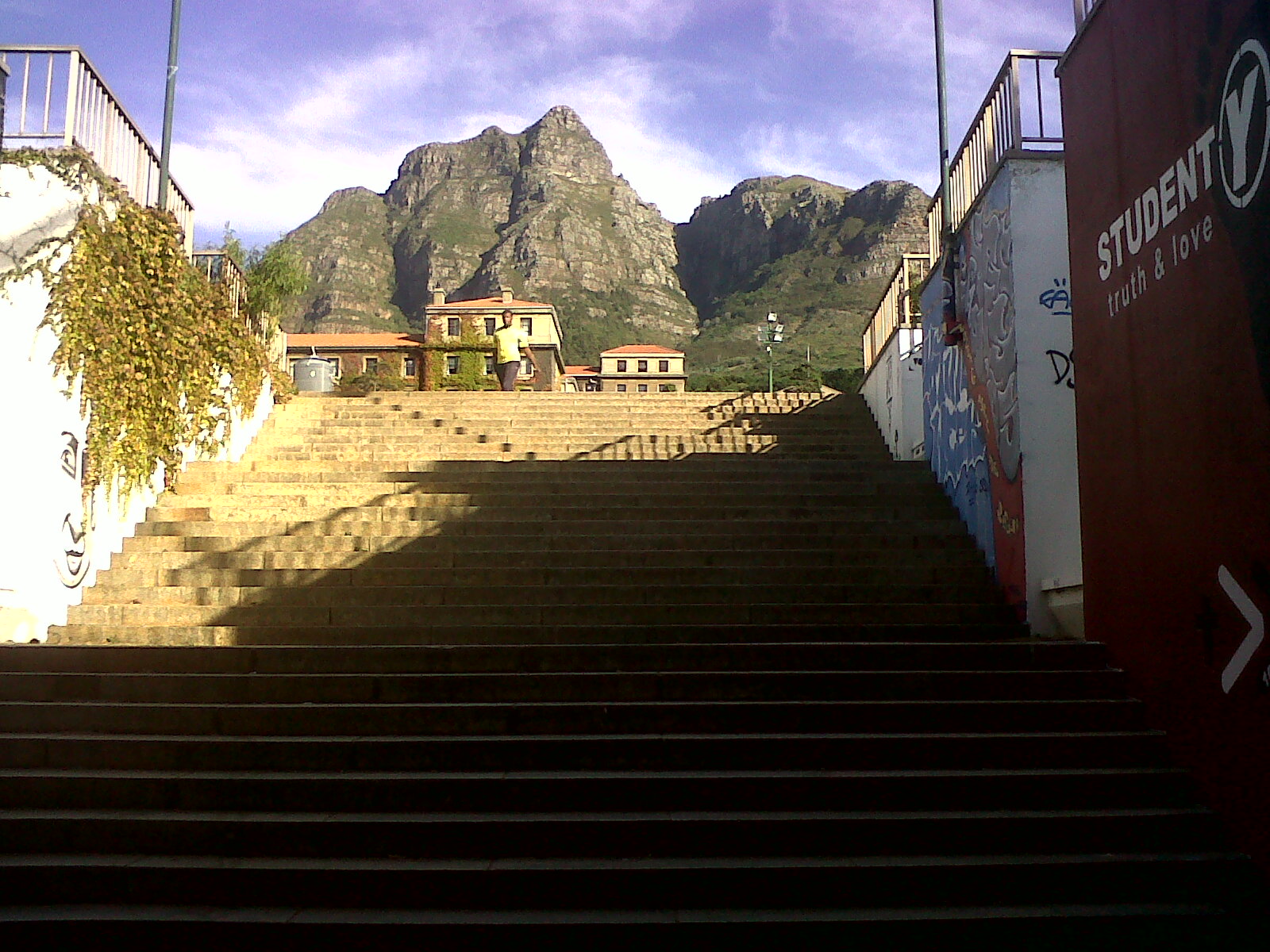
I’m not very well adapted for high temperatures, unlike the people who live here. The other day I heard a student complaining about how cold it was, only 24 degrees. When I said that it wasn’t really that cold in Cape Town, as London was only 12 degrees on that day, he said he couldn’t understand how people could live in a place where there was only half as much heat….
I do hope it wasn’t a physics student.
Follow @telescoperOn the Buses
Posted in Politics with tags Anglican Mainstream, Core Issues, gay, Stonewall on April 13, 2012 by telescoperIt seems that while I’m away there’s been a to-do and a hoo-ha about advertisements on London buses. It all started with this rather innocuous advertisement placed by the campaigning organization Stonewall…

Apparently this upset a couple of minority religious sects, the overtly homophobic Anglican Mainstream and Core Issues which apparently has a mission to convert happy homosexual people into miserable heterosexual ones by a mixture of coercion, brainwashing and quack psychology. It’s strange that Christian groups like this have such an obsession with homosexuality. Aren’t there more important things for a Christian to be doing, like being kind to the poor and loving your neighbour? Anyway, these folks responded with a bus advert of their own:

Following a number of complaints about the latter, and an intervention by the Mayor Boris Johnson, Transport for London decided to remove the second set of advertisements on the grounds that
We don’t believe these ads reflect TfL’s commitment to a tolerant and inclusive London.
Actually, I think it’s a shame that the Anglican Mainstream adverts were removed. For a start, it’s one of the prices of living in a free society that you have to put up with views you don’t like. More importantly, however, the clumsy and childish nature of the tit-for-tat response from the “religious” fringe to Stoenwall’s pithy original reveals them as the mean-spirited dullards that they are. Their implicit reference to voodoo therapies as “gay cures” will hopefully now receive wider scrutiny in the media, and be exposed for what it is i.e. dogma-inspired pseudoscience. These folk would be more honest if they just took out adverts saying “We hate gay people”, but the disguise is so transparent that’s the message they carry anyway. I am confident publicity campaigns like this are counter-productive in the long run, so let them stand up and be counted. By their slogans shall ye know them.
The Advertising Standards Agency – correctly, in my view – deemed both sets of advertisements acceptable. It was a decision by Transport for London to ban the second set. I don’t think that’s contrary to the spirit of free speech. Anglican Mainstream or any other group has the right to print and distribute literature, organize demonstrations and what have you. It is however, up to newspapers, television companies and radio stations to decide whether they feel comfortable carrying advertisements by organizations promoting messages that run counter to their own code of conduct.
Follow @telescoperFifty Years of the UK in Space
Posted in The Universe and Stuff with tags Ariel-1, BIS, UKSA on April 12, 2012 by telescoperI got an email just now advertising this event which I hadn’t heard about before today, so I thought I’d put my community service hat on and spread the word via the medium of this blog by passing on the content of the email with a minimum of edits. Unfortunately I won’t be going to the thing myself as I’ll be teaching on 26th April…

On 26 April 1962, Britain became the third space-faring nation with the launch of Ariel-1, the first satellite to be developed and operated by the UK. Fifty years on, the UK space sector is a world leader in space science, innovative technology and applications development helping Planet Earth.
To commemorate the launch of Ariel-1 and to celebrate the continued excellence of UK space activities, on the anniversary of the launch, 26 April 2012, the UK Space Agency and the Science Museum are co-hosting a two-day conference celebrating 50 years of the UK in space. It will bring together those who started the UK on the road to being a world-renowned centre for space technology and research with the scientists and engineers of the next fifty years. The Director of Science and Robotic Exploration at the European Space Agency will make the keynote speech and there will exciting announcements and memorable moments to enjoy at the evening reception hosted by the UK Space Agency on the 26th April. Come along, mingle with friends old and new and look forward to the next chapter of the UK in space. Admission is free.
More information can be found here, and at the conference website here. You can download a PDF of the conference programme here.
Follow @telescoperBayes, Bridge and the Brain
Posted in Books, Talks and Reviews, The Universe and Stuff with tags Bayesian probability, Bridge, George Ellis, neuroscience on April 12, 2012 by telescoperI was having a chat over coffee yesterday with some members of the Mathematics Department here at the University of Cape Town, one of whom happens to be an expert at Bridge, actually representing South Africa in international competitions. That’s a much higher level than I could ever aspire to so I was a bit nervous about mentioning my interest in the game, but in the end I explained that I have in the past used Bridge (and other card games) to describe how Bayesian probability works; see this rather lengthy post for more details. The point is that as cards are played, one’s calculation of the probabilities of where the important cards lie changes in the light of information revealed. It makes much more sense to play Bridge according to a Bayesian interpretation, in which probability represents one’s state of knowledge, rather than what would happen over an ensemble of “random” realisations.
This particular topic – and Bayesian inference in general – is also discussed in my book From Cosmos to Chaos (which is, incidentally, now available in paperback). On my arrival in Cape Town I gave a copy of this book to my genial host, George Ellis, and our discussion of Bridge prompted him to say that he thought I had missed a trick in the book by not mentioning the connections between Bayesian probability and neuroscience. I hadn’t written about this because I didn’t know anything about it, so George happily enlightened me by sending a few review articles, such as this:

I can’t post it all, for fear of copyright infringement, but you get the idea. Here’s another one:

And another…
Nature Reviews Neuroscience 11, 605 (August 2010) | doi:10.1038/nrn2787-c1
A neurocentric approach to Bayesian inference Christopher D. Fiorillo
Abstract A primary function of the brain is to infer the state of the world in order to determine which motor behaviours will best promote adaptive fitness. Bayesian probability theory formally describes how rational inferences ought to be made, and it has been used with great success in recent years to explain a range of perceptual and sensorimotor phenomena.
As a non-expert in neuroscience, I find these very interesting. I’ve long been convinced that from the point of view of formal reasoning, the Bayesian approach to probability is the only way that makes sense, but until reading these I’ve not been aware that there was serious work being done on the possibility that it also describes how the brain works in situations where there is insufficient information to be sure what is the correct approach. Except, of course, for players of Bridge who know it very well.
There’s just a chance that I may have readers out there who know more about this Bayes-Brain connection. If so, please enlighten me further through the comments box!
Follow @telescoperAcademic Spring Time
Posted in Open Access with tags Academic Journals, academic publishing, Elsevier, Research Excellence Framework, Research Works Act on April 11, 2012 by telescoperCatching up on the last few days’ activity on the Twittersphere I realise that at last the Academic Journal Racket has made it into the mainstream media. The Guardian ran an article on Monday reporting that the Wellcome Trust had weighed in on the side of open access to academic journals, and followed this up with an editorial this morning. Here are the first two paragraphs.
Some very clever people have put up with a very silly system for far too long. That is the upshot of our reporting on scholarly journals this week. Academics not only provide the raw material, but also do the graft of the editing. What’s more, they typically do so without extra pay or even recognition – thanks to blind peer review. The publishers then bill the universities, to the tune of 10% of their block grants, for the privilege of accessing the fruits of their researchers’ toil. The individual academic is denied any hope of reaching an audience beyond university walls, and can even be barred from looking over their own published paper if their university does not stump up for the particular subscription in question.
This extraordinary racket is, at root, about the bewitching power of high-brow brands. Journals that published great research in the past are assumed to publish it still, and – to an extent – this expectation fulfils itself. To climb the career ladder academics must get into big-name publications, where their work will get cited more and be deemed to have more value in the philistine research evaluations which determine the flow of public funds. Thus they keep submitting to these pricey but mightily glorified magazines, and the system rolls on.
These are the points many academics, including myself, have been making for several years apparently with little success. What seems to be giving the campaign against the racketeers some focus is the boycott of rapacious publishing giant Elsevier I blogged about earlier this year, which was kicked off by mathematician and blogger Tim Gowers; the petition now has over 9300 signatures. Elsevier is one of the worst of the racketeers, which is deeply ironic. When Galileo, having been forced to recant by the Inquisition, wrote the Dialogues concerning Two New Sciences and got them published in non-Catholic Leiden, by Elsevier…
Elsevier has since withdrawn its support for the infamous Research Works Act, but I hope that doesn’t mean the campaign will dissipate. For the sake of the future of science, the whole system needs to be systematically dismantled and rebuilt free of parasites.
Today I see there’s a related piece in the Financial Times (although it’s blocked by a paywall) and I gather there has also been coverage on BBC Radio over the last few days, although I didn’t hear any of it because of my current location.
The fact that this issue has garnered coverage from the mainstream media is a very good thing. Academics have put up with being ripped off for far too long, and it’s to our shame that we haven’t done anything about it until now. Now I think the public will be asking how we could possibly have accepted the status quo and sheer embarrassment might force a change.
Another thing that we need to realise is the extent to which the Academic Journal Racket is feeding off the monster that is Research Assessment, specifically the upcoming Research Excellence Framework. The main beneficiaries of such exercises are not the researchers, but the academic publishers who rake in the profits generated by the mountains of papers submitted to them in the hope that they’ll be judged “internationally leading” (whatever that means). If the government is serious about Open Access then only papers that are freely available should be accepted by the REF. If that doesn’t shake up the system, nothing will!
Follow @telescoperDyson on Eddington
Posted in Books, Talks and Reviews, The Universe and Stuff with tags Arthur Stanley Eddington, astronomy, Bending of Light, Eclipse Expeditions, Freeman Dyson, General Theory of Relativity, May 29th 1919 on April 10, 2012 by telescoperI’m grateful to George Ellis for sending me a link to a book review written by Freeman Dyson that appeared in a recent edition of the New York Review of Books. I was particularly interested to read the following excerpt about Arthur Stanley Eddington. I have been intrigued by Eddington since I wrote a book about his famous expeditions (to Principe and Sobral) in 1919 to measure the bending of light by the Sun as a test of Einstein’s general theory of relativity; I blogged about this on its ninetieth anniversary, by the way, in case anyone wants to read any more about it.
Although I read quite a lot about Eddington, not only during the course of researching the book but also afterwards, as there are many things about his character that fascinate me. He died long before I was born, of course, but whenever I meet someone who knew him I ask what they make of him. Not altogether surprisingly, opinions differ rather widely from one person to another as his character seems to have been extremely contradictory. He doesn’t seem to have been very good at small talk, but was nevertheless a much sought-after dining companion. He was a man of great moral integrity, but at times treated his colleagues (notably Chandrasekhar) rather shamefully. He was a brilliant astrophysicist, but got himself hooked on his peculiar Fundamental Theory which was a dead end. He remains an enigma.
Anyway, this is what Dyson has to say about him:
Follow @telescoperEddington was a great astronomer, one of the last of the giants who were equally gifted as observers and as theorists. His great moment as an observer came in 1919 when he led the British expedition to the island of Principe off the coast of West Africa to measure the deflection of starlight passing close to the sun during a total eclipse. The purpose of the measurement was to test Einstein’s theory of General Relativity. The measurement showed clearly that Einstein was right and Newton wrong. Einstein and Eddington both became immediately famous. One year later, Eddington published a book, Space, Time and Gravitation, that explained Einstein’s ideas to English-speaking readers. It begins with a quote from Milton’s Paradise Lost:
Perhaps to move
His laughter at their quaint opinions wide
Hereafter, when they come to model heaven
And calculate the stars: how they will wield
The mighty frame: how build, unbuild, contrive
To save appearances.Milton had visited Galileo at his home in Florence when Galileo was under house arrest. Milton wrote poetry in Italian as well as English. He spoke Galileo’s language, and used Galileo as an example in his campaign for freedom of the press in England. Milton had witnessed with Galileo the birth struggle of classical physics, as Eddington witnessed with Einstein the birth struggle of relativity three hundred years later. Eddington’s book puts relativity into its proper setting as an episode in the history of Western thought. The book is marvelously clear and readable, and is probably responsible for the fact that Einstein was better understood and more admired in Britain and America than in Germany.
As a student at Cambridge University I listened to Eddington’s lectures on General Relativity. They were as brilliant as his books. He divided his exposition into two parts, and warned the students scrupulously when he switched from one part to the other. The first part was the orthodox mathematical theory invented by Einstein and verified by Eddington’s observations. The second part was a strange concoction that he called “Fundamental Theory,” attempting to explain all the mysteries of particle physics and cosmology with a new set of ideas. “Fundamental Theory” was a mixture of mathematical and verbal arguments. The consequences of the theory were guessed rather than calculated. The theory had no firm basis either in physics or mathematics.
Eddington said plainly, whenever he burst into his fundamental theory with a wild rampage of speculations, “This is not generally accepted and you don’t have to believe it.” I was unable to decide who were more to be pitied, the bewildered students who were worried about passing the next exam or the elderly speaker who knew that he was a voice crying in the wilderness. Two facts were clear. First, Eddington was talking nonsense. Second, in spite of the nonsense, he was still a great man. For the small class of students, it was a privilege to come faithfully to his lectures and to share his pain. Two years later he was dead.
The World as a Beach
Posted in Biographical, The Universe and Stuff with tags Cosmology, Dreikoppen, Horizon, Kopano, large-scale structure of the Universe, Muizenberg, South Africa on April 10, 2012 by telescoperWell, as some of you will have noticed, I’ve been offline over the long weekend. There’s no internet connection – not one that I could get to work, anyway – at the residence I’m staying in and I couldn’t be bothered to traipse all the way up the hill to the department in the pouring rain to connect from my office. Hence the first gap in my postings this year. I don’t suppose anyone minds that much. Anyway, here are a few pictures and random thoughts from the weekend.
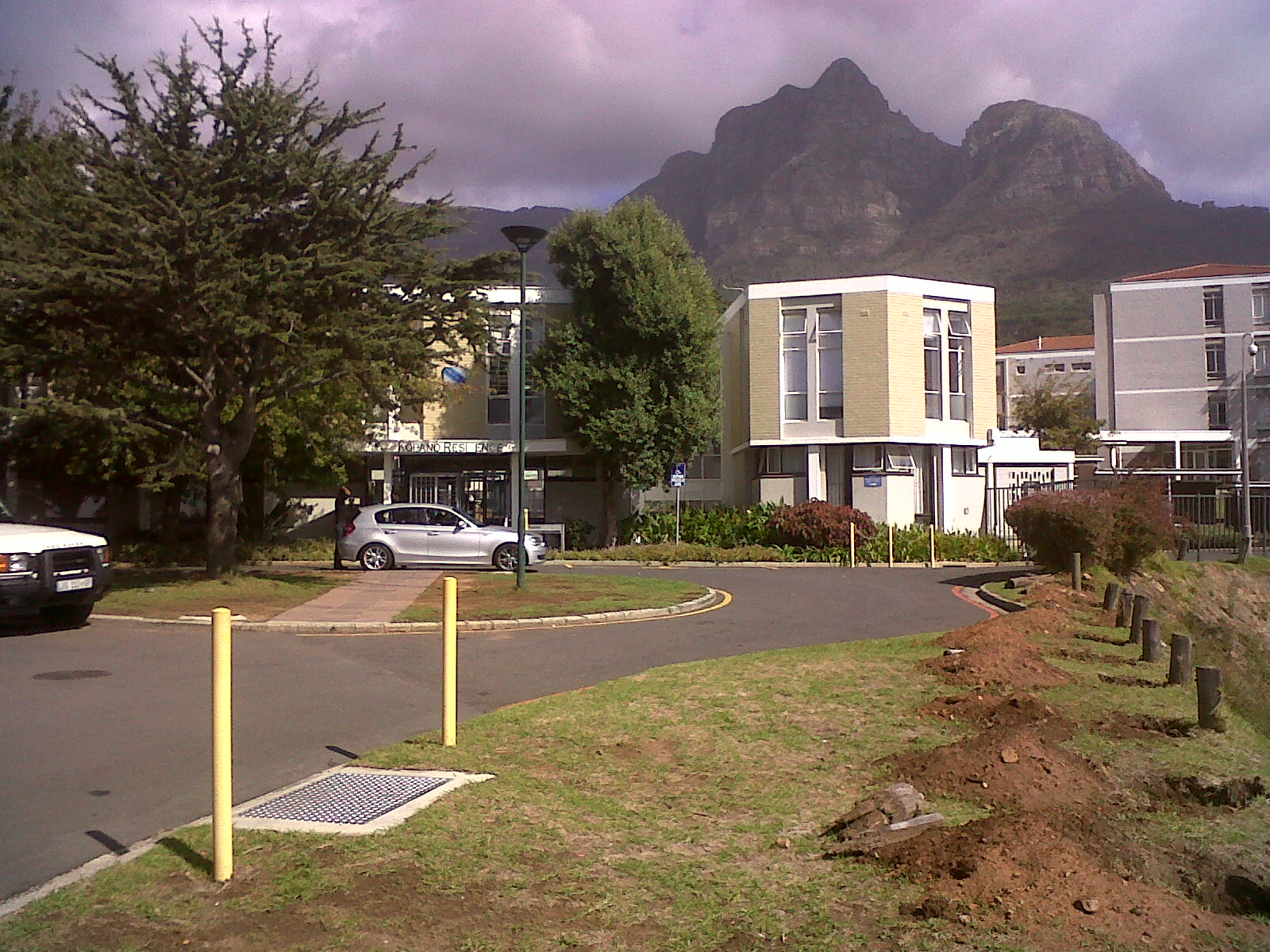
Here’s a picture of the residence, by the way. It’s called Kopano, although when I previously stayed it was called Driekoppen. The old name was a relic of the days of slavery – three slaves were tortured and executedin public after rebelling against the terrible conditions they were held in. Their heads were displayed on pikes nearby, hence the name which means “Three Heads”. This was in 1724. I’m not surprised that the end of apartheid brought a change in the name, although keeping it as it was would have served as a reminder of South Africa’s terrible past. One shouldn’t become obsessed by events that took place such a long time ago, but neither should one forget them.
Good Friday was a very Good Friday indeed, starting with a lovely breakfast and a walk on the beach in Muizenberg. Apparently this is something of a surfer’s paradise but, as I said, I didn’t have an internet connection so couldn’t join in. Also, they have sharks here. I mean big ones. Great White ones, as a matter of fact. None showed up while I was there, though, and in any case I was only paddling along the shoreline. It may not be obvious from the picture, but it was pretty hot. Almost 30 degrees.

 I was watching a chap surfing while we walked along and it reminded me of the post I did a while ago about teaching analogies. Standing on a beach looking out towards the horizon is a bit like doing cosmology. Off in the far distance everything looks smooth; the waves on the surface are much lower in amplitude than the depth of the sea out there, so everything evolves linearly and is quite easy to understand. That’s like looking back in time at the early Universe imprinted on the cosmic microwave background. Nearer to the shore, however, the waves become non-linear because their height is comparable to, or larger than, the depth of the water. These waves evolve in a non-linear way producing, breaking on the beach to produce foam and spray, just as the primordial waves collapse to form galaxies and the foam of large-scale structure when their self-gravity becomes sufficiently strong.
That’s enough of that, I think.
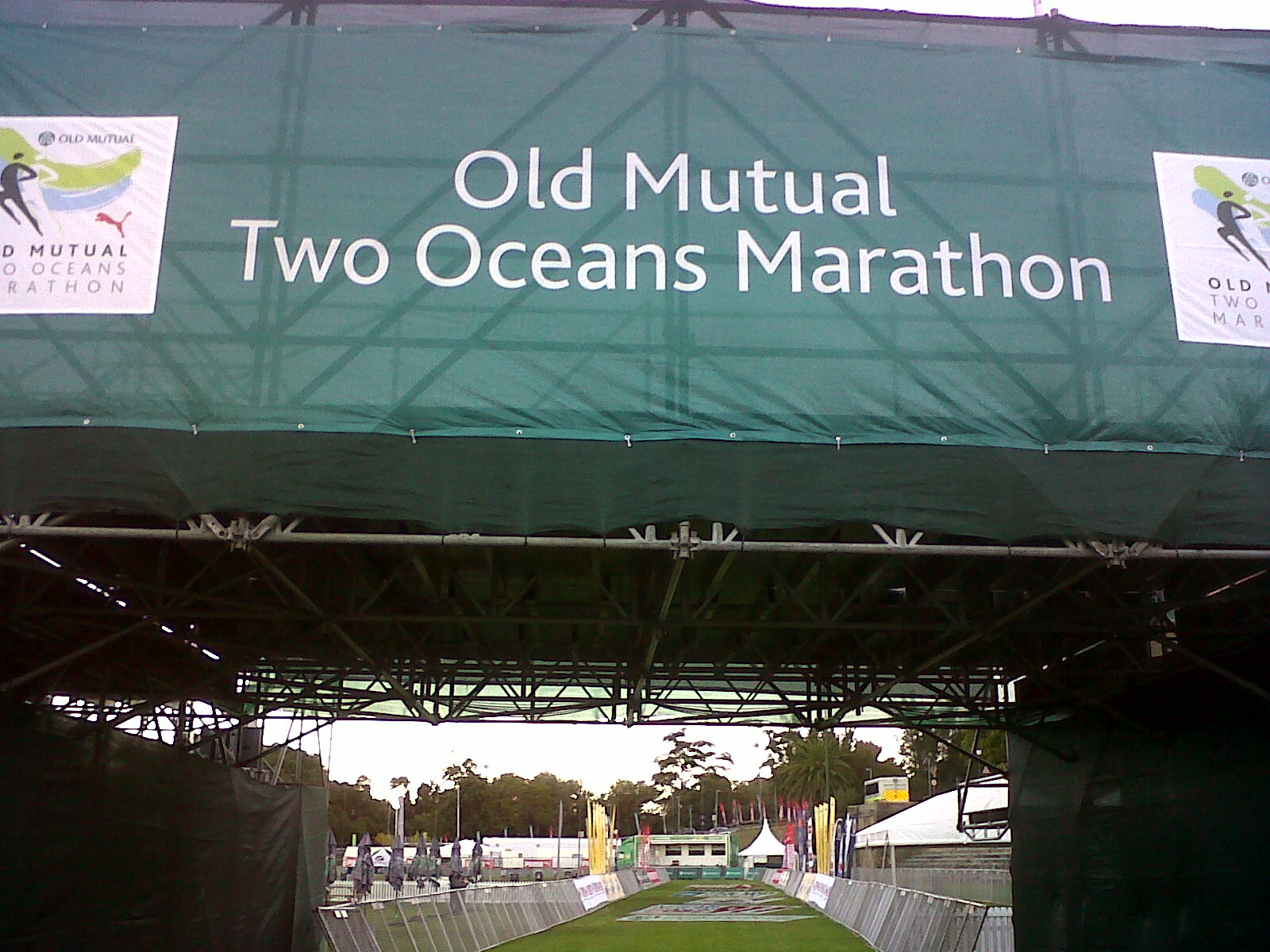
Unfortunately, the weather changed for the worse over the rest of the Easter weekend and torrential rain kept me from doing much on Saturday or Sunday. The finishing section of the Two Oceans Marathon, which ended on the UCT campus on Saturday, was like a quagmire. As you can see from the picture, I reached the line well in front of the pack. About two days in front, actually. I took this as they were building the stands and hospitality tents a few days before the race.
Anyway, the good side of the bad weather was that I got quite a lot of work done, catching up on things I have let slip for far too long. I also exhausted the reading material I brough with me, so will have to find a good bookshop in the next day or two. Well, that’s about enough for now. I hope to continue regular dispatches from now on until I return to Blighty next week.
Follow @telescoperThe Ancient Track
Posted in Poetry with tags H. P. Lovecraft, Poetry, The Ancient Track on April 6, 2012 by telescoperThere was no hand to hold me back
That night I found the ancient track
Over the hill, and strained to see
The fields that teased my memory.
This tree, that wall—I knew them well,
And all the roofs and orchards fell
Familiarly upon my mind
As from a past not far behind.
I knew what shadows would be cast
When the late moon came up at last
From back of Zaman’s Hill, and how
The vale would shine three hours from now.
And when the path grew steep and high,
And seemed to end against the sky,
I had no fear of what might rest
Beyond that silhouetted crest.
Straight on I walked, while all the night
Grew pale with phosphorescent light,
And wall and farmhouse gable glowed
Unearthly by the climbing road.
There was the milestone that I knew—
“Two miles to Dunwich”—now the view
Of distant spire and roofs would dawn
With ten more upward paces gone. . . .
There was no hand to hold me back
That night I found the ancient track,
And reached the crest to see outspread
A valley of the lost and dead:
And over Zaman’s Hill the horn
Of a malignant moon was born,
To light the weeds and vines that grew
On ruined walls I never knew.
The fox-fire glowed in field and bog,
And unknown waters spewed a fog
Whose curling talons mocked the thought
That I had ever known this spot.
Too well I saw from the mad scene
That my loved past had never been—
Nor was I now upon the trail
Descending to that long-dead vale.
Around was fog—ahead, the spray
Of star-streams in the Milky Way. . . .
There was no hand to hold me back
That night I found the ancient track.
by H.P. Lovecraft (1890-1937)
Follow @telescoper
 In the Dark