Author Archive
Homecoming
Posted in Uncategorized with tags Coalition for Equal Marriage on April 25, 2012 by telescoperCOBE and after…
Posted in Biographical, The Universe and Stuff with tags COBE, Cosmic Microwave Background, University of Kansas, WMAP on April 24, 2012 by telescoperAn item on the BBC website yesterday reminds me that it is twenty years since the announcement, in April 1992, of the discovery of temperature variations across the sky in the cosmic microwave background radiation by the Cosmic Background Explorer (COBE). Was it really so long ago?
At the time the announcement was made as I actually in the USA. In fact, I was at the University of Kansas for about a month working on this paper with Adrian Melott and Sergei Shandarin, which eventually came out early in 1993. I remember it very well because we started the project, did all the calculations and wrote up the paper within the short time I was there. Oh what it is to be a postdoc, having only research to think about and none of the other distractions that come with more senior positions.
Anyway, the COBE announcement hit the news while I was there and it got a lot of press coverage. I even did a TV interview myself, for a local cable news channel. Nor surprisingly, they were pretty clueless about the physics of the cosmic microwave background; what had drawn them to the story was George Smoot’s comment that seeing the pattern of fluctuations was “like seeing the face of God”. They were disappointed when I answered their questions about God with “I don’t know, I’m an atheist”.

The Face of God?
I didn’t know at the time that the way the announcement of the COBE discovery was handled had caused such ructions. Apparently George Smoot let his enthusiasm get the better of him, broke ranks with the rest of the COBE team, and did his own press conference which led to accusations that he was trying to steal the limelight and a big falling-out between Smoot and other members of the team, especially John Mather. It’s unfortunate that this cast a shadow over what was undoubtedly one of the most important science discoveries of the twentieth century. Without COBE there would have been no WMAP and no Planck, and our understanding of the early Universe and the formation of galaxies and large-scale structure would still be in the dark ages.
As a lowly postdoc at the time, living a hand-to-mouth existence on short-term contracts, I didn’t realise that I would still be working in cosmology twenty years later, let alone become a Professor. Nor could I have predicted how much cosmology would change over the next two decades. Most of all, though, I never even imagined that I’d find myself travelling to Stockholm as a guest of the Nobel Foundation to attend the ceremony and banquet at which the 2006 Nobel Prize for Physics was awarded to George Smoot and John Mather for the COBE discovery. It was a wonderful one-in-a-lifetime experience, made all the nicer because Smoot and Mather seemed to have made peace at last.
Where were you when the COBE results came out?
Follow @telescoperControversy brewing at ESA?
Posted in Science Politics with tags ATHENA, ESA, European Space Agency, JUICE, NGO on April 23, 2012 by telescoperInteresting stuff over at the e-astronomer relating to ESA’s handling of the process of selecting its next L-class mission. The plot thickens.

So the Athena folk are somewhat miffed at being pipped by Juice. (This metaphor doesn’t seem quite right ? Ed.) But what about Horse Number Three ? Aren’t the NGO folk doing a Grand Petition ? Nope. It seems their tactic is a semi-formal complaint about inadeqacies in the process : an email letter direct to Gimenez. I am not sure how widely it has been circulated, but I understand it is stern stuff, bringing up issues of inappropriate revisions of costings and risk factors, and inadequately resolved conflicts of interest. Feel free to comment if you have clear knowledge, but please (a) do not leak things that are confidential, and (b) keep coments about process and not about individuals.
Its not really clear what competition means when a very small number of items is under consideration, and moreoever each item represents one community-segment, each of which ESA wishes to…
View original post 356 more words
On the Dearth of Dark Matter in the Solar Neighbourhood
Posted in Astrohype, The Universe and Stuff with tags dark matter, ESA, ESO, GAIA, Galactic Disk, Gravity, Hipparchos, La Silla Observatory, Milky Way on April 22, 2012 by telescoperI’m a bit late getting onto the topic of dark matter in the Solar Neighbourhood, but it has been generating quite a lot of news, blogposts and other discussion recently so I thought I’d have a bash this morning. The result in question is a paper on the arXiv by Moni Bidin et al. which has the following abstract:
We measured the surface mass density of the Galactic disk at the solar position, up to 4 kpc from the plane, by means of the kinematics of ~400 thick disk stars. The results match the expectations for the visible mass only, and no dark matter is detected in the volume under analysis. The current models of dark matter halo are excluded with a significance higher than 5sigma, unless a highly prolate halo is assumed, very atypical in cold dark matter simulations. The resulting lack of dark matter at the solar position challenges the current models.
As far as I’m aware, Oort (1932, 1960) was the first to perform an analysis of the vertical equilibrium of the stellar distribution in the solar neighbourhood. He argued that there is more mass in the galactic disk than can be accounted for by star counts. A reanalysis of this problem by Bahcall (1984) argued for the presence of a dark “disk” of a scale height of about 700 pc. This was called into question by Bienaymé et al. (1987), and by Kuijken & Gilmore in 1989. In a later analysis based on a sample of stars with HIPPARCOS distances and Coravel radial velocities, within 125 pc of the Sun. Crézé et al. (1998) found that there is no evidence for dark matter in the disk of the Milky Way, claiming that all the matter is accounted for by adding up the contributions of gas, young stars and old stars.
The lack of evidence for dark matter in the Solar Neighbourhood is not therefore a particularly new finding; there’s never been any strong evidence that it is present in significant quantities out in the suburbs of the Milky Way where we reside. Indeed, I remember a big bust-up about this at a Royal Society meeting I attended in 1985 as a fledgling graduate student. Interesting that it’s still so controversial 27 years later.
Of course the result doesn’t mean that the dark matter isn’t there. It just means that its effect is too small compared to that of the luminous matter, i.e. stars, for it to be detected. We know that the luminous matter has to be concentrated more centrally than the dark matter, so it’s possible that the dark component is there, but does not have a significant effect on stellar motions near the Sun.
The latest, and probably most accurate, study has again found no evidence for dark matter in the vicinity of the Sun. If true, this may mean that attempts to detect dark matter particles using experiments on Earth are unlikely to be successful.
The team in question used the MPG/ESO 2.2-metre telescope at ESO’s La Silla Observatory, along with other telescopes, to map the positions and motions of more than 400 stars with distances up to 13000 light-years from the Sun. From these new data they have estimated the mass of material in a volume four times larger than ever considered before but found that everything is well explained by the gravitational effects of stars, dust and gas with no need for a dark matter component.
The reason for postulating the existence of large quantities of dark matter in spiral galaxies like the Milky Way is the motion of material in the outer parts, far from the Solar Neighbourhood (which is a mere 30,000 light years from Galactic Centre). These measurements are clearly inconsistent with the distribution of visible matter if our understanding of gravity is correct. So either there’s some invisible matter that gravitates or we need to reconsider our theories of gravitation. The dark matter explanation also fits with circumstantial evidence from other contexts (e.g. galaxy clusters), so is favoured by most astronomers. In the standard theory the Milky Way is surrounded by am extended halo of dark matter which is much less concentrated than the luminous material by virtue of it not being able to dissipate energy because it consists of particles that only interact weakly and can’t radiate. Luminous matter therefore outweighs dark matter in the cores of galaxies, but the situation is reversed in the outskirts. In between there should be some contribution from dark matter, but since it could be relatively modest it is difficult to estimate.
The study by Moni Bidin et al. makes a number of questionable assumptions about the shape of the Milky Way halo – they take it to be smooth and spherical – and the distribution of velocities within it is taken to have a very simple form. These may well turn out to be untrue. In any case the measurements they needed are extremely difficult to make, so they’ll need to be checked by other teams. It’s quite possible that this controversy won’t be actually resolved until the European Space Agency’s forthcoming GAIA mission.
So my take on this is that it’s a very interesting challenge to the orthodox theory, but the dark matter interpretation is far from dead because it’s not obvious to me that these observations would have uncovered it even if it is there. Moreover, there are alternative analyses (e.g. this one) which find a significant amount of dark matter using an alternative modelling method which seems to be more robust. (I’m grateful to Andrew Pontzen for pointing that out to me.)
Anyway, this all just goes to show that absence of evidence is not necessarily evidence of absence…
Follow @telescoperHaydn and Mahler
Posted in Music with tags BBC National Orchestra of Wales, Gustav Mahler, Joseph Haydn, Lisa Milne, Mahler Symphony No. 4, St David's Hall, Symphony No. 104, Thierry Fischer on April 21, 2012 by telescoperReturning from my travels I thought it was a good plan to make the most of the many opportunities Cardiff presents for listening to live music by going to last night’s concert at St David’s Hall. In there’s a considerable flurry of activity in the music scene over the next few weeks so if I can find the time during the flurry of work that will happen simultaneously then I’ll probably be doing quite a lot of concert-going (and blogging). I’m particularly looking forward to the Vale of Glamorgan Festival which offers a much more daring selection of music than the rather conservative fare on offer at St David’s.
Anyway, last night’s concert by the BBC National Orchestra of Wales began with Symphony No. 104 (“London”) by Joseph Haydn, the last symphony he ever wrote. It’s very typically Haydn, beautifully crafted in a straightforward, middle-of-the-road kind of way. Under the direction of conductor Thierry Fischer the Orchestra gave a polished performance of what is a familiar favourite. Like the other Haydn symphonies I’ve heard (which isn’t all that many actually), I found it quite enjoyable but rather unadventurous. For all that I admire the way it fits together so beautifully, his music is a bit too “safe” for my liking. I found it all a bit trite, I’m afraid.
The audience was rather sparse for the Haydn, but after the interval it filled up with a lot of young people, presumably music students. A number of them had A4 pads at the ready, which made me conjecture that Mahler might be on the examination syllabus this year. In fact when I booked a ticket, most of the stalls area showed up as taken. As usual, however, most of the capacity was given to BBC employees rather than sold to the public. When I went to collect my ticket before the performance, there was a problem printing it out so I had to get someone to write one out by hand. When she started she asked “Are you with the BBC, or did you actually pay?” Often the recipients of this largesse don’t bother to turn up, which makes for flat atmosphere during the performance. It can’t be fun for the performers to see swathes of empty seats in front of them.
Anyway, as I said, after the interval the hall was much fuller, as was the stage as Symphony No. 4 by Gustav Mahler requires a much larger orchestra than the Haydn piece, although not as large as some of Mahler’s other works. Symphony No. 4 is one of the most accessible of Mahler’s works, which is not to say that it’s particularly simple from a compositional point of view; its shifting tonality contrasts markedly with the static feel of the Haydn work we heard earlier. There’s also much less angst in this Symphony than you get with other Mahler symphonies. Although it has its tempestuous passages, the prevailing atmosphere is one of an almost childlike tenderness and there are moments of radiant beauty. Often in Mahler the light merely serves to make the shadows darker, but not in this piece. It’s wonderful.
I particularly enjoyed the restful 3rd movement, starting with cellos and plucked basses and gradually expanding to incorporate the entire orchestra, it slowly swings between sadness and consolation.The last movement, based on an extended setting of the Song Das himmlische Leben from Des Knaben Wunderhorn, depicting a child’s version of Paradise, beautifully sung last night by soprano Lisa Milne. It’s a far more satisfactory conclusion than most romantic symphonies from a structural point of view, as well as being a wonderful thing to listen to in itself.
Although both symphonies consist of four movements, the Mahler (58 mins) is almost exactly twice as long as the Haydn (29 mins). But that’s not the point. There’s just so much more going on in the Mahler, both inside the music and in its emotional impact. Haydn entertained me, but Mahler moves me. I could summarize the difference by suggesting that Haydn was a craftsman and Mahler was an artist.
Discuss.
Follow @telescoperMy Guardian Science Blog…
Posted in Open Access with tags Guardian, Guardian Science Blog, Open Access, Science, Science Policy on April 20, 2012 by telescoperJust a very quick post to direct you to a piece by me on the topic of Open Access and the Academic Journal Racket, which appeared today in the Grauniad Guardian Science Blog.
Here’s a taster, but for the whole thing you’ll have to go here.

The Word
Posted in Poetry with tags Poetry, The Word, Tony Hoagland on April 19, 2012 by telescoperDown near the bottom
of the crossed-out list
of things you have to do today,
between “green thread”
and “broccoli” you find
that you have penciled “sunlight.”
Resting on the page, the word
is as beautiful, it touches you
as if you had a friend
and sunlight were a present
he had sent you from some place distant
as this morning — to cheer you up,
and to remind you that,
among your duties, pleasure
is a thing,
that also needs accomplishing
Do you remember?
that time and light are kinds
of love, and love
is no less practical
than a coffee grinder
or a safe spare tire?
Tomorrow you may be utterly
without a clue
but today you get a telegram,
from the heart in exile
proclaiming that the kingdom
still exists,
the king and queen alive,
still speaking to their children,
– to any one among them
who can find the time,
to sit out in the sun and listen.
by Tony Hoagland (b. 1953)
Follow @telescoperBad News for Astrophysics from ESA
Posted in Science Politics, The Universe and Stuff with tags ATHENA, ESA, gravitational waves, IXO, JUICE, Jupiter, LIGO, LISA, X-ray astronomy on April 18, 2012 by telescoperJust a quick post to pass on the news (which I got from Steinn Sigurdsson’s blog) that the ESA Executive (see correction in comments below) Space Science Advisory Committee (SSAC) of the European Space Agency (ESA) has made a recommendation as to the next large mission to be flown. The short list consisted of a mission to Jupiter’s moons (JUICE), an X-ray observatory (ATHENA), and a gravitational wave observatory (NGO). The last two of these are severely de-scoped versions of missions (IXO and LISA respectively) that had to be re-designed in the aftermath of decisions made in the US decadal review not to get involved in them.
Not unexpectedly, the winner is JUICE. Barring a rejection of this recommendation by the ESA Science Programme Committee (SPC) this will be the next big thing for ESA space science.
The School of Physics and Astronomy at Cardiff University has a considerable involvement in gravitational wave physics, so the decision is disappointing for us but not entirely surprising. It’s not such a big blow either, as we are mainly involved in ground-based searches such as LIGO.
The biggest local worry will be for the sizeable community of X-ray astronomers in the UK. With no big new facilities likely for well over a decade one wonders how the expertise in this area can be sustained into the future, even if LOFT is selected as one of the next medium-sized missions. Or, given that STFC funding is already spread extremely thin, perhaps this is time for the UK to organize a strategic withdrawal from X-ray astronomy?
Follow @telescoperWelcome to Britain
Posted in Biographical with tags British Airways, First Great Western, Heathrow Express, Heathrow Terminal 5, Travel on April 17, 2012 by telescoperWell then. Back to Blighty. Not the best journey home, though.
For a start, the 11-hour flight from Cape Town became a 12-hour flight because of an hour spent circling around in a holding pattern over South London. One expects that at Heathrow. Air traffic delays are the rule rather than the exception, and you learn to get used to it. Kind of. Although since it always happens you would think the airlines might include it in their timetables and other advertising, for the sake of honest and accuracy. Just saying. Nevertheless, this didn’t particularly annoy me. Despite getting no more than an hour’s sleep last night I was in a fairly good mood when I got off the plane.
At least until I got into the terminal building, Terminal 5 at Heathrow. For those of you not familiar with this terminal, it’s a gleaming and apparently spacious affair only a few years old. The problem is that when it gets busy, like this morning, you discover that this glitzy exterior masks a design that’s completely idiotic.
We landed at a `B’ gate on a satellite building connected to the main terminal via a `transit’, i.e. a small train. A very small train. When passengers from my flight got to the concourse from which the transit departs, it was crammed full of people who had to squeeze onto the the little train when it eventually arrived:
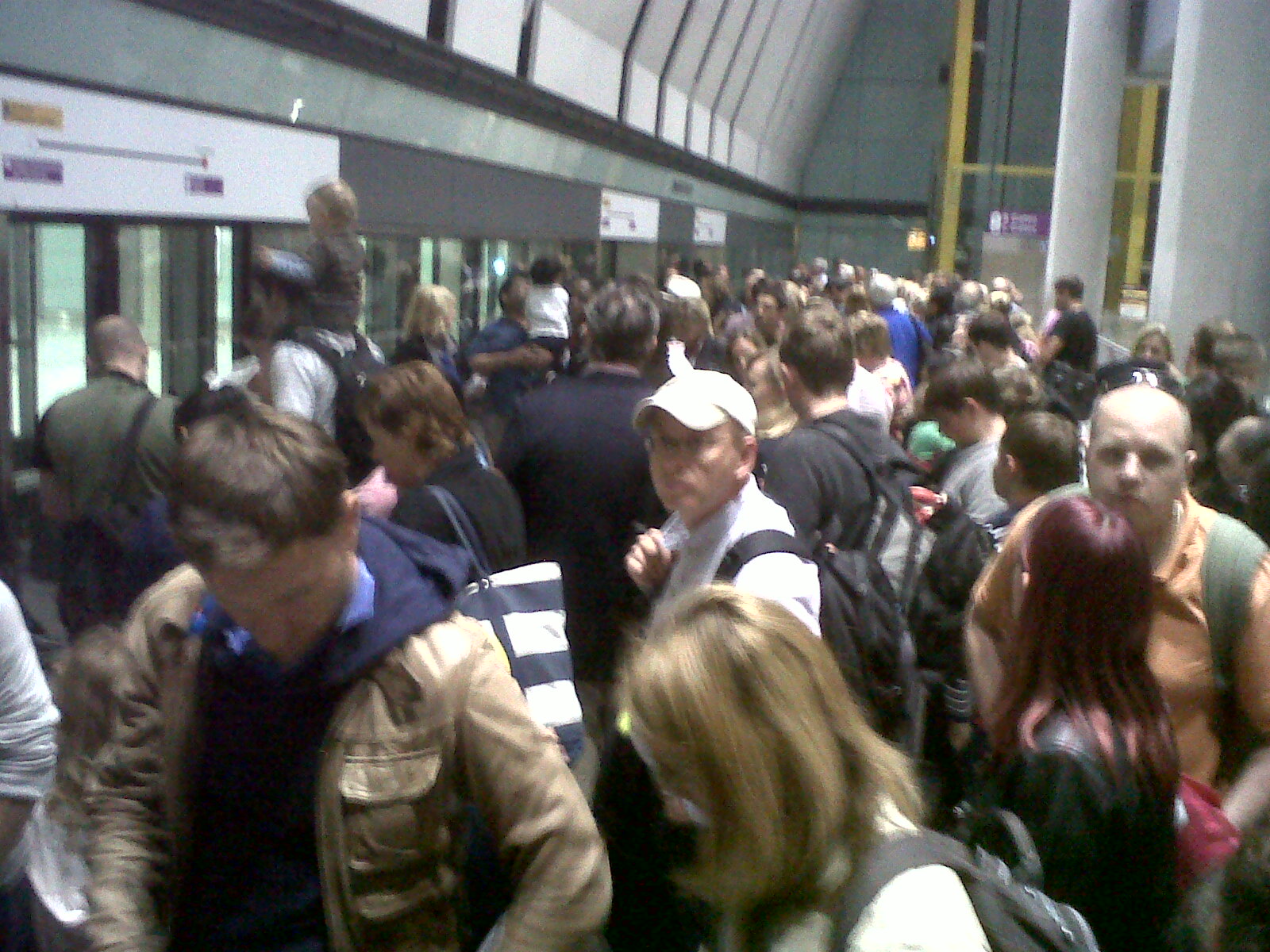
All this for a journey of about 2 minutes. It would have been much simpler to have constructed a walkway to the main terminal. In fact there is one. For staff only. But not for the passengers. There had to be a transit. Transits are the thing. Of course having a transit means having an extra subterranean level to the building, with lifts going down to it at one end and up from it at another. But lifts are the thing also. There are lots of lifts at Terminal 5. Going forward we’ll all be going up and down.
I wonder if the architect had shares in a company that makes lifts and transit trains?
Anyway on arrival at Terminal 5 there was a similar scrum at the lifts up to passport control. No escalators were working, so I had to wait in the crowd of disgruntled passengers, gradually inching forwards while the 3 operating lifts came and went. As we went up it dawned on me that there might be a delay at passport control..
In fact there were delays before we even got there. The immigration hall was so full that we had to form three separate queues along a corridor just to get into the main queue.
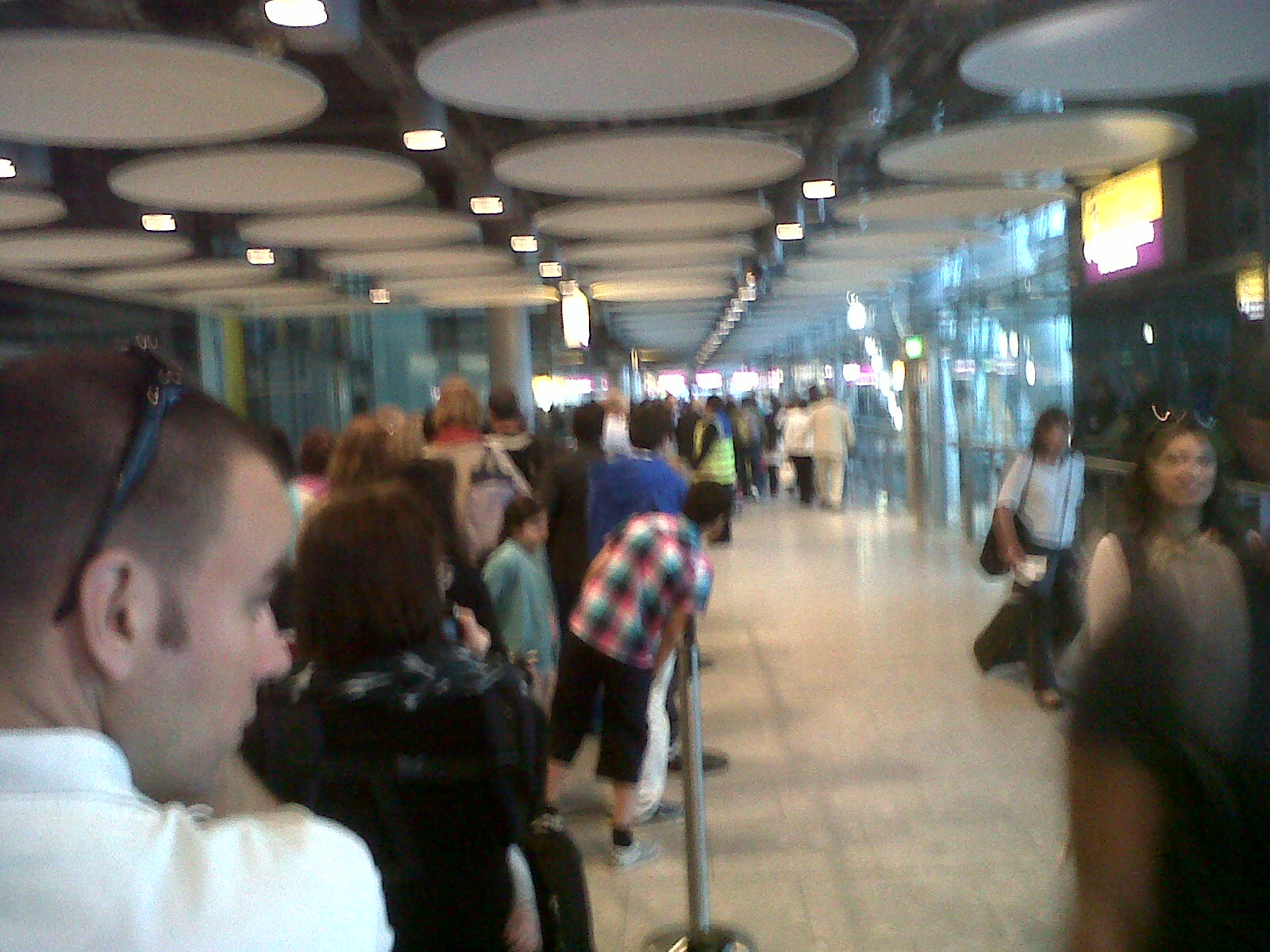
When I finally got into the immigration hall, it was pandemonium. The capacity in this area is clearly far too small and there are far too few people checking passports. The system just can’t cope with the traffic being sent through it. It’s a basic management problem that apparently nobody is prepared to do anything about. Improving it would cost money, of course, but why bother? Passengers are hardly going to turn around and go home at that point, so who cares?
At least the queue for UK/EU passport holders was moving. As I inched forward through the rat’s maze towards a desk I looked from time to time at the “Other passports” line, which barely budged. I felt a sense of anger mixed with shame. What sort of message does this send to visitors to our shores? What kind of country is it that makes showy new buildings like Terminal 5 and then runs them like Fawlty Towers?
They don’t allow photography in the passport control area, by the way. The ban is no doubt an attempt to conceal the evidence of what a shambles it is.
Anyway, at least the long delay at Immigration meant that my bag had arrived at the Baggage Reclaim by the time I got through. I picked it up and made for the Heathrow Express connection to Paddington. The time was just after 8.30; one hour and three quarters after we’d landed.
Still at least I was on my way. Or was I? The train departed and then stopped at a signal. We waited. Eventually the driver explained that there was a major points and signal failure so only one line was operating. We got to Paddington, but it took 35 minutes rather than the usual 15.
There is an alternative way of getting back to Cardiff from Heathrow, which involves taking a bus to Reading and getting the train from there. Although that route is cheaper, there is a risk of severe traffic delays at rush-hour periods, so opted for the Heathrow Express in the belief it was more reliable. More fool me.
When I arrived at Paddington, it too was a mass of disgruntled people. The reason? No trains.

The same signalling problem was disrupting trains into and out of Paddington. All departing trains were simply marked as “delayed” on the boards. Eventually, I got the 9.15, which departed at 9.38. Not too bad in the end. Except that it had to navigate a crowded route westwards. We arrived at Reading after 50 minutes instead of the usual 25.
Then things seem to settle down. We started to move at full speed. I even had a short nap. I was woken by an announcement from the guard. It had been decided that the train I was on would not, after all, be going to Cardiff but would terminate at Newport. First Great Western like to make the most of any possible inconvenience. It’s only 15 minutes from Newport to Cardiff, but it was too much trouble to take us that short distance. We were turfed off and had to wait for local commuter train. Not surprisingly, it was packed so I had to stand all the way.
I’ll be expecting a refund from First Great Western, but that’s not the point. It’s their contemptuous attitude to the travelling public that’s the point. Their prices are so high one might expect them to treat passengers with some respect. But no.
Anyway, I got home exhausted, stressed and frustrated. Given how badly things had gone I half-expected my house to have fallen down while I was away, but thankfully all was well back at the ranch. I decided to cool off a bit before writing this account of the journey, otherwise it would have been even more intemperate! I had been planning to go into work this afternoon but was in no fit state.
Still, it’s good to be home. Kind of.
Follow @telescoperGoing Virial
Posted in The Universe and Stuff with tags astronomy, self-gravitating system, Virial Theorem, Virialised on April 16, 2012 by telescoperHere’s something a bit different. I was talking the other day with some folks here about the use of the Virial Theorem to measure masses of galaxy clusters. In case you’ve forgotten, an important consequence of the virial theorem is that the average potential energy of an isolated system in gravitational equilibrium is equal to minus twice the average kinetic energy, i.e.

Being mathematicians they wanted to have a precise definition of when this theorem holds, i.e. what it means for a system to be in virial equilibrium. I have to admit I was a bit stumped.
The problem is that the proof of the theorem (which you can find on the wikipedia page) involves assuming that the time-average of a scalar quantity (the virial), derived from the positions and momenta of the particles in the system, is zero. That’s fine, but the average is taken over an infinite time and most cosmic objects we apply it too are rather younger than the age of the Universe. So how accurately does it apply to, e.g., galaxy clusters? How large are the fluctuations about the mean?
Another problem is that clusters aren’t really isolated either. According to prevailing wisdom clusters sit at the intersections of filaments and sheets of dark matter from which matter continually accretes onto them, increasing their mass.
Clusters also contain a sizeable amount of substructure. Does this cast further doubt on how well actual clusters are described by the virial theorem?
I’ve heard a number of lectures and seminars about virial mass estimates of clusters but never have I heard a precise, testable definition of when it is expected to apply and how large the deviations from it are in realistic situations. I’ve taught courses in which the theorem is applied to a variety of situations, but I never looked too deeply into its foundations – which is, of course, very sloppy of me. I tried asking a few people, and posted a question of Twitter, but didn’t get a really convincing response. Naturally, therefore, I decided to try it out on the readership of this blog….
So, please, would anyone out there please give me a precise testable definition of what is meant by a “virialised system” and explain how how well the virial theorem is supposed to apply to real clusters? Pointers to convincing discussions in the literature would be welcome!
Follow @telescoper

 In the Dark