Author Archive

Great Expectations

Posted in Film, Literature, Television with tags , , , , on December 29, 2011 by telescoper

I don’t make a secret of the fact that I don’t watch TV, and didn’t really do so over the Christmas holiday. However, I did catch the new BBC adapation of Charles Dickens’ Great Expectations which I think is one of the greatest novels in all literature. I wasn’t that keen to watch it, after seeing several pointless modern films of the story that didn’t do justice either to the original novel or to the marvellous 1946 film directed by David Lean, which I think is one of the greatest movies ever made. It’s not that I think people shouldn’t do remakes of classic stories – great novels can bear many different versions – it’s just that they’re often done with neither wit nor imagination and the end result can be so obviously inferior that one wonders why it was ever released. The recent remake of the perfect Ealing Comedy The Ladykillers, for example, was such total crap from start to finish it made me want to beat the director over the head with a blunt instrument.

In the end, though, I was persuaded to watch it and was very impressed indeed with the new version.   Douglas Booth, who plays the teenage Pip, as well as being an extraordinarily handsome young man, is also a fine actor. The young Pip’s encounter with the convict Magwitch (played by Ray Winstone) in Episode 1 was every bit as memorable as the older film, but I’ve decided to put the latter up here to encourage those who haven’t been fortunate enough to see the classic version.

I’m interested in suggestions of best and worst remakes….so feel free to add yours through the comments box.

Wanderlust

Posted in Jazz with tags , , , on December 29, 2011 by telescoper

I saw that someone posted this on Youtube, so couldn’t resist putting it on here. For a long time in the 70s and 80s this was used by Humphrey Lyttelton as the theme tune for his BBC Radio programme The Best of Jazz so it’s full of nostalgia for me as I used to listen to it every Monday night when I was school. Although quite a traditionalist in terms of his own music, Humph played all kinds of Jazz on his programme and in so doing introduced me to a great deal of music that I still love, thirty odd years later. The only problem with using this as his theme tune was that I never got to hear the whole thing all the way through, until I finally got around to buying the LP (which I still have).

This track, Wanderlust, is taken from the album Duke Ellington meets Coleman Hawkins and it features star performers from the Ellington Band of the early sixties, with the great Coleman Hawkins sitting in on tenor saxophone. It’s a fairly basic blues composition, of the type often played at jam sessions like this; Ellington himself doesn’t play a solo, but provides wonderful piano accompaniment throughout. The rest of the rhythm section comprises Aaron Bell (bass) and Sam Woodyard (drums). Soloists in order are: Johnny Hodges (alto sax), typically relaxed; Ray Nance on trumpet; Harry Carney (baritone sax); Lawrence Brown (trombone); and finally a longer contribution by the star of the show, Coleman Hawkins, whose climactic solo is superbly constructed around the simple blues chords, taking it into another dimension entirely, before an ensemble chorus after which Sam Woodyward whips it up in sixths and takes them home. A great record by a bunch of great musicians that manages to be simultaneously very typically Duke Ellington and very typically Coleman Hawkins.

Back from the North

Posted in Uncategorized with tags on December 28, 2011 by telescoper

After a nice Christmas break back in my home town of Newcastle I’m now back to Cardiff. The weather was a bit of a contrast after last year’s snow and ice, as it was unusually mild in the North East this year although a bit dark and blustery. I travelled there and back by train too, without any significant hitches either way, arriving on time on both journeys. It was a very restful holiday for me – which is just what I needed, if truth be told.

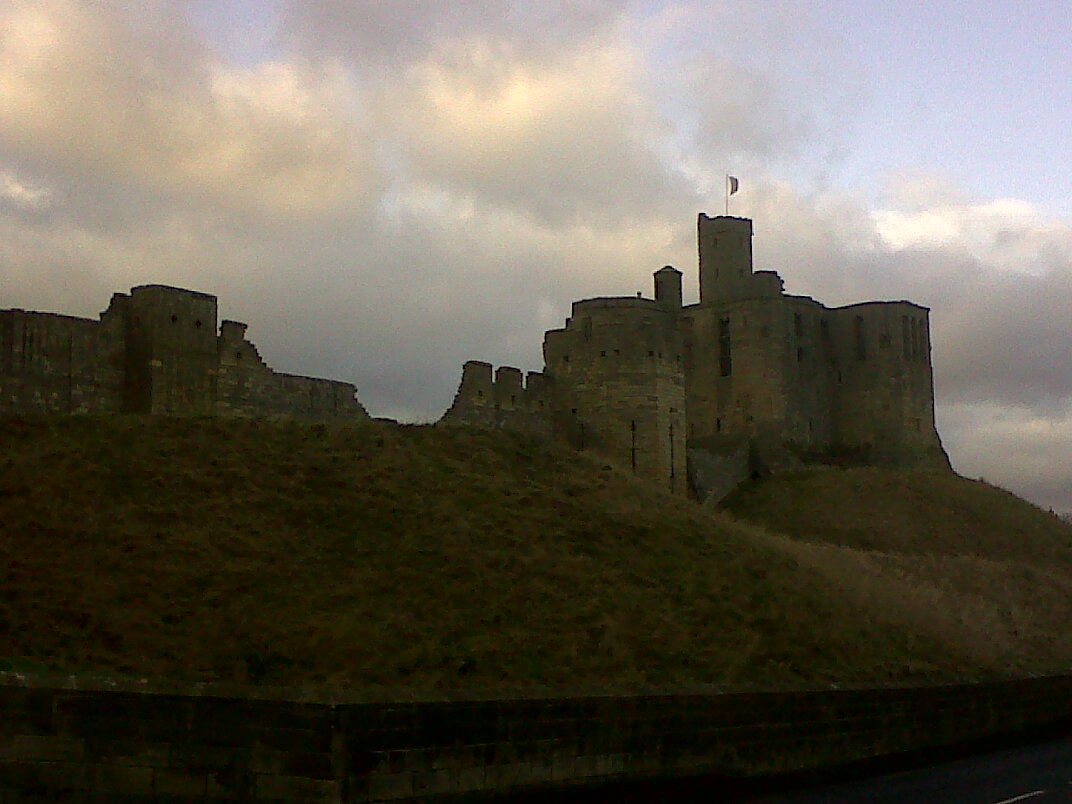
On boxing day we took a drive through the beautiful countryside of Northumberland where, as usual the winter weather produced some dramatic lighting effects. Although I only had my Blackberry with me I managed to get a snap of Warkworth Castle, which came out quite well, the castle looking brooding against the setting sun:


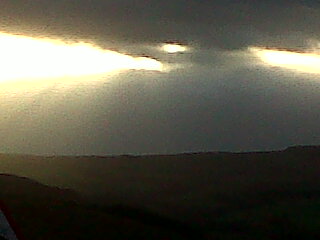
And a bit later on, over the moors, the wind clouds and sunbeams produced some ominous-looking patterns, which the little phone camera struggled to capture…

The portents turned out to be inaccurate, however, as Newcastle United managed to win their Boxing Day fixture, away against Bolton Wanderers, a team from the Midlands.

Anyway, I hope you all had as pleasant a festive period as I did. Now it’s all about preparing for the new year and new teaching term, and of course blogging will resume!

Rothbury Hills

Posted in Biographical, Music with tags , , on December 22, 2011 by telescoper

Well the old batteries are very nearly flat and I’ll shortly be heading up North for a Christmas break, after just one more meeting this afternoon about our consolidated grant application which is due in the new year. I can’t help getting a bit sentimental about the land of my birth at this time of year, especially the lovely countryside of Northumberland, so I thought I’d leave you for the holidays with this little clip I found on Youtube which also features the evocative sound of the Northumbrian Smallpipes played by Kathryn Tickell and her band.

Air is blown  through the smallpipes using bellows under the arm rather than the mouth. The  chanter – that’s the bit you finger to produce the notes – has a completely closed end, combined with the unusually tight fingering style (each note is played by lifting only one finger or opening one key) so that the style of playing is staccato; there are no grace notes in the Northumbrian smallpipes tradition. Their sound is also far quieter than most other bagpipes because the bores on both chanter and drones are very narrow. Anyway, I think it’s a beautiful sound and one that’s redolent with nostalgia, for me.

I don’t think I’ll be blogging while I’m up North, so let me take this opportunity to wish you all a very happy holiday!


Hylas and Philonous

Posted in History, The Universe and Stuff with tags , , , , , , , on December 21, 2011 by telescoper

I’ve just finished reading (and writing a review of) a funny little book about quantum mechanics called Quantum Enigma: Physics Encounters Consciousness by Bruce Rosenblum and Fred Kuttner. I won’t repeat the review here for fear of copyright infringement, but I will say that, somewhat to my surprise, I actually liked some of the book although it does go off the rails a bit now and then. Don’t we all, though?

Anyway, one thing did strike me that I didn’t really have time to write about in my piece concerns the philospher George Berkeley (1685-1753). In case you weren’t aware, the town of Berkeley (near San Francisco, in California) is actually named after him.

Berkeley was one of a number of philosophers responsible for the emergence in the 17th and 18th centuries of a movement now known as empiricism. The most striking of Berkeley’s arguments is that matter (or substance) cannot be said to exist in a manner that’s independent of the mind, butHis work has turned out to be nowhere near as durable as some of his contemporaries, notably David Hume,  but he’s actually a much more interesting thinker  than most people seem to give him credit for. Indeed, many writers – including the authors of the book I mentioned above – dismiss his views as a preposterously naive form of solipsism. Although I’m no empiricist myself, I think this Berkeley-bashing is a bit unfair.

I think Berkeley’s ideas are best understood in relation to the others that were being suggested around the time he was writing, particularly René Descartes whose method was to try to understand what could be known with certainty when all possible scepticism was argued away. In Berkeley’s most important work The Dialogues of Hylas and Philonous (1710)  he developed this approach into an argument that only ideas, perceived and created by the mind, could be known with any certainty, doing so through a dialogue between two characters. Hylas represents the view of “normal” scientific common sense (as one imagines would be exemplified by, say, Isaac Newton); Philonous represents Berkeley’s own views.

Time and time again Philonous comes up with ingenious counters to the “obvious” arguments presented by Hylas. Our understanding of what we consider to be actually existing objects to which we attribute certain qualities (such as white clouds or hot water) is essentially a mental affair. Sensations such as taste and pain have no basis in existence outside the mind, but what about trickier concepts like colour? Can it be said that when  an object looks red that it must contain in itself the quality of redness? Berkeley says no, because “red” is merely a category and cannot therefore exist in the colour. Of course we now know a lot more about how colour comes about than Berkeley did, but it remains an interesting point.

He suggested quite generally that impressions we get from our senses are not necessarily based on an innate qualities of the objects or substances with which our senses come into contact. For example, our sense of distance is not caused by the actual distance between objects themselves.

I have to re-iterate that I’m not an empiricist and I don’t agree with Berkeley’s position, just that his position is a great deal subtler and more interesting than usually represented. I mis-spent a large part of my youth struggling with  impenetrable works of philsophy, but Hylas and Philonous is one I definitely don’t regret reading. Not quite up to the standard of David Hume, mind you, but who is?

So give George Berkeley a break! Karl Popper, on the other hand…
Sea Christmas

Posted in Poetry with tags , , on December 21, 2011 by telescoper

This is the wrong Christmas
in the right place: mistletoe
water there is no kissing
under; the soused holly

of the wrack, and birds coming
to the bird-table with
no red on their breast. All
night it has snowed

foam on the splintering
beaches, but the dawn-
wind carries it away, load
after load, and look,

the sand at the year’s
solstice is young flesh
on a green crib, product
of an immaculate conception.

by R.S. Thomas (1913-2000).

The Geordie Particle

Posted in The Universe and Stuff with tags , , , , on December 20, 2011 by telescoper

As the media frenzy abates after the latest experimental results from the Large Hadron Collider show tantalising but inconclusive evidence for the existence of the Higgs boson, it’s perhaps now time to focus on the hard facts surrounding this elusive particle. At yesterday’s Christmas lunch I stumbled upon one piece of information of which I was previously unaware and which is clearly of national importance. The eponymous creator of the Higgs particle, Professor Peter Higgs, was in fact born in the fine city of Newcastle upon Tyne, which really is in The North. This fact identifies him as a Geordie, although having just heard him on the radio I think there’s not much sign of it in his accent.

Anyway, in honour of this important discovery I respectfully submit that  The Large Hadron Collider should be given a more appropriate name,  i.e. The Geet Big Hadron Basher. And I’m sure God won’t mind if the Higg’s boson is henceforth known as the Geordie Particle.

December Blues

Posted in Poetry with tags , , on December 20, 2011 by telescoper

At the bad time, nothing betrays outwardly the harsh findings,
The studies and hospital records. Carols play.

Sitting upright in the transit system, the widow-like women
Wait, hands folded in their laps, as monumental as bread.

In the shopping center lots, lights mounted on cold standards
Tower and stir, condensing the blue vapour

Of the stars; between the rows of cars people in coats walk
Bundling packages in their arms or holding the hands of children.

Across the highway, where a town thickens by the tracks
With stores open late and creches in front of the churches,

Even in the bars a businesslike set of the face keeps off
The nostalgic pitfall of the carols, tugging. In bed,

How low and still the people lie, some awake, holding the carols
Consciously at bay, Oh Little Town, enveloped in unease.

by Robert Pinsky (b. 1940)

Out to Lunch!

Posted in Jazz with tags , , on December 19, 2011 by telescoper

Today’s the day for our infamous annual departmental Christmas Lunch, which last year started at 12.30 and carried on until 3.30 the following morning (at least for me and a few other diehards). I thought I’d mark the occasion this year with an appropriate piece of music featuring one of my favourite jazz artists, saxophonist Eric Dolphy. This is the title track of the pioneering free jazz album Out to Lunch. This album is without doubt one of the high points of 1960s avant-garde jazz, primarily because of Dolphy’s extraordinary playing but also because of the brilliance of the other musicians. It’s a virtuoso performance all round, and it’s especially hard to believe that the superb drummer Tony Williams was only 18 when this track was recorded!

Unfortunately the original track is a bit too long for Youtube so this is in two parts; you’ll have to click through for the second bit.

Anyway, this would definitely be one of my Desert Island Discs and it probably also serves as an accurate musical illustration of the state my brain will be in later today. Enjoy!

Closer to Erdös…

Posted in Biographical with tags , , , , on December 18, 2011 by telescoper

After one of my  lectures a year or so ago, a student came up to me and asked whether I had an Erdős number and, if so, what it was.  I didn’t actually know what he was talking about but  tried to find out and eventually posted about it.

In case you didn’t know, Paul Erdős (who died in 1996) was an eccentric Hungarian mathematician who wrote more than 1000 mathematical papers during his life but never settled in one place for any length of time. He travelled between colleagues and conference, mostly living out of a suitcase, and showed no interest at all in property or possessions. His story is a fascinating one, and his contributions to mathematics were immense and wide-ranging.  The Erdős number is a tiny part of his legacy, but one that seems to have taken hold. Some mathematicians appear to take it very seriously, but most treat it with tongue firmly in cheek, as I certainly do.

So what is the Erdős number?

It’s actually quite simple to define. First, Erdős himself is assigned an Erdős number of zero. Anyone who co-authored a paper with Erdős has an Erdős number of 1. Then anyone who wrote a paper with someone who wrote a paper with Erdős has an Erdős number of 2, and so on. The Erdős number is thus a measure of “collaborative distance”, with lower numbers representing closer connections.

I say it’s quite easy to define, but it’s rather harder to calculate. Or it would be were it not for modern bibliographic databases. In fact there’s a website run by the American Mathematical Society which allows you to calculate your Erdős number as well as a similar measure of collaborative distance with respect to any other mathematician.

A list of individuals with very low Erdős numbers (1, 2 or 3) can be found here.

Given that Erdős was basically a pure mathematician, I didn’t expect first to show up as having any Erdős number at all, since I’m not really a mathematician and I’m certainly not very pure. However, his influence is clearly felt very strongly in  physics and a surprisingly large number of physicists (and astronomers) have a surprisingly small Erdős number.

Anyway, my erstwhile PhD supervisor John D. Barrow recently emailed to point out that he had written a paper with Robin Wilson, who once co-authored a paper (on graph theory) with Erdős himself. That means John’s Erdős number is now  2, mine is consequently no higher than 3, and  anyone I’ve ever written a paper with now has an Erdős number no greater than 4.

I’ll be making sure this new information is included in our forthcoming REF submission.