Author Archive

Kielder Star Camp

Posted in The Universe and Stuff with tags , , , on October 27, 2011 by telescoper

I  came across a story in the Grauniad about the Kielder Forest Star Camp at which scores of amateur astronomers are gathering along with their tents this week to exploit the darkest skies in England.  The skies are pretty dark above  Cardiff right now, but that’s because of the thick cloud rather than lack of light pollution. I hope they have better weather in Kielder which, if you didn’t know, is in Northumberland. With an area of 250 square miles, Kielder Forest is  England’s largest forest (although it’s actually more of a plantation, being man-made under the auspices the Forestry Commission) and it surrounds Kielder Water, the largest man-made reservoir in the UK. Anyway, as the time-lapse video shows, it’s  a fine spot for astronomy when the clouds stay away; at the end you’ll see the excellent new Kielder Observatory too!

Good luck to all the participants (and, more importantly, clear skies…) .

Come off it, REF!

Posted in Science Politics with tags , , , , , , on October 27, 2011 by telescoper

Yesterday we all trooped off to the Millennium Stadium in Cardiff for a Staff Away Day. We didn’t actually get to play on the pitch of course, which wasn’t even there, as it had been removed to reveal a vast expanse of soil. Instead we were installed in the “Dragon Suite” for a discussion about our preparation for the forthcoming Research Excellence Framework.

Obviously I can’t post anything about our internal deliberations, but I’m sure departments up and down the United Kingdom are doing similar things so I thought I’d mention a few things which are already in the public domain and my personal reactions to them. I should also say that the opinions I express below are my own and not necessarily those of anyone else at Cardiff.

The first thing is the scale of the task facing members of the panel undertaking this assessment. Each research active member of staff is requested to submit four research publications (“outputs”) to the panel, and we are told that each of these will be read by at least two panel members. The panel comprises 20 members.

As a rough guess I’d say that the UK has about 40 Physics departments, and the average number of research-active staff in each is probably about 40. That gives about 1600 individuals for the REF. Actually the number of category A staff submitted to the 2008 RAE was 1,685.57 FTE (Full-Time Equivalent), pretty  close to this figure. At 4 outputs per person that gives 6400 papers to be read. We’re told that each will be read by at least two members of the panel, so that gives an overall job size of 12800 paper-readings. There are 20 members of the panel, so that means that between 29th November 2013 (the deadline for submissions) and the announcement of the results in December 2014 each member of the panel will have to have read 640 research papers. That’s an average of about two a day…

Incidentally, as I’ve mentioned before, the Physics REF panel includes representatives from institutions in England, Scotland and Northern Ireland, but not Wales. The decision to exclude representation from Welsh physics departments was a disgrace, in my view.

Now we are told the panel will use their expert judgment to decide which outputs belong to the following categories:

  • 4*  World Leading
  • 3* Internationally Excellent
  • 2* Internationally Recognized
  • 1* Nationally Recognized
  • U   Unclassified

There is an expectation that the so-called QR  funding allocated as a result of the 2013 REF will be heavily weighted towards 4*, with perhaps a small allocation to 3* and probably nothing at all for lower grades. “Internationally recognized” research is probably worthless in the view of HEFCE, in other words. Will the papers belonging to the category “Not really understood by the panel member” suffer the same fate?

The panel members will apparently know enough about every single one of the papers they are going to read in order to place them  into one of the above categories, especially the crucial ones “world-leading” or “internationally excellent”, both of which are obviously defined in a completely transparent and objective manner. Not.

We are told that after forming this judgement based on their expertise the panel members will “check” the citation information for the papers. This will be done using the SCOPUS service provided (no doubt at considerable cost) by   Elsevier, which by sheer coincidence also happens to be a purveyor of ridiculously overpriced academic journals. I’ve just checked the citation information for some of my papers on SCOPUS, and found an alarming number of errors. No doubt Elsevier are  on a nice little earner peddling meaningless data for the HECFE bean-counters, but I haven’t any confidence that it will add much value to the assessment process.

There have been high-profile statements to the effect that the REF will take no account of where the relevant “outputs”  are published, including a recent pronouncement by David Willetts. On the face of it, that would suggest that a paper published in the spirit of Open Access in a free archive would not be disadvantaged. However, I very much doubt that will be the case.

I think if you look at the volume of work facing the REF panel members it’s pretty clear that citation statistics will be much more important for the Physics panel than we’ve been led to believe. The panel simply won’t have the time or the breadth of understanding to do an in-depth assessment of every paper, so will inevitably in many cases be led by bibliometric information. The fact that SCOPUS doesn’t cover the arXiv means that citation information will be entirely missing from papers just published there.

The involvement of  a company like Elsevier in this system just demonstrates the extent to which the machinery of research assessment is driven by the academic publishing industry. The REF is now pretty much the only reason why we have to use traditional journals. It would be better for research, better for public accountability and better economically if we all published our research free of charge in open archives. It wouldn’t be good for academic publishing houses, however, so they’re naturally very keen to keep things just the way they are. The saddest thing is that we’re all so cowed by the system that we see no alternative but to participate in this scam.

Incidentally we were told before the 2008 Research Assessment Exercise that citation data would emphatically not be used;  we were also told afterwards that citation data had been used by the Physics panel. That’s just one of the reasons why I’m very sceptical about the veracity of some of the pronouncements coming out from the REF establishment. Who knows what they actually do behind closed doors?  All the documentation is shredded after the results are published. Who can trust such a system?

To put it bluntly, the apparatus of research assessment has done what most bureaucracies eventually do; it has become  entirely self-serving. It is imposing increasingly  ridiculous administrative burdens on researchers, inventing increasingly  arbitrary assessment criteria and wasting increasing amounts of money on red tape which should actually be going to fund research.

And that’s all just about “outputs”. I haven’t even started on “impact”….
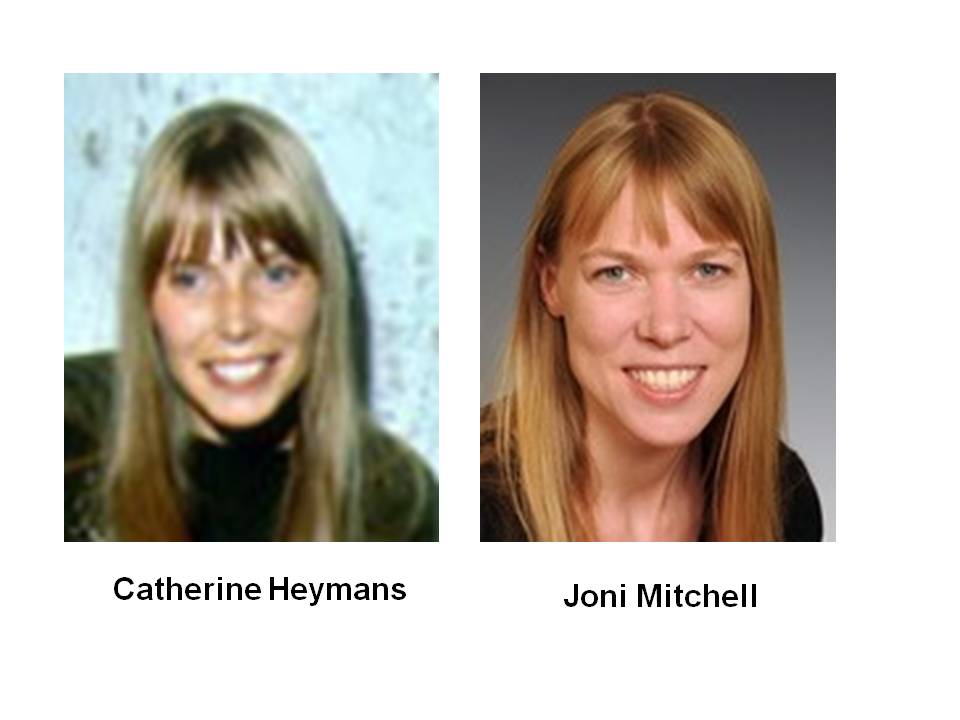
Astronomy Look-alikes, No. 68

Posted in Astronomy Lookalikes with tags , on October 26, 2011 by telescoper

I keep getting told off for not having enough female lookee-likees, so how about this one? I’m struck by the resemblance between astronomer Catherine Heymans and singer/songwriter Joni Mitchell. I wonder if by any chance they might be related?

University Admissions in Uncharted Territory

Posted in Education, Politics with tags , , , , , , on October 26, 2011 by telescoper

It turns out I have a few minutes spare before going to our staff Away (half) Day this afternoon, so I thought I’d pass on another interesting bit of news that came out this week.

The Universities and Colleges Admissions Services, known to all and sundry as UCAS, has released some interesting statistical information on numbers of applicants to UK universities and how this compares with the corresponding stage in the admissions timetable last year.

We’re still very early on in the process so it would be unwise to read too much into the figures available so far. The big question, however, is whether the ConDem government’s decision to raise fees for university students to £9K per annum has had any effect on the number of students applying. In fact the headline figure is that after several years of growth in overall applicant numbers, the figures for 2012 entry are down 9% on last year. Still early days, of course, but it does look like the new fee levels may be having the deterrent effect we all expected.

Another interesting thing that struck me, from Table 6 of the UCAS analysis, is that the number of students applying to study courses in the physical sciences (including Physics & Astronomy) is down by just 1.6% on the same stage last year, compared to an average of 7.9% across all subjects. (Note that this is not the same as the 9% mentioned above, because students get more than one choice of course..).

Of particular interest to us in Wales is the breakdown of applicants by domicile and choice of institution.  From Table 4 we see that the number of English students applying to Welsh Universities is down 13.4%, while the number of Welsh-domiciled students applying to study in England is down by only 4.3%. If this differential persists then it will have a big impact on the Welsh Higher Education sector, because of the Welsh Assembly Government’s decision to cut funding for Welsh Universities in order to pay for its  subsidy for  Welsh students wanting to study in England.

It’s too early to predict what will happen to overall student numbers for 2012/13, but I’m sure planning officers in universities all around the UK will be looking at the interim figures with a considerable degree of anxiety.

Posted in Science Politics with tags , , , on October 26, 2011 by telescoper

No time for a post of my own today – it’s our “Staff Away Day” (which owing to budget cuts is only half a day and is being held in Cardiff, at the Millennium Stadium). Anyway, I was going to pass on the same rumours that Andy Lawrence is writing about, and he knows more about this than I do, so over to him for the ongoing ramifications of JWST…

Astronomy Look-alikes, No. 67

Posted in Astronomy Lookalikes with tags , , , on October 25, 2011 by telescoper

I’m struck by the remarkable similarity between Dr Marek Kukula, “Public Astronomer” at the Royal Observatory, Greenwich, and Constable Kevin Goody, as played by actor James Dreyfus in the popular situation comedy The Thin Blue Line. I wonder if by any chance they might be related?

Marek Kukula

Kevin Goody

A Big Idea

Posted in The Universe and Stuff with tags , , , on October 25, 2011 by telescoper

I thought I’d share this, part of the Big Ideas series produced by Cardiff University, because it features our own Haley Gomez:

In the video Haley explains how enormous quantities of dust have been found by astronomers in the School of Physics & Astronomy. We just can’t get the cleaning staff, you see. In fact more recently there have also been discoveries of damp, mould, crumbling ceilings and broken windows.

I don’t want to steal Haley’s thunder in any way, but I should mention that an even more startling discovery has recently been made elsewhere in the School of Physics & Astronomy at Cardiff University. In my office, in fact.  Not  dust, but anti-dust!

A-Level Further Mathematics Examination, 1981

Posted in Education with tags , , on October 24, 2011 by telescoper

I’ve been forcibly evicted from my office this afternoon while a highly-trained operative of Cardiff University’s esteemed Estates Department replaces a broken window. It’s been broken since I moved into the office, about four years ago, by the way, but you can’t rush these things. Anyway, having been forced to change location I took the opportunity to decamp to the upstairs computer room wherein our departmental scanner resides and occupied myself with the task of scanning in yet another of the old examinations I took when I was in school. This one is the Further Mathematics examination, consisting of two papers each of three hours’ duration: Paper 1 is entirely Pure Mathematics; Paper 2 contains a mixture of Pure and Applied Mathematics, and Statistics.

Looking back on the paper now, thirty years after I first saw it, it seems to me that the Applied Mathematics questions (6-11 on Paper 2) actually look quite tough by the standard of 1st year undergraduate examinations in mechanics. However, I’ll leave it to you to comment on whether you think it’s harder, or easier, or about the same, compared to current A-levels in Further Mathematics. I’d also be interested in knowing whether there’s anything on these papers that isn’t on the syllabus nowadays.

The comments box awaits…

Another Crossword Competition

Posted in Crosswords with tags , , on October 24, 2011 by telescoper

Flushed with success after winning a prize in the Saturday Independent crossword competition (even if it is yet another dictionary) and flying high at No. 6 in the Azed Annual Honours List I thought I’d have another go at setting a puzzle for my readers. There were some complaints that my last crossword was too difficult, so here is a slightly simpler one for you:

Across                                                       Down

1  Current symbol for ego?                    1  One visual organ, we hear


Ghosts

Posted in Jazz with tags , , , , , , on October 23, 2011 by telescoper

I’ve been meaning to post this pioneering piece of music for some time but never seemed to get around to it until a comment yesterday reminded me that I’m probably not posting enough about Jazz these days. Albert Ayler was one of the true originals of the free jazz movement of the 1960s, and I think the album Spiritual Unity he made with Gary Peacock on bass and Sonny Murray on drums is the first record on which his radical ideas came fully to fruition, which is why I’ve chosen to post a track from it. His saxophone style was totally unique, with a rough broad vibrato and searing hard-edged tone contrasting dramatically with a superb command of the upper register and exhilirating speed of execution. His articulation is blurred in order to give the saxophone a more personal timbre, with inflections similar to a human voice, and he’s able to accomplish dramatic changes in mood, from a wild passion bordering on violence, to a deep sense of pathos or nostalgia. As is the case with other highly independent jazz musicians, such as Miles Davis and Thelonious Monk, you only have to hear one note to know immediately who’s playing.

This tune, the shorter of two versions on Spiritual Unity of an original composition by Albert Ayler called Ghosts, is a great example how he could make coherent what at first hearing sounds like disassociated bursts of sound. It involves remarkable improvised melodies based on short thematic lines designed to evoke unsophisticated  folk music or nursery tunes. It may sound primitive on the surface, but it’s very complex underneath and creating this extraordinary sound world clearly required great technical mastery from Ayler and his supporting musicians, especially Gary Peacock, who plays wonderfully on this track.

Yet for all its brilliance, this record also hints at the dark clouds that were never far from Ayler’s horizon. Although critically acclaimed, his music never found favour with the public. He battled depression throughout the late 60s and, in 1970, at the age of only 34, he took his own life by jumping off a ferry into New York’s  East River.