Author Archive

And Death shall have no Dominion

Posted in Poetry with tags , , on September 17, 2011 by telescoper

I’ve been meaning to post this marvellous reading by Dylan Thomas of his poem, And Death Shall Have No Dominion, and the sad news of the death of four miners in Gleision colliery near Pontardawe not far from Thomas’ own home town of Swansea makes this a fitting time to post it as a mark of respect to the four men and their grieving families.

And death shall have no dominion.
Dead mean naked they shall be one
With the man in the wind and the west moon;
When their bones are picked clean and the clean bones gone,
They shall have stars at elbow and foot;
Though they go mad they shall be sane,
Though they sink through the sea they shall rise again;
Though lovers be lost love shall not;
And death shall have no dominion.

And death shall have no dominion.
Under the windings of the sea
They lying long shall not die windily;
Twisting on racks when sinews give way,
Strapped to a wheel, yet they shall not break;
Faith in their hands shall snap in two,
And the unicorn evils run them through;
Split all ends up they shan’t crack;
And death shall have no dominion.

And death shall have no dominion.
No more may gulls cry at their ears
Or waves break loud on the seashores;
Where blew a flower may a flower no more
Lift its head to the blows of the rain;
Though they be mad and dead as nails,
Heads of the characters hammer through daisies;
Break in the sun till the sun breaks down,
And death shall have no dominion.

One Day International

Posted in Cricket with tags , , , , , on September 17, 2011 by telescoper

I promised yesterday to post a quick account of the Fifth (and final) One Day International between England and India at the SWALEC stadium in Sophia Gardens, Cardiff, so here goes…

As I feared, the weather in Cardiff yesterday wasn’t brilliant and, although it was quite warm during the morning, it was overcast and there were stacks of very dark clouds around by lunchtime. We got to the ground in time for the scheduled start, which was 2pm, but just as play was about to get under way the heavens opened and down came the rain.

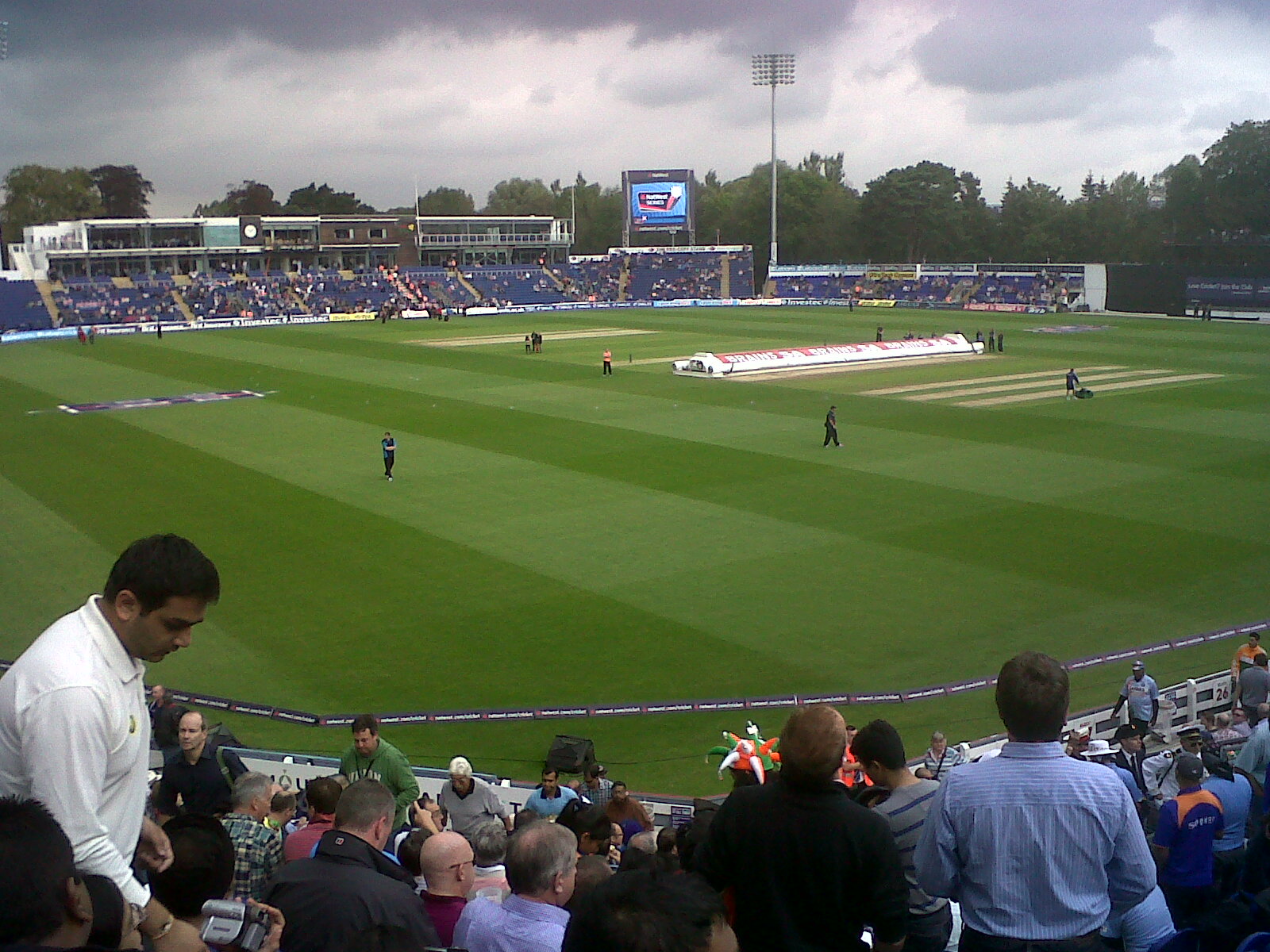
This was the scene about five to two, just as the covers were being taken off; they dark clouds to the left were moving from left to right and  covered the ground a few minutes later whereupon it stotted down.

Fortunately, although it came down in stair-rods for a while,  the rain  didn’t last long so play actually got under way about 2.40 and the authorities decided that the game would remain 50 overs a side (with a late finish).

England won the toss and decided to field. Openers Parthiv Patel and Ajinkya Rahane got the Indian innings off to a good start with a partnership of 52 runs, then Rahane was removed by Jade Dernbach when the batsman,  after scoring just  26 runs off 47 deliveries,  was caught by Steven Finn at third man, right down in front of us. In the 16th over, Patel also fell,  for 9 runs off 39 deliveries,  when he was caught by Tim Bresnan at mid-on off the bowling of spinner Graeme Swann.  Rahul Dravid (playing his last ODI)  and Virat Kohli then played a wonderful partnership which was not broken until the last delivery of the 42nd over.  England finally managed to grab the wicket of Dravid who left the field to a standing ovation after scoring  69 runs. The Dravid/ Kohli partnership had brought 170 runs; by the time  Dravid’s wicket fell, India were on 227-3. Meanwhile,  Kholi had managed to score his sixth one-day hundred but he was out for 107  in the 44th over when he was given out hit-wicket while trying to play a delivery by Swann; his back foot had apparently slipped and struck the stumps, dislodging a bail. Unlucky.

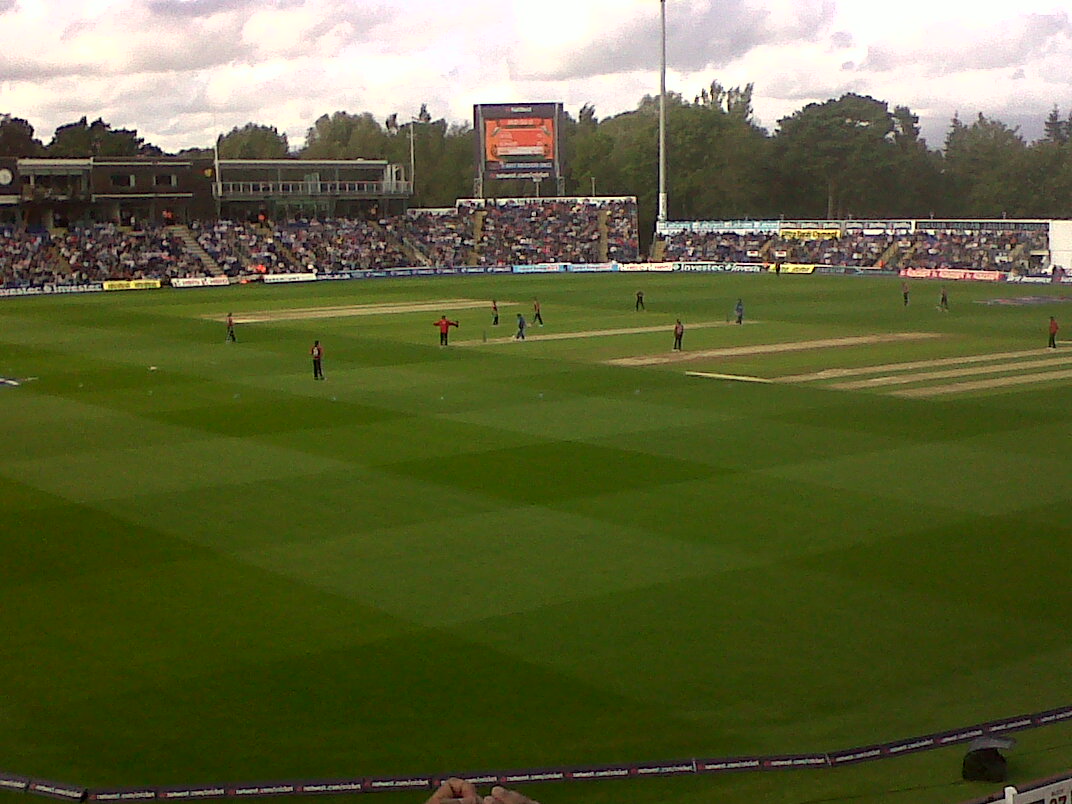
The Indian skipper Mahendra Singh Dhoni then smashed 50 runs off 26 deliveries to help his side post a score of 304-6, leaving England a daunting target of 305 runs to win. India certainly batted well, but were helped a bit by poor bowling by some of the England players. Indeed the only bowler I thought was really impressive was Finn, who was consistetly over 90 mph in his opening spell and was clearly troubling the Indian batsmen. Jade Dernbach, by contrast, committed the unpardonable sin of bowling wides in the last over. Incidentally, I managed to catch the umpire signalling an England wide, but I can’t remember who was bowling at the time:
Just after they players went off for a (shortened) interval, the rain came back again and this time it was decided that there wouldn’t be time for another full 50 overs. The Duckworth–Lewis (D/L) method was wheeled out, with the initial outcome that England would have to score 270 to win off 40 overs. That seemed very tough – the ten overs lost only reducing England’s target by 35. Another rain delay then  revised the target further  to 241 runs from 34 overs, a very stiff challenge indeed.

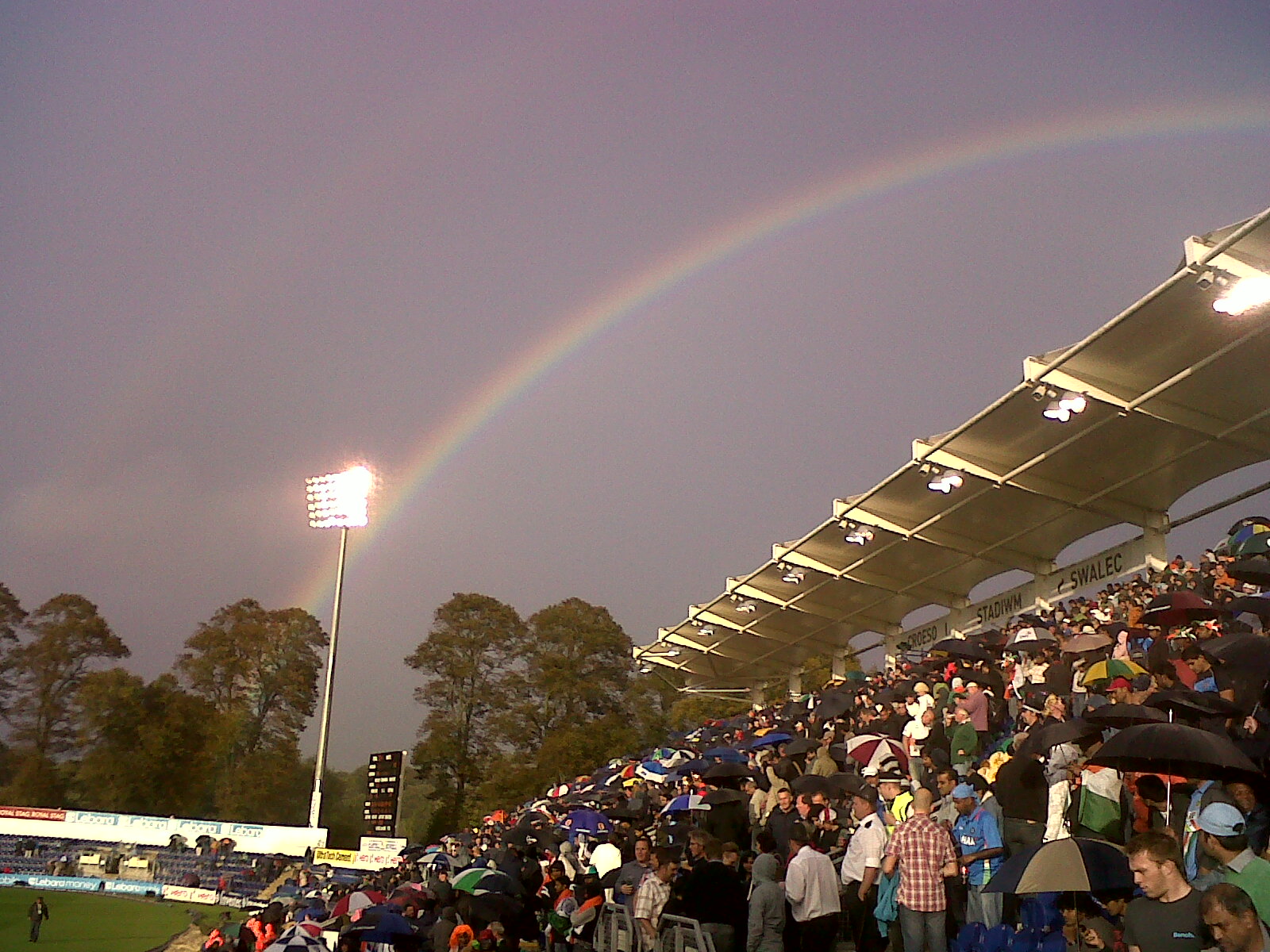
The many Indian supporters in the ground were buoyed by their team’s strong batting performance and seemed confidedent of a first victory against England this tour. I thought India would win at this point too, as a matter of fact. Anyway, the rain finally cleared and as the sun came out a rather nice rainbow appeared over Sophia Gardens as the floodlights were switched on for the “night” part of this “day-night” game.

England came out to bat and, rightly, sought to take the attack to India right from the ouset. Openers Alastair Cook and Craig Kieswetter scored quickly against some frankly rather poor Indian bowling.

England suffered their first loss in the fifth over with the score on 27 when Kieswetter was given leg-before wicket off the bowling of Vinay Kumar. Cook was then joined by Jonathan Trott, often a rather slow scorer, but  both batsmen scored quite freely building a partnership of 79 runs until Cook was dismissed in the 18th, bowled by Kohli. The England total was 106 at this point, with three wickets down but plenty of batting still to comeyet only 16 overs to score the remaining 135 needed to win.

Ian Bell departed after scoring 26 runs and then  Trott fell to a catch, off an uncharacteristically poor shot, for  63 runs off 60 deliveries. With four wickets now down, India (and their fans) must have been feeling pretty confident that they could stop England’s run chase. The result was firmly  in the balance.

Cue the  21-year-old debutant Jonathan Bairstow who looked a little nervous for his first two or three deliveries, but then  proceeded to smash the Indian bowling all round the park (and out of it). I think at least two of his big straight hits may well have landed in the River Taff after clearing the stands at the Riverside end quite comfortably.  The flurry of boundaries boosted England’s scoring rate so quickly that in no time the target started to look not just possible but comfortable.  In the end Bairstow remained unbeaten on 41 runs while his partner Ravi Bopara was not out 37 as England won by 6 wickets with more than an over to spare.

It was an impressive performance by the England batsman and a crushing disappointment for India, who now  return  home without winning a single match in England this season.

Despite the showery weather it was a thoroughly enjoyable occasion. The ground was packed,  the sizeable Indian contingent contributed a lot to the atmosphere, and the usual groups of daft blokes in bizarre fancy dress also added a measure of eccentricity to the event. It did look at one point that there might be an ugly scene between two groups of fans in our stand, but thankfully it didn’t turn out to be very serious. We don’t want any of that sort of thing at cricket matches, thank you very much.

So that’s that. A fine end to the  summer of international cricket, though perhaps not for the Indian players and supporters….
The End of Summer

Posted in Biographical, Cricket on September 16, 2011 by telescoper

Here we are then, at the end of what passes for summer in these parts. Not that I had much of a holiday at any point, but now the traditional signposts of summer’s end have passed, including the Last Night of the Proms last weekend and yesterday’s end of the cricket County Championship.  It’s strange how one’s life is measured by such rituals. There’s still a fortnight until teaching resumes, but it’s definitely back to the grind next week for me because I’ll be locked in a dark dungeon in Swindon on panel business for the most of the week.

The cricket season finished in exciting style as Lancashire chased down a score of 211 to win by 8 wickets down in Taunton, while Warwickshire, who had started the day as favourites to win, could only draw against Hampshire whose batsman saved them from what looked like a losing position. So congratulations to Lancashire, outright winners of the County Championship for the first time  in 77 years!

I have to  say that because I have a devout Lancastrian staying with me for a couple of days; he drove up to Cardiff from Taunton after the close of play and Lancashire’s victory provided a good excuse for some bubbly and a nice nosh-up at a local restaurant. I’m a bit hung over this morning, in fact, but I have got the day off.

It’s not quite the end of the cricket season, however, as today Cardiff hosts a One-day International between England and India, the last in a series of 5. England won two of the previous games, with one tied and one abandoned with no result because of rain. It’s therefore what you might call a dead rubber, but it’s the last cricket in Cardiff until next year and the last excuse for a day off before next week’s ordeals in Swindon, so I’ll be there. The weather isn’t marvellous and it may well rain at some point, but I’m pretty sure we’ll get at least some cricket. It’s a sell-out at the Swalec Stadium so there should at least be a good atmosphere.

I’ll update the blog with an account of the match in due course, but that’s all for now…

Commodification, the Academic Journal Racket and the Digital Commons (via The Disorder Of Things)

Posted in Open Access, Uncategorized with tags , , , , , , , , , , , , , , , , , , , , , on September 15, 2011 by telescoper

Here’s another reasoned rant regarding the rapacity of the research racketeers. I think it makes some really good points.

The video clip is worth watching too, it being very funny.

Commodification, the Academic Journal Racket and the Digital Commons David, my erstwhile ‘parasitic overlord’ from when I was co-editing Millennium, points me to some posts by Kent Anderson of the Society for Scholarly Publishing, who defends the industry on a number of grounds from Monbiot’s polemic against the journal racket. The comments threads on both pieces are populated by academics who agree with Monbiot and by publishing industry colleagues who agree with Anderson (and who alternate between dismissing and … Read More

via The Disorder Of Things

Telescoper Crossword Competition

Posted in Crosswords with tags , , , , , on September 14, 2011 by telescoper

Having had a busy weekend reading grant applications and referee reports in advance of next week’s meeting of the Astronomy Grants Panel, I’ve been unusually late completing the weekend’s crosswords. As I mentioned a while ago, I’ve given up buying the Guardian in favour of the Independent, whose crosswords are much better in my opinion. I managed to do the prize crossword in the newspaper without too much difficulty, but the magazine supplement has a much more testing one called Inquisitor. In addition to being quite a challenging cryptic crossword, this usually has a twist in that one has to highlight (or sometimes delete) letters entered into the grid according to some theme. I’m a bit skeptical about these extra tasks, I suppose because I think a good crossword doesn’t need any such embellishments. I have to say, though, that it is  a different kind of challenge from the usual cryptic and I might warm to it given time.

About a year ago at the Azed 2000 dinner I had the opportunity to chat with some professional crossword compilers. It seems one gets paid around £150 (give or take) for setting a crossword in a national newspaper which isn’t a lot considering how difficult it is. One of the features of the Azed puzzles in the Observer is the monthly clue-setting competition, which I enjoy entering, but I’ve never tried to compile an entire crossword.

However, after finishing this week’s Azed  and Inquisitor puzzles I suddenly hit on a potentially lucrative idea. I’ve decided to start a crossword competition of my own. Here  is Telescoper Prize Crossword No. 1, inspired by Azed’s “Carte Blanche” puzzles…

Instructions for solvers. To enter the competition, devise a set of clues and solutions that fill the above grid in the manner of a typical Azed puzzle. Mail completed grids, together with clues to me at:  Telescoper Prize Crossword No. 1, PO Box 16  (across), Cardiff. The best entries, as judged by me, will win 27p in (used) postage stamps plus the chance to see their crossword in a national newspaper with my name as setter.

As a business plan, this simply can’t fail. It’s nearly as good as running an academic journal!

A Poll about Peer Review

Posted in Science Politics with tags , , , on September 13, 2011 by telescoper

Anxious not to let the momentum dissipate about the discussion of scientific publishing, I thought I’d try a quick poll to see what people think about the issue of peer review. In my earlier posts I’ve advanced the view that, at least in the subject I work in (astrophysics), peer review achieves very little. Given that it is also extremely expensive when done by traditional journals, I think it could be replaced by a kind of crowd-sourcing, in which papers are put on an open-access archive or repository of some sort, and can then be commented upon by the community and from where they can be cited by other researchers. If you like, a sort of “arXiv plus”. Good papers will attract attention, poor ones will disappear. Such a system also has the advantage of guaranteeing open public access to research papers (although not necessarily to submission, which would have to be restricted to registered users only).

However, this is all just my view and I have no idea really how strongly others rate  the current system of peer review. The following poll is not very scientific, but ‘ve tried to include a reasonably representative range of views from “everything’s OK – let’s keep the current system” to the radical suggestion I make above.

Of course, if you have other views about peer review or academic publishing generally, please feel free to post them through the comments box.

Dolor

Posted in Poetry with tags , on September 12, 2011 by telescoper

I have known the inexorable sadness of pencils,
Neat in their boxes, dolor of pad and paper-weight,
All the misery of manila folders and mucilage,
Desolation in immaculate public places,
Lonely reception room, lavatory, switchboard,
The unalterable pathos of basin and pitcher,
Ritual of multigraph, paper-clip, comma,
Endless duplication of lives and objects.
And I have seen dust from the walls of institutions,
Finer than flour, alive, more dangerous than silica,
Sift, almost invisible, through long afternoons of tedium,
Dropping a fine film on nails and delicate eyebrows,
Glazing the pale hair, the duplicate grey standard faces.

by Theordore Roethke (1908-63).


Where were you on 9/11?

Posted in Biographical, Politics with tags , , on September 11, 2011 by telescoper

I’m up unusually early, especially for a Sunday, because I have to finish a mountain of work for the impending meetings of the Astronomy Grants Panel. For the same reason I’ll keep this brief.

At the risk of contributing to the deluge of (mainly mawkish) reminiscences about the happenings on this day a decade ago, let me just give a brief account of my recollection. The events of 9/11 are, I suspect, etched on many a memory in much the same way as people remember what they were doing when President Kennedy was assassinated.

For what it’s worth, I was actually at a conference on that day. It was called A New Era in Cosmology, and was hosted in the fine city of Durham; in fact one of the organisers was a certain Tom Shanks, an occasional commenter on this blog. What I remember is sitting listening to one of the talks – I can’t remember who it was by, and might even have been asleep – when a dear friend of mine, Manuela, came running down the aisle, stopped by me, tugged my arm, mumbled something about the “Twin Towers” and then ran back up the stairs and out of the lecture theatre. Thinking it was something to do with Wembley Stadium, I followed her out and she explained what had happened. We found a TV set, around which a crowd had already formed. I remember watching it all over and over again, even late at night when I got back to my hotel, not knowing how to respond to something of such enormity.

The loss of human life turned out to be much less than expected and was subsequently dwarfed by the tens of thousands killed in Iraq  as the British and US governments used the events of that day as a pretext to carry out the invasion of a country that had absolutely nothing to do with 9/11. Thus the cycle of hatred spins ever more viciously. When will the next atrocity strike, and on which side?

Anyway, my point is not the politics but to invite a bit of audience participation. While I’m busy slaving over hot grant applications, would anyone like to contribute their memories from that fateful day? If so, the comment box awaits your entry…

Science Publishing: What is to be done?

Posted in Science Politics with tags , , , on September 10, 2011 by telescoper

The argument about academic publishing has been bubbling away nicely in the mainstream media and elsewhere in the blogosphere; see my recent post for links to some of the discussion elsewhere.

I’m not going to pretend that there’s a consensus amongst all scientists about this, but everything I’ve read has confirmed my rather hardline view, which is that in my field, astrophysics, academic journals are both unnecessary and unhealthy. I can certainly accept that in days gone by, perhaps up to around 1990, scientific journals provided the only means of disseminating research to the wider world. With the rise of the internet, that is no longer the case. Year after year we have been told that digital technologies would make scientific publishing cheaper. That has not happened. Journal subscriptions have risen faster than inflation for over a decade. Why is this happening? The answer is that we’re being ripped off. What began by providing a useful service has now become simply a parasite and, like most parasites, it is endangering the health of its subject.

The scale of the racket is revealed in an article I came across in Research Fortnight. Before I give you the figures let me explain that the UK Higher Education funding councils, such as HEFCE in England and HEFCW in Wales, award funding in a manner determined by the the quality of research going on in each department as judged by various research assessment exercises; this funding is called QR funding. Now listen to this. It is estimated that around 10 per cent of all QR funding in the UK goes into journal subscriptions. There is little enough money in science research these days for us to be paying a tithe of such proportions. This has to stop.

You might ask why such an obviously unsustainable situation carries on. I think there are two answers to this. One is the rise of the machinery of research assessment, which plays into the hands of the publishing industry. For submitted work to count in the Research Assessment Exercise (or its new incarnation, the Research Excellence Framework) it must be published in a refereed journal. Scientists who want to break the mould by publishing their papers some other way will be stamped on by our lords and masters who hold the purse strings. The whole system is invidious.

The second answer is even more discomforting. It is that many scientists actually like the current system. Each paper in a “prestigious” journal is another feather in your cap, another source of pride. It doesn’t matter if nobody reads any of them, ones published output is a measure of status. For far too many researchers gathering esteem by publishing in academic journals has become an end in itself. The system corrupts and has become corrupted. You can find similar comments in a piece in last week’s Guardian.

So what can be done? Well, I think that physics and astronomy can show the way forward. There is already a rudimentary yet highly effective prototype in place, called the arXiv. In many fields, including astronomy, all new papers are put on the arXiv, and these can be downloaded by anyone for free. Particle physics led the way towards the World Wide Web, an invention that has revolutionised so many things. It’s no coincidence that physicists are also ahead of the game on academic publishing too.

Of course it takes money to run the arXiv and that money is at the moment paid by contributions from universities that use it extensively. You might then argue that means the arXiv is just another journal, just one where the subscription cost is less obvious.

Perhaps that’s true, but then just take a look at the figures. The total running costs of the arXiv amount to just $400,000 per annum. That’s not just for astronomy but for a whole range of other branches of physics too, and not only new papers but a back catalogue going back at least 15 years.

There are about 40 UK universities doing physics research. If UK Physics had to sustain the costs of the arXiv on its own the cost would be an average of just $10,000 per department per annum. Spread the cost around the rest of the world, especially the USA, and the cost would be peanuts. Even $10,000 is less than most single physics journal subscriptions; indeed it’s not even 10 per cent of my departments annual budget for physics journals!

Whenever I’ve mentioned the arXiv to publishers they’ve generally dismissed it, arguing that it doesn’t have a “sustainable business plan”. Maybe not. But it is not the job of scientific researchers to support pointless commercial enterprises. We do the research. We write the papers. We assess their quality. Now we can publish them ourselves. Our research is funded by the taxpayer, so it should not be used to line the pockets of third parties.

I’m not saying the arXiv is perfect but, unlike traditional journals, it is, in my field anyway, indispensable. A little more investment, adding a comment facilities or a rating system along the lines of, e.g. reddit, and it would be better than anything we get academic publishers at a fraction of the cost. Reddit, in case you don’t know the site, allows readers to vote articles up or down according to their reaction to it. Restrict voting to registered users only and you have the core of a peer review system that involves en entire community rather than relying on the whim of one or two referees. Citations provide another measure in the longer term. Nowadays astronomical papers attract citations on the arXiv even before they appear in journals, but it still takes time for new research to incorporate older ideas.

Apparently, Research Libraries UK, a network of libraries of the Russell Group universities and national libraries, has already warned journal publishers Wiley and Elsevier that they will not renew subscriptions at current prices. If it were up to me I wouldn’t bother with a warning…


Reflective Practice

Posted in Education with tags , , on September 9, 2011 by telescoper

I’ve just taken a short break from reading grant applications and filling in forms to read through the stack of teaching questionnaires that arrived yesterday, along with a complicated statistical analysis which I won’t even try to explain – because I  don’t understand it.

These questionnaires are handed out during a lecture, filled in by the students (anonymously), and then sent off to be analysed by a team of elves.  Doing this during a lecture ensures a reasonable rate of return; in my case about 2/3 of the students returned completed questionnaires. The results are condensed into a “Figure of Merit” (FOM) using a mystic formula of some sort. If my FOM turned out badly I would probably try to work out what it means, but since it’s quite good I’ll just assume the algorithm is excellent.

Questions on the questionnaire are divided into questions about the module (we don’t have courses, we have modules),  e.g. is it easy, hard, interesting etc, and questions about the lecturer(s), e.g. was he/she audible, legible. Generally speaking, students seemed to enjoy this particular first-year module, Astrophysical Concepts, but also thought it was difficult. In fact it’s a generic outcome of this sort of analysis that modules that are considered to be easy don’t get the best student feedback – they don’t seem to  mind so much if the material is difficult, as long as it is interesting. I think that’s where astrophysics is a lot easier to score well than, say, solid state physics.

The only thing I was disappointed with was the score for the responses to the prompt “The lecturer wrote helpful comments on the marked homework“. In fact, I didn’t write anything at all on the marked homework because I didn’t mark it – that’s usually done by PhD students,  according to a mark scheme I provide. Nevertheless, I do post full worked solutions (on a system called Learning Central) along with the mark scheme after  the scripts have been returned to students so they can easily find out where they went wrong and how they lost marks. I though that, supplemented by the comments written by the markers on the scripts,  would be sufficient feedback. Obviously not. Heigh-ho.

More interesting than the statistical analysis (to me) are the individual comments written on the reverse of the questionnaire. Most don’t write anything at all here, but there’s an opportunity to massage one’s ego by reading things like “Best lecturer this term by a long, long way”. Actually, come to think of it, that was the only one that said that.

Occasionally, however, one comes across a disgruntled response. An example was

I think the homeworks should be on Blackboard. They never are. If you misplace a homework you can never get another!

Sigh. Actually, all the homeworks were put on Blackboard (the older name for Learning Central) at the same time that I handed them out. As a matter of fact, they’re all still there…along with the solutions in a folder marked Assignments.

Anyway, Astrophysical Concepts was fun to teach and popular with the students, so obviously it had to go. It’s now been discontinued and replaced in the first year by a module about Planets. But I think some of it will make a return in a new problem-solving class for 2nd year students…

PS. In case you’re not up with the jargon, “reflective practice” is “the capacity to reflect on action so as to engage in a process of continuous learning” and is “one of the defining characteristics of professional practice” that involves “paying critical attention to the practical values and theories which inform everyday actions, by examining practice reflectively and reflexively. This leads to developmental insight.”

In other words, thinking about the stuff you do in order to do it better.