Author Archive

Astronomy Look-alikes, No. 63

Posted in Astronomy Lookalikes with tags , on September 25, 2011 by telescoper

I’m struck by the remarkable similarity between “author and science communicator” Mr Mark Brake (alias “@ProfMBrake”  on Twitter) and Mr Mark  Brake the disgraced former University of Glamorgan employee who falsely claimed to have a PhD when applying for a grant in 2006 and whose professorship at Glamorgan was terminated in mysterious circumstances in 2010. Old habits clearly die very hard…

Professor Yes?

Dr No

Euclid Alone Has looked On Beauty Bare

Posted in Euclid, Poetry, The Universe and Stuff with tags , , on September 25, 2011 by telescoper

Euclid alone has looked on Beauty bare.
Let all who prate of Beauty hold their peace,
And lay them prone upon the earth and cease
To ponder on themselves, the while they stare
At nothing, intricately drawn nowhere
In shapes of shifting lineage; let geese
Gabble and hiss, but heroes seek release
From dusty bondage into luminous air.
O blinding hour, O holy, terrible day,
When first the shaft into his vision shone
Of light anatomized! Euclid alone
Has looked on Beauty bare. Fortunate they
Who, though once only and then but far away,
Have heard her massive sandal set on stone.

by Edna St Vincent Millay (1892-1950)

Don Giovanni

Posted in Art, Opera with tags , , , , , , on September 24, 2011 by telescoper

Another sign that autumn is nigh is that the opera season has started again, which at least gives me the opportunity to resume my series of occasional opera reviews.

I was planning to go to see the new  Welsh National Opera production of Don Giovanni by Wolfgang Amadeus Mozart   last week but was stymied it clashed with the cricket, which turned out to be a day-night game finishing too late to allow me to go to both. Anyway, I was able to get tickets for last night’s performance as well as dispose of last week’s so it all worked out for me in the end.

First night reviews of this production weren’t particularly good – the reviews in the Telegraph and the Guardian are fairly typical – which probably accounted for the fact that the Wales Millennium Centre wasn’t particularly  full even for such an extremely popular opera. I don’t usually pay much attention to reviews myself and I thought the critics were excessively harsh, although some of the points they make are valid.

I won’t repeat the synopsis in detail here because it’s probably familiar to most people likely to read this, even those who aren’t opera buffs. In fact it’s all explained by the subtitle il dissolute punito. We meet the villainous “nobleman” Don Giovanni attempting to molest  Donna Anna after sneaking into the house of the Commendatore, Donna Anna’s father. Don Giovanni is rumbled and confronted by the Commendatore; a duel  ensues which appears to be ending without bloodshed until the Don draws a dagger and murders the Commendatore.

There then follows a series of escapades: attempted seductions, disguises, mistaken identities, narrow escapes, and so on. Typical comic opera stuff in fact, except that it’s not really typical comic opera  because it’s comic opera with music by Mozart and libretto by da Ponte. In other words, it’s genius.

Finally,  Don Giovanni’s past catches up to him. He taunts a statue of the dead Commendatore while seeking refuge in a graveyard. Later, back at Don Giovanni’s  house the statue arrives  and sends Don Giovanni to Hell.

The first impression you get of this production on entering the theatre is the monumental set, which is based (not inappropriately) on the  Gates of Hell by Auguste Rodin (shown left), a huge bronze sculpture that depicts a scene from Dante’s Inferno. What you see on stage, however, is not a simple replica of the Rodin piece, but a series of variations on and extensions of the original artwork. Extra pieces are added to form a walled courtyard, it opens out to form a series of rooms and chambers, and in the end the gates themselves open to take the eponymous villain down to Hell (along with a smoke and fire effect which unfortunately didn’t work very well last night; there wasn’t enough smoke to engulf him as was clearly intended).

The idea of basing the set around this work of art was potentially brilliant but I didn’t think it really worked as well as it might. The reason is that the magic of Mozart’s operas emanates, at least in part, from the huge dramatic contrasts. Don Giovanni certainly has a very dark edge, but it also has a great many lighter comic episodes, some of them bordering on the slapstick. Having this heavy sombre backdrop to everything tended to dampen the swings between light and shade. It’s as if the  production was so obsessed with this one idea, that everything else became subservient to it. What could have been brilliant was just too clumsy. You don’t have to force things so much, especially not with Mozart, especially not with Don Giovanni.

Another criticism I would make concerns David Kempster as Don Giovanni. He certainly sang extremely well, his smoky baritone voice sounding very rakish. However I thought he acted the part too broadly, at times like a pantomime villain, to the extent that he seemed delighted by the theatrical boos he got on his curtain call. He was at times very funny indeed, but again I thought he was a bit forced.

However, if it sounds like I’m being very negative about the performance then I don’t mean to be. Apart from the unnecessarily imposing set, the look of the production is wonderful: the costumes and lighting were beautifully done, and the crypto-Gothic look was appropriately spooky when “spooky” was called for.

David Soar was a really oustanding Leporello; I think the audience agreed with me as he got a huge cheer at the end. Camilla Roberts was excellent as Donna Anna as was Nuccia Focile as Donna Elvira. On the other hand I found Carlo Malinverno a disappointment as the Commendatore. He looked scary enough but his undistinguished and occasionally  wobbly bass voice didn’t have the necessary menace for climactic scene with Don Giovanni near the end. For me it has to be a voice that really reverberates with doom. Few can really pull it off, and Carlo Malinverno isn’t one of them.

A special mention, however, must be made of Samantha Hay, who stepped in at short notice to sing the part of Zerlina owing to the indisposition of Claire Ormshaw. She was absolutely wonderful, with a beautifully crystal-clear voice and engaging stage presence. Well done to her for a performance that was very warmly received by the audience.

Watching the opera last night it struck me again, as it always does listening to Don Giovanni,  just how many great pieces of music there are in it. Whereas most operas can offer at most a few set-pieces, in Don Giovanni they keep coming one after the other for well over three hours. This is Mozart at the very peak of his powers, and  a few blemishes don’t even come close to taking the magic away.

Neutrinos on Speed

Posted in The Universe and Stuff with tags , , , on September 23, 2011 by telescoper

The internet, twitterdom, blogosphere, and even the mainstream media are all alive today with wild speculations about a curious claim that neutrinos might travel faster than light.

If you’re interested in finding the source of this story, look at the arXiv paper here. I haven’t got time to go through the paper in detail, but I think it must be an instrumental artefact or some other sort of systematic error.

One major reason for doubting the veracity of the claim that neutrinos travel faster than light is provided by astronomical observations. Neutrinos produced by the explosion of Supernova SN1987a were detected when it went boom in 1987, approximately three hours before the visible light from SN 1987A reached the Earth.

The few hours delay between neutrinos and photons is explained by the fact that neutrino emission occurs when the core of the progenitor star collapses, whereas visible light is released only when a shock wave reaches the surface of the imploding object. Three different experiments detected (anti)neutrinos: Kamiokande II found 11 , IMB 8 and Baksan 5, in a burst lasting less than 13 seconds.

If the time delay reported by the OPERA detector over the distance between CERN and Gran Sasso were extrapolated to the distance between Earth and SN1987a then the neutrinos should have arrived not a few hours early, but a few years, and there would not have been coincident arrivals at the different detectors on Earth.

Do neutrinos go faster than light?
Some physicists think that they might.
In the cold light of day,
I am sorry to say,
The story is probably shite

UPDATE: Now that I’ve read the paper let me point out that the OPERA result is essentially

δv/c = (2.48 ± 0.28(stat) ± 0.30(syst)) × 10-5,

whereas the constraints from Supernova 1987a work out to be   δv/c < 2 × 10⁻⁹ for  neutrino energies of 10 MeV. See the comments below for discussion.

I’ll also mention at this point that the analysis done in the paper is entirely based on frequentist statistics. Somebody needs to do it properly.

A Whiter Shade of Bach?

Posted in Music with tags , on September 22, 2011 by telescoper

I’m finally back from a pretty intense three days in dear old Swindon. On the train coming home I happened to listen to this classic for the first time in ages and, too tired for anything else this evening, I thought I’d share this version  I found on Youtube because it’s positively dripping with nostalgia for the Swinging Sixties.

Incidentally, I’ve always believed that a Whiter Shade of Pale by Procol Harum was based pretty directly on music by Johan Sebastian Bach. I don’t know who told me so, but I’ve always taken it for granted. Listening to it a few times on my iPod and again since I got home has made me realise that I’ve probably been a bit unfair to the songwriters Gary Booker, Keith Reid and Matthew Fisher, a sentiment confirmed by the wikipedia article about the piece I linked to through its title.

It is true that it sounds very much like Bach, especially the trademark descending bass figures which feature in the Hammond organ part; indeed, the first few bars of the accompaniment are pretty much identical to the second movement from Johann Sebastian Bach’s Orchestral Suite No. 3 in D major, BWV 1068 better known as “Air on the G String“. After that, although the piece continues to sound like Bach, in the sense that the chord progression has a compelling sense of logic to it, it’s not an copy of anything I recognize (although of course I stand ready to be contradicted by music experts…). The melody is also, as far as I’m aware, quite original.

Here are the chords, by the way, if you’re interested. They’re a great illustration of the difference between a real progression and just a sequence. In fact I’m quite surprised this hasn’t been taken up by more jazz musicians, as it looks like very fertile grounds for improvisation – just as much of Bach’s own music is.

Anyway, whatever the inspiration, it was a huge hit and I think it still sounds fresh and interesting over 40 years later. I for one don’t think the word “masterpiece” is an exaggeration.

Postcard from Swindon

Posted in Uncategorized with tags , , on September 21, 2011 by telescoper

Surprisingly I have got time for a quick post this morning after all. I got here to Polaris House before most of the rest of the Astronomy Grants Panel so I’ve got 5 minutes on the wireless to put something up. It turns out that my decision to come on an early morning train yesterday rather than come on Monday evening was the right one. The hotel we had been booked into, The Jury’s Inn, Swindon, was full up on Monday night so several of the panel people (who had been booked in for months) didn’t have the rooms they thought they had and had to go elsewhere for the night. When I checked in yesterday the coachloads of alleged Germans responsible for this debacle had left and I had no trouble. When I got to my room I discovered a bottle of wine which had been left there to apologize for the problems with my reservation on Monday night. Which I never had. I guess incompetence cuts both ways and I’m now a bottle of wine up out of the deal!

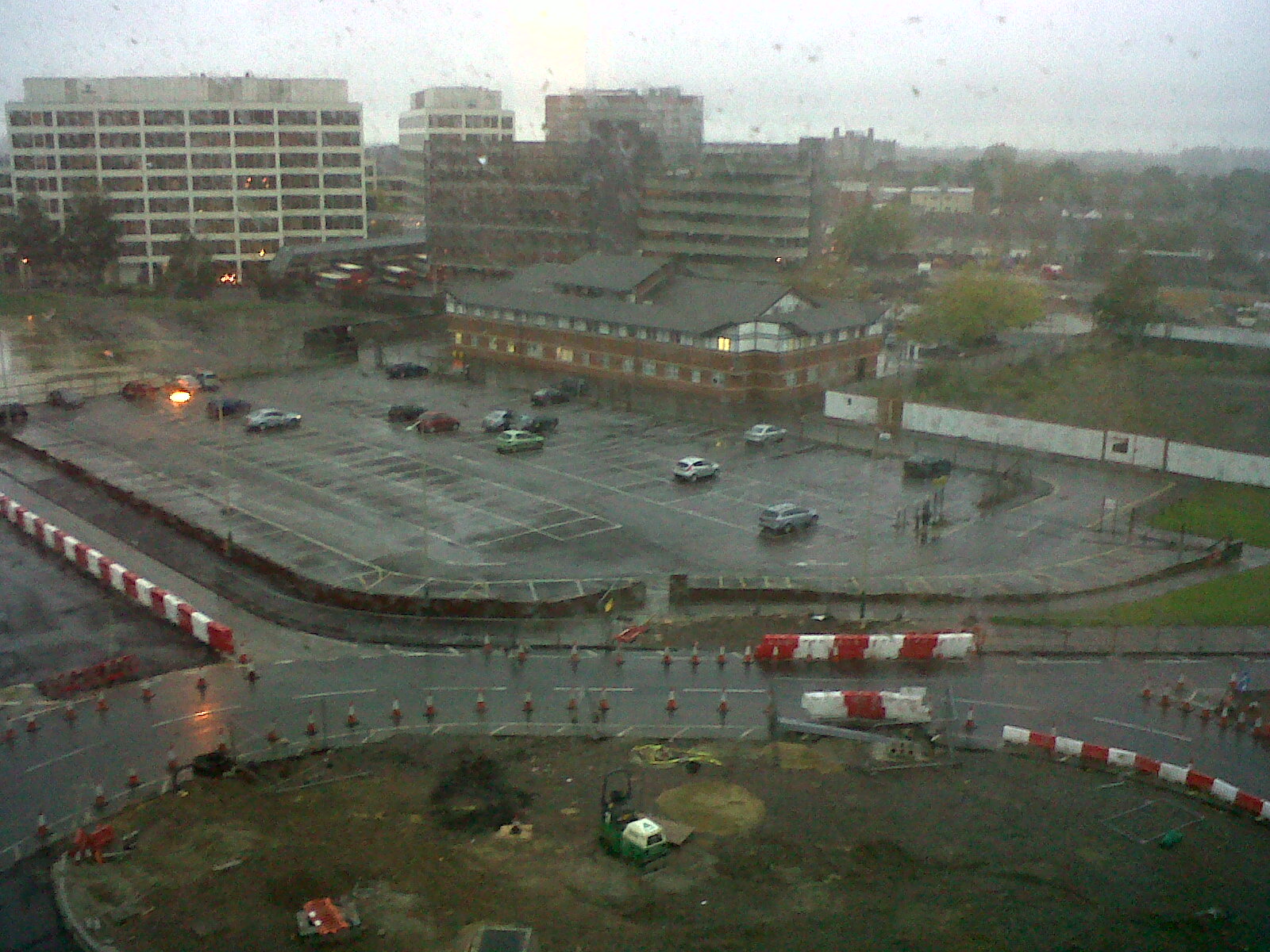
Anyway, we got through yesterday’s business reasonably well, although it was a long day and we were all flagging by the end. I guess that’s why they call it Swindon Wilts. We’re just about to commence Day Two so I’ve just got time to put up the following picture. For those of you who’ve never been to Swindon before, I believe this photograph conveys an accurate impression of what it’s like. This is the view through the rain from my hotel window yesterday evening.

Intermission

Posted in Uncategorized with tags , on September 20, 2011 by telescoper

Well, dear readers, I  am up at the crack of dawn in order to journey forth to Swindon, for  three days of hard labour on the STFC Astronomy Grants Panel for the duration of which I will be confined to a dark dungeon in Polaris House. Given the severity of the sentence  I very much doubt that I’ll have the time or the energy to blog while I’m there so, unless it all gets too much for me and I have to seek solace in a blog post,  there will now follow a short intermission.

Normal service will be resumed as soon as possible.


What’s the Matter?

Posted in The Universe and Stuff with tags , , , , , on September 19, 2011 by telescoper

I couldn’t resist a quick comment today on a news article to which my attention was drawn at the weekend. The piece concerns the nature of the dark matter that is thought to pervade the Universe. Most cosmologists believe that this is cold, which means that it is made of slow-moving particles (the temperature of  a gas being related to the speed of its constituent particles).  They also believe that it is not the sort of stuff that atoms are made of, i.e. protons, neutrons and electrons. In particular, it isn’t charged and therefore can’t interact with electromagnetic radiation, thus it is not only dark in the sense that it doesn’t shine but also transparent.

Cold Dark Matter (CDM) particles could be very massive, which would make them much more sluggish than lighter ones such as neutrinos (which would be hot dark matter), but there are other, more complicated, ways in which some exotic particles can end up in a slow-motion state without being massive.

So why do so many of us think the dark matter is cold? The answer to that is threefold. First, this is by far the simplest hypothesis to work on. In other words, good old Occam’s Razor. It’s simple because if the dark matter is cold there is no relevant physical scale associated with the speed of the particles. Everything is just dominated by the gravity, which means there are fewer equations to solve. Not that it’s exactly easy even in this case: huge supercomputers are needed to crunch the numbers.

The second reason is that particle physics has suggested a number of plausible candidates for non-baryonic candidates which could be cold dark matter particles. A favourite theoretical idea is supersymmetry, which predicts that standard model particles have counterparts that could be interesting from a cosmological point of view, such as the fermionic counterparts of standard model bosons. Some of these candidates could even be produced experimentally by the Large Hadron Collider.

The final reason is that CDM seems to work, at least on large scales. The pattern of galaxy clustering on large scales as measured by galaxy redshift surveys seems to fit very well with predictions of the theory, as do the observed properties of the cosmic microwave background.

However, one place where CDM is known to have a problem is on small scales. By small of course I mean in cosmological terms; we’re still talking about many thousands of light-years! There’s been a niggling worry for some time that the internal structure of galaxies, especially in their central regions,  isn’t quite what we expect on the basis of the CDM theory. Neither do the properties of the small satellite galaxies (“dwarfs”) seen orbiting the Milky Way seem to match what what we’d expect theoretically.

The above picture is taken from the BBC website. I’ve included it partly for a bit of decoration, but also to point out that the pictures are both computer simulations, not actual astronomical observations.

Anyway, the mismatch between the properties of dwarf galaxies and the predictions of CDM theory, while not being exactly new, is certainly a potential Achilles’ Heel for the otherwise successful model. Calculating the matter distribution on small scales however is a fearsome computational challenge requiring enormously high resolution. The disagreement may therefore be simply because the simulations are not good enough; “sub-grid” physics may be confusing us.

On the other hand, one should certainly not dismiss the possibility that CDM might actually be wrong. If the dark matter were not cold, but warm (or perhaps merely tepid), then it would produce less small-scale structure whilst not messing up the good fit to large-scale structure that we get with CDM.

So is the Dark Matter Cold or Warm or something else altogether? The correct answer is that we don’t know for sure, and as a matter of fact I think CDM is still favourite. But if the LHC rules out supersymmetric CDM candidates and the astronomical measurements continue to defy the theoretical predictions then the case for cold dark matter would be very much weakened. That might annoy some of its advocates in the cosmological community, such as Carlos Frenk (who is extensively quoted in the article), but it would at least mean that the hunt for the true nature of dark matter would be getting warmer.

In the Dark’s Third Anniversary

Posted in Uncategorized on September 18, 2011 by telescoper

Just a quick post to mention that this blog has now been running for over 3 years. In fact the anniversary was on Friday but amid all the cricketing excitement  it seemed to pass me by!

Since this blog started, on 16th September 2008, I have made 1,178 posts which have in total received 9,891 comments. As of this evening, according to the WordPress software, I’ve received 700,697 views, so  must have gone past the 700,000 mark at some point over the weekend. Over the last few months I’ve been getting between 1,000 and 3,000 (unique) hits per day, in case you’re interested in such things. I don’t know whether that’s a lot, but it’s a lot more than I expected ever to get when I started!

This occasion gives me the chance to thank you all  for your continuing interest in this blog. Let’s see how long it takes to reach a million hits!

After Columbo

Posted in Biographical, Columbo with tags , on September 18, 2011 by telescoper

It’s a gloomy Sunday here in Cardiff with dark clouds and heavy rain most of the morning. That, together with the impending ordeal of a trip to Swindon, has obviously dampened my mood a bit after the last couple of days. It has however at least given me the right frame of mind to write something about my dear departed Columbo, who passed away on 1st August. Was it really so long ago?

I’ve found it difficult to know what to do about writing about Columbo in the weeks that have passed since he died. I was devastated, of course, and often felt the urge to write something on here, but was anxious not to allow myself to get too mawkish about things. To do that would have exceeded even the generous allowance of self-indulgence which comes with writing a blog, so I’ve held off and tried the best I can to deal with it on my own. Now, though, I think I’m ready to write something about the past weeks and months. Who knows, it might even help other people going through similar things themselves.

When Columbo died I simply couldn’t face going straight back to work so I took a day off. What I did that day will probably seem strange to many people, but I felt I had to do it. I got rid of all Columbo’s things: his basket, toys, food dishes, the lot. The only thing I couldn’t dispose of was the yellow plastic “sharps” bucket containing the used hypodermic needles that I’d accumulated during the course of his treatment for diabetes. These constitute medical waste so it’s not permitted to throw them away with the usual refuse; I’d have to take them to the vets for disposal and pay a few pounds  to have them incinerated. In fact, I still haven’t done that. My last visit to the vets was so traumatic that I still haven’t been able to face going back there.

I was even going to take all the posts I’d made about Columbo offline, but in the end decided not to. That was mainly because people have told me they enjoy reading some of the old items and I therefore thought it would be a bit selfish to take them away. I know I’m not the only one who misses the poor old thing.

After a day or two of vegetating at home, I went into  work. I almost came straight back home again after bursting into tears on the way to my office, but soldiered on. Over the next few days and weeks I tried to work as hard as I could to distract myself from things and adopted a “business-as-usual” approach to the blog.  Although I was at work I tried to keep myself to myself more than usual, avoiding our communal coffee and lunch breaks, trips to the pub,  and so on. Going away to a conference also helped. Sudden mood swings came and went, but gradually their amplitude decreased. NowI think I’ve regained some sort of equilibrium. Life has changed, but goes on. The Columbo Era has ended.

Which is not to say that I don’t still miss Columbo terribly. Coming home from work there’s still the shock of an empty house and no Columbo to greet me at the door. Being an old fart it was my habit to take a nap on Sunday afternoons; Columbo always joined me for a loud purring session. Without him I simply can’t do that anymore. No cat, no nap…

I’m not the only one to miss Columbo. A couple of days after he went to meet his maker, one of the neighbours’ cats appeared at the  glass door  in my dining room peering inside. This cat, a female of the species,  was quite friendly with Columbo. I don’t know her name. Although she wears a collar I never managed to read the tag; I call her Maud because she comes into the garden. Although she’s been a regular visitor to my little garden I’d never seen her so close to the house before. I watched her searching all around, mewing plaintively. I could well be reading too much into this, but I do think she was looking for Columbo and was upset by his absence.

As time has passed, other cats have visited the garden with increasing frequency. There’s a very sleek black tom cat, a strange skinny cat with a big nose, and a young tabby who I first saw as a pair of green eyes staring out of the bushes late one night. Although Columbo was never much of a fighter these other cats didn’t come down into the garden very often while he was here; they usually sat on the fence or shed roof. Now there’ll probably be a turf war over who gets to count my little patch as part of their territory. I won’t chase them away. In fact I’d be quite happy if one day I could make their acquaintance properly. At the moment they all scarper as soon as I open the door.

The only other thing I want to say is to answer those people who have asked me whether I am planning to get another cat. Well, to be honest, I haven’t got any plans to do that. I just  couldn’t face it right now. I’m not sure I ever will, actually, but  you never know. Just not in the foreseeable future.