En route to the airport again, this suddenly popped into my mind. The tune was a hit for Randy Crawford in 1980 when I was still at school, but this version, which I like a much more than the original single, was made just about five years ago. It’s a lovely song by a much underrated singer, featured here with the Joe Sample Trio.
I thought I’d reblog this as it relates to the pronouncements about the LHC by Otto Rössler I mentioned yesterday.
As I predicted nearly two-and-a-half years ago, it looks like the Earth will survive the most powerful accelerator ever built. A recent article validates my prediction. On September 8, 2008, I recorded a Science News Flash podcast addressing concerns that the Large Hadron Collider (LHC) would produce a shower of black holes that would, in turn, consume Earth from the inside out. I predicted that Earth would not only survive the experiments perfor … Read More
You might also want to read this older blog post about the kerfuffle when the LHC was switched on. I quote:
Rössler turns out to be quite a strange fellow. He is an MD who stayed in academia, moved into biochemistry, and then made a name in the relatively new field of chaos theory. He seems to think of himself as a visionary, having founded a new field of physics called “endophysics,” which is supposed to take into account the observer’s inner state. Or something like that. Have you heard of it? Neither had I.
Recently, at the age of sixty-eight, Rössler, despite having no particle physics or blackhole physics credentials, announced that he had found important new results, alarmingly relevant to the destructive potential of microscopic black holes in LHC proton-proton collisions. Rössler variously estimates the likelihood of such blackhole production by LHC as being from 10% to 50% though he appears to have pulled these numbers out of a hat.
And there’s also this most excellent video that John Butterworth told me about because he’s in it…
Since I’m too lazy this Sunday to do anything too strenuous, I thought instead I would post the poem that was read to us on Friday morning. Appropriately enough it’s the Ode on Indolence, written around 1819 by John Keats. The opening epigram is actually from the New Testament (Matthew 6: 28-29), which, in the King James version I have, reads
28. And why take ye thought for raiment? Consider the lilies of the field, how they grow; they toil not, neither do they spin:
29. And yet I say unto you, That even Solomon in all his glory was not arrayed like one of these.
The poem isn’t just about being lazy, of course. It’s actually about the importance to the creative mind of having time for restful contemplation, i.e. just sitting and thinking about things. Call it meditation if you like. I’m sure that’s essential for artists and poets, but I also think we scientists need it too although finding time to think is increasingly difficult when you’re on a treadmill designed to mass produce “research outputs” for assessment by the factory bosses…
‘They toil not, neither do they spin.’
I
One morn before me were three figures seen,
With bowed necks, and joined hands, side-faced ;
And one behind the other stepp’d serene,
In placid sandals, and in white robes graced ;
They pass’d, like figures on a marble urn,
When shifted round to see the other side ;
They came again ; as when the urn once more
Is shifted round, the first seen shades return ;
And they were strange to me, as may betide
With vases, to one deep in Phidian lore.
II
How is it, Shadows ! that I knew ye not ?
How came ye muffled in so hush a mask ?
Was it a silent deep-disguised plot
To steal away, and leave without a task
My idle days ? Ripe was the drowsy hour ;
The blissful cloud of summer-indolence
Benumb’d my eyes ; my pulse grew less and less ;
Pain had no sting, and pleasure’s wreath no flower :
O, why did ye not melt, and leave my sense
Unhaunted quite of all but—nothingness ?
III
A third time pass’d they by, and, passing, turn’d
Each one the face a moment whiles to me ;
Then faded, and to follow them I burn’d
And ach’d for wings because I knew the three ;
The first was a fair Maid, and Love her name ;
The second was Ambition, pale of cheek,
And ever watchful with fatigued eye ;
The last, whom I love more, the more of blame
Is heap’d upon her, maiden most unmeek,—
I knew to be my demon Poesy.
IV
They faded, and, forsooth ! I wanted wings :
O folly ! What is love ! and where is it ?
And for that poor Ambition ! it springs
From a man’s little heart’s short fever-fit ;
For Poesy !—no,—she has not a joy,—
At least for me,—so sweet as drowsy noons,
And evenings steep’d in honied indolence ;
O, for an age so shelter’d from annoy,
That I may never know how change the moons,
Or hear the voice of busy common-sense !
V
And once more came they by ;— alas ! wherefore ?
My sleep had been embroider’d with dim dreams ;
My soul had been a lawn besprinkled o’er
With flowers, and stirring shades, and baffled beams :
I just got back home from Berlin, an hour later than I’d hoped owing to having spent an unenjoyable hour circling in a holding pattern east of London waiting for Air Traffic Control to give us clearance to land at Heathrow. The reason for the delay remains mysterious. “Showers” was what we were told, but since when was a plane prevented from landing by showers? And when we landed the airport taxiways and apron were dry anyway. Very strange. Still, the trip had been such fun that even this less than ideal ending didn’t cast much of a shadow over it.
I spent yesterday at the studio of renowned artist Olafur Eliasson who is probably best known for his installation The Weather Project which appeared in the Turbine Hall at Tate Modern in 2003/4. If you want to get an idea of why it made such an impact, take a look at this short clip
That work made him one of the world’s most famous contemporary artists, but he has of course done many other things besides.
About two years ago, Olafur invited me to his (then) new Institut für Raumexperimente, which is situated in the same converted brewery as his own studio, to talk to his students about my work on cosmology. I had a great time then so when I received an invitation to take part in another event at the studio, I gleefully accepted.
This event was in a series of extremely informal workshops called Life is Space. In fact this was the fourth; you can get an idea of the previous one here. The day revolved around a series of “experiments” involving all kinds of sensations and phenomena – sound, movement, laughter, even tickling – involving contributors and audience to a greater or lesser degree. Among the guests were scientists, artists, architects, musicians, poets, dancers – all sorts of creative people, really. Including the people working in Olafur’s studio and the guests the total number of participants was about 150, so it was a large event.
The day wasn’t really planned or rehearsed but (or perhaps because of this) was fascinating and, for me, quite inspirational. It was certainly a very different experience to the usual science conference.
I knew I was going to enjoy the day right from the start, because it opened with a reading of a poem by John Keats which I think I’ll post on here in due course..
Lacking the ability to present any “real” experiments of my own I decided to talk about various thought (or, as they say in Germany, gedanken) experiments to illustrate the idea of a horizon in cosmology, but also managed to weave in a few other ideas that had been suggested by previous contributions. I wasn’t consciously trying to construct a narrative for a day which had been deliberately designed not to have one, but it seemed to turn out that way because I was on relatively late in the day and I found lots of connections with earlier experiments sprang into my mind. Just as well because I hadn’t prepared anything!
In between the experiments there was a lot of time for informal discussion, all of it hugely stimulating, and we were given a splendid lunch and dinner at which the conversation and wine flowed freely. The participants were not only extremely knowledgeable about science but also very keen to learn more – I’ve got an inbox full of requests for information about various things I mentioned, which will take me some time to reply to.
The only disappointing part of the day for me was the contribution of Otto Rössler right at the end. This chap is a biochemist who achieved a certain amount of notoriety in 2009 for his claim that when it was switched on the Large Hadron Collider would create black holes that would destroy the Earth. He still thinks so, apparently, despite the evidence that it hasn’t. I was very embarrassed by his diatribe yesterday because it betrayed a staggering lack of understanding of basic physics but at the same time was delivered with an air of absolute confidence that he is right and everyone else is wrong. He gave a description of the properties of a black hole that a 1st year physics student would be ashamed of and at which I almost laughed out loud. It also turns out he believes that the cosmic microwave background was discovered in the 19th century (which it wasn’t) and that the Big Bang theory is wrong and that anyone who believes in it has been brainwashed.
I was getting a bit hot under the collar as his incoherent monologue meandered on. I thought of interjecting, but didn’t want to end the day with acrimony and in any case I thought it was self-evident that he didn’t know what he was talking about. When proceedings drew to a close and we went outside for pre-dinner drinks, it became clear that most of the non-science participants had pretty much the same opinion as me. “Is that guy a fucking crank or what?”, one participant asked me. “Yes” was all I could say.
I wonder if Prof. Rössler had been invited to provide comedy value?
Anyway I finally staggered back to the Hotel about midnight, tipsy, but at the same time invigorated. I wish science conferences were as much fun as this!
Live all thy sweet life thro’, Sweet Rose, dew-sprent, Drop down thine evening dew To gather it anew When day is bright: I fancy thou wast meant Chiefly to give delight.
Sing in the silent sky, Glad soaring bird; Sing out thy notes on high To sunbeam straying by Or passing cloud; Heedless if thou art heard Sing thy full song aloud.
Oh that it were with me As with the flower; Blooming on its own tree For butterfly and bee Its summer morns: That I might bloom mine hour A rose in spite of thorns.
Oh that my work were done As birds’ that soar Rejoicing in the sun: That when my time is run And daylight too, I so might rest once more Cool with refreshing dew.
Just time for a quick post today, as I’m off to the airport this afternoon for a short trip (which I’ll no doubt blog about at the weekend when I get back). I’m also late into the office because I had to take my cat Columbo to the vet for his six-monthly check-up.
Columbo is now 17 years old (and a few months) and has been diabetic for the last six or seven of those. He needs to have a check-up every 6 months primarily to monitor whether his insulin dose (which is administered twice a day) is adequate to control his blood sugar level. The vet also gives him a general medical, and weighs him, during these visits.
This morning Columbo was even more reluctant than usual to get into his box for the trip to the vets. Eventually I got him in, but was apprehensive. Usually when he’s in that sort of mood he retaliates by befouling the box. This time, however, he settled down quite quickly and there were no toiletary disasters en route. The vet’s waiting room was empty when we arrived at 9am so we got seen straight away.
The vet was impressed by his age, especially when she saw how long he has been diabetic. Even without this condition 16 is a pretty good age for a tom cat. Columbo has been through a number of serious medical episodes, at least a couple of which took him near death, but he has always managed to bounce back. He may be an old boy now, but he gets 10/10 for resilience. Looking back over his (substantial) medical history, the vet seems to be amazed by his powers of recovery although history is now definitely taking its toll and he’s looking a bit frail nowadays.
The vet noted the effects of the advancing years. His eyesight has clearly dimmed. He’s never been very good at catching birds and mice, but I think he struggles even to see them nowadays. Despite the glucosamine treatment he has been having, his arthritis has also deteriorated. The stiffness in his joints makes it difficult for him to groom himself, so his coat isn’t in great condition even though I brush him regularly. He’s also lost a bit of weight since the last visit; not enough to be life-threatening, but significant nevertheless.
On the other hand, his heartbeat and other vital signs seem to be in order, and he purred contentedly on the table during the examination. The vet was a little concerned about his weight loss, but said he clearly wasn’t in any discomfort and trying to prod and probe, take blood samples and whatever to find out the reason was just going to cause him distress. And even if they could fix it, he was still going to be a very old cat if and when he recovered and there’s no cure for old age.
During these visits the vet usually takes a blood sample in order to check glucose and fructosamine levels for diagnostic purposes. This time, however, she suggested that it was probably best to skip it. The business of drawing a vial of blood from a cat’s neck is unpleasant and extremely distressing for the animal. Given that his bodily signs were OK, there seemed little point in subjecting him to this. Instead she suggested we just maintain the current insulin level unless and until something appears to go wrong. I agreed.
Not doing the blood tests saved me a bit of money, but that’s not the point at all. I know the old boy is much nearer the end of his life than the beginning. I just want his last days to be as comfortable and happy as possible. I don’t see the point of making him uncomfortable to satisfy veterinary curiosity or to prolong his life by a few months. When the time comes, I’d rather he went peacefully.
The one thing I did agree on was to try some anti-inflammatory treatment for his arthritis, stuff you squirt on food. If that works it might make it easier for him to get around, and also groom himself. It does have a side-effect with some cats, making them nauseous, so I have to build it up slowly and keep an eye on him in case he gets sick.
Anyway, when it was time to go he climbed willingly into his box – the cat-box process is a very different business at the vet compared to what it’s like at home. When we got home he bundled out at high speed and headed straight for his food dish. He still has a healthy appetite, that’s for sure.
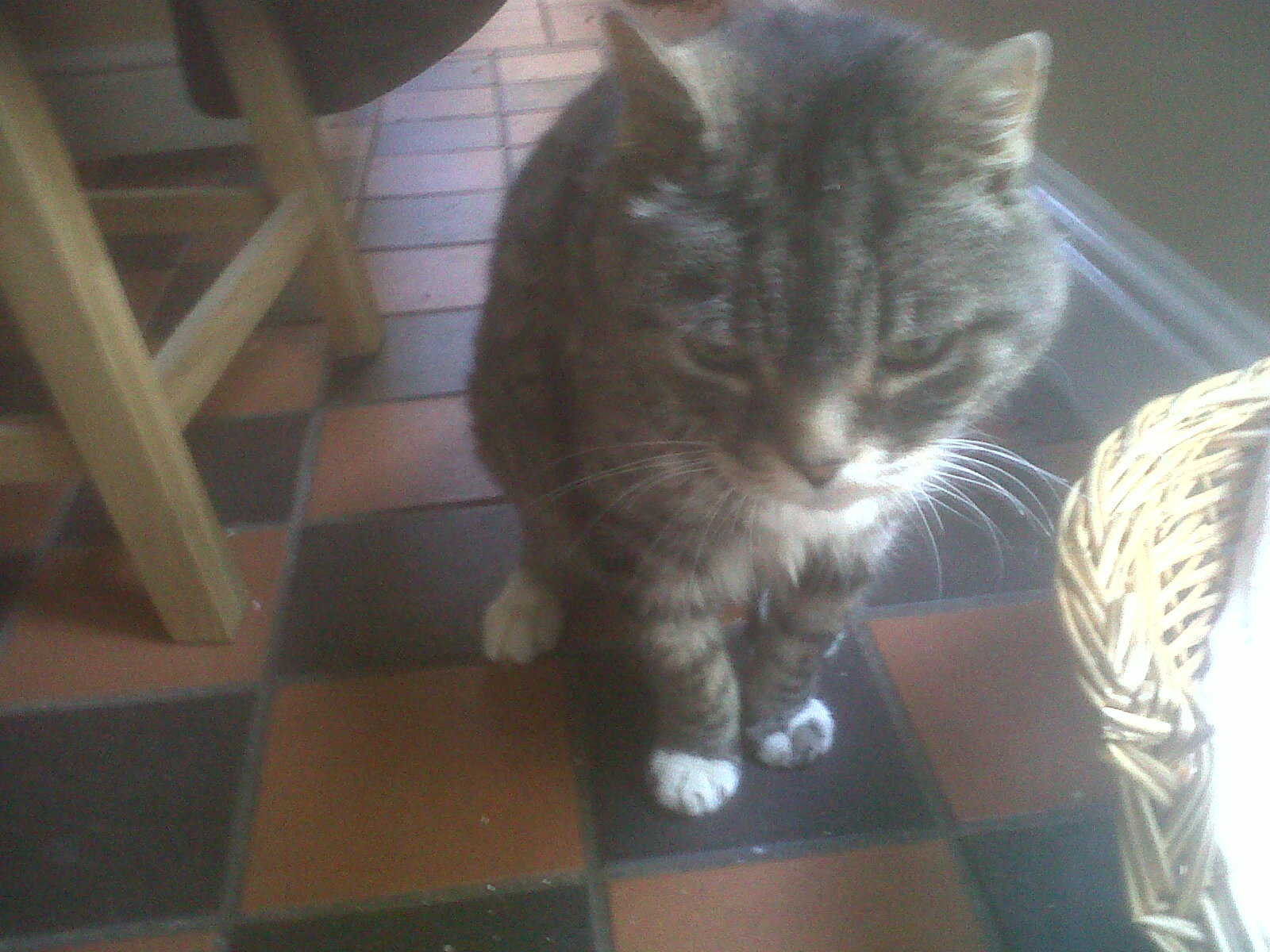
Here’s a quick picture for his fans, taken just before he went in his basket for a nap.
I had just finished the exciting job of marking my examinations and collating all the results with coursework when I noticed a rumour circulating on twitter about the Higher Education Funding Council for Wales (HEFCW) having rejected plans by all Welsh universities to charge higher fees than the basic £4K laid down by the Welsh Assembly Government. The rumour later developed into a story on the NUS website and then on the local BBC News, Wales Online and the Times Higher.
In case you’re not up with the intricacies of Welsh Higher Education policy, universities here in the Principality will, from 2012, be allowed to charge fees of up to £9K per annum (as in England) if and only if they have approval from HEFCW for plans relating “to widening access and to improving the student experience.” Note there’s apparently no requirement of providing a better education in that. As a mere university teacher I have no idea at all what has gone into Cardiff University’s plan nor do I know why it is deemed satisfactory. Such things are done by our lords and masters in the University administration.
It does seem strange, though, that the process works this way, i.e. that HEIs have to produce plans that they hope will be accepted by HEFCW. Why doesn’t HEFCW simply tell the HEIs what they have to do to be able to charge the fees? I wonder how the clear the guidance from HEFCW was. It might be a case of “Read my mind to see what I want, and if you don’t give it to me I’ll shoot you”.
Universities wishing to charge £9K (which is, predictably, nearly all of them) had to submit their plans to HEFCW by the end of May. Several universities did so, including Cardiff, Aberystwyth, Bangor, and even Glamorgan, who all want to charge the maximum £9K. HEFCW has now announced that none of them meet the standard needed to charge more than £4k. There’s still quite a bit of time for universities to amend their plans before the deadline of 11th July, so this is by no means the end of the story, but it has certainly set alarm bells ringing where I work!
The point is that the Welsh Assembly Government is heavily cutting the funds it allocates to Welsh Universities from 2012, so if institutions are not allowed to charge sufficiently high fees to recoup that loss then many departments are going to be in really big trouble, especially those teaching expensive subjects.
I asked for Hefcw to be thorough and robust when scrutinising the fee plans submitted by our higher education and further education institutions. It is clear that they have been and I heartily endorse this.
There are a number of ways of reading the lie of the land here. One is that it’s actually a sensible process of consultation between individual institutions and HEFCW. Since this is uncharted territory for both there may well be things that need to be clarified on both sides, and HEFCW may therefore be engaging in a sensible process of consultation and iteration in order to help institutions produce acceptable plans. It could also represent an element brinkmanship, so the Minister and HEFCW can be seen to be flexing a bit of muscle, in contrast to the situation in England, where it appears the government has no power to prevent institutions charging higher fees. I always felt it was inevitable that Cardiff, as a Russell Group University, would want to charge £9K, but I can imagine Leighton Andrews being irritated by places like Glamorgan wanting to charge the same.
Whatever game is being played, it’s a very dangerous one and the stakes are very high. The Welsh Assembly Government has already indicated it will pay the fees of any Welsh domiciled students wherever they study in the UK. For the most part that will mean £9K per student per year for Welsh students wanting to study in England. If Welsh universities can only charge £4K per year for students coming from England to Wales then there will be a huge imbalance in funds flowing in and out of the higher education sector. In effect, the Welsh Assembly Government will be subsidising English universities at the expense of Welsh ones.
Currently the number of English students coming to Wales exceeds the number of Welsh students studying in England. The WAG’s plan relies on a net influx of funds to offset the cuts in central funding needed to pay student bursaries. However, English students do not come in equal numbers to all Welsh institutions. More come to Cardiff University than, say, Bangor. So how will this extra income from England benefit the Welsh HE sector generally? Is the proposal to cut HEFCW funds to Universities who succeed in attracting English cash cows students and redistribute the dosh among those institutions that don’t? That hardly seems equitable to me.
I’m certainly not in a panic about this news, although I may be on July 11th when we find out the final outcome. In the meantime, as a humble academic at the bottom of the ladder when it comes to such matters, I’ll get on with my teaching and research and pray that those in charge actually know what they’re doing…
I wonder if anyone else has noticed the remarkable similarity both in character and appearance between Cardiff’s own Professor Derek Ward-Thompson and Thumper, the obdurate quarry vehicle from Thomas the Tank Engine? Is this why the 200 micron photometer on which Derek was the Principal Investigator was also called THUMPER?
It’s that time of year again. The annual meeting of the Board of Examiners of the School of Physics & Astronomy at Cardiff University met this afternoon to consider the marks for students due to graduate this year and to draw up recommendations for the final degree classifications.
This year’s meeting was actually quite interesting and, at just over two hours, somewhat shorter than some we’ve had in previous years. A group of students has already gathered in the foyer waiting for the dreaded list to be posted, and many will no doubt be celebrating or drowning their sorrows in local hostelries shortly after their fate is revealed.
Cardiff is a little old-fashioned in the way the final examiners’ meetings are conducted. For a start we still have a system of viva voce examinations for borderline candidates; they happened yesterday, in fact. Many universities have dispensed with this aspect of the process, but I still think they’re worthwhile. The Board of Examiners, including the two External Examiners, also still has some discretion in how it arrives at the degree boundaries (which are nominally at 70% for a first, 60% for a 2.1, 50% for a 2.2, and 40% for a 3rd).
The tide is turning against this very traditional approach, however, and there are moves here to dispense with the viva examinations and with academic discretion. I’m not sure when this will happen, but it’s likely to be sooner rather than later. I think the main reason for this is to make the system more automatic so there’s less chance of legal challenge. In any case there doesn’t seem to me that there can be any educational reason for it.
The one thing that strikes me about the system we have is that it’s the whole business of classifying degrees into broad categories which is where the problem lies. It was suggested some time ago that we should dispense with, e.g., the “Desmond” (2.2) and the “Thora Hird” (3rd) and instead simply give each student a transcript containing details of the entire spectrum of their academic performance. It’s been suggested again just recently too. That would seem to me to make much more sense than the current system of classifying degrees which involves (a) trying to condense a huge amout of information – examination marks, coursework, project assignments and the like – into a single number and then (b) drawing boundaries based on this number precisely where the distribution is most densely peaked. However, years have passed and nothing concrete has happened. The academic world is good at inertia.
Anyway, this isn’t the time or the place for a lengthy diatribe about the ins-and-outs of degree classifications. I’ve got to go back to marking my 1st year examination papers shortly in fact; these are considered by a separate meeting of the Board of Examiners.
It is time, however, for me to congratulate all our graduating students on their success. It’s the first group of Cardiff MPhys students that I’ve seen all the way through from entry to graduation. I’ll be sad to see them go, but wish them all the best as they venture forth into the real world. At least I hope to see them back next month for graduation. Until then, however, all I’ll say is
The views presented here are personal and not necessarily those of my employer (or anyone else for that matter).
Feel free to comment on any of the posts on this blog but comments may be moderated; anonymous comments and any considered by me to be vexatious and/or abusive and/or defamatory will not be accepted. I do not necessarily endorse, support, sanction, encourage, verify or agree with the opinions or statements of any information or other content in the comments on this site and do not in any way guarantee their accuracy or reliability.




 In the Dark