Author Archive

The Dissolution of the Assembly

Posted in Education, Finance, Politics with tags , , , on March 27, 2011 by telescoper

Yesterday’s mail included a polling card for the forthcoming elections to the Welsh Assembly. Coincidentally, I found out this morning that the Welsh Assembly will be dissolved on 31st March, to be re-convened on or after 5th May when the elections are finished.

Until Thursday the Welsh Assembly Government comprises a coalition of New Labour and Plaid Cymru and, although I don’t know enough about Welsh politics to predict what’s going to happen with any real confidence, it seems reasonably likely that not much will change. I can’t see the Tories or LibDems making any gains, at any rate.

I’m not sure of the extent to which Higher Education will be important in the forthcoming election campaign. It sure be, of course, as the relevant issues are those over which the Assembly has direct responsibility, education being one. The WAG’s hands are tied to a large extent by the funding it receives from Westminster, and it also has many other calls on its purse, but I do hope the new WAG, whatever its complexion is, will do the right thing by Welsh universities when it re-forms in May.

I have to admit, though, that I’m very worried for the future. As I predicted when the new funding arrangements for English universities were announced, the vast majority – and certainly all the research intensive ones – will be charging the full £9K fee level from 2012. That means the current WAG’s commitment to pay fees for Welsh-domiciled students wanting to study in England will be much more expensive than the WAG’s estimates, which were based on an average fee level of £7.5K. English students wanting to study in Wales will have to pay whatever fee Welsh universities charge, which isn’t known yet.

Currently about 25,000 English students study in Wales, compared with the 16,000 Welsh students who study in England. If numbers remain the same, in order for the funds coming in from England to exceed the money going to England, the fee level charged in Wales must  be at least 64% of that charged in England, i.e. £5760 if all English universities charge £9K. That’s way above the putative mininum fee level of £4K announced by the WAG; if Welsh universities charge fees at that level then the WAG will be providing a large net subsidy to English universities.

And breaking even isn’t anywhere near enough. The WAG has signalled an intention to top-slice teaching budgets by about 40%. We don’t yet know how that will be implemented, university-by-university and department-by-department,  but unless there are to be wholesale closures of “expensive” subjects (i.e. science and engineering) fee levels will have to rise substantially above the level calculated above. My own employer, Cardiff University, a member of the Russell Group of research-led universities, will probably want to brand itself alongside the English universities belonging  to this club by charging a high fee. I hope it doesn’t do this, but  the WAG’s policies are pushing it in that direction. As one of Wales’ biggest recruiters of English students, Cardiff will have to charge high fees in order to be seen as being of the same quality as leading English universities as well as to make up for funding lost in the latest round of deep cuts to recurrent grants.

The recent rhetoric of the WAG is all about achieving greater control of the HE sector in Wales to align it with strategic priorities within the Principality. This is certainly justifiable in principle as Wales has a university system which is far too fragmented and chaotic. Paradoxically, however,  the WAG’s own policies seem to be forcing Welsh universities to look to England for income to make up for the big cuts recently announced.

So what’s the alternative?

I think it would be much more rational to ditch the commitment to fund Welsh-domiciled students for studying in England. If a student wants to go to England then they should experience the same fee regime as students domiciled there. After all, you wouldn’t expect the WAG to pay fees for a Welsh student to go to America, would you? The cash thus saved should be reinvested in Welsh Higher Education, in accordance with the WAG’s strategic priorities, and in keeping tuition fee levels as low as possible within the Principality. The best way to avoid tuition fee levels of £9K is to maintain core grants at a level that makes it unnecessary to charge so much.

It seems to me that this plan is a better deal for Welsh students, for English students wanting to study in Wales,  for Welsh universities, and for the Welsh Assembly Government, but then I’m used to being in a minority of one.

Let’s just say I’ll be reading the party manifesto statements with great interest over the next few weeks…


Share/Bookmark

When I do count the clocks that tell the time

Posted in Poetry with tags , , , on March 27, 2011 by telescoper

When I do count the clock that tells the time,
And see the brave day sunk in hideous night;
When I behold the violet past prime,
And sable curls all silvered o’er with white;
When lofty trees I see barren of leaves
Which erst from heat did canopy the herd,
And summer’s green all girded up in sheaves
Borne on the bier with white and bristly beard,
Then of thy beauty do I question make
That thou among the wastes of time must go,
Since sweets and beauties do themselves forsake
And die as fast as they see others grow;
And nothing ‘gainst Time’s scythe can make defence
Save breed, to brave him when he takes thee hence.

Sonnet 12 by William Shakespeare, posted on the occasion of having forgotten to put my clocks forward one hour for the start of British Summer Time...


Share/Bookmark

A Tale of Two Balls

Posted in Biographical, Education with tags , , , , on March 26, 2011 by telescoper

This morning was definitely the one after the night before, as Friday was the occasion of the Annual Chaos Society Physics Ball. The Chaos Society organises a number of social events for both staff and students from the School of Physics & Astronomy at Cardiff University. This year’s ball was nearly a whole month earlier than last year’s, because we’re not having a term break before Easter this year as Easter is so late. There’s still another three weeks of teaching, in fact, whereas in most years we would stop now and resume after Easter.

Anyway, the do last night started off with a champagne reception at the Parc Thistle Hotel in central Cardiff, followed by dinner and dancing in the function room there. There was a fine band playing a sort of funky soul jazz mix at the start and end of dinner. There were a bit loud to make conversation possible at the beginning, but once the food arrived they took a break and resumed when coffee was served. Instead of attempting to make ourselves heard over the music, I decided to try to set the ball rolling by getting up and dancing with a lady called Tanys, who was a guest of the Head of School Walter Gear. Nobody else joined us, but it was fun anyway.

We then went “informal” so to speak. The DJ got going, but I didn’t reckon much to the music so went and mixed in the bar. Some final-year students celebrating having secured PhD places here and there, so congratulations to them, and there was a beautiful moment when Michael proposed to Matthew. They’re not allowed to be properly married here in the UK, and a proposal of “civil partnership” doesn’t quite have the same ring to it, but it was one of the highlights of the evening. Matthew accepted, of course.

After that we adjourned to a boutique nightclub called Crystal, an exotic place with peculiar soft furnishings and a bevy of bare chested muscle men in attendance. Around 3am I was poured into a taxi and got home quarter of an hour or so later, reasonably intact. Bad hangover this morning, though.

I’d like to add my personal thanks to the organisers of what was a hugely enjoyable evening, the Chaos Society generally and especially Natasha who did sterling work persuading so many people to come along. This was the third of these bashes I’ve been to, and it was definitely the best.

I’ve worked in a number of universities so far in my career as a jobbing astrophysicist, but the students at Cardiff are by far the friendliest and the most fun of all the groups I’ve had the pleasure to teach. And, yes, it does mean an awful lot to me when people tell me to my face that they enjoy my lectures. Even if they are drunk when they do so!

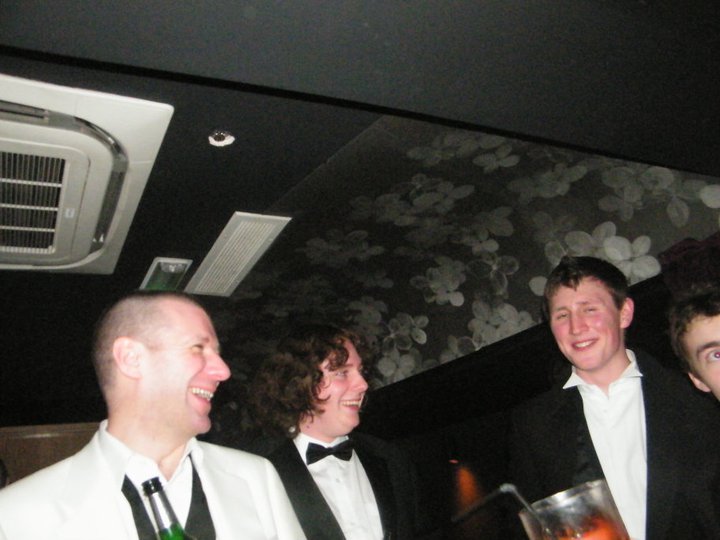
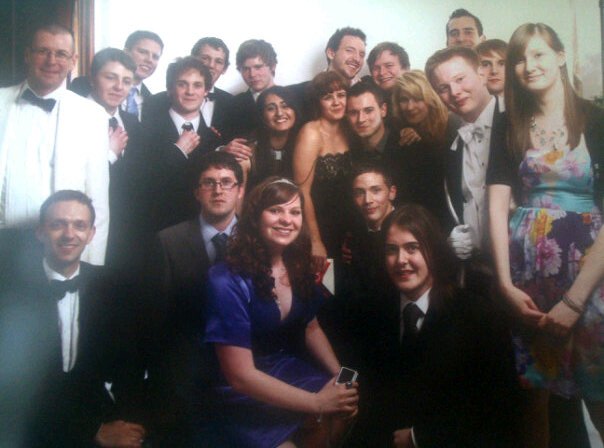
Anyway, some pictures are floating around on facebook. Here’s a couple, and I may add some more as they emerge from various cameras and phones. Of course it must be some kind of optical defect that makes me look so old in these, or perhaps it’s just because I’m surrounded by people less than half my age?

You’ll notice that I got the old white DJ out. Strictly speaking, UK tradition dictates that these should only be worn when abroad but I like wearing one when the weather is nice as it was yesterday whether it’s consistent with etiquette or not. There were plenty more serious breaches going on last night anyway, chiefly involving gentlemen removing their jackets at the dining table which is extremely poor manners.

You’re probably wondering what the second ball  refers to in the title of this post. Well, it’s just to remark that today in Cardiff  Wales played England at Football  (the “Association” variety, with a round ball, which I believe in some backward countries is called “soccer”). It was good to have an excuse for avoiding the city centre, and I was in a sufficiently vegetative state not to venture out of the house at all until the match was over. England beat Wales comfortably, 2-0.

UPDATE: Here’s a few more pictures, starting with one of me and the lovely Matthew. Well, at least one of us is photogenic…

These two were snapped at the club later on…

Here’s a couple more, one of me and the gorgeous Flo…

..and one last one, which I suspect was taken very late in the proceedings


Share/Bookmark

Local News

Posted in Education, Finance, Politics with tags , , , , , , , on March 25, 2011 by telescoper

I’m looking forward to tonight’s Annual Chaos Society Physics Ball, in advance of which I’ll have to go home to get my glad rags sorted out.

This posh night out should provide some welcome fun at the end of a week in which various items of news concerning Welsh universities have generated considerable anxiety around these parts.

For a start the Welsh Assembly Government has announced funding levels for HEFCW, the body that distributes funding to Welsh universities. According to a newspaper article

The Higher Education Funding Council for Wales (Hefcw) has seen its core budget slashed by 8.5% from £453m in 2010-11 to £388m in 2011-12.

Well, pardon my numeracy but a cut from £453m  to £388m is actually a drop of 14.3% not 8.5%. This is much worse than the cuts already announced by HEFCE for English universities, although it remains to be seen how HEFCW will pass on this cut to the institutions it funds. Whatever it does will cause considerable pain, as this cut is being imposed a full year before universities will be allowed to recoup any losses by charging increased tuition fees.

There was also some even more local and even more disappointing news this week concerning HEFCW. Over the past year or so, the three remaining physics departments in Wales (at Cardiff, Swansea and Aberystwyth) have developed a proposal to form a strategic alliance along the lines of similar initiatives in Scotland, the Midlands, and South-East of England which resulted in the injection of large amounts of cash into physics research in those areas. The bid went into HEFCW in January and this week we received the decision. No.

I suppose the decision wasn’t surprising given the current funding climate, but it’s nevertheless extremely disappointing to realise we’ve  missed a very important boat. If  Welsh physics had gone down this road a decade ago – which I believe it should – then we would be in much better shape to face the very uncertain future that hangs over us. Still, I suppose it spares us the effort of trying to think up an acronym.

What’s especially worrying about this is that it seems to me that it makes it  inevitable that Welsh physics will do as poorly in the forthcoming Research Excercise Framework as it did in the 2008 Research Assessment Exercise.
I think it’s worth quoting the observations made by Sub-panel 19 (physics) after the 2008 Research Assessment Exercise:

Sub-panel 19 regards the Scottish Universities Physics Alliance collaboration between Scottish departments as a highly positive development enhancing the quality of research in Scotland. South of the border other collaborations have also been formed with similar objectives. On the other hand we note with concern the performance of three Welsh departments where strategic management did not seem to have been as effective as elsewhere.

Ouch! The final sentence is completely out of order, of course, as it exceeds the remit of HEFCE (which administered the RAE) to try to dictate how Higher Education is run in Wales, as this responsibility is devolved to the Welsh Assembly Government. It is, however, to some extent a valid criticism. England and Scotland have pumped money into physics in order the develop strategic alliances. Wales hasn’t. And it isn’t going to either.

Given Wales’ relative autonomy when it comes to Higher Education I still don’t understand why its universities forced to participate in the REF anyway, but since it looks like we are stuck with it, I worry what the outcome will be, especially since Welsh physicists have been systematically excluded from the physics panel.

The last item of news concerns HEFCW itself. A report produced by John McCormick has recommended that it be scrapped and replaced with a new body called Universities Wales.

There are many reasons why scrapping HEFCW could turn out to be a good thing. For one thing, a new body might realise that continuing involvement in the REF is wasting a huge amount of time and money in the Welsh HE sector on an exercise that takes no account of Welsh strategic objectives. Nevertheless, I’m  a bit worried by some of the rhetoric coming out of the Welsh Assembly about this issue.

Universities are not the property of the Welsh Assembly (which in fact only funds part of their activity). Universities are independent charitable institutions. Their autonomy is essential in allowing them to do what they do best, free from the short-term expediency that dominates the thinking of the political establishment.

But that’s not to say that the Welsh Assembly is wrong to expect universities to respond to the changing socio-economic landscape. It’s all a matter of balance. If Universities Wales is sufficiently “hands-off” to allow universities to do what they do best – teaching and research – but sufficiently “hands-on” that it can help the HE sector to reorganize in the ways it clearly must, then this could be a very good move.

And if HEFCW does die, I’m afraid there will be few around these parts that mourn its passing.


Share/Bookmark

The Spring

Posted in Poetry with tags , on March 25, 2011 by telescoper

Now that the winter’s gone, the earth hath lost
Her snow-white robes, and now no more the frost
Candies the grass, or casts an icy cream
Upon the silver lake or crystal stream;
But the warm sun thaws the benumbed earth,
And makes it tender; gives a sacred birth
To the dead swallow; wakes in hollow tree
The drowsy cuckoo and the humble-bee.
Now do a choir of chirping minstrels bring
In triumph to the world the youthful spring.
The valleys, hills, and woods in rich array
Welcome the coming of the long’d-for May.
Now all things smile; only my love doth lour;
Nor hath the scalding noonday sun the power
To melt that marble ice, which still doth hold
Her heart congeal’d, and makes her pity cold.
The ox, which lately did for shelter fly
Into the stall, doth now securely lie
In open fields; and love no more is made
By the fireside, but in the cooler shade
Amyntas now doth with his Chloris sleep
Under a sycamore, and all things keep
Time with the season; only she doth carry
June in her eyes, in her heart January.

by Thomas Carew (1595-1640)


Share/Bookmark

Swans on the Taff

Posted in Uncategorized with tags , , on March 24, 2011 by telescoper

The lovely spring weather continues here in Cardiff. I awoke this morningto bright early sunshine and a vibrant dawn chorus supplied by more different kinds of birds than I could count. This evening as I walked home along the Taff past the cricket ground I noticed some swans – two pairs, to be precise – cruising up and down as if they owned the place. I took a couple of pics with my phone and then they spotted me and approached, no doubt thinking I had food. Close up, swans are easily big enough to be scary so I beat a hasty retreat.

I have always thought it curious that the collective noun for swans is a lamentation (which seems most inappropriate for such beautiful creatures), although four probably isn’t enough to qualify as a lamentation anyway.

Tomorrow night is our annual Physics Ball, and if the weather carries on like this I’ll be forced to don the white DJ and pretend to be a toff.


Share/Bookmark

Sine Nomine

Posted in Politics with tags , , on March 24, 2011 by telescoper

This morning’s hymn is No. 641 from the English Hymnal, and is chosen in honour of all those participating in today’s strike by the University and College Union.


Share/Bookmark

R.I.P. Elizabeth Taylor

Posted in Uncategorized with tags , on March 23, 2011 by telescoper

A farewell tribute to one of the greats.


Share/Bookmark

Northern Lights

Posted in The Universe and Stuff with tags , on March 23, 2011 by telescoper

Never seen the Aurora Borealis? Then get a load of this. It’s not a fake. This is what it’s really like.

I stood under a show like this once, in northern Norway, and I can tell you ever the word “awesome” applied to anything, this is it.

The curious thing is that I had the definite feeling that there was a booming and whooshing sound to go with the light show. I wasn’t the only one there who thought they could hear it as well as see it. And I wasn’t drunk either. Well, not very.

I’m reliably informed however that there is no physical mechanism that could produce sound waves of sufficient power to reach ground level from the altitude at which the light is generated. It must have been psychological, as if the brain wants to add a backing track when it sees something as spectacular as this.


Share/Bookmark

Beware the “Efficiency Factor” ..

Posted in Finance, Science Politics with tags , on March 22, 2011 by telescoper

That sigh of relief we all breathed when the flat-cash settlement for UK science funding was announced last October is now looking decidely premature. For one thing the rate of inflation has climbed to 5.5%, its highest level for 20 years. That’s going to be eating away at the money available for doing science at a much higher rate than we thought it would 6 months ago.

If that weren’t bad enough we now learn that the Dark Lords of the Treasury have been beavering away in the background to come up with a way of squeezing science still further, via so-called “efficiency savings”. Now they have announced their plans under the suitably Orwellian title Ensuring Excellence with Impact.

The full document is (probably deliberately) written in almost unreadable Treasury-speak; after all, you don’t want the lambs to know too much about their impending slaughter. Hidden amid the jargon, however, is a grim message. That grant money you thought you had might not be yours after all.

Some of what is written in the RCUK document was expected. For example, there will be no indexation of grants for the next two years as the public sector pay freeze bites. However, another part of the plan is to tackle the so-called “estates” and other “indirect costs”, the contribution Research Councils pay universities to support basic infrastructure. At the moment, universities cost this themselves. In fact, whenever I’ve applied for grants I have to leave this to other people to fill in as I have no idea how it is calculated. However, different Higher Education Institutes (HEIs) charge at vastly different rates. RCUK has noticed this and will henceforth place HEIs into efficiency groups, with the more expensive being the least efficient. Depending on which efficiency group your HEI is in, the indirect costs will be subject to a squeeze. In other words an “efficiency factor” will be applied.

But this won’t just apply to new grants. Cash you though you had already will be clawed back. Here is a quote from the summary:

To ensure that these changes to indirect cost rates do not present an administrative burden to research organisations, and reflecting the time it takes to prepare an application, existing grants will for this purpose be classed as those submitted via Je-S1 before 30th June 2011. Rather than apply reductions to each individual awarded grant, a top slice will be applied by the Research Councils to research organisations’ portfolio of funding after the 1st July 2011. The percentage of this indirect cost efficiency top slice will be dependent on the efficiency group that a research organisation is in.

Reduced rates of indexation will be used both as part of the efficiency factor for indirect costs and for other elements of grants that are indexed in line with current policies. Reduced rates of indexation for other elements of grants, other than the indirect costs element, will be introduced on 1st April 2011 in line with usual Research Council policies. The indexation changes will be greatest during the first two years to coincide with the period of Public Sector pay restraints, but will be gradually relaxed as the effect of savings being applied to new grants contributes greater efficiencies. The indexation savings will be applied to both new and existing grants. For new grants, new indexation rates will be used for grants awarded from 1st April. For existing grants that have been awarded with different indexation arrangement, i.e. those awarded on or by 31st March, the changes will become part of the “top-slice” by institution.

This is scary. It means money already in departmental and university budgets and used for future planning is going to disappear pretty quickly. How this is going help “Ensuring Excellence” I have no idea, but I have to admit it’s going to have some “Impact”.

Be afraid. Be very afraid.


Share/Bookmark