Author Archive

Desperate Measures

Posted in Uncategorized with tags , , on March 17, 2011 by telescoper

Heard this morning that helicopters are being used to drop sea water onto the stricken reactors at Fukushima. This looks like desperation to me. A back of the envelope calculation suggests there’s no way they can get enough water in that way, and it’s exposing the pilots to radiation risk too.

I’ve been looking at the layout of the plant I posted yesterday

Notice that it’s right on the coast, with the sea just metres away from the reactors. It seems to me that what they could do is get hold of some ships (e.g. fire-fighting vessels) with heavy duty pumping equipment, get them right up to the plant, get the pumps working and then get all the crews the hell out of there.

Can anyone see a reason why that wouldn’t work?

And while I’m at it, over on Cosmic Variance there’s a pretty clear explanation of what exactly went wrong when the tsunami struck.

Although the tone of the above post is a tad melodramatic, it’s nothing compared to what Michio Kaku’s been saying. Physicists never look good when they go seeking publicity for themselves…

Here’s a more measured summary at New Scientist and another from the Telegraph by way of balance.


Share/Bookmark

Things to Come

Posted in Jazz with tags , , , , , on March 17, 2011 by telescoper

I haven’t posted anywhere near enough music by the great Dizzy Gillespie on here so I thought I’d put up this clip which shows him in 1968 leading a phenomenal big band. Things to Come was an original composition by Dizzy Gillespie but it was Gil Fuller who provided the complex, gyrating arrangement which broke new ground when it was first performed (in 1946) in terms of the technical demands it made on the musicians, especially the trumpet section, but also in the sheer excitement it generated when performed live. This clip features a later version of Dizzy Gillespie’s Big Band which re-formed for a time in the 1960s after  a fairly lengthy hiatus, but it does contain several musicians who played in its earlier manifestation, including James Moody on tenor, who sadly passed away last December, but it is Paul Jeffrey who plays the wild tenor solo on this track. Star of the show, however, is undoubtedly Dizzy Gillespie whose staggering pyrotechnics threaten to blow the roof off!


Share/Bookmark

Aftershock

Posted in Uncategorized with tags , , , , , , on March 16, 2011 by telescoper

I haven’t commented so far on the crisis engulfing Japan after last Friday’s devastating earthquake and the ensuing tsunami. I can assure you that it’s not because I don’t care, it’s just that it’s hard to see how simply adding to the blizzard of words can do anything to help the Japanese people meet the immense challenges ahead. I’ve also wanted to make sure that everyone I know who’s actually in Japan at the moment was safe before I felt comfortable about writing anything.

The first thing I want to do is to express deep condolences to anyone who has lost relatives or loved ones in the disaster. Catastrophes such as this, coming out of the blue, must be extraordinarily difficult to come to terms with. My thoughts are with everyone struggling to provide assistance to those still suffering in the aftermath. It’s important to express compassion and humanity at times like this, especially when so many others seem anxious to do the opposite. An even better way of distancing yourself from the revolting pondlife that lives at the bottom of the internet is to donate to the relief effort. There are various ways to do this, but a good one is via the Red Cross.

One of the thing’s that has disturbed me most about the way the media (at least here in the UK) have behaved the aftermath of the earthquake is that they have focussed almost exclusively on the state of the nuclear power station at Fukushima. I’m not saying that this isn’t newsworthy, but it’s certainly not the only thing in Japan that merits coverage. Half a million people are homeless, many of them in freezing conditions, needing food and medicine, and emergency repairs will need to be carried out over a large part of the country. I think it’s disrespectful to all those caught up in the wider catastrophe to be so fixated on Fukushima.

Moreover, much of the press coverage of the Fukushima situation has been at best ill-informed and at worst scaremongeringly hysterical. I suppose that’s the sort of stuff that sells newspapers. It hasn’t helped that accurate information has been hard to come by – speculation always follows when that’s the case. Nevertheless, not to put too fine a point on it, I think we should all be concentrating on doing whatever we can to help the victims of the earthquake, instead of jerking off over the prospect of a nuclear catastrophe.

I’ve reblogged a much calmer account written by someone who actually knows what he’s talking about, which might help calm some fears.

Situation at the Fukushima Plant, 16/3/2011

Hopefully the situation will be contained before long, but whatever eventually happens at Fukushima it’s clear that there will now be hugely increased political opposition to further investment in nuclear (fission) power around the world. Indeed, the German government has already overreacted in bizarre fashion by shutting down existing reactors. One can certainly question the Japanese decision to build reactors so close to a major fault zone, but I can’t see any justification for German panic because the events in Japan over the last few weeks can’t possibly be repeated in Germany.

I have to admit that although I don’t fear nuclear power, I’ve never thought of the fission reactor as anything other than a stop-gap. I’d personally like to see much higher investment in long-term renewable energy sources and on fusion power, and rather less on fission reactors. We also need to learn to use less fuel, especially petrol. I don’t understand it’s so unthinkable to so many people, but I’ve never had a car fetish.

The loss of capacity from its nuclear reactors is going to be a major factor for Japan for some considerable time. Before the earthquake, Japan relied on nuclear energy for almost 30% of its electricity generation. Even if there were both the political will and the financial resources available to rebuild and restart nuclear power facilities – both of which are highly unlikely – it would take many years to restore the losses. Japan is not blessed with rich fossil fuel reserves, and it is unlikely that renewable energy can make up much of the shortfall. It seems to me, therefore, that Japan has no alternative but to cut its power consumption by a significant fraction for some considerable time. It’s going to be tough to achieve that, but they have no choice; just as much of the rest of the world will have no choice when the oil and gas runs out a few decades from now.

Alongside the critical question of how Japan will power itself in the short to medium term, there is also the cost of rebuilding the infrastructure so comprehensively destroyed by the tsunami. Estimates of the cost of this are well over £100 billion. Moreover, Japan’s economy was struggling with a very high level of per capita debt even before this blow. Likely power cuts and short-time working will not make it easy to rebuild the country.

The full impact of the Japanese disaster on the rest of the world is difficult to assess, but it’s not impossible that it may precipitate another global financial crisis.

Put all this together and it’s hard not to disagree with the Emperor of Japan who is reported to be “deeply worried”. I think we all are. But worrying won’t help anyone. Crises like this have a habit of bringing out the best in certain people, and although the forthcoming months and years will severely test the resilience and resourcefulness of the Japanese people, I hope and believe that they will pull through. And teach the rest of us a few things on the way…

Share/Bookmark

Why I am not worried about Japan’s nuclear reactors. (via Morgsatlarge – blogorific.)

Posted in Uncategorized on March 16, 2011 by telescoper

A voice of reason amid the nuclear hysteria…

Please click through to the new location of the post. I flagged this for a reblog some time ago, and didn’t check that the post had changed before actually posting it.

This post has moved. It is now hosted and maintained by the MIT Department of Nuclear Science and Engineering. Members of the NSE community have edited the original post and will be monitoring and posting comments, updates, and new information. http://mitnse.com/ The MIT website will be continually growing and evolving, so bookmark and check back regularly. Thank you everyone for your past and continuing support in our effort to empower the publi … Read More

via Morgsatlarge – blogorific.

The Ides of March

Posted in Uncategorized with tags , , , on March 15, 2011 by telescoper

Today being the Ides of March, I was looking about for something to mark the occasion when I chanced upon this video, produced, as part of Project Chanology, by members of Anonymous. The subject is a number of unexplained deaths connected with scientology. Almost as scarily, the original website http://www.whyaretheydead.net has been taken over, and now offers the reader a link directly to a Scientology website.


Share/Bookmark

A Light Exists in Spring

Posted in Poetry with tags , on March 15, 2011 by telescoper

A light exists in spring
Not present on the year
At any other period.
When March is scarcely here

A color stands abroad
On solitary hills
That science cannot overtake,
But human nature feels.

It waits upon the lawn;
It shows the furthest tree
Upon the furthest slope we know;
It almost speaks to me.

Then, as horizons step,
Or noons report away,
Without the formula of sound,
It passes, and we stay:

A quality of loss
Affecting our content,
As trade had suddenly encroached
Upon a sacrament.


by Emily Dickinson (1830-86).


Share/Bookmark

Bright Club

Posted in Biographical, Books, Talks and Reviews, The Universe and Stuff with tags , , , on March 14, 2011 by telescoper

Hardly any time to breathe today, never mind post anything. Lectures, and exercise class and a meeting of the lost souls attempting to figure out what we should do to prefer for the Research Excellence Framework.

Now all that’s over I’m going to think about what I should do on stage this evening as I participate in the Second Bright Club Wales, at the Buffalo Bar in Cardiff City Centre. Apparently, this event “blends comedy, science, music and anything else that can happen on stage” which certainly leaves a lot to the imagination.

This evening is part of National Science and Engineering Week. In fact, there’s another event this evening in Cardiff tonight relating to this, comprising a public lecture at the School of Physics & Astronomy followed by an open evening allowing members of the public to use our telescopes. The weather has been lovely today, but clouds are starting to appear. I hope there’s enough clear sky to make it worthwhile.

I’m actually quite nervous about this Bright Club lark,  as I’m not at all sure what to expect, but apparently I’ll be on fairly early in the evening so with a bit of luck the room won’t be too rowdy and I might not get pelted with rotten tomatoes. I don’t really know to what extent I’m expected to play it for laughs either. I sometimes try to tell jokes in lectures, but they usually go down like  lead balloons, so perhaps I’ll just stick to some science and leave the funny stuff to the professional comedians. I’ve only got 8 minutes, but that’s plenty of time to make a fool of myself.

Between you and me, I have actually tried doing stand-up comedy once or twice. In fact, the most terrifying experience of my life was doing an open-mike spot at a Comedy Club in Cambridge Heath Road, when I lived in Bethnal Green. It’s one thing to try to be amusing in a pub or around the dinner table with friends, but quite another when you’re trying to make complete strangers laugh, especially when they’ve paid for it! Anyway, I survived my 3 minutes (just about) and even got a few laughs, but the experience didn’t make me want to quit my day job.

Anyway, I asked for an early shift so I could get home on time to deal with Columbo’s needs so I’ll update this post later on with a review of my performance. Or lack of it.

UPDATE: 10pm. Well, it turned out to be good fun. The audience was friendly and I got a few laughs. Although I didn’t really prepare very much materia,l and I was first one up so didn’t have a chance to see what went down well, I found it quite easy to make it up as I went along, given such a relaxed atmosphere. A couple of pints of Guinness probably helped too. Had to leave after the first half to see to Columbo, but I hope the rest of the evening went well.


Share/Bookmark

A Dark Centenary

Posted in History with tags , on March 13, 2011 by telescoper

Very busy day today, and I’ve been out and about for most of it in the spring sunshine. I just thought I’d keep up my record of posting every day by marking a centenary that falls today. One hundred years ago, on March 13 1911, L. Ron Hubbard was born. I said “marking” rather than “celebrating” because Hubbard was a truly appaling man – a liar, a charlatan, a conman, a drug addict, and an egomaniac – who left a trail of wrecked lives, largely through the sinister Church of Scientology he founded in the 1950s. Purporting to be a “self-help” organisation, it has succeeded only in helping itself to large amounts of money from its gullible victims, much of it subsequently spent silencing its many critics. Let’s see if they have a go at me!

In 1977, the FBI raided the offices of the Church of Scientology and found damning evidence of burglary and conspiracy. Hubbard’s wife, Mary Sue, was convicted and sentenced to five years in prison. Hubbard himself escaped justice by going into hiding. He died in 1986.

If you want to know more about this so-called Church, I suggest you read the book The Scandal of Scientology, all of which is available online here. I also mentioned it in a post last year.

I’ll just point out one particular victim of L Ron Hubbard: his own son, Quentin. A shy and sensitive boy, he took his own life in 1976 aged just twenty-two, no longer able to tolerate his father’s relentless homophobic goading.

I feel pity for those duped into signing up as scientologists – it seems to me such a transparently phoney operation I don’t see how anyone could fall for it – but for Hubbard himself, pity doesn’t come into it. He was monstrous.


Share/Bookmark

A Census of the Ridiculous

Posted in Bad Statistics, History with tags , , , , on March 12, 2011 by telescoper

My form for the 2011 Census arrived yesterday. Apparently they were all posted out on Monday, so that’s 5 days in the post. Par for the course for the Royal Mail these days. I’m slightly surprised it arrived at all.

There’s a hefty £1000 fine for not completing the Census, so I suppose I’ll fill it in, despite my feeling that it’s both intrusive and unnecessary. What’s worse is that several of the questions are so badly designed that the information resulting will be useless.

For example, according to the census guide:

Very careful consideration is given to the questions included in the census. Questions must meet the needs of a substantial number of users in order that the census is acceptable to the public and yields good quality data. The questions are selected following several rounds of consultation with:

  • central and local government
  • academia
  • health authorities
  • the business community
  • groups representing ethnic minorities and others with special interests and concerns

Hang on. The “business community”? Why should they be consulted? What do they want with my personal information? I thought the census data was for planning public services!  On the other hand, when everything is privatised maybe all our personal data will be flogged off to the private sector anyway.

The 2011 Census is the first one to include a question on health. According to the saturation advertising about the census, this question will help plan new hospitals and distribute NHS funding. So what is the new question, the answer to which will provide such valuable data? Here it is, together with the possible responses:

13. How is your health in general?

  • Very good
  • Good
  • Fair
  • Bad
  • Very Bad

And that’s it for “health”. Does anyone actually believe such a vague question is  going to be of any use at all in planning NHS services? I certainly don’t.

And then there’s the famous question about religion.

20. What is your religion?

For a start I don’t think my religion or lack of it should be any concern to the government. To be fair, however, this question is marked as “voluntary” so respondents are allowed not to answer it without getting locked up in the Tower of London. But in any case it’s a leading question and should never have been included in the census in this form anyway. “Do you have a religion and, if so, what is it?” would have been much better.

I could go on, but I’ve got better things to do today.

I’ll just say this last thing about the Census. Most of it clearly has nothing whatever to do with planning public services. In fact the government already holds most of the information about your private circumstances the form demands. The Census is nothing more an opportunity for the government to cross-check tax, benefit or other records in the hope of finding inaccuracies. In other words, Big Brother is watching you.

And the cost of all this snooping? A whopping £500 million, more than double the cost of the 2001 Census, and all of it  at a time of huge cuts to public services. You have to laugh, don’t you?


Share/Bookmark

Why’s the Sun not Green?

Posted in The Universe and Stuff with tags , , , , on March 11, 2011 by telescoper

It’s Friday afternoon and time for a mildly frivolous post.

I’ve been recently been teaching first-year astrophysics students (and others) about the radiation emitted by stars, and how stellar spectra can be used to diagnose their physical properties.

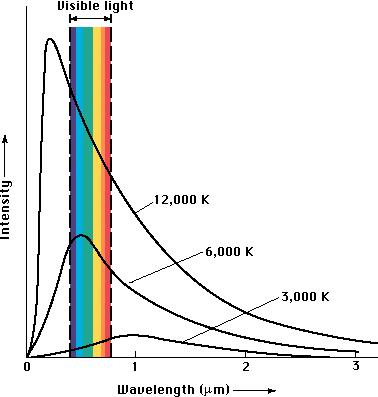
Received wisdom is that the continuous spectrum of light emitted by stars like the Sun is roughly of black-body form, with a peak wavelength inversely proportional to the surface temperature of the star. Here are some examples of black-body curves to illustrate the point.

The Sun has a surface temperature of about 6000 K – actually, more like 5800 K but we won’t quibble. The peak wavelength for the Sun’s spectrum  therefore corresponds to bluey-green light, which is why the Sun appears … er… yellow.

Anyone care to offer an explanation as to why the Sun isn’t green? Answers on a postcard or, preferably, through the comments box.

And while you’re at it, you might want to comment on why,  if the Sun produces so much green light, chlorophyll is actually green?


Share/Bookmark