Author Archive

(Guest Post) FQXi

Posted in The Universe and Stuff with tags on June 2, 2010 by telescoper

I’m happy to post the following message from Brendan Foster of the Foundational Questions Institute in order to help advertise their Large Grants Program. I should make clear that I have no formal connection with this Institute so if you have any questions about the program please contact them as advised in the post. And if you wish to apply, good luck!

-0-

I’d like to announce the 2010 round of the Foundational Questions
Institute
(FQXi) Large Grants Program.  Initial applications are due
in under two weeks, so get started now!

FQXi is an independent, philanthropically funded non-profit organization.  Our mission is to catalyze, support, and disseminate research on questions at the foundations of physics and cosmology.  We want to bring special focus to new frontiers and innovative ideas integral to a deep understanding of reality, but unlikely to be supported by conventional funding sources.

As part of our mission, we now invite proposals for research on foundational questions in physics and cosmology. The focus for this grant round is “Time and Foundations”.  We wish to especially encourage projects targeted on the Nature of Time. To quote from the Request for Proposals, “The topic of Time is of both deep and broad interest for research in foundational questions in physics and cosmology. Science, and particularly physics, has produced dramatic insights into the nature of time…Careful consideration of time has
likewise caused revolutions in physics, and may again do so.”

We will also consider more general proposals of exceptional quality, including suitable outreach projects. All proposed projects should qualify as foundational and unconventional. You can get a sense of the range of supported work by checking out the funded projects from the previous grant rounds, at

http://www.fqxi.org/grants/large/awardees/list

The application consists of a two-step, online process, with review by an external panel of experts.  The Initial Proposal is short and simple, consisting of little more than a page of summary and a rough budget. You should have more than enough time to get ready by the Initial Proposal deadline: June 14, 2010 (midnight, EST).

We will then invite selected proposals to be expanded into Full Proposals based on the selections of the Review Panel.  Funds for approved Full Proposals will be available (via a Donor Advised Fund) soon after January 1, 2011.

To view full instructions and the application form, go to

http://www.fqxi.org/grants/large/initial

The deadline again is Monday, June 14.

While you’re at it, visit our blog and online forums, at

http://fqxi.org/community

You’ll find articles, essays, and discussions on foundational physics questions, including the Nature of Time.  Send any questions to us at mail@fqxi.org.

Discovering Copenhagen

Posted in The Universe and Stuff with tags , , on June 2, 2010 by telescoper

Here I am, again, in the fine city of Copenhagen in Denmark. It’s a lot warmer here than last time I was here, in January, but I’m here for a short meeting at the Discovery Center which we be held on the premises of the Niels Bohr Institute over the next few days.

It looks like being a funny little meeting, because  nobody is allowed to talk about any Planck results yet so most speakers are talking about extraneous matters, almost like they’ll be talking about their hobbies. Should be fun. I haven’t decided what I’ll talk about yet, but my talk isn’t until tomorrow…

I travelled yesterday from Heathrow Airport with Leonid Grishchuk who I met in the airport. It turns out he had checked in extra-specially early for the the short flight to Copenhagen. The result of this enthusiasm was that his bags didn’t arrive with the plane. After filing a lost luggage report the usually avuncular Leonid turned into grumpy Grishchuk for the short Metro journey downtown. I saw him at breakfast just now and he told me his bag had actually been delivered to the hotel late last night. All’s well that ends well. It sounds like it must have come on the later flight, which probably means it never left Heathrow.

I was worried for a while I was going to miss the flight because my train from Cardiff was late as a result of being stuck in the Swansea area behind a broken-down train. Despite the delay and the fact that only one automatic check-in machine was working at the airport, I still had plenty of time to make the flight. My bag was one of the first out of the carousel.

Our meeting doesn’t start until lunchtime, so I’m going to take a walk around and do a little sightseeing beforehand. I know the city fairly well, but it will be nice to see how things have changed over the years. If memory serves, I think the first time I came here was in 1988. Quite a few of the places I went during that time have now closed but then I’m too old now to go them anyway!

Sull’aria

Posted in Opera with tags , , , on June 1, 2010 by telescoper

I’m about to set out on a short trip par avion and I’m not sure how good the wireless is going to be where I’m staying so I might be offline for a few days.  Following on from one of yesterday’s comments about the wonders of Mozart’s writing for more than one voice, I thought I’d leave you with the exquisite duettino Sull’aria from Le Nozze di Figaro. You’ll remember this from the Shawshank Redemption if you’ve ever seen the film, but here it is in a lovely performance from the Paris Opera Garnier in 1980. It’s three minutes of absolute joy.

I never promised you a rose garden…

Posted in Uncategorized on June 1, 2010 by telescoper

..but I’m nevertheless quite pleased with the way it’s turning out!

Now the Great Bear and Pleiades

Posted in Opera with tags , , , , on May 31, 2010 by telescoper

This Bank Holiday Monday I’ve been resolutely doing nothing at all, and very nice it’s been. I’m going to be similarly lazy about blogging today too, and just put up a piece of music. Some of you may know that BBC Radio 3 have recently been searching for the Nation’s Favourite Aria. Nominations are  accepted by email to 3breakfast@bbc.co.uk but the closing date is tomorrow (1st June). A list of the ten most popular nominations will be published on 2nd June and listeners are then invited to vote on the one they like best.

They’ve been playing the nominations as they come in and, as you’d expect, there seems to be a strong tendency to Puccini and Verdi. Nothing wrong with that, of course. You can always rely on them for a great tune.  If you have a favourite, why not send it in? I’ll just point out that it has to be a solo aria, no duos, trios, quartets or even choruses allowed! I’m interested to see the top ten is, but I’ll bet Nessun Dorma is in there.

Anyway, I’ve already emailed my suggestion in. I don’t know whether it will make the final list but I think it provides one of the greatest passages in one of the greatest of all operas, Peter Grimes by Benjamin Britten. Most people I know who have seen Peter Grimes think it is a masterpiece, and I’m interested to see another physics blog has already discussed this aria. Still, I don’t think Britten is sufficiently appreciated even in the land of his birth. There aren’t that many operas written in English so perhaps we feel a little uncomfortable when we can actually understand what’s going on without reading the surtitles?

I’ve often heard Peter Grimes described as one of the great operas written in English. Well, as far as I’m concerned you can drop “written in English” from that sentence and it’s still true. It’s certainly in my mind fit to put up alongside anything by Verdi, Puccini, Wagner and even Mozart.

In this aria it’s not just the extraordinary vocal line, beginning way up among the “head notes” beyond a tenor’s usual range, that makes it such a  powerful piece of music,  but also the tragic poetry in the words. The main character of Peter Grimes is neither hero nor villain, but  a man trapped in his own destiny. It’s a tragedy in the truest sense of the word:

Now the great Bear and Pleiades
where earth moves
Are drawing up the clouds
of human grief
Breathing solemnity in the deep night.
Who can decipher
In storm or starlight
The written character
of a friendly fate
As the sky turns, the world for us to change?
But if the horoscope’s
bewildering
Like a flashing turmoil
of a shoal of herring,
Who can turn skies back and begin again?


The part of Peter Grimes was actually written by Britten specifically to suit the voice of his partner, Peter Pears, who performed the role first. The classic recording of that performance is wonderful, but I’ve picked a later version starring Jon Vickers which is different but also excellent. For its combination of musical expressiveness and dramatic intensity, this music really does take some beating even if you listen to it on its own outside the context of the opera.

Turning the Tables

Posted in Science Politics with tags , , , on May 30, 2010 by telescoper

In Andy Fabian‘s Presidential Address to the Royal Astronomical Society (published in the June 2010 issue of Astronomy and Geophysics) he discusses the impact of UK astronomy both on academic research and wider society. It’s a very interesting article that makes a number of good points, not the least of which is how difficult it is to measure “impact” for a fundamental science such as astronomy. I encourage you all to read the piece.

One of the fascinating things contained in that article is the following table, which shows the number of papers published in Space Sciences (including astronomy) in the period 1999-2009 (2nd column) with their citation counts (3rd Column) and citations per paper (4th column):

USA 53561 961779 17.96
UK(not NI) 18288 330311 18.06
Germany 16905 279586 16.54
England 15376 270290 17.58
France 13519 187830 13.89
Italy  11485 172642 15.03
Japan 8423 107886 12.81
Canada 5469 102326 18.71
Netherlands 5604 100220 17.88
Spain 6709 88979 13.26
Australia 4786 83264 17.40
Chile 3188 57732 18.11
Scotland 2219 48429 21.82
Switzerland 2821 46973 16.65
Poland 2563 32362 12.63
Sweden 2065 30374 14.71
Israel 1510 29335 19.43
Denmark 1448 26156 18.06
Hungary 761 16925 22.24
Portugal  780 13258 17.00
Wales 693 11592 16.73

I’m not sure why Northern Ireland isn’t included, but I suspect it’s because the original compilation (from the dreaded ISI Thompson database) lists England, Scotland, Wales and Northern Ireland separately and the latter didn’t make it into the top twenty; the entry for the United Kingdom is presumably constructed from the numbers for the other three. Of course many highly-cited papers involve international collaborations, so some of the papers will be in common to more than one country.

Based on citation counts alone you can see that the UK is comfortably in second place, with a similar count per paper to the USA.  However, the number that really caught my eye is Scotland’s citations per paper which, at 21.82, is significantly higher than most. In fact, if you sort by this figure rather than by the overall citation count then the table looks very different:


Hungary 761 16925 22.24
Scotland 2219 48429 21.82
Israel 1510 29335 19.43
Canada 5469 102326 18.71
Chile 3188 57732 18.11
UK (not NI) 18288 330311 18.06
Denmark 1448 26156 18.06
USA 53561 961779 17.96
Netherlands 5604 100220 17.88
England 15376 270290 17.58
Australia 4786 83264 17.40
Portugal  780 13258 17.00
Wales 693 11592 16.73
Switzerland 2821 46973 16.65
Germany 16905 279586 16.54
Italy  11485 172642 15.03
Sweden 2065 30374 14.71
France 13519 187830 13.89
Spain 6709 88979 13.26
Japan 8423 107886 12.81
Poland 2563 32362 12.63

Wales climbs to a creditable 13th place while the UK as a whole falls to 6th. Scotland is second only to Hungary. Hang on. Hungary? Why does Hungary have an average of  22.24 citations per paper? I’d love to know.  The overall number of papers is quite low so there must be some citation monsters among them. Any ideas?

Notice how some of the big spenders in this area – Japan, Germany, France and Italy – slide down the table when this metric is used. I think this just shows the limitations of trying to use a single figure of merit. It would be interesting to know – although extremely difficult to find out – how these counts relate to the number of people working in space sciences in each country. The UK, for example, is involved in about a third as many publications as the USA but the number of astronomers in the UK must be much less than a third of the corresponding figure for America. It would be interesting to see a proper comparison of all these countries’ investment in this area, both in terms of people and in money…

..which brings me to Andy Lawrence’s recent blog post which reports that the Italian Government is seriously considering closing down the INAF (Italy’s National Institute for Astrophysics). What this means for astronomy and astrophysics funding in Italy I don’t know. INAF has only existed since 2002 anyway, so it could just mean an expensive bureaucracy will be dismantled and things will go back to the way they were before then. On the other hand, it could be far worse than that and since Berlusconi is involved it probably will be.

Those in control of the astronomy budget in this country have also made it clear that they think there are too many astronomers in the UK, although the basis for this decision escapes me.  Recent deep cuts in grant funding have already convinced some British astronomers to go abroad. With more cuts probably on the way, this exodus is bound to accelerate. I suspect those that leave  won’t be going to Italy, but I agree with Andy Fabian that it’s very difficult to see how the UK will be able to hold  its excellent position in the world rankings for much longer.

Astronomy Look-alikes, No. 28

Posted in Astronomy Lookalikes with tags , , on May 29, 2010 by telescoper

Am I alone in thinking that Professor Paul Shellard of Cambridge University looks a bit like Dick Dastardly from the Wacky Races? Failing that, there’s always Terry-Thomas…

Eurovision

Posted in Opera with tags , , , on May 29, 2010 by telescoper

Tonight’s the night of the dreadful Eurovision Song Contest, which I won’t be watching, but I thought I’d take the opportunity to post a reminder of the days when Eurovision was, at least occasionally, much classier. Here’s a live Eurovision broadcast from 1957, featuring Maria Callas. The aria is Casta Diva, from Norma by Vincenzo Bellini, a masterpiece of Italian Bel Canto opera. Gorgeous.

Astronomy Look-alikes, No. 27

Posted in Astronomy Lookalikes with tags , , on May 28, 2010 by telescoper

A few years ago Professor Nick Kaiser mentioned to me that people said he reminded them of Austin Powers. More recently, however, I’ve noticed that Nick looks less like the International Man of Mystery and more like his arch-rival, Dr Evil. He must have been spending too much time using a Mac.

Professor Kaiser

Doctor Evil

Clustering in the Deep

Posted in Bad Statistics, The Universe and Stuff with tags , , , , , , on May 27, 2010 by telescoper

I couldn’t resist a quick lunchtime post about the results that have come out concerning the clustering of galaxies found by the HerMES collaboration using the Herschel Telescope. There’s quite a lengthy press release accompanying the new results, and there’s not much point in repeating the details here, so I’ll just show a wonderful image showing thousands of galaxies and their far-infrared colours.

Image Credit: European Space Agency, SPIRE and HERMES consortia

According to the press release, this looks “like grains of sand”. I wonder if whoever wrote the text was deliberately referring to Genesis 22:17?

.. they shall multiply as the stars of the heaven, and as the grains of sand upon the sea shore.

However, let me take issue a little with the following excerpt from said press release:

While at a first glance the galaxies look to be scattered randomly over the image, in fact they are not. A closer look will reveals that there are regions which have more galaxies in, and regions that have fewer.

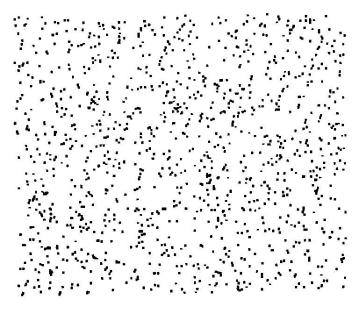
A while ago I posted an item asking what “scattered randomly” is meant to mean. It included this picture

This is what a randomly-scattered set of points actually looks like. You’ll see that it also has some regions with more galaxies in them than others. Coincidentally, I showed the same  picture again this morning in one of my postgraduate lectures on statistics and a majority of the class – as I’m sure do many of you seeing it for the first time –  thought it showed a clustered pattern. Whatever “randomness” means precisely, the word certainly implies some sort of variation whereas the press release implies the opposite. I think a little re-wording might be in order.

What galaxy clustering statistics reveal is that the variation in density from place-to-place is greater than that expected in a random distribution like that shown. This has been known since the 1960s, so it’s not  the result that these sources are clustered that’s so important. In fact, The preliminary clustering results from the HerMES surveys – described in a little more detail in a short paper available on the arXIv – are especially  interesting because they show that some of the galaxies seen in this deep field are extremely bright (in the far-infrared), extremely distant, high-redshift objects which exhibit strong spatial correlations. The statistical form of this clustering provides very useful input for theorists trying to model the processes of galaxy formation and evolution.In particular, the brightest objects at high redshift have a propensity to appear preferentially in dense concentrations, making them even more strongly clustered than rank-and-file galaxies. This fact probably contains important information about the environmental factors responsible for driving their enormous luminosities.

The results are still preliminary, but we’re starting to see concrete evidence of the impact Herschel is going to have on extragalactic astrophysics.