Archive for Norma

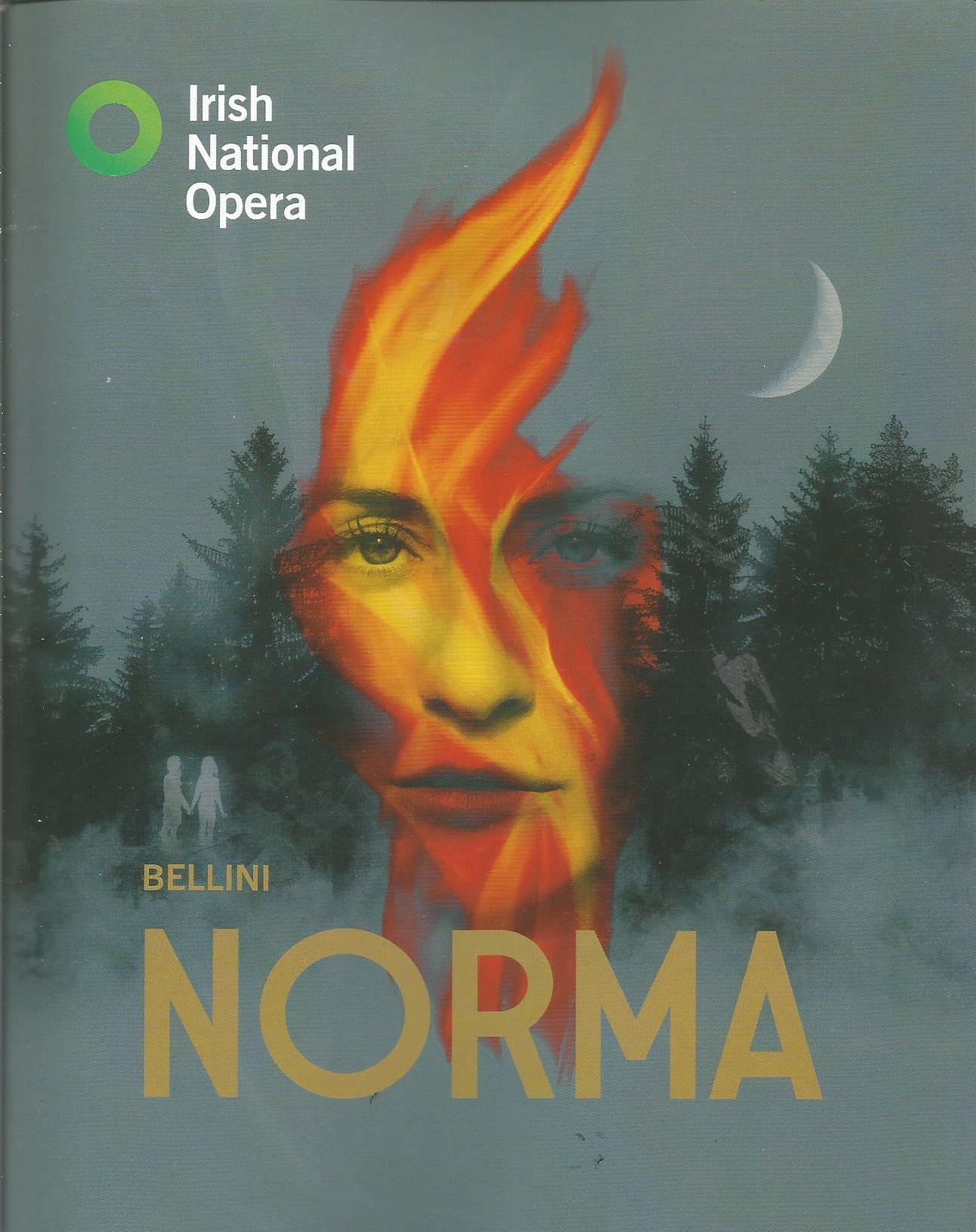
INO Norma at the National Opera House

Posted in Opera with tags , , , , , , , , on June 4, 2026 by telescoper

I had seen the by Vincenzo Bellini‘s opera Norma twice (before yesterday evening) but both times were before I starting blogging so I was very pleased to see that Irish National Opera were doing a new production this year. It had a run at the Gaiety Theatre in Dublin, but I took the chance to see it National Opera House in Wexford. The first time I went there was last year and was to see a very different opera, although that one and Norma are both generally categorized by the term bel canto. I was so excited by the prospect of seeing this production that I made myself a Bellini on Saturday, only to discover that the cocktail is named after a different Bellini…

Norma is not performed all that often, largely because it is difficult to find a singer capable of doing justice to the title role which is acknowledged as being one of the most vocally demanding roles in all opera. It is a role that the great Maria Callas made her own in the 1950s which places the additional burden on the the singer of stepping out of the shadow of such a legend. I was delighted that in Salome Jicia INO found an artist who could meet the challenges of the part. She was stunning.

I think the part of Norma is difficult not only because of the vocal range of the part, from the lyrical beauty of the famous aria Casta Diva to the agility needed to perform the coloratura passages, but also for the sheer stamina required. There really is a lot of singing for her to do in this opera! Jicia took it in her stride. Bellini rarely gets the orchestra to double the vocal line, so the voice of the singer is very exposed. At times it’s like watching acrobatics knowing that there’s no safety net!

Anyway, to the plot.

Norma is a tragedia lirica in two Acts, set in ancient Gaul which is under occupation by the Romans. The eponymous Norma is the high priestess of the native Druids. She is also a complex chartacter, not least because she is in a relationship with a high-ranking Roman, Pollione, with whom she has had two kids. It turns out that Pollione is tiring of Norma and has turned his attention to her friend Adalgisa, who does not know about Pollione’s involvement with Norma.

The Opera begins with the heavily armed Gauls, led by Norma’s father Oroveso, planning to rise up against the Roman occupiers. But only Norma can sanction an armed rebellion and she says no. The aria Casta Diva expresses Norma’s desire for peace, but this is not just because she feels the Romans have greater military strength and would crush the rising, but because of her thing with Pollione. Over the course of the Opera we find out about Pollione’s infatuation with Adalgisa and their planned elopement to Rome which sends Norma into such a rage she threatens to kill her own children. Eventually Norma decides to change her mind about the uprising and calls for it to go ahead. Protocol requires a human sacrifice to initiate such a move, so the question is who is for the chop? Will it be Pollione, or Adalgisa? Norma surprises the assembled Gauls by confessing her sacreligious relationship with Pollione and declaring herself to be the sacrifice. Pollione is overcome by remorse at what he has done, and decides to join Norma in death.

Well, what did you expect in an Opera, a happy ending?

This production eschews the Normal (geddit?) setting of forest groves and scared shrines and places it in a sort of modern post-apocalyptic dystopia. The stage is dominated by barricades apparently hastily constructed from broken furniture and scrap metal. Lighting is sombre and claustrophobic. This jars with Bellini’s music when it evokes pastoral beauty – the music is too light and pretty for such a gloomy setting.

Gone are the swords, spears and druidic robes and in come AK-47s, pistols and somewhat scruffy modern-looking outfits. Even Norma’s dress is nothing fancy. The Gauls look like a ramshackle but heavily armed paramilitary group and are indistinguishable in costume from the Romans, except that the latter have special haircuts – mohawks died bright red on top. I found this a bit confusing and felt that it negated the theme of “occupiers versus occupied” which runs throughout the piece. This choice is probably intended to show the struggle as one between two rival groups in a polarized community. In the hands of the chorus the guns create a very menacing backgroup to several scenes, and of course the ending ends not by ritual burning, as in the original, but by firing squad.

The musical pyrotechnics do pose challenges for the staging, however, because an opera is not just a concert. It doesn’t work as music drama if the singers are just standing there belting out tunes. They also need to employ gestures and facial expressions to match the emotions expressed by the score and it can’t be too static. In this production the set is rather simple, and when I first saw it I assumed that it would be moved around a lot to create different locations, but that was only done to a limited extent. To compensate for the inflexible scenery, the chorus often provides a moving backdrop to the action. In the hands of the chorus the proliferation of guns create a very menacing backgroup to several scenes, and of course the ending ends not by ritual burning, as in the original, but by firing squad. The chorus was used very imaginatively, I’d say, not only to make up the numbers on stage, but also in their singing. I liked the idea of the chorus being split for some passages, leading one’s attention around the stage as the different groups gave voice.

I already mentioned Salome Jicia, but the other principals were also very good. Mario Chang (tenor) was a fine Pollione, William Guanbo Su a towering Oroveso with a rich bass and Siobhan Stagge as Adalgisa sang and acted beautifully. Despite some reservations about the staging, I thought this was a hugely enjoyable performance. Bellini has his critics, but I think the last part of Act II, the principals and chorus singing their hearts out to wonderful music, as the drama moves inexorably to its tragic conclusion, is one of the most intensely moving experiences in the entire operatic repertoire.

P.S. If you have 20 minutes to spare, listen to the Act II finale as performed by Callas here.
Una Grande Vociaccia

Posted in Music, Opera with tags , , , , , , , on December 2, 2018 by telescoper

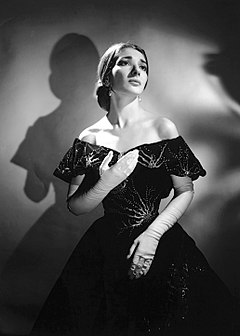
Had she still been alive, December 2nd 2018 would have been the 95th birthday of the most renowned opera singer of her time, Maria Callas.

She was born in 1923 in New York city of Greek parents who had moved there the previous year, and christened Maria Anna Sofia Cecilia Kalogeropoulou. Her mother, disenchanted with her deteriorating marriage, abandoned her husband (Maria’s father) and took Maria and her sister back to Athens in 1937. Maria enrolled at the National Conservatoire of Greece the same year after winning a scholarship with the quality of her voice, which

was warm, lyrical, intense; it swirled and flared like a flame and filled the air with melodious reverberations.

At this age, Maria was a rather plump young lady with a rather deep voice. Initially, she aspired to be a contralto but at the Conservatoire she was encouraged instead to become a dramatic soprano. Accordingly, she underwent special training to raise her natural pitch (or tessitura) and learned how to control her remarkable voice more accurately so she could sing in a sufficiently disciplined fashion that she could take on the dazzling coloratura passages that she would perform in later years with such success. She also worked on her chest tones to broaden the scope of her voice in the mezzo region. Although she became more technically refined as a singer during this period, there were some things that didn’t change. One was the sheer power of her voice, which is something that we tend to notice less in these days of microphones and studio recordings. People who heard her sing live confess to being shocked at the sheer scale of sound she could deliver without amplification. Perhaps more tellingly, she eschewed many of the devices sopranos tended to use to control the highest notes, usually involving some alteration of the throat to produce accuracy at the expense of a thinner and more constricted tone. When Callas went for a high note, she always did so in a full-throated manner. This often produced a piercing sound that could be intensely dramatic, even to the extent of almost knocking you out of your seat, but it was a very risky approach for a live performance. Audiences simply weren’t used to hearing a coloratura sing with such volume and in such a whole-hearted way. It wasn’t always pretty, but it was certainly remarkable and often very moving. It was this aspect of her voice that led her friend Tito Gobbi (who sang with her in Tosca) to call it una grande vociaccia, which I translate in my schoolboy Italian as meaning something like “a big ugly voice”. That isn’t meant to be as disparaging as it sounds (Gobbi was a great admirer of Callas’ singing).

Having listened to lots of recordings of Maria Callas I have to admit that they are certainly not all good. Sometimes the voice didn’t come off at all. Unkindly, one colleague said that she “sang with her ovaries”. When she talked about her own noice, Callas herself often referred to it as if it were some independent creature over which she had very little control. Anyway, whatever the reason, when she was bad she was definitely bad. But I adopt the philosophy that one should judge artists (and scientists, for that matter) by their best work rather than their worst, and when Callas was good she was simply phenomenal, like a sublime and irresistible force of nature. That’s why they called her La Divina.

Although her talent was very raw in the beginning there was no question that she always had a voice of exceptional power and dramatic intensity. When she started singing professionally she immediately attracted lavish praise from the critics not just for her voice but also for her acting. As a young soprano she sang in an astonishing variety of operas, including Wagner‘s Tristan und Isolde and Die Walküre, neither of which one would now associate with Callas.

It was in the late 194os that Callas began to take an interest in the type of opera that would really make her name. Bel canto opera was rather unfashionable at that time, probably because audiences preferred the grittier and more realistic verismo style. Virtually single-handed, Callas resurrected the bel canto canon by injecting a true sense of drama into works which had previously just been seen as vehicles for the singers to demonstrate their art. Callas brought an entirely new dimension to the great operas by Bellini (Norma, I Puritani, La Somnambula…) and Donizetti (Lucia di Lammermoor, Anna Bolena), although she was sufficiently versatile to also perform brilliantly in the verismo syle of Verdi and Puccini as well as lesser known composers such as Giordano (Andrea Chenier). Recordings of many of these performances are available, but it is sad that this glorious period of her singing career happened just a bit before high quality equipment was available so the true glory of her voice isn’t always evident.

In 1953, Callas decided that she wanted to change her appearance, perhaps so she would look more appropriate for the parts she was playing on stage. At the time she weighed almost 200lbs. In order to lose weight as quickly as possible, she followed the barbarous but highly effective expedient of swallowing a tapeworm. She lost 80lbs in a matter of months. The dramatic loss of weight changed her body and her face, emphasizing her high angular cheekbones and giving her a striking look very well suited to the opera stage. But it also affected her voice somewhat, especially at the upper end where she seems to have found it more difficult to avoid the dreaded “wobble” which was one of the alleged imperfections that critics tended to dwell upon.

Callas also had very poor eyesight which required her to wear very thick spectacles in order to see at all, a thing she refused to do onstage with the result that she was virtually blind during performances. In fact, during a performance of Tosca at Covent Garden she leant too far over a candle and her hair caught fire. Improvising magnificently, Tito Gobbi, as the loathsome Scarpia, extinguished the fire by throwing water at her before the audience had noticed. Although they weren’t much use for seeing with, her eyes were a great asset for her acting, in turns flashing like a demon then shining like an angel.

After her weight loss, Callas was suddenly no longer just a wonderful singer but also a strikingly beautiful woman. Her career took a back seat as she started to revel in the glamorous lifestyle that opened up in front of her. Her voice deteriorated and she performed rather less frequently. Eventually she embarked on a love affair with Aristotle Onassis, a notorious serial collector of trophy women. She hoped to marry him but he abandoned her to marry Jackie Kennedy, widow of John F. Kennedy.

She never really recovered from the failure of this affair, retired from singing and lived out the last years of her life as a virtual recluse in her apartment in Paris. She died in 1977.

I had heard a lot about Maria Callas when I was younger, but the recordings that I listened to (generally from the 1960s) were really not very good as her voice was undoubtedly much diminished by then. I just assumed that, as is the case with many artists, the legend of Callas was all mere hype. Then, about fifteen years ago, I was listening to BBC Radio 3 and they played the final scenes of the great 1954 recording of Norma with Callas in the title role, conducted by Tullio Serafin. I was completely overwhelmed by it and tears flowed freely from my eyes. I’ve always had a tendency to blub when I hear really beautiful music, but as I’ve got older I’ve learned not to be embarrassed by it. At least I don’t cry at football matches.

In England, Callas is probably best remembered for her performances in Tosca in Covent Garden. I have recordings of her in that role and they are really wonderful. But there are many fine recordings of Tosca by other singers, some of which are almost as good. In the case of Norma, though, there isn’t any other performance that comes within a mile of the Callas version. Or if there is, I’ve yet to hear it.

Now I know that there are some people, even opera lovers, who just don’t get Callas at all (just look at the comment boards on Youtube). I grant that she wasn’t always the most accurate singer, and I don’t think you could say her voice had a purely classical beauty. But even if you don’t like her voice you have to admit that she revitalized the opera stage and brought a new public into the theatres. I can’t imagine what the state of opera would be now, if there hadn’t been a Callas and you can’t argue that she is now an iconic figure. What I admire most about her is that, like it or loath it, her voice is instantly recognisable. In this sense, she always puts me in mind of a kind of operatic version of Billie Holliday. She’s a far cry from the many bland mediocrities that pass themselves off as opera singers nowadays.

I’m going to end with the obligatory clips from Youtube. There’s a lot of Callas on there, not all of it good. I’ve chosen a couple of items, although neither of them has a proper video. The first was performed live in 1955 in front of the notoriously difficult audience at La Scala in Milan and recorded from a radio broadcast so that the sound quality is quite poor. A studio recording of this aria, from Andrea Chenier, features most movingly in the film Philadelphia. This live version, however, is notable for a number of reasons. One is that you get some idea of the power of the Callas voice in the way she pushes aside the entire orchestra and is even able to cut through the distortions introduced by the rather primitive recording technology. The second thing is that she sings it so beautifully, with such feeling, lovely phrasing, and so much colour and vitality. Listen to the way the texture of her voice matches perfectly her changing emotions as she tells her story. The shattering, climactic high C that occurs near the end is a perfect example of what I was saying above. She stabs this note out like her life depended on it. It sends shivers down my spine and clearly had the same effect on the audience. The thunderous applause that follows the end of this aria is quite frightening in its intensity, but gives a good idea how much her public adored her. If you can put up with the lo-fi recording, this is certainly a better performance than the studio version.

The final piece has to be from Norma. I think Bellini is a wonderful composer of opera, but he doesn’t make life easy for the singers. There’s never any doubling of the vocal line by the orchestra so the singer is very exposed. This doesn’t bother Maria Callas. This is the famous aria Casta Diva, which has become a kind of signature tune for her and it’s one of the pieces that she always seemed to perform beautifully. It might be a bit hackneyed but I love it and, after all, it’s my blog. There’s also a nice compilation of pictures.

I’d be interested to hear what the general opinion of Callas is based on a sample of the two or three people who read my blog, so please feel free to add your comments!

Eurovision

Posted in Opera with tags , , , on May 29, 2010 by telescoper

Tonight’s the night of the dreadful Eurovision Song Contest, which I won’t be watching, but I thought I’d take the opportunity to post a reminder of the days when Eurovision was, at least occasionally, much classier. Here’s a live Eurovision broadcast from 1957, featuring Maria Callas. The aria is Casta Diva, from Norma by Vincenzo Bellini, a masterpiece of Italian Bel Canto opera. Gorgeous.

Una Grande Vociaccia

Posted in Music, Opera with tags , , , , , , , on December 7, 2008 by telescoper

I missed an important anniversary this week. Had she still been alive, December 2nd 2008 would have been the 85th birthday of the most renowned opera singer of her time, Maria Callas.

She was born in 1923 in New York city of Greek parents who had moved there the previous year, and christened Maria Anna Sofia Cecilia Kalogeropoulou. Disenchanted with her deteriorating marriage, her mother abandoned her husband and took Maria and her sister back to Athens in 1937. Maria enrolled at the National Conservatoire of Greece the same year after winning a scholarship with the quality of her voice, which

was warm, lyrical, intense; it swirled and flared like a flame and filled the air with melodious reverberations.

At this age, Maria was a rather plump young lady with a rather deep voice. Initially, she aspired to be a contralto but at the Conservatoire she was encouraged instead to become a dramatic soprano. Accordingly, she underwent special training to raise her natural pitch (or tessitura) and learned how to control her remarkable voice more accurately so she could sing in a sufficiently disciplined fashion that she could take on the dazzling coloratura passages that she would perform in later years with such success. She also worked on her chest tones to broaden the scope of her voice in the mezzo region. Although she became more technically refined as a singer during this period, there were some things that didn’t change. One was the sheer power of her voice, which is something that we tend to notice less in these days of microphones and studio recordings. People who heard her sing live confess to being shocked at the sheer scale of sound she could deliver without amplification. Perhaps more tellingly, she eschewed many of the devices sopranos tended to use to control the highest notes, usually involving some alteration of the throat to produce accuracy at the expense of a thinner and more constricted tone. When Callas went for a high note, she always did so in a full-throated manner. This often produced a piercing sound that could be intensely dramatic, even to the extent of almost knocking you out of your seat, but it was a very risky approach for a live performance. Audiences simply weren’t used to hearing a coloratura sing with such volume and in such a whole-hearted way. It wasn’t always pretty, but it was certainly remarkable and often very moving. It was this aspect of her voice that led her friend Tito Gobbi (who sang with her in Tosca) to call it una grande vociaccia, which I translate in my schoolboy Italian as meaning something like “a big ugly voice”. That isn’t meant to be as disparaging as it sounds (Gobbi was a great admirer of Callas’ singing).

Having listened to lots of recordings of Maria Callas I have to admit that they are certainly not all good. Sometimes the voice didn’t come off at all. Unkindly, one colleague said that she “sang with her ovaries”. When she talked about her own noice, Callas herself often referred to it as if it were some independent creature over which she had very little control. Anyway, whatever the reason, when she was bad she was definitely bad. But I adopt the philosophy that one should judge artists (and scientists, for that matter) by their best work rather than their worst, and when Callas was good she was simply phenomenal, like a sublime and irresistible force of nature. That’s why they called her La Divina.

Although her talent was very raw in the beginning there was no question that she always had a voice of exceptional power and dramatic intensity. When she started singing professionally she immediately attracted lavish praise from the critics not just for her voice but also for her acting. As a young soprano she sang in an astonishing variety of operas, including Wagner‘s Tristan und Isolde and Die Walküre, neither of which one would now associate with Callas.

It was in the late 194os that Callas began to take an interest in the type of opera that would really make her name. Bel canto opera was rather unfashionable at that time, probably because audiences preferred the grittier and more realistic verismo style. Virtually single-handed, Callas resurrected the bel canto canon by injecting a true sense of drama into works which had previously just been seen as vehicles for the singers to demonstrate their art. Callas brought an entirely new dimension to the great operas by Bellini (Norma, I Puritani, La Somnambula…) and Donizetti (Lucia di Lammermoor, Anna Bolena), although she was sufficiently versatile to also perform brilliantly in the verismo syle of Verdi and Puccini as well as lesser known composers such as Giordano (Andrea Chenier). Recordings of many of these performances are available, but it is sad that this glorious period of her singing career happened just a bit before high quality equipment was available so the true glory of her voice isn’t always evident.

In 1953, Callas decided that she wanted to change her appearance, perhaps so she would look more appropriate for the parts she was playing on stage. At the time she weighed almost 200lbs. In order to lose weight as quickly as possible, she followed the barbarous but highly effective expedient of swallowing a tapeworm. She lost 80lbs in a matter of months. The dramatic loss of weight changed her body and her face, emphasizing her high angular cheekbones and giving her a striking look very well suited to the opera stage. But it also affected her voice somewhat, especially at the upper end where she seems to have found it more difficult to avoid the dreaded “wobble” which was one of the alleged imperfections that critics tended to dwell upon.

Callas also had very poor eyesight which required her to wear very thick spectacles in order to see at all, a thing she refused to do onstage with the result that she was virtually blind during performances. In fact, during a performance of Tosca at Covent Garden she leant too far over a candle and her hair caught fire. Improvising magnificently, Tito Gobbi, as the loathsome Scarpia, extinguished the fire by throwing water at her before the audience had noticed. Although they weren’t much use for seeing with, her eyes were a great asset for her acting, in turns flashing like a demon then shining like an angel.

After her weight loss, Callas was suddenly no longer just a wonderful singer but also a strikingly beautiful woman. Her career took a back seat as she started to revel in the glamorous lifestyle that opened up in front of her. Her voice deteriorated and she performed rather less frequently. Eventually she embarked on a love affair with Aristotle Onassis, a notorious serial collector of trophy women. She hoped to marry him but he abandoned her to marry Jackie Kennedy, widow of John F. Kennedy.

She never really recovered from the failure of this affair, retired from singing and lived out the last years of her life as a virtual recluse in her apartment in Paris. She died in 1977.

I had heard a lot about Maria Callas when I was younger, but the recordings that I listened to (generally from the 1960s) were really not very good as her voice was undoubtedly much diminished by then. I just assumed that, as is the case with many artists, the legend of Callas was all mere hype. Then, about fifteen years ago, I was listening to BBC Radio 3 and they played the final scenes of the great 1954 recording of Norma with Callas in the title role, conducted by Tullio Serafin. I was completely overwhelmed by it and tears flowed freely from my eyes. I’ve always had a tendency to blub when I hear really beautiful music, but as I’ve got older I’ve learned not to be embarrassed by it. At least I don’t cry at football matches.

In England, Callas is probably best remembered for her performances in Tosca in Covent Garden. I have recordings of her in that role and they are really wonderful. But there are many fine recordings of Tosca by other singers, some of which are almost as good. In the case of Norma, though, there isn’t any other performance that comes within a mile of the Callas version. Or if there is, I’ve yet to hear it.

Now I know that there are some people, even opera lovers, who just don’t get Callas at all (just look at the comment boards on Youtube). I grant that she wasn’t always the most accurate singer, and I don’t think you could say her voice had a purely classical beauty. But even if you don’t like her voice you have to admit that she revitalized the opera stage and brought a new public into the theatres. I can’t imagine what the state of opera would be now, if there hadn’t been a Callas and you can’t argue that she is now an iconic figure. What I admire most about her is that, like it or loath it, her voice is instantly recognisable. In this sense, she always puts me in mind of a kind of operatic version of Billie Holliday. She’s a far cry from the many bland mediocrities that pass themselves off as opera singers nowadays.

I’m going to end with the obligatory clips from Youtube. There’s a lot of Callas on there, not all of it good. I’ve chosen a couple of items, although neither of them has a proper video. The first was performed live in 1955 in front of the notoriously difficult audience at La Scala in Milan and recorded from a radio broadcast so that the sound quality is quite poor. A studio recording of this aria, from Andrea Chenier, features most movingly in the film Philadelphia. This live version, however, is notable for a number of reasons. One is that you get some idea of the power of the Callas voice in the way she pushes aside the entire orchestra and is even able to cut through the distortions introduced by the rather primitive recording technology. The second thing is that she sings it so beautifully, with such feeling, lovely phrasing, and so much colour and vitality. Listen to the way the texture of her voice matches perfectly her changing emotions as she tells her story. The shattering, climactic high C that occurs near the end is a perfect example of what I was saying above. She stabs this note out like her life depended on it. It sends shivers down my spine and clearly had the same effect on the audience. The thunderous applause that follows the end of this aria is quite frightening in its intensity, but gives a good idea how much her public adored her. If you can put up with the lo-fi recording, this is certainly a better performance than the studio version.

The final piece has to be from Norma. I think Bellini is a wonderful composer of opera, but he doesn’t make life easy for the singers. There’s never any doubling of the vocal line by the orchestra so the singer is very exposed. This doesn’t bother Maria Callas. This is the famous aria Casta Diva, which has become a kind of signature tune for her and it’s one of the pieces that she always seemed to perform beautifully. It might be a bit hackneyed but I love it and, after all, it’s my blog. There’s also a nice compilation of pictures.

I’d be interested to hear what the general opinion of Callas is based on a sample of the two or three people who read my blog, so please feel free to add your comments!