Author Archive

Log Space

Posted in The Universe and Stuff with tags , , , on January 13, 2010 by telescoper

This is probably going to test the graphical limits of this blog to breaking point, but I thought it would be fun to put here nevertheless. This picture is a map showing the cosmos on a logarithmic scale, all the way out from the Earth’s centre to the edge of the observed Universe with the cosmological bit at the top (naturally). 

I wouldn’t mind a pound for every time this has found itself on someone’s office wall over the years!

It was made about five years ago by a group of astronomers at Princeton and if you follow the link you can find more explanation of how it was put together, as well as various versions of the plot in different formats and resolutions, so please follow it if you can’t see the picture very well here.

A Letter to Lord Drayson

Posted in Finance, Science Politics with tags , , on January 12, 2010 by telescoper

As reported in the Times Higher, the five chairs of the advisory panels that took part in STFC‘s recent prioritisation exercise have circulated an open letter to Lord Drayson. I’ve taken the liberty of posting the entire letter here.

-0-


UK fundamental science at a crossroads

An open letter to Lord Drayson, Minister for Science

On 16 December the Science and Technology Facilities Council announced the outcome of its “programmatic review”. The results present a dismal future for researchers in fundamental science: particle physics, nuclear physics, astronomy and space physics. In order to balance its books STFC announced cuts to these frontier science discovery areas amounting to about £28m per annum starting in 2012. Although STFC’s total annual budget is more than £450m, the cuts have been targeted at the roughly £175m annual spend on UK projects in these fundamental science areas. The cuts include:

  • an across-the-board reduction of 25 per cent for training of our brightest young scientists;
  • termination of involvement in more than 20 cutting-edge science projects in which the UK plays leading roles;
  • cancellation of support for an additional 20 projects, currently at the early R&D stage, which were planned to form the foundations of the future science programme 10-20 years from now, and in which the UK has international leadership.


Even those projects lucky enough to be continued will face cuts advertised at between 10 and 25 per cent, and this on top of cuts to STFC’s university physics grants, announced in the past 12 months, of 25 per cent across the board.

As chairs of STFC’s science advisory panels we represent the several thousand members of the UK’s particle physics, nuclear physics, astronomy and space physics communities. On 21 December we wrote to Professor Michael Sterling, chair of STFC Council, to express, on behalf of our communities, dismay at this terrible outcome. We pointed out the obvious consequences:

  • the waste of much of the significant prior investment made by the UK in forefront science;
  • the loss of hard-won UK leadership in many significant areas;
  • the lack of opportunity for developing future UK strategic opportunities for advancing the scientific frontier, with relevant knowledge exchange impact, on the 10-20 year horizon;
  • the extremely negative message to bright young people about the importance the UK places in cutting-edge, fundamental science, and the career opportunities that follow from training in these areas.


The Prime Minister has publicly stated his commitment, which we strongly agree with, to preserve funding for science, seeing it as a key part of the solution to the current economic difficulties. Given that, how could more than 40 internationally leading science projects, and hundreds of studentships, be identified for the chop?

The problem stems from the setting up of STFC in April 2007 as an agency for funding both fundamental science and large (mainly accelerator- and laser-based) facilities used by scientists in other disciplines: for example, biologists and chemists, whose research is funded by the other UK research councils. By December 2007 STFC was already in financial difficulty and announced the need to save £80m over the following three years. The House of Commons Science and Technology Select Committee investigated and concluded that STFC had been set up with a shortfall of funds needed to support both the science programme and development and operation of the facilities, and that it had managed the situation very poorly. These problems, inherent at STFC’s inception, have led inexorably to its pre-Christmas announcement to cut the science funding in order to support the operation of its facilities.

The situation has been exacerbated by the collapse of the pound against major currencies: STFC pays about £200m annually in subscriptions (in Euros and Swiss francs) for UK scientists to access major European research centres: CERN, the European Space Agency, the European Southern Observatory and others.

Unless the Government takes action, STFC’s science cuts will almost inevitably lead to:

  • irreparable damage to the high international reputation of the UK in these areas: we will be perceived as an untrustworthy partner in global projects;
  • a “brain drain” of the best UK scientists, university lecturers and professors to positions overseas;
  • a weakening of our capability to attract the best of overseas scientific talent to the UK;
  • a consequent reduction in the provision and quality of UK university physics teaching and training that are essential for the UK’s economic future.


It is obvious that STFC cannot continue to stagger between financial crises on an almost annual basis. It is structurally incapable of managing both an internationally leading fundamental science programme and domestic facilities that are used primarily by scientists funded by other research councils. Both the science programme and the facilities operations need to be properly supported by dedicated agencies, and the UK’s globally leading research in particle physics, nuclear physics, astronomy and space physics needs to be protected against exchange rate fluctuations.

Philip Burrows (University of Oxford) – Particle Physics Advisory Panel

Michele Dougherty (Imperial College London) – Near Universe Advisory Panel

Martin Freer (University of Birmingham) – Nuclear Physics Advisory Panel

Philip Mauskopf (Cardiff University) – Particle Astrophysics Advisory Panel

Bob Nichol (University of Portsmouth) – Far Universe Advisory Panel

From Sunset to Star Rise

Posted in Poetry with tags , , on January 11, 2010 by telescoper

It was just a last-minute thought to borrow the title for a recent post from a poem by Christina Rossetti, but since doing that I’ve been thinking I should perhaps post something a bit more appropriate to the greatest female poet in England before the 20th Century. Christina Rossetti was both prolific and popular, but suffered long periods of depression and ill-health and cultivated a reclusive image until she died in 1894. Her reputation suffered after her death, and the arrival of modernism, as she was considered old-fashioned and sentimental but more recently her work has become much more widely appreciated. Much of her poetry is devotional – she was a committed and pious Anglican – and some was written especially for children. However, her love poems are often  highly erotic and somtimes express desire for women as well as men. She made a virtue of ambiguity in many aspects of her work, in fact. Other recurring themes are loneliness, loss and unattainable hope.

I bought an edition of her Selected Poems for £1 in the closing down sale at Borders bookshop just before Christmas, thinking I wouldn’t really like them, but I was taken aback by their range and complexity. I especially recommend Goblin Market, one of her best-known poems and also one of her strangest. I thought it was a bit long to put on here, however, so here’s a less well-known one, not so much because it has a vaguely astronomical title, but because its wintry theme beautifully expresses a sense of love of solitude tinged with regret.

Go from me, summer friends, and tarry not:
I am no summer friend, but wintry cold,
A silly sheep benighted from the fold,
A sluggard with a thorn-choked garden plot.
Take counsel, sever from my lot your lot,
Dwell in your pleasant places, hoard your gold;
Lest you with me should shiver on the wold,
Athirst and hungering on a barren spot.
For I have hedged me with a thorny hedge,
I live alone, I look to die alone:
Yet sometimes, when a wind sighs through the sedge,
Ghosts of my buried years, and friends come back,
My heart goes sighing after swallows flown
On sometime summer’s unreturning track.

(Guest Post) Letter from America

Posted in Science Politics, The Universe and Stuff with tags , , , , , , , , on January 10, 2010 by telescoper

Synchronicity can be a wonderful thing. Yesterday I mentioned the meeting of the Royal Astronomical Society that took place on January 10th 1930. The importance of this event was that it prompted Lemaître to write to Eddington pointing out that he had already (in 1927) worked out a solution of Einstein’s equations describing an expanding space-time; eventually this led to the widespread acceptance of the idea that Hubble‘s observational measurements of redshifts and distances of extragalactic nebulae were evidence that the Universe was expanding. 

Meanwhile, triggered by a recent article in Physics World, I have been having an entertaining electronic exchange with Bob Kirshner concerning a much more recent development about the expanding universe, namely that its expansion is accelerating. Since he’s one of the top experts on this, I thought “What better time  to have my first ever guest post?” and asked Bob if he would like to write something about that. He accepted the invitation, and here is his piece. 

 -0-

Twenty-first century astrophysicists (like Telescoper) are the wrong people to ask to cast your horoscope or maximize your feng-shui.  But even people who spend time in warm, well-lighted buildings staring at computer screens notice the changing seasons.  (This refers to conditions before the recent budget exercise.)  

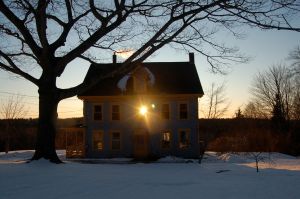
For me, the pivot of the year comes right after the solstice, while the Christmas wrapping paper is still in the trash can.  Our house in Maine has a window facing south of east.  When the winter sun rises as far south as it ever does, a clear morning lets a blast of light come in one side, straight down the hallway and out the bathroom window. Househenge!  What does it mean? 

It means it is time for the American Astronomical Society’s big meeting.  This rotates its location from Washington DC, this year’s site, to other more-or-less tolerable climates.  Our tribe can mark the passage of the seasons and of the decades by this rhythm.  Never mind all that highfalutin’ stuff about the earth going around the Sun.  Remember that AAS in Austin? What year was that? 
In January of 1998, the cycle of the seasons and of available convention centers of suitable size put the AAS in Washington.  It was an exciting time for me, because we were hot on the trail of the accelerating universe.  We had some great new data from the Hubble Space Telescope (HST), a paper in the press, and Peter Garnavich, my postdoc, was going to give a talk and be part of a press briefing.  This was a big deal and we prepared carefully.  

Adam Riess, who had been my graduate student, was then a Miller Fellow at Berkeley doing the calibration and analysis on our data.  Adam’s notebooks were beginning to show troubling hints of cosmic acceleration.  I thought it would go away. Brian Schmidt, who had also been my student, was then in Australia,  calling the shots on this project.  He didn’t want to get out on a  limb over unpublished hints.  The idea of a cosmological constant was already making him sick to his stomach.  We agreed that in January of 1998, Peter got to say that the supernova data showed the universe was not decelerating very much and would expand forever.  That’s it.  Nothing about acceleration. 

Saul Perlmutter’s Supernova Cosmology Project also prepared a careful press release that reported a low density and predicted eternal cosmic expansion.  A report the next day in the New York Times was pretty tame, except for Ruth Daly speculating on the possibility of a low-density universe coming out of inflation models. Saul was quoted as saying, “I never underestimate the power of a theorist to come up with a new model.”  I have gathered up all the clippings I could find about who said what in Washington. (We used to call them “clippings”.) 

While a few reporters sniffed out the hints of cosmic acceleration in the raw data, in January 1998 nobody was claiming this was a solid result.  The paper from our team with the title Observational Evidence from Supernovae for an Accelerating Universe and a Cosmological Constant didn’t get submitted until March 13, 1998.  The comparable paper from the SCP was submitted September 8, 1998.  These are fine dates in the history of cosmology, but they are not in January.  It’s not for me to say when savants like the Telescoper were convinced we live in an accelerating universe, but I am pretty sure it wasn’t in January 1998.

In January 2009, the sun was once again shining right through our house.  It illuminated the American Physical Society newsletter kept in the upstairs bathroom. One of the features is This Month in Physics History.  If you want to find out about Bubble Chamber progress in January 1955, this is the place. Flipping through the January 2009 issue I was gobsmacked (American slang for “blown away”) to learn we were supposed to celebrate the anniversary of the discovery of cosmic acceleration.  Say what?  In January?  Because of the press releases that said the universe was not going to turn around? 

Being a dutiful type, a Fellow of the APS, and the oldest of the High-Z Team, I thought it was my job to help improve the accuracy of this journal. I wrote them a cheerful (on the third draft) letter explaining that this wasn’t precisely right, and, if they liked real publications as evidence for scientific progress, they might want to wait until March.  A volley of letters ensued, but not at internet speed.  The editor of APS News decided he had had enough education and closed the discussion in July.  The letters column moved on to less controversial matters concerning science and religion and nuclear reactors. 

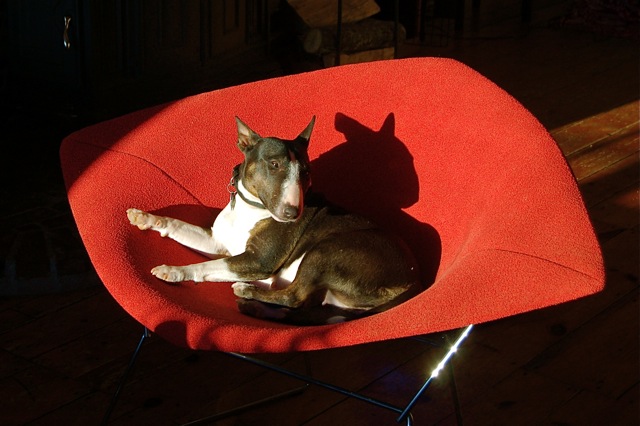
The rising point of the sun came north, and then marched south again.    Just after the solstice, a beam of light flashed right though our   happy home. 2010!  Google alerts flashed the news.  More brouhahah about the discovery of cosmic acceleration.   Now in Physics World. I am depicted as a surly bull terrier in a crimson tenured chair, clinging desperately to self-aggrandizing notions that actual  publications in real journals are a way to see the order of events.  The philosopher, Robert P. Crease, who wrote this meditation, says he loves priority disputes.  He is making a serious point, that “Eureka!” is not exactly at one moment when you have an international collaboration, improving data sets, and the powerful tools of Bayesian inference at your command. 
But, even in the world of preprint servers, press releases, and blogs without restraint (I am talking about other blogs!), a higher standard of evidence is demanded for a real paper in a real journal.   A page in a notebook, an email, a group meeting, a comment after a colloquium or even an abstract in the AAS Bulletin (whipped up an hour before the deadline and months before the actual talk) is not quite what we mean by “having a result”.  I’m not saying that referees are always helpful, but they make the author anticipate a skeptical reader, so you really want to present a well-crafted  case.

If that’s not so, I would like to have my lifetime’s page charges refunded forthwith: that’s 250 papers x 10 pages/paper/ x $100/ApJ page = $250 000. Send the  check to my office.

So, Telescoper, how is your house aligned?  And why do the Brits put the drains on the outside when you live in such a cold climate?

Astronomy Look-alikes, No. 9

Posted in Astronomy Lookalikes with tags , , on January 10, 2010 by telescoper

It’s probably impolite to draw visual parallels between  Professor Donald Lynden-Bell, winner of the inaugural Kavli Prize for Astrophysics in 2008, and Montgomery Burns from the Simpsons.

In the Bleak Midwinter

Posted in Biographical, Cricket, Poetry, Science Politics with tags , , , , , , on January 9, 2010 by telescoper

Apologies for my posts being a bit thin lately. It turned out to be quite a strange week, as I’ll explain in due course, but I thought I’d take the opportunity now to catch up a little bit. I apologize in advance for the rambling nature of this contribution, but if you read this blog regularly you’ll be used to that.

We’re all now back at work after the Christmas break, but this was always going to be an unusual week because it’s the last one before the mid-year examinations start. During this time there are revision lectures, but the timetable isn’t as full as in term-time proper, so  it’s more like a half-way house than a genuine return to full-time work. Although I’m always glad not to be thrown into full-time teaching or examination marking straight away after the break, I always find this hiatus slightly disorienting.

This year things are even stranger than usual because, after largely escaping the bad weather that has affected the rest of the country since before Christmas, snow and ice finally arrived with a vengeance in Cardiff on Tuesday night. It wasn’t too bad where I live, quite near the city centre, but a lot of snow fell up in rural areas, especially up in the valleys, with the result that quite a few members of staff couldn’t make it into work.

Talking of the weather gives me the excuse to include this absolutely beautiful picture of snow-bound Britain taken by NASA’s Earth Observatory satellite:

The problem wasn’t so much the snow itself, but the fact that the temperature dropped steeply soon after it fell leaving roads and pavements coated with sheets of ice. My regular refuse collection, scheduled for Wednesday, didn’t happen because the trucks couldn’t make it through the treacherous conditions, and buses and trains were severely disrupted. I think there’s been a similar picture across most of the United Kingdom.

Incidentally, the well-known Christmas carol from which I took the title of this post began life as a poem by Christina Rossetti, the first verse of which goes

In the bleak mid-winter
Frosty wind made moan,
Earth stood hard as iron,
Water like a stone;
Snow had fallen, snow on snow,
Snow on snow,
In the bleak mid-winter
Long ago.

I don’t know why but, as the snow was falling heavily in the early hours of Wednesday morning, I woke up with terrible stomach pains, so bad that they kept me awake all night. I assume that this was some sort of belated reaction to yuletide over- indulgence rather than anything more serious because the discomfort eventually died away and I was left with mere exhaustion after losing a whole night’s sleep. Rather than risk walking in through the snow, I retreated to bed and slept most of Wednesday although I didn’t eat or drink anything the whole day.

Columbo kept me good company during this unpleasant episode. Usually if we’re in the house at the same time he sometimes stays by my side, but he’s at other times quite happy to potter around, or sleep on his own in  a place of his choosing.  I think he knew something wasn’t right, because he never left me alone all day which is quite unusual. Alternatively, he may just have found it warmer being next to me than elsewhere. Who knows?

My guts apparently having recovered, I went into the department on Thursday for a busy day of project interviews. These are held half-way through the third year in order to assess the students progress on their projects. In between the interviews I was trying to keep up with progress on the last day of the test match between South Africa and England taking place in Cape Town, where the weather was somewhat different to Cardiff. The match had been coming to the boil, eventually ending in a draw as England’s last pair once again staved off what looked likely to be a defeat. Shades of Monty last summer! Although it was clearly a gripping finale, I’m glad in a way that I didn’t get to follow it more closely. I always get an uneasy churning feeling in my stomach during tense passages of play, and after what had happened the day before I think that was best avoided.

Yesterday (Friday) was the date of the January meeting of the Royal Astronomical Society in London, and I decided to show my faith in the public transport system by making the round trip to London.  No-one can accuse me of having lost my spirit of adventure! Some trains had been cancelled, but those still running seemed to be on time and I thought the odds weren’t too bad.

The specialist Discussion Meeting featured a programme dedicated to the legacy of XMM, a highly successful X-ray satellite that has just had its funding axed by STFC. Later on, during the Ordinary Meeting there was an interesting talk by Alan Fitzsimmons about the impact of a small asteroid with the Earth that took place in October 2008,  and Matt Griffin presented some of the stunning new results from Herschel. RAS Discussion meetings are always held on the 2nd Friday of the month. Astronomical historian Alan Chapman reminded the Society that the corresponding meeting 80 years ago, on 10th January 1930,  was an important event in the development of the theory of the expanding universe.

Fully recovered from my tummy problems, I rounded the week off with a trip to the RAS Club for a nice dinner at the Athenaeum. Turnout was a bit lower than usual, presumably because of the inclement weather. This was the so-called Parish Meeting, at which various items of Club business are carried out, including the election of new members and Club officers. Professor Donald Lynden-Bell recently announced his retirement from the position of President and this was his last occasion in the Chair; the resulting Presidential Election was a close-run affair won by Professor Dame Carole Jordan. The election of new members is an archaic and slightly dotty process which always leaves me wondering how I managed to get elected myself. At one point during these proceedings the Club finds itself to be “without Officers”,  whereupon the most junior member (by length of membership rather than age) suddenly becomes important. On this occasion, this turned out to be me but since I didn’t know what I was supposed to do, I fluffed it. If I’d known I might have seized the opportunity to stage a coup d’etat. Other than this, it seemed to go off without any major hitches and eventually we dispersed into the freezing night to make our ways home.

As usual on Club nights I took the 10.45pm train from Paddington to Cardiff. In the prevailing meteorological circumstances I was a bit nervous about getting home, but my fears were groundless. The train was warm and, with Ipod, Guardian and Private Eye crosswords, and the last 100 pages of a novel to occupy me, the journey was remarkably pleasant. We got to Cardiff 4 minutes ahead of schedule.

Bare Necessities

Posted in Jazz with tags , on January 7, 2010 by telescoper

The title of this isn’t meant to reflect the state of science funding. It’s just that it’s a bleak and freezing January and I thought we could probably all do with a bit of an injection of happiness. If Louis Armstrong can’t do that for you, then nobody can. OK, so it’s a far cry from the exhilirating adventurousness of the trumpet playing on his early recordings, but he was an old man when this was recorded and had already more than paid his dues. Anyway he always saw himself as much as an entertainer as a musician, and there’s nothing wrong with that.  I just love the infectiously swinging  way he sings on this track, and I hope it brings a smile to your face as it does to mine every time I see it.

This is the great man, recorded in 1968, singing a tune from Walt Disney’s film The Jungle Book, which came out the year before. Take it away, Satchmo!

Astronomy (and Space Science) Look-alikes, No. 8

Posted in Astronomy Lookalikes with tags , , , on January 6, 2010 by telescoper

When Professor Colin Pillinger decided to explore the surface of Mars using Beagle 2, was his interest at least partly accounted for by his similarity to archaeologist Phil Harding of TV’s Time Team? Perhaps not, as the latter has had more success using a trowel costing £3 than the former using a probe costing £30 million…


That Lucky Old Sun

Posted in Jazz with tags , on January 5, 2010 by telescoper

I used to have a wonderful old record of this tune by Louis Armstrong which I loved to bits (you can hear it here if you’re interested), and it’s actually one of the tunes on a CD my Dad recorded many years ago, but I found this spellbinding version by the great Ray Charles and it’s become my favourite rendition. If you like it half as much as I do, then I like it twice as much as you…

The Hubble Ultra Deep Field in Three Dimensions

Posted in The Universe and Stuff with tags , , , on January 4, 2010 by telescoper

I came across this video about the Hubble Ultra Deep Field (which I have blogged about before) and thought you might enjoy it. I think it’s fairly self-explanatory too!