Author Archive

Au Privave

Posted in Jazz with tags , , , on October 18, 2009 by telescoper

At the risk of becoming a complete bore on the subject of bebop I thought I’d follow up an earlier post on the joys of jazz with this brilliant performance of yet another Charlie Parker tune, not by the man himself, but by one of his disciples.

I was lucky enough to hear Sonny Stitt live a number of times and he was always brilliant; he died in 1982. He was criticised by some jazz buffs between  numbers during one gig I was at with the words “You’re just playing like Charlie Parker!”, to which he replied by handing his alto saxophone to the twit  in the audience and saying “Here then. YOU play like Charlie Parker.”

Anyway, in the late 1950s (after Charlie Parker had died) Sonny Stitt sat in as on alto saxophone with the Oscar Peterson trio of which Ray Brown (bass) and Ed Thigpen (drums) were the other two members. They made a classic album for the Verve label which features a number of Charlie Parker numbers. Oscar Peterson isn’t my absolute favourite jazz pianist but it has to be said that he and his sidemen build up a colossal head of steam on these records, especially the one I’ve picked which is called Au Privave.

I tried for ages to unravel this intricate little tune. It’s basically a twelve-bar blues, but it is built  on much more complicated chords than the usual blues cycle. In its simplest form, the blues involves only three chords, the same three that most rock-and-roll tunes are built on. The foundation is a  “tonic” chord (T) based on the root note of whatever key it’s played in, often a basic triad consisting of the first, third and five notes of a major scale starting on that note or including the dominant 7th. The next chord is the subdominant chord  (S), shifting things up by a perfect fourth relative to the tonic, and then finally we have the dominant (D) which brings us up by a fifth from the original root note.

The basic twelve-bar blues has one chord per bar. The first four bars are accompanied by the tonic, then the subdominant S takes over for two bars followed by a return to the tonic for another two. The last four bars introduce the dominant (but only for one bar), followed by S for one and then back down to the root for the final two.

In a standard blues in F the sequence would thus be

| F| F| F |F | B♭| B♭| F| F | C| B♭| F| F|,

or possibly with F7 etc. The slow and relatively simple progression of chords gives these  blues a rather statuesque form: the soloist has to be really good to keep the thing going without getting bogged down. When played by a master even the simplest blues can be immensely powerful, but they can also be very dull when played not so well. It may be simple, but it certainly isn’t easy.

Au Privave is in F but has considerably more complicated changes than the bog-standard F blues. Parker inserted several intermediate chords to keep the harmonies moving and dispensed with some of the conventional progressions.  There are also more chords, usually two per bar rather than just one. The sequence here looks more like

| F| Gm7C7| F |Cm7F7| B♭| B♭| F7Gm7| Am7D7 | Gm7| C| FD7| G7C7|,

although I’m not sure I got them right as it tends to be played very fast! It’s a lot more to remember, but it’s also a much more dynamic setting  to improvise in which is what people like Charlie Parker wanted to create. Instead of moving quasi-statically through perfect intervals each chorus, you run helter-skelter through a constantly shifting harmonic environment. Notice also that there’s no comfortable return to the tonic at measure 12, even. The appearance of a C7 chord here is called a turnaround. Complicated? Yes, I suppose it is. But whenever I hear it played by Sonny Stitt it’s always just four minutes of sheer exhilaration.

Oh, and there’s another thing. Listen to the chorus that starts about 2:58. Did he really play all twelve bars without breathing?

The Mailstorm

Posted in Uncategorized with tags , , , on October 17, 2009 by telescoper

Yesterday The Daily Mail – loathsome ragbag of hate-mongering lies masquerading as a newspaper – ran a piece by columnist Jan Moir on their website that sank below the level of the gutter and into the deepest depths of sheer evil.

The piece was about Stephen Gately, a singer and former member of the group Boyzone, who died suddenly over a week ago at the age of 33. Although the coroner declared his death to be of natural causes, the circumstances surrounding his death do remain a little unclear. However, anyone with any degree of sensitivity would have treated the matter as a private one and refrained from intruding in order allow his friends, family, and, especially, his partner to come to terms with what had happened. Anyone with any degree of sensitivity, that is. Not Jan Moir.

You see, Stephen Gately was gay. That’s no big deal for many people these days, but for the Daily Mail it made him a target for a post-mortem hatchet job. No need to worry about the laws of defamation as you can’t libel the dead. No need to check the facts, just sit down and let the vitriol pour out. Right up Jan Moir’s street.

This poisonous excuse for a human being composed a piece with the title. Why there was nothing `natural’ about Stephen Gately’s death. This wasn’t journalism of course. Jan Moir hadn’t uncovered any new facts about the case. Nothing she wrote was backed up by any evidence. It was simply an exercise of blind bigotry, achieved through insinuation and deliberately designed  to pander to the prejudices of the Daily Mail’s readership.

For example

… fit 33-year-old men do not just climb into their pyjamas and go to sleep on the sofa, never to wake up again

Well I’m sorry, Jan, but they do. Fit young people  drop dead while walking along the street too. A number of medical conditions can lead sudden unexpected death in apparently healthy people.

 Here’s another example, in which the monstrous Moir expands the horizons of her rant to encompass racism

After a night of clubbing, Cowles and Gately took a young Bulgarian man back to their apartment.

Bulgarian? Must be dodgy. Must have been a kinky threesome. Shows that the civil partnership of Gately and his partner Andrew Cowles was meaningless. All gay men are at it like rabbits all the time. They’re all irretrievably sleazy. We all know that. We read about it in the Daily Mail.

As a matter of fact, the third man was  Georgi Dochev (yes, Bulgarians have names too) , an old friend of the couple. It seems quite a reasonable alternative hypothesis that the three of them came home after a night out and simply crashed out wherever they could. I don’t know whether that was the case or not. Neither does Jan Moir, but she obviously didn’t want the absence of relevant facts to get in the way of a story.

Another real sadness about Gately’s death is that it strikes another blow to the happy-ever-after myth of civil partnerships. Gay activists are always calling for tolerance and understanding about same-sex relationships, arguing that they are just the same as heterosexual marriages.

 Sheesh. I won’t go on unpicking this odious item otherwise I’ll get angry again. I hope I’ve made the point. In any case Charlie Brooker in the Guardian has already done a much better job than I could.

Anyway, as soon as I found out about this piece (via Facebook) I fired off a complaint to the Press Complaints Commission as it was clearly in violation of Sections 1, 5 and 12 of their Code of Practice. Meanwhile a storm brewed up on Twitter (of which I am not a member) and so many people filed complaints to the PCC that their website crashed.  The Daily Mail’s own readership – not known for their liberal attitudes – roundly condemned the piece through the comments facility. Finally, and perhaps most importantly from the point of view of having an impact on the Mail itself, several advertisers (including Marks & Spencer and Nestlé) pulled their adverts off the website because they wanted to disassociate themselves from the opinions expressed there. The loss of advertising revenue probably means a lot more to bosses at the Daily Mail than any appeal to decency or respect.

The piece is still there, but has been heavily edited and has a new title. It’s still offensive, though. I’ll be following subsequent events with interest and have already made plans to burn Jan Moir in effigy at the forthcoming bonfire night celebrations on November 5th. I hope the Daily Mail shows her the door too.

Looking back on this affair a day later, I have to say that in a way I’m actually glad Jan Moir wrote the piece. Thoroughly disgusted as I am by what she wrote I feel bound to defend her right to say what she thinks. Gagging such people is not the answer. That piece tells us exactly the kind of creature she is. She can’t squirm out of this by offering a half-baked apology and saying it was just a joke. The Daily Mail published, and Jan Moir is damned. May she rot in hell.

Another thing this episode demonstrates the immense power of Twitter to do real good. I had previously thought of it as a trivial bit of net gimmickry. Now I’m seriously thinking of joining Twitter in the hope of adding one more voice to the campaign to save pure science from the oblivion it seems to be headed for.

The problem is that Twitter works through messages limited to 140 characters in length. Since I can’t seem to write a blog post in less than a thousand words I don’t think my tweets will be very effective..

Classic Collection

Posted in Biographical, Music with tags , , on October 16, 2009 by telescoper

I’ve been told on more than one occasion that some people find all the stuff about opera and poetry and the like is a bit too highbrow for them. In an effort to make myself more commercially relevant I’ve therefore decided to include something a bit different from my usual line of music posts.

Twenty years ago, while I was still living in Brighton, I didn’t go to the Opera or to classical music concerts at all, but instead went out most nights to various nightclubs (most of which have now closed down). This was all before I became too old and decrepid to be anything but an embarrassment in such a context. I also had a habit of buying singles of the records I heard night after night in the clubs which I would play before going out to get me into the mood for a boogie. I like dancing, in case you hadn’t guessed.

In recently sorted through my old vinyl record collection and hunted through Youtube to find the corresponding videos. So here are three examples from my own classic collection which will hopefully prevent any further accusations that this blog is too erudite. It won’t do much for my street cred with the younger generation, though, as these records are all older than most students.

First one up is from the cheesy end of the spectrum. It’s the sublime Bananarama, doing a very camp cover version of the Supremes’ hit Nathan Jones. I want you to pay particularly close attention to the video as I expect you all to learn the moves. There’ll be a test. Right hand on right hip. Left arm extended. Ready? Go!

Number two in my hit parade belongs to the commercial wing of the Acid House movement that swept through dance clubs during the late 1980s. S’Express released Hey Music Lover in 1989 and it immediately became one of my favourite things to dance to. It’s nowhere near as effective watching it on a small screen, away from the thumping sounds and whirling psychedelic environment of a nightclub, but this one always used to make the blood rush to my head and it also seemed to get the best out of the best dancers. Note the sly references to Federico Fellini in the video.

Lastly but definitely not leastly is easily the best dance record of the classical period under consideration. It deserves to be in the collection because it still packs the dance floors twenty years on. Fabulously funky, tantalising trippy and devilishly danceable, this was a huge hit in 1990 for the fantastic Dee-Lite – here is a medley of their hit Groove is in the Heart.

And that’s enough of that.

Greatness in Little

Posted in Poetry, The Universe and Stuff with tags , , on October 15, 2009 by telescoper

The BBC Website yesterday mentioned that according to the British Astronomer Royal, Lord Martin Rees, celestial bodies are less complicated than the bodies of insects – let alone those of human beings – and cosmology is an easier science than the study of a balanced diet.

As I was tucking into my carefully balanced meal of fish and chips last night, the first part of the quotation suddenly reminded me of the following poem Greatness in Little by Richard Leigh (1649-1728), a relatively obscure poet of the seventeenth century who managed to excel himself in this particular poem of 1675 in which he compares the intricate workings of insects with the grandest achievements of human explorers.

In spotted globes, that have resembled all
Which we or beasts possess to one great ball
Dim little specks for thronging cities stand,
Lines wind for rivers, blots bound sea and land.
Small are those spots which in the moon we view,
Yet glasses these like shades of mountains shew;
As what an even brightness does retain,
A glorious level seems, and shining plain.
Those crowds of stars in the populous sky,
Which art beholds as twinkling worlds on high,
Appear to naked, unassisted sight
No more than sparks or slender points of light.
The sun, a flaming universe alone,
Bigger than that about which his fires run;
Enlightening ours, his globe but part does gild,
Part by his lustre or Earth’s shades concealed;
His glory dwindled so, as what we spy
Scarce fills the narrow circle of the eye.
What new Americas of light have been
Yet undiscovered there, or yet unseen,
Art’s near approaches awfully forbid,
As in the majesty of nature hid.
Nature, who with like state, and equal pride,
Her great works does in height and distance hide,
And shuts up her minuter bodies all
In curious frames, imperceptibly small.
Thus still incognito, she seeks recess
In greatness half-seen, or dim littleness.
Ah, happy littleness! that art thus blest,
That greatest glories aspire to seem least.
Even those installed in a higher sphere,
The higher they are raised, the less appear,
And in their exaltation emulate
Thy humble grandeur and thy modest state.
Nor is this all thy praise, though not the least,
That greatness is thy counterfeit at best.
Those swelling honours, which in that we prize,
Thou dost contain in thy more thrifty size;
And hast that pomp, magnificence does boast,
Though in thy stature and dimensions lost.
Those rugged little bodies whose parts rise
And fall in various inequalities,
Hills in the risings of their surface show,
As valleys in their hollow pits below.
Pompous these lesser things, but yet less rude
Than uncompact and looser magnitude.
What Skill is in the frame of Insects shown?
How fine the Threds, in their small Textures spun?
How close those Instruments and Engines knit,
Which Motion, and their slender Sense transmit?
Like living Watches, each of these conceals
A thousand Springs of Life, and moving wheels.
Each ligature a Lab’rynth seems, each part
All wonder is, all Workmanship and Art.
Rather let me this little Greatness know,
Then all the Mighty Acts of Great Ones do.
These Engines understand, rather than prove
An Archimedes, and the Earth remove.
These Atom-Worlds found out, I would despise
Colombus, and his vast Discoveries.

I Did Expect the Spanish Inquisition…

Posted in Biographical, Science Politics with tags , , , on October 14, 2009 by telescoper

So that was it. D-Day.

Our application to the Science and Technology Facilities Council (STFC) for a rolling grant to cover the next 5 years of astronomy research went in a  few months ago. Over the summer we got feedback from independent referees. But today was the crunch. The dreaded panel visit.

In the old days the grants panel used to visit the applicants at their own institute, chat to the postdocs and staff, help themselves to free food, and generally get a feel for the place over a period of a couple of days. Now, all that cosiness has gone. Nowadays the applicants visit the panel.  Mohammed and the Mountain and all that (except I’m not sure which is which).

A large group of astronomers are involved in this application, but STFC rules permit only three representatives to make the pilgrimage to Swindon in order to testify in front of the experts. I was among the chosen few, although I was not particularly grateful for this honour.

This would have been stressful enough, but there is grim talk of slashed budgets and looming financial disaster for UK astronomy. The successful launch of Planck and Herschel in May, followed by the exceptionally promising snippets of data that we’ve been getting, has strengthened what was already a very strong case. These events should have given us all the cards. The trouble is, it looks like the casino has gone bust.

We were all a bit nervous, I can tell you, as we travelled to Swindon on the early train from Cardiff. Steve Eales is Principal Investigator on the grant and he’s a self-confessed morning person so he went on a ludicrously early train in case something happened to delay him. Derek Ward-Thompson and I followed on a more sensible one, but we all got there safely and on time in the end.

We started with a presentation by Steve which he delivered in superb style, keeping exactly to time but also ticking all the boxes we were asked to cover in the instructions we got. The science updates from the last 6 months are really impressive, and it was all made even more dramatic when he told the panel that the new Herschel images they were seeing were not public and therefore that they shouldn’t look at them.

Then we were due for 45 minutes questioning by the panel. I thought it might be something like Blind Date because there were three of us to do the answering. Question Number One for Contestant Number Two, that sort of thing, except that we anticipated slightly more technical questions and we weren’t expecting Cilla Black to be there.

But there weren’t many questions at all. In fact, I had only one question (on the cosmology part). It was curiously anti-climactic after having had a near-sleepless night worrying about it. This could mean either that they’d already decided to close us down, that they’d already decided we were brilliant, or that they already knew there was no money so there wasn’t any point in asking anything.

So 25 minutes into the 45 allotted we were shown the door and headed back to Cardiff by train. It was like Monty Python in reverse: we did expect the Spanish Inquisition, but it never happened…

We jabbered nervously on the return journey because the adrenalin was still going, speculating about what it all meant but not coming to any real conclusions except that Steve had given a great presentation and that we had all answered the questions as well as we could have been expected to. It’s all out of our hands now.

The trouble is that we’re not likely to get a new grant announcement until April 2010, which is actually when the grant is supposed to start. The postdoctoral researchers we currently employ will have to wait until then to hear about possible extensions to their contracts. Perhaps by April  the management will have sorted out the current STFC crisis so we can get on and do some science with the wonderful new data.

On the other hand, perhaps not….

The League of Extraordinary Gibberish

Posted in Bad Statistics with tags , , , on October 13, 2009 by telescoper

After a very busy few days I thought I’d relax yesterday by catching up with a bit of reading. In last week’s Times Higher I found there was a supplement giving this year’s World University Rankings.

I don’t really approve of league tables but somehow can’t resist looking in them to see where my current employer Cardiff University lies. There we are at number 135 in the list of the top 200 Universities. That’s actually not bad for an institute that’s struggling with a Welsh funding  system that seriously disadvantages it compared to our English colleagues. We’re a long way down compared to Cambridge (2nd), UCL (4th), Imperial and Oxford (5th=) . Compared to places I’ve worked at previously we’re significantly below Nottingham (91st) but still above Queen Mary (164) and Sussex (166). Number 1 in the world is Harvard, which is apparently somewhere near Boston (the American one).

Relieved that we’re in the top 200 at all, I decided to have a look at how the tables were drawn up. I wish I hadn’t bothered because I was horrified at the methodological garbage that lies behind it. You can find a full account of the travesty here. In essence, however, the ranking is arrived at by adding six distinct indicators, weighted differently but with weights assigned for no obvious reason, each of which is arrived at by dubious means and which is highly unlikely to mean what it purports. Each indicator is magically turned into a score out of 100 before being added to all the other ones (with appropriate weighting factors).

The indicators are:

  1. Academic Peer Review. This is weighted 40% of the overall score for each institution and is obtained by asking a sample of academics (selected in a way that is not explained). This year 9386 people were involved; they were asked to name institutions they regard as the best in their field. This sample is a tiny fraction of the global academic population and it would amaze me if it were representative of anything at all!
  2. Employer Survey. The pollsters asked 3281 graduate employers for their opinions of the different universities. This was weighted 10%.
  3. Staff-Student Ratio. Counting 20%, this is supposed to be a measure of “teaching quality”! Good teaching = large numbers of staff? Not if most of them don’t teach as at many research universities. A large staff-student ratio could even mean the place is really unpopular!
  4. International Faculty. This measures the  proportion of overseas staff on the books. Apparently a large number of foreign lecturers makes for a good university and “how attractive an institution is around the world”. Or perhaps that it finds it difficult to recruit its own nationals. This one counts only 5%.
  5. International Students. Another 5% goes to the fraction of each of the student body that is from overseas.
  6. Research Excellence. This is measured solely on the basis of citations – I’ve discussed some of the issues with that before – and counts 20%. They choose to use an unreliable database called SCOPUS, run by the profiteering academic publisher Elsevier. The total number of citations is divided by the number of faculty to “give a sense of the density of research excellence” at the institution.

Well I hope by now you’ve got a sense of the density of the idiots who compiled this farrago. Even if you set aside the issue of the accuracy of the input data, there is still the issue of how on Earth anyone could have thought it was sensible to pick such silly ways of measuring what makes a good university, assigning random weights to them, and then claiming that they had achieved something useful. They probably got paid a lot for doing it too. Talk about money for old rope. I’m in the wrong business.

What gives the game away entirely is the enormous variance from indicator to another. This means that changing the weights slightly would produce a drastically different list. And who is to say that the variables should be added linearly anyway? Is a score of 100 really worth precisely twice as much as a score of 50? What do the distributions look like? How significant are the differences in score from one institute to another? And what are we actually trying to measure anyway?

Here’s an example. The University of California at Berkeley scores 100/100 for 1,2 and 4 and 86 for 5. However for Staff/Student ratio (3) it gets a lowly 25/100 and for (6) it gets only 34, which combine take it down to 39th in the table. Exclude this curiously-chosen proxy for teaching quality and Berkeley would rocket up the table.

Of course you can laugh these things off as unimportant trivia to be looked at with mild amusement over a glass of wine, but such things have increasingly found their way into the minds of managers and politicians. The fact that they are based on flawed assumptions, use a daft methodology, and produce utterly meaningless results seems to be irrelevant. Because they are based on numbers they must represent some kind of absolute truth.

There’s nothing at all wrong with collating and publishing information about schools and universities. Such facts should be available to the public. What is wrong is the manic obsession with  condensing disparate sets of conflicting data into a single number just so things can be ordered in lists that politicians can understand.

You can see the same thing going on in the national newspapers’ lists of University rankings. Each one uses a different weighting and different data and the lists are drastically different. They give different answers because nobody has even bothered to think about what the question is.

Lux Aeterna

Posted in Music with tags , , on October 12, 2009 by telescoper

Since my recent trip to see György Ligeti‘s extraordinary Opera Le Grande Macabre, I’ve been trying to find out a bit more about the composer. I’ve stumbled across a few of his works, including some very strange and difficult piano pieces which I might put up here sometime. However, I thought it would be nice to acknowledge probably his most famous work particularly because it came up in a previous post.

Lux Aeterna is a choral work for sixteen unaccompanied voices which was written in 1966. Along with excerpts from his Requiem (from the Kyrie and Dies Irae) and the orchestral piece Atmospheres (1961), this composition formed part of the soundtrack for Stanley Kubrick’s 2001: A Space Odyssey. What I didn’t know until reading about Lux Aeterna was that Kubrick didn’t bother to ask for permission to use Ligeti’s work in his film and it was only after heated discussions that he agreed to pay the composer a fee. Ligeti doesn’t seem to have minded that much, however, as he subsequently went on record saying that he admired Kubrick’s work enormously.

Lux Aeterna (“Eternal Light”)  can be thought of as a kind of postscript to the Requiem and its text comes from the Roman Catholic Mass for the Dead (in Latin):

Lux aeterna luceat eis, Domine, cum sanctis tuis in aeternum, quia pius es. Requiem aeternum dona eis, Domine; et lux perpetua luceat eis.

 Although the piece is officially dated later than Ligeti’s setting of the rest of the Requiem Mass, the compositional technique he used seems to be similar and its emotional feel seems also  to belong with that longer work. It’s an uncompromisingly avant-garde work, exploiting a dense atonal polyphony to create a strange atmosphere that seems to combine agonised apprehension with a kind of bewildered exhilaration.

Here it is combined with images from the film and various bits of interesting information about Ligeti’s life and music.

I can only speak directly for myself, of course, but I suspect many will agree with me that it’s a remarkably effective piece on its own that has even greater  impact in the context of the movie. However, I wonder how many would say that it is  beautiful? I know I would.

The Law of Unreason

Posted in Bad Statistics, The Universe and Stuff with tags , , , , on October 11, 2009 by telescoper

Not much time to post today, so I thought I’d just put up a couple of nice little quotes about the Central Limit Theorem. In case you don’t know it, this theorem explains why so many phenomena result in measurable things whose frequencies of occurrence can be described by the Normal (Gaussian) distribution, with its characteristic Bell-shaped curve. I’ve already mentioned the role that various astronomers played in the development of this bit of mathematics, so I won’t repeat the story in this post.

In fact I was asked to prove the theorem during my PhD viva, and struggled to remember how to do it, but it’s such an important thing that it was quite reasonable for my examiners  to ask the question and quite reasonable for them to have expected me to answer it! If you want to know how to do it, then I’ll give you a hint: it involves a Fourier transform!

Any of you who took a peep at Joan Magueijo’s lecture that I posted about yesterday will know that the title of his talk was Anarchy and Physical Laws. The main issue he addressed was whether the existence of laws of physics requires that the Universe must have been designed or whether mathematical regularities could somehow emerge from a state of lawlessness. Why the Universe is lawful is of course one of the greatest mysteries of all, and one that, for some at least, transcends science and crosses over into the realm of theology.

In my little address at the end of Joao’s talk I drew an analogy with the Central Limit Theorem which is an example of an emergent mathematical law that describes situations which are apparently extremely chaotic. I just wanted to make the point that there are well-known examples of such things, even if the audience were sceptical about applying such notions to the entire Universe.

The quotation I picked was this one from Sir Francis Galton:

I know of scarcely anything so apt to impress the imagination as the wonderful form of cosmic order expressed by the “Law of Frequency of Error”. The law would have been personified by the Greeks and deified, if they had known of it. It reigns with serenity and in complete self-effacement, amidst the wildest confusion. The huger the mob, and the greater the apparent anarchy, the more perfect is its sway. It is the supreme law of Unreason. Whenever a large sample of chaotic elements are taken in hand and marshalled in the order of their magnitude, an unsuspected and most beautiful form of regularity proves to have been latent all along

However, it is worth remembering also that not everything has a normal distribution: the central limit theorem requires linear, additive behaviour of the variables involved. I posted about an example where this is not the case here. Theorists love to make the Gaussian assumption when dealing with phenomena that they want to model with stochastic processes because these make many calculations tractable that otherwise would be too difficult. In cosmology, for example, we usually assume that the primordial density perturbations that seeded the formation of large-scale structure obeyed Gaussian statistics. Observers and experimentalists frequently assume Gaussian measurement errors in order to apply off-the-shelf statistical methods to their results. Often nature is kind to us but every now and again we find anomalies that are inconsistent with the normal distribution. Those exceptions usually lead to clues that something interesting is going on that violates the terms of the Central Limit Theorem. There are inklings that this may be the case in cosmology.

So to balance Galton’s remarks, I add this quote by Gabriel Lippmann which I’ve taken the liberty of translating from the original French.

Everyone believes in the [normal] law of errors: the mathematicians, because they think it is an experimental fact; and the experimenters, because they suppose it is a theorem of mathematics

There are more things in heaven and earth than are described by the Gaussian distribution!

Darwin and After

Posted in Biographical, Science Politics with tags , , , , , , , , on October 10, 2009 by telescoper

Another sign that the academic year is back into full swing is that the monthly meetings of the Royal Astronomical Society have started up again after the usual summer hiatus. Since I’ve got a very heavy week coming up, I thought I’d take the advantage of a bit of breathing space in my timetable to attend yesterday’s meeting and catch up with the gossip at the Club afterwards.

The highlight of the day’s events was the annual George Darwin Lecture which was given this year by Neil Gehrels from the NASA Goddard Space Flight Center on the subject Gamma Ray Bursts and the Birth of Black Holes: Discoveries by SWIFT. This is a very hot topic (of course) and the lecture did full justice to it. The RAS has two other “prize” lectures – the Gerald Whitrow Lecture and the Harold Jeffreys Lecture – which are used to invite eminent speakers from around the world. They’re not always successful as lectures because the speakers sometimes try to make them too specialised and too detailed, but this one was exceptionally clear and well delivered. I enjoyed it, as well as learning a lot; that’s the essence of a good lecture I think.

The main task for visiting speakers when it comes to the George Darwin Lecture is to give their talk without revealing the fact that they hadn’t realised that Charles Darwin had a famous astronomical son!

Then to the Athenaeum, for drinks and dinner, where the current financial crisis at STFC was in the background of a lot of the conversation. Rumours abounded but I didn’t pick up any hard information about what is likely to happen to our funding next year. I suspect that’s because even STFC doesn’t know. After a bit of wine, though, conversation moved onto other,  less depressing, things including football, cheese and the Welsh landscape.

The colleague sitting next to me (an old friend from Queen Mary days, now at Imperial College) reminded me that in January last year Joao Magueijo invited me to give the vote of thanks at his inaugural lecture (as long as I promised to try to make my speech as short and as funny as possible). It turns out his lecture was only twenty minutes long, which didn’t give as much time as I’d hoped to think of something to say so I resorted to a couple of off-colour jokes and a facetious remark about how the brevity of Imperial’s lectures explained why their students never seemed to know anything. I got a very good laugh from the packed lecture theatre, but was told off afterwards by a senior physicist from the Imperial physics department. That particular episode is something I often think about, the pomposity of some of the staff reminding me that I’m not unhappy at not getting a job there I applied for a few years ago.

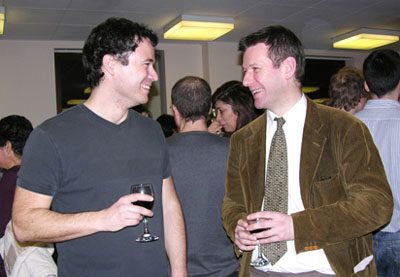
Actually, I just remembered that they took pictures at the party afterwards so here’s one of me and Joao having a chuckle afterwards. Notice I had put a tie on for the occasion, but Joao’s wardrobe is strictly T-shirts only.

37079699

After Friday’s dinner (roast partridge, if you want to know) I got the last train back to Cardiff from Paddington, snoozing comfortably for a large part of the journey. On time until just outside Cardiff Central, the train then sat motionless on the track almost within sight of the platform owing to the presence of a broken down goods train in front of us. We finally got into the station 50 (FIFTY) minutes late, and I didn’t get home until well after 2am.

Another Day at the ArXiv..

Posted in Cosmic Anomalies, The Universe and Stuff with tags , , , , , , , on October 8, 2009 by telescoper

Every now and again I remember that this is supposed to be some sort of science blog. This happened again this morning after three hours of meetings with my undergraduate project students. Dealing with questions about simulating the cosmic microwave background, measuring the bending of light during an eclipse, and how to do QCD calculations on a lattice reminded me that I’m supposed to know something about stuff like that.

Anyway, looking for something to post about while I eat my lunchtime sandwich, I turned to the estimable arXiv and turned to the section marked astro-ph, and to the new submissions category, for inspiration.

I’m one of the old-fashioned types who still gets an email every day of the new submissions. In the old days there were only a few, but today’s new submissions were 77 in number, only about half-a-dozen of which seemed directly relevant to things I’m interested in. It’s always a bit of a struggle keeping up and I often miss important things. There’s no way I can read as widely around my own field as I would like to, or as I used to in the past, but that’s the information revolution for you…

Anyway, the thing that leapt out at me first was an interesting paper by Dikarev et al (accepted for publication in the Astrophysical Journal) that speculates about the possibility that dust grains in the solar system might be producing emission that messes up measurements of the cosmic microwave background, thus possibly causing the curious cosmic anomalies seen by WMAP I’ve blogged about on more than one previous occasion.

Their abstract reads:

Analyses of the cosmic microwave background (CMB) radiation maps made by the Wilkinson Microwave Anisotropy Probe (WMAP) have revealed anomalies not predicted by the standard inflationary cosmology. In particular, the power of the quadrupole moment of the CMB fluctuations is remarkably low, and the quadrupole and octopole moments are aligned mutually and with the geometry of the Solar system. It has been suggested in the literature that microwave sky pollution by an unidentified dust cloud in the vicinity of the Solar system may be the cause for these anomalies. In this paper, we simulate the thermal emission by clouds of spherical homogeneous particles of several materials. Spectral constraints from the WMAP multi-wavelength data and earlier infrared observations on the hypothetical dust cloud are used to determine the dust cloud’s physical characteristics. In order for its emissivity to demonstrate a flat, CMB-like wavelength dependence over the WMAP wavelengths (3 through 14 mm), and to be invisible in the infrared light, its particles must be macroscopic. Silicate spheres from several millimetres in size and carbonaceous particles an order of magnitude smaller will suffice. According to our estimates of the abundance of such particles in the Zodiacal cloud and trans-neptunian belt, yielding the optical depths of the order of 1E-7 for each cloud, the Solar-system dust can well contribute 10 microKelvin (within an order of magnitude) in the microwaves. This is not only intriguingly close to the magnitude of the anomalies (about 30 microKelvin), but also alarmingly above the presently believed magnitude of systematic biases of the WMAP results (below 5 microKelvin) and, to an even greater degree, of the future missions with higher sensitivities, e.g. PLANCK.

I haven’t read the paper in detail yet, but will definitely do so. In the meantime I’d be interested to hear the reaction to this claim from dusty experts!

Of course we know there is dust in the solar system, and were reminded of this in spectacular style earlier this week by the discovery (by the Spitzer telescope) of an enormous new ring around Saturn.

That tenuous link gives me an excuse to include a gratuitous pretty picture:

It may look impressive, but I hope things like that are not messing up the CMB. Has anyone got a vacuum cleaner?