Author Archive

Cardiff University Christmas Lunch Special

Posted in Uncategorized with tags , , on October 7, 2009 by telescoper

The publication of Cardiff University’s new Alcohol and Drugs Policy recently circulated to staff as reported in last week’s Times Higher will require some changes to be made to forthcoming Christmas parties. In particular, we note that the new policy does not allow staff to

consume alcohol or illegal drugs while at work, except at approved functions where such consumption has been formally authorised by the Head of School / Directorate or nominee

so we regret that alcohol will no longer be served at staff Christmas lunches. However, thanks to special authorisation,  we can announce various enhancements to the menu, which will now be as follows:

Christmas Menu

—•—

Starters

—•—

Foie Grass

Garlic Magic Mushrooms

Quaalude Eggs

Thai Sticks

—•—

Main Courses

—•—

Coke au Vin

Pot au Foil

A Selection of Joints

(served with Greens, Beans and Herbs)

followed by

Cold Turkey

—•—

Desserts

—•—

Hash Brownies

Crystalmeth Pudding

—•—

Extras

—•—

Christmas Crackers (containing real Crack)

Dollies, Jellies, Candy and Ices

(with Munchies to follow)

Party Poppers

—•—

I hope the above menu proves satisfactory but if not please send your suggestions for additions through the comments box.

Three Poems by R. S. Thomas

Posted in Poetry with tags , on October 7, 2009 by telescoper

They

The new explorers don’t go
anywhere and what they discover
we can’t see. But they change our lives.

They interpret absence
as presence, measuring it by the movement
of its neighbours. Their world is

an immense place: deep down is as distant
as far out, but is arrived at
in no time. These are the new

linguists, exchanging acrosss closed
borders the currency of their symbols.
Have I been too long on my knees

worrying over the obscurity
of a message? These have their way, too,
other than a prayer of breaking that abstruse code.

Night Sky

What they are saying is
that there is life there, too:
that the universe is the size it is
to enable us to catch up.

They have gone on from the human:
that shining is a reflection
of their intelligence. Godhead
is the colonisation by mind

of untenanted space. It is its own
light, a statement beyond language
of conceptual truth. Every night
is a rinsing myself of the darkness

that is in my veins. I let the stars inject me
with fire, silent as it is far,
but certain in its cauterising
of my despair. I am a slow

traveller, but there is more than time
to arrive. Resting in the intervals
of my breathing, I pick up the signals
relayed to me from a periphery I comprehend.

The New Mariner

In the silence
that is his chosen medium
of communication and telling
others about it
in words. Is there no way
not to be the sport
of reason? For me now
there is only the God-space
into which I send out
my probes. I had looked forward
to old age as a time
of quietness, a time to draw
my horizons about me,
to watch memories ripening
in the sunlight of a walled garden.
But there is the void
over my head and the distance
within that the tireless signals
come from. An astronaut
on impossible journeys
to the far side of the self
I return with the messages
I cannot decipher, garrulous
about them, worrying the ear
of the passer-by, hot on his way
to the marriage of plain fact with plain fact.

(by Ronald Stuart Thomas)

Nobel Betting

Posted in Science Politics, The Universe and Stuff with tags , , , , on October 5, 2009 by telescoper

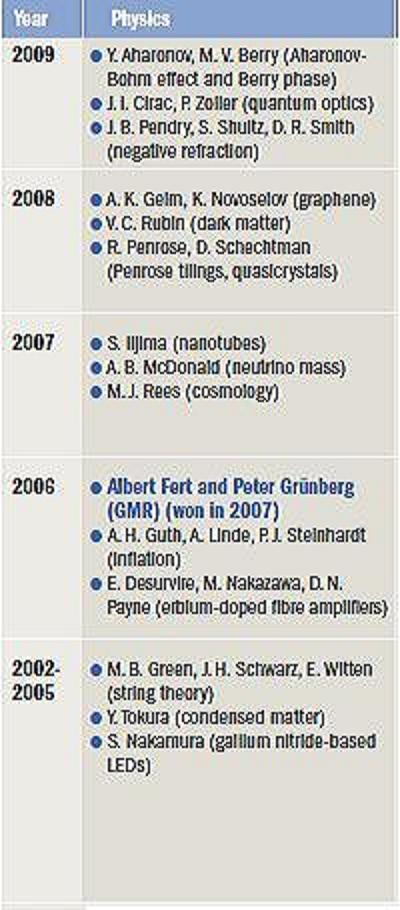
I’m reminded that the 2009 Nobel Prize for Physics will be announced tomorrow, on Tuesday 6th October. A recent article in the Times Higher suggested that British physicists might be in line for glory (based on a study of citation statistics). However, the Table they produced showed that their predictions haven’t really got a good track record so it might be unwise to bet too much on the outcome! This year’s predictions are at the top, with previous years underneath; the only successful prediction is highlighted in blue:

nobel

The problem I think is that it’s difficult to win the Nobel Prize for theoretical work unless confirmed by a definitive experiment, so much as I admire (Lord) Martin Rees – and would love to see a Nobel Prize going to astrophysics generally – I think I’d have to mark him down as an outsider. It would be absurd to give the prize to string theory, of course, as that makes no contact whatsoever with experiment or observation.

I think it would be particularly great if Sir Michael Berry won a share of the physics prize, but we’ll have to wait and see. The other British runner in the paddock is Sir John Pendry. While it would be excellent for British science to have a Nobel prize, what I think is best about the whole show is that it is one of the rare occasions that puts a spotlight on basic science, so it’s good for all of us (even us non-runners).

I think the panel made a bit of a bizarre decision last year and I hope there won’t be another steward’s enquiry this year to distract us from the chance to celebrate the achievements of the winner(s).

I’d be interested to hear any thoughts on other candidates through the comments box. No doubt there’ll be some reactions after the announcement too!

The Very Big Stupid

Posted in Science Politics with tags , , , on October 5, 2009 by telescoper

Sitting on the train yesterday coming back from a night at the Opera, I was reading The Observer. Last week’s edition had featured a superb piece by comedian David Mitchell on the topic of research funding. His argument, essentially, was that the government shouldn’t be directing its research funding at areas which will yield immediate economic benefit, but should instead be doing precisely the opposite. It is, he argues, the job of industry to invest in R&D that’s “relevant” to its immediate needs. It is the job of academia to do things driven by pure curiosity. If these happen to pay off it’s of course a good thing, but it’s a bonus and can only be expected to deliver a financial return in the long term.

Funding only that bit of science that can deliver immediate profits is a bit like diverting all the Arts Council grants into pop music or pantomimes when instead it should be funding things that are too experimental to  rely on revenue generated by paid customers, such as the Opera. I couldn’t agree more, but I am a bit biased in respect of that particular example. Although his piece was intended to be humorous, like a great deal of great comedy there is a great deal of truth in it.

This week’s edition of the Observer contained a number of letters about Mitchell’s piece. One called for him to be given a position in the government. Of course that would be inappropriate. He’s an intelligent and forward-thinking person, and would therefore be completely out of place in such a job. Another letter produced the following memorable quote from Frank Zappa which is exactly to the point.

The Very Big Stupid is a thing which breeds by eating The Future. Have you seen it? It sometimes disguises itself as a good-looking quarterly bottom line, derived by closing the R&D Department.

Meanwhile I attended a meeting this morning at which we were informed that all universities in England have been told to plan for cuts in their recurrent grants of about 15% next year. It is likely that Wales will follow suit. Since most of a University’s expenditure is on staff salaries, corresponding reductions will have to be made, either by cutting salaries or (more likely) by making redundancies.

Research Councils are also likely to feel the squeeze which will hit responsive mode grants too. For astronomy and particle physics, who rely on the Science & Technology Facilities Council for their funding, the situation is especially dire because even without the anticipated cuts, that particular organization has an enormous black hole in its  budget anyway.There is a strong likelihood that existing grant funding will be clawed back to plug the gap, with immediate consequences for postdoctoral researchers and a catastrophic long-term effect on morale.

Pure science in the UK faces a very grim period. All three main political parties have promised savage spending cuts after the next election. The Tories have promised a budget within a month of coming to power if they win; they certainly won’t increase  taxes to cover the budget deficit, especially not at the top end of the scale. A Conservative budget is very unlikely to contain any good news for science or higher education generally.

It’s time for us all to get lobbying about the importance of pure research, but the difficulty is that the Research Councils that are supposed to be distributing funds for this purpose are largely populated by politically appointed individuals who can’t or won’t fight the corner. The Chief Executive of STFC, for example, seems to be content to turn his organization into a channel through which government subsidy flows into technology and engineering companies with only a cursory nod in the direction of basic research. I suspect there are many within the higher levels of management of  other research council  who also see the current economic crisis as an opportunity to cut back “useless science” still further.

I’m sure  that in the long run people will look back on all this as a Very Big Example of The Very Big Stupid, but I’m also worried that for many research projects and for many scientific careers there may not actually be a long run.

Le Grand Macabre

Posted in Opera with tags , , , on October 4, 2009 by telescoper

According to the programme notes, Le Grand Macabre is an anti-anti-Opera in that it is to some extent a reaction against an artistic movement (“anti-Opera“) that sought to avoid and/or subvert the conventions of Opera. Thinking as a physicist, on the basis that C2=1, you would be forced to call this work an Opera, but György Ligeti‘s extraordinary apocalyptic surrealist farce is unlike any Opera I’ve ever seen. The production now running at English National Opera (which I went to see last night, Saturday 3rd October 2009) is a fabulously over-the-top realization of this wonderfully quirky piece of  musical theatre.

I’m not sure I can really describe the plot as there isn’t one as such. The Opera is split onto four scenes which are like comic sketches bearing only slight narrative relationship to each other. The result is a bit like Monty Python meets The Magic Flute. However, Mozart’s Opera managed to become an acknowledged masterpiece without its plot making any kind of sense, so in that respect this work is certainly in good company!

It probably suffices to explain that Le Grand Macabre is actually Death (in the Opera his real name is Nektrotzar and he’s played by Pavlo Hunka). He keeps appearing, complete with scythe, trumpet and egg-timer and warning of the forthcoming End of the World. Somehow, though, there’s always an excuse for it not arriving; just like the British railways. At one point, just as he seems to be getting it together to send everyone to their doom, two characters ply him with wine so he’s too sozzled to blow the Last Trump. The idea of getting Death too drunk to organize Armageddon is just one example of the  bizarre sense of humour that courses throughout this piece.

Other principals include the lovers Amando and Amanda who are dressed in costumes of flayed skin, like refugees from the Bodyworlds exhibition. These two are at it like rabbits all the time, but also have lovely music to sing while they’re on the job. Apparently their names were originally supposed to be Spermando and Clitoris, but it was decided that was a bit too rude…

We also have the court astrologer (Astradamors; Frode Olsen)) and his dominatrix wife (Mescalina; Susan Bickley), the latter with fake comedy boobs, a full wardrobe of SM gear and an excessively hairy “spider” (nudge nudge). Prince Go-Go is the effete ruler who wears a gold suit  and who blames the impending annihilation of his land on his ministers, a role brilliantly sung by counter-tenor Andrew Watts. I’ve never heard a male singer with such effortless control at the extreme end of his vocal range.  And while we’re on about stratospheric singing, I have to mention Susanna Andersson who doubles as the goddess Venus (in a diaphonous suit that looked like it was made of pink candy-floss) and Gepopo, the chief of the secret police (in full modern body armour).

Le Grand Macabre is set in the imaginary Bruegelland, inspired by the paintings of Peter Bruegel and Hieronymous Bosch and this production borrows a great deal of imagery from their paintings.  The critics have devoted a great deal of attention to the spectacular set, but reading about it doesn’t really prepare you for the real thing. After a short piece of film projected onto a giant screen, the curtain goes up to reveal a huge-scale torso of a naked woman that looms over the stage (see below). The head of this figure moves, clever projection effects give it facial expressions and change the appearance of its body into, e.g., a skeleton, its eyes sometimes glow red, and the whole thing also rotates so it can be viewed from different directions and used in different ways in different parts of the Opera. At various points characters emerge from the mouth, nipples, and other orifices. Yes, from there too!

All the action is carried out in front of, on top of, or inside this amazing structure. In one scene the figure has been cut in half exposing its insides, an image clearly originating in Bosch’s Garden of Earthly Delights:

Soldiers first force their way on stage through huge wobbly intestines, then the empty body cavity becomes a nightclub in which amongst other things, the dancers do a hilarious skit on Michael Jackson’s Thriller video.

Making this whole thing work to such stunning dramatic effect is an amazing achievement, and this production is worth seeing just for that. At least part of the joy of Opera is the sense of spectacle and this is indeed spectacular.

But I think it’s also important not to let the scenery and staging overshadow the rest of the work too. Although its critical reception has been very mixed, I thought Le Grand Macabre was absolutely superb. My companions thought it was a blast too.

For a start, it is hilariously funny (although quite rude and sexually explicit). Part of the humour is crudely lavatorial: there’s a sequence where two characters have a obscene name-calling contest which would have schoolboys chuckling with glee, and the whole show abounds with knob jokes and scatological remarks. However, there’s another level to the humour that derives from references to other composers and operas. My musical vocabulary isn’t that wide, but I definitely spotted irreverent quotes from Monteverdi, Beethoven, and Wagner. The final scene of the opera – a kind of epilogue for which all the principals return to the stage  and sing sanctimonious platitudes to the audience – just has to be a pisstake of the ending of Mozart’s Don Giovanni. The designers of the Opera also took a cue from the nature of the music, to make lots of visual jokes on stage. I’ve already mentioned the Michael Jackson reference – which was great – but there’s also more than a nod in the direction of Ridley Scott.

Don’t get the impression that this is just a kind of pastiche. Ligeti does  borrow ideas from elsewhere but there’s also a lot of his own uniquely quirky musical material in it too. From the Dress Circle we could see the orchestra pit filled with peculiar bits and pieces: sledge hammers, whistles, air raid sirens and the like. But there are passages with a fairly conventional orchestration that are just as  innovative as those for which the funny instruments and special effects are needed. I didn’t know much about Ligeti’s music before this performance, but I’m definitely going to listen to more of his work in the future.

So there we are then. My second Opera in two days, and both of them were superb. Le Grande Macabre, played to a full house at the Coliseum, and Friday’s Wozzeck were greeted with enthusiastic applause. I’m heartened that it’s not only La Traviata that bring people to the Opera. However, that’s all the Opera I’ll be seeing and writing about until mid-November.  Until then no doubt I’ll be returning to the real Bruegelland of UK science funding…

Wozzeck

Posted in Opera with tags , , on October 3, 2009 by telescoper

It was a late decision for me to go to see Welsh National Opera‘s production of Wozzeck last night (Friday 2nd October) at the Wales Milennium Centre. It has been a busy week and I’m travelling at the weekend too, so I wasn’t sure I could fit it in. In the end, I am really glad I did because it was by far the best of the three operas WNO are presenting in the current season; you can read about the other two here and here.

Stylistically, Wozzeck (composed by Alban Berg) is a far cry from Madam Butterfly and La Traviata but it is also a tragedy of some sort. The principal character – Wozzeck himself –  is one of life’s losers. The Opera opens with him establishing his servile nature by shaving a character called the Captain in order to supplement his salary. The original story has a military setting, but in this production it is moved to a factory producing tins of baked beans.

Wozzeck has fathered a child out of wedlock with Marie and is doing everything he can to earn money for her and their son. Later on we find out that he is also trying to earn cash by helping another character, the Doctor, in a medical experiment the main element of which seems to involve eating a large quantity of the baked beans produced in the factory.

Perhaps caused by his peculiar diet as well as the stress of his personal situation, Wozzeck is clearly losing his marbles. He suffers from hallucinations. Then Marie has an affair with another character, the Drum Major  we know he’s a bad guy because he likes golf and wears nasty white shoes. The Doctor and the Captain see the Drum Major and Marie in flagrante delicto and subsequently taunt Wozzeck with his lover’s infidelity. Wozzeck goes berserk, challenges the Drum Major to a fight and gets himself badly beaten up for his trouble. He takes  out his frustration on Marie, luring her outside and then killing her by cutting her throat with an opened baked bean tin. He doesn’t have the sense to wash the blood from his hands and when this is spotted he returns to the scene and tries to find the murder weapon. In the original story Wozzeck had thrown the weapon (a knife) into a lake: trying to get it back in order to hide it in a better place he falls in and drowns. In this production he had thrown the tin can into a huge hopper full of similar tins. He falls into this and dies among the rubbish. In the final scene, his young son is told of the death of his mother and father but it doesn’t really sink in. He sings a childish song and opens a tin of baked beans. Like father, like son.

The stark industrialised scenery and drably austere clothing  serve to reinforce the steady dehumanisation of Wozzeck and accentuate his descent into madness.  The subtext is about the exploitation of the poor and disadvantaged; the message is that those to whom evil is done, do evil in return. Wozzeck’s actions are not condoned, but we know from the start that he’s a man in trouble and if only someone had helped him rather than everyone tormenting him, things might have turned out for the better. Shades of Peter Grimes.

Peter Hoare was a creepily comical Captain and Cliver Bailey an appropriately ghoulish Doctor. Marie was sung beautifully by Wioletta Chodowicz. But even these were somewhat eclipsed by Christopher Purves’ wonderful and deeply moving performance as the tortured Wozzeck. His singing and acting raised the level of this to truly world-class. One of the best I’ve ever seen.

The real star of the show for me, though, was Berg’s amazing music, which managed to be both sumptious and edgy at the same time. This is an atonal piece, and I know some people are pretty much allergic to music that doesn’t rest on a tonal framework. But the orchestral colours Berg achieves have a remarkable effect in combination with the action on stage and some of the more lyrical passages are intensely beautiful.

Actually, it’s a remarkable opera altogether. For a start it’s exceptionally compact. Three Acts each of five Scenes but the overall running time is about 90 minutes (with no interval). The music for each act is constructed like a concert work. The three Acts are marked Five Character Pieces, Symphony in Five Movements and Six Inventions (five of the latter accompany the scenes, the sixth is an orchestral interlude before the final scene). There are leitmotifs, unusual vocal techniques such as Sprechgesang and Sprechstimme, innovative rhythmic explorations with strange uses of percussion, and so on. Berg packs so much into this work that it is definitely one to listen to over and over again.

I and the rest of the audience responded very enthusiastically both to the performers on stage and  to the Orchestra of WNO who did full justice to a 20th Century masterpiece. Bravo!

The Milky Way in a New Light

Posted in The Universe and Stuff with tags , , , , , on October 2, 2009 by telescoper

I note that the Herschel mission now has its own blog, so I no longer have to try to remember to put all the sexy images on here. However, at the end of a worrying week for UK astronomy, I thought it would be a good idea to put up one of the wonderful new infra-red images of the Milky Way just obtained from Herschel. This is the first composite colour picture made in “parallel mode”, i.e. by using the PACS and SPIRE instruments together. Together the two instruments cover a wavelength range from 70 to 500 microns. The resulting image uses red to represent the cooler long-wavelength emission (seen by SPIRE) and bluer colours show hotter areas. The region of active star formation shown is close to the Galactic plane; detailed images such as this, showing the intricate filamentary structure of the material in this stellar nursery, will help us to understand better how what the complex processes involved in stellar birth.

Poem in October

Posted in Poetry with tags , on October 2, 2009 by telescoper


It was my thirtieth year to heaven
Woke to my hearing from harbour and neighbour wood   
      And the mussel pooled and the heron
                  Priested shore
            The morning beckon
With water praying and call of seagull and rook
And the knock of sailing boats on the net webbed wall   
            Myself to set foot
                  That second
      In the still sleeping town and set forth.


      My birthday began with the water-
Birds and the birds of the winged trees flying my name   
      Above the farms and the white horses
                  And I rose   
            In rainy autumn
And walked abroad in a shower of all my days.
High tide and the heron dived when I took the road
            Over the border
                  And the gates
      Of the town closed as the town awoke.


      A springful of larks in a rolling
Cloud and the roadside bushes brimming with whistling   
      Blackbirds and the sun of October
                  Summery
            On the hill’s shoulder,
Here were fond climates and sweet singers suddenly   
Come in the morning where I wandered and listened   
            To the rain wringing
                  Wind blow cold
      In the wood faraway under me.


      Pale rain over the dwindling harbour
And over the sea wet church the size of a snail   
      With its horns through mist and the castle   
                  Brown as owls
            But all the gardens
Of spring and summer were blooming in the tall tales   
Beyond the border and under the lark full cloud.   
            There could I marvel
                  My birthday
      Away but the weather turned around.


      It turned away from the blithe country
And down the other air and the blue altered sky   
      Streamed again a wonder of summer
                  With apples
            Pears and red currants
And I saw in the turning so clearly a child’s
Forgotten mornings when he walked with his mother   
            Through the parables
                  Of sun light
      And the legends of the green chapels


      And the twice told fields of infancy
That his tears burned my cheeks and his heart moved in mine.   
      These were the woods the river and sea
                  Where a boy
            In the listening
Summertime of the dead whispered the truth of his joy   
To the trees and the stones and the fish in the tide.
            And the mystery
                  Sang alive
      Still in the water and singingbirds.


      And there could I marvel my birthday
Away but the weather turned around. And the true   
      Joy of the long dead child sang burning
                  In the sun.
            It was my thirtieth
Year to heaven stood there then in the summer noon   
Though the town below lay leaved with October blood.   
            O may my heart’s truth
                  Still be sung
      On this high hill in a year’s turning.
 
 
(by Dylan Thomas).

Medawar on Johnson on Milton on Science

Posted in Science Politics with tags , , , , on October 1, 2009 by telescoper

Have recent events left you with a sinking feeling that science isn’t valued in today’s modern world? Are you aggrieved that the great and the good nowadays seem to be so unimpressed by research for research’s sake and require us instead to divert our energies into “useful things” (whatever they are)?

Looking for something to optimistic to say I turned to Peter Medawar‘s book Advice to a Young Scientist and found, to my disappointment, that actually there’s nothing new about this attitude. For example, Medawar explains, no less a character than Dr Samuel Johnson, in his Life of Milton  offered the following rant about Milton’s daft idea of setting up an academy in which the scholars should learn astronomy physics and chemistry as well as the usual school subjects:

But the truth is that the knowledge of external nature, and the sciences which that knowledge requires or includes, are not the great or the frequent business of the human mind. Whether we provide for action or conversation, whether we wish to be useful or pleasing, the first requisite is the religious and moral knowledge of right and wrong; the next is an acquaintance with the history of mankind, and with those examples which may be said to embody truth and prove by events the reasonableness of opinions. Prudence and Justice are virtues and excellences of all times and of all places; we are perpetually moralists, but we are geometricians only by chance. Our intercourse with intellectual nature is necessary; our speculations upon matter are voluntary and at leisure. Physiological learning is of such rare emergence that one man may know another half his life without being able to estimate his skill in hydrostaticks or astronomy, but his moral and prudential character immediately appears.

Medawar attempts to cheer up his readers  by responding with the following feeble platitude

Scientists whose work is prospering and who find themselves deeply absorbed in and transported by their research feel quite sorry for those who do not share the same sense of delight; many artists feel the same, and it makes them indifferent to – and is certainly a fully adequate compensation for –  any respect they think owed to them by the general public.

Tripe. Delight doesn’t put your dinner on the table. It’s not enough to feel smug about how clever you are: we need to convince people that science is worth doing because it’s worth doing for its own sake, and worth funding by the taxpayer for the same reason. Feeling sorry for people who don’t get the message is a sickeningly patronising attitude to take.

I should point out that the rest of the book isn’t all as bad as this, but  the mood I’m in today the best advice I could offer a young scientist at the moment wouldn’t require a whole book anyway:

Don’t!

Alarm Bells at STFC

Posted in Science Politics with tags , , on September 30, 2009 by telescoper

The  financial catastrophe engulfing the Science and Technology Facilities Council (STFC) has suddenly reared its (very ugly) head again.

Here is a statement posted yesterday on their webpage.

STFC Council policy on grants

STFC Council examined progress of its current science and technology prioritisation exercise at a strategy session on 21 and 22 September. Without prejudging the outcome of the prioritisation, Council agreed that prudent financial management required a re-examination of upcoming grants.

Council therefore agreed that new grants will be issued only to October 2010 in the first instance. This temporary policy is in place pending the outcome of the prioritisation exercise, expected in the New Year.

According to the e-astronomer the  STFC  has written to all Vice-chancellors and Principals of UK universities to tell them about this move. I gather the intention is that this measure will be temporary, but it looks deeply ominous to me. Those of us whose rolling grant requests for  5 years from April 2010 are currently being assessed face the possibility of receiving grants for only 6 months of funding. On the other hand, I’m told that what is more likely is that our grant won’t be announced until January or February, after the hitlist prioritisation exercise has been completed in the New Year. Hardest hit will be the particle physicists whose rolling grants start on 1st October 2009 (tomorrow), which will have only a year’s funding on them…

It seems that STFC has finally realised the scale of its budgetary problems and payback time is looming. I honestly think we could be doomed…