Author Archive

Parallel Lives

Posted in Music, The Universe and Stuff with tags , on November 6, 2008 by telescoper

I’ve just finished reading The Life of Charles Ives by Stuart Feder, which I bought some time ago with my Cambridge University Press author discount and I’ve had on my shelves without getting around to read it until this week. It’s a very interesting and informative biography of one of the strangest but most fascinating composers in the history of classical music.

Charles Ives was by any standards a daring musical innovator. Some of his compositions involve atonal structures and some involve different parts of the orchestra playing in different time signatures. He also wrote strange and wonderful piano pieces, including some which involved re-tuning the piano to obtain scales involving quarter-tones. Among this maelstrom of modern ideas he also liked to add quotations from folk songs and old hymns which gives his work a paradoxically nostalgic tinge.

His pieces are often extremely diffficult to play (so I’m told) and sometimes not that easy to listen to, but while he’s often perplexing he can also be exhilarating and very moving. Other composers might play off two musical ideas against each other, but Ives would smash them together and to hell with the dissonance. I think the wholeheartedness of his eccentricity is wonderful, but I know that some people think he was just a nut.. You’ll have to make your own mind up on that.

My favourite quote of his can be found scrawled on a hand-written score which he sent to his copyist:

Please don’t try to make things nice! All the wrong notes are right. Just copy as I have – I want it that way.”

But the point of adding this post to my blog was that in the course of reading the biography, it struck me that there is a strange parallel between the life of this controversial and not-too-well known composer and that of Albert Einstein who is certainly better known, especially to people reading what purports to be a physics blog.

For one thing their lifespans coincide pretty closely. Charles Ives was born in 1874 and died in 1954; Albert Einstein lived from 1879 to 1955. Of course the one was born in America and the latter in Germany. One inhabited the world of music and the other science; Ives, in fact, made his living in the insurance business and only composed in his spare time while Einstein spent most of his career in academia, after a brief period working in a patent office. Not everything Ives wrote was published professionally and he also rewrote things extensively, so it is difficult to establish exact dates for things especially for a non-expert like me. In any case I don’t want to push things too far and try to argue that some spooky zeitgeist acted at a distance to summon the ideas from each of them in his own sphere. I just think it is curious to observe how similar their world lines were, at least in some respects.

We all know that Einstein’s “year of miracles” was 1905, during which he published classic papers on special relativity, brownian motion and the photoelectric effect. What was arguably Ives’ greatest composition, The Unanswered Question, was completed in 1906 (although it was revised later). This piece is subtitled “A Cosmic Landscape” and it’s a sort of meditation on the philosophical problem of existence: the muted strings (which are often positioned offstage in concert performances) symbolize silence while the solo trumpet evokes the individual struggling to find meaning within the void. Here’s a fine performance of this work recorded at La Scala in Milan, in which the strings are onstage while the trumpet is in the audience. I love the way that at the end nobody seems to know if they have finished!

The Unanswered Question is probably Ives’ greatest masterpiece, but it wasn’t the only work he composed in 1906. A companion piece called Central Park in the Dark also dates from that year and they are sometimes performed together as a kind of diptych which offers interesting contrasts. While the former is static and rather abstract, the latter is dynamic and programmatic (in that it includes realistic evocations of night-time sounds).

Einstein’s next great triumph was his General Theory of Relativity in 1915, an extension of the special theory to include gravity and accelerated motion, which which came only after years of hard work learning the required difficult mathematics. Ives too was hard at work for the next decade which resulted in other high points, although they didn’t make him a household name like Einstein. The Fourth Symphony is an extraordinary work which even the best orchestras find extremely difficult to perform. Even better in my view is Three Places in New England (completed in 1914) , which contains my own favourite bit of Ives. The last movement, The Housatonic at Stockbridge is very typical of his unique approach, with a beautifully paraphrased hymn tune floating over the top of complex meandering string figures until the piece ends in a tumultuous crescendo.

After this period, both Einstein and Ives carried on working in their respective domains, and even with similar preoccupations. Einstein was in search of a unified field theory that could unite gravity with the other forces of nature, although the approach led him away from the mainstream of conventional physics research and his later years he became an increasingly marginal figure.

By about 1920 Ives had written five full symphonies (four numbered ones and one called the Holidays Symphony) but his ambition beyond these was perhaps just as grandiose as Einstein’s: to create a so-called “Universe Symphony” which he described (in typically bewildering fashion) as

A striving to present – to contemplate in tones rather than in music as such, that is – not exactly within the general term or meaning as it is so understood – to paint the creation, the mysterious beginnings of all things, known through God to man, to trace with tonal imprints the vastness, the spiritual eternities, from the great unknown to the great unknown.”

I guess such an ambitious project – to create an entirely new language of “tones” that could give expression to timeless eternity, a kind of musical theory of everything – was doomed to failure. Although Ives was an experienced symphonic composer he couldn’t find a way to realise his vision. Only fragments of the Universe Symphony remain (although various attempts have been made by others to complete it).

In fact, the end of Ives’ creative career was much more sudden and final than Einstein who, although he never again reached the heights he had scaled in 1915 – who could? – remained a productive and respected scientist until his death. Ives had a somewhat melancholic disposition and from time to time suffered from depression. By 1918 he already felt that his creative flame was faltering, but by 1926 the spark was extinguished completely. His wife, appropriately named Harmony, remembered the precise day when this happened at their townhouse in New York:

He came downstairs one day with tears in his eyes, and said he couldn’t seem to compose anymore – nothing went well, nothing sounded right.”

Although Charles Ives lived almost another thirty years he never composed another piece of music after that day in 1926. I find that unbearably sad, but at least a lot of his work is available and now fairly widely played. Alongside the pieces I have mentioned, there are literally hundreds of songs, some of which are exceptionally beautiful, and dozens of smaller works including piano and violin sonatas.

Although they both lived in the same part of America for many years, I don’t think Charles Ives and Albert Einstein ever met. I wonder what they would have made of each other if they had?

If you believe in the multiverse, of course, then there is a part of it in which they do meet. Einstein was an enthusiastic violinist so there will even be a parallel world in which Einstein is playing the Ives’ Violin Sonata on Youtube.
The Train and the River

Posted in Jazz, Music with tags on November 5, 2008 by telescoper

It’s not particularly relevant or topical, but I thought I’d put this up as it’s a great favourite of mine. This was the opening set from the classic film Jazz on a Summer’s Day, which is about the 1958 Newport Jazz Festival. Beautifully directed by the fashion photographer Bert Stern, this was originally intended to be a drama set against the backdrop supplied by the various concerts, but Stern lost interest in the plot storyline and it was dropped. The final cut of the film released in 1960 is basically a straight documentary about the music festival, and it’s none the worse for that.

Stern’s photography didn’t just capture the diverse personalities of the artists, who range all over the spectrum of Jazz from Louis Armstrong to Thelonious Monk. He keenly observed the audience as the performances unfolded and sprinkled some wonderfully humorous glimpses into the film. In between the music there are also some wonderful impressionistic sequences of yachts racing off the coast of Rhode Island and reflections on the water. I think the film is pure joy from start to finish and I treasure my copy of it on DVD.

The opening track of the film is The Train and the River, by the Jimmy Giuffre three. Jimmy Giuffre was an immensely gifted saxophonist and clarinet player who was also an accomplished arranger and composer who worked for many big bands. His most famous piece as an arranger was Four Brothers which he wrote for Woody Herman’s fantastic saxophone section of Stan Getz, Zoot Sims, Serge Chaloff and Herb Steward. Giuffre was at one stage a very avant-garde musician playing quite challenging material, but in 1958 he had a more accessible style that blended jazz with folk elements, as you can hear from the video.

The other members of the band are the wonderful guitarist Jim Hall and the multi-instrumentalist Bob Brookmeyer who, on this number, plays valve trombone. Notice how they cleverly interchange the lead and rythmic support so you don’t really notice that it’s such a small band. There are studio recordings of the Train and the River, but none of them are anything like as good as this live version. Unfortunately the start of the tune is missing on the video because it was played over the opening titles, but if you want the whole thing just go and buy it!

Jimmy Giuffre died in April this year, before I started blogging, so let this be a belated tribute to him. I also think it’s a fitting way to celebrate the dawn of a new era in American politics with a reminder of the tremendous vitality, creativity and diversity of the nation that brought us jazz and a fervent hope that it will rediscover its true identity in the post-Bush era. Enjoy.

Bonfire of the Inanities

Posted in Biographical on November 2, 2008 by telescoper

Having survived the potential horrors of Halloween on Friday without so much as a knock at the door, last night I went to see the fireworks, organized by the local Round Table, in Bute Park, near my home in Cardiff. According to the website, this was to be “one of the largest firework events in the UK, with a spectacular display of pyrotechnics, a bonfire to behold, on-stage entertainment from a series of famous artists, as well as fun fair rides, food stalls and many other family attractions.”

I should have guessed that the “series of famous artists” would be a bunch of failed wannabes from TV talent shows like X-factor and that their primary purpose would be to delay the actual fireworks as long as possible while the audience stood in the pouring rain. The last of them – a dreadful brother-and-sister combination called Same Difference – spent less time singing than they did telling people how to download their new single from the net a whole day before it would be in the shops.

When the fireworks eventually started, quite a few of them seemed not to work properly. Perhaps they were wet through like the spectators were. If so, I now know the meaning of the phrase “a damp squib”. At least we got a good blast of Shirley Bassey by way of musical accompaniment, so it wasn’t all a disaster. After the last whizz-bang had whizzed and banged we trudged back through the muddy fields to Pontcanna where I cooked supper at home for a few friends.

The occasion for the fireworks is of course Guy Fawkes’ Night, which celebrates the Gunpowder Plot of 1605 which intended to blow up the Houses of Parliament. Guy Fawkes was supposed to light the blue touchpaper on that occasion and it has been a tradition to burn his effigy on the bonfire on the anniversary of the attempt, every November 5th, while letting off fireworks.

When I was young, this was the thing we celebrated rather than Halloween. Most families held their own bonfire in their garden and fireworks could easily be bought from local shops who stocked up at this time of year. Since we had the Spinney in front of our house, we had very big bonfires in Benwell which lots of other kids came to. The number of private bonfire parties has decreased markedly since then owing to safety concerns and they have largely been replaced by large scale organized celebrations, such as the one in Cardiff last night. The plus side of this is that you get better fireworks (generally speaking), but the downside is the perceived need to add unnecessary frills like the awful pop concert we had to endure. I think Cardiff City Council’s notorious Events Department probably played a part in adding the tackier embellishments to Bonfire Night in Bute Park.

The other drawback with municipal fireworks parties is that they have resulted in a drift away from November 5th itself to a date on the nearest weekend, such as last night’s Cardiff affair on November 1st. The problem with that is that there are other events scheduled for tonight (I can hear fireworks as I write) and there will no doubt be others on the proper night, next Wednesday. I think it’s better if there is one proper day where everything happens, rather than having it all spread out over practically a whole week. The Big Event loses its sparkle if it is broken up into little ones. And there are more occasions where we have fireworks nowadays too, including New Years Eve. In the old days we only had fireworks on Bonfire Night, so they were special. It’s also a particular problem for Columbo, who gets very frightened by fireworks if they are let off nearby. Instead of being a scaredy cat for just one night he has to cope for several.

Another tradition associated with November 5th also seems to have died completely. When I was a kid the thing to do was to make an effigy of Guy Fawkes (called a “Guy”) and parade him from door to door asking for “Penny for the Guy”. The idea was if you had an impressive effigy, people would give you money which you used to buy fireworks for the forthcoming party. Of course you were hoping for a bit more than a penny.

I suppose that this tradition has been displaced by the American import “Trick or Treat”, which I think is a shame. It’s true that many bonfire celebrations have an unpleasant anti-catholic undertone which is a reminder of the religious intolerance that blights much of British history. It may be an ugly history, but at least its ours. Next thing you know we won’t have Guy Fawkes’ Night at all; we’ll have to call it 5/11.

I remember one year spending ages making a really good Guy with a head made from papier mache and with plasticene for his eyes, nose and mouth. I was really proud of him, especially when he sat on top of the huge pile of wood that was going to form the bonfire. When it was lit – which happened before the fireworks started – the heat from the flames started to melt the plasticene features of the Guy.

The other kids rushed around in excitement as the adults sorted out the roman candles, catherine wheels and the rest of the soon-to-be-ignited pyrotechnics, but I stood transfixed, staring at the Guy. After a few minutes I started sobbing and ran to my mum in anguish as molten plasticene dripped from his eyes.

Guy Fawkes was crying.

In the Dark

Posted in Biographical with tags on October 30, 2008 by telescoper

We never had Halloween when I was a kid. I mean it existed. People mentioned it. There were programmes on the telly. But we never celebrated it. At least not in my house, when I was a kid. It just wasn’t thought of as a big occasion. Or, worse, it was “American” (meaning that it was tacky, synthetic and commercialised). So there were no parties, no costumes, no horror masks, no pumpkins and definitely no trick-or-treat.

Having never done trick-or-treat myself I never acquired any knowledge of what it was about. I assumed “Trick or Treat?” was a rhetorical question or merely a greeting like “How do you do?”. My first direct experience of it didn’t happen until I was in my mid-thirties and had moved to a suburban house in Beeston, just outside Nottingham. I was sitting at home one October 31st, watching the TV and – probably, though I can’t remember for sure – drinking a glass of wine, when the front door bell rang. I didn’t really want to, but I got up and answered it.

When I opened the door, I saw in front of me two small girls in witches’ costumes. Behind them, near my front gate, was an adult guardian, presumably a parent, keeping a watchful eye on them.

“Trick or Treat?” the two girls shouted. Trying my best to get into the spirit but not knowing what I was actually supposed to do, I answered “Great! I’d like a treat please”.

They stared at me as if I was mad, turned round and retreated towards their minder who was clearly making a mental note to avoid this house in future. Off they went and I, embarrassed at being exposed as a social inadequate, retired to my house in shame.

Ever since then I’ve tried to ensure that I never again have to endure such Halloween horrors. Every October 31st, when nightfall comes, I switch off the TV, radio and lights and sit soundlessly in the dark so the trick-or-treaters think there’s nobody home.

That way I can be sure I won’t be made to feel uncomfortable.

Hot Tip

Posted in Finance with tags on October 29, 2008 by telescoper

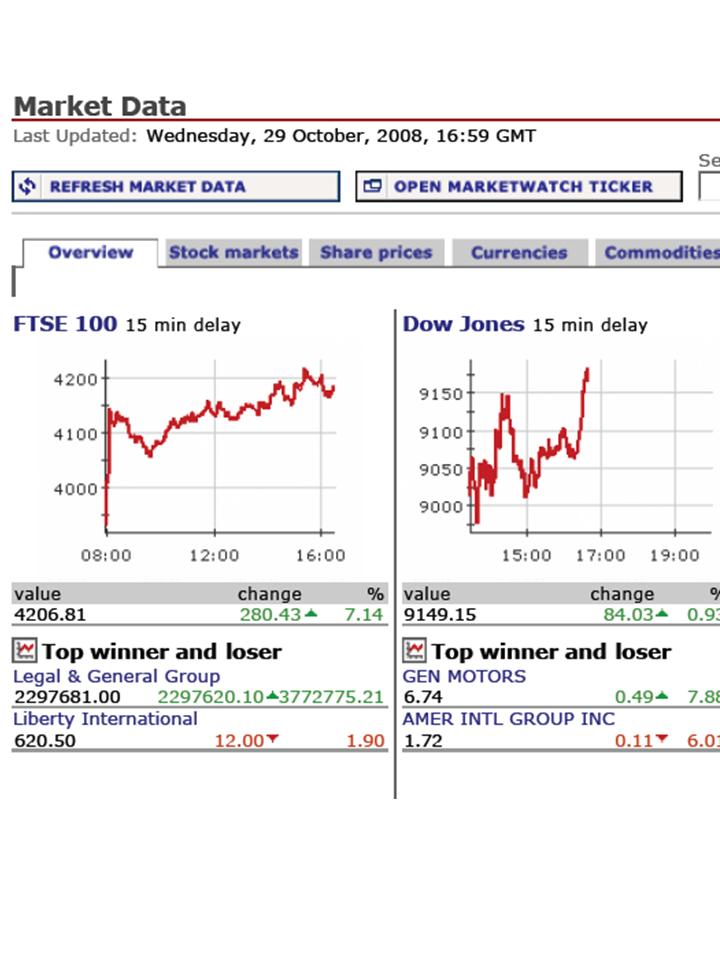
I don’t know much about stocks and shares, but judging by the BBC website, it think The Legal and General Group must be one to watch:


A Blast from the Past

Posted in Uncategorized on October 29, 2008 by telescoper

Trawling the web today for something completely different, I accidentally stumbled upon a film featuring my former Nottingham PhD Student, Emma King. It is part of a series about young scientists made by the Vega Science Trust and originally broadcast on BBC 2 as part of The Learning Zone. I had completely forgotten about it. How could I have failed to remember my one and only appearance on the Emma King Show? You can watch the film here.

Emma successfully completed her PhD in 2006 and now runs her own science communication business from her home in the Isle of Man.

Event Horizon

Posted in Bute Park with tags , on October 29, 2008 by telescoper

As I walked into work this morning from Pontcanna across Bute Park I decided, just for a change, to take a slightly different route along the front of Cardiff’s splendid City Hall. When I got there I was forced to take a big detour. The path through the small park that lies in front of the City Hall is now inaccessible to pedestrians, as the Council has taken over this bit of ground in order to construct “Winter Wonderland” on it. This has involved covering the grass with temporary surfacing, emptying the pond and replacing it with a skating rink, and building a Ferris Wheel. On either side of the park there are now two large and very ugly white tents that look a bit like the mobile mortuaries used when a train crash or air disaster produces an excess of corpses. I gather that one of these is to be a bar, presumably so the local child molesters can enjoy a drink while they scan the crowds of skating children looking for their next victim.

Not only does the monstrosity that is Winter Wonderland completely hide the natural greenness of the park from view and prevent pedestrian access to it, it also completely obliterates one of the best sightlines in Cardiff and renders the City Hall invisible behind a pile of tacky garbage. I can only guess how long it will take the park to recover from the damage done to it by covering most of the grass and allowing heavy vehicles to plough up the rest. No doubt Winter Wonderland will be followed by Spring Swamp and Summer Sandpit.

The fair is sponsored by BMI Baby, an offshot of the airline BMI which has caused outrage for its enthusiastic support for the enforced deportation of asylum seekers, which gives yet another reason to boycott this eyesore.

If you’re still interested in trying out the skating, take plenty of money with you because it is £8.50 for an hour on the tiny open-air rink. Judging by the size of it, I bet you won’t have much of a mean free path.

Winter Wonderland hasn’t actually opened yet but its construction and associated disruption have been going on for weeks already and it looks like the gardens and City Hall will be blighted for months to come. When it has run its course it will no doubt take months for the park to recover, if it is allowed to do so before it is vandalised again for the next “Event”.

But I’m afraid this is by no means the worst excess perpetrated by Cardiff City Council and their notorious Events department. A tenth-rate pop concert held last summer in the same park as part of Cardiff’s “Big Weekend” led not only to obscene amounts of noise but also to heaps of litter.

Another example is their absurd decision to host this summer’s National Eisteddfod of Wales in Cardiff on Pontcanna Fields, to the north of Bute Park. There’s nothing absurd about the Eisteddfod of course – it’s an extremely important part of the Welsh cultural calendar. It was great having it in Cardiff, apparently for the first time in 30 years. But the location chosen for it by Cardiff City Council was totally unsuitable and so obviously so that one wonders what kind of harebrained fool thought the idea up in the first place.

For one thing, the area was covered by sports fields which had to be ploughed up to accommodate the temporary buildings in which the Eisteddfod was housed. For another, it is low-lying ground that forms part of the flood plain of the River Taff. In order to allow heavy vehicles access to the site to construct and supply the festival, huge areas of grass were smothered with gravel and new roads were built with sufficient strength to support articulated lorries. Months after the Eisteddfod has finished, the site is still a total wreck. The Council is facing a bill of at least £400,000 to clean it up. The heavy rain and flooding of late summer this year is likely to have set back the restoration of Pontcanna fields and it is unlikely the replacement sports fields will be ready for next season.

But even this isn’t the worst of the Council’s excesses. They have plans to develop Bute Park itself as a site for even more events and, to this end, have pushed through a proposal to build a new road into the heart of the park, wide enough to accommodate articulated lorries, and complete with traffic lights and a bridge over the feeder canal. Unsurprisingly, the Council voted to give itself planning permission despite furious objections from local residents who are protesting about the environmental damage (including the felling of trees) that will be caused during and after the construction of this grotesque intrusion into beautiful public space. Ironically, the Council’s own website describes the Bute Park as a “green lung” full of historical and wildlife interest. True, but it is a green lung that is about to receive a very painful wound.

Amazingly, the Council’s plans are supported and actively encouraged by the Heritage Lottery Fund, which has made future funding for the restoration of Bute Park contingent on the completion of this monstrous new road. How this squares with their commitment to “conserve the UK’s diverse heritage for present and future generations to experience and enjoy” is anyone’s guess. Since the Council has summarily dismissed ongoing petitions and representations against its plans, I’m also a bit confused about how this project relates to their desire to “help more people … take an active part in and make decisions about their heritage”.

The Battle for Bute Park is not over. For one thing, it’s by no means obvious that it belongs to the Council in the first place (it was actually presented to “the people of Cardiff” in 1947). For another, there are grave doubts about the procedures followed at the meeting at which planning consent was granted, opening up the possibility for legal intervention in the form of an appeal. Unless this plan is halted there will be a steadily accelerating destruction of green sites in Cardiff to make way for more vulgar money-grabbing “events” and associated disruption, noise and inconvenience. What happens to the proceeds of these commercial ventures? I wish I knew. But I bet we won’t be seeing a reduction in our Council Tax next year.

It seems that the Council will only be satisfied when its rapacious Events Department has violated every single square yard of Cardiff’s precious green land in a frantic quest to justify its own existence. Perhaps this will only stop when every tree in Cardiff is felled, every blade of grass trampled and every view blighted. Only then will we have reached the Event horizon.

P.S. The petition against lorries in Bute Park is still active, so please take the time to sign it if you think parks are for people and not for lorries.

Overhead and down below

Posted in Biographical on October 28, 2008 by telescoper

I’ve just been catching up on a few of the posts on cosmic variance. Of course their blog is a complete swizz because there are several contributors, which is obviously cheating. However they do manage to cover a lot of ground and provoke a lot of discussion.

One recent theme which has extended over several posts concerns John McCain’s complaints about the cost of an “overhead projector” (about $3M) at the Adler Planetarium in Chicago. Of course this is no ordinary OHP, but a wonderful “Sky Theater” for which the price tag seems actually rather modest.

Of course I could complain about the spelling of “Theater” or the refusal to use the proper plural for planetarium but it would be completely unlike me to go on about such things. Instead, I thought I’d meditate on the theme of old-fashioned proper overheard projectors.

Most people use powerpoint for lectures and conference talks these days, but it’s not long ago that we all seemed to use transparencies (“viewgraphs”) to be placed on the OHP. I was relatively late to switch to powerpoint, but got the hang of it quite quickly having decided to do so. I have, however, resisted the temptation for annoying gimmicky animations and sounds in favour of a plainer minimalist style that draws appropriate attention to the extraordinary level of my verbal eloquence. *Cough*

Powerpoint also means that I’ll never have to suffer the embarrassment I once endured at an international conference (which shall remain nameless). Giving the first talk of the morning session, I turned up with a neat stack of transparencies that I’d carefully written out in my hotel room the night before the talk.

As the audience settled down and the chairperson introduced my talk, I took the first slide and placed it carefully on the glass top of the projector. For maximum impact, I didn’t switch on the light until I was ready to speak. My first slide had just the title of my talk and little else in the way of text or pictures. When I was sure everyone was paying attention, I hit the switch and the light came on. I knew this pause would ensure everyone would be looking. I turned around to glance at the screen and check it was all in focus.

Brightly illuminated, perfectly focussed, projected to an enormous size and plain for all to see, was a single shocking and inexplicable pubic hair.

A Friend of Dorothy

Posted in Biographical with tags , , on October 26, 2008 by telescoper

In my previous post about childhood memories of Benwell, one of the stones I left unturned was the story of our next door neighbour when we lived there. I was going to skip this because I feel quite guilty still, but on the grounds that it will probably be some form of catharsis I decided to write about it now.

In the other one of The Cottages I described in the previous post there lived an old lady, a spinster whose name was Dorothy Newton. She was already living there when we moved in next door and had, in fact, lived there for as long as she could remember. She had never married and had little experience of children, at least at the start. My first encounter with her wasn’t at all auspicious. I had accidentally kicked a football into her garden and without thinking about it at all, just went in and got it. As I picked it up I saw her looking out and, scared, I ran back to my house. Technically, I was trespassing and I assumed she was angry with me.

A bit later I had the chance to talk to her in her garden and she said she hadn’t minded, but that in future I should try not to trample her roses. I got to know her slowly and eventually started visiting her quite regularly. She became my “Aunty Dorothy”, although she obviously wasn’t actually a relative. This was before I started School so I would have been less than five years old. I’m told I called her something like “Ann Dorry” at that time because I couldn’t manage her full name.

Aunty Dorothy was an invalid, having suffered a fall on a trolley bus some years previously which resulted in permanent problems with both her legs. She got around on sticks at first and then, later on, needed to use a walking frame. If our house was basic, hers was downright primitive. At some point in the past (which she always referred to as “The Flood”) her roof had suffered a big leak and large amounts of water had got in and badly damaged half of her house. Since she never had money to repair it, the right-hand side of her cottage (out of shot in the picture in the previous post) was completely unusable. As she became more infirm she couldn’t manage the stairs and lived entirely from the ground floor room whose window you can see in the first photograph on my previous post. Her kitchen (which she called the “scullery”) was really Victorian in style, complete with old-fashioned walk-in pantry. And she too had an outside loo.

Life for Aunty Dorothy had, I think, always been tough and she lived a very humble existence but she had acquired an almost unimaginable sense of determination over the years as well as the ability to take huge amounts of pleasure from the small things in life. She had numerous accidents around the house – she was very prone to falls, and sometimes these left her lying for days on end before anyone found her – but she always recovered and carried on with her routine regardless. It took her ages to do even simple things but she never gave up and never complained.

As time went on she eventually found it impossible to leave the house, except for a spot of gardening, and lived an increasingly solitary life, apart from visits from the home help (whom she didn’t like at all) and the nurse who, amongst other things, helped her take a bath once a week.

When I started school a sort of routine developed. My mum and dad both worked at that time and weren’t home when school finished around 4pm. Since I had no distance to go to get home I would have to wait outside the house for one of them to return, so instead I called on Aunty Dorothy. We would sit and have tea (usually with jam or banana sandwiches). Sometimes we would watch the children’s TV programmes in black-and-white and sometimes we would just talk, until about 6pm when I would go next door to my own house. We had tea like that most days for about five years.

In the beginning I was, by any standards, an extremely backward child. I was very slow to learn to speak, which I didn’t even start to do do until I was three. I also had various physical problems, including a condition my mum always referred to as “spacky feet” which meant I had to visit an orthopaedic clinic from time to time. I’m not sure which particular deficiency was responsible, but it took me absolutely ages to learn to ride a bicycle. I think when I started School I was immediately earmarked as a likely basket-case from an educational point of view. In those days the slow kids didn’t really get much help; they sat at the back of the class and did raffia. I wonder how often these diagnoses turned out to be self-fulfilling, but I was definitely a misft from the start.

I think my parents might have mentioned to her that they were worried about my performance in school but whether or not they did, Aunty Dorothy started to take an active interest in my education. I didn’t realise it at the time but she did this in very clever ways. She started asking me to run errands for her to the local shops (which were very close). She would always send me for a single item and ask me to make sure I got the right change. I realise now that she basically invented these jobs to help me practice my arithmetic. I’m sure that myriad of little jobs, allied to the confidence that she obviously placed in me, helped me get over my difficulties with sums to the extent that, by the time I was 10, I even looked forward to Mr Martin’s mental arithmetic tests.

Aunty Dorothy was also keen on horse-racing, which she liked to watch on the telly. When I was a little older, she would sometimes ask me to work out the odds for her. I realised only later that she knew perfectly well how to work out what her winnings would be and this, like the little trips to the shops, was just a way of getting me to work things out myself. At the time, though, I was chuffed to feel I was helping.

Later on, when the dreaded decimalisation happened in the early 1970s she asked me to help with that, although this time I don’t think she was faking it. The pound was no longer 20 shillings, each containing 12 pence, but a simple 100 “new pence”. It may seem simple now but it was a difficult transition for the older generation. The old pound notes were still legal tender for a time, but some coins and rarer notes had to be swapped for the new versions, such as the ten-bob note (10 shillings) which was replaced by the 50p coin. The old shilling coin became the new 5p and the 2 bob was 10p, but there was no longer a place for the old threepenny bit or the sixpence (tanner). Aunty Dorothy once sent me to the post office with a couple of ten bob notes and brought her back the two coins, but she didn’t like them. Somehow you feel richer with paper money.

And then there was reading. I was very behind in developing my reading skills, just like everything else really, but here again Aunty Dorothy helped me enormously. Her eyesight wasn’t great but it wasn’t as bad as she pretended it was when she asked me to read carefully selected items from the Newcastle Evening Chronicle (which now has its own website) to her. On Sundays she got the Sunday Post, a Scottish newspaper which was quite popular on Tyneside in those days. It had a kid’s supplement which was really good, and I would avidly read the cartoons, especially Oor Wullie and The Broons, and do the puzzles.

After a time I had caught up with reading in class and eventually managed to read just about every book the School had to offer, including the Diaries of Samuel Pepys which were for some reason on the shelves in Class 2 and which I was allowed to borrow. I don’t think anyone had read them before so nobody, including the teachers, knew how rude they were. I had no idea at that time that less than ten years later I would be studying at Magdalene College Cambridge, site of the Pepys Library where the orignal diaries are kept as well as the rest of Pepys’ own collection of rare books.

Aunty Dorothy and I were close for many years, during which I underwent a transition from dimwit to high-flier (or at least the closest approximation to such a thing that Pendower School had ever produced). It wasn’t just her that helped me succeed academically – I also had many good teachers at Pendower School – but she certainly played an important part.

In due course my family moved from The Cottages to an ordinary semi-detached house (with an inside toilet) in Hodgkin Park Road but I carried on going to Pendower School, which was only half a mile away, and visiting my adopted Aunt as often as I could over the next few years even though I was no longer living right next door.

I remember during the time of the Miner’s Strike in 1974 when the country switched to a three day working week for a time, sitting in Dorothy’s house with only candles to light us, listening to her stories about the wartime blackout. She also told me that the strike was a good thing because it would probably bring down the hated Conservative government of Ted Heath. She was certainly right on that count.

I also remember that she had a peculiar suspicion about thunderstorms. If there was any sign of lightning in the area, she unplugged all the electrical equipment in the house and switched off all the lights. That much I think I can understand but, for reasons I never figure out, she also insisted on putting all metal objects (such as cutlery) away into drawers or covering them with a tablecloth if there wasn’t time to do that.

In 1974 I took the entrance examination at eleven-plus for the Royal Grammar School in Jesmond and was recommended by the Governors for the award of a scholarship. This was effectively a private school but the City Council paid the fees for a limited number of pupils who did well in the entrance examination. I therefore got a free place which is just as well since there’s no way my family could have afforded the fees. The following year, the new Labour government scrapped the arrangement and the School became fully independent but the Council agreed to carry on paying the fees for those students who were already there. I had got in by the skin of my teeth.

However, the RGS was (and is) in Jesmond, which is on the other side of the city to where I was living so I had to get the bus there and back every day, a journey that took over an hour in each direction. I also had lots of homework to do every night. The frequency of my visits to Aunty Dorothy decreased. Although I had promised to keep in touch with her as best as I could, I didn’t keep my word and after a year or so I stopped visiting her altogether.

I found out in 1978 that she had died in hospital after suffering yet another fall at her home from which this time she hadn’t recovered. I never had the chance to say goodbye and had never taken the time to tell her how grateful I was for all the help she had given me over the years.

Behind the Wall

Posted in Biographical with tags , , , on October 26, 2008 by telescoper

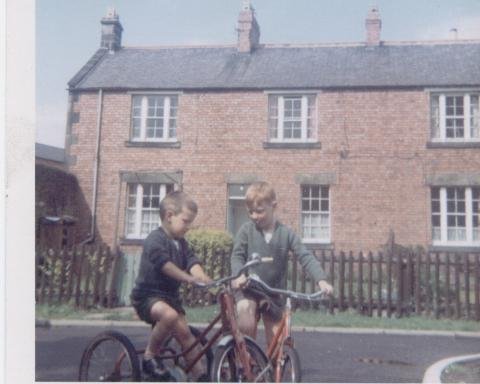
This photograph was taken in front of the little house in Benwell Village that I grew up in during the sixties. I’m on the left and my older brother Jeffrey is on the right. I don’t know when it was taken, but I was obviously just a young ‘un and it may actually have been before I started school. The house, as you can see, was quite small – basically two rooms on either side of each floor (each with one window) and with a kitchen at the back of the ground floor and a small bathroom upstairs. There was a similar house next door (of which you can see a part) and together these two were called “The Cottages”.

I wasn’t actually born in Benwell, which lies to the West of Newcastle upon Tyne, but in Walker which is to the East. However, we moved there when I was very young and all my earliest memories are from Benwell. Its name, incidentally, is derived from Hadrian’s Wall which ran from Wallsend (near to Walker) through the area covered by the modern city (which is built on the site where there has been a large town since mediaeval times), and west towards Carlisle. The whole area is littered with ruined forts, temples and mile stations and occasional pieces of the wall itself can be found between peoples’ gardens or next to modern roads; good examples include the fort at Condercum and the nearby temple which was right next to the wall itself. Benwell lies just to the south of the wall, hence its name which is a corruption of “Bynnewalle” meaning “behind the wall” and the oldest historical record of Benwell is from the 11th century, before the Norman conquest.

Our house was a strange place to grow up in primarily because of its location. Immediately behind The Cottages was Pendower School (Infants and Juniors) which I attended between the ages of 5 and 11. My trip to School in those days was about twenty yards, which made it quite difficult to think of excuses for being late. The other kids entered through the official gates on Pendower Way to the North or from Benwell Village itself to the West; I just had to turn left at the end of the garden and walk around the Cottages and I was there in the playground.

Pendower School was an austere, rather ugly,  building of Dickensian aspect but it was very well run by the Headmaster, Mr Brown, and had several very good teachers. I particularly remember Mrs Locke, Miss Stobbs and Mr Martin; the latter was a dapper fellow with a military moustache who was particularly good at drawing and painting as well as being hot on mental arithmetic, which we did every morning in class between 9 and 9.30 during my last year at Junior School. You know the sort of thing: “If it takes ten men three hours to fill a swimming pool with water using two buckets each, how long would it take two men each with one bucket?” This was Britain pre-decimalisation too, so we had to do mental arithmetic not only with pounds shillings and pence but also hundredweights, stones, pounds and ounces, gallons quarts and pints, rods poles and perches. Those were the days. Mr Brown the Headmaster didn’t take any classes but he insisted that we all did music and at assembly and during lunch he frequently played us classical music from an old gramophone. He particularly liked Purcell.

The School I attended (which had both boys and girls in it) shared its building with a school for older girls, but they were strictly separated from the youngsters, both inside and in the playground. There mustn’t have been enough space for the girls’ school so there were some outbuildings in the form of wooden huts at the edge of the playground, just to the right of The Cottages (from the viewpoint of the photograph). These were evidently for art lessons. I never went inside and was too small to look in through the windows, but they didn’t have very good drains and often the ground outside them was covered with brightly coloured mud resulting from botched attempts to dispose of paint that had ended up blocking up the pipes. The road our bikes are on in the picture was a sort of access road to allow deliveries to be made to these huts, but there were big metal gates (to the left) that were usually locked preventing access most of the time making this bit of road a good place to learn how to ride a bike, although I still hadn’t graduated from a tricycle when this picture was taken, for reasons that will become obvious later.

In front of The Cottages (i.e. behind the photographer’s position in the first picture) was a small wood called “The Spinney” which was enclosed on all sides by walls. In the slightly older picture to the right, which was taken from the garden looking south, you can see a little of the wood and some sheds that were later removed when the road was widened. This one was taken on my birthday, I think, but I don’t know which year it was.

Originally the two cottages were intended to house people who worked in a grand house at the south end of the Spinney which had been destroyed by fire some time before we moved in. The ruins of the house were still there for some time and they were the source of considerable fascination for me until eventually the council demolished what was left, carted the debris away and landscaped it over. That’s probably just as well as it was undoubtedly a dangerous place for a small child to be wandering about on his own.

The Spinney was probably about 100 yards square. The Cottages were in the northwest corner facing south, with Pendower School forming the rest of the northern edge, Benwell Lane to the south, where the entrance to the big house used to be, and Ferguson’s Lane as it passed through Benwell Village (past Block’s garage and the Hawthorn Inn) to the west. To the east was the former residence of the Bishop of Newcastle, another grand house called Benwell Towers, which, when I lived in Benwell, was being used a base for the Mine Rescue Unit, a specialist emergency service for the many coal mines that still operated in the area. Just a few years later all the mines were finished and Benwell Towers was flogged off to become a tacky nightclub. Since the house was supposed to have been haunted, the nightclub took the name of the ghost: The Silver Lady. This was all after we had moved away from the area.

So you will see that I lived in an unusual place when I was little: on the edge of the School playground, with my own private wood to play in, and with a haunted house only about 100 yards away!

On the far left of the original picture, which was taken facing north, you can see that there was a high wall running down the western side of the garden of our house. This carried on down the side of the house to the back where it formed the wall surrounding our back yard. There was both a door and a coalhole the size of a window in this wall, the one leading into the yard and the other to allow coal to be delivered directly from the street outside (Ferguson’s Lane) into the coalhouse, the place where it was stored. Coal provided the only heating in the house, including the hot water which was heated by a boiler behind the fires downstairs. There was no heating in the bedrooms at all and during the winter it was quite normal for there to be ice on the inside of our bedroom windows.

The backyard was also where our toilet was situated. Outside toilets (“netties”) are definitely a thing of the past but they weren’t at all unusual when and where I lived. There were only two problems with ours. One that there was no electric light so if you had to go at night it was necessary to take a paraffin lamp. The smell of paraffin always brings a memory of that back to me. I often think that if Marcel Proust had my background, A La Recherche de Temps Perdu wouldn’t have been full of that boring stuff about cakes. The other problem was the rats which frequented the area. The toilet door didn’t go all the way to the ground; there was a gap of an inch or so through which rats would sometimes poke their noses while you were on the bog, presumably attracted by the light. We kept a shovel in the loo to fetch down on the intruding rodents if they appeared. I never hit one, although I tried quite a few times. With the prospect of a rat appearing at any minute you didn’t hang around to do your business and were unlikely to need a laxative.

We had few of the comforts that people take for granted these days but my family wasn’t any worse off than any of those whose kids went to the same school as me. We always had enough food (as you can tell from the photograph), so we never thought of ourselves as being particularly poor. But it is true to say that our living conditions were pretty basic. We didn’t own the house, which I think was owned by the City Council (who also owned the Spinney), but our rent was very cheap because of the state it was in.

I go back to Newcastle from time to time, usually at Christmas. During one such visit I had the opportunity to pass through Benwell and look at where I used to live. Benwell is a grim place these days, devastated by crime and social disorder, which is depressing because I have such happy memories of the place. Even more traumatically, from a personal point of view, I realised that The Cottages, The Spinney and even Pendower School have all completely vanished.

The buildings were demolished and the little bit of woodland I used to play in ploughed up to make way for a new housing estate. The only thing that remains is a small piece of our wall, where the coalhole used to be, and behind which, forty years ago, a small boy sat, shovel in hand, hoping the rats would stay away.