Author Archive

News Roundup

Posted in Uncategorized with tags , on October 24, 2008 by telescoper

It’s not often that your own department gets onto the BBC News, but to do it twice in a few days with different stories has to be worth a mention!

Earlier this week was an item about the Einstein Telescope project, which has just received 3M euros in funding for design studies. Unlike familiar telescopes, this one is planned to exploit gravitational waves rather than the usual optical, radio or X-ray radiation (which are all varieties of electromagnetic waves). Gravitational radiation hasn’t actually been detected yet, but there are good reasons to believe that it will soon be measured for the first time. The next challenge will be to use gravitational waves from distant sources to study the processes that generate them, such as collisions between black holes. That’s what the new project is intended to do. In principle, gravitational waves will allow us to look much farther into the distant Universe (and therefore farther back in time) than we can do with even the largest optical or radio telescopes so this could be the dawn of a new era of observational astronomy.

But that doesn’t mean that optical telescopes will be defunct, especially when it comes to inspiring the young to take up an interest in astronomy. The other news item on the BBC this week about this department is our own new (optical) telescope which is now fully installed and will shortly to be opened. This is situated on the roof of the building that houses the School of Physics & Astronomy and it will be used primarily for undergraduate teaching, but it will also be available to be used by the general public and school visits on open nights. It should be put to particularly good use in 2009, which is the International Year of Astronomy.

It’s a small telescope by professional standards, about half a metre in diameter, but large compared with what’s available at other Universities in the UK and it promises to be a valuable addition to our already large range of astronomical facilities which is one of the reasons Cardiff is such a good place to work and study.

On the grounds that all publicity is good publicity, I was very pleased to see these things get a full airing on the local media, although I have to admit that the news that really caught my eye this week was the discovery of a headless corpse on the track at Llandaff railway station.

Network Reception

Posted in Biographical with tags on October 22, 2008 by telescoper

Tonight the Park Plaza Hotel in Cardiff played host to a wine-and-canapes reception on behalf of the Wales and West region of the RSA, an organization of which I am a Fellow, after being elected about two years ago.

The RSA is actually called the Royal Society for the Encouragement of the Arts, Manufactures and Commerce although this is frequently shortened to the Royal Society of Arts, a name that doesn’t really convey its true interdisciplinary nature. It’s London base is a splendid Georgian building in John Adam Street, just off the Strand and not far from Charing Cross, where it has been situated since 1774. Fellows have free use of this building, including its library and wi-fi connections, which I find very handy when visiting London. They do nice lunches too.

THe RSA is a venerable institution, formed in 1754, but it has evolved considerably over the years. Early on it attempted to stimulate progress by laying down challenges and offering rewards (“premiums”) for their successful completion. Probably the most famous of these was the challenge to transport live breadfruit to the West Indies taken up by Captain William Bligh with his ship the Bounty. His first attempt ended in the famous mutiny, but he survived and, showing immense skill, managed to navigate an open boat across the ocean to safety. When he got back to England he repeated the attempt, this time successfully and he duly collected the reward (or premium).

The RSA also organized Britain’s first public exhibition of contemporary art and it was such a hit that two of its members – Thomas Gainsborough and Joshua Reynolds – formed a spin-off organization in 1768 called the Royal Academy of Arts, which is now based in Burlington House Piccadilly, on the same site as the Royal Astronomical Society.

Originally the Society had a manifesto deriving from the high ideals of the 18th Century Enlightenment, chiefly to harness the energy and creativity of high achievers to improve society in general. Nowadays its aims have been altered to reflect the changes in society, but it is still involved in many and various campaigns and projects, chiefly on educational and environmental issues, and even runs its own academy, a type of school (concocted by New Labour )that is state-funded, but not controlled by a local education authority. The RSA also runs public lectures and activities from its London base as well as various regional campaigns.

Tonight’s reception was basically just to allow new Fellows to meet and to receive a few words of wisdom from the thrusting, dynamic Chief Executive Matthew Taylor. I’m afraid that part didn’t go too well. Mr Taylor went on at length about the importance of its academy to future RSA strategy without apparently realising that here in Wales there aren’t any academies at all. New Labour may have tinkered with English education, but devolution has protected the Welsh from a lot of the associated nonsense. I’m a relative newcomer to the Society, but I already have a feeling that it is a bit too London-centric for its own good (as, sadly, many things are in Britain).

Apparently when Matthew Taylor first took up his position as Chief Executive he decided to ditch the title Fellow on the grounds that it was sexist. He suggested changing the title to Member, until his staff pointed out that people probably wouldn’t want to have the letters MRSA after their name. I quite like having FRSA after mine, because I’m already FRAS. Maybe I’ll try to collect the whole set of permutations.

Anyway, after the speeches we got down to “networking”, i.e. drinking. I talked to various interesting people: a retired schoolteacher, a lady who works in the National Museum of Wales in Cardiff, and a strange man with long hair and white shoes, who I was told used to be a City Councillor in Cardiff and who was kicked out after some scandal. I thought he would probably be quite interesting to talk to, but he wasn’t very forthcoming. I think he might have thought I was a reporter, judging by the rate I was knocking back the wine.

Overall, it was quite an enjoyable evening. The wine was free and the nibbles were delicious, especially the little bread things with olive pate on them.

Powers and the Playhouse

Posted in Books, Talks and Reviews, Uncategorized with tags on October 21, 2008 by telescoper


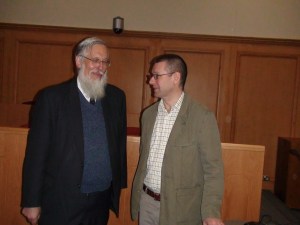
I got this picture this morning from the University of Derby. It was taken at the end of my lecture there last week. The chap on the left of the picture is Jonathan Powers, who is a former pro-vice chancellor of the University of Derby and who introduced my lecture as well as generally acting as master of ceremonies. He’s a very knowledgeable and genial fellow with a huge range of interests.

Over drinks after the talk he told me how he had recently become involved with a campaign to save the historic Derby Playhouse which was recently put into administration and is in danger of demolition if the current rescue package doesn’t work out.

I promised to put in a plug for the campaign, but forgot to do so until the photograph reminded me. You can keep in touch with the campaign and hopefully get involved by visiting their website here.

Carbon Footprints

Posted in Biographical with tags , on October 20, 2008 by telescoper

I found out this morning about an altercation during the early hours of Sunday morning in Cardiff’s city centre that resulted in a welsh rugby player having to go to hospital with facial injuries. This all happened about four o’clock in morning somewhere in the Mill Lane area of the city. Any civilised person who knows Cardiff will realize that’s generally an area to be avoided on Saturday night because of the very high density of rather seedy late-night venues and their undesirable clientele. It looks like it might have been a closing-time row but anyway it seems no serious injury was done so it will probably all be alright in the end.

Most of Britain’s cities now seem to have their weekend no-go areas as the national obsession with binge drinking and picking fights for no reason seems to have become entrenched over the last few years. Although these places are loud and unpleasant you can usually avoid trouble quite easily by showing a bit of discretion and walking away from obvious disturbances or, better still, avoiding these places altogether. If drunks want to fight each other, why not have a designated area so they can be contained? Two drunks are unlikely to inflict serious injury on each other if they are too inebriated, and the only real worry is when two gangs decide to embark on a mass brawl. That’s why there’s always a heavy police presence in such places.

I doubt if this kind of crime will attract much attention nationally, but it does remind me of the problems that developed in Nottingham (where I used to live) after the enormous increase in the number bars and clubs in the city centre about ten years ago followed by the more recent relaxation of the laws on licensing hours. Nottingham’s central area, including the Lace Market, now has over three hundred and fifty drinking establishments and at weekends these draw an estimated 100,000 people into the city on Saturdays. The consequent pandemonium never really affected me personally as I didn’t go to the pubs and clubs in that area, and had anyway been been brought up in Newcastle which has a similar reputation, but it did cause a considerable strain on the local police force and may have contributed to their difficulty in controlling Nottingham’s soaring crime figures.

On the other hand, when Nottingham acquired the nickname of the Gun Capital of Britain this definitely did have an impact close to home for me, as it clearly affected the number of student applications to the University of Nottingham. Although (as far as I know) no student was ever involved in a gun crime, there was also a rise in low-level crime including burglaries which did affect many students especially those living off-campus in the Lenton and Radcliffe areas. On most admissions days we had to contend with questions from both parents and students about crime and it was a constant struggle to counter the impression that Nottingham was a completely lawless place.

My own house was burgled a few years ago too, and several other members of staff I knew there had break-ins and other experiences with crime while I was living there. Ironically, in my case I’d just been involved in running an open day for prospective new students which had gone very well and I’d spent the evening having a few drinks in the Staff Club on the campus at University Park. I walked home to Beeston, which is near the campus, but when I got to my house I saw all the lights were on, which they weren’t when I left that morning. One of the ground floor windows had been forced open and the house was very cold, caused by the fact that the window and back door to the garden were open. Once I’d recovered from the shock I started to worry that something might have happened to Columbo, but he appeared very soon showing no signs of harm having probably slept through the whole thing.

I looked around the house and discovered that they had taken quite a lot of things, making good their escape through the garden at the back of my house thus avoiding drawing attention to themselves in the street at the front. They had taken a bit of foreign currency, a portable CD player, TV, a vacuum cleaner and various other inconsequential things. But they also took a lot of my CDs, some of which were quite obscure and difficult to replace. Although I was fully insured, so I didn’t actually lose anything much in a financial sense, I was definitely very annoyed about losing some of my favourite music. On the other hand, I wasn’t too bothered about the mess the burglars had made because my house is never very tidy anyway.

I called the police and they were at the house within a few minutes. After a cursory look around they left me a card, logged the incident and went away, telling me to try not to touch anything until the forensic officer came the next day. I called the insurers and the next morning a guy came to fix the window and door. By then I had calmed down and was just interested in getting things back to normal.

Then a SOCO (Scene-of-Crime-Officer) arrived to do some forensic tests. I had been an avid watcher of CSI: Crime Scene Investigation for some time so I was quite interested to see what sort of tests they would do.

It wasn’t anything like the TV. The lady that came sprinkled powder here and there and then announced that the intruders must have worn gloves. Then she went into the back ground floor room that led into the garden. This room had a wood laminate floor which was covered in muddy footprints.

“Oh great,” she said “I can use this new stuff!”

She rummaged in her bag and brought out some kind of graphite powder and sheets of plastic stuff like clingfilm. She poured the powder all over the floor and lifted several footprints using the sticky plastic.

“I never tried this before. I’ll let you know when I get back to the lab whether I can identify the prints.”

And off she went, leaving the powder for me to clean up. That turned out to be impossible because it was stuck deep into the grain of the wood. It was a hell of a job to clean off the fingerprint stuff too. They never show you that in the movies.

Anyway, the next day I got an excited phone call from the conscientious SOCO. She had identified the footprint. It was a size 7 Reebok trainer. Gee, I thought, there must only be a few thousand of those in Nottingham. Obviously, this discovery didn’t help much and the crime remains unsolved.

I was thinking of sending a bill for the cleaning, but decided against.

The Veggiana Monologues

Posted in Biographical, Cardiff, Maynooth with tags , on October 19, 2008 by telescoper

I’m not a vegetarian, but I do like vegetables.

A few years ago when I lived in Nottingham I decided on a plan to increase the quantity and quality of the vegetables I was eating by ordering a weekly box of from an organic supplier. The one I picked there was River Nene who provided very good stuff all year around. When I moved I had to cancel the arrangement, and I remained predominantly inorganic while I was renting a flat here. When I finally managed to buy a new house and move in, though, I looked to reestablish the regular deliveries. I was pleased to find a company called River Ford, which is kind of affiliated to River Nene, and which undertakes deliveries of organic produce in the Cardiff area. I’ve been getting a box from them regularly for a few months now, and I’m very happy with the quality.

There are several reasons why I get my vegetables this way.

First and foremost, organically grown vegetables definitely taste far nicer than the bland varieties carried by most mainstream suppliers, including both supermarkets and local greengrocers. Once you’ve tasted how carrotty a carrot should be you’ll never want to eat one of those supermarket ones that look too orange to be true and have no flavour at all.  This applies not just to carrots but to most vegetables; fresh organic ones are so much better. Although, strictly speaking, they are not vegetables, organic mushrooms are particularly good. I often get the huge flat portobello variety which are absolutely delicious and are very easy to include in all kinds of dishes.

Some supermarkets do carry organic ranges but the prices are astronomical, and they are often shipped in from all around the world. That brings me to the second point which is that all (or virtually all) the vegetables I get in my weekly box are grown locally. They’re correspondingly fresh and the environmental impact of bulk transportation is also lessened.

Third, the nature of the scheme is that all the vegetables are seasonal. I think it’s quite sad that people have largely forgotten about the passing of the seasons by virtue of the fact that you can get strawberries all year around in Sainsbury’s. I think it’s have a bit more respect for the passage of time and enjoy the correct food when it happens to be ready. You wouldn’t want to have Xmas dinner every day, so why not be prepared to wait until October to eat fresh sweetcorn?  To every thing there is a season. There’s always something yummy to eat if you’re prepared to be imaginative with your cooking.

And that’s the final point. I have a standing order for a small box of vegetables every week costing about £10. The composition varies from week to week and with the time of year. The company does email and post on its website the contents of the following week’s boxes, but I generally don’t look at it. When the box arrives, it’s usually a mixture of staples (potatoes, carrots, onions, etc) plus things that are not so familiar, and that I’ve often never cooked before.  If it hadn’t been for the veggie box, I would probably never have found out about how to cook chard, romanesco, jerusalem artichokes and celeriac. I look forward to these surprises. Not knowing exactly what’s coming forces me to cook new things, and if I don’t know how to cook them there’s always google.

Of course, the summer salads and lighter things have now finished and, with winter coming on, there will be more root vegetables. I think the heavier vegetables tend to put some people off a bit, but there’s enough variety to keep it fun. Last week’s box contained a nice swede and leeks (of course, I’m in Wales) among other things, but I’m really looking forward to cauliflower and parsnips which should be ready soon.

Each box looks like a lot of food, but I always manage to eat most of it. I have to admit that not all my culinary experiments are successful, but more often than not I am pleasantly surprised. I tried curried beetroot a few weeks ago, with more than a little trepidation. It turned out to be absolutely delicious, even if I did have to ad-lib a bit with some of the ingredients. The only drawback was an unexpectedly colourful trip to the lavatory the next morning…

Anyway, if anyone is thinking of taking the plunge I’d thoroughly recommend them. You don’t have to buy vegetables the way I do it. You can do one-off orders or you can order specific things rather than set boxes.  They do meat and poultry too, but you have to buy a relatively large amount and I don’t eat enough meat to make it worthwhile. I also have a splendid butcher around the corner from me and tend to buy enough there to satisfy my carnivorous side.

I thought I’d break my own tradition and have a peep at what Tuesday’s box has in store. Here we go:cosmos potatoes, red onions, carrots, cauliflower, bunched beetroot, sweetcorn, butternut squash, cavolo nero

Hang on a minute. Cavolo Nero? For a moment I thought it was a black horse from Italy, but  a quick google and I learn that it is Black Kale. Sounds nice. The carrots are always tasty and as I’d hoped the cauliflower is coming through now. I thought the sweetcorn might be finished, but there’s more on the way apparently. Butternut squash is quite trendy these days.

And more beetroot. Ah well. At least this time I won’t think I’m suffering from internal bleeding.
Theories of Everything

Posted in The Universe and Stuff with tags , on October 18, 2008 by telescoper

A string theorist arrives home one evening. When he goes into his house, his wife tells him that she’s hired a private detective who has been following him for the past week and she now knows he’s having an affair with another woman.

“But darling…” says the string theorist. “I can explain everything.”

Space Invader

Posted in Columbo on October 18, 2008 by telescoper
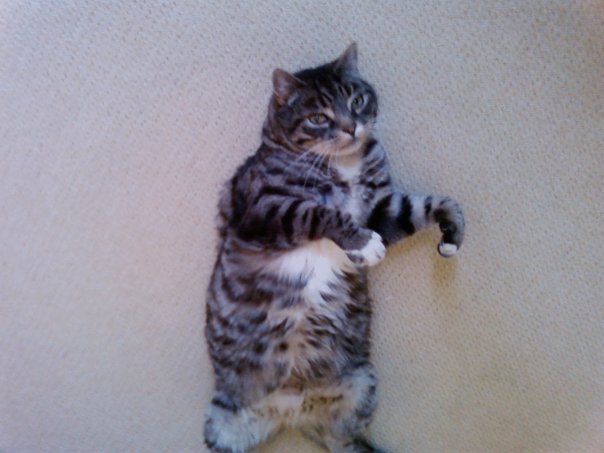
Columbo, resting before an exhausting day's sleep

Columbo, resting before an exhausting day's sleep

I think I should post a short message on behalf of Columbo to his many admirers. He’s doing well, having perked up enormously over the past few weeks. When I first moved into my new house at the end of June this year he seemed a bit down, and I couldn’t work out whether it was the dislocation of moving or the non-stop rain that carried on throughout July and August that made him a bit less ebullient than usual. It was probably a mixture. But the fine weather we have been having over the last few weeks led to him spending a lot more time outside and he’s looking and acting like he’s in fine fettle.

Another factor he had to contend with was that when we first moved in we were visited a few times by a strange black-and-white cat who seemed to upset Columbo, although as far as I know they never fought. Columbo is a heavyweight (about 7kg), but such a softy he never wins no matter how much smaller his opponent is. Anyway, after a few visits this other cat obviously decided that there wasn’t much fun to be had at my house so I haven’t seen it again all summer. I think Columbo was glad to see the back of it.

Last weekend, though, another cat turned up and sat on my shed roof. Actually, it’s not really a shed. It’s the old outside toilet that belonged to this house. It no longer has a loo in it, but it’s a sold brick building and very handy for storing things. The only problem with it is a big hole in the roof, which I have yet to get fixed. Cats are smart enough not to fall into holes like that, so this cat was quite secure in his vantage point. He was a very handsome chocolate-coloured long haired cat, and he was one of those cats who just seems to love looking. I’ve met several cats of that type over the years; you can often see them looking out of windows when you pass people’s houses. They sit motionless like small statues, just looking.

Columbo has never been a looker in that way. I think he gets bored easily so a few minutes of watching things and he generally goes to sleep. In fact after a few minutes of anything at all he usually goes to sleep.

But this cat sat on the roof, looking, and for some reason he was driving Columbo to distraction, probably because he was on Columbo’s turf, metaphorically speaking (because there is no actual turf on the toilet roof). He normally doesn’t make that much noise, but he was practically howling in irritation as he paced around the garden. He’s not nimble enough to get onto the roof himself, which is probably just as well because he would probably have come off worst. The visiting cat sat motionless and just carried on looking. It could have been a deliberate attempt to provoke. If so, it worked.

I had to go out at that point, so I left them to it. Columbo has to look after himself sometimes. But when I came back about an hour later the cat was still there on the roof and Columbo was on the lawn, sleeping. Clearly he even gets bored with being annoyed. When I went into the garden Columbo woke up and my presence seemed to scare the invader away. I haven’t seen him since, although he may well have seen me. Cats that like to look are probably looking even when you can’t see them.

Anyway, next week I’ll have to take him to the new vets and get some more medical supplies and food. I hope they’re better than the old ones. I’m just glad that he seems healthy and enjoying life, even to the extent of playing quite a lot with his toy mice from time to time and chasing leaves around the garden whenever it’s windy.

I nearly lost him a couple of years ago when his blood sugar level dived, probably because of too much insulin, and I found him flat out on the kitchen floor struggling for breath. Remembering the stuff I had read on the internet I realised he was in hypoglycemic shock, so I found the bottle of syrup I had bought especially for the purpose and got as much into him as possible before running up to the vets. He was immediately put on a drip and the vet said he was very dangerously ill, but I had done the right thing with the syrup. He stayed at the vet all day and remained unconscious and then was transferred to a veterinary hospital for the night. I really thought he would die, and was even thinking about where I might bury his remains, but the next morning he seemed to be a bit better and I took him home the following night. He gradually recovered and hasn’t had any similar episodes since.

I know he’s old now and needs a lot of looking after. I’ll be very sad when he does pass away. I dread to think how much money he’s cost me or how many things I’ve been unable to do because of his requirements. But it’s worth it. Fellow cat-lovers will understand.

The October Country

Posted in Finance, Literature with tags , on October 17, 2008 by telescoper

I don’t know why I stopped reading science fiction and fantasy stories. I don’t know exactly when either. Perhaps it was a gradual thing to do with getting older. But when I was a teenager that’s the sort of thing I read all the time. I was a big fan of Michael Moorcock and read book after book of his stories, from the swords and sorcery novellas to the amazing End of Time series, and even the trippy psychedelic 1960s adventures of Jerry Cornelius. I enjoyed Tolkien, Mervyn Peake, Asimov,  Arthur C. Clarke and many others which I usually binge-read by buying everything I could find by a given author and ploughing through them one after the other.

One of the authors I devoured in this way was Ray Bradbury, and his books are among the few that I still like to re-read from time to time. To be honest, I wasn’t all that keen on the pure science fiction books like The Martian Chronicles, but I loved his collections of macabre short stories. Perhaps it’s because I now know how difficult it is to write in that genre that my appreciation of his story-telling skill has if anything grown with time.

I was watching the news last night about the continuing tailspin in the world’s stock markets and it reminded me of one of my favourite collections of Ray Bradbury stories, The October Country. I rummaged around in the stacks of old paperbacks I still haven’t got around to putting on shelves – mainly because I haven’t got around to buying enough shelves – and finally located my copy. It’s a weirdly eclectic mixture of the whimsical and the frightening. The October Country of the title isn’t a specific place. It is many places: “a picturesque Mexican village where death is a tourist attraction; a city beneath the city where drowned lovers are silently reunited; a carnival midway where a tiny man’s most cherished fantasy can be fulfilled night after night. The October Country’s inhabitants live, dream, work, die–and sometimes live again–discovering, often too late, the high price of citizenship. Here a glass jar can hold memories and nightmares; a woman’s newborn child can plot murder; and a man’s skeleton can wage war against him. Here there is no escaping the dark stranger who lives upstairs…or the reaper who wields the world.”

What binds the separate tales together is the way Bradbury conjures up an atmosphere that is both autumnal and alien, both familiar and unnerving, like that of a long-forgotten room where dust gathers on lost artefacts of the past.

But what does this have to do with Stock Markets?

The baffling thing is that the greatest episodes of spine-chilling terror that grip the stock market from time to time also always seem to happen in October. The great Wall Street Crash of 1929 happened in October. More recently, the 1987 crash known Black Monday happened in the same month. Now, in 2008, although the credit crunch has been with us for a significant time, the most dramatic drops in share prices have also been in October.

In order to find the answer to why this is the case I went to Wikianswers and discovered somebody has already posted the question, but so far there have been no answers.

Whatever it is, something about October seems to give investors the jitters.

I blame Ray Bradbury.

East Midlands yesterday

Posted in Books, Talks and Reviews on October 16, 2008 by telescoper

I travelled to Derby yesterday to give the annual Flamsteed Lecture, named in honour of John Flamsteed who was born in Derby and was the first Astronomer Royal. I was delighted to find out that there was a full house of around 250 in the audience, including a contingent from Derby and District Astronomical Society who had a display outside the lecture hall at the University of Derby.

Curiously the lecture hall itself turned out to be the “Court Room”, a complete mock up of a court complete with witness box, dock and jury box used for training would-be lawyers. Apparently the local police sometimes use it too, for practicing the giving of the evidence. Anyway, I hope in my case it wasn’t too much of a trial for the audience.

After the lecture there was a wine and cheese reception laid on by the University of Derby and the local branch of Waterstone’s stayed open late so I could do a book signing. That seemed to go well too, although it kept me away from the wine. I didn’t keep track of how many books they sold, but every little helps!

When the festivities were over I went back to the Midland Hotel near Derby station where I crashed out as I had to get a very early train back this morning to give a postgraduate lecture on statistics. Rushing to get my slides together on the train I made quite a few mistakes – I hate powerpoint – and found myself having to correct on the fly during the lecture. I also discovered I had accidentally deleted one slide altogether. As I got increasingly flustered, the lecture degenerated into one of the worst I’ve ever done.

This sort of reflective practise, criticizing one’s performance, is supposed to be good for lecturers to do, but I think it’s probably better to prepare things more carefully in the first place, i.e. not on the train first thing in the morning while trying to contend with a hangover.

Still, at least the train wasn’t late.

The New Inflationary Universe

Posted in Finance, Science Politics on October 14, 2008 by telescoper

Among the bits of economic information released by the Office of National Statistics today is one item that academics in all disciplines wanted to hear about: the value of the Retail Prices Index (RPI) in the UK for September 2008, which turned out to be 5.0%.

The reason for the fascination with this number is that, in an unusual spasm of farsightedness, the University and College Union stipulated that the final stage of the pay deal it negotiated in 2006 would be applied in October 2008 and this would amount to 2.5% or the RPI whichever is the greater. Two years ago it seemed a very different world, and 2.5 % seemed to be much the likelier eventuality, but energy and commodity prices surged last year and the RPI now stands at double that figure. So we’re all set for a 5% pay rise this month, although probably we won’t actually get any more money until the November pay packet arrives.

It would have been even better had UCU chosen the Consumer Prices Index (CPI), which has now overtaken the RPI and stands at 5.2%. This is the governments preferred measure of inflation, which is based only on the price of consumer goods and household utilities, while the RPI includes other items such as mortgage costs and transport costs.

At least in the short-term, this seems good news for all academics in UK universities.

But even in paradise there was a serpent, and there is a significant danger that some departments’ balance sheets will suffer very badly from these extra salary costs. Many already operate on very tight margins. In the longer term there may be mergers and closures followed by redundancies. Also since the research councils’ cash allocations for the next few years are already fixed, an increase in salaries over that already accounted for will mean a corresponding reduction in the number of positions that can be funded, which is bad news for younger people looking for PDRA positions. Given that the Science and Technology Facilities Council‘s budget wasn’t very generous in the first place, causing a crisis in funding for astronomy and particle physics research the extra wage demands are likely to cause further strain.

Still, a 5% pay rise just before Xmas will be good while it lasts.