Author Archive

Death and Conkers

Posted in Uncategorized with tags , , on September 24, 2008 by telescoper

Strange connections. No sooner do I post a meandering item about the autumn weather bringing about flashbacks when I get two – quite different echoes – from today’s Guardian.

The first came from the obituary pages, where I read of the death on September 21st 2008 of Professor Sir Brian Pippard, aged 88.

I never knew him personally. In fact he retired from his post as Cavendish Professor of Physics in 1982, which was the year I started my undergraduate degree at Cambridge, so I was never taught by him. His research was predominantly in the area of superconductivity, which is far from my own speciality, so I never knew him through that route either.  But I did develop a kind of respect for him through a little book he compiled, called Cavendish Problems in Classical Physics.

This was on the list of required textbooks I got before I started my time as a student and I still have it today. As its name suggests, this contains all manner of problems about very mainstream topics in physics: electricity, magnetism, mechanics, and so on. Some of them are short, some long, but all have interesting little twists in them and each is instructive in its own way. 

I tried some of these problems on first year physics students at Cardiff last academic year and they turned out to be excessively challenging. In other words, the students couldn’t do them. I don’t want to go into a rant about declining standards of school science teaching, but it is a fact that A-level physics nowadays provides absolutely no preparation for tackling the likes of the  Cavendish Problems because it does not cultivate the kind of lateral thinking needed even to formulate these problems. Instead the students tend to be taken through standard exercises that they learn by rote and regurgitate in examinations. Anything different to what they’ve been led through completely throws them. I’m generalizing horribly, I know, but there’s a lot of truth in there.

It’s not so much that students can’t complete the Cavendish problems, but that they don’t even know how to start. It’s a shame that the art of genuine problem solving is so badly neglected in today’s schools, especially because its the bit that’s the most fun .  The brain can be so much more than a memory device, if only we could free up future generations of young minds by abandoning the obsession with modularised, factoid based teaching.

I think Brian Pippard would have agreed.

The other of today’s autumnal flashbacks was triggered by a short piece about the humble horse chestnut tree.  At this time of year the ground underneath these trees is covered with conkers which are collected by schoolboys and used in the game of the same name.  Or at least that’s what used to happen.

Apparently, for several years now horse chestnut trees have been struggling with adverse weather and attacks from moths. Now they have an even tougher enemy, a virulent disease called bleeding canker. This causes a sticky ooze to emanate from the trunk and branches of the trees, the leaves to die much earlier than usual and, worst of all,  the conkers to be very small or even non-existent. The bacterium that causes this disease  now infects about half the horse chestnut trees in the United Kingdom, and there is no known cure.

The death of high school physics is bad enough, but how can we ever cope without conkers?

Poetry Corner

Posted in Uncategorized with tags , on September 23, 2008 by telescoper

COMPOSED A FEW MILES BELOW TINTERN ABBEY, ON NEVER REVISITING THE BANKS OF THE WYE DURING A TOUR. September 22 , 2008.

When Tintern Abbey still had bells,
Which it does not now because it’s ruin’d,
Imagine when those bells were rung
And echoed across the Sylvan Wye.
Was their sound by those who heard them
Called a Tintern-abulation?

Peter Coles

The MacGuffin Factor

Posted in Science Politics, The Universe and Stuff with tags , , , on September 22, 2008 by telescoper

Unpick the plot of any thriller or suspense movie and the chances are that somewhere within it you will find lurking at least one MacGuffin. This might be a tangible thing, such the eponymous sculpture of a Falcon in the archetypal noir classic The Maltese Falcon or it may be rather nebulous, like the “top secret plans” in Hitchcock’s The Thirty Nine Steps. Its true character may be never fully revealed, such as in the case of the glowing contents of the briefcase in Pulp Fiction , which is a classic example of the “undisclosed object” type of MacGuffin. Or it may be scarily obvious, like a doomsday machine or some other “Big Dumb Object” you might find in a science fiction thriller. It may even not be a real thing at all. It could be an event or an idea or even something that doesn’t exist in any real sense at all, such the fictitious decoy character George Kaplan in North by Northwest.

Whatever it is or is not, the MacGuffin is responsible for kick-starting the plot. It makes the characters embark upon the course of action they take as the tale begins to unfold. This plot device was particularly beloved by Alfred Hitchcock (who was responsible for introducing the word to the film industry). Hitchcock was however always at pains to ensure that the MacGuffin never played as an important a role in the mind of the audience as it did for the protagonists. As the plot twists and turns – as it usually does in such films – and its own momentum carries the story forward, the importance of the MacGuffin tends to fade, and by the end we have often forgotten all about it. Hitchcock’s movies rarely bother to explain their MacGuffin(s) in much detail and they often confuse the issue even further by mixing genuine MacGuffins with mere red herrings.

North by North West is a fine example of a multi-MacGuffin movie. The centre of its convoluted plot involves espionage and the smuggling of what is only cursorily described as “government secrets”. But although this is behind the whole story, it is the emerging romance, accidental betrayal and frantic rescue involving the lead characters played by Cary Grant and Eve Marie Saint that really engages the characters and the audience as the film gathers pace. The MacGuffin is a trigger, but it soon fades into the background as other factors take over.

There’s nothing particular new about the idea of a MacGuffin. I suppose the ultimate example is the Holy Grail in the tales of King Arthur and the Knights of the Round Table and, much more recently, the Da Vinci Code. The original Grail itself is basically a peg on which to hang a series of otherwise disconnected stories. It is barely mentioned once each individual story has started and, of course, is never found.

Physicists are fond of describing things as “The Holy Grail” of their subject, such as the Higgs Boson or gravitational waves. This always seemed to me to be an unfortunate description, as the Grail quest consumed a huge amount of resources in a predictably fruitless hunt for something whose significance could be seen to be dubious at the outset.The MacGuffin Effect nevertheless continues to reveal itself in science, although in different forms to those found in Hollywood.

The Large Hadron Collider (LHC), switched on to the accompaniment of great fanfares last week, provides a nice example of how the MacGuffin actually works pretty much backwards in the world of Big Science. To the public, the LHC was built to detect the Higgs Boson, a hypothetical beastie introduced to account for the masses of other particles. If it exists the high-energy collisions engineered by LHC should reveal its presence. The Higgs Boson is thus the LHC’s own MacGuffin. Or at least it would be if it were really the reason why LHC has been built. In fact there are dozens of experiments at CERN and many of them have very different motivations from the quest for the Higgs.

Particle physicists are not daft, however, and they have realised that the public and, perhaps more importantly government funding agencies, need to have a really big hook to hang such a big bag of money on. Hence the emergence of the Higgs as a sort of master MacGuffin, concocted specifically for public consumption, which is much more effective politically than the plethora of mini-MacGuffins which, to be honest, would be a fairer description of the real state of affairs.

Even this MacGuffin has its problems, though. The Higgs mechanism is notoriously difficult to explain to the public, so some have resorted to a less specific but more misleading version: “The Big Bang”. As I’ve already griped, the LHC will never generate energies anything like the Big Bang did, so I don’t have any time for the language of the “Big Bang Machine”, even as a MacGuffin.

While particle physicists might pretend to be doing cosmology, we astrophysicists have to contend with MacGuffins of our own. One of the most important discoveries we have made about the Universe in the last decade is that its expansion seems to be accelerating. Since gravity usually tugs on things and makes them slow down, the only explanation that we’ve thought of for this perverse situation is that there is something out there in empty space that pushes rather than pulls. This has various possible names, but Dark Energy is probably the most popular, adding an appropriately noirish edge to this particular MacGuffin. It has even taken over in prominence from its much older relative, Dark Matter, although that one is still very much around.

We have very little idea what Dark Energy is, where it comes from, or how it relates to other forms of energy we are more familiar with, so observational astronomers have jumped in with various grandiose strategies to find out more about it. This has spawned a booming industry in survey of the distant Universe (such as the Dark Energy Survey) all aimed ostensibly at unravelling the mystery of the Dark Energy. It seems that to get any funding at all for cosmology these days you have to sprinkle the phrase “Dark Energy” liberally throughout your grant applications.

The old-fashioned “observational” way of doing astronomy – by looking at things hard enough until something exciting appears (which it does with surprising regularity) – has been replaced by a more “experimental” approach, more like that of the LHC. We can no longer do deep surveys of galaxies to find out what’s out there. We have to do it “to constrain models of Dark Energy”. This is just one example of the not necessarily positive influence that particle physics has had on astronomy in recent times and it has been criticised very forcefully by Simon White.

Whatever the motivation for doing these projects now, they will undoubtedly lead to new discoveries. But my own view is that there will never be a solution of the Dark Energy problem until it is understood much better at a conceptual level, and that will probably mean major revisions of our theories of both gravity and matter. I venture to speculate that in twenty years or so people will look back on the obsession with Dark Energy with some amusement, as our theoretical language will have moved on sufficiently to make it seem irrelevant.

But that’s how it goes with MacGuffins. Even the Maltese Falcon turned out to be a fake in the end.

p.s. I heard on Saturday that the LHC is having some problems with its magnets and will actually be off-line for a few months. Last week I heard a particle physicist describing the great switch-on as like “Christmas”. This turns out to have been truer than he can have imagined. Only a week has passed and his most expensive toy is already broken…
Equinox

Posted in Biographical with tags , on September 22, 2008 by telescoper

Yesterday I sat in the garden doing the crosswords in the weekend papers. This was the first Sunday in my new home that I’ve been able to do that without getting drenched by the continuously pouring rain. Now the summer is officially over and the weather takes a perverse turn for the better. Although my house is quite close to a big road, it was very quiet all afternoon.

Columbo has really taken to the decking that occupies the far corner of the little garden. He lies on his back with his eyes closed, his big belly as white as my freshly pegged out laundry. Closing his eyes, he waves his paws around as he tries to catch butterflies or birds or whatever other imaginary creatures flutter through the dreamscape of a cat’s mind.

The weather is unsettling. It’s warm, but somehow the warmth doesn’t quite fill the air; somewhere inside it there’s a chill that reminds you that autumn is not far away.

I find this kind of weather a bit spooky because it always takes me back to the time when I left home to go to University, as thousands of fledgling students are about to do this year in their turn. I did it 26 years ago, getting on a train at Newcastle Central station with my bags of books and clothes. I said goodbye to my parents there. There was never any question of them taking me in the car all the way to Cambridge. It wasn’t practical and I wouldn’t have wanted them to do it. After changing from the Inter City at Peterborough onto a local train, we trundled through the flatness of East Anglia until it reached Cambridge. The weather, at least in my memory, was exactly like today.

I don’t remember much about the actual journey, but I must have felt a mixture of fear and excitement. Nobody in my family had ever been to University before, let alone to Cambridge. Come to think of it, nobody from my family has done so since either. I was a bit worried about whether the course I would take in Natural Sciences would turn out to be difficult, but I think my main concern was how I would fit in generally.

I had been working between leaving school and starting my undergraduate course, so I had some money in the bank and I was also to receive a full grant. I wasn’t really worried about cash. But I hadn’t come from a posh family and didn’t really know the form. I didn’t have much experience of life outside the North East either. I’d been to London only once before going to Cambridge, and had never been abroad.

I didn’t have any posh clothes, a deficiency I thought would mark me as an outsider. I had always been grateful for having to wear a school uniform (which was bought with vouchers from the Council) because it meant that I dressed the same as the other kids at School, most of whom came from much wealthier families. But this turned out not to matter at all. Regardless of their family background, students were generally a mixture of shabby and fashionable, like they are today. Physics students in particular didn’t even bother with the fashionable bit. Although I didn’t have a proper dinner jacket for the Matriculation Dinner, held for all the new undergraduates, nobody said anything about my dark suit which I was told would be acceptable as long as it was a “lounge suit”. Whatever that is.

Taking a taxi from the station, I finally arrived at Magdalene College. I waited outside, a bundle of nerves, before entering the Porter’s Lodge and starting my life as a student. My name was found and ticked off and a key issued for my room in the Lutyen’s building. It turned out to be a large room, with a kind of screen that could be pulled across to divide the room into two, although I never actually used this contraption. There was a single bed and a kind of cupboard containing a sink and a mirror in the bit that could be hidden by the screen. The rest of the room contained a sofa, a table, a desk, and various chairs, all of them quite old but solidly made. Outside my  room, on the landing, was the gyp room, a kind of small kitchen, where I was to make countless cups of tea over the following months, although I never actually cooked anything there.

I struggled in with my bags and sat on the bed. It wasn’t at all like I had imagined. I realised that no amount of imagining would ever really have prepared me for what was going to happen at University.

I  stared at my luggage. I suddenly felt like I had landed on a strange island where I didn’t know anyone, and couldn’t remember why I had gone there or what I was supposed to be doing.

After 26 years you get used to that feeling.

Nice work if you can get it..

Posted in Books, Talks and Reviews with tags , , , on September 19, 2008 by telescoper

I’ve just discovered that my review of Steven Weinberg’s new book “Cosmology” has been published today in the American journal Science. ( I think the link will only work if you or your institution has a subscription to the magazine.) It’s quite a nice job getting to review books like this, not because you get paid a lot (in fact, usually you don’t get paid at all), but because you get a free copy of the book and there is a clear incentive to read it. Reviews themselves are quite easy to do, as they’re usually only around a thousand words so don’t take more than an hour or so to rattle off.

The case of this particular book is quite unusual, thought, because Science usually only includes reviews of popular-level books, and this one is very technical. However, because Weinberg is such an eminent and well known physicist and this work is a long-awaited update of his classic Gravitation and Cosmology (published in 1972), it makes an interest subject for a review even if it is probably impossible for a non-specialist to actually read and understand all of it. It’s definitely not for the mathematically faint-hearted. In the review I stayed off the mathematical details and tried to explain how this book exemplifies the changes that have taken place in cosmology over the past thirty or forty years. Anyway, as you will see if you read the review, I liked the updated book a lot but I think it’s definitely for connoisseurs rather than absolute beginners.

Selling Shorts in the September Sun

Posted in Finance with tags , on September 19, 2008 by telescoper

I’ve been following the wild instabilities in the stock market over the last few weeks with a mixture of amusement and despair. On the one hand it’s not at all unpleasant to see some overpaid city slickers brought back down to earth, but on the other it’s alarming to see how the world economy depends so strongly on a the whims of a bunch of erratic traders.

After what seems like weeks of falls on the stock market, shares suddenly leaped up by about 8% this morning on news that the government had banned “short-selling” on a particular set of shares. As I understand it, short selling basically means you borrow shares in a company and then sell them in the hope that the price will fall. When it does, you buy back the shares at a lower price, return them to wherever you borrowed them from, and pocket the difference. Basically it’s a bet on the future behaviour of the shares. This violates one of my two rules about gambling, namely that you should only gamble with your own money and it is a bit surprising it was ever allowed anyway.

On the other hand, even this is a bit more transparent than the practice of buying and selling derivatives, where you don’t even have to possess (however temporarily) the thing you sell. This kind of activity is what hedge funds do all the time. They operate on the principle that you can make different kinds of bets at the same time in such a way as to guarantee a win. Bookies on a racetrack are smart enough to ensure that a punter can never make a combination of bets that ensures a profit, but this is not the case with shares and other financial dealings.

Anyway, apparently the reason why banking shares have plummetted recently is that there’s been a lot of short selling and the government decided to stop it, at least temporarily. I suppose it’s good that they are actually trying to do something to stop the chaos, but I think the underlying problem is that the UK and other western economies have been living beyond their means for many years and, despite best efforts to paper over the cracks, some kind of retribution is inevitable. It wouldn’t surprise me if next week the FTSE dived again as emerges that hedge funds weren’t really responsible for the problem in the first place.

Maybe the reason why the FTSE has really been falling has been overlooked. Over the last two years since the credit crunch became apparent, the weather in the UK has been very poor. Two summers of heavy rain may have had more influence on the optimism of city traders that interbank lending rates. Perhaps that’s the kind of liquidity that really gets them down (geddit?). This week the weather is nicer, so shares have risen. I’m sure you can correlate the FTSE index with the weather and a result at least as significant as with any other econometric indicator.

I’ve got a little bit of personal interest in this because, although I’m not really a player on the stock market, I do have a 10-year investment plan that matures at the end of October this year. If I’d been able to bale out this time last year I would have made a healthy profit on it, but now it looks like this years losses will wipe most of that out. Even if they don’t, it’s been a white knuckle ride so when I do get the cash I’ll probably put it somewhere much safer, allthough I don’t know what is really safe these days and I’m maxed out on grannie bonds.

In the meantime, I’m just left with the feeling that so much of our modern economy is not only artificial but also impenetrable to ordinary people. In a sense it doesn’t matter very much if a few city tossers get burned, but the fallout from the ongoing Credit Crunch will have a real impact on the lives of ordinary people through redundancies and loan defaults as unsustainable companies go to the wall. We all fool ourselves that we live in a democracy where we can influence the way the country is run, but the fact of the matter is that governments really don’t have the resources to control or even influence global capitalism to any great extent.

Surely there has to be a better way…

Columbo

Posted in Columbo with tags on September 18, 2008 by telescoper

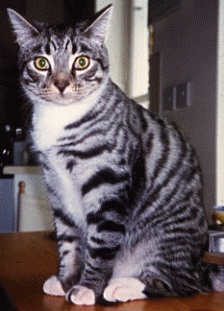
I suppose it’s time to introduce Columbo, who has owned me since he was a kitten. He’s about 14 now. The photograph is of him when he was a bit younger (and a bit less massive) taken in my old flat in Bethnal Green, London, before I moved to Nottingham and then here to Cardiff. The picture doesn’t quite convey the scale, because he’s a big fellow – he weighs in around 7kg. He’s big boned, but is also quite fat, despite my attempts to control his diet. About three years ago he was diagnosed as being diabetic which means that he needs to have two insulin injections every day. That probably sounds a bit scary, but the needles are very small and the insulin dose is miniscule so it’s actually quite easy to do. It does mean, however, that I have to be there to do the injections every morning and evening or if I go away anywhere I have to try to get someone else to do it instead. I generally use a petsitter service these days if I go away, because they generally employ veterinary nurses, but over the years I have relied on friends a lot to help out, especially when I lived in Beeston.

Many -perhaps even most – people are scared of injections, but Columbo doesn’t seem to be fazed by them at all. His main priority in life is food (since he’s been neutered the obvious other distraction doesn’t affect him). The trick is to put his food down and then inject into the scruff of the neck while he’s scoffing it. The insulin doesn’t go into the bloodstream directly, but into the fatty tissue in the neck which has very few nerve endings in it (which is why you can pick a cat up by the scruff of the neck without it feeling pain). He barely notices the jab.

The only other noticeable thing about diabetic cats is that they drink a lot of water. If the blood sugar level goes very high then the kidneys have to work hard to get rid of the glucose via the urine, a process which uses up a lot of water. I always put lots of fresh water down for him with his food, but he prefers to go outside and drink dirty water from the drains or plant pots. Vets have told me that cats have a very strong sense of smell, much better than ours, and tap water often smells of chlorine to them so they don’t like it so much. Actually the water in Cardiff is very hard too, and tastes very different from where I used to live.

Every six months or so, he usually has to have a blood sample extracted so that the fructosamine levels can be tested. This apparently is a diagnostic of the level of sugar in the blood over the previous month or so, and therefore is a measure of how well the diabetes is controlled. Last time he was fine, and he certainly seems to be in pretty good health, for an old cat. He gets around alright, but at his own pace.

When he was first diagnosed as diabetic it took quite a long time to establish the correct dose of insulin, so I had to keep taking him back to the vet for blood and urine samples to be taken and tested for glucose. The vet always used to take him into another room to do this. I know how they take a blood sample (from the neck), but I was curious about the urine sample as Columbo’s not noted for the accuracy of his aim. When I asked the vet he said that usually to get a urine sample they have to put a needle into the cat’s bladder, which sounds awful, but in Columbo’s case that wasn’t necessary. Whenever they put the needle in to take the blood sample, he always piddled all over the table….

Anyway, Columbo was looked after very well in Nottingham by the Priory Vets who were really excellent. When he first moved down here he was living with a friend of mine in the Whitchurch area while I was renting a little flat and trying to buy my own place. I registered Columbo with Valley Vets, but it’s quite a long way from my new house. Having no car – I can’t drive – it’s quite a pain trekking up there, especially with a 7kg cat in a box to carry. Basically I have to get a taxi, and not all drivers like to take animals in their cars. I’m also very unhappy with the service they provide. I have to order insulin once a month along with special food which can only be obtained from a vet. (Columbo used to be very partial to poppadoms, but can’t eat them now.) They don’t keep a stock of either insulin or food, so I order it by phone and then check by phone that it has arrived before going there to pick it up. The last three occasions I have been told they had my order but when I traipsed up there to pick it up there’s always been something missing or wrong. Sometimes it was the wrong type of insulin. Sometimes there was no food. This morning I took Columbo for a checkup having ordered food and insulin earlier this week. The check-up went OK but when I went to pay and collect the gear, it turned out that they didn’t have the food after all. This was after a 20-minute wait standing in reception with a taxi on the meter outside. I’m afraid I lost my temper with them, said some choice words (which I regret), paid for what I’d got and then stormed out saying that I was going to find a different vet.

About an hour later I got a call from one of the vets, which I assumed was going to be an apology for screwing up again. Instead he was demanding an apology from me for upsetting the staff in reception with my behaviour. In retrospect this wasn’t without justification, and I’m not at all proud I lost my temper. I’m definitely becoming a grumpy old man, and it’s very disagreeable to realise it. I have sent some flowers to the receptionists by way of an apology. But I won’t be going back to them with or without Columbo.

There’s another vet much closer to my house and I’ve now registered with them. Tune in again for later episodes of the continuing story of Columbo and his drug dependency….

The Curious Case of the Inexpert Witness

Posted in Bad Statistics with tags , , , on September 17, 2008 by telescoper

Although I am a cosmologist by trade, I am also interested in the fields of statistics and probability theory. I guess this derives from the fact that a lot of research in cosmology depends on inferences drawn from large data sets. By its very nature this process is limited by the fact that the information obtained in such studies is never complete. The analysis of systems based on noisy or incomplete data is exactly what probability is about.

Of course, statistics has much wider applications than in pure science and there are times when it is at the heart of controversies that explode into the public domain, particularly when involved in medicine or jurisprudence. One of the reasons why I wrote my book From Cosmos to Chaos was a sense of exasperation at how poorly probability theory is understood even by people who really should know better. Although statistical reasoning is at the heart of a great deal of research in physics and astronomy, there are many prominent practioners who don’t really know what they are talking about when they discuss probability. As I soon discovered when I started thinking about writing the book, the situation is even worse in other fields. I thought it might be fun to post a few examples of bad statistics from time to time, so I’ll start with this, which is accompanied by a powerpoint file of a lunchtime talk I gave at Cardiff.

I don’t have time to relate the entire story of Sally Clark and the monstrous miscarriage of justice she endured after the deaths of her two children. The wikipedia article I have linked to is pretty accurate, so I’ll refer you there for the details. In a nutshell, in 1999 she was convicted of the murder of her two children on the basis of some dubious forensic evidence and the expert testimony of a prominent paediatrician, Sir Roy Meadow. After appeal her convinction was quashed in 2003, but she died in 2007 from alcohol poisoning having apparently taken to the bottle after three years of wrongful imprisonment.

Professor Meadow had a distinguished (if somewhat controversial) career, becoming famous for a paper on Munchausen’s Syndrome by Proxy which appeared in the Lancet in 1977. He subsequently appeared as an expert witness in many trials of parents accused of murdering their children. In the Sally Clark case he was called as a witness for the prosecution, where his testimony included an entirely bogus and now infamous argument about the probability of two sudden infant deaths happening accidentally in the same family.

The argument is basically the following. The observed ratio of live births to cot deaths in affluent non-smoking families (like Sally Clark’s) is about 8,500:1. This means that about 1 in 8,500 children born to such families die in such a way. He then argued that the probability that two such tragedies happen in the same family is this number squared, i.e. about 73,000,000:1. In the mind of the jury this became the odds against the death of Mrs Clark’s children being accidental and therefore presumably the odds against her being innocent. The jury found her guilty.

For reasons why this argument is completely bogus, and more technical details, look in the following powerpoint file (which involves a bit of maths):

the-inexpert-witness

It is difficult to assess how important Roy Meadow’s testimony was in the collective mind of the Jury, but it was certainly erroneous and misleading. The General Medical Council decided that he should be struck off the medical register in July 2005 on the grounds of “serious professional misconduct”. He appealed, and the decision was partly overturned in 2006, the latest judgement basically being about what level of professional misconduct should be termed “serious”.

My reaction to all this is a mixture of anger and frustration. First of all, the argument presented by Meadow is so clearly wrong that any competent statistician could have been called as a witness to rebut it. The defence were remiss in not doing so. Second, the disciplinary action taken by the GMC seemed to take no account of the consequences his testimony had for Sally Clark. He was never even at risk of prosecution or financial penalty. Sally Clark spent three years of her life in prison, on top of having lost her children, and now is herself dead. Finally, expert testimony is clearly important in many trials, but experts should testify only on those matters that they are experts about! Meadow even admitted later that he didn’t really understand statistics. So why did he include this argument in his testimony? I quote from a press release produced by the Royal Statistical Society in the aftermath of this case:

Although many scientists have some familiarity with statistical methods, statistics remains a specialised area. The Society urges the Courts to ensure that statistical evidence is presented only by appropriately qualified statistical experts, as would be the case for any other form of expert evidence.

As far as I know, the criminal justice system has yet to implement such safeguards.

How many more cases like this need to happen before the Courts recognise the dangers of bad statistics?


Among the Literati

Posted in Books, Talks and Reviews with tags , , on September 16, 2008 by telescoper
Front Cover

Front Cover

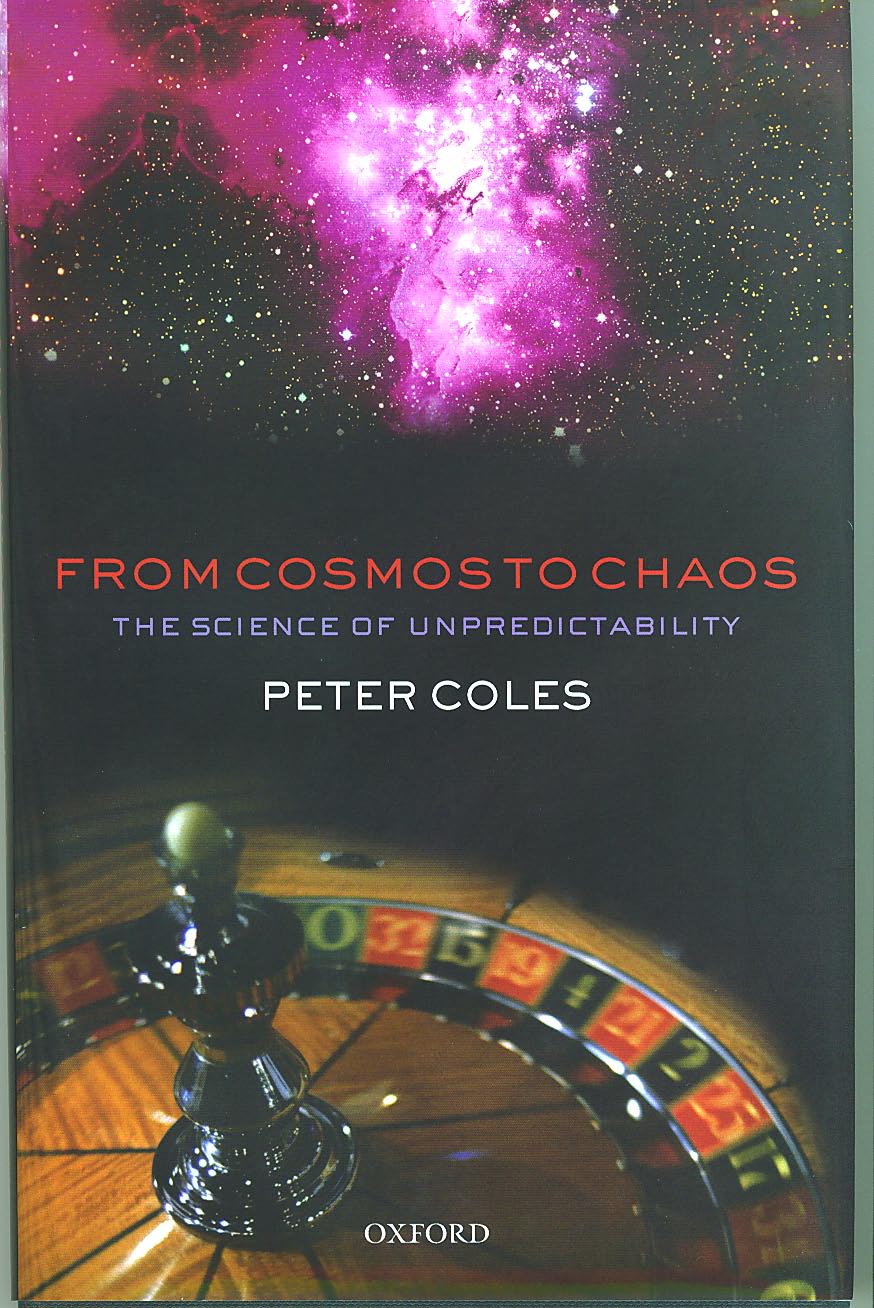
I couldn’t resist including the following which is taken from the Times Literary Supplement (March 28, 2008, No. 5478). I get the TLS mainly for the crossword, and was chuffed when they actually published a review of my book From Cosmos to Chaos, published by Oxford University Press in 2006, and which was also reviewed in Nature and Physics World.

Between you and me the book developed out of a number of bits and pieces about probability theory I had written over quite a long time but never published. I cobbled them together in a rush and the book is a bit of a mess, really. Had I had more time it might have been more coherent. Perhaps. And it didn’t help that OUP didn’t allow me to correct the proofs, so there are lots of typographical errors. Anyway, reviewers have been very generous, particular Jim Bennett (Director of the Museum of the History of Science at Oxford) who wrote the review from which I have taken the following excerpt. And in case you think I edited out the bad bits, that’s not true. He actually reviewed four books in one article and I’ve just taken the bit about mine.

We can turn from inclusiveness and caution to the refreshingly opinionated writing of Peter Coles in From Cosmos to Chaos. This is really a book about probability theory and its application to different branches of science, but Coles is a Professor of Astrophysics, and cosmology is one of the most evident strengths of his book. Here again we learn much besides about our author: he supports Newcastle United, follows cricket and is keen on gambling. His is the only book of these four that has any formal mathematics to speak of, and we are encouraged not to give up at the first hurdle. He also uses illustrations from card games and seems oblivious to the fact that his fascination with contract bridge is just as likely as his affection for mathematical formulae to put readers off.

Coles’s preferred methodology in probability theory is Bayesian, based on an assignment of probabilities, understood as degrees of reasonable belief, to possible outcomes, rather than deriving them from frequency-based statistics.

This preference is carried throughout From Cosmos to Chaos and its epistemological implications are readily embraced. The “standard model” in particle physics, for example, is not absolutely right, but is currently the best bet among the alternatives. The Big Bang is not certain but the best available model given the present array of observational data. A “Theory of Everything” will not, pace Stephen Hawking, reveal the Mind of God – that is “silly” – it will be the most economical description of the universe and a good way of saving paper. The concept of entropy has a “subjective” aspect, not in the sense that anyone can use it as they choose, but because it arises from “the way we manage our knowledge about nature rather than (being) about nature itself’. Here there is a genuine engagement between the scientist, the historian and the philosopher of science.

Is it his approach based on the assignment of reasonable belief that has liberated Coles to express such clear preferences and opinions on all manner of theories? He is good on the difficulties and inadequacies in quantum mechanics, and charming in telling us that, having been warned beforehand that the subject would be confusing, he studied it for three years before realizing “what was the correct way to be confused about it”. He is amazed that the Copenhagen interpretation (where an act of measurement compels a realization of one or other physical states that existed previously only within a distribution of probabilities) could have been embraced seriously by so many highly intelligent people; but he has even less time for the multiverse, and contends that “in the gap left by the failure to find a sensible way to understand quantum reality there has grown a pathological industry of pseudo scientific gobbledegook”.

Coles suggests that the probabilistic descriptions given by quantum mechanics may simply arise from its incompleteness and he sees potential in a Bayesian approach, where quantum states are understood as states of knowledge rather than states of reality. He is pessimistic about the value of string theory: its apparent unconcern for predictable outcomes sets it outside scientific practice, while its plethora of possible accounts of our universe, known as the “string landscape”, would be better called the “string scrap-yard”.

Coles’s mathematics is not always easy to follow, but it seems to occupy its proper place, with the voice of the physicist helping us to position and appreciate it even without full understanding. In the chapter on the Big Bang, for example, the general reader may not understand all of the technical accounts, but she will get a real sense of what cosmology is and the kinds of claims it makes. These are not dogmatic but offered with a kind of realistic integrity and concluded by a series of “open questions” – fundamental but not yet answered. In the last chapter, probabilistic reasoning is applied to questions closer to everyday life, such as medical statistics and expert witnessing, and in a final – seemingly incongruous but enjoyable – addendum Coles addresses the breakdown of trust between scientists and the public. This does not arise from his subject and seems to be there just because the author – characteristically, one feels – had things he wanted to say. While bemoaning decline in the distribution of science understanding, he also berates the baleful effect of the scientific zealot, insisting that the scientific approach is pragmatic rather than idealistic. Coles urges scientists to engage honestly with the public and educationalists not to dumb down the school curriculum.

Gambling for Losers

Posted in Biographical, Finance with tags , on September 16, 2008 by telescoper

In order to encourage fresh-faced school students to pick a Physics degree out of all the possible courses they could University, one of the most persuasive arguments admissions tutors have always trotted out is that it would qualify them for highly paid jobs in the financial services sector. This argument is backed up by surveys of graduate destinations, and is explained by the fact that banking and insurance companies are crying out for numerate people with the ability to analyse complex and often chaotic systems with quantitative rigour.

The most recent episode of the so-called “Credit Crunch” is the fall-out from the collapse of the Lehman Brothers bank which caused heavy falls on Wall Street yesterday and corresponding panic overnight on Asian markets. Apparently far-eastern stocks were affected by the sudden realization that many companies had liabilities arising from the Lehman crisis. It’s interesting that this was all hidden until the bank actually folded…

Anyway, with inflation rising, shares falling and the economy stuttering into recession I wonder how many recent physics graduates may be regretting their choice of career. The rewards may be high, but the risks are high too. I’m glad I remained a physicist, even if my own portfolio appears to be flying south for the winter.

Not that I’m sanctimonious about gambling, as long as (a) it’s with your own money and (b) you don’t bet more than you can afford to lose. I like to bet on various things, and I have a fool-proof system. I usually only bet on events where there are only two outcomes (e.g. football matches) and where I actually support one of the two teams. I bet on the opposition to win, on the grounds that if my team wins I lose the bet but am happy anyway. If the opposition wins then I am financially compensated for my loss.

Being a supporter of Newcastle United, this strategy has stood me in good financial stead because a bet on the opposition is more often than not a good one. Last Saturday’s embarrassing home defeat to lowly Hull City resulted in an especially handsome dividend.

On the other hand the strategy doesn’t always work. A few day’s previously I made a substantial investment on Croatia to beat England in their World Cup qualifying match (in Zagreb). The odds weren’t great and I was sure that Croatia would win. Surprisingly, England won 4-1 and I lost £100.

You can criticise my interest in gambling if you like, but I think this form of betting is more more reputable than the murky dealings taking place on today’s stock markets. And if I happen to lose a bet, it’s not going to make a big hole in anybody’s pension.