Archive for the Art Category

Breaking Free

Posted in Art, Music with tags , , , , , , on January 6, 2017 by telescoper

I’ve been enjoy a series of fascinating programmes about music from the Second Viennese School (chiefly Arnold Schoenberg, Alban Berg and Anton Webern) on BBC Radio 3 this week gathered under the umbrella title of Breaking Free. In the period from roughly 1903 to 1925 these composers finally abandoned the traditional forms of tonality that late Romantic composers such as Gustav Mahler had struggled with in their later work. Aside from its obvious emotional intensity, one of the reasons I find music from this period absolutely absorbing because it was written in a period of highly turbulent transition; you get such a strong sense of new possibilities being opened up when you listen to some of the pioneering works. Some of them are also extremely beautiful. I often hear people say that they they think atonal music sounds ugly, but I disagree. The same people would probably agree that birdsong is beautiful, and most of that is entirely atonal..

The only problem is that I’ve now got a very long list of recordings to buy, as I don’t have any CDs or downloads of some very important pieces. I’m going to be a but poorer financially as a consequence of this educational experience, but hopefully enriched in a cultural sense.

The “breaking free” in this period wasn’t confined to music – revolutionary change was underway in other artistic fields, including painting. Last night I was listening to one of the programmes in the Breaking Free series and it inspired me to have a look in some of my art books for something appropriate to post from the time (if not the location) of the 2nd Viennese School. I decided on this, wan abstract painting by Wassily Kandinsky called Composition VII which was painted in 1913.

composition-vii-1913

Infinite LIGO Dreams

Posted in Art, The Universe and Stuff with tags , , , , , on November 28, 2016 by telescoper

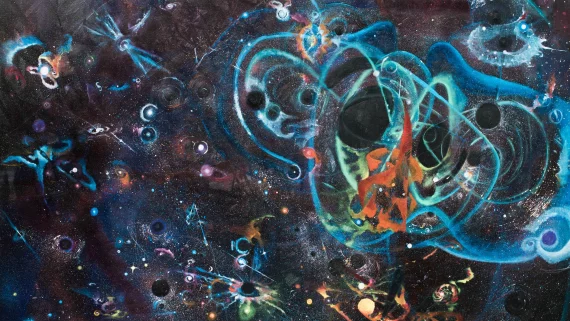
There was a special event in the School of Physics & Astronomy here at Cardiff University on Friday afternoon – the unveiling of a new work of art in our coffee area. The work, a large oil painting, called Infinite LIGO Dreams by local artist Penelope Rose Cowley was inspired by the detection of gravitational waves earlier this year:


gravitational-wave-artwork-copyright-penelope-cowley-16x9

You can read more about this work, and the circumstances behind its creation, at the Cardiff University website and via the Physics World blog. If you like the piece you can order a poster-sized print from Penelope Cowleys’s own website here.

The unveiling of this artwork was preceded by a drinks reception, which probably accounts for the errors that crept into the blog post I wrote on Friday after the party!


Dunes on Mars

Posted in Art, The Universe and Stuff with tags , , , , on November 21, 2016 by telescoper

dunes

This isn’t a new picture, but I hadn’t seen it before a friend put in on their Facebook page at the weekend. It isn’t what I first thought it was – a wonderful piece of abstract art – but is, in fact, an equally wonderful photograph of the inside of the Bunge crater on Mars, where a complex pattern of dunes has formed through wind action. The area covered by the image is about 14 kilometers wide.

According to the official NASA webpage: “This image was taken in January 2006 by the Thermal Emission Imaging System instrument on NASA’s Mars Odyssey orbiter and posted in a special December 2010 set marking the occasion of Odyssey becoming the longest-working Mars spacecraft in history.”

La Gravitation Universelle

Posted in Art with tags , on November 12, 2016 by telescoper

image

(René Magritte, 1943; oil on canvas)

Too Brave To Dream

Posted in Art, Poetry with tags , , , , , , , , on November 7, 2016 by telescoper

berave

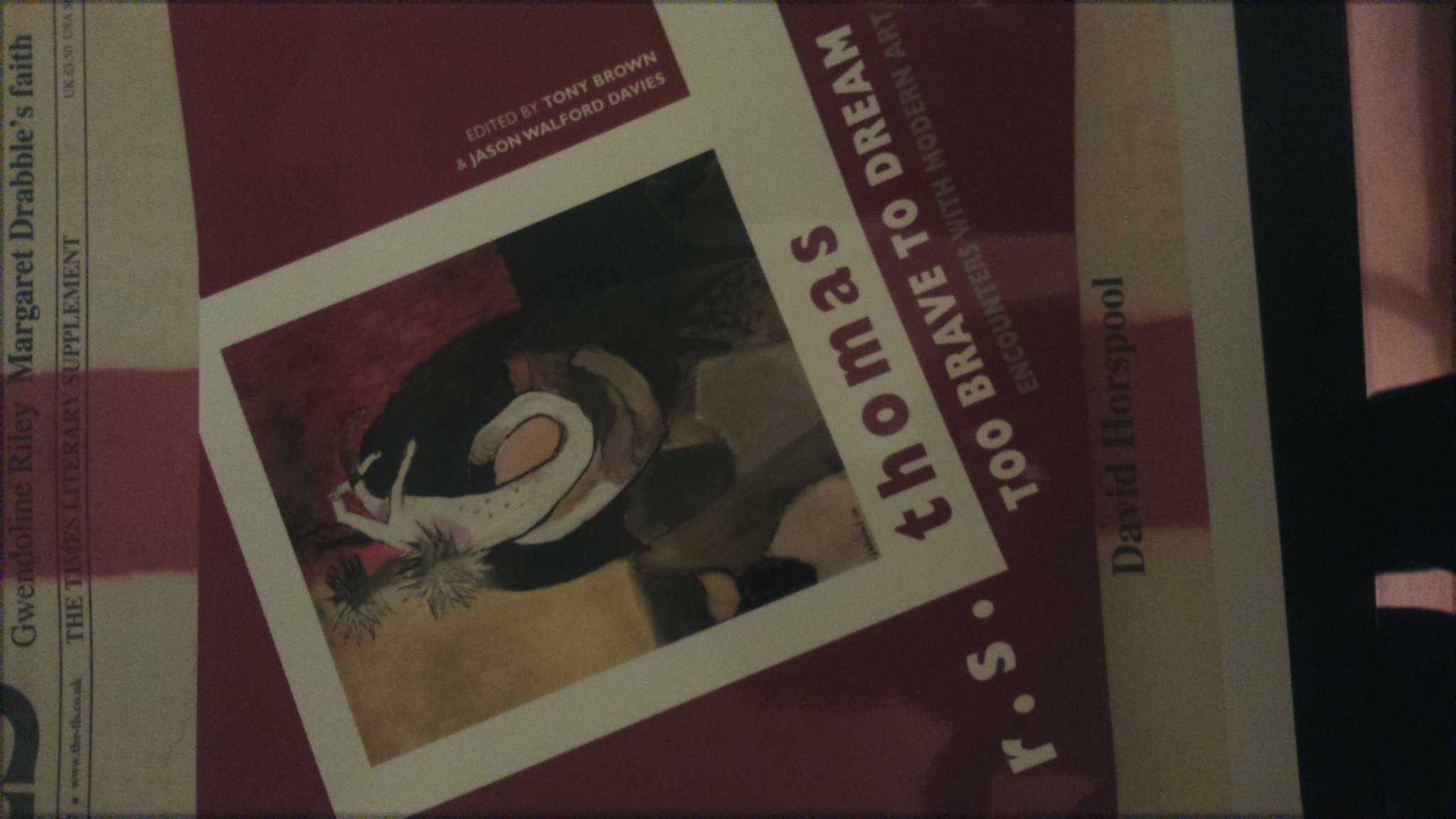
One day last week I found this wonderful item had been delivered to my house. Is a new book called Too Brave To Dream which contains about three dozen previously unpublished poems by R.S. Thomas, who died in 2000. After his death, two seminal studies of modern art were found on his bookshelves – Herbert Read’s Art Now (1933/1948) and Surrealism (1936), edited by Read and containing essays by key figures in the Surrealist movement. Poems handwritten by Thomas were later discovered between the pages of the two books. These poems written in response to a selection of the many reproductions of modern art in the Read volumes, including works by Henry Moore, Edvard Munch, George Grosz, Salvador Dalí, René Magritte and Graham Sutherland – many of whom were Thomas’s near contemporaries. Written between 1987 and 1993, these poems are published in Too Brave To Dream for the first time – alongside reproductions of the works of modern art that inspired them. They poems are instantly recognizable as works of R.S. Thomas. According to the publishers blurb:

Thomas’s readings of these often unsettling images demonstrate a willingness to confront, unencumbered by illusions, a world in which old certainties have been undermined. Personal identity has become a source of anguish, and relations between the sexes a source of disquiet and suspicion. Thomas’s vivid engagements with the works of art produce a series of dramatic encounters haunted by the recurring presence of conflict and by the struggle of the artist who, in a frequently menacing world, is ‘too brave to dream’.

The poems vary considerably in style and mood. Some are wry and playful – although Thomas isn’t perhaps best known for his sense of humour, he certainly wasn’t averse to playing with words and you can find puns throughout his work including in these new poems. Others are bleaker in tone, reflecting the disturbing nature the artworks to which they respond.

Incidentally, these poems were all written after Thomas had, after forty years of service, retired from his post as an Anglican priest. He seems to have experienced something of a crisis after his retirement, perhaps because of the lack of daily routine and regular duties require of him by the Church. He wrote to a friend in 1978, just before his retirement

I am retiring at Easter. I shall be 65. I could stay till 70, but I am glad to go from a Church I no longer believe in, sycophantic to the queen, iconoclastic with language, changing for the sake of change and regardless of beauty.

The form of his religious faith was never straightforward to R.S. Thomas but it did continue to dominate his poetry. He may have given up on the Anglican Church but that does not imply he had given up on religion altogether.

The poem that gives this book is title is a response to one of Henry Moore’s Shelter Sketches. During the ‘Blitz’ the London Underground served as a shelter for Londoners – who not only used the platforms as refuges, but also slept there. Moore produced a group of drawings based on his observations of people in the shelters. They’re are revelation if you think of Moore only as a sculptor but in any case they are very powerful images. I can’t reproduce the particular example that inspired the poem in question here for copyright reasons, but it is dated 1941 and is a sombre image of a figure in what appears to be a restless sleep, presumably during an air raid, with one hand rolled into a fist. Here is Thomas’s poem:

Hand clenched
on the dark dream
where the sleeper wanders
far from the crackling
meadows and the sharp flowers
with their smell
of combustion. Alas
that waking to safety
should be waking also
to survivors poking
among the remains of others
who were too brave to dream.


I’ve enjoyed dipping into this book enormously not only for the “new”poems by one of my favourite poets but also because of the interesting cross-section of influential works of art that it includes, including a number of artists who were completely new to me. If you’re interested in poetry or art you’ll find this book fascinating!

P.S. The cover image is Gorse on a Sea Wall, by Graham Sutherland.

Did Jesus have a Beard?

Posted in Art, Beards, History, Uncategorized with tags , , , on September 20, 2016 by telescoper

I don’t often venture into matters religious via the medium of this blog, but I think I’ll make an exception in this case to address a question that must surely be of prime concern to theological scholars.

The question Did Jesus have a Beard? was provoked by this image which I saw on Twitter this morning:

jesus

This is the oldest known depiction of Jesus found in England, a Roman mosaic found at Hinton St Mary, which dates from around AD 350.

All the very old depictions of Jesus that I’m aware of show him clean-shaven. The oldest I have seen in person (in the Basilica San Vitale in Ravenna, Italy) shows him likewise beardless (he’s in the middle):

ravenna_005-627x364


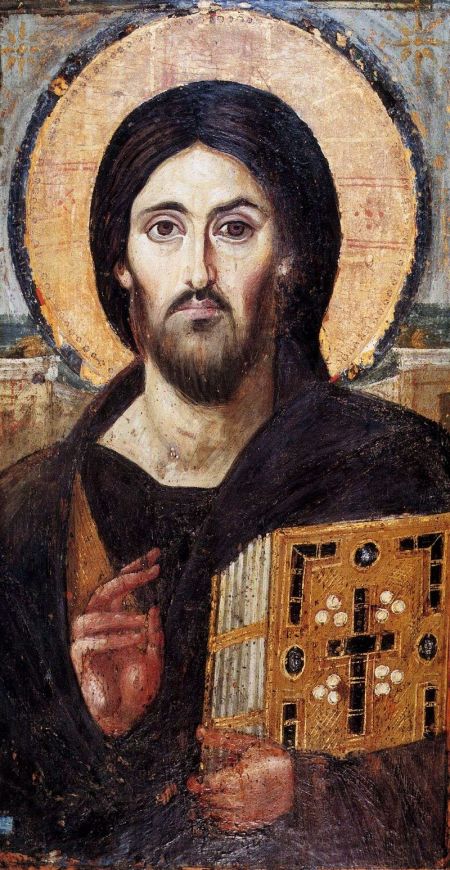
Another famous depiction, in the Basillica of Sant’Apollinare Nuovo also in Ravenna, which is dated 520 AD) shows him in a series of scenes in which he appears beardless, but the final scene (of the Passion) shows him with the full beard that became the norm for later portraits and remains so up to the present day. This image is from the 6th Century AD and is very much in line with the we have come to assume Jesus looked like.

800px-spas_vsederzhitel_sinay

As far as I am aware, it doesn’t say anywhere in the Bible whether Jesus had a beard or not, so does the fact that the oldest known depictions show him clean-shaven mean that the real historical figure of Jesus didn’t have a beard?

Not necessarily. You have to remember that these early depictions were Roman, so it’s natural that they would have reflected the conventions of the culture at that time, not those of a different country (Judea) more than three centuries earlier. Being clean-shaven would have been regarded as a mark of nobility in Roman society, which probably explains why he was represented in that way.

I will probably get a deluge of corrections and clarifications from people who know a lot more than me about the early Christian church, so I’ll now step back and let the Comments Box do its work!


Uccello and the Problem of Space

Posted in Art, Television, The Universe and Stuff with tags , , , , on August 12, 2016 by telescoper

The other night I was watching an old episode of the detective series Lewis and it reminded me of something I wanted to blog about but never found the time. The episode in question, The Point of Vanishing, involves a discussion of a painting which can be found in the Ashmolean Museum in Oxford:

Uccello_TheHunt

I won’t spoil the plot by explaining its role in the TV programme, but this work – called “The Hunt in the Forest” or “The Night Hunt” or some other variation on that title –  is by one of the leading figures of the Early Renaissance, Paolo Uccello, who was born in Florence and lived from about 1396 until 1475. He was most notable for his explorations of the use of perspective in painting, and specifically in “The Problem of Space”, i.e. how to convey the presence of three dimensions when the paint is confined to only two. This picture accomplishes this not only by having a clear vanishing point in the centre of the composition, but also by the arrangement of the figures. Notice how the figures in the foreground are generally moving in the plane of the canvas, but towards the centre they are heading away from the observer. The composition thus acts like a funnel, drawing the viewer’s eye into the centre of the picture and then off into the distance, and the darkness.

Two other things are of interest here. One is that it’s not at all clear what is being hunted, or even whether there’s anything out there in the darkness at all. Is the hunt a metaphor for something else, perhaps the pursuit of something unattainable?

It’s also clear that Uccello wasn’t as interested in realism as he was in geometry and proportion. The horses, dogs and people are drawn in a rather primitive style reminiscent of mediaeval painting.  I think that suggests a metaphorical interpretation of the subject matter.

I see this painting as  a brilliant experiment in geometry rather than an attempt to depict a likeness of an actual event.  Reading about Uccello reveals him to have been somewhat obsessive about perspective – his  friend, the great artist Donatello, remarked that Uccello  spent too much time studying and not enough painting – but his contribution to the development of painting techniques during the Renaissance period was immense.

Although Uccello may have taken it to an extreme, interest in the formal, geometric, aspects of art wasn’t at all unusual in this period. I blogged a while ago about another favourite Renaissance artist, Piero della Francesca (c. 1415-1492) whose life overlapped with Uccello. He combined his work as an artist with a distinguished career as a Mathematician. It would be surprising if Uccello and Piero della Francesca never met, but a quick search didn’t find any definitive evidence that they did.

Another great example of Uccello’s art is this:

g013_uccello_rout

It is one of the three panels of The Battle of San Romano. Again, the living figures are simply drawn – the bodies, weapons and bits of armour on the ground look like they might be toys on a nursery floor – but the way the painting gives the impression that everything is receding into the distance is remarkably effective.

But the best example of Uccello’s work that I’ve seen in the flesh (so to speak) is this:

Paolo_Uccello_Deluge_web

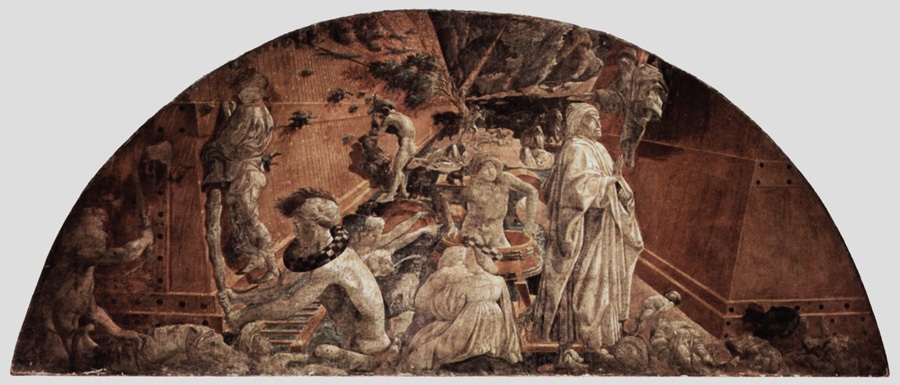
This – Flood and Waters Subsiding –  is a fresco located in the Church of Santa Maria Novella in Florence. Unfortunately it’s quite badly damaged – not only have the colours faded badly but parts of the plaster have crumbled away entirely. Fresco is a notorious fragile medium and it’s sad that so many great Renaissance works of this type have been lost over the years. However, despite the disrepair, this is still an amazing piece. Perhaps helped by the semi-circular space into which it was designed to fit, this work manages to convey a sense of vorticity; There’s not so  much a vanishing point as a point of origin and the action seems to swirl around it as well as to emerge from it. Note also that in contrast to the previous two paintings, the figures in this one are very lifelike, although the fading of the colours gives them a rather ghostly appearance. It’s also interesting that this work pre-dates The Hunt in the Forest by at least twenty years so the movement away from realism was something that happened in later life.

I’ve often wondered why I feel so intrigued by Early Renaissance Art. Of course these works are beautiful or exciting or in some other way pleasurable to look at, but there’s much more to it than that. They inspire curiosity. What is going on? Who are these figures? What is being hunted? Why is everything arranged in that particular way? And the act of looking at a painting like that , and being curious, perhaps reminds us that curiosity is so important for its own sake.


Flaming June Again

Posted in Art, Biographical, Bute Park, History with tags , , , , on June 10, 2016 by telescoper

Since we’re in the middle of a modest heatwave I thought “Flaming June” would be a good title for a blog post. Until a few years ago I always thought that “Flaming June” was some sort of folk expression or quotation from a poem, but it is instead the title of this Pre-Raphaelite painting by Frederic Leighton of a lady wearing what looks like a dress made out of old curtains. Apparently the oleander branch seen in the upper right symbolizes the fragile link between sleep and death. It looks to me like she must be attending a lecture…

But I’m rambling. This has been an exhausting week, probably because I a few days off last week and have come back to one of the busiest periods of the academic year. The examination period is over so there are scripts to mark,  examiners’ meetings, class lists and the like, all parts of the arcane business of academic life. In fact I’ll be spending the first three days of next week in Cambridge where I’m External Examiner for Physics, and I have a lot to do here before I go.

In between all the meetings I had to attend yesterday I noticed that it was the 9th of June, a date of enormous cultural significance for those of us born on Tyneside, as Geordie Ridley’s famous music hall song The Blaydon Races begins “I went to Blaydon Races, ’twas on the 9th of June… The original Blaydon Races were horse races and site of the course is long since gone, but the name has recently been resurrected as a road race involving people on foot rather than on horseback. Incidentally, the usual “Whit Week” holiday in late May or early June is still referred to on Tyneside as “Race Week”.

All this reminded me of the occasion – over twenty years ago – when I entered the Great North Run for the first time. Nowadays this race – the biggest mass participation half-marathon race in the world, with 50,000 competitors – is run in September, but in those days it was held in June. As it happened, there was also a heatwave the first time I did it. I remember lining up at 9.30 on a Sunday morning on the start grid (I was number eleven thousand and something) while the stewards went round pleading with all the participants to take plenty of water as they went around as it was going to be very hot indeed and they didn’t want people suffering from dehydration.

In those days I was quite a keen long-distance runner and was fairly fit. I wasn’t that concerned about the heat but took the advice to heart and determined to stop at all the water stations on the way from Newcastle to South Shields. When we started I also took care not to go off too fast over the first mile or so, which is basically all downhill from the Town Moor to the Tyne Bridge. Not that you could go fast anyway, as the track was so crowded with runners.

I remember the wonderful feeling as we emerged onto the Tyne Bridge and took in the splendid view of the bridges along the river. When we got to Gateshead the crowds were out in large numbers cheering everyone on and I felt completely elated. The first water station was near Gateshead athletics stadium, and I took a drink there as I did at the next, and the next. After Gateshead the route heads towards the Felling bypass at about 4-5 miles and then the runners can see a long climb in front of them. A large thermometer showed the temperature on the road to be about 45 Celsius. Fortunately the people living in houses either side of the road were out in their front gardens offering encouragement and sometimes had their hoses out to shower people as they went past. At one point there was a fire engine that had made an impromptu fountain by the side of the road too.

Unfortunately, as I near the ten mile mark I started to feel a bit strange. I had never actually taken on water while I was running before this race; I never felt the need for it when on training runs. My stomach wasn’t used to the water sloshing around while I was running. I felt quite sick by the time we got to the top of the climb but when I saw the sea and felt its breath on my face I cheered up and descended the steep downward slope towards the seafront near Marsden Rock.

There’s a good mile and a half along the seafront to the finish, however, and I was definitely struggling really badly by then. I could see the finish line but it felt like it wasn’t getting any closer. I slowed to a crawl but kept going, finally reaching the grandstand where a large crowd shouted encouragement. I must have looked dreadful because I heard several people shouting out my number along with “keep going, son”  and “you’re nearly there”.

Eventually I got to the finish line but the feeder lanes were quite busy then – I was finishing at about the peak  time of about 1hr 50 – so I was forced to slow right down because of the people in front of me.

As I crossed the line, I stopped running and was immediately overcome with nausea. I bent over, hands on my knees and emptied the contents of my stomach – mainly water – all over the grass. I felt absolutely dreadful but, after a quick check from the St John Ambulance crew who were on hand, I recovered and found my folks who were nearby. After we got home and I had a shower I felt fine.

About a week later, when I had returned to my flat in London a letter arrived for me. I opened it up and found a small passport-sized photograph, with the caption “YOUR MOMENT OF TRIUMPH”. It turns out there was an automatic camera near the finishing line that snapped everyone crossing it along with a shot of the digital clock showing their finishing time. The idea is that you could order a blow-up of the picture for £25 to put on your wall.

In my case, though, the picture showed not a moment of splendid athletic achievement, but a bedraggled creature puking uncontrollably while those around him looked on in disgust. I didn’t order the blow-up of my throw-up.

Over the years I did the Great North Run a number of times – six or seven, I don’t remember exactly – and a few marathons too, but the strain of running on the roads around London gradually told on my knees and I had to stop because of recurrent pain and swelling. Eventually, a few years ago I surrendered to the inevitable and had arthroscopic surgery to sort out the damage to my knee joints. That seems to have fixed the problem, but my running days are over.

 

Mystery Photograph

Posted in Art, History on April 13, 2016 by telescoper

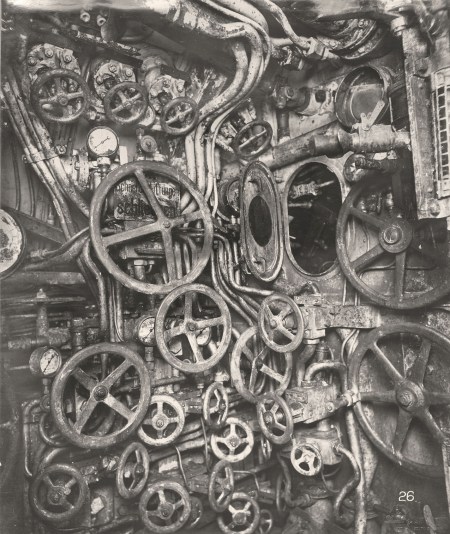
In lieu of a blog post today, I thought I’d post an intruiging photograph. See if you can figure out what this shows:

Mystery

If you want to know the answer you can find out here, where you can find many other pictures from the same source.

This is not a spiral

Posted in Art on April 11, 2016 by telescoper

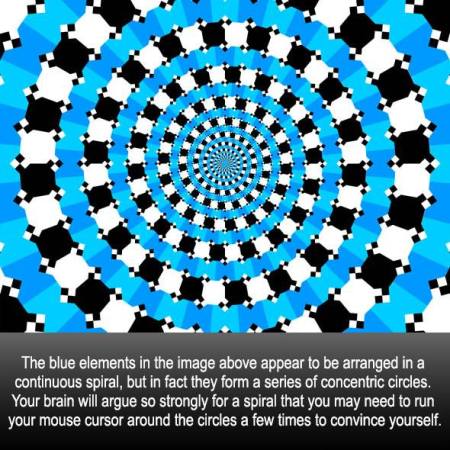
Talking of art, feast your eyes on this image from a really interesting website called CosmusUp:

Spiral

Picture courtesy of CosmosUp

It’s a stunningly convincing optical illlusion. You can see how it works if you draw an horizontal line through the centre. The small black and white squares at the corners of the larger ones are aligned differently on the inside and outside of each ring and alternate in orientation as you go around. This creates a pattern of black squares that appears to bend, creating the impression of an anti-clockwise spiral.