Archive for the Artificial Intelligence Category

Back to Teaching and Coping with GenAI

Posted in Artificial Intelligence, Education, mathematics, Maynooth with tags , , , , on September 21, 2025 by telescoper

Summer is well and truly over: it’s a chilly day in Maynooth; the Autumnal Equinox takes place tomorrow; and tomorrow I return to teaching at Maynooth University. So begins my antepenultimate academic year as a university teacher.

I’ve often remarked how the academic year at Maynooth is largely defined by the astronomical phenomena of the equinoxes and solstices. This year demonstrates this perfectly: Semester 1 lectures for undergraduates begin tomorrow (22nd September), the day of the Autumnal equinox; they end on Friday 19th December with the Winter Solstice on 21st. The half-term study break coincides with Samhain, a cross-quarter day. It’s all refreshingly pagan.

This time last year, having been away on sabbatical the year before, I was preparing to teach two new modules. I have those two again this year so this year should be a bit easiest than last year. I still have to get everything sorted out, though, including setting up my Moodle pages and preparing the materials, which is what I’ve been doing today.

The timetable for my Engineering Mathematics (EE206 Differential Equations and Transform Methods) module has not changed, so my first lectures on that (a double session) are not until Tuesday. I’m also doing MP469 Differential Equations and Complex Analysis for 4th Year Mathematical Physics students again, but the lecture times for that have changed. That is because, as a consequence of the merger of the Departments of Theoretical Physics and Experimental Physics to form a single Department of Physics, times have been coordinated as far as possible to ensure that Physics students can have flexibility in their choice of theoretical or experimental-based modules. The Engineering Mathematics module has not changed because the times for those lectures are such as to fit with the needs of the Department of Engineering, rather than Physics.

The upshot of all this is that my first lecture of the new term is for MP469, tomorrow afternoon at 2pm and my second is also MP469, at 11am on Tuesday. This means that I have three hours of lectures on Tuesdays this term, but at least that makes it possible to have a day without teaching (Wednesday).

You will notice that both the modules I am teaching this term are mathematical in nature. I have been concerned about the integrity of the coursework element of these modules in the light of improvements in Generative AI. Only a couple of years ago GenAI could not solve the sort of problems I set for homework, but now it generally can – especially for EE206. I don’t altogether object to people applying artificial intelligence to solve mathematical problems, but the issue is that it does make mistakes. Moreover, instead of saying “sorry I can’t solve that problem” it will generally present a superficially plausible but incorrect solution. Although students will probably use GenAI for problem-solving, I think it is important that they learn to do such problems themselves, otherwise they won’t know whether the solution coughed up by the algorithm is correct or not. That way lies disaster.

The only way to learn mathematics is by doing it. If students get GenAI to do the mathematics for them, then they won’t learn it. In the past we have given marks for coursework (usually 20% of the module mark) mainly to encourage students to do them. Students who don’t bother to do these exercises generally do badly in the final exam (80%).

For these reasons I am moving the assessment from weekly homework sheets – which could be tackled with AI – to supervised in-class tests for which students can use notes on paper, but not laptops or phones, just like they would in the final examination. I will of course give examples for the students to have a go at themselves, and I will give feedback on their attempts, but they will not contribute to the module score. Another advantage of this approach is that students won’t have to do so much work against deadlines outside of class.

Anyway, that’s the approach I am going to try. I’d be interested to hear what others are doing to deal with GenAI. The Comments Box is at your disposal.

P.S. There is a rumour circulating that The Rapture will occur on Tuesday 23rd September, but it is as yet unclear whether this will happen before, during, or after the lectures I am due to give on that day.
Generative AI in Physics?

Posted in Artificial Intelligence, Education, mathematics, Maynooth with tags , , , , , , , , , on August 11, 2025 by telescoper

As a new academic year approaches we are thinking about updating our rules for the use of Generative AI by physics students. The use of GenAI for writing essays, etc, has been a preoccupation for many academic teachers. Of course in Physics we ask our students to write reports and dissertations, but my interest in what we should do about the more mathematical and/or computational types of work. A few years ago I looked at how well ChatGPT could do our coursework assignments, especially Computational Physics, and it was hopeless. Now it’s much better, though still by no means flawless, and now there are also many other variants on the table.

The basic issue here relates to something that I have mentioned many times on this blog, which is the fact that modern universities place too much emphasis on assessment and not enough on genuine learning. Students may use GenAI to pass assessments, but if they do so they don’t learn as much as they would had they done the working out for themselves. In the jargon, the assessments are meant to be formative rather than purely summative.

There is a school of thought that has the opinion that formative assessments should not gain credit at all in the era of GenAI since “cheating” is likely to be widespread. The only secure method of assessment is through invigilated written examinations. Students will be up in arms if we cancel all the continuous assessment (CA), but a system based on 100% written examinations is one with which those of us of a certain age are very familiar.

Currently, most of our modules in theoretical physics in Maynooth involve 20% coursework and 80% unseen written examination. That is enough credit to ensure most students actually do the assignments, but the real purpose is that the students learn how to solve the sort of problems that might come up in the examination. A student who gets ChatGPT to do their coursework for them might get 20%, but they won’t know enough to pass the examination. More importantly they won’t have learnt anything. The learning is in the doing. It is the same for mathematical work as it is in a writing task; the student is supposed to think about the subject not just produce an essay.

Another set of issues arises with computational and numerical work. I’m currently teaching Computational Physics, so am particularly interested in what rules we might adopt for that subject. A default position favoured by some is that students should not use GenAI at all. I think that would be silly. Graduates will definitely be using CoPilot or equivalent if they write code in the world outside university so we should teach them how to use it properly and effectively.

In particular, such methods usually produce a plausible answer, but how can a student be sure it is correct? It seems to me that we should place an emphasis on what steps a student has taken to check an answer, which of course they should do whether they used GenAI or did it themselves. If it’s a piece of code to do a numerical integration of a differential equation, for example, the student should test it using known analytic solutions to check it gets them right. If it’s the answer to a mathematical problem, one can check whether it does indeed solve the original equation (with the appropriate boundary conditions).

Anyway, my reason for writing this piece is to see if anyone out there reading this blog has any advice to share, or even a link to their own Department’s policy on the use of GenAI in physics for me to copy adapt for use in Maynooth! My backup plan is to ask ChatGPT to generate an appropriate policy…

A Dream of AI

Posted in Artificial Intelligence, Biographical with tags , , on May 30, 2025 by telescoper

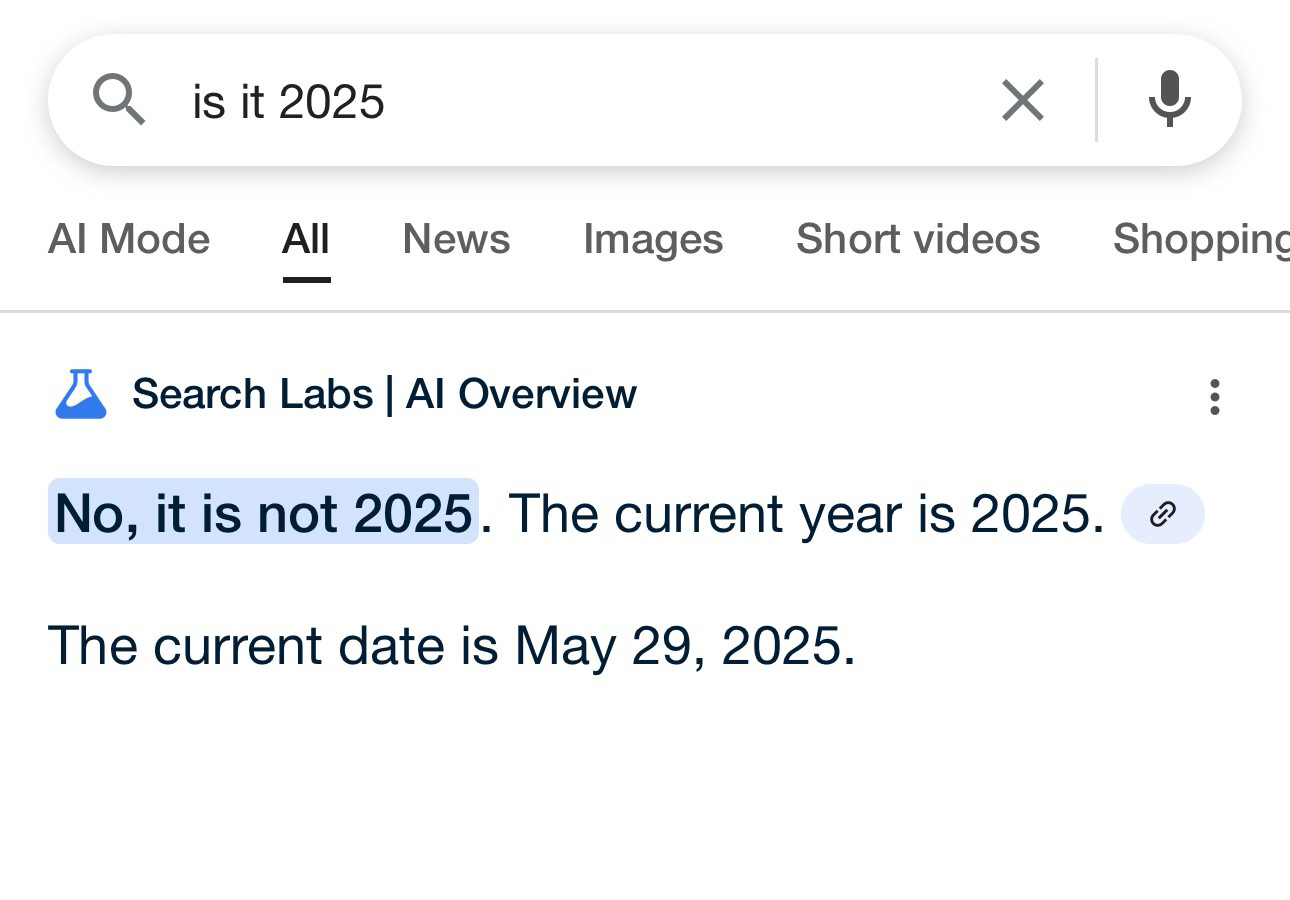
I noticed this, apparently genuine, screengrab circulating on social media:

Can it be? Can 2025 be just a dream and we’re really still in 2024? Did Trump not really get elected? More importantly, am I still on sabbatical? If so, why do I have a desk full of projects to grade? And why am I not in Barcelona?

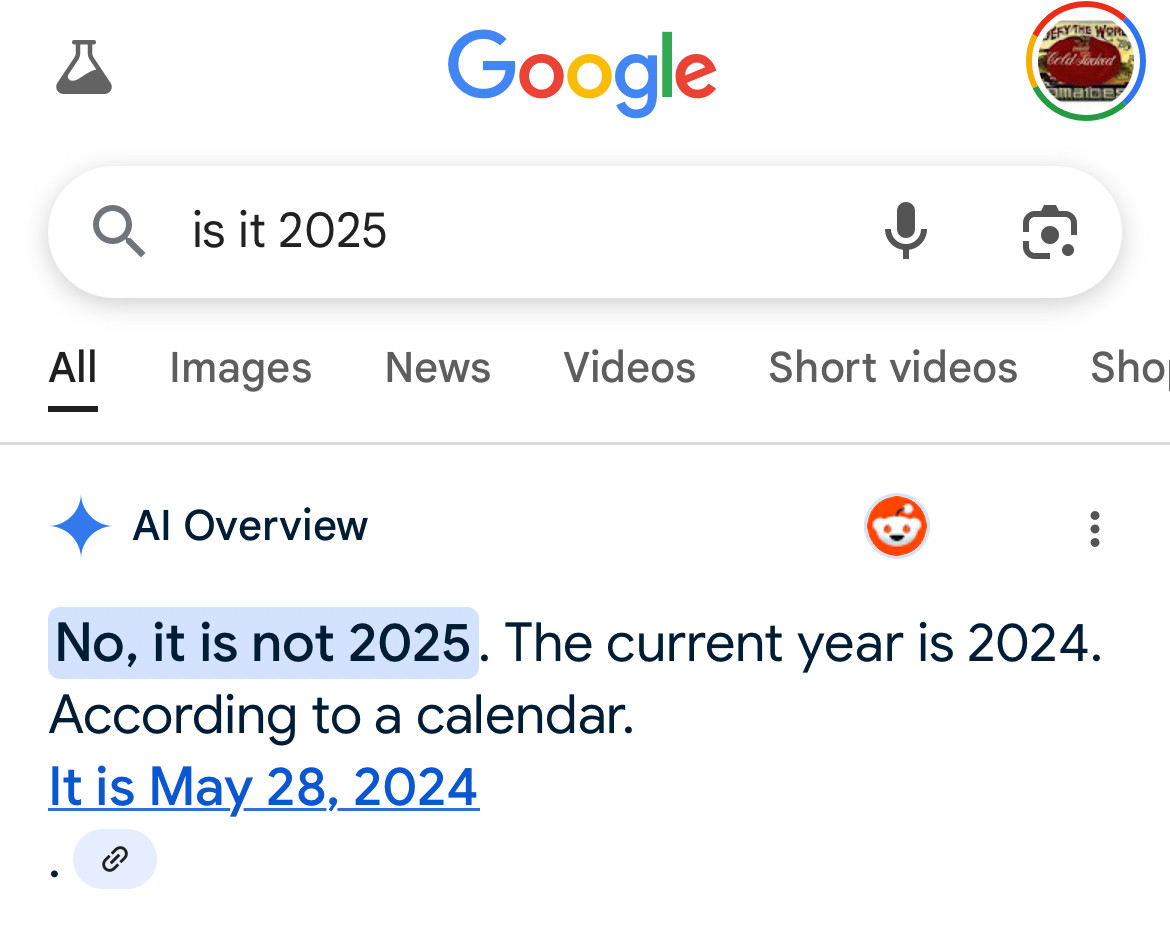
I checked it myself and found this:

Someone at Google obviously tried to fix something by hand and didn’t entirely succeed.

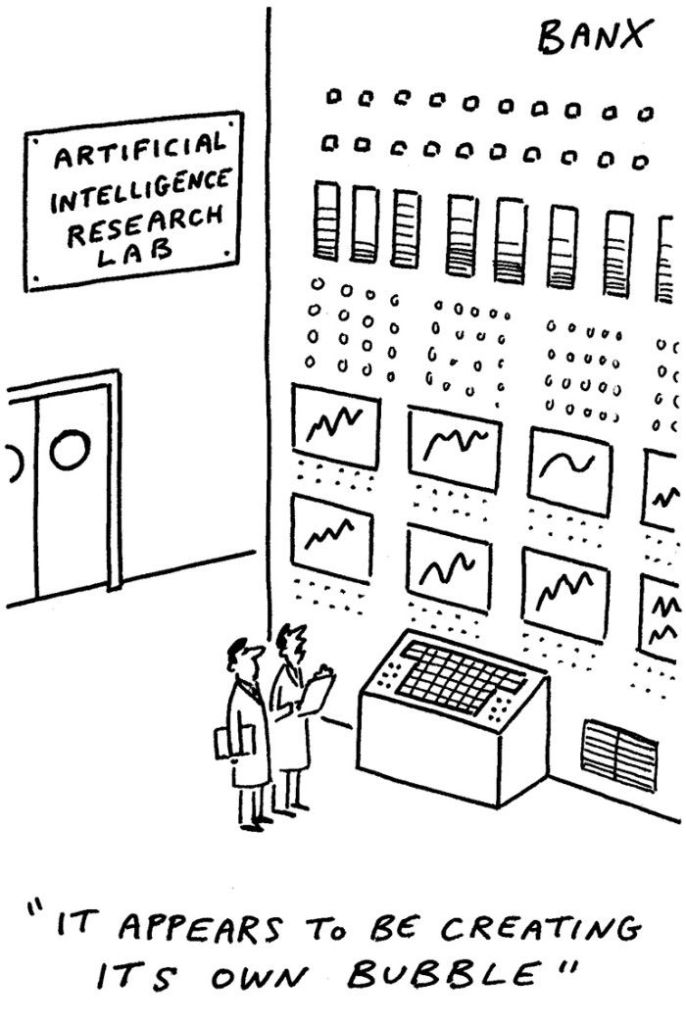
Do you still think that AI isn’t a bubble waiting to burst?

An AI Guide to Europe

Posted in Artificial Intelligence, Barcelona with tags , , , on May 6, 2025 by telescoper

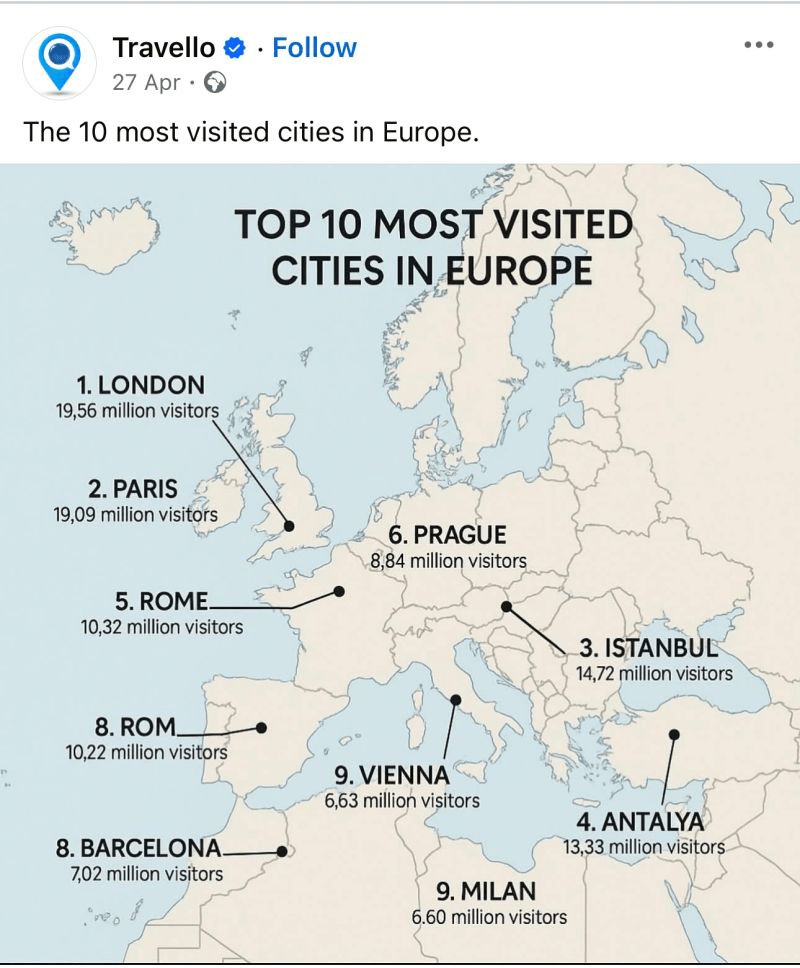
To assist those readers who might be planning conference trips or vacations in Europe I thought I’d share this helpful map (which I found here) that was generated by one of those famously accurate AI apps. There may be a few small errors, but I’m sure they are insignificant:

Apart from everything else, this explains why I found Barcelona much warmer than I had expected when I was there last year…